

Can Laser Surgery Correct Astigmatism? Who Qualifies and Which Corneas Should Wait

Key Takeaways
- LASIK corrects regular astigmatism by removing more corneal tissue along the steep meridian than the flat one, applying the same cylinder-and-axis principle as glasses to the cornea itself.
- The main barrier to laser surgery is not the cylinder number but corneal shape and thickness, which is why keratoconus and irregular topography are the leading reasons candidates are declined.
- The NHS and Mayo Clinic describe typical candidates as adults with a prescription stable for around two years, adequate corneal thickness and a healthy tear film.
- Dry eye is the most common early effect, with Mayo Clinic noting reduced tear production for roughly the first six months as corneal nerves recover.
- Vision usually stabilizes about two to three months after surgery, so residual astigmatism and any enhancement are assessed only after that point.
- LASIK does not prevent presbyopia or cataract, so keeping copies of pre-operative corneal measurements makes future lens calculations more accurate.
Yes—laser surgery, including LASIK, can correct most regular astigmatism by reshaping the cornea so light focuses at a single point. Candidacy depends on a stable prescription, adequate corneal thickness, a regular corneal shape, and healthy eyes. People with keratoconus, very thin or irregular corneas, unstable prescriptions, or uncontrolled dry eye are usually advised to wait or consider other options. Only an eye surgeon's examination can confirm eligibility.
The optometrist tilts the phoropter, clicks one more lens into place, and the blurred letters on the far wall snap into focus. Then she says the word you half expected: astigmatism. You have worn glasses since middle school, you are tired of contact lenses that dry out by mid-afternoon, and a friend just came back from laser surgery talking about waking up and reading the clock. So you ask the question almost everyone with a cylinder in their prescription eventually asks: can LASIK fix astigmatism, or does that number on the line marked “CYL” rule you out?
The short version is encouraging, but the honest version has conditions attached. Astigmatism itself is rarely the obstacle. The shape, thickness and stability of your cornea are what an eye surgeon is really weighing, and those measurements decide whether you are a straightforward candidate, someone who should wait, or someone better served by a different approach altogether.
This explainer walks through what the laser actually does, who typically qualifies, which corneas are asked to hold off, and what the weeks afterward tend to look like—grounded in mainstream evidence rather than forum anecdotes.
Can LASIK fix astigmatism? What the laser is actually changing
Picture the cornea, the clear dome at the front of the eye, as a lens you were born with. In an eye without astigmatism, that dome curves like the side of a basketball, equally round in every direction, and light passing through it lands at a single point on the retina. In an eye with astigmatism, the dome curves more like the side of an American football: steeper along one meridian, flatter along the one at right angles to it. Light splits into two focal lines instead of one point, and everything—near or far—carries a faint smear.
Astigmatism is common. Cleveland Clinic estimates it affects roughly one in three people, often alongside nearsightedness or farsightedness. Most cases are small enough that people barely notice; larger amounts produce the tilted, shadowed letters that make night driving tiring.
Glasses correct it with a cylinder lens, a lens that adds power along one direction only, set at a specific angle called the axis. LASIK applies the same optical principle to the cornea itself. An excimer laser, an ultraviolet laser that removes microscopic layers of tissue without heat damage, flattens the steep meridian more than the flat one. The football becomes, in effect, more basketball-shaped, and the two focal lines collapse toward a single point.
Two details matter for expectations. First, the laser corrects the total astigmatism the eye measures, whether it arises from the cornea or from the natural lens behind it. Second, the procedure reshapes a healthy cornea; it cannot fix astigmatism caused by a diseased or structurally weak one. That single distinction, explored below, is why some people are welcomed as candidates while others are asked to wait.
What actually happens during LASIK for astigmatism
The procedure is shorter than most people imagine. Mayo Clinic describes LASIK as typically taking about 30 minutes or less for both eyes, with the reshaping itself lasting under a minute per eye.
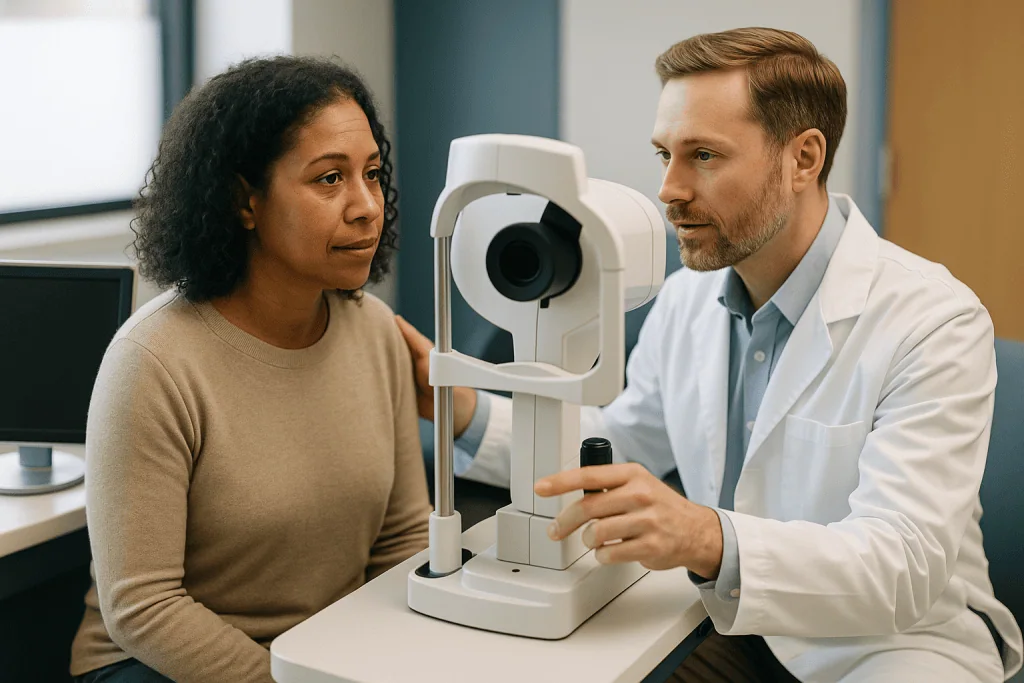
You lie back in a reclining chair. Anesthetic drops numb the surface of the eye, so you feel pressure rather than pain. A small lid holder keeps you from blinking. The surgeon then creates a thin, hinged flap in the outer cornea using either a fine mechanical blade or a femtosecond laser, an infrared laser that separates tissue with pulses lasting quadrillionths of a second. As the flap is made, a suction ring steadies the eye and vision briefly dims—an unsettling but expected moment.
Once the flap is lifted, the excimer laser delivers the customized pattern. For astigmatism, the pattern is deliberately asymmetric, removing more tissue along the steep meridian. Because the correction depends on angle, alignment matters: eyes rotate slightly when you move from sitting to lying down, a shift called cyclotorsion. Modern systems track the iris or reference marks to keep the axis where the measurements say it should be. You will be asked to look at a blinking light, though the tracker follows small eye movements automatically.
Many people notice a faint smell during the ablation and a ticking sound from the laser. Both are normal. The surgeon then floats the flap back into position, where it adheres on its own without stitches, and the second eye follows.
Someone must drive you home. Vision is typically hazy for the rest of the day, and Mayo Clinic notes that eyes often itch, burn or water in the first hours as the anesthetic wears off.
Regular vs irregular astigmatism: the distinction that decides candidacy
Ask an eye surgeon whether astigmatism is a problem for LASIK and you will usually get a question back: which kind?
Regular astigmatism is the football shape described above. The steepest and flattest meridians sit 90 degrees apart, the curvature is symmetric, and glasses or soft toric contact lenses—lenses with cylinder built in—correct it fully. Nearly everyone reading this with an astigmatism prescription has regular astigmatism, and it is the type LASIK was designed to treat.
Irregular astigmatism is different in kind, not just degree. The cornea curves unevenly, without that tidy 90-degree relationship. Causes include corneal scarring from injury or infection, previous eye surgery, and keratoconus, a progressive condition in which the cornea thins and bulges outward into a cone. A clue that astigmatism may be irregular: glasses never quite deliver crisp vision, but a rigid contact lens, which imposes its own smooth surface on the eye, does.
The distinction matters because LASIK removes tissue. A cornea already thinned or weakened by keratoconus can respond to that tissue loss by bulging further, a complication called corneal ectasia. Mayo Clinic lists keratoconus and other corneal diseases among the conditions that generally rule LASIK out, and most surgeons screen for it specifically.
The screening tool is corneal topography, a painless scan that maps thousands of points across the corneal surface and displays them as a color contour map, much like a hiking map shows elevation. Tomography adds a cross-sectional view, including the back surface of the cornea, where early keratoconus often shows first. Together these maps, more than the number on your glasses prescription, tell the surgeon whether your astigmatism is the kind a laser can safely smooth.
Who usually qualifies for LASIK with astigmatism
Candidacy is a portrait built from several measurements rather than a single test. Guidance from Mayo Clinic and the NHS converges on a similar profile.

You are an adult—the NHS sets 18 as the usual minimum—and your prescription has stopped drifting. The NHS suggests stability for at least two years, because reshaping a cornea to a prescription that is still changing simply builds in future error. Your cornea is thick enough to remove tissue and still leave a sturdy foundation; this is measured with pachymetry, an ultrasound or optical scan of corneal thickness. Your topography shows regular astigmatism with no signs of thinning or bulging. The ocular surface is healthy, meaning no active dry eye disease, eyelid inflammation or infection. Your overall health supports normal healing.
Mayo Clinic also notes that pregnancy and breastfeeding temporarily alter the prescription through hormonal effects on the cornea, so surgeons typically ask people to wait until well after that period.
The evaluation itself is thorough. Expect a dilated examination, topography and tomography, pachymetry, pupil measurement in dim light, tear film testing and a careful refraction. Contact lenses mold the cornea slightly, so you will be asked to stop wearing them for a period your surgeon specifies before measurements are taken—longer for rigid lenses than soft ones. Skipping this step is one of the more common reasons a first set of measurements has to be repeated.
Meeting the profile does not guarantee an offer of surgery, and falling slightly outside it does not always mean refusal. The surgeon weighs the whole picture, including what you need your eyes to do, and the decision rests with that team after examining you in person.
What disqualifies you from LASIK, and which corneas are asked to wait
It helps to separate reasons that are usually permanent from reasons that are usually temporary, because “not now” and “not this procedure” lead to very different conversations.
Conditions that typically rule out LASIK altogether include keratoconus or topography suspicious for it, a cornea too thin to leave a safe residual bed, irregular astigmatism from scarring, certain inherited corneal dystrophies, advanced glaucoma, and cataracts (where replacing the natural lens can correct astigmatism at the same time). Mayo Clinic also lists autoimmune diseases such as rheumatoid arthritis or lupus, immune deficiency, and poorly controlled diabetes among factors that raise concern, because they can impair healing or increase infection risk. Severe dry eye that has not responded to treatment falls in this group too, since LASIK temporarily reduces tear production and can worsen an already struggling surface.
Conditions that usually mean waiting rather than never include a prescription that changed within the last year or two, being under 18, pregnancy or breastfeeding, active but treatable dry eye or eyelid inflammation, a recent eye infection, and contact lenses worn too close to the measurement date. Once the underlying issue settles, many of these people are re-evaluated.
A third group sits between: people whose corneas are borderline thin, or whose astigmatism is unusually high. They may be steered toward PRK, which preserves more tissue because no flap is created, or toward lens-based approaches described later.
One reassurance worth stating plainly: being told to wait is not a judgment on your eyes. Surgeons who decline borderline cases are applying the same caution the evidence supports, and a second opinion for a genuinely borderline result is reasonable, provided the same full set of scans is reviewed.
LASIK for high astigmatism: is there a ceiling?
Astigmatism is measured in diopters, a unit of lens power. Small amounts—under about a diopter—are almost incidental to planning. As the cylinder climbs, three things change.
More tissue must be removed along the steep meridian, which eats into the safety margin of the residual stromal bed, the layer of cornea left untouched beneath the flap. Surgeons preserve a minimum thickness there to keep the cornea mechanically sound, so a high correction on a moderately thin cornea can be unsafe even when the same cornea would handle a low correction easily.
Predictability also decles somewhat. Mayo Clinic notes that undercorrection, overcorrection and induced astigmatism are all more likely with larger corrections, and that vision can regress toward the original prescription over time. High cylinder amplifies the effect of tiny alignment errors, too: a rotation of only a few degrees off the intended axis leaves measurable residual astigmatism.
Finally, laser platforms operate within treatment ranges approved by regulators, and individual surgeons often set their own more conservative limits based on their outcomes.
None of this means high astigmatism is untreatable. It means the surgeon may recommend a different tool. A phakic intraocular lens, an implantable lens placed inside the eye in front of the natural lens, can carry cylinder correction and leaves the cornea untouched. For people with early cataract, a toric intraocular lens implanted during lens surgery corrects astigmatism as part of the same operation. Some surgeons plan a staged approach, treating most of the error first and considering a small enhancement once healing is complete.
The honest answer to “is there a ceiling?” is yes, but where it sits for you depends on thickness, topography and your surgeon’s judgment, not the cylinder number alone.
LASIK vs PRK for astigmatism and other options: a side-by-side
LASIK is the best-known laser procedure, but it is one option among several, and the alternatives exist precisely for the corneas LASIK does not suit. MedlinePlus groups the laser approaches together under laser eye surgery; the differences lie mainly in how the laser reaches the tissue.
| Option | How it works | Often considered when | Common trade-offs |
|---|---|---|---|
| LASIK | Hinged flap lifted; excimer laser reshapes underlying tissue | Regular astigmatism, adequate thickness, healthy surface | Fast visual recovery; flap-related risks; dry eye in early months |
| PRK | Surface layer (epithelium) removed; same laser reshaping; surface regrows | Thinner corneas, contact-sport participants, some dry-eye concerns | No flap; slower, more uncomfortable first days; haze risk |
| SMILE | Femtosecond laser cuts a thin lens-shaped disc inside the cornea, removed through a small incision | Nearsightedness with astigmatism within its treatment range | Small incision; fewer surface nerves cut; less established for high cylinder |
| Phakic intraocular lens | Lens implanted inside the eye; cornea untouched | High prescriptions, thin corneas | Intraocular surgery; removable; requires adequate space inside the eye |
| Toric lens with cataract surgery | Natural lens replaced with an astigmatism-correcting implant | Cataract present or developing | Corrects both problems at once; lens surgery risks |
| Toric contact lenses or glasses | External optical correction | Anyone; the baseline comparison | No surgical risk; daily dependence |
Two practical notes. PRK and LASIK use the same laser and correct astigmatism to a similar degree; PRK’s advantage is structural, not optical. And lens-based options are true surgery inside the eye, so they carry a different risk profile rather than a smaller one. Your surgeon should explain why a specific option fits your measurements rather than presenting LASIK as the default.
What are the risks? What the evidence actually says
Any honest explainer has to sit with the risks in plain language, neither minimizing nor dramatizing them.
The most common effect is dry eye. LASIK cuts corneal nerves that help trigger tear production, and Mayo Clinic notes that reduced tearing is typical for roughly the first six months while those nerves recover. Most people improve; a minority have longer-lasting dryness, which is why an unhealthy tear film beforehand is a reason to wait.
Visual disturbances at night—glare, halos around lights, starbursts, occasionally double images—are common in the early weeks and usually fade over weeks to months, per Mayo Clinic. Larger pupils and higher corrections make them more likely.
Undercorrection, overcorrection and induced astigmatism occur when tissue removal does not match the plan or when healing is uneven. Undercorrection can sometimes be addressed with an enhancement once vision stabilizes; overcorrection is harder to reverse.
Flap complications—folds, incomplete flaps, cells growing beneath the flap—are specific to LASIK and are the reason PRK exists. Corneal ectasia, the progressive bulging described earlier, is rare but serious and is the main reason topography screening is so rigorous. Infection is uncommon because the flap seals quickly, but it can occur. Loss of best-corrected vision, meaning vision worse even with glasses than before surgery, is rare but has been reported.
The NHS describes serious complications as uncommon and notes that most problems can be treated. It also states the obvious but easily forgotten point: the procedure is not reversible. Tissue removed does not return.
A responsible surgeon will discuss these before you sign anything, along with your personal risk given your measurements. If the risk conversation feels rushed, that itself is useful information.
What the first days and weeks after LASIK usually look like
The first evening is rarely comfortable and rarely alarming. Mayo Clinic describes eyes that feel gritty, burn, itch and water, with light sensitivity and hazy vision. Most people are told to go home and sleep, since closed eyes are the cornea’s best environment for the initial hours. A clear shield taped over the eyes at night protects the flap from an accidental rub.
Your surgeon will prescribe eye drops, typically an antibiotic class to reduce infection risk and an anti-inflammatory class to calm healing, plus lubricating drops for dryness. The schedule and duration are set by the prescribing clinician and vary; follow that plan rather than a friend’s.
A follow-up visit within the first day or two checks that the flap is in position and healing is on track, according to Mayo Clinic. Many people notice dramatically clearer vision by this visit, often with a soft haze that lifts over the following days.
The first week or two is about protection. Do not rub your eyes. Keep water, soap and sweat out of them. Mayo Clinic advises avoiding swimming pools, hot tubs and contact sports for several weeks, and eye makeup until your surgeon clears it. Screen work is fine once comfortable, though dryness may make long sessions tiring.
Vision fluctuates over the first couple of months, particularly between morning and evening as the tear film changes. Mayo Clinic puts full stabilization at roughly two to three months. Any conversation about residual astigmatism or enhancement waits until that point, because measurements taken earlier may not reflect the final result.
Driving resumes when your surgeon confirms your vision meets the legal standard, not when you personally feel ready.
Astigmatism after LASIK: residual, regression and what happens 10 years on
People searching “astigmatism after LASIK” are usually worried about one of three things.
Residual astigmatism is a small amount of cylinder left after healing. It is not unusual, especially after larger corrections, and often sits below the level that bothers people in daily life. If it is troublesome and the cornea has adequate remaining thickness, surgeons may offer an enhancement once the eye is stable. If thickness is marginal, glasses for specific tasks such as night driving may be the safer answer.
Regression means a partial drift back toward the original prescription over months to years. Mayo Clinic lists it among recognized outcomes, more likely with higher corrections. It is a change in the cornea’s healing response, not a sign the procedure was done incorrectly.
Then there is the long view, the “what happens 10 years later” question. The most common change a decade on has nothing to do with the laser. Presbyopia, the age-related stiffening of the natural lens that makes near print blur, arrives for almost everyone from the mid-40s, and Mayo Clinic notes LASIK does not prevent it. People who had distance vision corrected typically need reading glasses at the same age they would have otherwise. Later still, cataracts develop as they would in any eye.
That last point carries a practical instruction: keep copies of your pre-operative measurements. Calculating the right lens power for cataract surgery is more complicated in an eye that has had LASIK, and the original corneal data makes the calculation more accurate decades later.
Laser surgery does not exempt you from routine eye care. Annual examinations still catch glaucoma, retinal changes and the ordinary business of aging eyes.
Is it worth getting LASIK for astigmatism? How to think about the decision
Nobody needs LASIK. Glasses and contact lenses correct regular astigmatism completely, carry no surgical risk, and adjust as your eyes change. Laser surgery is a quality-of-life choice, and framing it that way keeps the decision honest.
The people who tend to describe it as worthwhile share some patterns. Their contact lenses had become uncomfortable, often because of dryness or the cost in time of daily care. They play sports or work in environments where glasses are a nuisance or a hazard. Their prescription is moderate, their corneas are unremarkable on scanning, and their expectations are specific: fewer hours in lenses, not perfect vision at every distance forever.
The people who later express regret often had one of the risk factors above—borderline dry eye, very high correction, large pupils—or expected something the procedure was never designed to deliver, such as freedom from reading glasses in their fifties.
A fair way to weigh it is to write down what you actually want your eyes to do, then ask the surgeon which of those goals the measurements support and which they do not. Ask what your vision is likely to be at night, what the plan is if residual astigmatism remains, and what alternatives exist if your corneas fall short.
Insurance is a common question. In most systems laser vision correction is classed as elective and is often not covered, though some plans offer partial benefits or discounts through vision programs. The only reliable answer comes from your own plan documents, and the answer should not change your clinical decision.
Whatever you decide, the surgeon’s role is to tell you what your eyes can safely accept, and yours is to decide whether the trade-offs suit your life.
What people often get wrong about LASIK and astigmatism
Misunderstandings cluster around this topic, and several are worth correcting directly.
“Astigmatism means I can’t have LASIK.” This was closer to true in the early years of the procedure. Modern excimer lasers correct regular astigmatism routinely, as MedlinePlus and Mayo Clinic both describe. Irregular astigmatism is the exception, not astigmatism as such.
“Astigmatism is an eye disease.” It is a refractive error, a shape variation, in the same family as nearsightedness. It does not damage the eye or progress into something worse on its own. Keratoconus is a disease that causes astigmatism; astigmatism is not itself a disease.
“LASIK stops my eyes from aging.” It reshapes the cornea once. It does not touch the lens, where presbyopia and cataract develop, and Mayo Clinic is explicit that reading glasses arrive on schedule regardless.
“Dry eye will go away after LASIK.” The reverse is more likely in the short term. Pre-existing dry eye is a reason to treat first and reconsider later, not a problem the surgery solves.
“If the flap moves, I’ll go blind.” Flap displacement is rare and usually results from rubbing or trauma in the early days. It is treatable when caught promptly, which is why the red flags later in this article matter.
“PRK is the old-fashioned version.” PRK predates LASIK, but it remains a current, deliberate choice for thinner corneas and high-impact lifestyles, using the same laser technology.
“A high cylinder number is the main obstacle.” Thickness and topography usually matter more. Someone with moderate astigmatism and a thin, irregular cornea is a weaker candidate than someone with higher astigmatism and a thick, regular one.
Questions to ask your care team before LASIK for astigmatism
A consultation is a two-way examination. You are assessing whether this surgeon and this plan fit your eyes, and specific questions get specific answers. Bring a written list; it is easy to forget once your pupils are dilated and the room is dim.
- Is my astigmatism regular or irregular, and did my topography and tomography show any features that concern you?
- How thick are my corneas, and how much tissue would this correction remove? What residual thickness would remain?
- Has my prescription been stable long enough, based on the records you have seen?
- Do I have any signs of dry eye or eyelid inflammation now, and should those be treated before surgery?
- Given my measurements, why LASIK rather than PRK, SMILE or a lens-based option?
- What is your plan for aligning the astigmatism axis during treatment?
- What night-vision effects should I expect with my pupil size and correction?
- What would you do if residual astigmatism remains after healing—enhancement, glasses, or something else?
- Which risks are higher for me personally than for an average candidate?
- What symptoms should prompt me to call you urgently after surgery, and how do I reach someone after hours?
- Will I receive a copy of my pre-operative measurements to keep for future eye care?
Listen for answers that reference your own scans rather than general statistics. A surgeon who explains what your topography shows, and who is willing to say “I would not operate on this cornea” if that is the finding, is applying the standard the evidence supports. Hesitation to answer, or pressure to decide the same day, is a reason to pause.
When to call your doctor after LASIK
Most recovery is quiet: some grittiness, fluctuating focus, dryness that lubricating drops settle. A short list of symptoms falls outside that pattern and warrants a prompt call to your surgical team, the same day, rather than waiting for a scheduled visit.
Pain that increases rather than eases after the first day, particularly if it is sharp or deep, needs assessment. A sudden drop in vision after it had been improving, or vision that becomes noticeably worse in one eye, should never be watched at home. Increasing redness, sticky or colored discharge, or light sensitivity that worsens after initially improving can signal infection or inflammation beneath the flap, both of which are treatable when caught early.
Any blow to the eye, or a moment when you realize you rubbed it hard, deserves a call even if vision seems fine, because flap displacement is most likely in the early weeks and is repositioned most easily when addressed quickly. A sensation that something is stuck under the lid, or a visible wrinkle or shadow across your vision, fits the same category.
Symptoms unrelated to the cornea also matter. New flashes of light, a shower of floaters, or a curtain across part of your visual field are retinal warning signs in any eye, and highly nearsighted eyes carry a somewhat higher baseline risk of retinal problems regardless of surgery.
Before surgery, one situation also merits a conversation: if your glasses prescription has been changing quickly, or if an optometrist has ever mentioned an unusual corneal shape, raise it explicitly at consultation. Mayo Clinic and Cleveland Clinic both emphasize that irregular corneas are the main reason laser correction is declined, and early disclosure saves time and disappointment.
When in doubt, call. Surgical teams expect these calls, and a reassuring answer costs nothing.
Frequently asked questions
Can LASIK fix astigmatism completely?
LASIK can correct most regular astigmatism, often to a level people no longer notice in daily life. A small residual amount is common after larger corrections, and vision can drift slightly over time. Whether your astigmatism is fully treatable depends on its type, your corneal thickness and topography, which only a surgeon’s examination can determine.
What disqualifies you from getting LASIK?
Keratoconus or suspicious corneal topography, corneas too thin to leave a safe residual bed, irregular astigmatism from scarring, cataracts, advanced glaucoma, uncontrolled autoimmune disease and severe untreated dry eye are typical disqualifiers. Temporary reasons to wait include an unstable prescription, being under 18, pregnancy or breastfeeding, and recent eye infection.
Is LASIK for high astigmatism safe?
Higher astigmatism can be treated, but it removes more tissue and is less predictable, with greater chances of residual error or regression according to Mayo Clinic. Safety depends on corneal thickness and shape rather than the cylinder number alone. For very high corrections, surgeons may recommend a phakic or toric intraocular lens instead of laser reshaping.
LASIK vs PRK for astigmatism: which is better?
Both use the same excimer laser and correct astigmatism to a similar degree. LASIK creates a flap and recovers faster; PRK removes the surface layer instead, preserving more tissue and avoiding flap risks at the cost of a slower, more uncomfortable first week. The better choice depends on corneal thickness, lifestyle and dry-eye status.
Is it worth getting LASIK for astigmatism?
It is a quality-of-life decision rather than a medical necessity, since glasses and toric contact lenses correct astigmatism fully without surgical risk. People with moderate prescriptions, healthy corneas, contact lens intolerance and realistic expectations tend to weigh it favorably. Those with borderline measurements or hopes of avoiding reading glasses later are more likely to be disappointed.
What happens 10 years after LASIK?
The corneal reshaping generally persists, though some regression toward the original prescription can occur. The biggest change a decade on is usually presbyopia, the age-related need for reading glasses that Mayo Clinic notes LASIK does not prevent. Cataracts develop later as in any eye, and pre-operative measurements help with lens calculations at that stage.
Can astigmatism come back after LASIK?
Astigmatism can partially return through regression, particularly after larger corrections, or a small amount may remain from the start. Neither means the surgery failed. Once vision has stabilized, typically two to three months after the procedure, your surgeon can measure any residual cylinder and discuss whether an enhancement, glasses for specific tasks, or observation makes sense.
Will insurance cover LASIK for astigmatism?
Laser vision correction is usually classed as elective and is often not covered by standard health insurance, although some vision plans offer partial benefits. Coverage varies widely by plan and region, so the only reliable answer comes from your own policy documents. Insurance status should not influence whether your corneas are suitable for the procedure.
How long does it take to recover from LASIK for astigmatism?
Many people see noticeably better within a day or two, with a follow-up visit in that window according to Mayo Clinic. Grittiness and fluctuating focus are common for several weeks, and Mayo Clinic puts full stabilization at roughly two to three months. Swimming, hot tubs and contact sports are typically avoided for several weeks.
Can you have LASIK if you have keratoconus?
LASIK is generally not recommended for keratoconus because removing tissue from an already thinned, weakened cornea risks further bulging, a complication called ectasia. Mayo Clinic lists keratoconus among conditions that rule LASIK out. People with keratoconus are usually managed with specialized contact lenses, corneal cross-linking to stabilize the cornea, or other approaches decided by a corneal specialist.
References
- NHS — Laser eye surgery and lens surgery
- MedlinePlus — Laser Eye Surgery
- Cleveland Clinic — Astigmatism
This article is for general information only and is not a substitute for professional medical advice. Please consult a qualified doctor about your individual situation.

More from the Blog

How to Reduce Swelling After Surgery: What Helps, What Is Myth, What Is Patience
To reduce swelling after surgery, elevate the area above heart level several times a day, use cold packs wrapped in cloth for short intervals…

Does Microneedling Hurt? Numbing Options and What the Sensation Is Really Like
Microneedling is usually described as mildly to moderately uncomfortable rather than truly painful: a scratchy, vibrating pressure that feels sharper over bony areas such…

Does Psoriasis Cause Hair Loss? Scalp Psoriasis, Treatment and Regrowth
Psoriasis itself does not destroy hair follicles, but scalp psoriasis can cause temporary hair loss. Thick scale, inflammation, scratching and picking at plaques can…

Thyroid Tests: What TSH, T3 and T4 Mean Together
A thyroid test typically measures TSH, the pituitary signal that controls the thyroid, along with T4 and T3, the hormones the gland makes. High…

Stable vs Unstable Angina: What the Difference Means for Your Treatment Plan
Stable angina is chest discomfort that follows a predictable pattern, arrives with exertion or stress, and eases within minutes of rest; it is usually…

Quad Stretches: How to Do Them Without Straining Your Knees
To stretch your quadriceps without straining your knees, warm up for five minutes first, then gently draw your heel toward your buttock while keeping…