Types of Joints in the Body: Fibrous, Cartilaginous, and Synovial

Fibrous joints are tightly connected and allow little to no movement. Cartilaginous joints use cartilage to join bones and allow limited movement.
Key Takeaways
- Fibrous joints are tightly connected and allow little to no movement.
- Cartilaginous joints use cartilage to join bones and allow limited movement.
- Synovial joints are the most movable and include the shoulders, knees, hips, and elbows.
- Joint structure helps explain everyday movement, flexibility, and joint pain patterns.
- Injury, inflammation, and wear-and-tear can affect different joint types in different ways.
Types of joints in the body are usually grouped as fibrous, cartilaginous, and synovial. Each type has a different structure and allows a different amount of movement, which helps the body stay stable while moving efficiently.
Overview
The body contains many joints, and they are not all built the same way. A joint is the place where two or more bones meet, and its structure determines how much movement is possible. The main types of joints are fibrous, cartilaginous, and synovial joints.
This classification helps explain why some joints are nearly immobile, such as those in the skull, while others are designed for wide motion, such as the shoulder. Understanding the types of joints can also make symptoms like stiffness, swelling, or reduced range of motion easier to interpret.
Joints work together with muscles, ligaments, tendons, and cartilage to support posture, protect the body, and allow daily activities such as walking, reaching, and bending. When any part of this system is irritated or damaged, movement can become painful or restricted.
Fibrous Joints
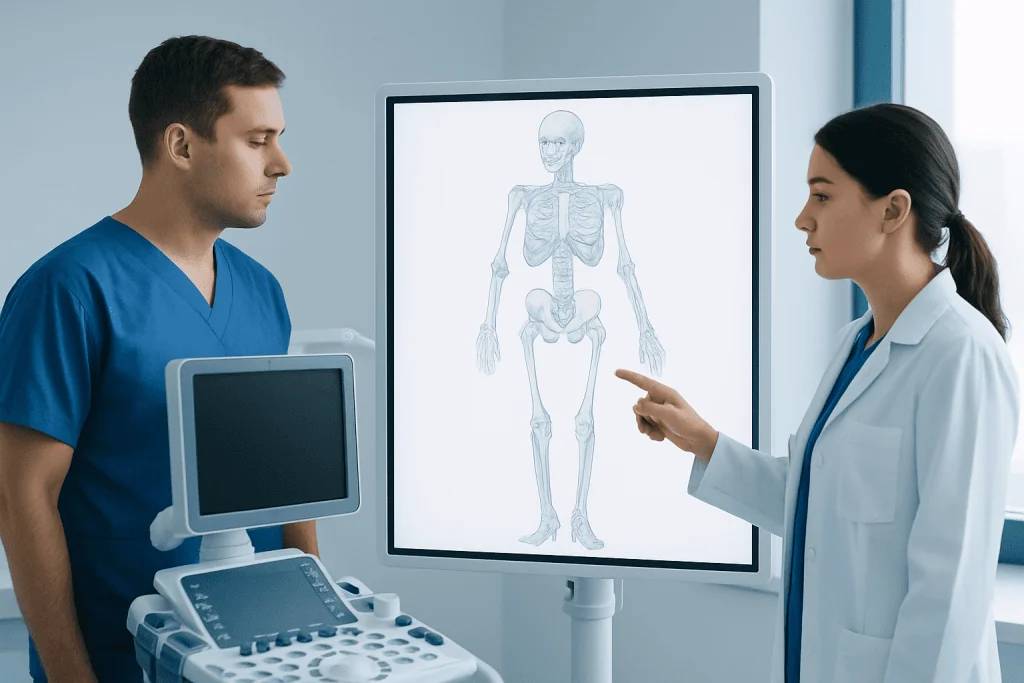
Fibrous joints are held together by dense connective tissue rich in collagen fibers. Because the bones are connected so tightly, these joints allow little or no movement. Their main role is stability and protection rather than flexibility.
Examples include the sutures in the skull, where small bones fit closely together to protect the brain. Another example is the connection between the tibia and fibula in the lower leg, which allows only slight movement. In younger people, some fibrous connections may be more flexible than in adulthood.
Fibrous joints are especially important in areas that need strength and support. They help absorb forces and keep bones aligned, but they are not designed for repeated motion. When they become irritated, symptoms are often related to nearby tissues rather than the joint itself.
Cartilaginous Joints
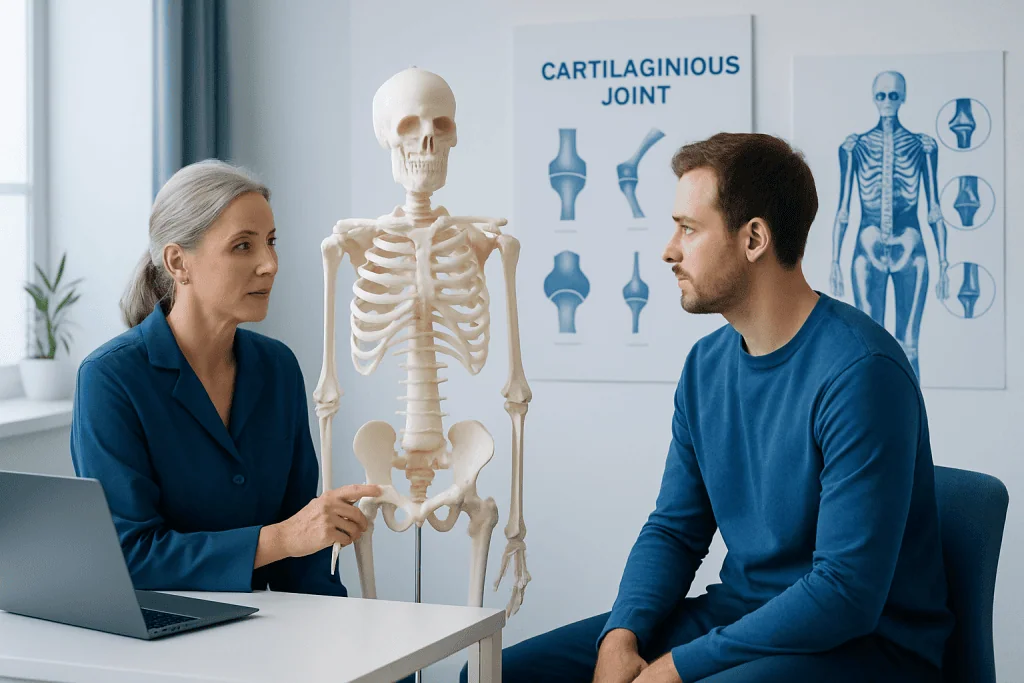
Cartilaginous joints are joined by cartilage, which provides a balance between stability and limited movement. These joints do not move freely like synovial joints, but they are more flexible than fibrous joints. The cartilage acts as a cushion and helps distribute pressure between bones.
There are two main kinds of cartilaginous joints. In one type, bones are joined by hyaline cartilage, such as the growth plates in children. In the other, bones are connected by fibrocartilage, such as the joints between the vertebrae of the spine and the pubic symphysis. These joints support shock absorption and controlled motion.
Because they bear load and permit small movements, cartilaginous joints are important for posture, walking, and spinal flexibility. Changes in these joints may contribute to stiffness, back discomfort, or reduced mobility, especially with aging or repetitive stress.
Synovial Joints
Synovial joints are the most movable joints in the body and are responsible for much of human motion. They have a joint cavity filled with synovial fluid, which helps lubricate the joint and reduce friction. The bone ends are covered by articular cartilage, which supports smooth movement.
Common examples include the shoulders, hips, knees, elbows, wrists, ankles, and the small joints of the fingers. These joints are built for flexibility, but they also rely on strong ligaments, muscles, and tendons for stability. Because they move frequently, synovial joints are often the joints most affected by injuries and degenerative conditions.
Arthroscopic surgery may be used in some synovial joint problems when a specialist needs to examine or treat the joint through a small incision. Treatment choices depend on the cause of symptoms and whether the problem involves cartilage, ligaments, inflammation, or bone alignment.
Symptoms of Joint Problems
Symptoms depend on which joint is affected and what is causing the problem. Some issues cause pain only during movement, while others lead to swelling, stiffness, or a feeling that the joint is unstable. Limited motion is a common sign that a joint is not functioning normally.
People may notice joint clicking, locking, tenderness, or warmth in a joint that is inflamed. Pain in fibrous joints is often less about movement within the joint and more about tension or injury in nearby structures. In cartilaginous and synovial joints, discomfort may become more noticeable with activity, prolonged sitting, or weight-bearing.
Children and adults can experience joint symptoms for different reasons. In growing children, pain or limited motion may reflect growth-related changes, overuse, or injury. In adults, symptoms are more often related to strain, arthritis, repetitive use, or trauma.
Causes & Risk Factors
Joint problems can arise from injury, inflammation, infection, overuse, or degenerative change. The underlying cause often depends on the joint type and the stresses placed on it. For example, synovial joints are more likely to be affected by sprains, dislocations, and arthritis because they move more often.
Risk factors may include aging, previous injury, repetitive activities, poor posture, excess body weight, and certain inherited conditions. Some people are also more prone to joint problems because of autoimmune disease, congenital differences in bone formation, or occupational strain.
Cartilaginous joints may be affected by wear-and-tear, especially in the spine, while fibrous joints can be stressed by trauma or inflammatory conditions around the skull or limb bones. A doctor can help identify which tissue is involved and whether the symptoms are coming from the joint itself or from surrounding muscles and ligaments.
Diagnosis
Diagnosis usually starts with a medical history and physical examination. A doctor will ask about the location of pain, how long symptoms have been present, what makes them better or worse, and whether there was an injury. Examining range of motion, tenderness, swelling, and joint stability helps narrow the possible causes.
Imaging tests may be used when needed. X-rays can show bone alignment, joint space, and signs of degeneration; MRI can provide more detail about cartilage, ligaments, and other soft tissues; and CT may help in more complex bony problems. In some situations, blood tests or joint fluid analysis are used to look for inflammation or infection.
Not every joint symptom requires extensive testing. The right evaluation depends on the severity of symptoms, the suspected joint type, and whether there are warning signs such as persistent swelling, fever, or difficulty bearing weight.
Treatment Options
Treatment depends on the joint type and the specific condition affecting it. Many joint problems improve with conservative care such as rest, activity modification, physical therapy, and guided exercise. These approaches can reduce pain, improve mobility, and support the tissues around the joint.
Medication may be recommended to ease pain or inflammation, depending on the diagnosis. In some cases, injections or other procedures are considered, especially when symptoms do not improve with simpler measures. For structural problems in synovial joints, specialist procedures may be discussed after a full evaluation. In selected cases, advanced options such as joint replacement surgery or spine surgery may be appropriate when there is significant joint damage, deformity, or loss of function.
Treatment plans are individualized. A specialist will consider age, activity level, joint involved, symptom severity, and overall health before recommending the safest and most effective approach.
Prevention & Self-care
While not all joint conditions can be prevented, healthy habits can lower strain and support joint function. Regular low-impact movement, such as walking, swimming, or cycling, helps maintain flexibility and muscle support. Strengthening the muscles around a joint can also improve stability and reduce stress on cartilage and ligaments.
Good posture, proper technique during exercise, and using ergonomic setups at work can protect both cartilaginous and synovial joints from repetitive stress. Maintaining a healthy body weight may reduce load on weight-bearing joints such as the hips, knees, and spine.
Self-care also includes listening to the body. Persistent pain should not be pushed through repeatedly, especially after an injury. Gentle stretching, warm-up routines, supportive footwear, and adequate recovery time can all help preserve joint health over time.
When to See a Doctor
A doctor should be consulted if joint pain lasts more than a short period, keeps returning, or affects daily activities. Medical evaluation is especially important if there is swelling, redness, warmth, reduced movement, or pain after an injury. A prompt assessment can help determine whether the problem is in the joint, bone, cartilage, ligaments, or surrounding soft tissues.
Children, older adults, and people with known inflammatory or autoimmune conditions may need closer monitoring when joint symptoms appear. Sudden inability to bear weight, visible deformity, or a joint that feels stuck or unstable also deserves medical review.
Acibadem International’s multidisciplinary specialists and JCI-accredited hospitals diagnose and treat joint conditions for international patients, with care tailored to the type of joint involved and the cause of symptoms.
How Joint Types Relate to Movement
The amount of movement a joint allows depends on how it is built. Fibrous joints are designed for stability, cartilaginous joints for support with limited motion, and synovial joints for free movement. This spectrum explains why the skull is protective and rigid, while the shoulder can move in many directions.
Knowing the joint type can also guide expectations for recovery and treatment. A problem in a highly movable synovial joint may require a different approach from a problem in a firmly connected fibrous joint or a load-bearing cartilaginous joint. The same symptom, such as pain, can have very different meanings depending on the structure involved.
For that reason, a careful diagnosis matters. Understanding joint anatomy gives patients a clearer picture of how the body works and why specific therapies are recommended.
Frequently asked questions
What are the three main types of joints in the body?
The three main types are fibrous, cartilaginous, and synovial joints. They differ in how the bones are connected and how much movement they allow. This structure helps determine whether a joint is mainly for protection, support, or motion.
Which type of joint moves the most?
Synovial joints move the most. They have a joint cavity with synovial fluid, which supports smooth movement. Examples include the shoulder, hip, knee, and elbow.
Are the joints in the skull movable?
Most skull joints are fibrous joints called sutures, and they do not move in adults. Their main purpose is to protect the brain and hold the skull bones tightly together. In infants and young children, these connections are not fully closed yet, which helps growth.
What is an example of a cartilaginous joint?
The joints between the vertebrae and the pubic symphysis are examples of cartilaginous joints. These joints allow limited movement and help absorb shock. They are important for posture and daily motion.
Can joint pain come from more than one joint type?
Yes. Pain can come from the joint itself, from nearby ligaments, muscles, tendons, or from inflammation affecting the area. A doctor can help determine which structure is involved and what treatment is most appropriate.
How can someone keep joints healthy?
Regular exercise, strong supporting muscles, good posture, and healthy body weight all help protect joints. It is also helpful to avoid repeated overuse and to seek medical advice when pain does not improve. Joint health is best supported by balanced movement and recovery.
References
- World Health Organization
- Merck Manual Professional Edition
- American Academy of Orthopaedic Surgeons
- National Institute of Arthritis and Musculoskeletal and Skin Diseases
This article is for general information only and is not a substitute for professional medical advice. Please consult a qualified doctor about your individual situation.
Joint and spine care in Turkey — expert assessment & treatment
JCI-accredited · board-certified surgeons · reply within 24h
Add us as a Preferred Source to see more of our trusted health content across Google Search, AI Overviews and Discover.