Skin fungus pics: Common Causes, Warning Signs, and When to Worry

Skin fungus infections often cause itchy, scaly, red, or ring-shaped rashes, but appearance varies by body area and skin tone. Photos may suggest a fungal rash, yet eczema, psoriasis, contact dermatitis, and bacterial infections can look similar.
Key Takeaways
- Skin fungus infections often cause itchy, scaly, red, or ring-shaped rashes, but appearance varies by body area and skin tone.
- Photos may suggest a fungal rash, yet eczema, psoriasis, contact dermatitis, and bacterial infections can look similar.
- Common fungal skin problems include athlete’s foot, jock itch, ringworm of the body, yeast in skin folds, and nail fungus.
- Early treatment usually works well and may include antifungal creams, powders, or oral medication for more extensive cases.
- Medical care is important if the rash spreads, affects the scalp or nails, keeps returning, or does not improve with routine care.
Skin fungus pics can be useful for recognizing patterns such as ring-shaped rashes, scaling, redness, and itchy patches, but photos alone cannot confirm a diagnosis. Many skin conditions look similar, so a clinician may need to examine the rash and sometimes test a skin sample before treatment begins.
Overview: What skin fungus pics can and cannot show
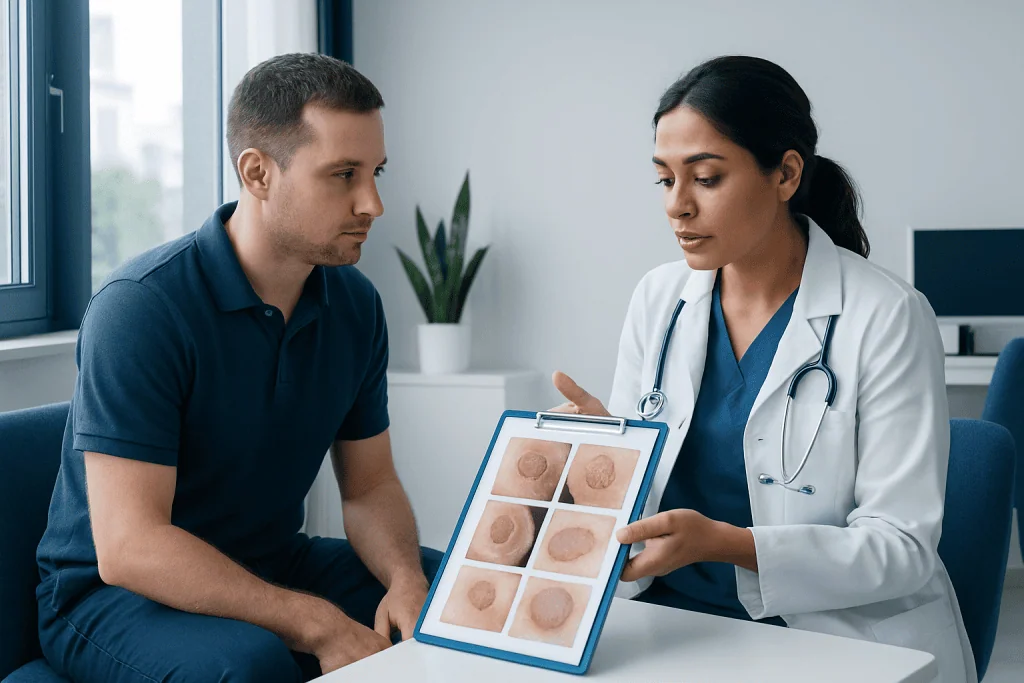
People searching for skin fungus pics usually want to know whether a rash looks fungal and whether it needs treatment. Photos can be helpful for spotting common patterns such as circular patches, scaling, peeling between the toes, or a moist rash in skin folds. However, pictures are only a starting point because many non-fungal conditions can closely resemble a fungal infection.
Skin fungi are microscopic organisms that grow on the outer layers of skin, hair, or nails. They tend to thrive in warm, moist environments and may spread through skin-to-skin contact, contaminated surfaces, shared towels, shoes, or clothing. Not every fungal infection looks dramatic; some cause only mild itching and dryness, while others create clear borders, discoloration, cracking, or discomfort.
The most useful way to view skin fungus pics is as a visual guide rather than a diagnosis. A doctor considers the rash’s location, shape, symptoms, timing, and risk factors. If needed, a clinician may gently scrape the skin for testing to confirm whether fungus is truly present before recommending treatment.
What skin fungus may look like in different areas

Fungal skin infections can appear differently depending on where they develop. On the body, ringworm often forms a round or oval patch with a more active, scaly border and relatively clearer skin in the center. On darker skin tones, the rash may look brown, gray, or violet rather than bright red, which is why comparison photos do not always tell the whole story.
On the feet, athlete’s foot commonly causes peeling, scaling, burning, or itchy skin between the toes or on the soles. In the groin, jock itch often creates a red or darker discolored rash with a defined edge and itching, usually sparing the genitals themselves. In skin folds such as under the breasts, the armpits, or the abdominal fold, yeast overgrowth may cause a shiny, moist rash with soreness, small surrounding spots, or a stinging sensation.
Fungal infections can also affect the scalp and nails. Scalp infection may lead to scaling, broken hairs, tender areas, or patchy hair loss, especially in children. Nail fungus often causes thickening, crumbling, yellowing, or lifting of the nail rather than an itchy rash. Conditions such as athlete’s foot and nail fungus are common examples, but they still need proper evaluation because not all scaling or nail changes are caused by fungus.
- Ring-shaped or oval patches
- Scaly or flaky skin
- Itching, burning, or stinging
- Cracking, peeling, or moist skin in folds
- Discoloration of skin or nails
Common causes and risk factors
Fungal skin infections develop when fungi grow more easily than the skin can control. Moisture is one of the most important factors. Sweat trapped in socks, tight shoes, sports clothing, or skin folds creates an environment that supports fungal growth. Heat, friction, and limited airflow can make the problem worse.
Some people are more likely to develop these infections than others. Risk factors include frequent use of locker rooms or public showers, sharing personal items, wearing damp clothing for long periods, having obesity with deeper skin folds, diabetes, or a weakened immune system. Skin barrier damage from scratching, shaving, or another rash may also make infection more likely.
Different fungi cause different patterns. Dermatophytes often cause ringworm, athlete’s foot, and jock itch. Yeasts such as Candida are more likely to affect moist folds and may also occur after antibiotic use or in people with blood sugar that is not well controlled. Recurrent or unusually widespread infection should be evaluated carefully to look for contributing medical factors.
Conditions that can look similar
One reason skin fungus pics can be misleading is that several skin disorders mimic fungal infection. Eczema can cause itchy, scaly patches; psoriasis can create thick plaques with scaling; contact dermatitis can produce redness and irritation after exposure to soaps, fabrics, or skin products. In some cases, bacterial infection may also resemble a fungal rash, especially if the skin becomes inflamed or crusted.
Even within fungal conditions, appearance overlaps. A rash in the groin could be jock itch, yeast, irritation from friction, or another inflammatory skin condition. A flaky foot rash may be athlete’s foot, dry skin, eczema, or psoriasis. Nail thickening may be due to trauma, aging, psoriasis, or fungal infection, which is why testing is sometimes recommended before long treatment courses.
Using the wrong treatment can delay healing. For example, steroid creams may temporarily calm redness and itching but can also change how a fungal rash looks and allow it to spread more quietly. If the diagnosis is uncertain, a dermatologist or another qualified clinician can help distinguish fungal disease from look-alike conditions such as psoriasis.
How doctors diagnose a fungal skin infection
Diagnosis usually begins with a careful skin examination. The doctor looks at the rash’s border, scale, moisture, color change, body location, and whether the pattern fits a fungal infection. They may ask when the rash began, whether it itches or burns, what treatments have already been tried, and whether family members or close contacts have similar symptoms.
When the appearance is not fully typical, simple office tests can be very helpful. A skin scraping may be examined under a microscope to look for fungal elements. In some cases, a sample may be sent for fungal culture to identify the organism more precisely, especially when scalp, nail, or recurrent infections are involved. Nail changes may take longer to evaluate because nails grow slowly and can be affected by more than one problem at the same time.
Testing matters because it prevents unnecessary treatment and helps match the right medication to the right condition. If symptoms are severe, long-lasting, or repeatedly returning, the doctor may also consider whether an underlying issue such as diabetes, excessive sweating, or immune suppression is contributing.
Treatment options and what to expect
Most mild fungal skin infections improve with antifungal treatment and good skin care. Depending on the body area and suspected fungus, treatment may include creams, sprays, powders, or solutions applied directly to the skin. These are often used for several weeks, even if symptoms begin to settle earlier, because stopping too soon may allow the infection to return.
Oral antifungal medication may be needed when infection is extensive, affects the scalp or nails, keeps recurring, or does not respond to topical treatment. Nail and scalp infections often require more prolonged management than a small rash on the body or feet. A doctor will choose treatment based on the likely organism, the site of infection, and the person’s overall health.
Self-care supports healing. The affected area should be kept clean and dry, especially between the toes and in skin folds. Socks, underwear, towels, and sports clothing should be changed regularly and washed after use. In some cases, a doctor may recommend dermatology evaluation or targeted skin biopsy when the diagnosis remains uncertain or the rash is not behaving as expected.
Recovery time varies. Athlete’s foot and jock itch may improve within weeks, while nail fungus can take much longer because the damaged nail must gradually grow out. If symptoms worsen during treatment, spread rapidly, or become painful, medical review is important.
Prevention and everyday self-care
Prevention focuses on reducing moisture and limiting exposure to fungi. Feet should be dried well after bathing, especially between the toes. Breathable shoes, moisture-wicking socks, and prompt changing out of sweaty clothing can lower the risk of infection. In gyms, pool areas, and communal showers, protective footwear may help reduce exposure.
People who get repeated fungal rashes may benefit from reviewing habits that keep the skin damp or irritated. Loose-fitting clothing, gentle cleansing, and reducing friction in skin folds can help. Towels, razors, shoes, hats, and hairbrushes should not be shared if fungal infection is suspected, particularly when the scalp or feet are involved.
If a person has diabetes or another long-term medical condition, managing overall health can support skin healing and reduce recurrences. Repeated infections should not simply be treated over and over without reassessment, because there may be a hidden cause or the rash may not be fungal at all. For persistent concerns, a clinician may coordinate care through services such as dermatology check-up.
When to seek medical care
Medical care is advisable when a rash is severe, rapidly spreading, painful, oozing, or associated with fever. A person should also seek professional advice if the rash affects the face, scalp, nails, or genitals, or if it develops after starting a new medication. These situations may need a more precise diagnosis and different treatment than an ordinary superficial fungal rash.
It is also sensible to see a doctor if over-the-counter antifungal treatment does not help after a reasonable period, if the rash keeps returning, or if the person has diabetes, poor circulation, or a weakened immune system. Children with possible scalp fungus should be assessed promptly because delayed treatment can increase the risk of spread and hair loss.
At the end of evaluation, some people may need specialist care to confirm whether the problem is fungal or another skin condition. Acibadem International’s multidisciplinary specialists and JCI-accredited hospitals diagnose and treat skin conditions for international patients, including cases that need dermatology expertise and follow-up.
Frequently asked questions
Can skin fungus pics diagnose a rash accurately?
No. Skin fungus pics can help a person recognize common visual patterns, but many rashes look similar in photos. A medical professional may need to examine the skin and sometimes test a sample to confirm the diagnosis.
What does a fungal skin infection usually look like?
It often appears as an itchy, scaly, or peeling patch with redness or other color change depending on skin tone. Some fungal rashes have a ring-like border, while others are moist and irritated in skin folds or cause cracking between the toes.
Why does my rash not look red like the pictures online?
Fungal infections do not look the same on every skin tone. On darker skin, they may appear brown, gray, purple, or simply darker than the surrounding skin rather than bright red. Lighting, photo quality, and the stage of the rash also change its appearance.
Can I treat a suspected fungal rash at home?
Many mild cases improve with good hygiene, keeping the area dry, and using an appropriate antifungal product from a pharmacy. However, if the rash is spreading, painful, affects the scalp or nails, or does not improve, medical advice is important.
What makes fungal skin infections come back?
Recurrence is more likely when moisture remains trapped on the skin, treatment is stopped too early, shoes or clothing stay damp, or another household member has the infection. Conditions such as diabetes, obesity, or immune suppression can also make recurrence more likely.
Should steroid cream be used on a rash that might be fungus?
It is best not to start steroid cream unless a clinician recommends it. Steroids can reduce redness and itching temporarily but may also mask a fungal infection and allow it to spread or become harder to recognize.
References
- American Academy of Dermatology
- Centers for Disease Control and Prevention
- National Health Service
- Mayo Clinic
- World Health Organization
This article is for general information only and is not a substitute for professional medical advice. Please consult a qualified doctor about your individual situation.
Explore treatments in Turkey — costs, top hospitals & a free quote
JCI-accredited · board-certified surgeons · reply within 24h
Add us as a Preferred Source to see more of our trusted health content across Google Search, AI Overviews and Discover.

More from the Health Library



Related Specialists

Dr. Gökan Güler
Emergency Service
Assoc. Prof. Dr. Bahar Temur
Cardiovascular Surgery
Prof. Dr. Emel Özcan
Physical Medicine & Rehabilitation
Dr. Ioseb Gabunia
Inpatient Clinic Physicians Clinical Service