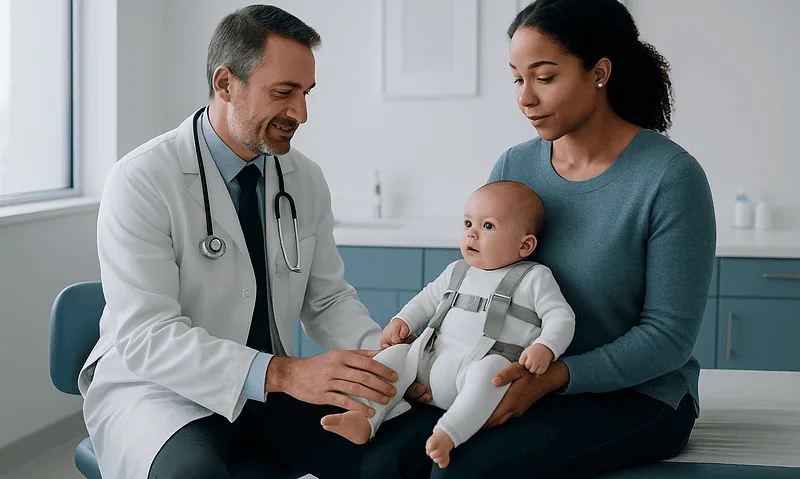
How a Pavlik Harness Keeps Your Baby’s Hips in Place So the Socket Can Deepen
A Pavlik harness works by holding a baby's hips bent up and gently spread apart, so the ball at the top of each thigh…
Read article

Articles on bones, joints and muscles: knee, hip, shoulder and back problems, joint replacement and sports injuries, explained from the first symptom through treatment options to recovery.
A Pavlik harness works by holding a baby's hips bent up and gently spread apart, so the ball at the top of each thigh…
Most people wear a sling for about two to six weeks after shoulder replacement, regain everyday reach by three months, and see strength keep…
Before hip replacement, ask your surgeon which surgical approach they use and why, what implant type and bearing surface they plan (cemented or uncemented,…
The first signs of arthritis in the fingers are usually subtle: stiffness on waking or after gripping something, aching or tenderness in a knuckle,…
Blood thinners after hip replacement are standard because surgery on the hip, combined with days of reduced movement, sharply raises the chance of a…
Hip dysplasia surgery risks include blood clots in the leg or lung, irritation or numbness of skin nerves around the incision, infection, bleeding, slow…
For international patients, our guide range for a total knee replacement is EUR 7,800-16,250, covering surgeon, implant, hospital stay and early rehabilitation. The same…
A shoulder replacement candidate is usually someone with advanced shoulder arthritis whose pain and stiffness continue despite months of non-surgical care, with X-rays showing…
Radiofrequency ablation for pain uses a thin, heated needle tip to disable the small sensory nerves that carry pain signals from an arthritic joint,…
Most flat feet, bunions and cavus (high-arched) feet are managed without surgery first. Typical flat feet treatment options include supportive footwear, over-the-counter or custom…
Foot surgery recovery time depends on whether bone was cut or only soft tissue was repaired. Soft-tissue procedures often allow protected walking within days,…
Flat feet in adults are usually a normal variation of foot shape and need no treatment when they cause no pain. They matter when…
Limb lengthening surgery works by cutting a long bone, such as the femur or tibia, and fixing the two ends to a device, either…
Bunions cannot be reversed without surgery, but most people can keep them comfortable for years. Wide, low-heeled shoes with a roomy toe box, protective…
A trauma surgeon is a surgeon trained to assess and treat people with sudden, serious physical injuries, such as those from crashes, falls or…
Preparing for shoulder replacement surgery usually means a pre-operative visit with X-rays and often a CT scan, blood tests and sometimes a heart tracing,…
Wrist pain most often comes from one of five sources: strained ligaments after a fall, overloaded tendons from repetitive or forceful use, a pinched…
A baby's first clubfoot appointment is mainly a hands-on orthopedic examination. The clinician checks whether the foot is a flexible positional foot or a…
Choose which cookies you allow. Essential cookies are always on because the site cannot work without them.