

After Sarcoma Surgery: Physiotherapy Milestones From the First Days to Full Movement
Key Takeaways
- Sarcoma surgery removes muscle, nerve or bone rather than repairing it, which is why rehabilitation runs slower than after a joint replacement and why the operative note shapes every exercise.
- Patients with flaps, skin grafts, endoprostheses or pre-operative radiation are commonly asked to delay or restrict movement so the reconstruction can establish its blood supply or fixation.
- Early breathing exercises, ankle pumps and assisted standing in the first days target clots and chest complications, both recognized risks of major surgery and immobility.
- Radiation slows wound healing and stiffens tissue over months through fibrosis, so a daily stretching routine continued well after the last session protects range of motion.
- Lymphedema after node removal or radiation can be controlled with skin care, exercise, compression and specialized drainage, but current guidance is clear it cannot be reversed.
- Soft tissue sarcoma most often spreads to the lungs when it does spread, which is why follow-up includes chest imaging for several years, and why any new lump in the scar should be reported promptly.
Physiotherapy after sarcoma surgery usually begins within the first day or two with breathing, circulation and gentle assisted movement, then progresses through protected range-of-motion work, graded strengthening and functional retraining over several weeks to months. The pace depends on how much muscle, nerve or bone was removed, whether a flap or implant was used, and whether radiation is planned, so your surgical and rehabilitation team sets each milestone individually.
On the second morning after her thigh operation, the physiotherapist arrived before breakfast, pushed a walking frame to the bedside and asked a question that sounded almost absurd: “Shall we try standing?” The incision ran nearly the length of her femur. A drain still dangled from the dressing. Standing felt like something for next month, not today.
That small scene captures what sarcoma surgery recovery physiotherapy really is: a series of carefully timed permissions. Each one, from the first assisted stand to the first unaided stair, is granted only when the tissue underneath has earned it. Move too early and a repair can fail. Move too late and joints stiffen, muscles waste and confidence drains away.
This explainer walks through those permissions in order, from the hospital bed to the point where movement feels like your own again. It is written for the patient and the family member holding the walking frame, and it stays honest about what the evidence can and cannot promise.
What sarcoma surgery recovery physiotherapy actually involves
A sarcoma is a cancer that starts in the body’s connective tissues: muscle, fat, tendon, nerve, blood vessel or bone. Because these tissues are exactly the ones that make movement possible, removing a sarcoma almost always removes some capacity to move. Physiotherapy, meaning supervised, progressive exercise and manual treatment aimed at restoring function, exists to rebuild that capacity in the safest possible order.
The work has four overlapping jobs. The first is protection: keeping the surgical repair, any skin flap or graft, and any bone reconstruction free from forces they cannot yet withstand. The second is range of motion, which simply means how far a joint can bend and straighten. The third is strength, rebuilt gradually in the muscles that remain and, where possible, retrained so that neighboring muscles take over lost roles. The fourth is function: walking, reaching, dressing, climbing stairs, eventually returning to work and sport.
What makes this different from a generic exercise program is the operative note. A good rehabilitation physiotherapist reads exactly what the surgeon removed, which nerves were preserved or sacrificed, how the wound was closed and what the pathology report said about margins. The margin is the rim of healthy tissue taken around the tumor; wider margins mean more muscle gone and a slower start. Mayo Clinic describes surgery for soft tissue sarcoma as removing the tumor together with a border of healthy tissue, sometimes combined with radiation therapy before or after the operation. Every one of those details changes the timetable, which is why two patients with the “same” diagnosis can be on very different programs by week three.
Why recovery after sarcoma surgery is slower than after a joint replacement
Patients often compare notes with a neighbor who had a knee replaced and walked unaided in a fortnight. The comparison is understandable and misleading. A joint replacement removes worn cartilage and bone and replaces it with a well-fitted implant; the surrounding muscles are largely left alone. Sarcoma surgery is the reverse. The implant, if there is one, is incidental. The main event is the deliberate removal of soft tissue that will not grow back.
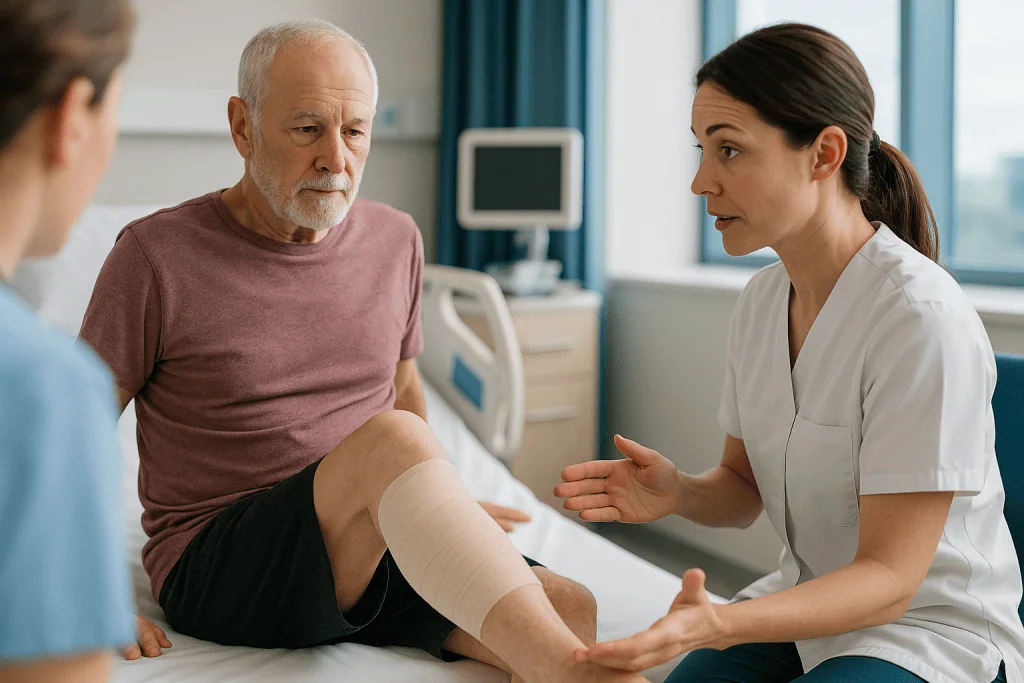
Three features slow things down. The first is the wide local excision itself: the surgeon takes the tumor plus a cuff of normal muscle so that no cancer cells are left behind. A thigh that has lost a portion of its quadriceps cannot simply be “stretched back” into shape; the remaining fibers must hypertrophy, meaning enlarge and strengthen, to compensate. The second is reconstruction. Large wounds are sometimes closed with a flap, a block of skin, fat and sometimes muscle moved from elsewhere in the body with its own blood supply. Flaps need days of near-stillness while new vessels connect. The third is radiation. NHS guidance notes that radiotherapy is frequently given before or after surgery to lower the chance of the sarcoma returning. Radiation slows wound healing and, over months, stiffens tissue through a process called fibrosis, the laying down of dense scar collagen.
Put together, the picture is of healing happening where tissue was removed rather than where it was repaired. That is why timelines quoted in this article are ranges tied to published guidance, never promises, and why your treating team’s version of the plan always outranks the general one.
Who starts moving on day one, and who is asked to wait
Early mobilization is the default after most operations because it lowers the risk of blood clots, chest infections and pressure sores. MedlinePlus describes getting out of bed and walking soon after surgery as a standard part of recovery. Sarcoma surgery follows the same principle, but with important exceptions, and knowing which group you fall into helps make sense of what the ward team asks of you.
People who typically begin moving within a day or two include those with tumors removed from the trunk, shoulder girdle or arm where walking is unaffected, and those with a straightforward limb excision closed directly without a flap. For them, the first sessions focus on breathing, circulation and getting safely to a chair.
People who are usually asked to wait, or to move only certain parts of the body, include:
- Anyone with a free flap or large rotational flap, where the surgeon may order strict positioning and no tension on the wound for a set number of days.
- Anyone with a skin graft, which needs time to attach before the underlying joint moves through its range.
- Anyone whose bone was resected and reconstructed with an endoprosthesis, an internal metal replacement for a segment of bone, or with a bone graft that must be protected until fixation is stable.
- Anyone who had radiation before surgery, because irradiated skin heals more slowly and wound breakdown is a recognized concern in NHS and Mayo Clinic guidance.
Being asked to wait is not a setback. It is the surgeon and physiotherapist agreeing that, for now, stillness is doing more for your long-term function than motion would. The permission to move will come, and it will come in stages.
The first days: breathing, circulation and the first assisted movements
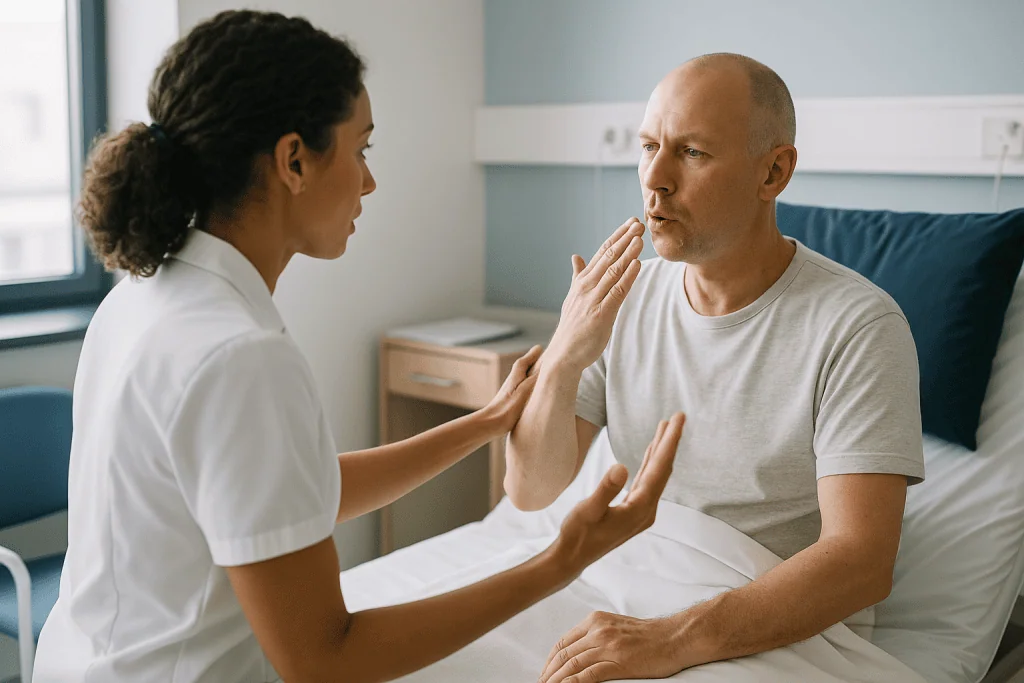
The first forty-eight hours are less about the limb and more about the rest of you. Anesthesia and lying flat let the lower parts of the lungs collapse slightly, so the physiotherapist teaches deep breathing and supported coughing, often with a rolled towel or pillow braced against the wound. Ankle pumps, drawing the feet up and down, squeeze blood through the calf veins. That matters because a deep vein thrombosis, a clot forming in the deep veins of the leg, is a known risk after major surgery and immobility, and MedlinePlus lists surgery among its main triggers.
Pain control shapes what you can do. Teams commonly use a nerve block, an epidural or a combination of medicine classes such as opioids and anti-inflammatories in the early days. None of that is a decision for this article; the point is that well-controlled pain is a rehabilitation tool, and telling the nurse when relief is inadequate helps your physiotherapy rather than hindering it.
Drains, the thin tubes removing fluid from the wound, are usually still in place. They do not stop you sitting on the edge of the bed, standing with a frame or taking a few steps if the surgeon has cleared it. What they do is restrict how far the operated area moves, so the first exercises for the limb itself are often static: gently tightening a muscle without moving the joint, or moving a joint above or below the surgical site.
By the time the drains come out and the first dressing check is done, most people have a short daily routine of breathing, circulation and assisted transfers. It looks small. It is the foundation for everything that follows.
Weeks two to six: protecting healing tissue while range of motion returns
This is the phase that tests patience. The wound is closing, stitches or staples are typically removed, and the acute soreness fades. Energy returns just enough to make the restrictions feel arbitrary. They are not.
Range-of-motion work usually begins passively or with assistance: the physiotherapist or your own other hand moves the joint through a comfortable arc, then you gradually take over. The goal is to stop the joint capsule and healing tissues from shortening, not to force a full stretch. Mayo Clinic notes that recovery after soft tissue sarcoma surgery depends on the size and location of the tumor and can take weeks to months; in this window, the tissue is still remodeling, and a hard stretch across a fresh flap or graft can compromise blood supply.
Typical elements of the home program in this phase include:
- Gentle, frequent movement within a pain-tolerable range, several times a day rather than one long session.
- Scar management once the wound is fully closed, using light massage to keep the skin gliding over the tissue beneath.
- Walking with the aid the team recommends, with a clear rule about how much weight the operated leg may take.
- Positioning to reduce swelling, such as elevating the limb when resting.
People whose radiation is planned after surgery may have it scheduled once the wound has healed enough to tolerate it; NHS guidance describes post-operative radiotherapy as a common part of treatment, and your oncology team sets the timing. If radiation is coming, this is also when the physiotherapist starts talking about stretches you will need during and after it, because it is far easier to keep motion than to win it back once fibrosis sets in.
Weeks six to twelve: rebuilding strength, and how radiation changes the plan
Somewhere around the six-week mark, many programs pivot from protection to loading. The wound has matured, deeper tissues have knitted, and the physiotherapist begins asking muscles to work against resistance. Strength returns unevenly. The muscles that were cut or partially removed recover slowly, while the ones that were merely inhibited by pain and swelling often bounce back fast, which can make the limb feel oddly unbalanced for a while.
Balance retraining matters as much as raw strength, particularly after lower-limb surgery. Proprioception, the sense of where a joint is in space, is disrupted when muscle, fascia and nerve are removed. Standing on the operated leg, weight-shifting drills and slow stair practice rebuild it. Upper-limb programs focus on reaching, lifting and the fine coordination that dressing and cooking demand.
Radiation, whether it happened before surgery or is underway now, reshapes the work. Skin over the treatment field can redden and become fragile, so friction and heavy manual techniques are avoided over the area. Fatigue is common during a radiation course and can dampen exercise tolerance; Mayo Clinic lists fatigue among the frequent side effects of radiation therapy. The longer-term concern is fibrosis. Irradiated muscle and fascia progressively stiffen over months, and a daily stretching routine, continued well beyond the last radiation session, is the main defense. Physiotherapists often describe this as “banking” range of motion while the tissue is still pliable.
Toward the end of this phase, the question shifts from “what can I do?” to “what do I want to get back to?” A gardener, a carpenter and a swimmer need different end points, and a good program is built backward from the life the person is returning to.
A sarcoma surgery recovery physiotherapy timeline at a glance
The table below summarizes the typical shape of the program described so far. Every row is a pattern drawn from general post-surgical and sarcoma-specific guidance from Mayo Clinic, the NHS and MedlinePlus, not a schedule. Flap reconstruction, bone replacement, radiation and complications all shift the phases later, and your team’s plan is the one to follow.
| Phase | Main goals | Usual precautions | Typical signs of readiness to progress |
|---|---|---|---|
| First days in hospital | Breathing, circulation, safe transfers, first assisted stand | Drains in place; flap or graft protection; weight-bearing set by surgeon | Pain controlled, drains removed, wound edges intact |
| Weeks two to six | Wound protection, gentle range of motion, scar mobility, walking with aid | No forceful stretching across healing tissue; radiation-field skin care if applicable | Wound fully closed, swelling settling, pain-free comfortable arc of movement |
| Weeks six to twelve | Graded strengthening, balance and proprioception, functional tasks | Fatigue management during radiation; avoid heavy friction over irradiated skin | Confident single-leg stance or reaching tasks; reduced reliance on aids |
| Three months onward | Return to work, sport and hobbies; long-term stretching against fibrosis; lymphedema surveillance | Endoprosthesis or amputation rules continue; avoid high-impact loading unless cleared | Team-agreed functional goals met; stable strength and movement over successive visits |
Two things are worth reading between the rows. First, “full movement” rarely means identical movement. Where muscle has been removed, the realistic aim is full function through compensation: other muscles taking over, technique adjusted, a task achieved a slightly different way. Second, the phases overlap rather than switch. Scar work continues into strengthening; strengthening continues into return to sport. The timeline is a river, not a staircase.
Swelling and lymphedema: what physiotherapy can and cannot do
Some swelling after any operation is normal and fades as the tissues heal. Lymphedema is different. It is a persistent build-up of lymph fluid because the lymphatic vessels or nodes that normally drain it have been removed, cut through or scarred by radiation. The NHS describes it as a long-term condition that can develop after cancer treatment involving the lymph nodes or radiotherapy, and it most often affects the limb on the treated side.
Physiotherapy cannot rebuild missing lymph channels. What it can do, according to NHS and Cleveland Clinic guidance, is manage the swelling and protect the skin through a combination usually called decongestive therapy:
- Skin care to reduce the risk of infection, since swollen tissue is more prone to cellulitis, a bacterial skin infection.
- Movement and exercise, because muscle contraction is the main pump for lymph fluid.
- Compression garments or bandaging fitted by a trained therapist to stop fluid re-accumulating.
- Manual lymphatic drainage, a specialized light massage that redirects fluid toward working channels.
The honest position on evidence is that these measures reduce volume and symptoms in many people and slow progression; they do not reverse the underlying damage, and the condition needs lifelong attention. The NHS is explicit that there is no way to make lymphoedema disappear entirely, only to control it.
The most useful thing a patient can do is notice early. A ring or watch that feels tight, a sleeve that no longer sits the same, a limb that feels heavy at the end of the day: these are the moments to tell the team, because swelling caught early is far easier to control than swelling that has been present for months. Lymphedema does not mean the cancer has returned, a misunderstanding addressed later in this article, but new or sudden swelling always warrants a conversation.
Physiotherapy after limb sparing surgery, endoprostheses and amputation
Bone sarcomas, and soft tissue sarcomas that wrap around bone, often require the surgeon to remove a segment of bone along with the tumor. Limb sparing surgery replaces that segment with an endoprosthesis, an internal metal implant that may include an artificial joint, or with a bone graft. The rehabilitation logic is different from soft tissue surgery in one crucial way: the limit is set by how the implant is fixed to living bone, not by how the skin is healing.
Weight-bearing rules therefore come directly from the surgeon and can be strict. Some fixations allow partial loading from the start; others require several weeks of protected weight-bearing while bone grows into or around the implant. Physiotherapy in this period concentrates on the joints above and below, on the muscles that will later drive the reconstructed limb, and on safe crutch or frame technique. Because tendons are sometimes reattached to the implant, certain movements may be restricted until that attachment matures, and the physiotherapist will name them explicitly.
When the tumor cannot be removed with a working limb left behind, amputation may be the surgeon’s recommendation. Mayo Clinic notes that this is now less common than in the past but remains necessary in some cases. Rehabilitation then follows its own sequence: wound healing and shaping of the residual limb, desensitization of the skin, strengthening of the hip or shoulder that will control a prosthesis, and, once the limb has stabilized in size, fitting and gait training with a prosthetist. Phantom sensation, feeling the missing part as though it were still present, is common and is discussed openly rather than dismissed.
In both routes, the measure of success is what the person can do, and the team’s judgment about which operation offers the better long-term function is a medical decision made with, not for, the patient.
Pain, nerve symptoms and fatigue during rehabilitation
Three kinds of discomfort tend to surface during sarcoma rehabilitation, and telling them apart helps you report them accurately.
Surgical pain is the deep, mechanical ache of tissues that have been cut and are healing. It eases week by week and responds to the pain-control plan set by your team. Physiotherapy should not sharply worsen it; a mild increase during exercise that settles within a couple of hours is generally acceptable, while pain that lingers into the next day suggests the load was too much.
Nerve-related symptoms are different in character: burning, tingling, electric jolts, numbness or exquisite skin sensitivity. They arise when a nerve was stretched, bruised or deliberately divided during the excision, or when irradiated tissue tightens around it. Some of these symptoms fade over months as nerves recover; others persist where a nerve was removed. Clinicians sometimes use medicines from the anticonvulsant or antidepressant classes that dampen nerve signaling, and any decision about them, including whether to start, continue or stop, belongs to the prescribing clinician. Physiotherapy contributes desensitization techniques and gentle nerve-gliding movements where appropriate.
Fatigue is the most underestimated of the three. Major surgery, anesthesia, blood loss, disrupted sleep and, if applicable, radiation or chemotherapy all draw on the same reserve. Mayo Clinic lists fatigue among the common effects of cancer treatment. The counterintuitive evidence is that graded activity tends to reduce cancer-related fatigue more reliably than rest does, provided the activity is paced. Physiotherapists teach pacing explicitly: shorter sessions, planned rest, and a weekly rather than daily view of progress. On a bad day, doing half the program well beats skipping it or forcing the whole thing.
Can soft tissue sarcoma come back, and how does that shape recovery?
Yes, it can, and pretending otherwise would fail the people this article is written for. Sarcoma can return at the original site, called local recurrence, or appear elsewhere, called metastasis. Mayo Clinic notes that when soft tissue sarcoma spreads, the lungs are the most common destination, which is why follow-up typically includes chest imaging. The NHS describes regular check-ups for several years after treatment so that any recurrence can be found early.
How likely recurrence is depends on the tumor’s grade, meaning how abnormal the cells looked under the microscope, its size, its depth, whether the surgical margins were clear, and whether radiation was given. These factors vary so widely that a single “recurrence rate” or “survival rate” quoted here would be meaningless or misleading. Your oncologist has your pathology report and can give figures that apply to your situation. This article deliberately does not.
What the possibility of recurrence should not do is stall rehabilitation. Restoring strength and movement does not increase the risk of the cancer returning; there is no mainstream evidence for that fear. Physical fitness makes any future treatment easier to tolerate, and a limb that moves well is a limb whose changes you will notice sooner.
That last point is practical. The person who knows their scar, who stretches it daily and feels its texture, is the person who spots a new firm lump within it early. Recurrence in the scar or nearby tissue often presents as exactly that: a new, growing, usually painless lump. It should be reported promptly and is far more often something benign, such as scar tissue, a fluid collection or a fat necrosis, but that judgment is the team’s to make, ideally with imaging rather than guesswork.
What people often get wrong about rehab after sarcoma surgery
Several beliefs circulate among patients and, occasionally, well-meaning relatives. Each has a kernel of sense and a misleading conclusion.
“Pain means damage, so stop.” Discomfort during controlled movement of healing tissue is expected; damage announces itself as sharp, escalating pain, a sudden give, or pain that persists into the following day. The physiotherapist’s job is to teach you the difference, not to keep you pain-free at the cost of a stiff joint.
“Rest is the safest option.” Bed rest raises the risk of clots and chest infection, and joints held still after surgery lose range that can be hard to recover. MedlinePlus general post-surgical guidance emphasizes early, safe movement for precisely these reasons.
“If some is good, more is better.” Healing tissue has a load ceiling. Doubling the exercises does not double the progress; it often causes a flare of swelling that sets the program back a week.
“Physiotherapy ends when I leave hospital.” For most people the hospital phase is the shortest part. The strengthening, stretching and, after radiation, the anti-fibrosis routine continue for months, much of it at home.
“Swelling means the cancer is back.” Swelling after limb surgery is far more often lymphedema, ordinary post-operative edema or a fluid collection. New swelling still needs reporting, but the leap to recurrence is not justified without assessment.
“I can’t exercise during radiation.” With adjustments for skin fragility and fatigue, continuing gentle movement and stretching during radiotherapy is usually encouraged, because it preserves range that fibrosis would otherwise take.
“Full recovery means my limb will be exactly as before.” Removed muscle does not regrow. Full function through compensation is the realistic and achievable target, and reframing the goal that way tends to make the later months of recovery feel like progress rather than shortfall.
Questions to ask your care team
Clinic appointments are short and the questions that matter most tend to arrive on the drive home. Writing them down beforehand helps. These are the ones that most directly affect your physiotherapy program; the answers are individual and belong to the team treating you.
- Exactly which muscles, nerves or bone were removed, and which were preserved? Can the operative note be shared with my physiotherapist?
- Was the wound closed directly, with a graft or with a flap, and what movement or positioning restrictions does that create in the first weeks?
- How much weight may I put through the operated limb now, and what will change that rule?
- Are there specific movements I must avoid until a tendon reattachment, graft or implant has matured?
- Is radiation planned before or after surgery, when will it start, and what should my stretching routine look like during and after it?
- Were lymph nodes removed or irradiated, and what should I watch for in terms of lymphedema?
- What kind of discomfort during exercise is acceptable, and what kind should make me stop and call?
- How often will I be seen by physiotherapy, and what should I be doing on my own between visits?
- What is my follow-up schedule for imaging, and what changes in the scar or limb should I report between appointments?
- Are there activities, sports or job tasks I should postpone, and what would need to be true before I return to them?
One more question is worth asking even if it feels awkward: “What does a good outcome look like for someone with my operation?” The answer sets expectations honestly and gives both you and the physiotherapist a shared destination to work toward.
When to call your doctor
Most bumps in recovery are minor and can wait for the next scheduled visit. A short list of signs should not wait, because they can indicate a clot, an infection, a problem with the wound or reconstruction, or something that needs imaging.
Seek urgent medical attention, calling emergency services if severe, for:
- Sudden chest pain, breathlessness or coughing up blood, which can signal a clot that has traveled to the lung.
- New pain, swelling, warmth or discoloration in the calf or arm, particularly on one side, which can indicate a deep vein thrombosis.
- A flap or reconstructed area that becomes pale, dusky, cold or dark, or bleeds heavily.
- Fever with shaking, feeling very unwell, or a rapidly spreading area of red, hot, painful skin.
Contact your surgical or oncology team the same day for:
- Wound edges separating, increasing redness, pus or a new foul smell from the dressing.
- Pain that is escalating rather than easing, or that no longer responds to your prescribed plan.
- New numbness, weakness or loss of movement in the limb that was not present before.
- Rapid new swelling of the limb or a tight, shiny appearance of the skin.
- A new lump in or near the scar, or any lump that is growing.
- A fall, or a sudden give or clunk in a limb with an implant or bone graft.
Trust the instinct that something is not right. Calling about a symptom that turns out to be nothing carries no cost to your recovery; waiting on one that matters can. Every decision about what to do next, from a dressing change to a scan, sits with the team that knows your operation.
Frequently asked questions
Can soft tissue sarcoma come back after surgery?
Yes, soft tissue sarcoma can return either at the original site or elsewhere in the body, most commonly the lungs. The likelihood depends on the tumor’s grade, size, depth, whether surgical margins were clear and whether radiation was given, so only your oncologist can give figures that apply to you. Regular follow-up visits and imaging for several years are standard practice precisely so that any recurrence is found early.
How long does it take to recover from sarcoma removal surgery?
Recovery commonly takes weeks to months, and the range is wide because it depends on how much tissue was removed and how the wound was reconstructed. Straightforward excisions closed directly tend to progress fastest, while flap reconstructions, bone replacements and cases involving radiation take longer. Mayo Clinic notes that recovery depends on the tumor’s size and location; your surgical team’s estimate for your specific operation is the one to rely on.
What is the survival rate for patients with sarcoma recurrence?
There is no single survival figure that honestly applies to everyone with recurrent sarcoma. Outcomes vary enormously by sarcoma subtype, where the recurrence appears, how many sites are involved, how long after the original treatment it occurred and what treatment options remain. Quoting a general percentage would mislead more than inform. Your oncologist, with your pathology and imaging in hand, can discuss what the evidence suggests for your particular situation.
How likely is sarcoma to spread?
The risk of spread depends mainly on the tumor’s grade and size, with high-grade and larger tumors carrying more risk than small, low-grade ones. When soft tissue sarcoma does spread, the lungs are the most frequent site, which is why chest imaging features in follow-up. Because the range between low-risk and high-risk tumors is so broad, your treating team is the right source for a personalized estimate rather than a general statistic.
Is exercise after sarcoma surgery safe?
Supervised, graded exercise is not only safe but central to recovery when it follows the restrictions set by your surgeon and physiotherapist. There is no mainstream evidence that rebuilding strength increases the risk of recurrence. The precautions are about protecting healing tissue: respecting weight-bearing limits, avoiding forceful stretching across flaps or grafts, and keeping heavy loading away from implants until fixation is stable. Increase activity in steps and report pain that lingers into the next day.
What does rehabilitation after soft tissue sarcoma surgery look like at home?
Home rehabilitation is usually a short routine done several times a day rather than one long session. It typically includes gentle range-of-motion movements, scar massage once the wound is closed, prescribed strengthening exercises, walking with any recommended aid, and, if radiation is involved, daily stretches to counter tissue stiffening. Your physiotherapist adjusts the program at each visit based on how the tissue is responding, so the routine evolves over weeks and months.
What is the typical sarcoma surgery recovery time before returning to work?
Return to work varies from a few weeks for desk-based roles after smaller excisions to several months for physically demanding jobs after major limb or bone surgery. Radiation courses, fatigue and any lymphedema management also affect timing. The decision rests with your surgical and rehabilitation team and depends on the specific tasks your job requires, so it helps to describe those tasks in detail at your follow-up appointments.
Can I continue physiotherapy during radiation therapy?
In most cases yes, with adjustments. Gentle movement and stretching during radiotherapy help preserve range of motion that fibrosis would otherwise reduce over the following months. Physiotherapists typically avoid friction, heavy manual techniques and anything that irritates skin within the treatment field, and they scale sessions to your energy because fatigue is a common side effect. Your oncology team and physiotherapist coordinate the plan together.
Will I get full movement back after sarcoma surgery?
Many people regain excellent function, but muscle that has been removed does not regrow, so movement is often restored through compensation rather than an exact return to the previous state. Neighboring muscles take over, technique adapts and tasks are achieved a slightly different way. How close you get depends on what was removed, whether nerves were preserved and how consistently the rehabilitation program is followed, which is why realistic goals are set with your team early.
Why does my scar still feel tight months after sarcoma surgery?
Scar tissue continues to remodel for a year or more, and tissue that has been irradiated becomes progressively denser through fibrosis, so tightness months later is common and expected. Daily scar massage and stretching help keep the skin and underlying tissue gliding. Tightness alone is not a warning sign, but a new firm lump within the scar, rapidly increasing tightness or new swelling should be reported to your team for assessment.
References
- Soft tissue sarcomas (NHS)
- Soft Tissue Sarcoma (MedlinePlus)
- Lymphoedema (NHS)
- Lymphedema (Cleveland Clinic)
This article is for general information only and is not a substitute for professional medical advice. Please consult a qualified doctor about your individual situation.

More from the Blog
Why Intravesical Therapy Often Follows TURBT and How the Treatment Course Runs
Intravesical therapy usually follows TURBT because the operation removes visible bladder tumours but cannot reliably clear microscopic cancer cells, and non-muscle-invasive bladder cancer tends…
Warning Signs During Liver Cancer Treatment: What to Report to Your Oncology Team
During liver cancer treatment, report a fever of 100.4°F (38°C) or higher, new yellowing of the skin or eyes, dark urine, unusual bruising or…
Does Colon Cancer Always Need Chemotherapy After Surgery? How the Pathology Report Decides
No. Whether colon cancer needs chemotherapy after surgery depends mainly on the pathology report: how deeply the tumor grew, whether lymph nodes contained cancer,…
Removing Part or All of the Thyroid for Cancer: How Surgeons Weigh the Options
For thyroid cancer, surgeons choose between removing one lobe (partial thyroidectomy, also called lobectomy or hemithyroidectomy) and removing the whole gland (total thyroidectomy) based…
Pulmonary Rehabilitation After Lung Cancer Treatment: Rebuilding Stamina Safely
Pulmonary rehabilitation after lung cancer is a supervised program of graded exercise, breathing training, and education that helps people rebuild stamina once surgery, chemotherapy,…
How Long to Stay Near the Hospital After CAR-T Infusion: Planning as an International Patient
After a CAR-T infusion, most programs keep patients in hospital for roughly one to two weeks of monitoring, then ask them to remain within…