

Removing Part or All of the Thyroid for Cancer: How Surgeons Weigh the Options

Key Takeaways
- The American Thyroid Association guideline allows either lobectomy or total thyroidectomy for differentiated thyroid cancers between 1 and 4 centimeters that have not spread beyond the gland or into lymph nodes.
- Radioactive iodine only works effectively once the whole thyroid is gone, so expecting to need it is one of the strongest reasons a surgeon recommends total thyroidectomy.
- A lobectomy exposes one laryngeal nerve and two parathyroid glands; a total thyroidectomy exposes both nerves and all four, which is why low calcium after surgery is almost exclusive to the larger operation.
- Total thyroidectomy always requires lifelong thyroid hormone replacement, whereas after a lobectomy the remaining lobe often, though not always, produces enough hormone on its own.
- For very small papillary cancers confined to the thyroid, active surveillance with regular ultrasound is a recognized alternative to any operation.
- Anaplastic thyroid cancer is the rarest and most aggressive type and carries the worst outlook, while papillary cancer is the most common and generally slow-growing.
For thyroid cancer, surgeons choose between removing one lobe (partial thyroidectomy, also called lobectomy or hemithyroidectomy) and removing the whole gland (total thyroidectomy) based on tumor size, cancer type, spread beyond the thyroid or into lymph nodes, and whether radioactive iodine may be needed afterward. Guidelines allow either operation for many small, low-risk papillary cancers; larger or higher-risk tumors usually call for total removal. The treating team makes the final decision.
The call comes while she is unloading groceries. The nodule the ultrasound flagged is papillary thyroid cancer, the biopsy is clear, and the surgeon would like to see her next week to talk about how much of the gland to take out. That last clause is the one she will turn over for days: how much? Isn’t the answer obviously all of it?
The total vs partial thyroidectomy for cancer conversation is one of the most common in endocrine surgery and one of the least understood by the people sitting on the other side of the desk. It is also, for a large share of patients, a genuine choice rather than a foregone conclusion, with trade-offs that reach years past the operating room.
What follows is the version of that conversation a good surgeon would have if the clinic ran an hour behind and nobody minded: what the two operations actually remove, which features of a cancer push toward one or the other, what the guidelines say when the evidence is honestly uncertain, and what daily life looks like on each path.
What total vs partial thyroidectomy for cancer actually means
The thyroid sits low in the front of the neck, shaped like a butterfly: two lobes, each roughly the size of a thumb, joined by a narrow bridge of tissue called the isthmus. Every thyroid operation for cancer is a decision about how much of that butterfly comes out.
A partial thyroidectomy, in cancer care, almost always means a thyroid lobectomy, also called a hemithyroidectomy: the surgeon removes the lobe containing the tumor, usually with the isthmus, and leaves the other lobe in place. A total thyroidectomy removes the entire gland. Some surgeons use the term near-total thyroidectomy when a sliver of tissue is deliberately left behind to protect a nerve or a parathyroid gland; in practice it is treated like a total.
Two other terms come up. A completion thyroidectomy is a second operation to remove the remaining lobe, done when the final pathology after a lobectomy shows features that change the plan. A neck dissection means removing lymph nodes, the small filters that drain fluid from the thyroid, from the central compartment beside the gland or from the side of the neck, when imaging or biopsy suggests cancer has reached them. The lymph node question runs alongside the lobe-versus-whole-gland question rather than replacing it.
The older term subtotal thyroidectomy, leaving substantial tissue on both sides, is rarely used for cancer today because it combines the downsides of both approaches: it leaves tissue that can harbor disease while still putting both sides of the neck at risk. The labels matter because the rest of the decision is about matching the amount of tissue removed to the amount of risk the cancer carries.
How thyroid surgery works: what actually happens in the operating room
The operation happens under general anesthesia, through a horizontal incision low on the front of the neck, often placed in a natural skin crease. Surgeons part the thin strap muscles rather than cutting through them, then work along the surface of the gland.
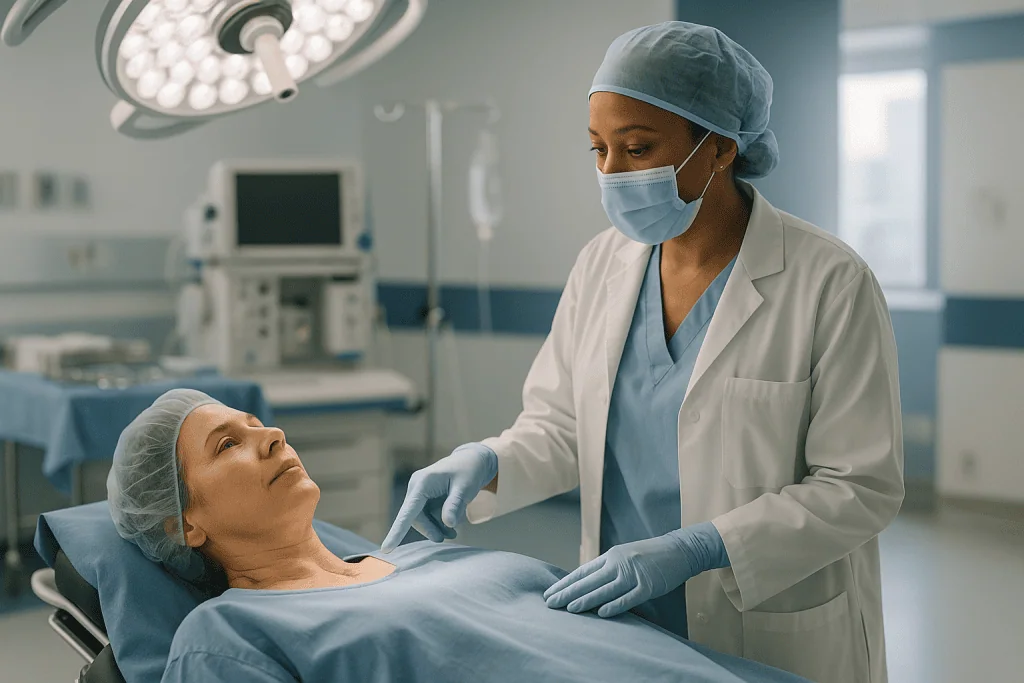
Two structures dictate the pace. The recurrent laryngeal nerve, a thread-thin nerve running behind each lobe, controls the vocal cord on that side; finding and protecting it is the central technical task, and many teams use a nerve monitor that signals when the nerve is stimulated. The parathyroid glands, four rice-grain-sized glands that regulate blood calcium, cling to the back of the thyroid and share its blood supply. A lobectomy exposes one nerve and two parathyroids; a total thyroidectomy exposes both nerves and all four.
Sometimes the surgeon sends tissue for a frozen section, a rapid look under the microscope while the patient is still asleep, or inspects suspicious lymph nodes directly. The plan agreed before surgery can therefore shift in the operating room, which is why consent conversations often cover the possibility of removing more than initially planned.
Once the gland is out, the incision is closed with sutures or skin glue, occasionally over a small drain. According to the Mayo Clinic’s thyroidectomy overview, most people go home the same day or after one night, can eat and drink normally, and notice a sore throat and a stiff neck rather than severe pain. The tissue goes to a pathologist, whose final report, arriving days later, is what fixes the diagnosis and, quite often, the next step.
Which type of thyroid cancer has the worst prognosis, and why type comes first
Before size, before scans, the surgeon wants to know what kind of cancer this is, because thyroid cancers behave in strikingly different ways.
Papillary thyroid cancer is by far the most common type, according to the Mayo Clinic, and tends to grow slowly; it is the type where the total-versus-partial debate genuinely exists. Follicular thyroid cancer is the second differentiated type, meaning its cells still look and act somewhat like normal thyroid cells and usually still take up iodine. One complication: a needle biopsy often cannot tell a benign follicular growth from a follicular cancer, so a lobectomy sometimes serves as the diagnostic step itself.
Medullary thyroid cancer arises from a different cell population, the C cells, which make a hormone called calcitonin rather than thyroid hormone. It does not absorb iodine, can run in families through changes in the RET gene, and is usually treated with total thyroidectomy plus lymph node removal because both lobes may be involved. Anaplastic thyroid cancer is the rarest and most aggressive form; the Mayo Clinic describes it as growing quickly and being very difficult to treat, and it carries the worst outlook of the group. When it is diagnosed, surgery may be one piece of an urgent, multi-specialty plan, or may not be feasible at all.
The practical message is that the fine print on the biopsy report shapes the operation more than the size of the lump. For the differentiated cancers there is a real choice. For medullary and anaplastic disease, the question is rarely whether to remove the whole gland but what else needs to happen around it.
Do you need your thyroid removed if you have cancer?
Not always, and not always immediately. That answer surprises many people, who assume a cancer diagnosis means the gland has to go.

For very small papillary cancers confined to the thyroid, an approach called active surveillance, meaning regular neck ultrasounds instead of immediate surgery, is an option the Mayo Clinic lists alongside operative treatment. The reasoning is that many of these tiny tumors grow slowly or not at all, and surgery can be offered later if growth appears. This is a monitored choice, not neglect, and it requires a patient willing to keep appointments and a team confident in its imaging.
When surgery is chosen, removing the whole gland is one option, not the default. For tumors that meet low-risk criteria, the American Thyroid Association guideline states that lobectomy alone can be sufficient treatment. For higher-risk features, total thyroidectomy is advised. So the honest reply to “do I need it all out?” is: it depends on the type, the size, whether cancer has crossed the thyroid’s outer capsule or reached lymph nodes, and whether radioactive iodine is likely to be part of the plan afterward.
There is a third scenario. Sometimes the diagnosis is not settled before surgery because the biopsy came back indeterminate. Here a lobectomy is chosen partly to find out what the nodule is. If the pathology shows a low-risk cancer, that operation may also have been the treatment. If it shows features that call for more, a completion thyroidectomy follows. Building this possibility into the plan from the start spares people the feeling that something went wrong when a second conversation happens.
Thyroid lobectomy for papillary cancer: who is usually offered it, and who is asked to wait
Guideline thresholds give the discussion its shape. The American Thyroid Association guideline, indexed on PubMed, groups differentiated cancers by size. Tumors under 1 centimeter with no extension beyond the thyroid and no involved lymph nodes: lobectomy alone is usually sufficient unless there are specific reasons to remove the rest. Tumors between 1 and 4 centimeters without those features: either lobectomy or total thyroidectomy is acceptable, and the choice is individualized. Tumors over 4 centimeters, or any tumor with gross extension into surrounding tissue, clinically evident nodes or distant spread: total thyroidectomy is recommended.
A centimeter is roughly the width of a fingernail, so that middle band covers a large share of the papillary cancers people are actually diagnosed with. Within it, surgeons look for tie-breakers that lean toward removing the whole gland: nodules in the opposite lobe, radiation to the head or neck in childhood, a family history of thyroid cancer, aggressive cell features on biopsy, or a strong preference for one operation and one clear surveillance pathway. Tie-breakers toward lobectomy include a solitary tumor, a normal opposite lobe, no suspicious nodes, and a wish to avoid lifelong hormone replacement where that is realistic.
Who is asked to wait? Two groups. People with very small, confined papillary cancers may be offered active surveillance rather than any operation. People whose biopsy is indeterminate are sometimes asked to wait for molecular testing of the sample, tests that look for gene changes associated with cancer, before committing to surgery.
None of these thresholds decides a case on its own. They are the frame a surgeon and an endocrinologist put around one person’s scans, biopsy and priorities.
Hemithyroidectomy vs total thyroidectomy: the trade-offs side by side
Laid out together, the two operations look less like a good choice and a bad one, and more like two different bargains. The table below summarizes what each typically involves for a differentiated thyroid cancer; individual plans vary.
| Feature | Lobectomy (hemithyroidectomy) | Total thyroidectomy |
|---|---|---|
| Tissue removed | One lobe, usually with the isthmus | Entire gland |
| Nerves and parathyroids exposed | One recurrent laryngeal nerve, two parathyroids | Both nerves, all four parathyroids |
| Lifelong thyroid hormone replacement | Not always; some people need it | Always |
| Low calcium after surgery | Uncommon, since the other side is untouched | Possible, usually temporary |
| Radioactive iodine afterward | Not practical while a lobe remains | Possible if the team recommends it |
| Thyroglobulin as a follow-up marker | Less informative | Clear marker |
| Chance of a second operation | Yes, if pathology upgrades the risk or cancer recurs in the other lobe | Lower for the thyroid itself |
| Typical guideline fit | Low-risk tumors, particularly under 4 centimeters | Larger, node-positive or invasive tumors; medullary cancer |
Read down the lobectomy column and the theme is preserving function: half a gland, half the exposure, a real chance of never taking a daily pill. Read down the total column and the theme is completeness: nothing left to watch, nothing left to absorb iodine, and a clean blood marker for years of follow-up.
Which theme matters more is not a medical fact; it is a values question that the medical facts constrain. A person who dreads a second operation more than a lifelong prescription may reasonably lean one way. A person who wants to keep every option for avoiding medication may lean the other. The surgeon’s job is to say which of those preferences the cancer will actually permit.
Why radioactive iodine treatment often decides the whole-gland question
Radioactive iodine explains more of the total-versus-partial decision than any other single factor. Thyroid cells, and most differentiated thyroid cancer cells, pull iodine out of the bloodstream to build hormone. A swallowed capsule of radioactive iodine rides that same pathway: the radiation concentrates in thyroid tissue and destroys it from within, with relatively little exposure to the rest of the body. The NHS describes it as a treatment given after surgery to some people to destroy any remaining thyroid cells.
The catch is that a healthy remaining lobe would soak up most of the iodine, leaving little for any stray cancer cells. Radioactive iodine is therefore effectively paired with total thyroidectomy. If the team expects it will be needed, because of node involvement, spread beyond the capsule or a large tumor, the gland comes out entirely.
Not everyone receives it. The American Thyroid Association guideline does not recommend routine radioactive iodine after surgery for low-risk cancers, uses it selectively for intermediate-risk disease, and recommends it for high-risk disease. This is precisely why lobectomy is possible at all: when a cancer is low-risk enough that radioactive iodine would not be advised anyway, one of the main reasons to remove the second lobe disappears.
Preparation typically involves a low-iodine diet for a period beforehand, so remaining cells are hungry for iodine, and either a pause in thyroid hormone or an injected hormone that stimulates thyroid tissue; the nuclear medicine team sets those details. A thyroglobulin blood test, measuring a protein made only by thyroid tissue, becomes a clean marker after total removal, because any detectable amount raises the question of remaining or recurrent cells. After a lobectomy the marker is muddier, and follow-up leans more heavily on ultrasound.
What the risks look like on each side: voice, calcium and the second operation
Both operations are considered safe and routine, but their risk profiles are not identical, and the difference is mostly about exposure.
Voice change tops the list. If the recurrent laryngeal nerve is bruised or stretched, the vocal cord on that side moves weakly and the voice becomes hoarse, breathy or tired by evening; most such changes recover over weeks to months, and permanent injury is uncommon. A total thyroidectomy exposes both nerves, and injury to both, while rare, can affect breathing. A smaller nerve near the top of the gland affects pitch and projection, which matters to singers and teachers even when ordinary speech sounds normal.
Low blood calcium comes next. Parathyroid glands that are bruised or lose blood supply can go quiet for a while, causing tingling around the lips and fingertips or muscle cramps; the Mayo Clinic lists underactive parathyroids among thyroidectomy complications. Temporary cases are far more common than permanent ones, and the problem is almost exclusive to total thyroidectomy, because a lobectomy leaves two untouched glands on the other side. Calcium and vitamin D supplements may be prescribed for a period, in amounts set by the team.
Shared risks include bleeding into the neck, which is rare but urgent because swelling can press on the airway, wound infection, scarring, and the general risks of anesthesia. The lobectomy-specific risk is needing a completion operation, which means working through scar tissue and accepting a second round of nerve and parathyroid exposure. The total-specific certainty is lifelong hormone replacement. The guideline also observes that complication rates tend to be lower when thyroid surgery is performed by surgeons who do it frequently, which is a fair question to raise in any consultation.
Life after total thyroidectomy: how thyroid hormone replacement works
Remove the whole gland and the body loses its only source of thyroid hormone, the chemical signal that sets the pace of metabolism, heart rate, temperature and mood. Replacement is not optional; it is part of the operation’s aftermath in the same way a cast is part of setting a bone.
The medicine most often prescribed is levothyroxine, a synthetic version of thyroxine, the main hormone the gland makes. The body converts it into the active form, exactly as it would the natural hormone. It is typically taken once a day on an empty stomach, and its effect builds gradually rather than hour by hour. The prescribing clinician sets the amount and adjusts it based on a blood test called TSH, thyroid-stimulating hormone, the pituitary signal that rises when the body wants more thyroid hormone and falls when it has enough. Getting to a steady level usually takes several checks over the following months, and any change is the prescriber’s call, never something to adjust at home.
For some people with higher-risk cancers, the team deliberately keeps TSH on the low side for a period, because TSH can encourage any remaining thyroid cells to grow; the guideline describes this as a risk-adjusted strategy rather than a rule for everyone.
After a lobectomy the remaining lobe often takes over, but not always. The Mayo Clinic notes that some people still need thyroid hormone after partial removal, and TSH is checked after surgery to find out. The honest framing is this: lobectomy offers a chance of avoiding a daily prescription, while total thyroidectomy makes it certain. Most people on stable replacement describe an ordinary life, but reaching stability is a process, and tiredness, weight shifts or a racing heart during that period are reasons to call the clinic, not to change anything unilaterally.
What the days and weeks after thyroid surgery usually look like
The first evening is mostly about the throat. The breathing tube and the surgery itself leave a scratchy, swollen feeling, and the neck is stiff from being positioned with the head tilted back. People are usually up and walking within hours and eating soft food the same day. The Mayo Clinic notes that discharge is commonly the same day or the next morning, depending on the operation and on calcium checks after a total thyroidectomy.
The first week brings a tight, pulling sensation across the incision, a voice that may sound huskier or tire quickly, and a temptation to look at the wound too often. Skin glue or steri-strips come off on their own or at the first visit. Showering is usually allowed early; soaking the incision is not. Driving resumes when the neck turns comfortably and no sedating pain relief is being used.
Somewhere in this window the pathology report lands. For many people it simply confirms the plan. For some, it triggers the completion or radioactive iodine conversation described earlier, which is why a follow-up appointment is always booked before discharge.
Weeks two to four are about rebuilding. The Mayo Clinic advises waiting roughly ten days to two weeks before vigorous activity or heavy lifting; walking is encouraged from the start. The scar goes through an angry pink phase before fading over months, and sun protection helps it settle. Voice therapy is offered when hoarseness persists. Thyroid hormone, if prescribed, is started right away and checked over the following weeks. Any sudden neck swelling, difficulty breathing or persistent tingling in this period is a same-day call, covered in detail below.
Can thyroid cancer come back after partial thyroidectomy? Thyroid cancer recurrence after lobectomy explained
Yes, it can, and pretending otherwise would be the wrong way to earn a patient’s trust. Differentiated thyroid cancer can reappear in the remaining lobe, in lymph nodes in the central or lateral neck, or, less often, at a distant site such as the lungs or bones. It can also recur after a total thyroidectomy, in the neck nodes or the thyroid bed, which is why nobody is discharged from follow-up the day the stitches come out.
The more useful question is whether choosing lobectomy makes recurrence more dangerous. The American Thyroid Association guideline reviewed this directly for low-risk tumors and concluded that the evidence did not show a survival advantage for total thyroidectomy over lobectomy in that group, which is why both operations are listed as acceptable. What the guideline does acknowledge is a somewhat greater chance of needing further surgery after lobectomy, because a recurrence in the other lobe, or a pathology upgrade, means a completion operation.
Follow-up looks a little different on each path. After total thyroidectomy, the thyroglobulin blood test does much of the work, backed by neck ultrasound. After lobectomy, ultrasound of the remaining lobe and neck becomes the main tool, with thyroglobulin trends read cautiously because normal tissue produces it too. Either way, the schedule is set by the risk category the team assigns after surgery and is adjusted as the years go by.
A recurrence, when it happens, is usually treatable: further surgery, radioactive iodine if the whole gland has been removed, or in selected cases targeted medicines that act on specific cancer-cell signals, which an oncologist would explain individually. Recurrence is a reason to stay in follow-up, not a reason to assume the smaller operation was a mistake.
What people often get wrong about total vs partial thyroidectomy for cancer
Myths gather quickly around this decision, partly because friends and online forums tend to generalize from one person’s story.
“Taking it all out is always the safer choice.” Safer against what? Total thyroidectomy leaves less tissue to watch, but it doubles the nerve and parathyroid exposure and guarantees lifelong medication. For low-risk tumors, the guideline found no survival difference between the operations. Safety has two sides here, and both deserve weight.
“Half a thyroid means half the hormone.” The remaining lobe usually compensates, at least partly, and many people never need replacement. Some do, which is why TSH is checked. It is not a simple division.
“You can’t live a normal life without a thyroid.” With steady replacement, the body has what it needs. The adjustment period is real; a permanently diminished life is not the typical experience.
“A small cancer means no follow-up.” Small and low-risk means less intensive follow-up, not none. Ultrasound and blood tests continue for years on either path.
“Everyone gets radioactive iodine.” Guidelines have moved away from routine use in low-risk disease. Its role is selective and tied to the whole-gland decision.
“Thyroid cancer is the good cancer, so the details don’t matter.” Many differentiated thyroid cancers do carry a favorable outlook, but the phrase dismisses the real weight of surgery, the anxiety of surveillance and the rarer aggressive types. Respecting the decision means taking the details seriously.
“The surgeon decides in the room and tells you afterward.” The plan, and its possible extensions, should be agreed before anesthesia. If it hasn’t been, that is the first thing to fix.
Questions to ask your care team before choosing an operation
A consultation goes better with a short written list than a long anxious silence. These questions tend to surface the information that actually changes decisions.
- What type of thyroid cancer is this, and how confident is the pathologist?
- How large is the tumor, and is there any sign it has grown beyond the thyroid or into lymph nodes?
- Based on those features, which risk group do you place me in, and which guideline are you following?
- Is a lobectomy a reasonable option for me, and if so, what would make you recommend total thyroidectomy instead?
- Do you expect I will need radioactive iodine, and how does that expectation affect the operation you are proposing?
- If I choose lobectomy, what is the chance I would need a completion operation, and what would trigger it?
- If I choose total thyroidectomy, how will hormone replacement and calcium be managed in the first weeks, and who adjusts them?
- Would active surveillance be an option in my case, and what would it involve?
- Are there nodules in the other lobe, and does that change your advice?
- How many thyroid operations does your team perform, and what does your follow-up schedule look like?
Bring someone with you if you can; two sets of ears catch more. Ask for the pathology and ultrasound reports so you can read them at home, and ask whether the case has been or will be discussed at a multidisciplinary meeting, where surgeons, endocrinologists, pathologists and nuclear medicine specialists review it together. Finally, ask how much time you have to decide. For most differentiated cancers the answer is weeks, not days, and knowing that can turn a frightening rush into a considered choice.
When to call your doctor after thyroid surgery
Most recoveries are uneventful, and a sore throat, a huskier voice and a stiff neck are expected for a while. A small number of problems, however, need a same-day call or emergency care, and knowing them in advance is far less frightening than discovering them at midnight.
Call emergency services or go to the nearest emergency department without delay for:
- Rapid swelling of the neck, a feeling of tightness or pressure under the incision, or any difficulty breathing or swallowing. This can signal bleeding into the neck, which the Mayo Clinic lists as a rare but serious complication because it can compress the airway.
- Noisy or labored breathing, especially after a total thyroidectomy, which can point to weakness of both vocal cords.
- Severe muscle cramps, spasms of the hands or face, or a seizure, which can indicate dangerously low calcium.
Contact the surgical team the same day for:
- Tingling or numbness around the lips, fingertips or toes, or cramping in the hands or feet, common early signs of low calcium after total thyroidectomy.
- Fever, spreading redness, increasing pain or pus at the incision.
- A voice that is a whisper or fails entirely, rather than merely hoarse, or choking on liquids.
- Bleeding that soaks the dressing.
In the weeks after surgery, call the clinic rather than adjusting anything yourself if you notice marked tiredness, palpitations, unexplained weight change or persistent low mood while hormone replacement is being settled, since these may prompt a blood test and a change by the prescriber. And at any point in follow-up, a new lump in the neck, a hoarse voice that arrives without a cold, or difficulty swallowing deserves a prompt appointment. None of these signs means the worst has happened; each simply needs a clinician’s eyes rather than reassurance from a search engine.
Frequently asked questions
Which is better, partial or total thyroidectomy?
Neither is better in every case; the right operation depends on the cancer’s type, size and spread. For low-risk differentiated tumors under 4 centimeters, the American Thyroid Association guideline considers both acceptable and found no survival advantage for total removal. Larger tumors, involved lymph nodes, spread beyond the gland, medullary cancer or an expected need for radioactive iodine usually point to total thyroidectomy. The treating team weighs these features with the patient’s own priorities.
Can thyroid cancer come back after partial thyroidectomy?
Yes, thyroid cancer can recur after a lobectomy, most often in the remaining lobe or in neck lymph nodes, which is why follow-up ultrasound continues for years. It can also recur after total thyroidectomy. For low-risk tumors, guidelines have not shown that recurrence after lobectomy shortens survival compared with total removal, though a recurrence in the other lobe would usually mean a completion operation. Regular surveillance is designed to catch this early.
Which type of thyroid cancer has the worst prognosis?
Anaplastic thyroid cancer has the worst outlook; the Mayo Clinic describes it as rare, fast-growing and very difficult to treat. Medullary thyroid cancer sits in between, particularly when lymph nodes are involved. Papillary and follicular cancers, the differentiated types, are the most common and generally slow-growing, and they are the only types where a partial thyroidectomy is a realistic option. Individual outlook depends on stage, age and response to treatment, which the oncology team assesses.
Do you need your thyroid removed if you have cancer?
Not necessarily. Very small papillary cancers confined to the thyroid may be monitored with active surveillance rather than operated on immediately, and many low-risk tumors can be treated by removing only the affected lobe. Total removal is usually advised for larger tumors, those that have spread to lymph nodes or beyond the gland, medullary cancer, and cases where radioactive iodine treatment is planned. The decision rests with the surgical and endocrine team.
What is life after total thyroidectomy like day to day?
Most people describe an ordinary life once thyroid hormone replacement is stable, which usually takes several blood tests and adjustments over the following months. A daily tablet replaces the hormone the gland used to make, and the prescriber tunes it using TSH levels. Early on, calcium may need short-term support and the voice may tire easily. Follow-up with ultrasound and thyroglobulin blood tests continues for years, at intervals set by the risk category.
Is hemithyroidectomy vs total thyroidectomy decided before or during surgery?
The plan is agreed before surgery, but it can change in the operating room. If the surgeon finds suspicious lymph nodes, sees the tumor extending beyond the gland, or receives a concerning frozen-section result, the consent usually allows converting a planned lobectomy into a total thyroidectomy. Conversely, the final pathology days later can prompt a second, completion operation. Asking exactly what has been consented to is a reasonable pre-operative question.
Will I need thyroid medication after a lobectomy?
Not everyone does. The remaining lobe often produces enough hormone, but the Mayo Clinic notes that some people still need replacement after partial removal, and a TSH blood test after surgery shows whether that applies. For certain higher-risk cancers, the team may also prescribe hormone deliberately to keep TSH low, since TSH can stimulate residual thyroid cells. Whether to start, and how much, is entirely the prescribing clinician’s decision.
How long is recovery after a thyroidectomy?
Most people go home the same day or after one night and return to light daily activities within days, according to the Mayo Clinic, which advises waiting roughly ten days to two weeks before vigorous exercise or heavy lifting. A sore throat, stiff neck and huskier voice are common for a week or more. The scar fades over months. Hormone and calcium levels, if relevant, are checked in the following weeks; those timelines are typical ranges rather than promises.
What is a completion thyroidectomy and why might I need one?
A completion thyroidectomy removes the remaining lobe after an earlier lobectomy. It is offered when the final pathology reveals higher-risk features than expected, such as a larger tumor, aggressive cell type or lymph node involvement, when radioactive iodine becomes advisable, or when cancer later appears in the other lobe. It carries similar risks to the original operation plus some scar tissue. Building this possibility into the initial plan helps people feel prepared rather than blindsided.
Does removing the whole thyroid mean I will need radioactive iodine?
No. Total thyroidectomy makes radioactive iodine possible, not automatic. The American Thyroid Association guideline does not recommend it routinely for low-risk cancers, uses it selectively for intermediate-risk disease and recommends it for high-risk disease. The decision depends on the final pathology, lymph node findings and post-operative thyroglobulin levels, and is made by the endocrine and nuclear medicine teams after surgery rather than at the time of the operation.
References
This article is for general information only and is not a substitute for professional medical advice. Please consult a qualified doctor about your individual situation.

More from the Blog
Pulmonary Rehabilitation After Lung Cancer Treatment: Rebuilding Stamina Safely
Pulmonary rehabilitation after lung cancer is a supervised program of graded exercise, breathing training, and education that helps people rebuild stamina once surgery, chemotherapy,…

How Long to Stay Near the Hospital After CAR-T Infusion: Planning as an International Patient
After a CAR-T infusion, most programs keep patients in hospital for roughly one to two weeks of monitoring, then ask them to remain within…
Cervical Cancer Treatment When You Hope to Have Children: Fertility-Sparing Options
Fertility-sparing cervical cancer surgery removes the cancer while leaving the uterus in place, so pregnancy may remain possible. Options range from a cone biopsy…

Infection Risk During Multiple Myeloma Treatment: Vaccines, Precautions and Urgent Signs
Multiple myeloma raises infection risk in two ways: the disease itself suppresses normal antibody production, and treatments such as steroids, proteasome inhibitors, anti-CD38 antibodies,…

Infection Precautions During Acute Lymphocytic Leukemia Treatment and Why Fever Is Urgent
During acute lymphocytic leukemia treatment, chemotherapy lowers neutrophils, the white cells that fight bacteria, so ordinary germs can become serious within hours. Careful hand…

What a Skin Cancer Biopsy Report Tells Your Team and How It Shapes Treatment
A skin cancer biopsy report names the cancer type (most often basal cell carcinoma, squamous cell carcinoma or melanoma), describes how deeply it grows,…