

Apple Watch ECG and AFib Alerts: What a Single-Lead Trace Can and Cannot Detect
Key Takeaways
- The Apple Watch ECG records Lead I, a single arm-to-arm electrical viewpoint, while a hospital electrocardiogram records twelve views from ten electrodes.
- In the 419,297-person Apple Heart Study, only 0.52 percent of participants received an irregular rhythm notification, and 84 percent of notifications that coincided with a chest patch recording matched true atrial fibrillation.
- Among recordings it can classify, the ECG app detected atrial fibrillation with roughly 98 percent sensitivity and labeled normal rhythm correctly more than 99 percent of the time in validation testing, but inconclusive results are common.
- The feature cannot detect a heart attack, heart block, ventricular tachycardia or any structural heart disease, and a sinus rhythm result during chest pain is not reassurance.
- The ECG app and irregular rhythm notification were FDA cleared through the De Novo pathway in 2018 for adults 22 and older; cleared is not the same regulatory status as approved.
- Atrial fibrillation raises stroke risk about fivefold and becomes far more common after 65, which is why wrist-based detection offers the most value to older adults and those with cardiovascular risk factors.
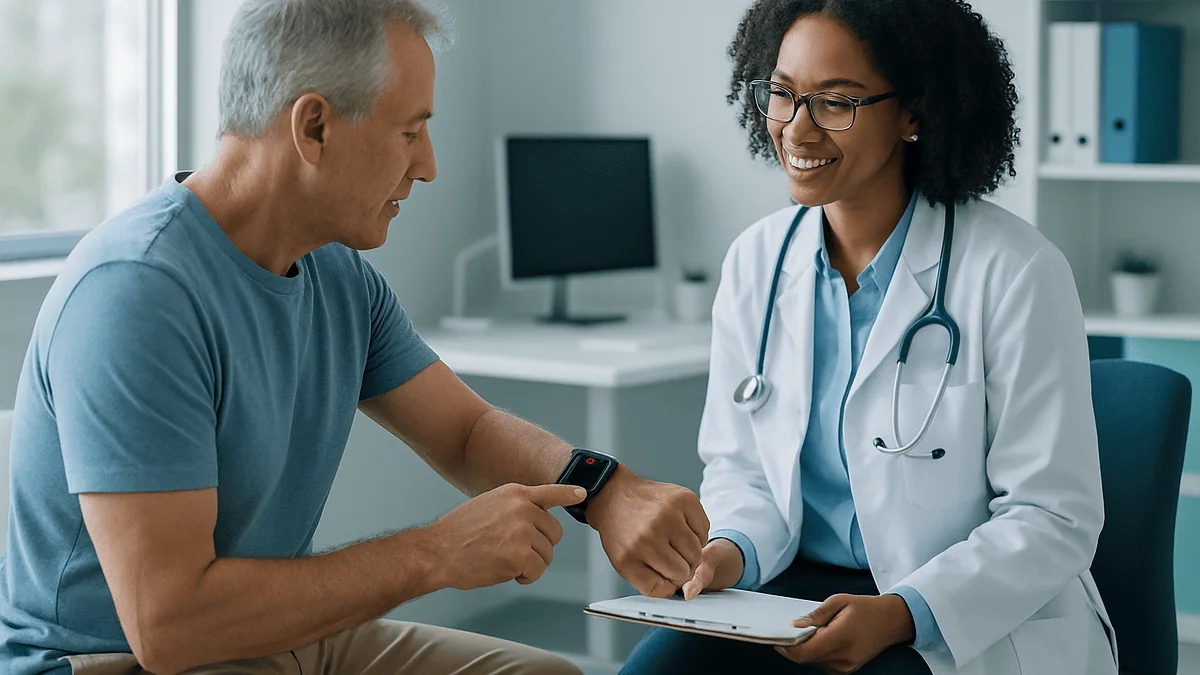
The Apple Watch ECG records a single-lead electrocardiogram from the wrist and fingertip in 30 seconds and can classify the rhythm as sinus rhythm, atrial fibrillation, or inconclusive. It is FDA cleared for adults 22 and older and performs well for atrial fibrillation in studies, but it cannot detect heart attacks, most other arrhythmias, or structural heart disease. Any alert still needs confirmation by a clinician.
Somewhere this month a person at a dinner table has pressed a fingertip against the crown of a watch, held still for half a minute, and quietly read a line that said their heart rhythm looked irregular. Then came the question everybody asks next: how much should I trust this?
As of October 2025, that question is being typed into search engines more than at any point since the feature launched. A new watch generation arrived in September, blood pressure notifications were cleared by US regulators in the same month, and the Apple Watch ECG is once again being described online as everything from a lifesaver to a gimmick. Neither label is accurate.
What the wrist can do is narrow and genuinely useful. What it cannot do is broad and often misunderstood. This explainer walks through the physics of a single-lead trace, the published evidence, the real limits, and the moment when a watch result belongs in a clinician’s hands rather than yours.
What changed recently with wrist-based heart monitoring
The timeline matters because the technology has shifted in stages, and many viral posts blur them together.
In September 2018 the US Food and Drug Administration granted De Novo authorization to two separate features: an ECG app that records a single-lead electrocardiogram, and an irregular rhythm notification that uses the optical sensor to flag pulse patterns suggestive of atrial fibrillation. Both were classified as low to moderate risk devices for adults 22 and older.
In November 2019 the Apple Heart Study was published in the New England Journal of Medicine and indexed on PubMed. It enrolled 419,297 people and remains the largest prospective dataset on wrist-based rhythm screening. Its headline numbers appear later in this article.
In 2022 a third feature, AFib History, was cleared for people who already carry a diagnosis of atrial fibrillation. It estimates how often the rhythm is present over a week rather than raising alarms. In 2024 the FDA qualified that feature as a Medical Device Development Tool, meaning researchers can use it as an endpoint in clinical trials, a notable vote of confidence in the data quality.
The 2023 atrial fibrillation guideline from the American Heart Association and the American College of Cardiology acknowledged consumer wearables as a reasonable way to detect possible atrial fibrillation, while stressing that a clinical electrocardiogram must confirm the diagnosis.
September 2025 brought the newest watch generation and FDA clearance of hypertension notifications, a feature unrelated to ECG but one that renewed public interest in what a wrist sensor can honestly measure. The ECG function itself did not change in any fundamental way. The electrodes, the single lead and the 30-second recording are the same as in 2018.
How does the Apple Watch ECG actually work?
An electrocardiogram, usually shortened to ECG or EKG, is a recording of the tiny electrical signals your heart produces each time it beats. Those signals travel through body fluids to the skin, where electrodes pick them up as voltage changes of about one thousandth of a volt.

The Apple Watch ECG uses two electrodes. One is built into the back crystal that rests on your wrist. The other is the digital crown, the small dial on the side. When you touch the crown with a finger of the opposite hand, you complete a circuit that runs from one arm, across the chest, to the other arm. In clinical terms that path is Lead I, the same arm-to-arm view a hospital machine records as one of its twelve.
The watch samples that signal for 30 seconds, filters out muscle noise and movement, and then runs a classification algorithm. The algorithm looks for two things above all: whether beats arrive at regular intervals, and whether a P wave, the small bump that represents the upper chambers contracting in an organized way, is present before each larger spike.
In atrial fibrillation the upper chambers quiver chaotically instead of contracting, so the P wave disappears and beat-to-beat timing becomes irregular. That pattern is distinctive enough to be caught from a single lead, which is exactly why the feature was designed around this one rhythm.
The resulting waveform is saved to the Health app as a PDF that can be shared with a clinician. The trace is a real ECG, not a simulation. The limitation is not its authenticity but its narrowness: one electrical viewpoint, 30 seconds long, interpreted by software trained for a single question.
What does single-lead mean, and why does the number of leads matter?
A lead in cardiology is not a wire. It is a viewpoint, the electrical difference measured between two points on the body. A standard hospital electrocardiogram uses ten stick-on electrodes to generate twelve leads, each looking at the heart from a different angle, rather like twelve cameras around a stadium.
Six of those leads look at the heart in the frontal plane, from the limbs. Six more sit across the chest and look at it horizontally, from front to back. Together they let a clinician localize problems to specific regions: the front wall, the side wall, the underside, the right ventricle.
Lead I, the one a wrist device records, is a single camera positioned to the patient’s left. It is excellent for judging rhythm because timing is the same from every angle: if beats are irregular, they are irregular in every lead. It is poor for judging damage, because a problem on the underside of the heart may barely register from the side.
Think of listening to an orchestra through one microphone placed in the balcony. You can tell whether the musicians are playing in time. You cannot reliably tell which violinist is out of tune.
Amplitude adds another limitation. Voltage measured between two arms is smaller and noisier than voltage measured directly over the chest, so subtle changes in the shape of the waveform are harder to trust. Mayo Clinic describes the standard test as the way clinicians check for prior heart attacks, chamber enlargement and blocked arteries, tasks that depend on comparing many leads at once. A single lead was never built for that job, and the makers of wrist devices do not claim it was.
Does the Apple Watch tell ECG results, and what do the screens mean?
Yes, the Apple Watch ECG gives you a result immediately, and the wording of each result is more carefully chosen than it may appear.
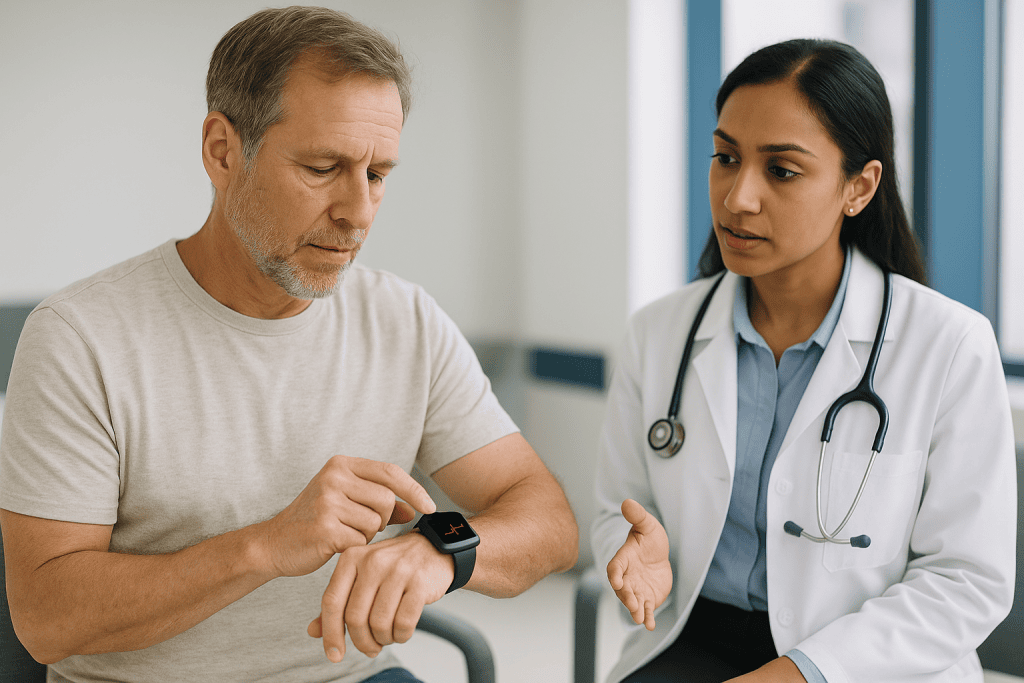
Sinus rhythm means the recording showed a regular rhythm between 50 and 100 beats per minute with the expected pattern. It does not mean your heart is healthy in every respect. It means that, during those 30 seconds, no atrial fibrillation was seen.
Atrial fibrillation means the software detected an irregular rhythm with features of the condition. Newer software versions report this for heart rates between 50 and 150 beats per minute. This result is a strong signal, not a diagnosis.
Low or high heart rate appears when the rate falls below 50 or rises above 120 (or 150 in later versions). Below or above those thresholds the algorithm cannot reliably assess rhythm, so it declines to classify. A high rate after climbing stairs is expected; the same rate at rest deserves attention.
Inconclusive means the recording was clean enough to analyze but did not fit any category. This happens with certain pacemakers, some other arrhythmias, and occasionally with perfectly healthy hearts that have an unusual but harmless pattern.
Poor recording means the signal was too noisy to interpret, usually from movement, a loose band, dry skin, or resting the arm on a surface that vibrates.
Each result includes the waveform itself, and that image is often more valuable to a clinician than the label. Someone trained to read electrocardiograms can see things the algorithm was never asked to look for, which is one good reason to save and share the trace rather than only reporting the word on the screen.
Apple Watch AFib alerts versus the ECG app: two different tools
Much confusion about Apple Watch AFib detection comes from treating two features as one. They use different sensors, answer different questions and carry different error rates.
The irregular rhythm notification works in the background. It relies on photoplethysmography, a technique in which green LEDs shine into the skin and a light sensor measures how blood volume in the capillaries changes with each pulse. From that pulse pattern the software estimates beat-to-beat intervals, usually when you are still, often during sleep. If it sees enough irregular intervals across several checks over a period of hours, it sends a notification suggesting you record an ECG.
That optical method sees the pulse, not the heart’s electricity. It is good at spotting irregularity but cannot see P waves, so it cannot distinguish atrial fibrillation from other causes of an irregular pulse such as frequent extra beats.
The ECG app is the confirmation step. You trigger it deliberately, it reads actual electrical signals, and it looks for the specific electrical signature of atrial fibrillation. In the intended workflow the optical sensor casts a wide net, and the electrical sensor sorts what it caught.
The third feature, AFib History, is only for people with an existing diagnosis. It uses the optical sensor to estimate the percentage of time the rhythm is present each week, a figure clinicians sometimes call burden. It does not send alarm-style alerts, because for someone already diagnosed, the fact of atrial fibrillation is not news; the trend over time is.
Knowing which feature produced a message changes how to interpret it. A background notification is a prompt to check. An ECG result is evidence to share. A weekly history is context for a conversation already under way.
What the evidence actually says about wrist ECG accuracy
Evidence quality deserves plain labels, so here they are.
Manufacturer validation studies (moderate strength, not independent). Before clearance, the ECG app was tested against a 12-lead electrocardiogram in several hundred adults. Among recordings the software could classify, it identified atrial fibrillation in about 98 percent of people who had it (sensitivity) and correctly labeled sinus rhythm in more than 99 percent who did not (specificity). Those figures exclude inconclusive and unreadable traces, which is a meaningful caveat.
The Apple Heart Study (strong for what it measured, but observational and single-arm). Published in 2019 and listed on PubMed, it followed 419,297 adults. Only 2,161, about 0.52 percent, received an irregular rhythm notification over roughly eight months. Among people over 65 the rate was about 3 percent; among those under 40, about 0.16 percent. Of participants who wore a follow-up chest patch for a week, 34 percent were found to have atrial fibrillation. When a notification coincided with the patch recording, the positive predictive value was 0.84, meaning 84 percent of simultaneous alerts matched true atrial fibrillation. There was no control group and no measurement of whether detection improved health outcomes.
Independent hospital studies (smaller, mixed settings). Studies in cardiology wards and clinics have generally confirmed high sensitivity and specificity for classifiable traces while reporting higher rates of inconclusive results, sometimes one recording in five, especially in older patients with other heart conditions.
Outcome data (absent). No randomized trial has yet shown that wrist-based screening reduces stroke or death. Large trials of screening with other devices have produced mixed results. The honest summary: the technology detects atrial fibrillation accurately when it produces a verdict; whether finding it this way helps people live longer is still an open question that guideline writers flag as unresolved.
Comparison table: what each kind of heart recording can and cannot detect
The table below sets the wrist device alongside the tests a clinician would order. It summarizes general capability as described by Mayo Clinic, MedlinePlus and published device labeling, not guaranteed performance in any individual.
| Capability | Optical pulse sensor (irregular rhythm notification) | Single-lead watch ECG | 12-lead clinical ECG | Holter or patch monitor (24 hours to 14 days) |
|---|---|---|---|---|
| Detect atrial fibrillation during the recording | Suggestive only | Yes, with high accuracy when classifiable | Yes | Yes, including brief episodes |
| Catch episodes that come and go | Yes, passively over days | Only if you record during one | Only if present during the 10-second test | Yes, this is its purpose |
| Identify a heart attack in progress | No | No | Yes, often | Not designed for it |
| Diagnose heart block or other conduction problems | No | Not reliably; may read inconclusive | Yes | Yes |
| Measure chamber enlargement or strain | No | No | Partly | No |
| Requires clinician interpretation | Yes, for any next step | Yes, to confirm | Always | Always |
Two points stand out. The wrist sensor’s genuine advantage is time: it is present at three in the morning when a clinic is closed and a brief episode would otherwise go unrecorded. Its genuine weakness is breadth: nearly every row other than atrial fibrillation reads no or not reliably.
That shape explains why clinicians tend to welcome a saved trace and simultaneously order a proper electrocardiogram. The two are not competitors. One raises the question; the other answers it.
What a single-lead trace cannot detect, and why that matters
The list of things a wrist ECG cannot tell you is long, and the most important item on it is a heart attack.
A heart attack occurs when blood flow to part of the heart muscle is blocked. On a 12-lead electrocardiogram this often shows as a shift in the ST segment, the flat stretch after the main spike, in the leads that face the injured region. Because Lead I faces only the left side, it can miss changes that are obvious in chest or inferior leads. The device labeling states plainly that the feature does not look for signs of a heart attack. A sinus rhythm result during chest pain is not reassurance.
Other rhythm problems also escape it. Heart block, in which signals from the upper chambers are delayed or dropped, requires measuring the relationship between P waves and the larger QRS complex with a precision one noisy lead rarely allows. Ventricular tachycardia, a dangerous fast rhythm from the lower chambers, typically pushes the heart rate above the range the algorithm will classify, so the result may simply read high heart rate. Supraventricular tachycardia tends to be regular, so it does not trigger an atrial fibrillation flag at all.
Structural problems are invisible. An electrocardiogram of any kind cannot see valve disease, weakened pumping or fluid around the heart; those need an echocardiogram, an ultrasound of the heart.
Then there is the problem of timing. Atrial fibrillation is frequently intermittent, especially early on. A normal 30-second recording proves only that the rhythm was normal for those 30 seconds. According to the NHS, episodes can last minutes or days and may produce no symptoms. Absence of evidence on a watch is not evidence of absence in the heart.
Is the Apple Watch ECG FDA approved?
The precise answer is that the Apple Watch ECG is FDA cleared, not FDA approved, and the distinction is more than semantics.
The FDA sorts medical devices into three classes by risk. Class III devices, such as implanted pacemakers, must go through premarket approval with extensive clinical trial data. Lower-risk devices are cleared or authorized through lighter pathways. The ECG app and the irregular rhythm notification received De Novo authorization in 2018 as Class II devices, meaning the agency agreed they were reasonably safe and effective for a defined use, with specific controls and labeling limits.
Those limits are part of the authorization. The features are intended for adults 22 and older. The irregular rhythm notification is not intended for people who already have a diagnosis of atrial fibrillation; that group is directed to the separate AFib History feature. None of the features are intended to replace traditional diagnosis, and none are intended for people who feel unwell to decide whether to seek care.
Why 22? Validation data were collected in adults, and younger people have a very low baseline rate of atrial fibrillation, so the balance of true alerts to false ones would be unfavorable. The algorithm has not been validated in pediatric or adolescent hearts.
Regulatory status also varies by country. The feature is marked under European medical device rules and has been authorized in dozens of other jurisdictions, but availability depends on local review, which is why the app is absent in some regions.
Clearance confirms that the device does what its label says. It does not elevate the result to a diagnosis, and it does not change the fact that treatment decisions, including whether any medicine is needed, rest with a clinician who has examined you and reviewed a full electrocardiogram.
Why false alarms and inconclusive readings happen
Every screening tool produces false positives, false negatives and unreadable results. Understanding the mechanisms behind each makes a watch result far easier to interpret calmly.
False positives from extra beats. Premature atrial or ventricular contractions, the skipped-beat sensation most adults feel occasionally, make the pulse irregular. The optical sensor cannot tell this from atrial fibrillation, so frequent extra beats are a common cause of background notifications that a subsequent ECG labels sinus rhythm or inconclusive.
Motion and contact noise. Muscle electrical activity is far larger than heart signal at the wrist. Talking, tensing the forearm, or holding the arm unsupported during the 30 seconds adds noise the filter cannot fully remove. Dry skin, a loose band, lotion or a tattoo over the sensor area all degrade the signal.
Heart rate outside the window. Below 50 or above the upper threshold the algorithm refuses to classify, which can look like a failure but is by design: at very fast rates the P wave merges with the previous beat and cannot be assessed.
Pacemakers and implanted devices. Paced rhythms produce waveforms the software was not trained on, and the result is usually inconclusive. People with these devices already have monitoring through their cardiology team.
Low-amplitude signals. Some people, including those with larger body habitus or certain lung conditions, naturally produce smaller arm-to-arm voltages, pushing recordings toward poor recording results.
The Apple Heart Study put the false-positive question in context: about one in six notified participants who wore a patch did not show atrial fibrillation, though some may have had episodes outside the patch window. For the ECG app specifically, false positives are rarer than inconclusive results. A single unexpected result is a reason to repeat the recording after sitting still for a minute, then to share the trace, not a reason to panic or to dismiss it.
Who benefits most from Apple Watch AFib detection, and who may worry needlessly?
The value of any screening test depends on how common the condition is in the person being tested. That principle, more than any feature of the hardware, decides who gains from wrist-based rhythm checks.
Atrial fibrillation becomes steadily more common with age. The CDC estimates that more than 12 million people in the United States will have it by 2030, and the American Heart Association notes that it raises stroke risk roughly fivefold. Many cases produce no noticeable symptoms, so a device worn around the clock has a real chance of catching something a yearly checkup would miss. The Apple Heart Study found notification rates about twenty times higher in people over 65 than in those under 40, which is exactly what you would expect.
People most likely to benefit, then, are older adults and those with conditions that raise atrial fibrillation risk: high blood pressure, diabetes, heart failure, sleep apnea, prior stroke or a strong family history. For them a confirmed finding can open a conversation about stroke prevention that would otherwise have waited for a symptom.
People with a confirmed diagnosis may find AFib History useful for tracking how often the rhythm appears, information cardiologists increasingly use when discussing management options.
At the other end sit healthy adults in their twenties and thirties with no risk factors. Their baseline rate is so low that most alerts they receive will turn out to be extra beats or noise, and the main consequence can be anxiety and unnecessary testing. Johns Hopkins and other centers have raised this concern about overdiagnosis in low-risk users.
Nobody should feel pressured to wear a sensor to be responsible about heart health. Blood pressure control, physical activity, moderate alcohol intake and not smoking do more to prevent atrial fibrillation than any wearable does to detect it.
Is it worth having ECG on a watch? An evidence-based opinion
Here is a view, held loosely and grounded in the data above.
For an adult over about 60, or anyone with risk factors for atrial fibrillation, a wrist ECG is worth having if, and only if, they understand what it is for. Used as a confirmation tool when something feels off, or as a way to capture an episode that a clinic visit would miss, it adds information that genuinely changes conversations with clinicians. Cardiologists routinely see patients whose saved traces shortened the path to a diagnosis that would otherwise have required weeks of ambulatory monitoring.
For a healthy younger adult, the feature is closer to a curiosity. It will almost always say sinus rhythm, and when it does not, the odds favor a benign explanation. That is not a reason to avoid it, but it is a reason not to treat it as a health plan.
What the feature is not worth is false confidence. The scenario that worries clinicians most is a person with chest pressure who records a normal trace and decides to wait until morning. No wrist device has ever been designed to make that call, and its makers say so. Chest symptoms are a reason to seek care regardless of what any watch displays.
Worth also depends on follow-through. A notification that is screenshotted and forgotten has done nothing. Value appears only when the trace reaches someone qualified to act on it, who then decides whether a 12-lead electrocardiogram, a longer monitor, or simple reassurance is the right next step.
So the honest answer to the search query is: worth it for the right person, for the right question, with the right expectations. That is a narrower endorsement than the marketing and a broader one than the skeptics allow, and it matches what the evidence supports.
Common myths about the Apple Watch ECG, corrected
Several claims circulate widely enough to deserve direct answers.
Myth: the watch can detect a heart attack. It cannot, and its labeling says so. Heart attack signs on an electrocardiogram usually require multiple leads, and the algorithm is not trained to look for them. A normal result during chest pain means nothing about blood flow to the heart muscle.
Myth: a sinus rhythm result means my heart is healthy. It means no atrial fibrillation was seen during 30 seconds. Valve disease, blocked arteries, weak pumping and intermittent arrhythmias can all coexist with a normal single-lead trace.
Myth: the ECG is just a fancy pulse reader. The ECG app records genuine electrical signals through two electrodes. The background notification, by contrast, does read the pulse optically. People often conflate the two.
Myth: an atrial fibrillation result is a diagnosis. It is a strong indication that needs confirmation by a clinician reviewing a standard electrocardiogram. Treatment decisions are never made from a watch reading alone.
Myth: there is a free app that turns an iPhone into an ECG. A phone has no electrodes. Camera-based apps estimate pulse rate by watching color changes in a fingertip, which is photoplethysmography, not electrocardiography. Some can suggest irregularity, but none record the heart’s electricity, and most lack regulatory clearance.
Myth: the feature is not accurate because studies show lots of inconclusive results. Inconclusive is not inaccurate. The algorithm is designed to decline rather than guess. Among traces it does classify, agreement with a 12-lead electrocardiogram is high.
Myth: it works for anyone who can wear a watch. It is cleared for adults 22 and older, has not been validated in children, and is not intended for people with pacemakers or those who already have a diagnosis of atrial fibrillation to use as an alert system.
When to see a doctor about a watch ECG or an AFib alert
A wrist device can start a conversation. It can never finish one. These are the moments when the result should move from your screen to a clinician, and the ones when you should not wait for an appointment at all.
Call emergency services immediately, regardless of any watch reading, if you have:
- Chest pain, pressure, tightness or squeezing, especially with sweating, nausea, or pain spreading to the arm, jaw or back
- Sudden shortness of breath at rest
- Fainting or near-fainting, particularly with a fast or irregular heartbeat
- Signs of stroke: facial drooping, arm weakness, slurred or confused speech, sudden vision loss or severe headache
- A sustained very fast heartbeat with dizziness, confusion or difficulty breathing
Arrange a prompt appointment, within days, if:
- You receive an atrial fibrillation result on the ECG app, even once, and you have not been diagnosed before
- You receive repeated irregular rhythm notifications
- You get recurrent inconclusive results alongside palpitations, fatigue or reduced exercise tolerance
- Your resting heart rate is persistently below 50 or above 100 without an obvious explanation
Mention it at a routine visit if: you have had a single irregular rhythm notification followed by normal ECG recordings and no symptoms. Bring the saved PDF traces; they are far more useful than a verbal description.
If you already take medicine for a heart rhythm or for stroke prevention, do not change, skip or stop any of it because of a watch reading. A normal trace does not mean the medicine is unnecessary, and an abnormal one does not mean it has failed. Both are questions for the clinician who prescribed it.
Finally, if a result frightens you and you cannot reach your usual clinician, nurse advice lines and urgent care services exist for exactly this kind of uncertainty. Uncertainty is a legitimate reason to ask.
Frequently asked questions
Does the Apple Watch tell ECG results right away?
Yes. After a 30-second recording the watch displays one of several results: sinus rhythm, atrial fibrillation, low or high heart rate, inconclusive, or poor recording. The waveform is saved to the Health app as a PDF you can share. The result is a classification, not a diagnosis, and any atrial fibrillation reading should be confirmed by a clinician with a standard electrocardiogram.
Is the Apple Watch ECG FDA approved?
It is FDA cleared, not FDA approved. The ECG app and irregular rhythm notification received De Novo authorization in 2018 as lower-risk Class II devices for adults 22 and older. Approval is a stricter pathway reserved for high-risk devices such as implants. Clearance confirms the device performs as labeled; it does not make a watch result equivalent to a clinical diagnosis.
Is there a free ECG app for iPhone?
No phone app can record a true electrocardiogram, because a phone has no electrodes to measure the heart’s electrical signals. Camera-based apps estimate pulse rate from color changes in a fingertip, a technique called photoplethysmography. Some suggest rhythm irregularity, but they are not electrocardiograms, and most lack regulatory clearance. A genuine ECG requires skin electrodes, whether on a watch or in a clinic.
Is it worth having ECG on a watch?
For adults over about 60 or anyone with atrial fibrillation risk factors, a wrist ECG can be worthwhile as a way to capture episodes a clinic visit would miss and to confirm a background alert. For healthy young adults the yield is low and false alarms are relatively more common. It is never worth relying on for chest pain or as a substitute for medical evaluation.
How accurate is Apple Watch AFib detection?
For recordings it can classify, the ECG app showed about 98 percent sensitivity and over 99 percent specificity for atrial fibrillation in validation testing against a 12-lead electrocardiogram. The background irregular rhythm notification had a positive predictive value of 0.84 in the Apple Heart Study when compared with a simultaneous chest patch. Inconclusive readings are the main limitation, especially in older adults with other heart conditions.
Can the Apple Watch ECG detect a heart attack?
No. A heart attack typically shows on an electrocardiogram as changes across several leads facing the injured area, and the watch records only one lead and is not programmed to look for those changes. Its labeling states this clearly. Chest pain, pressure or shortness of breath is a reason to call emergency services immediately, whatever the watch displays.
Why does my Apple Watch ECG say inconclusive?
Inconclusive means the recording was readable but did not match sinus rhythm or atrial fibrillation. Common causes include a heart rate outside the classifiable range, a pacemaker, frequent extra beats, or other rhythm patterns the algorithm was not trained on. Occasionally healthy hearts produce unusual but harmless traces. Repeated inconclusive results, particularly with symptoms, are worth showing a clinician.
What is the difference between the ECG app and the irregular rhythm notification?
The irregular rhythm notification runs in the background using the optical pulse sensor and flags pulse patterns that might indicate atrial fibrillation. The ECG app is started manually and records actual electrical signals through two electrodes to classify the rhythm. The notification casts a wide net; the ECG is the confirmation step. Both results still require clinical confirmation before any treatment decision.
Can I use the Apple Watch ECG if I already have atrial fibrillation?
The ECG app can still be used, but the irregular rhythm notification is not intended for people with an existing diagnosis. Instead, a feature called AFib History estimates how often the rhythm is present each week. Never adjust or stop any prescribed rhythm or stroke-prevention medicine based on watch readings; share the data with the clinician managing your care.
What should I do after an Apple Watch AFib alert?
Sit still, rest your arm on a surface, and record an ECG. If the result shows atrial fibrillation, or alerts keep recurring, arrange a prompt appointment and bring the saved PDF traces. Seek emergency care immediately if you also have chest pain, fainting, severe breathlessness, or stroke symptoms such as facial drooping or slurred speech. A single alert followed by normal recordings can be raised at a routine visit.
References
This article is for general information only and is not a substitute for professional medical advice. Please consult a qualified doctor about your individual situation.

More from the Blog

AI in Healthcare: What It Already Does in Hospitals, and Where It Falls Short
AI in healthcare currently helps hospitals read medical images, flag patients at risk of deterioration such as sepsis, draft clinical notes from recorded visits,…

Home Blood Pressure Monitors: Wrist vs Arm and How to Take a Reading That Counts
For most adults, the best home blood pressure monitor is an automatic upper-arm cuff that has passed independent validation testing and fits your arm…
Telehealth: What Can Be Diagnosed on a Video Call and What Cannot
Telehealth can reliably assess conditions a clinician diagnoses mostly by history and by looking: many rashes, mental health concerns, medication follow-ups, chronic disease check-ins…

Recovering from Radiotherapy: How Long Until You Feel Better
Most people start to feel noticeably better within a few weeks of their last radiotherapy session, although side effects such as fatigue and skin…

Patient Portals: How to Read Your Own Lab Results Without Panicking
A patient portal is the secure website or app your health system uses to show you appointments, messages, and test results, and since 2021…

Over-the-Counter CGMs: What Glucose Data Means for People Without Diabetes
Over-the-counter continuous glucose monitors such as Stelo and Lingo show adults without diabetes how blood sugar rises and falls through the day. For most…