

Apple Watch Sleep Apnea Notifications: How the Feature Works and What to Do After One
Key Takeaways
- The Apple Watch sleep apnea feature uses the motion sensor, not the blood oxygen sensor, and needs at least ten nights of sleep data within thirty days before it evaluates anything.
- In the manufacturer's validation submitted to the FDA in September 2024, the feature identified roughly two in three adults with moderate-to-severe apnea and produced false alarms in under five percent of people without it.
- A notification signals a pattern consistent with fifteen or more breathing events per hour, the moderate-to-severe range; it cannot detect mild apnea, count events, or distinguish obstructive from central types.
- The 3 percent and 4 percent rules are laboratory scoring criteria for how much oxygen must fall to count a hypopnea, and the same night can yield two different severity grades depending on which is applied.
- A home sleep apnea test measures airflow, effort and oxygen but not confirmed sleep time, so it can under-count events, and a mild result with heavy symptoms is a reason to move to an in-lab study.
- As of September 2026, no third-party watch app has published regulatory-reviewed accuracy data for detecting sleep apnea, and none should be used to decide against formal testing.
Apple Watch sleep apnea notifications use the watch's motion sensor to track small wrist movements linked to interrupted breathing during sleep, then flag a possible pattern of moderate-to-severe sleep apnea if it appears repeatedly over at least ten nights in a month. The alert is a screening signal, not a diagnosis. The right next step is a clinician visit and, usually, a formal sleep test.
A friend texted me a screenshot last week. Above the blue graph in her Health app sat three words she hadn’t expected from a wristwatch: Possible Sleep Apnea. She had slept fine, she thought. Her husband, reading over her shoulder, said nothing for a moment and then admitted he had been nudging her awake for years.
That kind of conversation is happening in a lot of bedrooms. As of September 2026, two full years after US regulators authorized the feature in September 2024, the annual autumn watch-and-software cycle has pushed a fresh wave of these screenshots onto social feeds, alongside viral claims that the apple watch sleep apnea alert is either a life-saver or a gimmick that scares healthy sleepers.
Both stories miss the point. The feature is a screening tool with published, specific performance numbers, a narrow job description, and a clear hand-off to a clinician. What follows is how it works, what the evidence supports, and what to do the morning after your watch taps you on the wrist.
What changed recently with apple watch sleep apnea notifications
The timeline matters, because much of the confusion online comes from mixing up three separate events.
In September 2024, the US Food and Drug Administration authorized the Sleep Apnea Notification Feature through its De Novo pathway, the route used for lower-risk devices that have no existing predecessor to compare against. That authorization defined the feature as software intended to identify signs of moderate-to-severe sleep apnea in adults who have not already been diagnosed. It did not authorize the watch to diagnose, stage or rule out the condition.
The same month, the feature shipped with the autumn software update to the then-current and one-generation-older watch models. The user-facing pieces were new: a nightly Breathing Disturbances reading filed under respiratory metrics, a monthly evaluation, and a notification that appears only when a pattern persists.
Since then, the evidence base that most readers actually care about has not changed as fast as the marketing cycle. The definitions of sleep apnea severity, the scoring rules used in sleep laboratories, and the treatment pathways summarized by the National Heart, Lung, and Blood Institute and Mayo Clinic are the same in September 2026 as they were before the watch feature existed. A wrist sensor changed how some people first hear about the problem; it did not change what the problem is or how it is confirmed.
Why the current surge? Two years is long enough for tens of millions of owners to have worn the watch overnight, and the feature evaluates roughly once a month. Each cycle produces a new batch of people who wake to a notification, search their symptoms, and post the result. Add the autumn hardware announcements that always renew attention on health sensors, and you have a topic that trends every September without a single new trial or guideline behind it. Understanding that keeps the rest of this piece grounded: the useful facts are stable, and the noise is seasonal.
How does the Apple Watch detect breathing disturbances while you sleep?
Here is the part most explainers skip: this feature does not use the blood oxygen sensor at all. It relies on the accelerometer, the same motion chip that counts steps, tuned to pick up movements far smaller than a step.
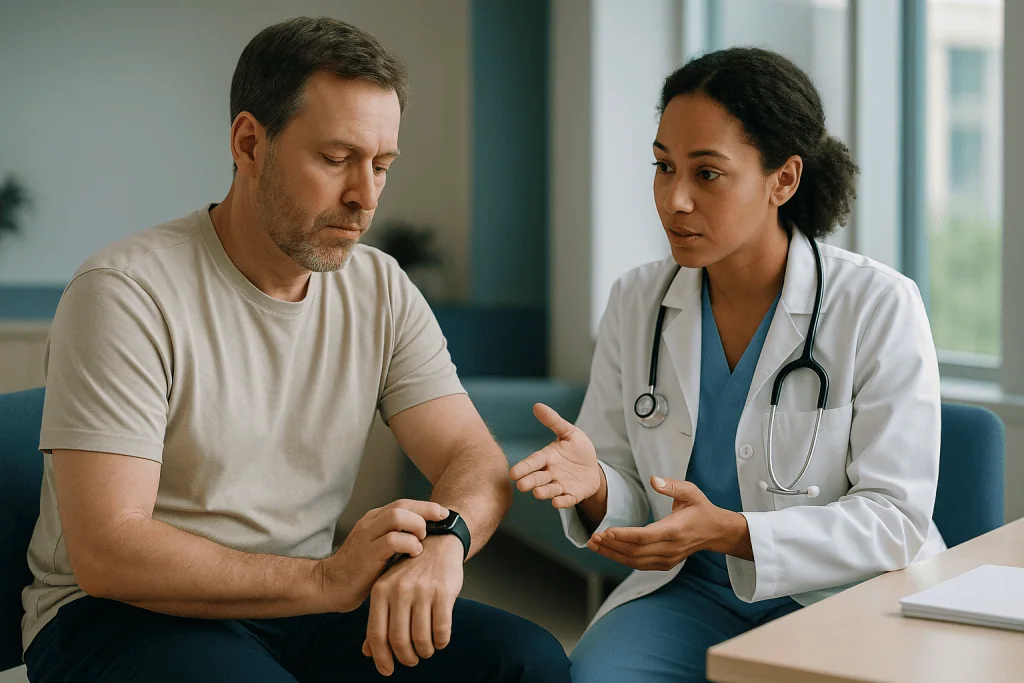
When your airway narrows or closes during sleep, breathing does not stop silently. The chest and diaphragm keep working against the blockage, the body briefly rouses, and the arm resting on the mattress shifts by fractions of a millimeter in a characteristic rhythm. Normal, uninterrupted breathing produces a smooth, low-amplitude wave at the wrist. Disturbed breathing produces pauses, recoveries and micro-arousals that break that wave.
The software translates a night of that motion into a single reading called Breathing Disturbances, and labels it either Elevated or Not Elevated. The label is relative to a threshold the manufacturer set during development, when the algorithm was trained on nights of wrist data collected alongside polysomnography, the overnight laboratory sleep study that records brain waves, airflow, oxygen and muscle activity at once and remains the reference standard.
Three practical consequences follow from this design.
- You must actually wear the watch to bed, with sleep tracking enabled, for the data to exist. A watch charging on the nightstand records nothing.
- Motion is a proxy, not a direct measurement of airflow or oxygen. Anything else that jostles the wrist in a repeating pattern, from a restless partner to a dog on the bed, adds noise the algorithm has to filter.
- The feature deliberately looks for a pattern, not a bad night. A single Elevated reading after a late flight or a few drinks is expected and, on its own, is not what triggers the alert.
Think of it less like a smoke detector and more like a rain gauge checked once a month: it is asking whether a lot of water has fallen consistently, not whether one cloud passed overhead.
What does an Elevated Breathing Disturbances reading actually mean?
Open the respiratory section of the Health app and you will see nights marked Elevated or Not Elevated. People understandably read Elevated as bad news. In isolation, it is closer to weather than to diagnosis.
Breathing varies from night to night for reasons that have nothing to do with sleep apnea. Alcohol relaxes the throat muscles and increases snoring and pauses for a few hours. Nasal congestion from a cold forces mouth breathing and changes airway dynamics. Sleeping flat on your back lets the tongue fall backward. A late, heavy meal, a sedating medicine, or simply a different mattress on holiday can all shift a single night into the Elevated column.
The algorithm was built with that variability in mind. According to the manufacturer’s public description of the feature, the monthly evaluation requires at least ten nights of usable sleep data within a thirty-day window before it will judge anything, and it issues a notification only when a consistent pattern of Elevated nights points toward moderate-to-severe apnea. Scattered Elevated readings mixed with Not Elevated nights will not, by design, generate an alert.
So how should you read the nightly labels?
- A run of Not Elevated nights is mildly reassuring for moderate-to-severe apnea specifically, and says nothing about mild apnea or other sleep disorders.
- Occasional Elevated nights that line up with a cold, alcohol or travel are expected physiology.
- A cluster of Elevated nights without an obvious explanation is worth mentioning to a clinician even if no notification has arrived, especially alongside snoring or daytime sleepiness.
One thing the reading cannot do is tell you how many breathing events you had. It is a binary label derived from movement, not a count. The apnea-hypopnea index, the number of breathing pauses or partial pauses per hour of sleep that clinicians use to define severity, comes only from a formal test. Treat Breathing Disturbances as a trend line, not a lab value.
What does a sleep apnea notification mean, and what does it not mean?
The notification itself is brief. It tells you that, over a stated range of dates, your breathing data showed signs consistent with moderate-to-severe sleep apnea, and it encourages you to talk with a doctor. It also lets you export a summary document covering the relevant period.
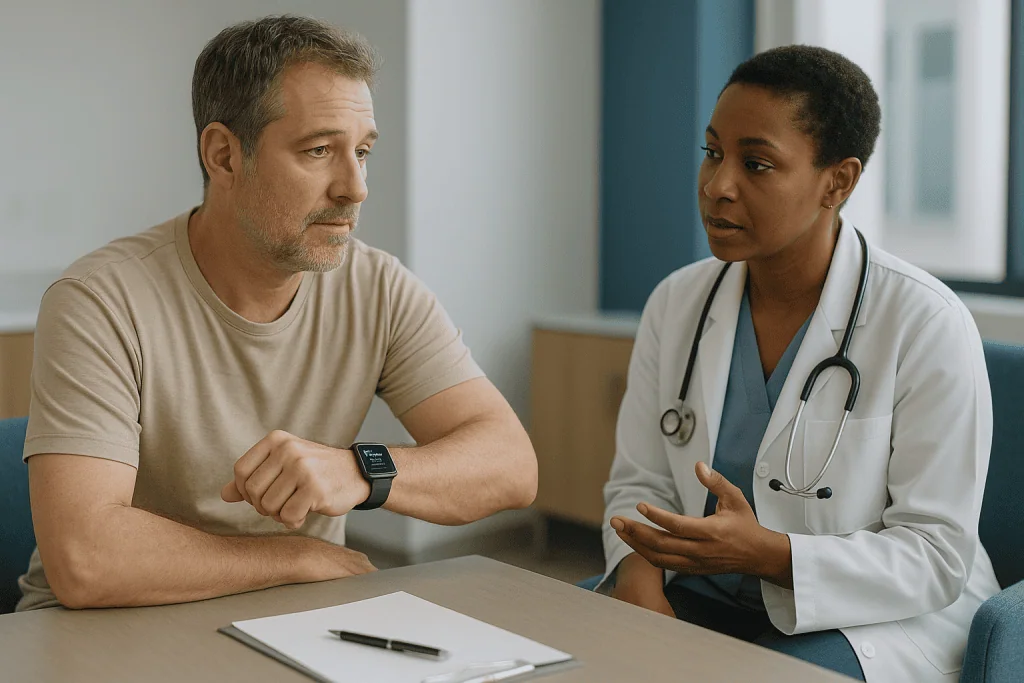
What it means, in plain terms: across at least ten nights of a month, your wrist motion looked more like the pattern seen in people who, in laboratory testing, had fifteen or more breathing events per hour than like people who did not. That is a meaningful signal. In the validation data the manufacturer submitted to regulators, the large majority of people who received a notification did have moderate-to-severe apnea when tested.
What it does not mean is equally important.
- It is not a diagnosis. Sleep apnea is diagnosed by a clinician using a sleep study, as the National Heart, Lung, and Blood Institute and NHS both describe.
- It does not tell you which type you have. Obstructive sleep apnea, caused by the airway physically collapsing, and central sleep apnea, caused by the brain failing to send steady breathing signals, look different in a lab and are managed differently.
- It does not grade severity beyond the moderate-to-severe threshold, and it cannot detect mild apnea at all.
- It does not identify other causes of poor sleep such as insomnia, restless legs or medication effects.
Equally, a notification is not a reason for alarm in the emergency sense. Sleep apnea is common, chronic and treatable. Mayo Clinic notes that treatment ranges from lifestyle changes and positional therapy to airway pressure devices and oral appliances, and that most people improve substantially once treated. The alert’s real value is that it moves a condition which is frequently missed for years onto a clinician’s desk sooner. A large share of people with sleep apnea have never been diagnosed, in part because the person who would notice the symptoms is asleep beside them.
What the evidence actually says about apple watch sleep apnea accuracy
Accuracy questions deserve numbers and a grade for how much to trust them. Let’s do both.
The core performance data come from the manufacturer’s clinical validation, in which participants wore the watch while undergoing polysomnography, and the algorithm’s output was compared with the laboratory’s apnea-hypopnea index. That dataset was submitted to the FDA as part of the September 2024 authorization. Two figures matter most.
- Sensitivity, the share of people with the condition whom the test correctly flags, was roughly two in three for moderate-to-severe apnea. Put differently, about one in three people who truly had moderate-to-severe apnea did not receive a notification.
- Specificity, the share of people without the condition whom the test correctly leaves alone, was above 95 percent. False alarms were uncommon.
Those numbers tell you the feature was tuned to avoid crying wolf. It accepts missing some true cases in exchange for rarely alarming people who are fine. That is a defensible choice for a consumer device worn by millions, but it has a consequence: silence from the watch is weak evidence of a healthy airway.
Now the grading. This is manufacturer-sponsored validation data reviewed by a regulator, which sits below independent, peer-reviewed randomized trials in the evidence hierarchy and roughly alongside good-quality observational diagnostic studies. Independent studies of wrist-worn devices for sleep apnea have been growing, and reviews of consumer wearables indexed in PubMed generally find that motion- and pulse-based screening can identify moderate-to-severe apnea with moderate sensitivity and good specificity, but that they underperform for mild disease and for central apnea. That pattern matches the manufacturer’s figures, which adds some confidence. What does not yet exist, as of September 2026, is a randomized trial showing that receiving a watch notification leads to earlier diagnosis, better treatment adherence, or fewer heart events compared with usual care. Those outcome data are the missing piece, and honest reporting should say so.
The bottom line: a notification is a strong reason to get tested; the absence of one is not a reason to skip testing if symptoms are present.
Can a smartwatch detect sleep apnea the way a sleep study can?
No, and it is not trying to. The clearest way to see the difference is to line up what each tool measures and what it can tell you.
| Method | What it measures | What it can conclude | Main limits |
|---|---|---|---|
| Wrist-worn watch notification | Wrist movement patterns linked to breathing interruptions, aggregated over about a month | Possible moderate-to-severe apnea; a signal to seek testing | Cannot diagnose, count events, detect mild or central apnea, or measure oxygen for this feature |
| Home sleep apnea test | Airflow, breathing effort, oxygen saturation and heart rate over one to a few nights, using a kit worn at home | Diagnosis of obstructive sleep apnea with an event count in many adults | Does not record sleep stages; can underestimate severity; less suitable if other sleep or heart-lung conditions are suspected |
| In-lab polysomnography | Brain waves, eye movement, muscle tone, airflow, effort, oxygen, heart rhythm and limb movement, with a technologist present | Definitive diagnosis, severity, apnea type, and detection of other sleep disorders | Requires a night away from home; limited availability in some regions |
MedlinePlus describes polysomnography as the reference test because it records the full picture of sleep at once, including whether you were actually asleep when a breathing pause occurred. A watch cannot know that with laboratory certainty; a home test cannot either, which is one reason home kits can under-count events per hour of true sleep.
None of this makes the watch useless. A test that lives on your wrist every night for years has one advantage no laboratory can match: it is there. Clinicians have long known that most people with sleep apnea are undiagnosed, and the barrier is rarely the test itself. It is the moment of recognition that something is wrong. The watch lowers that barrier. The sleep study still does the diagnosing.
What is the 3% rule for sleep apnea, and what is the 4% rule?
These two phrases show up constantly in search, usually from people who have just read a sleep report and found two different event counts. They refer to how a hypopnea is scored.
An apnea is a near-complete stop in airflow lasting at least ten seconds. A hypopnea is a partial reduction in airflow, typically a drop of about 30 percent or more for at least ten seconds, that is only counted if it causes a consequence. The debate is over which consequence counts.
- Under the 3 percent rule, a hypopnea is scored when the airflow drop is accompanied by a fall in blood oxygen saturation of at least 3 percentage points, or by an arousal, a brief shift toward wakefulness visible on brain-wave recording.
- Under the 4 percent rule, the airflow drop must be accompanied by a fall of at least 4 percentage points in oxygen saturation, and arousals alone do not count.
The 3 percent-or-arousal standard is the one recommended by the major sleep medicine scoring guidance and used by most laboratories. The stricter 4 percent standard persists because some insurers and programs historically required it to approve treatment. The same night can therefore produce two apnea-hypopnea indexes, and the 3 percent version is almost always higher, sometimes enough to move someone from mild to moderate.
Why does this matter to a watch user? The watch notification was validated against laboratory scoring for moderate-to-severe apnea, meaning fifteen or more events per hour. Which scoring rule a given laboratory uses can shift where an individual lands relative to that threshold, and it explains why two people with similar symptoms and similar watch data can receive different severity labels after testing.
Neither rule is something you can apply at home, and neither has anything to do with the watch’s Breathing Disturbances label, which does not measure oxygen. If your report lists two indexes, ask the clinician which one guided the recommendation and why. That is a reasonable question, not a challenge.
What sleep apnea is, and how severity is graded
Strip away the wearables and sleep apnea is a simple mechanical problem with wide-reaching effects. During sleep, breathing repeatedly stops or becomes shallow, oxygen dips, the brain briefly rouses to restart breathing, and sleep is fragmented dozens or hundreds of times a night. Most people have no memory of any of it.
The National Heart, Lung, and Blood Institute describes two main types. Obstructive sleep apnea, by far the more common, happens when the muscles of the throat relax and the soft tissue collapses inward, blocking the airway. Central sleep apnea happens when the brain’s breathing control briefly stops sending signals, often in people with heart failure, certain neurological conditions, or long-term use of some medicines. A mixed pattern exists too.
Severity is graded by the apnea-hypopnea index, or AHI, the average number of apneas and hypopneas per hour of sleep on a formal test.
- Fewer than 5 events per hour: within the normal range.
- 5 to 14: mild.
- 15 to 29: moderate.
- 30 or more: severe.
The watch feature was built and validated to flag the moderate and severe bands, which start at 15. That threshold was not arbitrary. Moderate-to-severe apnea is where the evidence linking untreated disease to high blood pressure, heart rhythm problems, stroke and metabolic disease is strongest, and where treatment benefit is best established.
Common symptoms, as described by Mayo Clinic and the NHS, include loud snoring, pauses in breathing noticed by a partner, gasping or choking during sleep, waking with a dry mouth or headache, getting up several times to urinate, unrefreshing sleep, daytime sleepiness, irritability and trouble concentrating. Risk rises with excess body weight, a larger neck circumference, a narrow airway, older age, male sex, a family history, smoking, alcohol or sedative use near bedtime, and chronic nasal congestion. None of these is destiny. Plenty of slim, young, non-snoring people have significant apnea, which is exactly why a passive screen that works on everyone wearing it has appeal.
Who the feature is not designed for, and why no notification is not a clean bill of health
Every screening tool has a population it was built for. Wander outside it and the numbers stop applying.
The feature is intended for adults aged 18 and over who have not been diagnosed with sleep apnea. If you already carry a diagnosis, the watch is not a monitoring tool for your treatment, and an Elevated or Not Elevated night should not change how you use your prescribed therapy. That decision belongs with the clinician managing your care.
Several groups should read the watch’s silence with particular caution.
- People with likely mild apnea. The algorithm was not tuned to catch fewer than fifteen events per hour, and mild apnea with heavy symptoms still deserves evaluation.
- People at risk of central sleep apnea, including those with heart failure or certain neurological conditions. Central events produce a different movement signature and the feature was validated mainly against obstructive disease.
- People who sleep with the watch loose, wear it on the non-dominant wrist inconsistently, or often skip nights. Ten qualifying nights a month is the floor; fewer than that and no evaluation occurs at all.
- People whose bed partner, child or pet moves a great deal. Shared motion is noise.
- People who are pregnant, or who have significant tremor or movement disorders, for whom the validation data are limited.
Remember the sensitivity figure: roughly one in three people with true moderate-to-severe apnea did not get a notification in validation testing. That is not a flaw hidden in fine print; it is the trade-off that keeps false alarms rare. It does mean that the sentence my watch would have told me is not medical reassurance.
If you snore loudly, a partner has seen you stop breathing, you fall asleep unintentionally during the day, or you wake with headaches or a racing heart, the presence or absence of a watch alert is beside the point. Those symptoms alone justify a conversation with a clinician, and both the NHS and Mayo Clinic list them as reasons to seek evaluation.
What to do after an Apple Watch sleep apnea notification: a calm, practical sequence
The morning my friend got her alert, she did two sensible things and one unhelpful one. She screenshotted the notification, she asked her husband what he had noticed, and then she spent forty minutes reading forum posts that made her feel worse. Skip the third step and follow the first two.
A reasonable sequence looks like this.
- Export the summary. The notification offers a document covering the relevant nights. Save it where you can find it, because a clinician will want dates and the pattern, not a verbal description.
- Gather witness testimony. Ask anyone who shares your room about snoring volume, pauses, gasps or restless movement. Their account carries real weight in a clinical assessment.
- Write down your own symptoms for a week or two. Morning headaches, dry mouth, night-time trips to the bathroom, dozing while reading or watching television, mood changes, and difficulty concentrating are all relevant. Note your typical bedtime, wake time and alcohol use.
- List your health history. High blood pressure, atrial fibrillation, type 2 diabetes, a prior stroke, and any heart or lung disease change how a clinician will think about testing.
- Book a visit with your primary care clinician. You do not need a specialist referral to start. Many primary care practices can order a home sleep apnea test directly or refer to sleep medicine when an in-lab study is more appropriate.
- Keep wearing the watch. Continued data adds context, though it should not delay the appointment.
What not to do matters just as much. Do not stop, start or adjust any prescribed medicine on the basis of a watch alert; some medicines affect breathing during sleep, and only the prescriber can weigh that. Do not buy an airway pressure machine or mouth device online without a diagnosis; fitting and pressure settings are clinical decisions. Do not drive when drowsy while you wait for testing, and tell your clinician if sleepiness behind the wheel has ever happened.
Most people who follow this sequence have an answer within weeks, and the answer, when apnea is confirmed, usually comes with an effective plan.
What is a home sleep apnea test, and will you need an in-lab study instead?
For most otherwise healthy adults whose main question is whether they have obstructive sleep apnea, the next step after a watch alert is a home sleep apnea test. It is far less involved than people fear.
A home kit typically includes a small recorder worn on the chest or wrist, a nasal cannula to measure airflow, an effort belt around the chest or abdomen, and a finger sensor for oxygen saturation and pulse. You set it up at bedtime following the instructions, sleep in your own bed for one to three nights, and return the device. A sleep technologist scores the recording and a physician interprets it, producing an event count per hour and a severity grade.
An in-lab polysomnography, the study MedlinePlus describes in detail, adds brain-wave electrodes, eye and chin sensors, leg sensors and continuous video, with a technologist monitoring overnight. It is the more complete test and the one clinicians reach for when:
- central sleep apnea, narcolepsy, periodic limb movements or another sleep disorder is suspected alongside or instead of obstructive apnea;
- you have significant heart failure, lung disease, a neuromuscular condition or use opioid medicines, all of which can distort a home recording;
- a home test came back negative or technically inadequate despite strong symptoms;
- treatment needs to be started and adjusted during the same night, sometimes called a split-night study.
Which path you take is a clinical judgment, not a consumer choice, and it depends on your history rather than on how your watch phrased its alert. The alert is one piece of information among several; a clinician will weigh it alongside your symptoms, examination findings such as neck circumference and airway shape, blood pressure, and any partner’s report.
One expectation to set: a home test can under-count. It measures recording time rather than confirmed sleep time, so if you lay awake for two hours, the events per hour figure is diluted. A mild result on a home test in someone with heavy symptoms is a recognized reason to move to the laboratory rather than to stop looking.
Common myths about Apple Watch sleep apnea detection, corrected
Viral claims travel faster than validation data. Here are the ones that most need correcting.
Myth: the watch diagnosed me with sleep apnea. It did not. The feature is authorized to identify signs consistent with moderate-to-severe apnea and to prompt a medical conversation. Diagnosis requires a sleep test interpreted by a clinician.
Myth: it uses the blood oxygen sensor, so it is measuring my oxygen dips. The sleep apnea feature is driven by the accelerometer. Oxygen is measured by home tests and laboratory studies, not by this notification.
Myth: no notification means I definitely do not have sleep apnea. In validation, about one in three people with moderate-to-severe apnea were missed, and mild apnea is not targeted at all. Symptoms override silence.
Myth: one Elevated night means I stopped breathing. Single nights fluctuate with alcohol, congestion, position and travel. The algorithm ignores isolated nights by design and only acts on a pattern across at least ten nights.
Myth: there is a best third-party app that detects sleep apnea more accurately. As of September 2026, the built-in notification is the only sleep apnea function on this device that has undergone regulatory review with published performance data. Third-party sleep apps can offer snoring recordings, movement graphs and sleep-stage estimates, and some people find these useful for describing their nights to a clinician, but they have not demonstrated diagnostic accuracy for sleep apnea, and none should be used to self-diagnose or to decide against testing.
Myth: the alert means I need a breathing machine. Treatment depends on confirmed severity, apnea type, anatomy and your preferences. Options range from positional therapy and weight management to oral appliances, airway pressure devices, surgery and, for some, prescription therapies. That choice is made with a clinician after diagnosis, never from a notification.
Myth: this is fear-mongering by a technology company. Sleep apnea is common and heavily under-diagnosed, and moderate-to-severe disease carries well-documented cardiovascular risks. A conservative screen that rarely produces false alarms is a reasonable public health contribution, provided everyone understands its limits, which is the point of this article.
Why moderate-to-severe sleep apnea matters for your heart and metabolism
If the watch only ever flagged an inconvenience, no one would bother regulating it. It flags a condition with real downstream effects, and the strength of the evidence varies by outcome, so let’s grade it.
High blood pressure has the firmest link. Repeated oxygen dips and arousals surge the sympathetic nervous system all night, and people with untreated moderate-to-severe apnea have substantially higher rates of hypertension, including hypertension that resists standard treatment. This is supported by large observational cohorts and by randomized trials showing modest blood pressure reductions with airway pressure therapy. The American Heart Association recognizes sleep apnea as a contributor to cardiovascular risk and encourages screening in people with resistant hypertension, atrial fibrillation and heart failure.
Atrial fibrillation and other rhythm disturbances show a consistent association in observational data, and studies suggest treating apnea may reduce recurrence after rhythm procedures, though randomized evidence remains limited.
Stroke and coronary events are more common in people with severe apnea in cohort studies. Randomized trials of airway pressure therapy for preventing these events have been disappointing, in part because participants often used the therapy for only a few hours a night, so the honest summary is: strong association, unproven prevention.
Type 2 diabetes and metabolic syndrome are associated with apnea independent of body weight in observational work, with plausible mechanisms through disrupted sleep and stress hormones; treatment effects on glucose are inconsistent in trials.
Daytime sleepiness and accident risk carry some of the clearest patient-level evidence. Untreated apnea raises the risk of motor vehicle crashes, and treatment reduces sleepiness reliably in randomized trials. For many people this is the benefit they feel first.
Where does that leave a watch owner holding a notification? With a solid reason to get tested and, if apnea is confirmed, a solid reason to treat it, especially if blood pressure, heart rhythm or sleepiness are already issues. It does not leave you with a reason to panic. The harms accumulate over years, and the pathway from alert to diagnosis to treatment is usually measured in weeks.
What treatment looks like once sleep apnea is confirmed
People often delay testing because they picture a lifetime attached to a mask. The reality, as Mayo Clinic and Cleveland Clinic both lay out, is a menu matched to severity, anatomy and the person.
For mild disease or as a foundation at any severity, clinicians start with the airway’s environment. Sleeping on your side rather than your back reduces tongue collapse, and positional devices or simple pillow strategies can help. Avoiding alcohol and sedating medicines close to bedtime lessens throat relaxation. Treating nasal congestion improves airflow. Weight reduction, where relevant, can lower event counts meaningfully, and clinicians may discuss structured programs or, for some adults with obesity, prescription options; any medicine decision belongs to the prescribing clinician and is beyond what a wearable can inform.
Positive airway pressure remains the most effective and best-studied treatment for moderate-to-severe obstructive apnea. A bedside device delivers gently pressurized air through a mask, holding the airway open. Modern devices are quiet, masks come in many designs including nasal pillows that sit under the nose, and the pressure is prescribed and adjusted by the care team based on your study and your response. Randomized trials consistently show reduced sleepiness and improved blood pressure with regular use; benefit tracks closely with how many hours a night the device is worn.
Oral appliances, custom-fitted by a dentist trained in sleep medicine, hold the lower jaw and tongue forward. They suit many people with mild-to-moderate apnea and some with severe disease who cannot tolerate pressure therapy.
Surgical and implant options exist for selected people, including procedures to remove or reshape obstructing tissue and an implanted stimulator that activates the tongue’s nerve during sleep. These are decisions for a sleep specialist and surgeon after a full evaluation.
Central sleep apnea is managed differently, often by treating the underlying heart or neurological condition and using specialized breathing devices.
Follow-up matters as much as the initial choice. A repeat study or device data review confirms that treatment is actually controlling events. Your watch may continue to record Breathing Disturbances, but it is not validated to monitor treatment, and readings should be discussed with, not acted on ahead of, your clinician.
When to see a doctor about sleep apnea, and which signs should not wait
A watch notification is itself a reason to book a routine appointment. Beyond that, some situations call for prompter attention, and a few for urgent care.
Make a routine appointment if you have any of the following, whether or not your watch has said a word:
- loud, regular snoring, especially with pauses, gasps or choking reported by someone else;
- waking unrefreshed most mornings, or with headaches or a dry mouth;
- daytime sleepiness that interferes with work, driving or conversation, or nodding off unintentionally;
- getting up to urinate several times a night without another explanation;
- high blood pressure that is hard to control, or a diagnosis of atrial fibrillation, heart failure or type 2 diabetes;
- new mood changes, memory or concentration problems that coincide with poor sleep.
Seek care promptly, within days, if:
- you have fallen asleep, or nearly fallen asleep, while driving or operating machinery;
- you wake repeatedly with a pounding or irregular heartbeat;
- you have been diagnosed with sleep apnea and your treatment has stopped working, is causing problems, or you are considering stopping it, do not stop on your own; ask the prescriber.
Call emergency services if you or someone else experiences:
- chest pain or pressure, especially with shortness of breath, sweating or pain spreading to the arm or jaw;
- sudden face drooping, arm weakness, or slurred speech, the warning signs of stroke;
- a witnessed period during sleep in which breathing stops and the person cannot be roused;
- severe breathlessness, blue-tinged lips or confusion on waking.
These emergencies are not what a watch alert indicates, but sleep apnea shares risk factors with heart disease and stroke, so knowing the signs is part of taking the alert seriously.
At the appointment, bring the exported summary, your symptom notes and your partner’s observations. Expect questions about sleepiness, a look at your throat and neck, a blood pressure reading, and a discussion of home versus in-lab testing. Every decision that follows, from the type of test to any treatment, belongs to you and your clinician together. The watch’s job ended when it started the conversation.
Frequently asked questions
How accurate is the Apple Watch sleep apnea notification?
In the manufacturer’s validation study submitted to US regulators, the notification identified roughly 66 percent of adults with moderate-to-severe sleep apnea and correctly left alone more than 95 percent of those without it. That means false alarms are rare, but about one in three true cases go unflagged. The data are manufacturer-sponsored and regulator-reviewed rather than independent randomized trials, so treat a notification as a strong prompt to be tested and silence as weak reassurance.
What is the 3% rule for sleep apnea?
The 3 percent rule is a laboratory scoring criterion: a partial drop in airflow lasting at least ten seconds is counted as a hypopnea if it comes with a fall in blood oxygen saturation of at least 3 percentage points or with a brief arousal from sleep. Most sleep laboratories use this recommended standard. It produces a higher event count than the stricter 4 percent rule, which can shift a person from mild to moderate severity.
What is the 4% rule for sleep apnea?
Under the 4 percent rule, a hypopnea is counted only if the airflow reduction is accompanied by an oxygen saturation drop of at least 4 percentage points; arousals alone do not qualify. Some insurers and programs have historically required this criterion to approve treatment. Because it excludes arousal-only events, it yields a lower apnea-hypopnea index than the 3 percent rule from the same recording, which explains why sleep reports sometimes list two numbers.
Can a smartwatch detect sleep apnea, or is it just marketing?
A smartwatch can screen for, but not diagnose, sleep apnea. Wrist motion and pulse patterns change during interrupted breathing, and published validation shows this can flag moderate-to-severe obstructive apnea with moderate sensitivity and high specificity. Independent reviews of consumer wearables in the medical literature reach similar conclusions while noting poor performance for mild and central apnea. Diagnosis still requires a home sleep apnea test or in-lab polysomnography interpreted by a clinician.
What is the best Apple Watch app to detect sleep apnea?
As of September 2026, the built-in Sleep Apnea Notification Feature is the only sleep apnea function on this device that has undergone regulatory review with published performance data. Third-party apps can record snoring, chart movement and estimate sleep stages, and some people find those recordings useful for describing symptoms to a clinician, but none has demonstrated diagnostic accuracy for sleep apnea. No app should replace formal testing or be used to rule the condition out.
What does 'elevated breathing disturbances' on the watch mean?
It means that, on a given night, the movement pattern at your wrist looked more like the interrupted-breathing signature seen in people with sleep apnea than like smooth, uninterrupted breathing. A single elevated night is common after alcohol, a cold, back sleeping or travel and does not by itself indicate a problem. The notification is triggered only when elevated nights form a consistent pattern across at least ten nights within a month.
I got a sleep apnea notification but I feel fine. Do I still need to see a doctor?
Yes, a routine appointment is worthwhile even without obvious symptoms. In validation testing, most people who received a notification did have moderate-to-severe apnea on formal testing, and many people with the condition genuinely feel fine because they never witness their own breathing pauses. Untreated moderate-to-severe apnea is associated with high blood pressure and heart rhythm problems that develop silently over years. A clinician can decide whether a home test or lab study is appropriate.
What is a home sleep apnea test like?
A home sleep apnea test is a small kit you wear in your own bed for one to three nights, usually including a nasal airflow sensor, a chest or abdominal effort belt, and a finger sensor measuring oxygen and pulse. A technologist scores the recording and a physician interprets it, producing an events-per-hour count. It suits most healthy adults suspected of obstructive apnea, though it does not record brain waves and can under-count events.
Does the watch use blood oxygen readings to detect sleep apnea?
No. The sleep apnea notification is based on the accelerometer, which picks up tiny, rhythmic wrist movements associated with breathing interruptions and arousals. It does not use the blood oxygen sensor for this feature, which is one reason it cannot report oxygen dips or apply the 3 percent or 4 percent scoring rules. Oxygen saturation is measured during a home sleep apnea test or in-lab polysomnography.
Should I change my medicines or buy a breathing machine after a sleep apnea notification?
No. Never stop, start or adjust a prescribed medicine on the basis of a watch alert, since only your prescriber can weigh how a medicine affects your breathing during sleep. Airway pressure devices and oral appliances are prescribed and fitted after a confirmed diagnosis, with settings chosen by your care team. The appropriate step after a notification is a clinician visit and, usually, a formal sleep test.
References
- Sleep Apnea – National Heart, Lung, and Blood Institute (NIH)
- Sleep apnoea – NHS
- Polysomnography – MedlinePlus Medical Encyclopedia
- Sleep Apnea – Cleveland Clinic
This article is for general information only and is not a substitute for professional medical advice. Please consult a qualified doctor about your individual situation.

More from the Blog
The Military Sleep Method and 4-7-8 Breathing: Do the Viral Fall-Asleep Techniques Work?
The military sleep method and 4-7-8 breathing are relaxation routines that combine muscle release, slow breathing and calming imagery. They are low-risk and can…
The Best Temperature for Sleep: Why a Cooler Room Deepens Sleep
For most healthy adults the best temperature for sleep is roughly 60 to 67°F (about 15.5 to 19.5°C), with some guidance settling around 64…
How to Sleep Better: The 12 Evidence-Backed Habits, Ranked by How Much They Actually Help
To sleep better, keep the same wake time every day, get outdoor light within an hour of waking, use the bed only for sleep,…
Caffeine Half-Life: Why a 3 pm Coffee Is Still in Your Blood at Midnight
Caffeine half life is the time your body needs to clear half of a dose, about five hours in a typical healthy adult, with…
Sleep Score: What the Number Means and How Seriously to Take It
A sleep score is a proprietary estimate, usually on a 0-to-100 scale, that blends how long you slept, how restless you were, and sleep…
Sleep Cycles Explained: The 90-Minute Rhythm, the Stages and Why Waking Time Matters
A sleep cycle is one pass through the light, deep and REM stages of sleep, lasting roughly 90 to 120 minutes in adults, with…