

Before Committing to an Aesthetic Dentistry Plan: What to Ask the Cosmetic Dentist

Key Takeaways
- Cosmetic dentistry is not a recognised dental specialty in the US, so the dentist's training, case experience and laboratory partnership are what you have to ask about directly.
- Gum health comes first: restoration margins are placed to the gum line, and inflamed gums move, which is why periodontal charting numbers decide whether a cosmetic plan should start.
- Enamel removed for veneers or crowns never regrows, so the single most protective question is exactly how much tooth each option takes and whether bonding, whitening or orthodontics could avoid it.
- Cleveland Clinic puts typical porcelain veneer lifespan around 10 to 15 years and bonding around 3 to 10, meaning most cosmetic work is a cycle of maintenance and eventual replacement, not a one-off.
- Whitening is usually done before veneers or crowns because restorations cannot be lightened later and are matched to the surrounding natural shade.
- Worsening pain, heat sensitivity, a high bite or a loose restoration warrant a same-day call, while facial swelling, fever or trouble swallowing need urgent care.
Before agreeing to any aesthetic dental plan, ask the cosmetic dentist whether your gums and teeth are healthy enough to treat, how much natural enamel each option removes, which alternatives would reach a similar result, how long the work typically lasts, what the risks and maintenance involve, and who will manage problems later. Good answers are specific, evidence-based and unhurried; the final decision rests with you and your treating team.
A woman in her forties sits in a consultation room holding a mirror she did not ask for, listening to a treatment plan that already runs to eight teeth. She came in about one chipped incisor. Nothing being proposed is wrong, exactly. It is just that nobody has yet asked what she wants her smile to look like, or whether the gums behind it are ready for any of this.
That gap is why the best questions for cosmetic dentist appointments are rarely about materials or technique. They are about sequence, honesty and what happens to the tooth underneath. Cosmetic dentistry is still dentistry: enamel removed does not grow back, and a veneer placed over an inflamed gum line looks worse in a year, not better.
What follows is a working checklist built from mainstream clinical guidance, not marketing. Bring it, use the parts that fit, and expect a good clinician to welcome every question on it.
What actually happens at a cosmetic dentistry consultation?
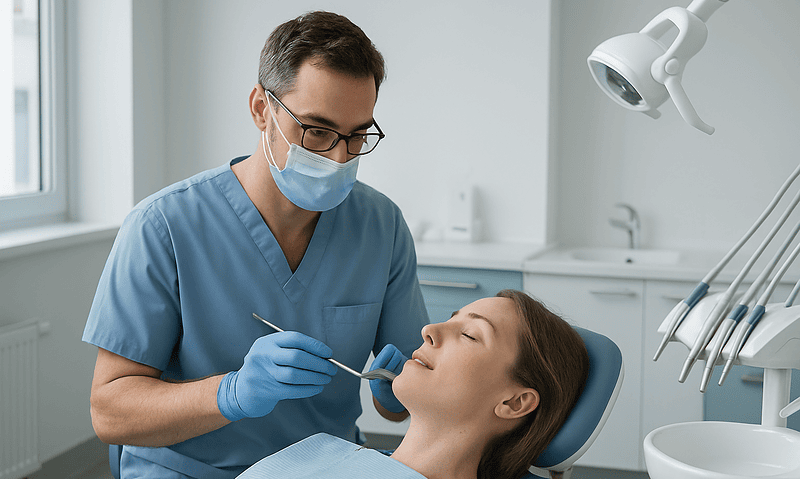
A thorough first visit looks less like a sales meeting and more like a check-up with extra photographs. The dentist, or a hygienist working with them, should examine every tooth, probe the gums, check how your upper and lower teeth meet when you bite, and look at the joints and muscles of the jaw. Radiographs, the X-ray images that show roots and the bone around them, are usually taken unless recent ones exist.
Only after that does the conversation turn to appearance. Expect intraoral photographs, sometimes a digital scan that builds a three-dimensional model of your mouth, and a frank discussion about what bothers you. Colour, shape, alignment, gaps and gum display are separate problems with separate fixes, so a clinician who lumps them together has skipped a step.
According to MedlinePlus, cosmetic procedures range from whitening and bonding to veneers, crowns and orthodontic alignment, and the right one depends on what is wrong with the tooth, not only on how it looks. A consultation that ends with a single option and a signature line has not finished the job.
You should leave with three things: a written summary of your oral health findings, a list of at least two ways to approach your concern, and an understanding of what each option does to the natural tooth. If the appointment runs out of time before you have them, ask for a second visit. In most practices that is normal, not awkward, and it tells you something useful about how the team works under no pressure at all.
Questions for cosmetic dentist visits start with one: is my mouth healthy enough?
This is the question that decides everything else, and it is the one patients most often forget to ask. Cosmetic treatment sits on top of a foundation of gum, bone and sound tooth structure. If that foundation is inflamed or decayed, the aesthetic result will not hold.

Gum disease is the clearest example. Periodontal disease, an infection of the tissues that hold teeth in place, is common in adults and often painless in its early stages, as the NIH’s dental research institute explains. Gums that bleed on probing, recede or sit over bone that has started to thin are not ready for veneers or crowns whose margins must meet healthy tissue precisely. Most clinicians will stabilise gum health first and re-examine before any cosmetic work.
The same logic applies to untreated decay, cracked fillings, root infections and teeth that hurt on biting. These are treated as disease first; appearance comes afterwards.
Who is usually asked to wait? Anyone with active gum inflammation, uncontrolled grinding, pregnant patients wanting elective whitening, and people whose expectations rest on a result the tooth cannot physically deliver. Smokers are often asked to consider quitting before implant or gum procedures, because tobacco slows healing. None of these are refusals. They are sequencing decisions, and a careful dentist will explain the order and the reason.
So open with a plain request: “Before we talk about how it will look, tell me what you found that needs treating first.” The quality of that answer is your first piece of evidence.
Do cosmetic dentists fill cavities?
Yes, and the reason matters more than the answer. In the United States, cosmetic dentistry is not a formally recognised dental specialty in the way orthodontics, periodontics or oral surgery are. A “cosmetic dentist” is a licensed general dentist who has chosen to focus on appearance, often with extra postgraduate courses. That means they are trained to diagnose and treat decay, and ethically they are obliged to tell you about it.
A cavity is a hole in the tooth caused by acid from bacteria breaking down enamel and the softer dentine beneath it. Left alone, it reaches the nerve. A veneer cemented over an untreated cavity hides the problem until it becomes a root canal or an extraction, so any honest plan deals with decay before or during cosmetic work.
What you want to hear is how the practice handles the ordinary dentistry around the glamorous part. Who checks your bite? Who manages a filling that fails under a new crown? Does the same clinician treat gum disease, or will you be referred to a periodontist, a specialist in gum and bone? Referral is a sign of good judgement, not weakness.
Patients sometimes assume a cosmetic practice will be dismissive of routine care. The reverse should be true: the clinician who stakes their reputation on how a smile looks in five years has every reason to keep the teeth under it healthy. If decay or bleeding gums are noted but waved through so the “real” treatment can start, that is a reason to pause and seek a second opinion.
What training and experience should I ask about?
Because the label is unregulated, your questions have to do the work a specialty title would normally do. Ask how many cases similar to yours the dentist treats in a typical year, what postgraduate training they have completed in restorative or aesthetic dentistry, and whether they work with a specific dental technician, the person who physically makes veneers and crowns in a laboratory.

Ask to see photographs of their own completed work, taken under consistent lighting, and specifically ask to see cases a few years after placement rather than the day of fitting. Everything looks good on fitting day. Gum lines and margins tell the truth later. Ask also whether the examples include people with a similar starting point to yours; a perfect result on straight, healthy teeth says little about a worn, crowded bite.
Then ask what they do not do. A clinician who says “I refer complex gum surgery” or “I don’t place implants, I work with a surgeon who does” is describing the boundaries of safe practice. A clinician who claims to do everything deserves a gentle follow-up about where they trained for each of those things.
Finally, ask how the plan was built. Was your bite analysed? Were models or a digital scan used to test the design before anyone touched a tooth? MedlinePlus notes that cosmetic options differ in how much tooth they remove and how long they last; a dentist who designs first and drills second is treating your enamel as the limited resource it is. Credentials matter. The thinking behind the plan matters more.
Veneers vs bonding vs crowns: which options should be on the table?
Most aesthetic concerns can be addressed in more than one way, and the differences are about how much tooth is sacrificed, how the result is made and how long it tends to last. Ask the dentist to walk you through each of these for your case rather than presenting one.
A veneer is a thin shell of porcelain or composite resin bonded to the front of a tooth. Bonding is tooth-coloured resin shaped directly onto the tooth in the chair and hardened with light. A crown is a cap that covers the whole tooth above the gum. Whitening is a chemical process that lightens the existing tooth. Orthodontic treatment moves teeth without altering them at all.
| Option | Tooth removed | Typical longevity (Cleveland Clinic / NHS) | Reversible? |
|---|---|---|---|
| Whitening | None | Months to about 3 years, depending on habits | Yes, fades over time |
| Composite bonding | Little or none | Roughly 3–10 years | Largely, can be removed or repaired |
| Porcelain veneer | Thin layer of front enamel | Roughly 10–15 years | No |
| Crown | Substantial, all surfaces | Roughly 5–15 years or more | No |
| Orthodontics | None | Lasts with retainer wear | Teeth can relapse without retention |
These ranges come from Cleveland Clinic’s patient pages on veneers, bonding and crowns and the NHS whitening guidance; they are averages across many patients, not predictions for you. The point of the table is sequencing. If alignment is the real problem, orthodontics may solve it without cutting enamel. If colour is the problem, whitening is tried before anything irreversible. Veneers and crowns sit at the far end for a reason.
How long do veneers last, and what makes them fail early?
Cleveland Clinic puts the typical lifespan of porcelain veneers at around 10 to 15 years, with composite versions tending to last less time before staining or chipping. Those numbers are useful mainly for what they imply: a veneer placed in your thirties is a commitment to replacing it, perhaps more than once, over a lifetime.
Ask the dentist what shortens that span in people like you. The usual culprits are mechanical. Bruxism, the habit of grinding or clenching teeth, often during sleep, loads thin porcelain far beyond what it was designed for; Mayo Clinic describes it as a common condition that frequently goes unnoticed until teeth show wear. A dentist who sees flattened edges or enlarged jaw muscles should raise it before quoting longevity, and may recommend a night guard as part of the plan.
Habits count too. Biting nails, opening packaging with teeth, chewing ice or pens, and acidic or heavily pigmented drinks all take a toll. Gum recession exposes the join between veneer and root, which can stain or decay. Poor hygiene lets decay start at the margins, where the veneer ends and the natural tooth begins.
Then ask the practical follow-ups. What happens when one chips? Can it be repaired in the chair, or does it need remaking? If a veneer fails in year three, what is the practice’s approach? Will your records, photographs and shade information be kept so a replacement can match? A clear maintenance plan, with regular reviews and professional cleaning, is part of the treatment, not an optional extra. If nobody mentions it, bring it up yourself.
How much of my natural tooth will be removed?
Of every question on this list, this is the one to ask slowly and write the answer down. Enamel is the hard outer layer of the tooth, and it has no living cells to rebuild itself. Whatever is removed to make room for a veneer or crown is gone for good, and the tooth will need some form of covering for the rest of its life.
Preparation varies widely. Some veneers need only a light reduction of the front surface. Others, especially where teeth are rotated or crowded, require more. A crown removes material from every surface so the cap can fit over the top. Cleveland Clinic’s patient guidance describes crowns as appropriate when a tooth is already weakened or heavily filled; using one on a healthy tooth purely for appearance is a trade many dentists would counsel against.
Ask these follow-ups in order. Could this tooth be treated with bonding or whitening instead, and if not, why not? Could orthodontic alignment first reduce how much needs to be cut? Will you show me on the model or scan exactly what will be removed? Could any tooth end up needing root canal treatment because of how close the preparation comes to the nerve?
That last risk is real and rarely volunteered. Deep preparation can irritate the pulp, the soft tissue inside the tooth, and a small share of teeth become sensitive or inflamed afterwards. A good clinician will acknowledge this plainly and explain how they minimise it. A dismissive answer is a reason to slow down. Your enamel is the one material in the room that cannot be reordered from the laboratory.
What should I ask about teeth whitening before anything else?
Whitening is often the right place to start, precisely because it removes no tooth structure and because the colour of the natural teeth sets the shade for everything else. A veneer cannot be whitened later; the surrounding teeth are matched to it, so most dentists whiten first and design restorations afterwards.
How it works is simple chemistry. Professional whitening uses a peroxide-based gel that releases oxygen molecules into the enamel, breaking down the pigmented compounds that have built up from food, drink, tobacco and age. The NHS explains that it is a dental procedure that should be carried out or supervised by a registered dental professional, and that results are not permanent, lasting from a few months to up to about three years depending on habits.
Ask what kind of staining you have. Surface stains from coffee and tea respond well. Discolouration from certain childhood antibiotics, trauma to a tooth or fluorosis can be patchy and may lighten unevenly. Existing fillings, crowns and veneers do not change colour at all, which can leave them looking darker afterwards; ask whether any will need replacing to match.
Ask about sensitivity. Mayo Clinic notes that temporary tooth sensitivity and mild gum irritation are the most common side effects and usually settle after treatment ends. If you already have sensitive teeth, exposed roots or untreated decay, the dentist may want to address those first.
And ask the honest question: how white is realistic for my teeth? A good answer references your current shade and a plausible target, not a stranger’s photograph.
Can I see the result before you touch a tooth?
You can, and you should. Modern aesthetic planning offers several ways to preview a result, and asking for one is among the most protective cosmetic dentist consultation questions you can raise.
The oldest method is a diagnostic wax-up: a technician builds the proposed new shapes in wax on a plaster model of your teeth. From that model the dentist can make a thin template and, using temporary resin, press a mock-up directly onto your unprepared teeth. You see and feel the proposed shapes in your own mouth, speak with them, smile in a real mirror and take photographs home. Then it comes off, and nothing has been cut.
Digital smile design does something similar on screen, combining photographs and a three-dimensional scan to simulate the outcome. Both approaches let you say “too long”, “too square”, “I want to keep the little gap” while changes still cost only time.
Ask whether the mock-up reflects the final material and thickness, because a resin trial can look brighter or bulkier than finished porcelain. Ask whether the technician who will make the final work is involved in the design stage. Ask how your bite, speech and lip movement were tested on the mock-up, not just the static smile.
If a practice does not offer any preview for a multi-tooth plan, that is worth understanding. It may be reasonable for a single small bonding. For eight veneers it is a gap in process, and process is what protects you when the result is not what you imagined.
What are the real risks, and how often do they happen?
Every procedure carries risk, and the measure of a good consultation is whether those risks are named before you ask. Describe them in neutral terms and expect the same back.
Sensitivity after whitening or tooth preparation is the most common complaint, and it is usually temporary. Pulp inflammation after deep preparation can lead to a need for root canal treatment on a tooth that was healthy before. Veneers and crowns can chip, debond or fracture, particularly in people who grind. Margins can trap plaque and lead to decay or gum inflammation if hygiene slips. Gum recession over time can expose the edge of a restoration. Colour mismatch, shape you dislike and a bite that feels wrong are not medical complications, but they are the ones people regret most, which is why the preview stage matters.
Cleveland Clinic lists these risks on its patient pages for veneers and crowns; it does not attach reliable percentages to most of them, because outcomes depend heavily on case selection and maintenance. Be wary of any dentist who quotes a tidy success figure without saying where it comes from.
Ask specifically: what in my mouth raises or lowers these risks? Which of these problems can be fixed in the chair and which need the laboratory? What is the plan if I am unhappy with the look at the trial stage? Who do I contact if something breaks at the weekend?
Also ask what would make the dentist advise against this plan. A clinician who can describe the circumstances in which they would say no has thought about your interests, not just the procedure.
What do the days and weeks after cosmetic dental work usually look like?
Timelines vary with the procedure, so ask for yours in writing. The patterns below are typical ranges drawn from Cleveland Clinic and NHS patient information, not promises.
After whitening, sensitivity to cold often peaks within the first day or two and generally fades over the following days once treatment stops. Many clinicians suggest avoiding strongly coloured foods and drinks for a short period while the enamel rehydrates, because freshly whitened teeth take up pigment more readily.
After bonding, the resin is fully hardened when you leave, so eating is normal almost immediately. The main adjustment is the feel of the new shape against your lip and tongue, which usually settles within a week or so as your mouth adapts.
Veneers and crowns involve two phases. Between preparation and fitting, usually a couple of weeks while the laboratory works, you wear temporaries that can feel rough and come loose; you are asked to avoid sticky foods and to call if one falls off. After final cementation, mild gum tenderness and sensitivity around the margins are common for a few days. The bite is checked at a review visit and adjusted if any spot feels high, because even a tiny high point can cause aching or chipping.
Across all of these, the hygiene routine does not change: brush twice daily with fluoride toothpaste, clean between teeth, and keep review appointments. If a dentist tells you the new work needs no special care, hold that against the maintenance questions you asked earlier. Everything in the mouth needs looking after; some things simply need it more than others.
What does 1, 2, 3, 4 mean at the dentist, and why does it matter for cosmetic plans?
If you have ever lain in the chair while someone called out a stream of numbers, you have heard a periodontal chart being recorded. A thin probe is slid gently into the small crevice between tooth and gum at several points around each tooth, and the depth is read off a scale in millimetres. Shallow readings mean the gum is attached snugly to the tooth. Deeper readings mean a pocket has formed where bacteria can collect and the supporting bone may have started to break down.
You may also hear “bleeding on probing” noted, or a separate code, used in UK practice, where each sixth of the mouth is scored to summarise gum health. The NIH’s dental research institute describes gum disease as beginning with gingivitis, inflammation that is reversible with good cleaning, and progressing in some people to periodontitis, where the bone itself is lost.
This matters for cosmetic work for a blunt reason: restorations are placed to a gum line, and a gum line that is inflamed will move. Margins that looked invisible can become visible. Bone that is lost does not return without surgery. So those numbers are not background noise; they are the go or no-go signal for your plan.
Ask to see your chart and have it explained. Ask which readings concern the dentist and what is being done about them before cosmetic treatment starts. Ask how often it will be repeated after treatment. A practice that charts carefully and acts on the findings is treating you as a patient first and a smile second, which is exactly the order you want.
What people often get wrong about cosmetic dentistry
Several beliefs persist because they contain a grain of truth. Here is where the evidence actually lands.
“Veneers are permanent, so the problem is solved.” They are permanent in the sense that the tooth can never go uncovered again. They are not permanent in the sense of lasting forever; Cleveland Clinic’s typical range is around a decade or more, after which replacement becomes likely.
“Whitening damages enamel.” Supervised peroxide whitening has not been shown to harm sound enamel when used as directed, according to the NHS and Mayo Clinic; the main side effects are temporary sensitivity and gum irritation. Unsupervised, overused or acidic home remedies are a different matter.
“Crowns are stronger than veneers, so they are the safer choice.” A crown removes far more tooth. On a healthy tooth that is a loss, not a safety margin. Crowns earn their place on teeth already weakened by fillings, fractures or root treatment.
“Cosmetic work means no more cavities on those teeth.” Decay can and does start at the margins where restoration meets tooth, which is why hygiene and reviews continue.
“A cosmetic dentist is a specialist.” Not in the regulated sense in the US; training and experience vary, which is why you ask about them.
“The whiter, the better.” Natural teeth are not uniformly white; a shade that ignores your skin tone and the whites of your eyes tends to read as artificial. Good design chooses a shade that looks like yours on a very good day.
None of this argues against treatment. It argues for treatment chosen with clear eyes.
Questions to ask your care team before you sign
Here is the list in one place. Take it to the consultation, and judge the answers less on polish than on specificity.
- What did you find in my examination and X-rays that needs treating before any cosmetic work, and in what order?
- What exactly bothers me about my smile in your assessment: colour, shape, alignment, gum display or a mix, and which options address each part?
- For each option, how much natural tooth is removed, and is it reversible?
- Could orthodontic treatment or whitening alone get me close to what I want?
- How long does each option typically last for someone with my bite and habits, and what shortens that?
- Do I grind or clench, and how will the plan protect the work if I do?
- Can I see a mock-up or digital preview in my own mouth before anything is prepared?
- Who makes the laboratory work, and will they be involved in the design?
- What are the specific risks for my teeth, including the chance of needing root canal treatment afterwards?
- What does recovery look like week by week, and what is normal versus a reason to call?
- What is the maintenance plan: review intervals, hygiene visits, night guard?
- If a restoration chips or comes off, how is that handled, and by whom?
- What would make you advise me against this plan?
- May I have the plan, findings and alternatives in writing so I can think it over?
That last question is a quiet test. Any team confident in its plan will be glad you want time with it. The decision belongs to you and your treating clinicians, and it is a better decision for being made at your kitchen table rather than in the chair.
When to call your doctor
Most discomfort after cosmetic dental treatment is mild and fades over days. Some signs mean the treating dentist should hear from you promptly rather than at the next scheduled review, and a few mean urgent care.
Contact your dentist the same day if you notice pain that is getting worse rather than better after the first few days, throbbing or spontaneous pain that wakes you at night, a tooth that has become very sensitive to heat rather than cold, a temporary or final restoration that has come loose or fallen off, a bite that feels high or uneven when you close your teeth together, bleeding from the gums around new work that does not settle with gentle cleaning, or a chip or crack in a new veneer or crown.
Seek urgent dental or medical care, through an emergency dental service or your local urgent care route, if you develop facial swelling, swelling under the jaw or in the floor of the mouth, difficulty swallowing or breathing, fever alongside dental pain, or a rapidly growing lump on the gum. These can signal a spreading infection that needs treatment without delay.
If you take medicines that affect bleeding or your immune system, or you have a heart or joint condition that your physician has said requires special precautions for dental work, tell the dental team before treatment and call them or your physician if anything unexpected happens afterwards.
Writing down what you feel, when it started and what makes it better or worse helps the team sort an ordinary settling-in period from a problem that needs attention. When in doubt, call. Dentists would far rather hear about a false alarm than a tooth that could have been saved.
Frequently asked questions
Do cosmetic dentists fill cavities?
Yes. A cosmetic dentist is a licensed general dentist, trained to diagnose and treat decay, and any sound plan addresses cavities before or alongside aesthetic work. Covering an untreated cavity with a veneer or crown hides it until it reaches the nerve. If decay or bleeding gums are noted in your examination but not written into the plan, ask why, and consider a second opinion.
What does 1, 2, 3, 4 mean at the dentist?
Those numbers are usually periodontal probing depths: how deep the small crevice between each tooth and the gum measures, read in millimetres with a fine probe. Shallow readings suggest healthy, attached gum; deeper readings can indicate pockets where bacteria collect and bone may be breaking down. Ask to see your chart explained, because gum health determines whether cosmetic work should go ahead.
What are the most useful cosmetic dentist consultation questions?
Start with what needs treating before any cosmetic work, then ask how much natural tooth each option removes, whether whitening or orthodontics alone could get you close, how long each option typically lasts for someone with your habits, what the specific risks are, whether you can see a mock-up first, and what maintenance and repair look like afterwards. Request the findings and alternatives in writing.
How long do veneers last?
Cleveland Clinic’s patient guidance gives a typical range of around 10 to 15 years for porcelain veneers, with composite veneers generally lasting less before staining or chipping. Grinding, nail biting, chewing hard objects, gum recession and poor hygiene at the margins all shorten that span. Treat the figure as an average across many patients, not a prediction for your mouth.
Veneers vs bonding vs crowns: how do I decide?
The main differences are how much tooth is removed and how long the result tends to last. Bonding removes little or no enamel and can be repaired but wears sooner. Veneers remove a thin front layer and last longer but are irreversible. Crowns cover the whole tooth and are usually reserved for teeth already weakened by fillings or fractures. Your dentist should explain why one fits your tooth.
Is teeth whitening safe for enamel?
Supervised peroxide whitening carried out or overseen by a registered dental professional has not been shown to damage sound enamel, according to NHS and Mayo Clinic guidance. The common side effects are temporary cold sensitivity and mild gum irritation, which usually settle once treatment ends. Existing fillings, crowns and veneers do not lighten, and results fade over months to a few years.
Can cosmetic dental work be undone later?
Whitening fades on its own and bonding can usually be removed or reshaped, so both are considered largely reversible. Veneers and crowns are not: the enamel removed to make space does not regrow, and the tooth will need some covering for life. That is why asking how much tooth each option removes is the most protective question before committing.
What do dentists wish patients knew before cosmetic treatment?
Most would say three things. Gum health and bite matter more to the final look than the brand of porcelain. Grinding is common, often unnoticed, and is the leading reason thin restorations chip, so a night guard may be part of the plan. And a result that looks natural usually involves slight asymmetry and a shade that suits your face, not the brightest option available.
What are some fun facts about dentistry that actually matter here?
Enamel is the hardest substance in the human body, yet it has no living cells, so it cannot repair itself once removed. Tooth colour comes largely from the yellowish dentine showing through translucent enamel, which is why ageing teeth darken as enamel thins. And no two people share the same bite pattern, which is why a mock-up tested in your own mouth beats any photograph of someone else.
What should I do if I feel pressured to start treatment the same day?
Ask for the examination findings, proposed options and alternatives in writing and take them home. Irreversible cosmetic treatment is elective, and a well-designed plan does not lose anything by waiting a week or two. A team confident in its recommendations will welcome the pause. If pressure continues, a second consultation elsewhere is a reasonable and common step.
References
- MedlinePlus: Cosmetic Dentistry
- Cleveland Clinic: Dental Veneers
- Cleveland Clinic: Dental Crowns
- NIH National Institute of Dental and Craniofacial Research: Periodontal (Gum) Disease
This article is for general information only and is not a substitute for professional medical advice. Please consult a qualified doctor about your individual situation.

More from the Blog

Is Gum Disease Contagious or Hereditary, and Does Vaping Cause It?
Gum disease is not contagious in the way a cold is, though the bacteria involved can pass between people through saliva; disease develops only…
Is Sensitivity After a Dental Filling Normal? When a Bite Adjustment Helps
Mild sensitivity to cold, sweets, or pressure is common after a dental filling and usually fades over days to a few weeks as the…

Tooth Decay Treatment in Older Adults: Root Cavities, Dry Mouth and Medication Effects
Cavities in older adults are common and treatable at any age. They often form on exposed root surfaces, which are softer than enamel, and…

Life After a Root Canal: Why the Crown Matters and How to Chew on the Tooth Safely
A crown after a root canal protects a tooth that is now hollowed, dry and more brittle, especially a back tooth that takes heavy…

Are Fissure Sealants Only for Children? Who May Benefit and Which Molars Are Sealed
Fissure sealants are not only for children. They are most often placed on newly erupted permanent molars in children aged roughly 6 to 14,…

Porcelain Veneers for International Patients: Two Visits, Temporaries and Follow-Up
Porcelain veneers are usually completed over two clinical visits: the first covers examination, consent, tooth preparation, impressions or digital scans and temporary veneers; the…