

Before Eye Laser Treatment: Corneal Thickness, Eye Pressure and Stopping Contact Lenses

Key Takeaways
- Corneal thickness, measured in micrometers by pachymetry, and corneal shape from topography are the first gatekeepers for laser treatment, ahead of the prescription itself.
- Contact lenses temporarily mold the cornea, so they must be stopped before the measurement visit, with soft lenses needing roughly a couple of weeks and rigid lenses often a month or more.
- A pre-treatment eye pressure baseline protects you for decades, because thinner post-laser corneas make standard tonometers read lower than the true pressure.
- Keratoconus, corneas too thin for a safe residual bed, active eye disease, an unstable prescription and uncontrolled autoimmune conditions are among the common reasons laser treatment is declined.
- Untreated dry eye is one of the most frequent reasons plans are delayed, since LASIK disturbs corneal nerves and temporary dryness is expected afterward.
- Vision after LASIK is often much clearer by the next day, but full stabilization typically takes two to three months, and laser treatment does not prevent age-related reading glasses.
An eye exam before laser treatment measures far more than your glasses prescription. Clinicians map the cornea's shape, measure its thickness in micrometers, check eye pressure, test tear quality, and dilate the pupils to inspect the retina. Because contact lenses temporarily reshape the cornea, most people are asked to stop wearing them for a set period before these measurements, so the surgical plan reflects the eye's true shape.
The appointment letter is oddly specific. Bring your glasses, it says. Do not wear your contact lenses. Arrange a ride home. Somewhere between the third and fourth line, a person who has worn soft lenses every waking hour for fifteen years starts doing math about how they will get through two weeks of work in frames they last updated during a different presidency.
That small inconvenience is the first clue that the eye exam before laser treatment is not a formality. It is the part of the process where the real decisions get made. A surgeon can only remove tissue that exists, only reshape a surface that is stable, and only predict a result if the measurements are honest. Most of what determines whether laser vision correction is a good idea for a particular pair of eyes is decided in that darkened exam room, long before anyone lies down under a laser.
Here is what the instruments are looking for, why the numbers matter, and what the answers can mean for you.
What an eye exam before laser treatment actually measures
Most people picture an eye exam as reading letters off a chart. That part happens, but it is the shortest and least decisive piece of a pre-laser assessment. The exam is a sequence of measurements, each answering a different question about whether the eye can safely be reshaped.
It begins with a refraction, the test that determines your exact prescription, usually done twice: once with your eyes relaxed naturally and once after drops that stop the focusing muscle from working. The second version matters because a tense focusing muscle can make a prescription look stronger than it is, and the laser will be programmed to the number the surgeon trusts.
Next comes a set of imaging tests. Corneal topography maps the curvature of the cornea, the clear front window of the eye, point by point. Pachymetry measures how thick that cornea is, in micrometers, which are thousandths of a millimeter. Pupil size is recorded in dim light, because large pupils can influence night-vision symptoms after treatment. Tear production and tear quality are assessed. Eye pressure is measured. Finally, the pupils are dilated with drops so the clinician can examine the lens and the retina at the back of the eye for anything that would change the plan.
Mayo Clinic and Cleveland Clinic both describe this as the stage where candidacy is decided, not merely confirmed. A surprising number of people arrive expecting to schedule surgery and leave with a different conversation: a recommendation to wait, to treat dry eye first, to consider a different type of procedure, or to keep wearing glasses. That outcome is not a failure of the exam. It is the exam doing its job.
Why corneal thickness matters more than your prescription
Laser vision correction works by removing a precise, microscopic layer of corneal tissue to change how light bends as it enters the eye. In LASIK, a thin hinged flap is created on the surface, the laser reshapes the tissue beneath, and the flap is laid back down. In PRK, the surface layer is removed instead of lifted as a flap and grows back over several days. Either way, tissue that is removed does not return.

The cornea is thin to begin with, roughly the thickness of a credit card at its center. The stronger the prescription, the more tissue must be removed to correct it. Surgeons therefore care about two numbers: how thick the cornea is now, and how much will be left behind after the flap and the treatment are accounted for. That remaining layer, often called the residual bed, is what keeps the cornea structurally sound against the constant outward push of the eye’s internal pressure.
Remove too much and the cornea can gradually bulge forward over months or years, a complication called ectasia that distorts vision and is difficult to reverse. Mayo Clinic lists a thin cornea among the reasons a person may not be offered LASIK, and Cleveland Clinic makes the same point. This is why someone with a strong prescription and a thin cornea may be steered toward a surface procedure that spares more tissue, toward a lens-based alternative, or away from surgery entirely.
The practical lesson: a mild prescription on a thin cornea and a strong prescription on a thick one can both be fine, while a strong prescription on a thin cornea may not be. Only pachymetry can tell the difference, and it takes a few seconds with a handheld ultrasound probe or a scanning camera. Ask for your number. Clinicians expect the question.
Corneal mapping: what topography reveals that a chart cannot
A healthy cornea is shaped roughly like a section of a smooth sphere, slightly steeper in one meridian than the other in people with astigmatism. Corneal topography and its more detailed cousin, tomography, photograph the surface and the layers beneath it and turn the data into a color map. Warm colors mark steeper areas, cool colors flatter ones. To a trained eye, these maps are as recognizable as fingerprints.
The pattern the surgeon most wants to rule out is keratoconus, a condition in which the cornea thins and gradually bulges into a cone shape. Cleveland Clinic describes it as a progressive disorder that often begins in the teens or twenties and that may show no obvious symptoms in early stages beyond a frequently changing prescription. On a topography map, early keratoconus tends to appear as an off-center area of steepening, often in the lower half of the cornea, sometimes accompanied by thinning at the same spot.
Removing tissue from a cornea that is already weakening is the worst possible combination. This is why an irregular map is one of the clearest reasons a person will be told laser treatment is not appropriate, even when their prescription is modest and their vision in glasses is excellent. Cleveland Clinic lists keratoconus and other corneal disorders plainly among the conditions that rule out LASIK.
Topography also catches subtler issues. It can show irregular astigmatism that a standard refraction misses, warping from years of contact lens wear that has not yet resolved, and scars from old injuries or infections. Each of these changes what the laser should do, or whether it should do anything at all. Some practices repeat the mapping at a second visit to confirm the picture is stable before finalizing a plan.
Eye pressure before laser eye surgery: what the number means
Intraocular pressure is the fluid pressure inside the eye, measured in millimeters of mercury, the same unit used for blood pressure. Mayo Clinic describes the typical range as roughly 10 to 21, though what counts as healthy varies between individuals. The measurement, called tonometry, is done either with a gentle puff of air or with a small probe that briefly touches the numbed surface of the eye. Neither hurts.
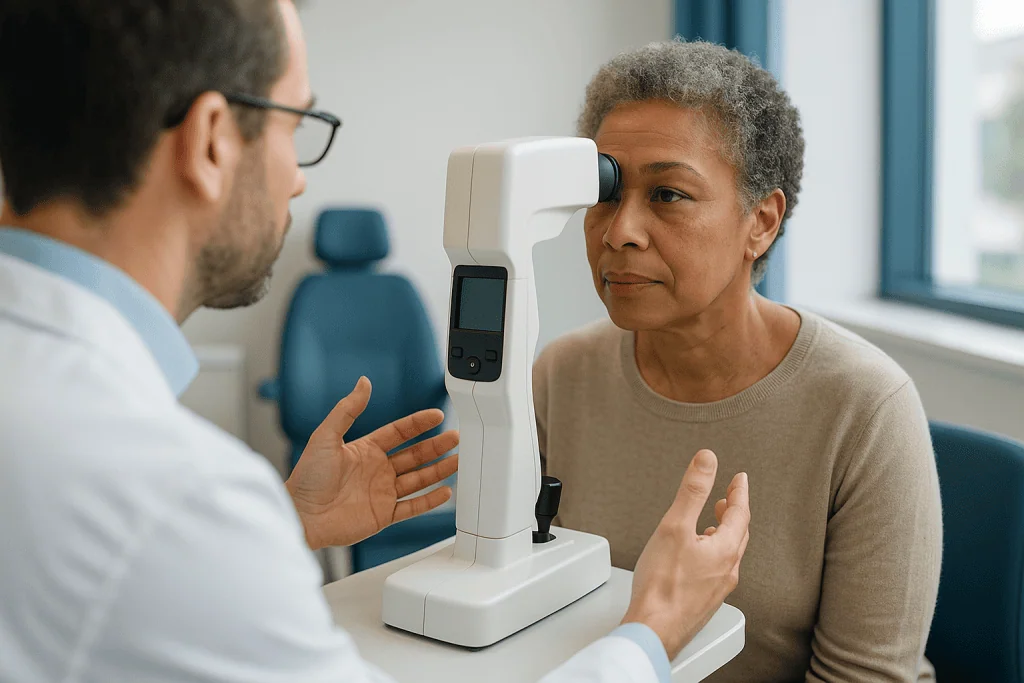
Pressure is checked before laser treatment for two related reasons. The first is glaucoma, a group of conditions in which the optic nerve is damaged, often in association with raised pressure. Glaucoma is not necessarily a barrier to laser vision correction, but it needs to be known about and stable, and the surgeon will want to see the optic nerve during the dilated exam. Mayo Clinic notes that the pressure applied to the eye during flap creation is a consideration for people with existing glaucoma, so this is a conversation to have with both the laser surgeon and whoever manages the glaucoma.
The second reason is that laser treatment changes future pressure readings. A thinner, flatter cornea after LASIK or PRK causes standard tonometers to underestimate pressure, sometimes by several units. A person who later develops glaucoma could have their pressure read as normal when it is not. A documented pre-treatment baseline lets every future eye doctor interpret readings correctly. Keep a copy of it.
Steroid eye drops used after surgery can also raise pressure temporarily in a minority of people, which is one reason the drops are used for a limited course and pressure is rechecked at follow-up visits. If your pressure is borderline before surgery, expect the team to factor that into how they monitor you afterward, and follow their instructions on the drop schedule exactly as written.
Why you stop wearing contacts before LASIK measurements
A contact lens sits on the cornea for twelve or sixteen hours a day and, however gently, presses on it. Over years the cornea adapts to that shape, in the same way a wristwatch leaves a mark that fades once it is removed. Take the lens out and the cornea slowly relaxes back toward its natural curvature. The catch is that this relaxation takes time, and measurements taken before it finishes describe the lens-molded cornea rather than the real one.
If the laser is programmed from a warped map, the correction will be aimed at a shape that no longer exists once the cornea recovers, leaving residual blur or astigmatism. Mayo Clinic and Cleveland Clinic both advise stopping lenses before the pre-operative evaluation, with the required break depending on the lens type. Soft lenses generally need the shortest break, often a couple of weeks according to Cleveland Clinic’s guidance; toric soft lenses for astigmatism tend to need a little longer; and rigid gas-permeable lenses, which are firmer and reshape the cornea more, can require a month or more. Some clinics repeat topography until two maps taken a week apart match, then proceed.
The break applies to the exam, not only to the surgery day. This surprises people who assumed they could keep wearing lenses until the last minute. It also means the glasses you dig out of a drawer need to be a workable prescription; if they are badly outdated, an optometrist can update them before the laser consultation.
For long-term rigid lens wearers, the cornea can take longer to stabilize than any rule of thumb suggests. If the first map still looks irregular, being asked to wait longer and return is a sign of caution, not a problem with your eyes.
The pre-laser tests at a glance: what is measured and why
The sequence of tests can feel like an assembly line. Knowing what each machine is for makes the visit less mysterious and helps you ask sharper questions afterward.
| Test | What it measures | Why it matters for laser treatment |
|---|---|---|
| Refraction (dry and dilated) | Exact glasses prescription | Programs the laser; dilated version rules out a falsely strong reading from focusing effort |
| Corneal topography / tomography | Curvature and shape of the corneal surface and layers | Detects keratoconus, irregular astigmatism and lens-related warping |
| Pachymetry | Corneal thickness in micrometers | Determines how much tissue can safely be removed and which procedure fits |
| Tonometry | Intraocular pressure | Screens for glaucoma and records a baseline, since readings shift after surgery |
| Pupil measurement in dim light | Pupil diameter | Helps plan treatment zone size and counsel about night glare |
| Tear film assessment | Tear volume and how quickly tears evaporate | Untreated dry eye tends to worsen after surgery and can blur results |
| Dilated fundus exam | Health of lens, retina and optic nerve | Finds cataract, retinal weakness or nerve changes that alter the plan |
None of these tests is painful, though the dilating drops sting for a few seconds and leave vision blurry and light-sensitive for several hours, according to MedlinePlus. Reading and screen work are difficult until the drops wear off, and driving is not advised, which is why the appointment letter asks you to bring someone.
Expect the whole visit to run considerably longer than a routine glasses check. A thorough assessment is a good sign; a very brief one before a surgery date is offered is worth asking about.
Who laser treatment is usually for, and who is usually asked to wait
The classic candidate is an adult whose prescription has not changed meaningfully for at least a year, whose corneas are of adequate thickness with a regular shape, whose eyes are otherwise healthy, and who understands that the goal is to reduce dependence on glasses rather than to guarantee freedom from them. Mayo Clinic and the NHS frame candidacy in roughly these terms.
Age enters the picture because the eye keeps changing into early adulthood. The NHS notes that laser eye surgery is generally not recommended while vision is still changing, which for many people means the late teens and early twenties. Operating on a prescription that will drift another step within two years simply builds in a future disappointment.
People who are commonly asked to wait rather than told no include those who are pregnant or breastfeeding, since hormonal shifts can temporarily alter the prescription and the tear film; those whose recent prescription history shows movement; those with active dry eye or eyelid inflammation that can be treated first; and long-term contact lens wearers whose corneal maps have not yet settled. In each case the exam is repeated later and the answer may change.
People taking certain medicines that affect healing or the tear film, and those with autoimmune conditions, may be evaluated more cautiously; Mayo Clinic lists uncontrolled autoimmune disease among the reasons LASIK may be inadvisable. This is not a judgment about the person. It reflects the fact that a cornea heals through a controlled inflammatory process, and anything that disrupts that process changes the risk.
Finally, expectations count as a candidacy factor. Someone who needs perfect uncorrected vision for their livelihood, or who would find any halo at night intolerable, deserves an especially frank conversation before proceeding. The treating team makes the final call, and a thoughtful team will sometimes decline to operate on eyes that are technically suitable.
What disqualifies you from laser eye surgery?
Some findings close the door on standard laser treatment rather than postponing it. The most common, drawn from Mayo Clinic and Cleveland Clinic guidance, fall into a few groups.
Corneal problems lead the list. Keratoconus or a topography pattern suspicious for it, corneas too thin to leave a safe residual bed after treatment, and significant scarring are each reasons a surgeon will decline. A previous eye surgery on the cornea does not automatically rule out further treatment but demands careful assessment.
Very high prescriptions may fall outside what can safely be corrected, because the amount of tissue required would compromise the cornea. In such cases, lens-based procedures, in which a corrective lens is placed inside the eye, are sometimes discussed as an alternative; the NHS describes these as options for people who are not suitable for laser treatment. Whether they are appropriate is a separate evaluation.
Eye diseases matter too. Advanced glaucoma, cataract that is already affecting vision, and certain retinal conditions change the picture, since treating the cornea does nothing for a problem behind it. A cataract, in particular, will eventually need its own operation, and that operation can correct the prescription at the same time, which is why surgeons are reluctant to laser a cornea in someone whose lens is already clouding.
Severe dry eye that has not responded to treatment, poorly controlled diabetes, and some autoimmune and immunodeficiency conditions round out the list, largely because of healing concerns. A history of significant herpes infection of the eye is also weighed carefully.
Being told no is disappointing, and it is reasonable to ask the clinician to walk you through the specific finding on your own scans. It is equally reasonable to seek a second evaluation. What is not reasonable is shopping until someone says yes. A surgeon who declines is protecting the only pair of eyes you have.
The dry eye check that changes more plans than people expect
Dry eye sounds minor next to corneal thickness and glaucoma, yet it is among the most frequent reasons a laser plan is adjusted or delayed. The reason is mechanical. Creating a LASIK flap cuts through some of the tiny corneal nerves that signal the eye to produce tears. Those nerves regrow over months, and in the meantime the eye tends to feel drier than before. Mayo Clinic lists temporary dry eye among the most common effects after LASIK, and someone who starts from a dry baseline has less margin.
Dryness does more than cause discomfort. A patchy, unstable tear film blurs vision, sometimes noticeably, and it can also make the pre-operative measurements themselves less reliable, since topography relies on a smooth reflective surface. Treat the dryness first and both the map and the eventual result tend to be clearer.
The assessment usually involves a few quick tests: how long the tear film holds before breaking up after a blink, how much tear volume the eye produces, and whether the oil glands along the eyelid margins are blocked or inflamed. Dye drops that glow under blue light may be used to reveal dry patches on the surface.
When dryness or eyelid inflammation is found, the team may ask you to work on it for several weeks before rescheduling the measurements. That can mean warm compresses and lid hygiene, lubricating drops, or prescription treatments chosen by the clinician, and it may mean addressing screen habits or a medicine that reduces tear production. Some people are steered toward a surface procedure such as PRK, which disturbs fewer corneal nerves, or toward a lens-based option.
Do not hide symptoms to keep the schedule. Gritty, tired, or fluctuating vision at the end of the day is exactly the information the team needs, and disclosing it improves your odds of a comfortable recovery.
How to prepare for laser eye surgery, and what not to do before the eye exam
Preparation for the assessment and for the surgery day overlap, so it helps to think of them as one stretch of a few weeks.
The single most consequential step is the contact lens break, discussed above, because it determines whether the measurements are trustworthy. Beyond that, arrive at the exam with a list of every medicine, supplement and eye drop you use, including occasional allergy tablets, since several affect the tear film. Bring old prescriptions if you have them; a stable history over a year or more is itself evidence of candidacy.
On the day of the exam, skip eye makeup, which can shed particles into the tear film and interfere with imaging, and avoid rubbing your eyes, which can transiently alter corneal shape. Do not schedule anything that requires sharp vision or driving afterward, because dilating drops blur near vision and cause light sensitivity for several hours, as MedlinePlus explains. Bring sunglasses. Eat normally; there is no need to fast.
In the days before surgery itself, Mayo Clinic advises stopping eye makeup, creams and lotions around the eyes for a period specified by the surgeon, since residue on the lashes increases infection risk and can affect the laser’s tracking. Plan for someone to drive you home and, ideally, to the first follow-up visit. Stock the house with the drops the team prescribes and set phone reminders for the schedule they give you. Clear the day or two afterward of work commitments, screen-heavy tasks and anything dusty or sweaty.
Finally, prepare mentally for the possibility that the answer is not yet or no. Going in with that door open makes it far easier to hear a cautious recommendation for what it is: careful medicine.
What the days and weeks after laser treatment usually look like
Recovery timelines vary with the procedure and the person, and the figures below are typical ranges drawn from Mayo Clinic and Cleveland Clinic rather than promises.
In the first hours after LASIK, most people describe burning, itching, watering and a strong urge to rub, along with hazy vision. Rubbing is the one thing not to do, since the flap is held in place by natural adhesion rather than stitches during the early period; protective shields are often worn for sleep in the first nights. Vision is commonly much clearer by the next morning, and a first follow-up visit usually happens within a day or two to check the flap and the surface.
After PRK, the surface layer must grow back, so the first several days are typically more uncomfortable and vision takes longer to sharpen, often a week or more before it settles enough for demanding tasks. A soft bandage lens is frequently placed for the first few days.
As for how many days to rest, Cleveland Clinic notes that many people return to desk work within a day or two after LASIK, with PRK requiring longer. Strenuous exercise, swimming, hot tubs and eye makeup are generally held off for a couple of weeks or as directed, because water and cosmetics carry infection risk while the surface heals; Mayo Clinic gives similar guidance. Contact sports need a longer break and, afterward, protective eyewear.
Dryness, halos around lights and fluctuating clarity are common in the early weeks and tend to ease as nerves recover and the surface stabilizes. Mayo Clinic notes that full stabilization can take two to three months. Follow-up visits are scheduled across that window to check pressure, healing and prescription. If vision drifts, a decision about any further treatment belongs to the surgeon and is not made before healing is complete.
What people often get wrong about the eye exam before laser treatment
“It’s just a consultation; the tests come later.” The assessment is the point at which suitability is decided. Skipping the lens break or the dilation to save time undermines the entire plan.
“My prescription is mild, so I must be a good candidate.” A mild prescription on a thin or irregular cornea can be a poorer candidate than a strong prescription on a thick, regular one. Thickness and shape, not the number on your glasses, are the first gatekeepers, as both Mayo Clinic and Cleveland Clinic emphasize.
“Laser treatment fixes everything about my eyes.” It reshapes the cornea to correct focus. It does not treat glaucoma, cataract, retinal disease or the age-related loss of near focus that arrives in the forties. People treated for distance vision in their twenties will still need reading glasses later. The NHS makes this point plainly.
“If one clinic says no, another will say yes, and that’s fine.” Opinions can differ on borderline cases, and a second evaluation is reasonable. Structural findings such as keratoconus, however, do not change between clinics, and any offer that ignores them deserves suspicion.
“Dry eye after surgery means something went wrong.” Temporary dryness is expected, especially after LASIK, because of nerve disruption. The pre-operative tear assessment is precisely what predicts how pronounced it may be.
“Eye pressure only matters if I have glaucoma.” A recorded baseline protects you for decades, because post-treatment corneas make standard pressure readings run low.
“Results are permanent.” The corneal change is permanent, but eyes keep aging. Some people experience regression over years and may or may not be suitable for further treatment. Honest counseling includes this.
Questions to ask your care team before you agree to a date
Good questions do two things: they get you information, and they show you how the team communicates when the answers are not simple. Bring a written list; dilated eyes make note-taking hard.
- What is my central corneal thickness, and how much tissue would remain after the procedure you are recommending?
- Did my topography show any irregularity or asymmetry, and did you repeat it to confirm stability after my contact lens break?
- What was my eye pressure today, and will I receive a copy of that baseline for my records?
- Which procedure are you recommending for my eyes, and what made you choose it over the alternatives, including surface treatment and lens-based options?
- What did the tear film assessment show, and should I treat dryness before proceeding?
- What is my pupil size in dim light, and how does that affect the treatment zone and the likelihood of night glare?
- What did the dilated exam show about my lens and retina?
- Which of my medicines or health conditions affect healing, and have you discussed them with my other doctors where relevant?
- What symptoms in the first week would you want to hear about immediately?
- What is the follow-up schedule, and who do I contact after hours?
- If my prescription drifts after healing, what are the options, and who decides?
- What would make you advise me not to have this done?
That last question is the most revealing. A clinician who can readily describe the circumstances in which they would decline is one who has weighed your case rather than processed it. Leave with your measurements written down, and do not feel pressure to book on the day; the numbers will still be true after you have slept on them.
When to call your doctor
Most of what people feel after laser treatment is expected and eases with time: grittiness, watering, light sensitivity, mild aching, and vision that swims between clear and hazy. Certain signs are different. Mayo Clinic and MedlinePlus advise contacting the surgical team without delay if any of the following occur, at any hour.
- Pain that is severe, worsening, or not relieved by the measures the team recommended
- A sudden drop in vision, or vision that was clearing and then deteriorates
- Increasing redness, especially with discharge or a sticky eyelid
- A sensation that something is caught under the lid, particularly after being bumped or rubbing the eye, which can signal a displaced flap
- Marked new light sensitivity beyond the first day or two
- Flashes of light, a shower of new floaters, or a curtain or shadow across part of the vision, which can indicate a retinal problem
- Nausea or headache with eye pain, which can accompany a sharp rise in eye pressure
Before surgery, call if your eyes become red, painful or infected in the days leading up to the date, or if you develop a cold sore or eye infection, since operating on an inflamed eye is usually postponed.
If you cannot reach the surgical team and symptoms are severe, particularly sudden vision loss or intense pain, seek urgent care. Tell whoever sees you that you have had laser corneal surgery and when, because that history changes how pressure readings are interpreted and how the eye should be examined.
Everything else, including the ordinary fluctuations and the dryness, belongs in a conversation at your scheduled follow-up. Write symptoms down as they happen. Treatment decisions, including whether any further procedure is appropriate, remain with the team that knows your eyes and your scans.
Frequently asked questions
What disqualifies you from laser eye surgery?
The most common disqualifiers are structural: keratoconus or a suspicious corneal map, corneas too thin to leave enough tissue after treatment, and significant scarring. Active eye disease such as advanced glaucoma, cataract or retinal problems, a prescription that is still changing, severe untreated dry eye, poorly controlled diabetes and some autoimmune conditions are also reasons surgeons decline, according to Mayo Clinic and Cleveland Clinic.
How long do I stop wearing contacts before LASIK?
It depends on lens type. Cleveland Clinic guidance suggests soft lenses commonly need a break of around two weeks before measurements, toric soft lenses somewhat longer, and rigid gas-permeable lenses a month or more, because they reshape the cornea more firmly. Some clinics repeat the corneal map until two readings match. The break applies before the assessment, not only before surgery day.
How many days should I rest after eye laser treatment?
Many people return to desk work within a day or two after LASIK, while PRK typically needs a week or more because the surface layer must regrow, according to Cleveland Clinic and Mayo Clinic. Swimming, hot tubs, eye makeup and strenuous exercise are generally held off for a couple of weeks or as your surgeon directs. Full visual stabilization can take two to three months.
Is there anything I shouldn't do before an eye exam for laser treatment?
Do not wear contact lenses for the period your clinic specifies, skip eye makeup on the day, avoid rubbing your eyes, and do not plan to drive afterward. Dilating drops blur near vision and cause light sensitivity for several hours, per MedlinePlus, so bring sunglasses and a driver. Eating normally is fine. Bring a list of all medicines and any old prescriptions you have.
How do I prepare for laser eye surgery in the final days?
Keep to the contact lens break, stop eye makeup, creams and lotions around the eyes for the period your surgeon specifies, and arrange transport home and to the first follow-up. Mayo Clinic notes that lash residue raises infection risk and can affect laser tracking. Fill any prescribed drops in advance, set reminders for the schedule you are given, and clear the day or two afterward of screen-heavy or dusty work.
What happens at a LASIK eye exam, and what should I expect?
Expect a longer visit than a routine glasses check. It typically includes a refraction before and after dilating drops, corneal topography to map shape, pachymetry to measure thickness, tonometry for eye pressure, pupil measurement in dim light, a tear film assessment and a dilated examination of the lens and retina. None of it is painful, but your vision will be blurry and light-sensitive for hours afterward.
Why does corneal thickness matter so much?
The laser corrects vision by permanently removing corneal tissue, and stronger prescriptions require more removal. Surgeons need enough tissue left behind to keep the cornea structurally sound against internal eye pressure. Too little remaining tissue raises the risk of ectasia, a gradual forward bulging that distorts vision. Mayo Clinic lists a thin cornea among the reasons LASIK may not be offered.
Can I have laser eye surgery if I have glaucoma or high eye pressure?
Not automatically ruled out, but it requires careful evaluation. Mayo Clinic notes that glaucoma is a consideration because of pressure applied to the eye during flap creation and because steroid drops after surgery can raise pressure in some people. Your laser surgeon and whoever manages your glaucoma should coordinate. A recorded pre-treatment baseline is essential, since post-laser corneas make later pressure readings run low.
Will laser treatment stop me needing reading glasses later?
No. Laser treatment reshapes the cornea to correct distance focus, astigmatism or nearsightedness. It does not prevent presbyopia, the age-related stiffening of the eye’s lens that makes near focus harder from the mid-forties onward. The NHS makes this point clearly. Some surgeons discuss strategies for this with people already in that age range, and that is a separate conversation with the treating team.
What if the exam shows I have dry eye?
The team will usually recommend treating it before repeating measurements or scheduling surgery. Dryness blurs vision, makes topography less reliable, and tends to worsen temporarily after LASIK because flap creation disturbs corneal nerves, as Mayo Clinic describes. Management is chosen by the clinician and may include lid hygiene, lubricants or prescription options. Some people are steered toward a surface procedure or a lens-based alternative.
References
This article is for general information only and is not a substitute for professional medical advice. Please consult a qualified doctor about your individual situation.

More from the Blog
What the Microscope Changes in Microsurgery: Repairing Vessels and Nerves Thinner Than a Hair
Microsurgery magnification lets a surgeon see and stitch structures roughly one millimeter across or smaller, such as facial nerve branches and the arteries that…

Can Xanthelasma Return After Surgical Removal? Recurrence and the Next Options
Yes. Xanthelasma can come back after surgical removal, and published case series report recurrence often enough that surgeons discuss it before treating. The plaques…
Is Surgical Tattoo Removal an Option for You? Size, Location and Skin Elasticity Explained
Yes, tattoos can be surgically removed, but excision suits a narrow group: small to medium tattoos on areas with loose, elastic skin, in people…
How Masseter Botox Is Injected: Locating the Chewing Muscle and What the Session Involves
In a masseter botox procedure, a clinician first asks you to clench your teeth so the masseter, the thick chewing muscle at the back…

Fibroblast Plasma Skin Tightening Results: What Changes, How Gradually and How Long It Lasts
Fibroblast plasma treatment results tend to be modest and gradual rather than dramatic. Small dark crusts usually lift within one to two weeks, pinkness…

How Long Does a Thread Lift Last? Honest Longevity and Who It Suits
A thread lift typically lasts one to three years, depending on the suture material, your age, skin quality, and how much lift was attempted.…