

Bladder Tumor Resection (TURBT) Step by Step: Removing the Tumor Through the Urethra

Key Takeaways
- TURBT reaches the bladder through the urethra, so there is no external incision, and the whole operation commonly takes 15–60 minutes depending on tumor size.
- The tissue removed is examined for grade and depth, and the presence of bladder muscle in the sample is what allows the pathologist to rule out muscle-invasive disease.
- A second round of light bleeding around days 10–14 is usually the healing scab lifting, not a sign the cancer has returned.
- A planned second-look resection within about six weeks is guideline-driven for high-grade, large or incompletely staged tumors, not evidence that the first operation failed.
- Bleeding is the most frequently reported complication, while bladder perforation is uncommon and usually heals with extended catheter drainage.
- Because non-muscle-invasive bladder cancer often recurs elsewhere in the lining, surveillance cystoscopies are part of the treatment rather than optional follow-up.
A TURBT (transurethral resection of bladder tumor) is a procedure in which a surgeon passes a thin telescope through the urethra into the bladder, cuts away the visible tumor with a wire loop or laser, and sends the tissue for analysis. It is done under anesthesia, usually takes under an hour, and most people go home within a day, with a follow-up plan set by their treating team.
The letter arrives with a date, a time to stop eating, and a word most people have never had to pronounce before: cystoscopy. Somewhere below that, in smaller print, three more letters. TURBT. The urologist had explained it in the consulting room, gently, with a diagram, but the details evaporated somewhere between the parking lot and the kitchen table.
If you are trying to picture what the surgeon will actually do, you are asking the right question. Understanding the TURBT procedure step by step takes a good deal of the dread out of the day. It is a procedure with no external incision, a wire loop finer than a paperclip, and a surgeon watching a screen rather than looking into an open abdomen.
This explainer walks through it in the order it happens: who is offered it, what the operating room looks like, what the pathologist needs from the tissue, how the days afterward tend to feel, and which signs mean you should pick up the phone. Every decision along the way belongs to you and your treating team; the aim here is to make those conversations easier.
What actually happens during a TURBT, in plain language
Start with the anatomy. The bladder is a muscular bag lined with a thin, delicate inner layer called the urothelium. Most bladder cancers begin in that lining, and many of them grow inward, into the empty space of the bladder, like a small frond or a flat patch. The urethra is the tube that carries urine from the bladder out of the body. Because that tube already connects the outside world to the inside of the bladder, a surgeon can reach a tumor without making a single cut in the skin.
A TURBT, short for transurethral resection of bladder tumor, uses that natural corridor. A rigid instrument called a resectoscope is passed along the urethra. It is a telescope with a light, a camera, an irrigation channel and a working channel for a cutting tool. Fluid flows in continuously to keep the bladder gently expanded and the view clear, the way a swimmer sees better in a still pool than a churning one.
The tool at the tip is most often a thin wire loop carrying an electrical current, which slices tissue and seals small blood vessels in the same motion. The surgeon shaves the tumor away in strips, then treats the base where it grew. The fragments float in the irrigation fluid and are flushed out and collected. Those fragments are the point of the exercise as much as the removal is: a pathologist will examine them to identify the cancer type, its grade (how abnormal the cells look) and its stage (how deep it has reached).
The NHS and Mayo Clinic both describe TURBT as the standard first procedure for bladder tumors that have not grown into the bladder’s muscle wall. It diagnoses and treats in one sitting, which is unusual among cancer procedures and is why it is offered so early in the pathway.
Who is TURBT usually for, and who is usually asked to wait?
The typical candidate has had blood in the urine, or an incidental finding on a scan, followed by an outpatient cystoscopy (a look inside the bladder with a flexible camera) that showed a growth. At that point the urologist cannot yet say what the growth is or how deep it goes, and a TURBT answers both questions while removing what can be seen.

According to the NHS, most bladder cancers are found while still confined to the inner lining, a category called non-muscle-invasive bladder cancer. For this group, TURBT is frequently the main treatment, sometimes followed by medication placed directly into the bladder. For cancers that have already grown into the muscle wall, TURBT still matters, but its role shifts: it confirms the depth of invasion so the team can plan bigger treatments such as chemotherapy, radiotherapy or removal of the bladder.
Some people are asked to wait, and the reasons are practical rather than dismissive. A urinary tract infection is usually treated first, because operating on an infected bladder raises the risk of bleeding and of infection spreading to the blood. People on blood-thinning medicines will need a plan from the prescribing clinician about whether and when to pause them; that decision weighs stroke or clot risk against bleeding risk and is never made by the surgical team alone. Heart or lung problems may call for an anesthetic assessment beforehand.
A smaller group may be offered something other than a full TURBT. Very small, low-grade recurrences in someone with a long track record of similar tumors are sometimes treated in an outpatient setting with a laser or by simply burning the spot through a flexible cystoscope. Which route is right depends on the tumor history and on the person, and the treating team makes that call with you.
Getting ready: tests, medicines and the night before
The run-up to a TURBT is short and mostly administrative. A pre-assessment visit or phone call covers your medical history, allergies and current medicines. You will usually give a urine sample to check for infection and, depending on age and health, have blood tests and possibly an electrocardiogram. Imaging of the kidneys and ureters (the tubes from kidney to bladder) is often arranged around this time as well, because the same lining runs the whole length of the urinary tract and the team wants to know whether anything else is there.
Medicines deserve a specific conversation. Anticoagulants and antiplatelet drugs, the two broad classes that reduce clotting, are the ones most likely to need adjustment, and any change must come from the clinician who prescribed them. Do not stop or restart anything on your own initiative. Bring a complete, written list, including supplements, since some herbal products also affect bleeding.
Fasting instructions follow the anesthetic team’s rules. Mayo Clinic’s patient guidance for bladder procedures describes stopping food and most drinks for a set number of hours beforehand; your letter will give the exact times. If you smoke, the pre-assessment team will almost certainly raise it. Tobacco is the leading modifiable risk factor for bladder cancer according to the CDC and NHS, and stopping improves anesthetic safety and wound healing in general, not only for this operation.
Practical points that people wish they had known: arrange someone to take you home, because you will not be allowed to drive after a general anesthetic; expect to be in a gown with compression stockings; and bring loose, dark trousers for the journey home, since a little leakage or pink-tinged urine in the first day is common and not a sign of trouble.
TURBT procedure step by step: inside the operating room
Here is the sequence as it usually unfolds, drawn from NHS, Mayo Clinic and MedlinePlus descriptions of transurethral bladder procedures.
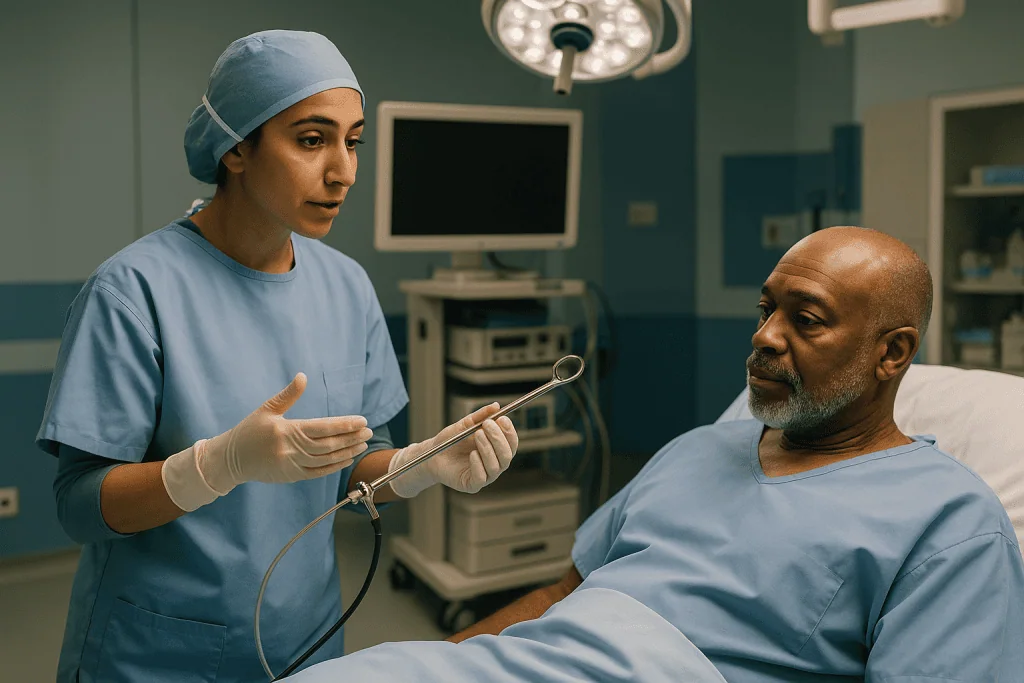
Anesthesia. You receive either a general anesthetic, in which you are fully asleep, or a spinal anesthetic, an injection into the lower back that numbs everything below the waist while you stay awake or lightly sedated. The anesthetist chooses with you, based on your health and preference. Antibiotics are typically given through a vein at this stage.
Positioning. Once you are asleep or numb, your legs are placed in padded supports so the surgeon can reach the urethra. The skin is cleaned and sterile drapes are laid.
Inspection. The resectoscope is lubricated and passed gently along the urethra. The bladder fills with fluid, and the surgeon performs a systematic tour of every wall, noting the size, number and position of any growths and drawing a map on a bladder diagram.
Resection. The wire loop is advanced and the tumor is shaved away in strips, working from the top down. The surgeon aims to take the visible tumor entirely, then to take a separate deeper sample from its base that includes the underlying muscle. Each strip is flushed out through the scope.
Hemostasis. Bleeding points are sealed with the electrical current. The surgeon checks the whole bladder again for anything missed.
Optional instillation. Where the tumor looks non-muscle-invasive and there is no sign of a hole in the bladder wall, many teams place a single dose of a chemotherapy drug into the bladder through the catheter before the person leaves recovery. The NHS describes this as a way to reduce the chance of cancer cells re-implanting.
Catheter. A soft tube is left in the bladder to drain urine and let the lining rest. The whole operation commonly lasts 15–60 minutes depending on how much needs removing.
Loop, laser or en bloc: how the cutting tools compare
Patients often hear a surgeon mention bipolar, monopolar, laser or en bloc and wonder whether they are being offered something better or worse. These are variations on a theme, not different operations. The table summarizes what each term means in plain language.
| Technique | What it means | Where it is commonly used | What the evidence says |
|---|---|---|---|
| Monopolar loop | Electric current passes through the body to a pad on the thigh; uses a non-salt irrigation fluid | Long-established standard in many centers | Well studied; occasional stimulation of the obturator nerve can make the leg jerk during cutting |
| Bipolar loop | Current travels only between two electrodes at the tip; allows saline irrigation | Increasingly common | Comparable tumor clearance; some studies suggest less nerve stimulation and less fluid-related electrolyte disturbance |
| Laser | Light energy vaporizes or cuts tissue | Small tumors, outpatient treatment of recurrences | Useful where tissue for diagnosis is less critical; vaporization can destroy the sample |
| En bloc resection | Tumor lifted out in one piece rather than strips, using loop, laser or a specialized tip | Selected tumors of suitable size and position | Produces a specimen that is easier for the pathologist to orient; long-term outcome comparisons remain under study |
Two points matter more than the label. First, whichever tool is used, the goal is complete removal with muscle in the specimen so staging is reliable. Second, the surgeon chooses the technique that fits the tumor in front of them; a very large or awkwardly placed growth may not suit en bloc removal, and a tiny recurrence may not warrant a full loop resection. If a term in your operation note is unclear, ask your team what it meant for your specific tumor rather than assuming one method is superior.
Why the surgeon wants muscle in the sample
A phrase that recurs in surgical notes and pathology reports is “detrusor muscle present” or “absent.” The detrusor is the bladder’s muscle layer, and whether it appears in the resected tissue turns out to be one of the most important quality markers of the whole operation.
The reason is staging. Bladder cancer is described by how deep it has grown: confined to the lining, into the connective tissue beneath the lining, or into the muscle. Treatment differs sharply at that muscle boundary. Mayo Clinic notes that muscle-invasive disease is usually managed with a combination of major surgery, chemotherapy or radiotherapy, while non-muscle-invasive disease is often managed with TURBT and treatments placed inside the bladder. A pathologist can only rule out muscle invasion if there is muscle in the sample to inspect.
This creates a balance for the surgeon. Cutting deeper captures muscle but brings the loop closer to the outer wall of the bladder, where a full-thickness hole, called a perforation, becomes possible. Cutting shallower is safer in the moment but may leave the team unable to say how far the cancer reached. Experienced surgeons manage this by taking the bulk of the tumor first, then a deliberate, controlled deeper bite from the base.
Some situations are forgiving of an absent muscle layer. Small, obviously low-grade, frond-like tumors in someone with a history of similar growths may not need it. In a first-time or high-grade tumor, its absence is a common reason for a second procedure a few weeks later, discussed further down. If your report says muscle was absent, that is not a failure; it is information your team will factor into what happens next.
Is TURBT major surgery? An honest answer
People hear “cancer operation” and picture a long scar and a week on a ward. TURBT is not that, but it is also more than a scan. The fairest description is a moderate procedure with a light footprint and a serious purpose.
On the side of “not major”: there is no incision, no muscle is cut on the way in, and most people are eating and walking within hours. The NHS describes it as usually taking under an hour, and both the NHS and Mayo Clinic note that many people go home the same day or after one night, once the catheter is out and they are passing urine comfortably. Pain is typically limited to a burning sensation on urination and a bladder-spasm cramp that eases over days rather than weeks.
On the side of “take it seriously”: it requires a general or spinal anesthetic, with all the ordinary anesthetic considerations. It carries real if uncommon risks, including bleeding heavy enough to need a return to theater and, rarely, a perforation of the bladder wall. It is also, for many people, the moment a cancer diagnosis becomes concrete, and the emotional weight of that deserves acknowledgment alongside the physical facts.
How it is classified matters less than how it is prepared for. Treat the anesthetic assessment seriously, be candid about medicines and alcohol, arrange help at home for the first couple of days, and plan for at least a short break from work. If your job involves heavy lifting or long hours on your feet, ask the team how long they would like you to modify duties, because that timeframe is individual and depends on how much tissue was removed and how much bleeding there was.
The first hours: catheters, cloudy bags and going home
Waking from a TURBT feels, for most people, like waking from any short anesthetic: groggy, a little cold, perhaps mildly nauseated. The first thing many notice is the catheter, a soft tube draining into a bag, and the color of what is in the bag. Pink or light red is expected. Nurses watch for it to clear over the following hours and may run fluid through the catheter to rinse the bladder if the urine is heavily blood-stained or contains clots.
A cramping urge to pass urine even though the catheter is draining is called bladder spasm. It is uncomfortable and alarming if you are not warned about it, and it is caused by the bladder muscle contracting against the catheter balloon and the raw resection site. Teams have medicines that ease spasm; ask rather than endure it. Pain from the operation itself is usually modest and managed with simple analgesics chosen by the team.
If a single dose of chemotherapy was placed in the bladder, the catheter is typically clamped for a period so the drug bathes the lining, then released. The NHS describes this instillation being given within the first day after surgery. Afterward you may be asked to wash hands carefully and flush the toilet twice for a day or so, because traces of the drug leave in the urine.
Catheter removal, when the urine has cleared, is brief and usually painless. You will need to pass urine a set number of times and have your bladder checked for emptying, often with a small ultrasound probe on the abdomen, before discharge. Expect a leaflet, a contact number for problems, and either a follow-up appointment or a promise of one once the pathology report is back, which commonly takes one to three weeks.
TURBT recovery time: what the following days and weeks look like
Recovery has a shape, and knowing it prevents unnecessary alarm. The first two to three days bring burning on urination, frequent trips to the toilet, and urine that fades from pink to amber. The NHS advises drinking enough fluid to keep urine pale, which dilutes it and helps flush small clots, while avoiding overloading yourself in a way that is exhausting.
Around the end of the first week, most people feel close to normal in terms of energy. Then, commonly between roughly 10 and 14 days, a second episode of light bleeding can occur. This is the scab over the resection site loosening as new lining grows beneath it, much as a graze on the knee bleeds slightly when the crust lifts. Patient guidance from the NHS and Mayo Clinic describes intermittent blood in the urine for up to a few weeks as within the expected range, provided you can still pass urine and feel well.
The bladder lining itself takes several weeks to heal fully. Urologists commonly describe 2–6 weeks for the raw area to re-epithelialize, and this window is why activity restrictions are set for a similar period. Sexual activity is generally paused until bleeding has stopped, because it increases pelvic blood flow and can restart it; your team will give a personal timeframe.
Emotionally, the waiting for pathology is often harder than the physical recovery. Many people describe the fortnight between operation and results as the worst part. It helps to know in advance who will call, roughly when, and what the possible next steps are, so the news arrives into a framework rather than a void. Ask for those details before you leave the hospital.
What not to do after TURBT
The list of restrictions is short, and each item has a mechanism behind it rather than tradition.
- Do not lift heavy loads or strain. Bearing down raises pressure inside the abdomen and pelvis, which can pop open sealed vessels at the resection site. Most guidance suggests avoiding anything heavier than a light shopping bag for about two weeks, with your team adjusting that to your operation.
- Do not let yourself become constipated. Straining on the toilet has the same effect as lifting. Fiber, fluid and, if needed, a laxative chosen by your team keep stools soft.
- Do not ignore a sudden inability to pass urine. A clot can block the outflow; this is one of the few genuine emergencies after TURBT and is covered below.
- Do not restart blood-thinning medicines on your own timetable. The prescribing clinician sets the day, weighing bleeding against clot risk.
- Do not drive for at least 24 hours after a general anesthetic, or longer if you are still taking sedating pain medicines or feel unwell.
- Do not soak in hot baths for long periods in the first days. Heat dilates blood vessels; short showers are fine.
- Do not assume that pink urine on day 12 is a disaster. Read the section above; it is usually the healing scab.
Things people wrongly avoid: gentle walking, which reduces the risk of leg clots and is encouraged from the first day; normal food; and coffee or tea in moderation, though some find caffeine worsens bladder irritation temporarily. Alcohol is best kept minimal while the bladder is raw, partly because it irritates the lining and partly because it interacts with pain medicines.
One further “do not”: do not stop attending follow-up cystoscopies once you feel well. The NHS notes that non-muscle-invasive bladder cancer frequently returns, and surveillance is how recurrences are caught while they are still small and treatable.
TURBT complications: the most common and the rare
Every procedure has a risk profile, and describing it candidly is part of consent. For TURBT, the risks cluster into three groups.
Common and usually minor. Bleeding is the most frequently reported complication, as Mayo Clinic and the NHS both describe. Most of it is the self-limiting pink urine already discussed. A small proportion of people bleed enough to need a catheter reinserted, bladder washouts, or occasionally a return to the operating room to seal a vessel. Urinary tract infection is the next most common; the burning that lingers past a few days, or a new fever, is the usual clue. Bladder spasm and temporary urgency are expected rather than complications, but they are worth naming because they are unpleasant.
Uncommon but important. Bladder perforation, a hole through the full wall, happens when the loop cuts deeper than intended, particularly in thin-walled bladders or when the leg jerks from nerve stimulation. Most perforations are small, stay outside the abdominal cavity and heal with a longer period of catheter drainage. A minority need open repair. Urethral injury or later scarring (a stricture) can narrow the stream over months and may need a minor procedure to widen it.
Rare. Absorption of irrigation fluid into the bloodstream during long monopolar resections can dilute the blood’s sodium; this is why bipolar systems using saline have become popular. Anesthetic complications and blood clots in the legs or lungs are risks shared with any operation, mitigated by early walking and stockings.
The frequencies of these events vary with tumor size, number and location, and with the individual. Your surgeon will quote figures relevant to your situation at consent, and those numbers are the ones to trust over anything general.
Second-look TURBT and what comes after the first operation
A phrase that surprises many patients is “we would like to do it again.” A repeat resection, often called a second-look or re-TURBT, is a planned second operation a few weeks after the first. It is not an admission that the first was botched.
Guidelines followed by UK and US urologists recommend a second resection in defined circumstances: when the first specimen contained no muscle and the tumor was not clearly low-grade, when the tumor was large or there were many of them so that complete removal is uncertain, and when pathology shows a high-grade tumor that has reached the connective tissue under the lining. In that last group, a meaningful proportion turn out to have deeper disease or residual tumor on the second look, which changes treatment. UK guidance (NICE) places this second procedure within about six weeks of the first.
After resection, the team decides on adjuvant treatment, meaning treatment given to lower the chance of recurrence. For lower-risk tumors this may be the single instillation already given, followed by surveillance cystoscopies. For intermediate and higher-risk non-muscle-invasive disease, the NHS describes a course of medication placed into the bladder over weeks, either a chemotherapy drug or an immune-stimulating agent originally derived from a tuberculosis vaccine strain. Both work by acting on cancer cells in the lining directly, with limited absorption into the rest of the body. The choice, schedule and duration sit entirely with the treating team.
Where muscle invasion is confirmed, TURBT has done its diagnostic job and the conversation moves to bladder removal, chemotherapy, radiotherapy or combinations, often through a multidisciplinary team. That is a different article, but it starts with the tissue collected in this one.
What people often get wrong about TURBT
“They removed the tumor, so I am done.” For many people with low-grade disease the TURBT is indeed the main treatment, but the NHS is clear that bladder cancer has a high tendency to recur elsewhere in the lining, sometimes years later. Surveillance is part of the treatment, not an afterthought.
“Blood in the urine two weeks later means it has come back.” Almost always it means the scab has lifted. Recurrence is detected by cystoscopy, not by the color of the urine in the first month.
“A second operation means the surgeon missed something.” Second-look resection is a guideline-driven step for specific pathology findings and is planned for quality reasons, as described above.
“No muscle in the sample means the surgeon did a poor job.” Sometimes; more often it reflects a deliberate balance against perforation, or a tumor type where muscle was not essential to the decision.
“Laser is more modern, so it must be better.” Laser vaporization can destroy the tissue the pathologist needs. Its place is in small, well-characterized recurrences, not in first diagnosis.
“The chemotherapy in the bladder will make my hair fall out.” Intravesical drugs act locally on the lining, with little absorption. Systemic effects such as hair loss are associated with chemotherapy given into the bloodstream, which is a different treatment for a different stage.
“Because there is no scar, I can go straight back to the gym.” The wound is inside, on a raw bladder wall, and behaves like any wound. Straining reopens it.
“I should stop my blood thinner myself to be safe.” The opposite: unsupervised stopping risks stroke or clot, and unsupervised restarting risks bleeding. The prescribing clinician decides both dates.
Questions to ask your care team before and after TURBT
Consultations are short and memory under stress is poor. Writing questions down, and bringing someone to listen, changes how much you take away. These are the questions urology nurses report patients most often wish they had asked.
Before the operation
- What did the cystoscopy show: how many growths, how large, and where in the bladder?
- Which anesthetic do you recommend for me, and why?
- Do I need to change any of my medicines, and who will tell me exactly when to stop and restart?
- Will you give a single dose of medication into the bladder at the end, and what would make you decide not to?
- How long do you expect I will have a catheter, and will I stay overnight?
- Who calls me with the pathology result, and roughly when?
After the result
- What grade and stage did the pathologist find, in plain terms?
- Was muscle present in the sample, and if not, does that matter for my case?
- Do you recommend a second-look resection, and what would it tell us?
- What is my risk category, and what surveillance schedule does that imply?
- Are you recommending treatment placed into the bladder, and what is the reasoning?
- If the cancer were to come back, what would the options be?
- Is there anything in my lifestyle, especially smoking, that changes my outlook?
- Who is my point of contact if I have a problem between appointments?
A team that welcomes these questions is doing its job well. If an answer is uncertain, a good clinician will say so, and that honesty is worth more than false reassurance.
When to call your doctor after TURBT: red-flag signs
Most recoveries are uneventful, but a few situations need same-day contact with your urology team or, out of hours, an emergency department. Keep the contact number from your discharge leaflet somewhere visible.
Seek urgent care if you experience any of the following:
- You cannot pass urine at all, or pass only dribbles with a painful, swollen lower abdomen. A clot may be blocking the outflow; this needs a catheter promptly.
- Urine that is deep red like wine rather than pink, contains large clots, or does not clear despite drinking, particularly if you feel faint or dizzy.
- Fever, shaking chills, or feeling suddenly very unwell. Infection can spread quickly from a raw bladder.
- Severe or worsening abdominal pain, especially with a rigid or tender belly, nausea or vomiting. This can indicate a perforation or fluid leakage.
- Calf pain or swelling, or sudden breathlessness and chest pain, which can signal a blood clot in the leg or lung.
- Burning on urination that is getting worse after the first few days rather than better, or cloudy, foul-smelling urine.
Signs that are usually fine but worth mentioning at your next contact include mild pink urine that comes and goes, brief spasms, and frequency that is slowly settling. When in doubt, call; urology teams would far rather field a question about pink urine than see someone arrive in retention at midnight.
A final word on the bigger picture. TURBT is the opening move in managing bladder cancer, and the pathology it produces shapes everything after it. The steps described here are the standard ones, drawn from mainstream guidance, but your bladder, your tumor and your health are individual. The plan that fits them will come from the people who have examined you, and every decision along the way should be made with them.
Frequently asked questions
How long does it take for the bladder to heal after a TURBT?
The raw area where the tumor was removed generally takes several weeks to regrow its lining, with urologists commonly describing a window of about 2–6 weeks. Symptoms settle sooner: burning and frequency usually ease within days, and energy returns within about a week. Intermittent pink urine can appear during the healing period. Your team will set activity restrictions to match the size of your resection.
What is the TURBT recovery time before returning to work?
Many people with desk-based jobs return within about a week, once bleeding has settled and they are no longer taking sedating pain medicines. Physically demanding work, especially lifting, is usually deferred for roughly two weeks or longer because straining can restart bleeding at the resection site. These are typical ranges from NHS and Mayo Clinic guidance; your surgeon will give a timeframe based on your operation.
What not to do after TURBT?
Avoid heavy lifting, straining on the toilet, prolonged hot baths and sexual activity until bleeding has stopped, because each raises pelvic pressure or blood flow and can reopen sealed vessels. Do not drive for at least a day after a general anesthetic, and never stop or restart blood-thinning medicines without instruction from the prescribing clinician. Gentle walking, by contrast, is encouraged from day one.
Is TURBT major surgery?
It sits between minor and major. There is no incision and most people go home within a day, which places it well short of open abdominal surgery. It does, however, require a general or spinal anesthetic and carries real if uncommon risks such as significant bleeding or bladder perforation. Preparing for it with the seriousness of any anesthetic procedure is the sensible approach.
What is the most common complication of TURBT?
Bleeding into the urine is the most frequently reported complication, according to Mayo Clinic and NHS patient guidance. Most of it is mild and self-limiting, but a small proportion of people need a catheter reinserted or a bladder washout, and occasionally a return to theater. Urinary tract infection is the next most common. Bladder perforation is uncommon and usually managed with longer catheter drainage.
Are you awake during a TURBT?
Usually not. Most TURBTs are done under a general anesthetic, in which you are fully asleep. Some are done under a spinal anesthetic, a numbing injection in the lower back, in which case you may be awake but feel nothing below the waist and can be given sedation. The anesthetist discusses the choice with you beforehand based on your health and preference.
Why does the surgeon want to do a second TURBT?
A planned second-look resection is recommended by guidelines in specific situations: when the first sample had no bladder muscle and the tumor was not clearly low-grade, when the tumor was large or multiple, or when the pathology showed a high-grade tumor reaching the connective tissue under the lining. It checks for residual or deeper disease and refines staging. It is quality control, not a sign of failure.
How long does TURBT take?
The operation itself commonly lasts between 15 and 60 minutes, depending on how many tumors there are and how large they are. The whole hospital episode is longer because of anesthetic preparation, recovery time and catheter care. NHS guidance describes many people going home the same day or after one night once they are passing urine comfortably.
What are the TURBT complications I should watch for at home?
Call your team urgently if you cannot pass urine, pass deep red urine or large clots, develop a fever or chills, have severe abdominal pain, or notice calf swelling or sudden breathlessness. These can signal a clot blocking the outflow, heavy bleeding, infection, perforation or a blood clot in the leg or lung. Mild pink urine that comes and goes is usually part of normal healing.
Does TURBT remove the cancer completely?
For many people with non-muscle-invasive bladder cancer, TURBT removes all visible tumor and is the main treatment, sometimes combined with medication placed in the bladder. Bladder cancer has a well-documented tendency to recur elsewhere in the lining, however, so the NHS describes ongoing surveillance cystoscopies as essential. Whether further treatment is needed depends on the pathology findings, which your team will explain.
References
This article is for general information only and is not a substitute for professional medical advice. Please consult a qualified doctor about your individual situation.

More from the Blog

How a Stem Cell Transplant Donor Is Chosen: HLA Typing and Matching Explained
A stem cell transplant donor is chosen mainly by HLA typing, a genetic test that reads the human leukocyte antigen markers on a person's…
What Happens During a Therapeutic Apheresis Session: Access, the Circuit and Return
During a therapeutic plasma exchange session, blood leaves the body through a needle or catheter, passes through a machine that separates the liquid plasma…
Questions to Ask Your Gynecologic Oncologist Before Vulvar Cancer Treatment
Before vulvar cancer treatment, ask your gynecologic oncologist what type and stage of cancer you have, whether surgery, radiation, chemotherapy or a combination is…
Your First Cancer Rehabilitation Visit: What to Bring and Which Daily Tasks to Write Down
For a first cancer rehab appointment, bring your treatment summary, a current list of medicines and supplements, any recent scan or lab reports, comfortable…
Inside a Breast Cancer Tumor Board: Who Sits at the Table and What Gets Decided
A breast cancer tumor board is a scheduled meeting where a surgeon, medical oncologist, radiation oncologist, radiologist and pathologist, often with a nurse navigator,…

Medicines After a Bone Marrow Transplant: Anti-Rejection, Antivirals and What Blood Tests Track
After a bone marrow (stem cell) transplant, most people take a combination of immunosuppressants to prevent graft-versus-host disease, plus preventive antiviral, antifungal and antibiotic…