

Bleeding, Breathing Changes or Fever After Head Cancer Treatment: When to Call Your Team
Key Takeaways
- The white blood cell count typically falls to its lowest point about 7–14 days after a chemotherapy dose, which is when a fever carries the most weight and cannot wait.
- Fever thresholds differ between services: many use 100.4°F (38°C), while NHS chemotherapy guidance uses 37.5°C or a low reading below 36°C, so the number on your own card is the one to follow.
- Pink or brown streaks in saliva during the first weeks after mouth or throat surgery are common; a change in pattern toward brighter, fresher or more blood is the signal to call.
- Stridor, a high-pitched noise on breathing in, means air is squeezing through a narrowed passage and is an emergency at rest at any stage of treatment.
- Radiation soreness in the mouth and throat usually peaks in the first one to two weeks after the final session, making the period just after treatment ends a high-risk window for aspiration, dehydration and infection.
- England's 62-day rule and the former two-week rule are health-system waiting-time targets from referral to treatment, not clinical rules about how long a symptom is safe to watch.
After head and neck cancer treatment, call your care team the same day for any fever at or above the threshold they gave you (commonly 100.4°F / 38°C), for bleeding that is more than faint pink streaks in saliva, or for breathing that feels harder than it did yesterday. Call emergency services for heavy bleeding from the mouth, neck or tracheostomy, noisy or labored breathing, or fever with confusion, chills or a racing heartbeat.
It is a quarter past eleven. Twelve days after surgery for a cancer of the tongue, a man rinses his mouth at the bathroom sink and watches the water swirl faintly pink. His neck feels warm along the incision. He has the team’s card on the fridge, and he has read it a dozen times, but the question he is really asking is smaller and harder: is this a phone call, or is this nothing?
Almost everyone treated for a cancer of the mouth, throat, voice box, sinuses or salivary glands ends up here at some point, usually late, usually alone with a thermometer or a tissue. People type the phrase head cancer treatment when to call into a search bar at odd hours because the discharge sheet covers the obvious and life covers everything else.
This explainer is about the three signals that matter most after treatment to the head and neck: bleeding, breathing changes and fever. It sorts the expected from the urgent, explains why each happens, and tries to make that late-night decision a little less lonely. None of it replaces the number on your card. All of it is meant to help you use it.
Head cancer treatment when to call: why bleeding, breathing and fever are the three signals
Head and neck cancers are a family of cancers that begin in the lining of the mouth, throat, voice box (larynx), nose, sinuses and salivary glands, as described by the NIH National Cancer Institute. Brain tumors are a separate group with their own warning signs, though some of the advice here, particularly about fever during chemotherapy, overlaps.
What makes this family different from, say, a cancer of the colon is geography. The same few inches of tissue carry air to the lungs, food to the stomach and blood to the brain. The carotid arteries run a finger’s width from the tonsils. The windpipe sits behind a thin sheet of skin. Anything that removes, burns, swells or infects tissue in this corridor tends to announce itself in one of three ways: blood where it should not be, breathing that changes, or a temperature that climbs.
That is why discharge instructions from head and neck teams look so similar across the world, and why this article is built around those three signals rather than a long menu of symptoms. A fourth signal deserves a mention because it hides behind the others: being unable to swallow enough fluid. Dehydration thickens secretions, raises heart rate and can mimic infection, so most teams ask to hear about it just as promptly.
The practical point is simple. You do not have to decide what is wrong. You only have to notice that one of the three signals has changed from yesterday and let the team decide what it means. Most calls end with reassurance and a note in the chart. The ones that do not are exactly the reason the number exists.
What actually happens to the tissues during head and neck cancer treatment
The three signals make more sense once you know what each treatment does to living tissue.

Surgery removes the tumor with a margin of healthy tissue around it. When the gap is large, surgeons often fill it with a free flap: a piece of skin, muscle or bone taken from the forearm, thigh or lower leg, moved to the neck with its own artery and vein, and stitched under a microscope to vessels in the neck. A flap is living tissue that depends on those tiny connections, which is why teams check its color and warmth so obsessively in the first days. Lymph nodes in the neck are frequently removed as well, leaving drains and a wound that crosses major blood vessels.
Radiation therapy uses high-energy beams to damage the DNA of dividing cells. Cancer cells divide fast, but so do the cells lining the mouth and throat, which is why the lining becomes inflamed and raw. That soreness has a name, mucositis, meaning inflammation of the moist lining of the mouth and throat. Saliva glands stall, skin reddens, and over months the treated tissue slowly stiffens, a process called fibrosis. The NHS notes that these effects usually build through a course and continue for a period after it ends.
Chemotherapy, most often a platinum-based drug given alongside radiation, circulates through the body and suppresses the bone marrow that makes white blood cells. Fewer neutrophils, the white cells that fight bacteria, means fever becomes a very different kind of warning.
Immunotherapy with immune checkpoint inhibitors works another way again: it releases natural brakes on the immune system so it can attack the tumor. The same release can inflame the lungs, gut, thyroid or skin, sometimes weeks after a dose.
Bleeding after neck surgery or radiation: what is expected and what is not
Some blood is part of healing here, and knowing what kind saves a great deal of worry.
In the first week or two after surgery inside the mouth or throat, saliva that is streaked pink or brown is common. Old blood from the wound bed loosens as tissue heals, and a raw surface may ooze a little after coughing, brushing or a first attempt at soft food. Drain fluid usually starts red and fades to straw-colored over a few days. During radiation, inflamed lining can bleed slightly when touched, and a spot of blood on a tissue after a cough is not unusual.
What the team wants to hear about the same day is any bleeding that is new, more than streaks, or persistent: repeated mouthfuls of blood, a wound edge that keeps weeping, a drain that suddenly refills with bright red fluid, or blood around a tracheostomy tube that does not stop with gentle suction and a few minutes of rest.
Brisk, bright-red bleeding from the mouth, nose, neck wound or tracheostomy is an emergency, full stop. The carotid and its branches lie beside many surgical and radiation fields, and in a small number of people, particularly after both surgery and radiation, a damaged artery wall can fail. Clinicians sometimes see a smaller warning bleed first, which is why teams take even a single unexplained mouthful of fresh blood seriously rather than waiting to see if it happens again.
If heavy bleeding starts, sit upright, lean forward so blood drains out of the mouth rather than down the throat, press firmly on a neck wound with a clean cloth if that is where it comes from, and have someone call emergency services while you do so.
Breathing problems after radiotherapy or surgery: swelling, stridor and aspiration
Breathing rarely fails suddenly after head and neck treatment. It usually changes first, and the change is the message.
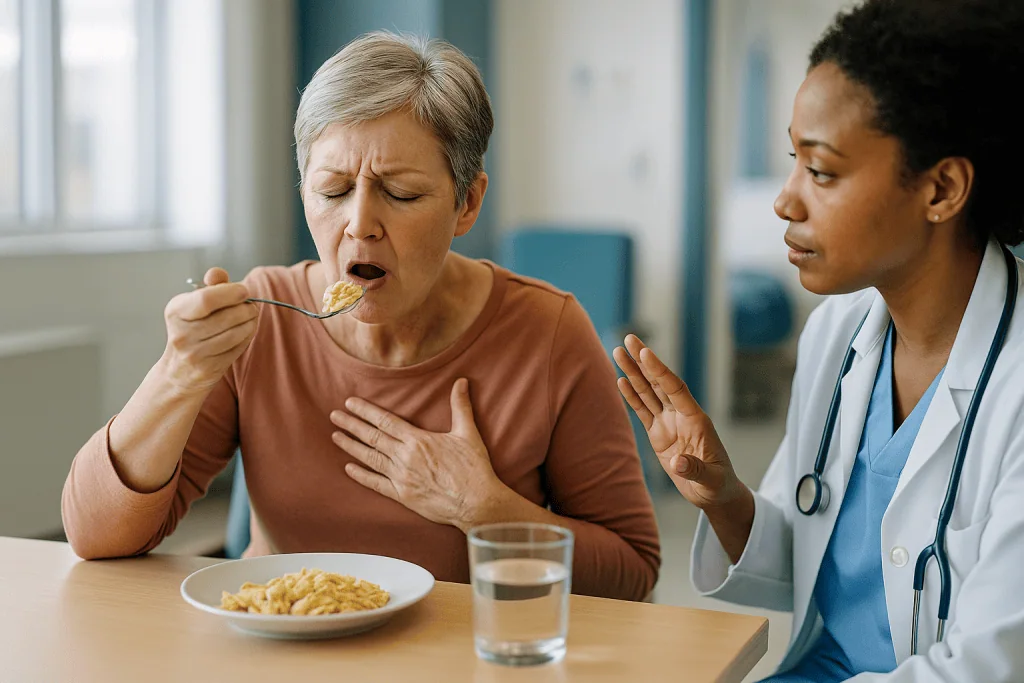
Swelling is the most frequent cause. Surgery and radiation both inflame the throat and voice box, and lymphedema, a build-up of fluid when lymph channels have been removed or scarred, can puff the neck and the inside of the throat for weeks. Most of the time this feels like fullness or a hoarse voice. When it narrows the airway, breathing takes on a sound. Stridor is a high-pitched, whistling or crowing noise, usually on the in-breath, that means air is squeezing through a narrowed passage. It is different from a wheeze, which is lower and comes mostly from the chest. Stridor at rest is an emergency at any stage of treatment.
Aspiration is the second cause. Treatment can weaken the muscles and nerves that close the airway during a swallow, so liquid or food slips toward the lungs. A cough during meals, a wet or gurgly voice afterwards, or a low fever a day or two after a coughing fit at dinner can all point to aspiration and, if it continues, to pneumonia. The NHS lists swallowing difficulty and its complications among the common after-effects of treatment to this region.
People with a tracheostomy, an opening made through the front of the neck into the windpipe, have a third cause: a tube partly blocked by dried mucus. The NHS tracheostomy guidance stresses humidity, regular cleaning and prompt help if the tube blocks, because a plug can shrink airflow quickly.
The rule of thumb most teams give is honest and useful: if you could not do yesterday’s activity today without stopping for breath, that is a same-day call. If you are struggling at rest, that is emergency services.
Head and neck cancer fever: why the thermometer matters more than how you feel
Fever after head and neck cancer treatment is the signal people most often underrate, because it so rarely feels dramatic at first.
A fever is the body raising its temperature in response to infection or inflammation. After treatment to this region there are more places than usual for bacteria to take hold: a wound that crosses saliva, a raw radiation-burned lining, a flap, a drain site, a feeding tube through the abdominal wall, or a lung that has quietly received a mouthful of soup. Each is manageable when caught early. Each becomes harder once infection spreads into the bloodstream.
The threshold matters, and it is not universal. Many teams and the Cleveland Clinic use 100.4°F (38°C) as the number that triggers a call. Some services, including NHS chemotherapy guidance, ask patients to call at 37.5°C (99.5°F) or above, and also for a temperature that has dropped below 36°C (96.8°F), because a low reading can be an early sign of sepsis. Use the number your own team wrote down, not the one a neighbor remembers.
Measure rather than guess. Fever-reducing medicines can mask a rising temperature, so some teams ask patients to check before taking them or to avoid them altogether during chemotherapy cycles; follow whatever your prescriber advised. A thermometer under the tongue may be unreliable if the mouth is full of sores or has been operated on, so an under-arm, ear or forehead reading, whichever your team recommends, is better than skipping the check.
Chills, shaking, a heart that feels fast at rest, new confusion or sleepiness, or simply feeling much worse than an hour ago should never wait for the thermometer to confirm them.
Head cancer treatment when to call: a quick-reference table
Written instructions from your own team override anything here, but most head and neck programs sort the three signals into roughly the same three lanes. The table is meant to be photographed and kept next to the phone number.
| Signal | Usually expected | Call the team the same day | Call emergency services |
|---|---|---|---|
| Bleeding | Pink or brown streaks in saliva in the first weeks; drain fluid fading from red to straw | Repeated mouthfuls of blood; a wound that keeps weeping; a drain refilling with bright red fluid; blood at a tracheostomy that does not settle | Brisk, bright-red bleeding from the mouth, nose, neck or tracheostomy; any single large fresh bleed |
| Breathing | Hoarseness, mild neck fullness, more mucus than usual | Breathlessness with activity you managed yesterday; a wet, gurgly voice after meals; a tracheostomy that needs constant clearing | Stridor or struggling for breath at rest; blue or gray lips; a tracheostomy tube that will not clear |
| Fever | A slightly warm feeling with normal readings; mild flushing on radiation days | Any reading at or above your team’s threshold, even once; a low reading below 36°C; chills without a fever | Fever with confusion, severe shaking, a racing heart, mottled skin, or passing very little urine |
| Swallowing and fluids | Discomfort, slow meals, preference for soft foods | Unable to keep down fluids for a day; very dark urine; a feeding tube that will not flush | Choking that does not resolve; unable to swallow saliva with drooling and distress |
Two habits make the table work. First, the middle lane means today, not the next scheduled visit. A same-day call is often a two-minute conversation and an adjustment, not an admission. Second, when a signal sits between two lanes, it belongs in the more urgent one. Teams would rather field an unnecessary call at 2 a.m. than meet a preventable emergency at 8.
Who these rules are usually for, and who is asked to watch and wait
Vigilance is not the same for everyone, and knowing where you sit helps you calibrate.
The people asked to call soonest are those in the highest-risk windows. Anyone within the first two to three weeks of major surgery, especially with a free flap, a tracheostomy or a neck dissection, is in one. So is anyone receiving chemotherapy, because the white cell count typically falls to its lowest point about 7–14 days after each dose, according to NHS guidance on chemotherapy side effects, and that is precisely when a fever is most likely to signal a serious infection. People in the final weeks of radiation and the first few weeks after it, when the lining is rawest and swallowing weakest, sit in a third window. Those on immune checkpoint inhibitors are asked to report fever, cough or diarrhea at any point during treatment and for some time after, because immune-related inflammation does not follow a neat schedule.
Watching and waiting is what teams ask of a different group: people several months into surveillance, with healed wounds and stable swallowing, who notice a symptom in the expected column. Faint streaks of blood after brushing a dry mouth, a warm day and a reading a fraction below the threshold, a voice that is hoarse by evening: these are worth a note in a diary and a mention at the next appointment, not a midnight call.
Two caveats keep this honest. Watching and waiting always has an expiry, usually 24 hours for something that should have settled and did not. And the categories are about the treatment phase, not about being tough. A person months into recovery who develops a fever with shaking chills is back in the emergency lane immediately, whatever the calendar says.
What the first days and weeks after treatment usually look like
Timelines here are typical ranges drawn from mainstream guidance, not promises. Your team will tell you where your own recovery sits.
After surgery, swelling and wound discomfort peak in the first few days and then ease. Drains usually come out once output falls and pales. Pink saliva fades over the first one to two weeks as the wound bed heals. If a tracheostomy was placed, the team plans its removal around swelling and swallowing rather than a fixed date. The NHS notes that recovery from head and neck surgery varies widely with the extent of the operation, and that speech and swallowing therapy commonly starts while wounds are still healing.
Radiation works on a slower curve. Mouth and throat soreness usually begins in the second or third week of a course, worsens toward the end, and often peaks in the first one to two weeks after the last session, before gradually improving over the following weeks and months, as the NHS describes. Skin redness follows a similar arc. Dry mouth and taste changes can persist far longer, sometimes permanently, and treated tissue may stiffen over months. This is why the highest-risk period for aspiration, dehydration and infection is often just after radiation ends, when appointments thin out and people expect to feel better.
Chemotherapy given with radiation adds a rhythm of its own: the 7–14 day trough in white cells after each dose is when fever carries the most weight.
Beyond the first months, the signals do not disappear but they change meaning. New bleeding, breathing difficulty or fever long after treatment can point to late effects such as a jaw bone that heals poorly after radiation, an underactive thyroid, narrowing of a treated artery, or, occasionally, a returning cancer. Any of these deserves a prompt call, not a wait for the next routine scan.
Neutropenic fever symptoms and sepsis: the fever that cannot wait
One kind of fever gets its own section because it changes how quickly medicine has to move.
Neutropenia means a low count of neutrophils, the white blood cells that swallow bacteria. Chemotherapy causes it by slowing the bone marrow, and the Cleveland Clinic describes the count typically reaching its lowest point one to two weeks after treatment before recovering. During that trough, a minor infection that a healthy body would contain, in a tooth socket, a drain site or a lung, can spread into the bloodstream within hours.
Neutropenic fever is a fever that occurs while the count is low. The uncomfortable truth is that its symptoms are often mild at first, because the very cells that produce redness, pus and obvious illness are missing. A person may simply feel cold, tired, or a little muddled, and register a temperature at or just above the threshold. That is why cancer teams treat the number itself as the alarm: a single reading at threshold during chemotherapy is a call now, day or night, without waiting to see if it comes down.
Sepsis is the body’s overwhelming, damaging response to infection. The NHS sepsis guidance lists warning signs that apply to anyone, but especially to someone recently treated for cancer: confusion or slurred speech, extreme shivering or muscle pain, passing no urine for a day, severe breathlessness, skin that is mottled, blotchy or blue-tinged, and a feeling that something is very badly wrong. Any of these with a fever, or even without one in a person on chemotherapy, means emergency services, not the clinic line.
Hospitals treat suspected neutropenic sepsis as a time-critical emergency, with blood tests and antibiotics started quickly, often before results return. The decision about which antibiotic, and for how long, belongs entirely to the admitting team.
Tracheostomies, feeding tubes, flaps and clots: the problems that are not the cancer
Much of what goes wrong after head and neck treatment has nothing to do with whether the cancer is gone. It has to do with plumbing, hardware and healing.
A tracheostomy needs moist air, regular cleaning and a spare tube close at hand. Thick or discolored secretions, a tube that needs suctioning far more often than usual, or a sound of air struggling past a partial blockage all warrant a same-day call; a tube that cannot be cleared is an emergency. Bleeding at the stoma, the opening in the neck, is common in small amounts after suctioning but should not persist.
A feeding tube placed through the abdominal wall into the stomach can leak, block or become inflamed around the skin. Spreading redness, warmth, pus or fever near the site is a call the same day. A tube that will not flush is not an emergency in itself, but going a day without fluids or medicines through it can quickly become one.
A free flap is monitored closely in hospital, but problems occasionally surface after discharge. A flap that turns pale, dusky purple, cold or firm, or a wound that suddenly swells and tightens, needs urgent assessment because the tissue’s blood supply may be threatened.
Blood clots deserve a mention in any breathing discussion. Cancer, surgery and reduced mobility each raise the risk of a clot forming in a leg vein and traveling to the lungs. A swollen, painful calf, or sudden breathlessness with sharp chest pain, particularly on breathing in, should be treated as an emergency until proven otherwise. Teams often prescribe clot-prevention measures after major surgery; whether and how long is their decision, based on your risk.
What people often get wrong about calling after head and neck cancer treatment
The myths here are understandable, and most of them come from a wish not to be a burden.
The first is that a fever means the cancer is back. It almost never does in the weeks after treatment. Fever is overwhelmingly a sign of infection or of inflammation from treatment, and both are treatable problems. Delaying a call out of dread only makes the treatable problem bigger.
The second is that a little blood is fine because there was some yesterday. Streaks in saliva can be fine. A trend toward more, brighter or fresher blood is not, and neither is a single mouthful of bright red blood with no obvious cause. The question is not whether blood is present but whether the pattern has changed.
The third is that nights and weekends are for emergencies only. Cancer teams staff their lines around the clock precisely because chemotherapy troughs and flap problems do not respect office hours. A call that turns out to be nothing costs a few minutes. A fever that waits until Monday can cost days in hospital.
The fourth is that fever-reducing medicine has fixed the problem once the reading drops. It has hidden the reading. During chemotherapy in particular, many teams ask to hear about the original number regardless of what happened after a tablet.
The fifth is that breathing difficulty must be sudden to matter. Most airway problems in this setting creep: a hoarser voice, a slower walk to the mailbox, a wet cough after tea. Noticing the creep is the skill.
The last is that the person who feels reasonably well cannot be seriously ill. In neutropenia, feeling well is exactly what a dangerous infection can look like. The thermometer, not the mood, makes the call.
The 2-week rule, the 62-day rule and the timelines people search for
Two phrases keep appearing in searches about head cancer treatment when to call, and they refer to waiting-time targets rather than to red flags. They are worth understanding because they shape expectations, and because confusion about them can cause people to sit on a symptom.
Both come from England’s National Health Service. The two-week rule described a standard that anyone urgently referred by a family doctor with suspected cancer should be seen by a specialist within two weeks. The NHS guide to waiting times explains that this has been superseded by a Faster Diagnosis Standard, under which patients should be told whether or not they have cancer within 28 days of an urgent referral. The 62-day rule is the target that a patient’s first treatment should begin within 62 days of that urgent referral. These are system performance targets, not clinical rules about what is safe for an individual; other countries use different frameworks, and no target should stop anyone from seeking care sooner for a symptom that worries them.
A related question is how long a cancer takes to move from stage 1 to stage 4. There is no fixed answer, and honest sources do not give one. Staging describes how far a cancer has spread at the moment it is measured; progression depends on the tumor’s site, its biology, whether it is linked to HPV in the throat, and on individual factors nobody can fully predict. Some head and neck cancers grow over many months; others advance faster. What the evidence does support is that earlier detection generally allows a wider choice of treatments, which is the real reason behind those targets.
After treatment, the same logic applies to the three signals. The sooner a bleed, a breathing change or a fever is assessed, the more options the team usually has.
Questions to ask your care team before you go home
The most useful call is the one you already know how to make. Before discharge, or at the first follow-up, these questions turn a generic instruction sheet into a plan written for you.
- What temperature reading should make me call, and should I check it before or instead of taking anything for fever? Which method of measuring do you want me to use, given my mouth surgery or sores?
- How much blood in my saliva is expected for someone with my operation, and for how long? What does a warning bleed look like, and what should I do in the first two minutes if heavy bleeding starts?
- Which breathing changes are expected with my swelling or radiation field, and which would you want to hear about today? If I have a tracheostomy, who do I call if the tube blocks, and where is my spare?
- When is my white cell count expected to be lowest after each chemotherapy dose, and does the fever threshold change during that window?
- If I am on immunotherapy, which symptoms should I report even weeks after a dose?
- Who answers the line at night and at weekends, and what should I say first so the call is routed quickly?
- How will I know if my flap, wound or feeding tube site is healing normally, and what change would make you want to see it the same day?
- What should I do if I cannot swallow enough fluid for a day?
- Are there clot-prevention steps you want me to follow at home, and for how long?
Write the answers on the same card as the phone number. Recovery is a poor time to rely on memory, and a partner or friend who has the card can make the call when you cannot speak clearly.
When to call your doctor
Every decision about what these signs mean, and what to do about them, rests with your treating team. Your job is to notice and to call. The list below reflects mainstream guidance from the NHS, the Cleveland Clinic and the NIH National Cancer Institute, but the specific thresholds your own team gave you take precedence.
Call your cancer team the same day, at any hour, for: a temperature at or above your threshold, even once, or a reading below 36°C (96.8°F); chills or shaking without a fever, especially during chemotherapy; blood in saliva that is more than streaks, or any bleeding that persists or increases; breathlessness with activity you managed the day before; a wet or gurgly voice, or coughing during meals that is new or worse; spreading redness, warmth, pus or increasing pain at a wound, drain, flap or feeding tube site; a flap that looks pale, dusky or feels cold; being unable to keep down fluids for a day, or very dark urine; a tracheostomy needing constant clearing; or new cough, diarrhea or rash if you are receiving immunotherapy.
Call emergency services, or have someone call while you sit upright and lean forward, for: brisk bright-red bleeding from the mouth, nose, neck or tracheostomy; stridor or struggling to breathe at rest; blue or gray lips or fingertips; a tracheostomy tube that will not clear; fever with confusion, slurred speech, severe shivering, mottled skin, a racing heart or very little urine; a swollen painful calf with sudden breathlessness or chest pain; or a sense that you are rapidly getting worse.
If you are unsure which list you are on, use the more urgent one. The people who staff these lines expect uncertainty, and they would far rather talk you down than meet you too late.
Frequently asked questions
What temperature counts as a fever after head cancer treatment?
It depends on the threshold your team set, so use theirs. Many programs, including the Cleveland Clinic, ask for a call at 100.4°F (38°C) or above. NHS chemotherapy guidance uses a lower bar of 37.5°C, and also asks patients to call if the reading drops below 36°C, because a low temperature can be an early sign of sepsis. Measure rather than guess, and report the original reading even if a fever-reducing tablet brought it down.
Is a little blood in my saliva normal after head and neck surgery?
Small amounts often are, in the first one to two weeks. Old blood from the wound bed loosens as tissue heals, so saliva that is streaked pink or brown after coughing, brushing or eating is common. What is not expected is bleeding that increases, turns bright red, arrives in mouthfuls, or keeps going. Any single large fresh bleed from the mouth, neck or tracheostomy is an emergency; a changing pattern is a same-day call.
What are neutropenic fever symptoms and why are they so urgent?
Neutropenic fever is a fever that occurs while chemotherapy has lowered the neutrophils that fight bacteria, typically one to two weeks after a dose. Symptoms are often mild because the cells that produce obvious signs of infection are missing: a person may just feel cold, tired or slightly muddled. Because infection can spread to the bloodstream within hours, any reading at your threshold during this window is a call now, whatever the time.
What is the 62 day rule for cancer?
It is a waiting-time target in England’s National Health Service stating that a patient’s first cancer treatment should begin within 62 days of an urgent referral from a family doctor. It measures how quickly a health system moves, not how long an individual can safely wait. Other countries use different frameworks, and no target should stop anyone from seeking care sooner if a symptom worries them or changes.
What is the 2 week rule for cancer?
The two-week rule was an NHS standard that anyone urgently referred with suspected cancer should see a specialist within two weeks. According to the NHS guide to waiting times, it has been replaced by the Faster Diagnosis Standard, under which patients should be told whether or not they have cancer within 28 days of an urgent referral. Like the 62-day rule, it is a performance target rather than a clinical rule about symptoms.
Can head and neck cancer be treated successfully?
Many head and neck cancers are treated with the aim of removing or controlling the disease, using surgery, radiation, chemotherapy, immunotherapy or a combination, as the NIH National Cancer Institute describes. How likely that is for any one person depends on the site, the stage at diagnosis, whether a throat cancer is linked to HPV, and general health. Only your treating team can give you an honest, individual picture, and it is fair to ask for one.
How much time does cancer take from stage 1 to stage 4?
There is no fixed timeline, and reliable sources do not give one. Stage describes how far a cancer has spread when it is measured, and progression depends on the tumor’s site, its biology and individual factors that cannot be fully predicted. Some head and neck cancers grow over many months; others advance faster. What the evidence does support is that earlier detection generally allows a wider choice of treatments.
What causes breathing problems after radiotherapy to the neck?
Most often swelling. Radiation inflames the throat and voice box, and fluid can build up when lymph channels are scarred, narrowing the airway. Weakened swallowing can also let liquid slip toward the lungs, causing coughing at meals and sometimes pneumonia. Effects usually peak toward the end of a course and in the first weeks after it. Breathlessness with activity you managed yesterday is a same-day call; noisy breathing at rest is an emergency.
Should I call my cancer team at night or wait until morning?
Call at night if the signal is on the same-day list: a fever at threshold, bleeding beyond streaks, breathing that is harder than yesterday, or a device or wound problem. Cancer teams staff their lines around the clock because chemotherapy troughs and flap problems ignore office hours. A call that turns out to be nothing costs minutes; a fever that waits until morning during neutropenia can cost days in hospital.
Can immunotherapy cause fever weeks after the last dose?
Yes. Immune checkpoint inhibitors release natural brakes on the immune system, and the resulting inflammation of the lungs, gut, thyroid, liver or skin does not follow a neat schedule; it can appear during treatment or some time after it ends. Teams therefore ask people on these medicines to report fever, new cough, breathlessness, diarrhea or rash promptly rather than waiting for the next visit, so the cause can be sorted out early.
References
This article is for general information only and is not a substitute for professional medical advice. Please consult a qualified doctor about your individual situation.

More from the Blog

Is a Second Pathology Review Useful for Lymphoma? Why Subtype Accuracy Matters
A second pathology review of a lymphoma biopsy is widely considered worthwhile, especially before treatment begins. Lymphoma has dozens of subtypes that can look…

Preparing for HIPEC: Bowel Preparation, Fasting and the Medication Review Before Surgery
Preparing for HIPEC usually begins several weeks before surgery and centers on three tasks: a structured medication review covering blood thinners, diabetes medicines and…

What the Pathology Report Says After Basal Cell Carcinoma Removal and Why Margins Matter
After basal cell carcinoma removal, the pathology report confirms the diagnosis, names the growth pattern (subtype), and states whether cancer cells reach the cut…
Can a Second Opinion Change a Pancreatic Cancer Plan? When Surgical Review Is Requested
A second opinion can change a pancreatic cancer plan, though it more often confirms one. A surgical review re-reads the scans to judge whether…

What a Neck Dissection Removes and How the Neck Heals After Surgery
A neck dissection removes lymph nodes, and the fatty tissue around them, from defined zones of the neck so a pathologist can check whether…
Staging Stomach Cancer: What Endoscopy, CT and Laparoscopy Each Contribute
Stomach cancer staging tests work as a set. Endoscopy with biopsy confirms the diagnosis and, with endoscopic ultrasound, measures how deeply the tumor has…