

Can a Reverse Tummy Tuck Be Combined With Breast Surgery? Sharing the Same Incision Line

Key Takeaways
- A reverse tummy tuck pulls upper abdominal skin upward into the crease beneath the breasts, the same inframammary fold used by many breast lifts, reductions and augmentations, which is what allows a single shared incision.
- The reverse approach treats only the area above the navel and gives poor access to separated lower abdominal muscles, so it is usually a complement to, not a replacement for, a standard tummy tuck.
- Sharing one incision means two skin flaps with lifted blood supply meet at the same line, which is why wound-healing problems at the fold are the complication surgeons watch most closely and why smoking is treated so seriously.
- If skin must be removed from the center of the upper abdomen, the two fold incisions may join across the sternum, creating a short scar segment that low necklines can reveal.
- Recovery guidance from the Mayo Clinic and NHS for the individual procedures points to roughly one to two weeks off work and about six weeks before heavy lifting or strenuous exercise, with the combined operation realistically at the longer end.
- No high-quality trial compares doing both procedures together versus in stages; surgeons choose based on total operating time, medical history, body mass, and whether implants are involved.
Yes. A reverse tummy tuck, which removes loose skin from the upper abdomen through an incision hidden in the fold beneath the breasts, can often be combined with a breast lift, reduction, or augmentation because the procedures share the same inframammary incision line. Whether combining is appropriate depends on skin quality, general health, smoking status, and the surgeon's assessment, so the decision is made case by case with a plastic surgeon.
She has already had one long scar. The standard tummy tuck she underwent years ago fixed the lower belly, and she is glad she did it. What bothers her now is the roll of skin that folds over the top of her bra band when she sits, plus breasts that have drifted lower after two pregnancies. Two problems, two operations, two more scars: that is the arithmetic she has been dreading. Then a surgeon mentions a reverse tummy tuck with breast lift, done through a single line under the breasts, and the arithmetic changes.
It is a reasonable question and a surprisingly under-explained one. Most patient information covers the classic abdominoplasty. Far less explains the upside-down version, or what happens when a breast operation borrows the same incision.
This explainer walks through the anatomy, the sequence in the operating room, who tends to be a good fit, what the scar really looks like, and the honest limits of the evidence. Every decision, as always, sits with the treating team.
What is a reverse tummy tuck with breast lift?
A reverse tummy tuck, known in surgical language as a reverse abdominoplasty, is an operation that removes loose skin and fat from the upper abdomen by pulling the tissue upward rather than downward. The incision sits in the inframammary fold, the natural crease where the underside of each breast meets the chest wall. A standard tummy tuck does the opposite: it makes a low horizontal incision near the pubic hairline and pulls skin down toward it.
A breast lift, or mastopexy, reshapes and raises breasts that have sagged by removing excess skin and repositioning the nipple. Several breast-lift patterns use an incision in that same inframammary fold. So when a surgeon proposes a reverse tummy tuck with breast lift, the idea is anatomical economy: one crease, one line of stitches, two zones addressed.
The combination is not new, but it is uncommon. According to the Mayo Clinic’s overview of abdominoplasty, the conventional tummy tuck targets the area below the navel and remains the default for most people with loose abdominal skin. The reverse approach is reserved for a narrower group: those whose laxity sits mainly above the belly button, often because a previous lower abdominoplasty tightened everything below it, or because significant weight loss left a fold high on the torso.
Why does that matter for a reader weighing the idea? Because the published evidence on reverse abdominoplasty consists largely of smaller surgical case series rather than large comparative trials. That does not make it experimental; it is a recognized technique taught in plastic surgery training. It does mean that claims about how it compares to other approaches should be read cautiously, and that the surgeon’s individual experience with the technique becomes a legitimate thing to ask about.
How does sharing the same incision line actually work?
Think of the torso as two sheets of skin meeting under the breast. Above the fold is breast skin; below it is abdominal skin. When a surgeon performs a breast lift through an inframammary incision, they already have access to that crease. A reverse abdominoplasty simply extends the work downward from the same opening: the surgeon lifts the upper abdominal skin off the underlying muscle layer, draws it upward, trims the surplus, and stitches the new edge back into the crease.

The critical detail is blood supply. Skin survives after surgery only if enough small vessels still feed it. Abdominal skin receives blood from vessels rising from below and from perforating branches that come through the muscle wall. A breast receives its supply from several directions, including branches that pass near the fold. When both operations happen in the same field, the surgeon must plan so that neither dissection cuts off the other’s supply. This is the main reason the combination requires deliberate planning rather than simply bolting two procedures together.
Tension is the second concern. Upward pull on the abdominal skin and downward settling of a freshly lifted breast meet at the same line. If the closure is too tight, the fold can be dragged downward over time, blunting the crease that defines the lower breast. Surgeons manage this by anchoring deeper tissue layers to the chest wall so the skin edge itself is not carrying the load.
The result, when planning goes well, is a single scar that runs along the underside of each breast, sometimes joining across the midline of the chest and sometimes left as two separate curves. Whether the midline segment is needed depends on how much skin must be removed from the center of the upper abdomen, a point covered in the scar section below.
What happens in the operating room, step by step
Most combined procedures are performed under general anesthesia, meaning the patient is fully asleep with breathing supported by an anesthesiologist. The Mayo Clinic notes that abdominoplasty is typically done under general anesthesia, and the same is true for most breast lifts.
Before anything is cut, the surgeon draws the plan on the standing patient. Skin sags differently when lying flat, so markings made upright are more reliable. The lines mark the new fold position, the amount of abdominal skin to be removed, and the breast-lift pattern.
The sequence then usually runs in this order, although individual surgeons vary:
- The inframammary incision is made on each side.
- The breast procedure is carried out first or second depending on the plan. Lifting the breast first lets the surgeon set the final fold position before the abdominal skin is pulled to meet it.
- The upper abdominal skin is separated from the muscle layer down to roughly the level of the navel, keeping the perforating vessels intact where possible.
- The skin flap is drawn upward, the excess is measured and removed, and deeper layers are anchored to the rib cage and chest wall fascia, the tough connective tissue sheet covering muscle.
- The skin edges are closed in layers with absorbable sutures beneath the surface and fine sutures or adhesive strips on the skin.
Small tubes called surgical drains may be placed to draw off fluid that collects under the skin in the first days. The Mayo Clinic’s abdominoplasty guidance describes drains as commonly left in place for several days after surgery. A compression garment or surgical bra is applied before the patient wakes.
Operating time depends on how much is being done. A lift alone, a lift with implants, or a lift with reduction each add different amounts of time, and the surgeon will give an individual estimate rather than a general figure.
Upper abdominoplasty with breast augmentation, reduction or lift: which combinations are common?
Three breast procedures pair naturally with an upper abdominoplasty because each can be done through the inframammary fold.

A breast lift on its own is the most straightforward partner. The surgeon removes breast skin, tightens the envelope, raises the nipple if needed, and the abdominal skin is pulled up to the reset crease. When the lift requires only a fold incision, the combined scar is essentially invisible in a bra or bikini top.
Breast reduction removes glandular tissue as well as skin to make breasts smaller and lighter. It usually needs additional incisions around the nipple and vertically down to the fold, forming an anchor or lollipop shape. The fold portion still shares its line with the reverse tummy tuck. Reduction adds surgical time and a larger volume of tissue removal, which can slightly increase the risk of fluid collections and healing delays, so surgeons weigh the total burden carefully.
Upper abdominoplasty with breast augmentation, meaning placement of implants, is the combination that raises the most planning questions. An implant adds weight and forward projection to the breast. That extra load pulls on the very fold where the abdominal closure is anchored. Surgeons managing this pairing pay particular attention to how the deep tissue is fixed to the chest wall so the fold does not migrate downward as the implant settles. The Mayo Clinic notes that breast lift results are not permanent and that aging, gravity, and weight change continue to alter breast shape; an implant does not stop that process.
Fat transfer to the breast, where the patient’s own fat is injected for modest volume, is sometimes discussed as an alternative to implants in the same operation. Its role here is limited, and the evidence for durability of transferred fat volume is mixed, so it should be described as an option with uncertainties rather than a proven equivalent to implants.
Who is a candidate for a reverse tummy tuck, and who is usually asked to wait
The ideal profile is specific. Surgeons generally look for loose skin concentrated in the upper abdomen, above the navel, with relatively good tone below. Common backgrounds include a previous standard tummy tuck that left the upper zone untouched, substantial weight loss that produced a fold beneath the ribs, or age-related laxity in someone with a naturally short torso.
Breast sagging severe enough to justify a lift, or a wish for reduction or augmentation, is the second half of the equation. If the breasts do not need surgery, a reverse abdominoplasty alone creates a scar under breasts that would otherwise have none, and many surgeons consider that trade unattractive.
Stable weight matters. Both the NHS and Mayo Clinic advise that abdominoplasty is best done when weight has been steady, because further loss loosens the skin again and gain stretches the result. Anyone planning pregnancy is also usually asked to wait, since pregnancy stretches the abdominal wall and breasts.
Smoking is the factor surgeons speak about most bluntly. Nicotine narrows small blood vessels, and skin flaps that depend on marginal blood supply are exactly the tissue that suffers. The NHS guidance on tummy tuck notes that surgeons commonly ask patients to stop smoking before the operation because it impairs healing. The combined procedure, with two dissections converging on one fold, leaves even less margin.
People are usually asked to defer or reconsider when they have:
- Poorly controlled diabetes, which slows wound healing.
- A history of blood clots, which raises the risk of deep vein thrombosis after long operations.
- Unrealistic expectations, such as hoping the reverse approach will tighten the lower abdomen or remove deep fat.
- Significant abdominal wall weakness or hernia needing repair, which the reverse approach reaches poorly.
None of these is an automatic refusal. Each is a conversation with the surgeon and, where needed, other specialists.
Reverse tummy tuck vs. standard tummy tuck: how do they compare?
Patients often arrive assuming the reverse version is simply a smaller or gentler tummy tuck. It is neither. It is a different operation aimed at a different zone, and it does not do several things the standard procedure does well.
| Feature | Reverse tummy tuck | Standard tummy tuck |
|---|---|---|
| Incision location | Inframammary fold under the breasts | Low horizontal line near the pubic area |
| Direction of pull | Upward | Downward |
| Zone treated | Upper abdomen, above the navel | Lower abdomen, often the whole front wall |
| Navel | Usually left in place | Usually repositioned through a new opening |
| Muscle repair | Limited access; rarely the main goal | Frequently includes tightening of separated abdominal muscles |
| Natural partner procedure | Breast lift, reduction or augmentation | Liposuction of flanks, hernia repair |
| Scar visibility | Hidden in bra line; may cross the chest midline | Hidden in underwear line; hip to hip |
| Frequency | Uncommon | Among the most common body contouring operations |
The muscle row deserves a pause. Many people who want a tummy tuck after pregnancy have diastasis recti, a separation of the two vertical abdominal muscles that leaves a soft bulge. The Mayo Clinic describes muscle tightening as a routine component of standard abdominoplasty. The reverse approach reaches the upper part of that muscle but gives poor access to the lower portion, so anyone whose main complaint is a post-pregnancy bulge is usually better served by the conventional route, or by a conventional tummy tuck first and a reverse procedure later if an upper fold remains.
Neither operation is a weight-loss tool. Both remove skin and a modest layer of fat. Deep visceral fat inside the abdomen, the kind that makes a belly firm rather than soft, is untouched by either.
Reverse tummy tuck scar: where the line ends up and how it heals
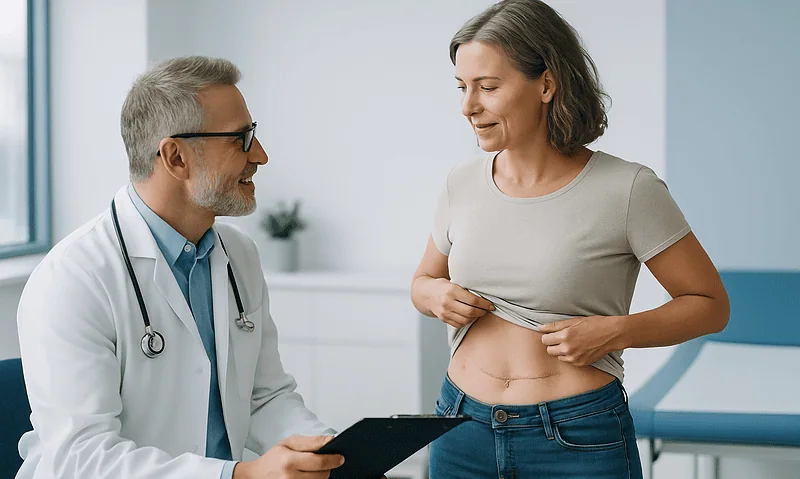
The scar is the reason this combination exists, so it deserves honest description. On each side, the incision runs along the underside of the breast, following the crease. In a woman with well-defined folds and moderate breast size, that line disappears when the breast rests on the chest.
The question patients rarely anticipate is the midline. If the surgeon needs to remove skin from the center of the upper abdomen, the two fold incisions must join across the sternum, the flat bone in the middle of the chest. That short connecting segment sits over bone, not under a breast, and can be visible in low necklines. Some surgeons avoid it by leaving a gap and accepting slightly less central tightening; others include it when the central fold is the main complaint. Which trade-off applies is a conversation to have before surgery, ideally with the plan drawn on the skin.
Skin over the sternum also tends to scar more thickly than skin elsewhere. Raised or widened scars are more likely there, and people with a history of keloids, which are scars that grow beyond the original wound, are at higher risk.
Scar maturation is slow. The NHS tummy tuck guidance notes that scars may take a year or more to fade and will never disappear entirely. The Mayo Clinic breast lift information gives a similar range, describing scars that are red and raised at first and typically soften and lighten over one to two years. A reverse tummy tuck scar follows the same biology: pink and firm for months, then gradually paler and flatter.
Wearing supportive garments, protecting the line from sun, and avoiding tension on the closure during early healing are the measures most surgeons recommend. Silicone-based scar dressings are widely used; the evidence for them is modest but generally favorable, and the care team will advise on timing.
What are the risks of combining the two procedures?
Every risk that attaches to a breast lift or an abdominoplasty attaches to the combination. Some are heightened because the two dissections meet.
Wound healing problems at the fold top the list. The inframammary line bears tension from above and below, and the skin edges receive blood from flaps that have both been lifted. Delayed healing, small openings in the incision, or loss of a strip of skin along the edge are the complications surgeons watch for most closely in the first two weeks. Smokers and people with diabetes carry higher risk.
Fluid collections come next. A seroma is a pocket of clear fluid under the skin; a hematoma is a pocket of blood. Both can occur after either procedure and are more likely when a large area has been lifted. The Mayo Clinic lists seroma among the most common complications of abdominoplasty. Drains reduce but do not eliminate the risk. Small collections often resolve on their own; larger ones may need drawing off with a needle in clinic.
Sensation changes are expected to some degree. The Mayo Clinic breast lift guidance notes that numbness of the nipple or breast skin can occur and that it is often temporary but sometimes lasting. Upper abdominal skin can also feel numb for months as small nerves regrow.
Asymmetry, fold migration, and blunting of the crease are aesthetic risks specific to this pairing. If the anchoring holds unevenly, one fold may sit lower than the other, or the crease may lose definition as the abdominal skin pulls it down.
General surgical risks apply as well: infection, bleeding, reaction to anesthesia, and blood clots in the legs or lungs. Longer combined operations increase clot risk, which is why surgeons prescribe early walking, compression stockings, and sometimes anticoagulant medicine, a class of drugs that reduces the blood’s ability to clot. Decisions about such medicine rest with the surgical and anesthesia team.
Reverse abdominoplasty recovery time: what the first days and weeks usually look like
Recovery from the combination resembles recovery from each procedure alone, with the chest and upper abdomen doing most of the complaining. Published timelines refer to the individual operations; the figures below are drawn from those and should be read as typical ranges, not promises.
The first two or three days are the sorest. Sitting up from lying down uses the very muscles beneath the incision, so most people sleep propped on pillows for the first week or so. Drains, if placed, are usually removed within several days according to the Mayo Clinic’s abdominoplasty guidance. A surgical bra and an upper-body compression garment are worn continuously.
By the end of the first week, most people are walking around the house comfortably and showering. The Mayo Clinic advises breast lift patients to expect to take about one to two weeks off work, and the NHS suggests a couple of weeks off after a tummy tuck. For a combined procedure, the longer end of those ranges is the more realistic planning figure, and people with physical jobs often need more.
Lifting is the main restriction. Raising the arms above the head or lifting anything heavier than a light bag pulls directly on the fold. The Mayo Clinic breast lift guidance advises avoiding heavy lifting for about six weeks, and both the Mayo Clinic and NHS give a similar six-week horizon before resuming strenuous exercise after abdominoplasty. The Mayo Clinic also describes wearing an abdominal support garment for about six weeks.
Swelling settles gradually over the following months. The final shape of the fold and the upper abdomen is typically judged at around six months to a year, once swelling has gone and the scar has begun to mature.
Driving usually waits until the person can turn and brake without pain and is no longer taking sedating pain medicine, a decision that belongs with the surgeon.
One operation or two? How surgeons decide about staging
Combining procedures has obvious appeal: one anesthetic, one recovery, one bill of time away from work and family. Surgeons also value the ability to set the fold once with both procedures in view rather than committing to a breast position and then discovering the abdominal skin will not comfortably meet it.
Staging, meaning doing the breast operation and the reverse abdominoplasty on separate occasions, has its own logic. A longer single operation means more time under anesthesia, more blood loss, and higher clot risk. When a large breast reduction or extensive weight-loss skin removal is planned, some surgeons prefer to split the work so that no single session becomes excessive. Staging also lets the first scar settle before the second dissection disturbs the same field, which some surgeons believe protects the blood supply to the fold.
Which approach is safer for a given person depends on factors the surgeon and anesthesiologist weigh together:
- Total expected operating time.
- Body mass, since higher weight increases anesthetic and clot risk.
- Medical history, especially clotting disorders, heart or lung disease, and diabetes.
- The amount of tissue to be removed from each zone.
- Whether implants are involved, since the added weight changes fold dynamics.
There is no high-quality trial comparing combined and staged reverse abdominoplasty with breast surgery. The honest summary is that both are practiced, that combining is common when the total work is moderate and the patient is healthy, and that staging is chosen when the surgeon judges the combined burden too great. Patients sometimes hear one approach described as clearly superior; the evidence does not support that certainty either way.
Ask which approach the surgeon recommends for your specific case and why. The reasoning matters more than the label.
What people often get wrong about reverse tummy tucks
Myths gather around uncommon operations because so few people have direct experience to correct them. Several deserve plain correction.
“It’s a scarless tummy tuck.” It is not. The scar is real and permanent; it is simply placed where a bra strap or bikini top covers it. The NHS tummy tuck guidance is clear that scars from abdominoplasty fade but do not vanish.
“It replaces a standard tummy tuck.” For most people it does not. Loose skin below the navel, stretch marks low on the belly, and separated abdominal muscles are all better addressed from below. The reverse procedure is a complement, often a second stage, not a substitute.
“Combining saves recovery time by half.” Combining saves a second anesthetic and a second block of time off, but the recovery from a combined operation is longer and sorer than from either alone. Someone who has had a breast lift before should expect more, not the same.
“It will fix the fat under my ribs.” It removes skin and a thin layer of fat directly beneath it. It does not treat fat inside the abdomen, and it does not tighten the waist the way people sometimes picture.
“The fold incision means no nipple scars.” That is true only when the breast procedure is a lift or augmentation that needs the fold alone. Reductions and larger lifts require incisions around the nipple and down the breast; the fold segment is shared, but the rest is additional.
“Any plastic surgeon does these routinely.” Most do not. Because the procedure is uncommon, experience varies widely. Asking how often a surgeon performs reverse abdominoplasty, and how they plan fold anchoring, is a fair and useful question.
“Results are permanent.” The Mayo Clinic notes that breast lift results are not permanent; skin continues to age, and weight change alters everything. The same applies to the abdomen.
What are the alternatives to a combined procedure?
The right alternative depends on which problem bothers the person most.
A standard tummy tuck remains the default when laxity involves the whole front of the abdomen or when muscle separation contributes to the bulge. An extended version can reach around the flanks. If, after that operation, an upper fold persists, a reverse abdominoplasty can follow later.
Liposuction alone removes fat but does not remove skin, and it can worsen laxity in someone whose skin has already lost elasticity. It suits people with good skin tone and localized fat, which is not the usual profile for someone considering a reverse tummy tuck.
Breast surgery alone is a reasonable choice when the upper abdominal fold is mild. Lifting or reducing the breasts sometimes changes how the upper abdomen looks simply by removing the overhang that pressed on it, and some people find that sufficient.
Non-surgical skin tightening devices using radiofrequency or ultrasound energy are marketed for mild laxity. The evidence for meaningful tightening of a true skin fold is weak, and they should not be expected to substitute for excision when there is genuine excess skin. Describing them as an option for mild cases with modest expectations is fair; describing them as an equivalent is not supported.
Doing nothing is also an alternative, and a legitimate one. Surgery for appearance is elective. The NHS cosmetic surgery guidance encourages people to take time, seek more than one opinion where possible, and be certain about motivations before proceeding.
Weight stabilization comes before any of these. If weight is still changing, the sensible course is to wait until it has been steady for a period the surgeon considers adequate, because operating on a moving target wastes both the scar and the recovery.
Questions to ask your care team
A consultation goes better with a list. These questions are framed to draw out reasoning rather than yes-or-no answers.
- Is my loose skin mainly above the navel, or would a standard tummy tuck serve me better?
- How often do you perform reverse abdominoplasty, and how often combined with breast surgery?
- Which breast procedure do you recommend for me, and does it need incisions beyond the fold?
- Will the incision cross the midline of my chest? Can you draw the planned scar on me while I stand?
- How will you anchor the fold so it does not migrate downward, particularly if implants are involved?
- Would you do this as one operation or two, and what makes you lean that way in my case?
- What is your plan for preventing blood clots during and after surgery?
- Do I need drains, and for roughly how long?
- What would make you cancel or postpone on the day?
- What complications have you seen with this combination, and how were they managed?
- How will my ability to breastfeed or my nipple sensation be affected?
- What happens if I gain or lose weight, or become pregnant, afterward?
- Who do I call out of hours if something looks wrong, and how quickly will I be seen?
- Is the anesthesia given by a physician anesthesiologist, and where will I recover?
Write down the answers. Comparing notes from two consultations often reveals where surgeons genuinely disagree, which is itself useful information. A surgeon who welcomes these questions and answers with specifics about your anatomy, rather than generalities, is giving you a good sign.
If anything in the plan is unclear after the consultation, ask for a second appointment before signing consent. Elective surgery has no deadline that matters more than understanding what is about to happen.
When to call your doctor
Most recoveries are uneventful. A minority involve problems that improve dramatically when caught early, which is why the surgical team will give you a direct contact number. Use it. Surgeons would far rather hear about a false alarm than see a preventable complication a week late.
Contact the surgical team the same day if you notice any of the following:
- Rapid swelling of one breast or one side of the upper abdomen, especially if it feels tight, hot, or looks bruised, which can signal a hematoma.
- An area of skin along the incision that turns dusky, purple, or black, or a section of the wound that opens.
- Spreading redness, increasing pain, warmth, or thick discharge from the incision, which can indicate infection.
- Fever, chills, or feeling generally unwell in the days after surgery.
- A drain that suddenly stops producing fluid while the area swells, or drain fluid that becomes bright red in volume.
Seek emergency care immediately, by calling emergency services, for:
- Chest pain, sudden shortness of breath, coughing up blood, or a racing heartbeat. These can indicate a pulmonary embolism, a blood clot that has traveled to the lungs.
- Pain, swelling, warmth, or redness in one calf or thigh, which the NHS describes as typical signs of deep vein thrombosis.
- Heavy bleeding that soaks dressings and does not slow with firm pressure.
- Fainting, confusion, or a severe allergic reaction with facial swelling or difficulty breathing.
Numbness, mild swelling, pulling sensations at the fold, and moderate bruising are expected in the early weeks and are not emergencies, but if something worries you and you cannot tell which category it belongs to, call. The treating team knows your operation and is the right judge. This article cannot replace that call, and nothing here should delay it.
Frequently asked questions
Can a reverse tummy tuck be done at the same time as a breast lift?
Yes, the two are frequently combined because both can be performed through an incision in the fold under the breasts. The surgeon lifts the breast, sets the new crease, and then draws upper abdominal skin up to meet it. Whether combining is right for a specific person depends on health, skin quality, smoking status, and how much tissue must be removed, all judged by the treating surgeon.
How long is reverse abdominoplasty recovery time compared with a standard tummy tuck?
The published timelines are similar. The NHS suggests a couple of weeks off work and about six weeks before strenuous activity after a tummy tuck, and the Mayo Clinic gives comparable ranges for breast lift. Combined procedures tend to sit at the longer end of those ranges, with sleeping propped up and lifting restrictions the main practical differences. Individual recovery varies, and the surgeon sets the actual timeline.
What does a reverse tummy tuck scar look like?
It runs along the underside of each breast in the natural crease and is usually covered by a bra or bikini top. If skin must be removed from the center of the upper abdomen, a short segment may cross the chest between the breasts, which is more visible. According to the NHS and Mayo Clinic, such scars fade over a year or more but remain permanent.
Who is a candidate for a reverse tummy tuck?
The typical candidate has loose skin concentrated above the navel, often after a previous standard tummy tuck or major weight loss, combined with breasts that would benefit from a lift, reduction, or augmentation. Stable weight, no plans for pregnancy, not smoking, and controlled medical conditions are generally expected. Anyone whose main issue is lower abdominal laxity or muscle separation is usually directed to a conventional approach.
Can upper abdominoplasty be combined with breast augmentation instead of a lift?
It can. Implants are often placed through the same fold incision, so the pairing is anatomically convenient. The added weight and projection of an implant pull on the fold where the abdominal skin is anchored, so surgeons pay particular attention to fixing deeper tissue to the chest wall. Fold migration or blunting of the crease over time is a recognized risk that should be discussed beforehand.
Does a reverse tummy tuck tighten abdominal muscles?
Only to a limited degree. The fold incision gives access to the upper part of the abdominal wall but reaches the lower portion poorly. The Mayo Clinic describes muscle tightening as a routine part of standard abdominoplasty, where the low incision allows the surgeon to repair the full length of separated muscles. People whose main complaint is a post-pregnancy bulge are usually better served by the standard operation.
Will the combined operation affect nipple sensation or breastfeeding?
Possibly. The Mayo Clinic notes that breast lift can cause temporary or occasionally permanent changes in nipple sensation, and reductions carry a higher chance of affecting the ability to breastfeed because glandular tissue and ducts are removed. The reverse abdominoplasty itself does not add to breast-specific risks, but the choice of breast procedure does. Anyone planning future breastfeeding should raise this before deciding on the pattern of surgery.
Is it safer to have the two procedures in separate operations?
There is no high-quality evidence proving one approach safer than the other. Combining means one anesthetic and one recovery but a longer operation, which raises clot and healing risk. Staging spreads the burden and lets the first scar settle before the second dissection. Surgeons decide based on total operating time, body mass, medical history, and the amount of tissue being removed. Ask your surgeon which they recommend and why.
What is the most common complication after a reverse tummy tuck with breast surgery?
Problems at the shared incision line are the ones surgeons watch most closely, including delayed healing, small wound openings, and fluid collections called seromas. The Mayo Clinic lists seroma among the more common complications of abdominoplasty generally. Because the fold carries tension from both directions and the skin edges come from lifted flaps, careful anchoring, drains where used, and avoiding smoking all matter. Most such problems are manageable when reported early.
How long before the final result of a reverse tummy tuck is visible?
Swelling settles over several months, and scars continue to mature for a year or more according to NHS and Mayo Clinic guidance on the individual procedures. Most surgeons assess the settled shape of the fold and upper abdomen somewhere between six months and a year. The result is not permanent; the Mayo Clinic notes that aging, gravity, and weight change continue to alter breast and skin shape afterward.
References
This article is for general information only and is not a substitute for professional medical advice. Please consult a qualified doctor about your individual situation.

More from the Blog

Brazilian Tummy Tuck vs BBL: Two Very Different Procedures Behind Similar Names
A "Brazilian tummy tuck" is a marketing name for an abdominoplasty, an operation that removes loose abdominal skin, tightens the muscle wall and often…
Tummy Tuck Scars: Placement, Healing Stages and Realistic Long-Term Appearance
Tummy tuck scars are permanent, but they typically fade substantially over time. The main scar runs low across the abdomen from hip to hip,…
How Long Do Mommy Makeover Results Last? Weight, Future Pregnancy and Aging Explained
Mommy makeover results typically last many years, but they are not frozen in time. Tummy tuck and liposuction changes hold best when weight stays…

Who Is a Candidate for an Arm Lift? Loose Upper-Arm Skin, Weight Stability and Skin Quality
An arm lift candidate is usually an adult whose upper-arm looseness comes mainly from excess skin rather than fat alone, whose weight has held…

Is CoolSculpting for Weight Loss? Why It Only Suits Pinchable Fat and a Stable Weight
No. CoolSculpting, the brand name for a technique called cryolipolysis, is not a weight loss treatment. It cools a small, pinchable pocket of fat…

J Plasma vs Tummy Tuck: When Skin Tightening Energy Is Enough and When It Is Not
Energy-based skin tightening, including helium plasma devices sold under the J Plasma name, heats the underside of the skin to shrink mild to moderate…