

Cervical Disc Replacement vs ACDF: Preserving Motion vs Fusing the Level

Key Takeaways
- The decompression step that relieves nerve or spinal cord pressure is identical in cervical disc replacement and ACDF; the two operations differ only in what fills the empty disc space.
- Randomized trials were designed to show disc replacement is at least as good as fusion for pain and function, not better, and that is broadly what they found.
- Replacement requires a mobile level, dense bone, healthy facet joints, and usually nerve-root rather than spinal-cord symptoms; worn facets, osteoporosis, instability, or kyphosis point toward fusion.
- Adjacent segment disease is partly a fusion effect and partly normal aging, and current evidence suggests replacement reduces but does not eliminate the chance of a later operation nearby.
- Disc replacement has its own downsides, including device wear, unwanted bone growth that can stiffen the level, and a more involved revision if the implant must come out.
- After a healed single-level fusion there is very little most people are told never to do again; the meaningful restrictions belong to the months while bone is knitting.
Cervical disc replacement and ACDF both remove a damaged neck disc through the front of the neck to free a pinched nerve or the spinal cord. ACDF then fuses the two vertebrae into one solid bone, while disc replacement inserts a movable implant to keep that level moving. Trials show broadly similar symptom relief, so the choice usually rests on bone quality, joint wear, and alignment, decided with your surgical team.
Two glossy brochures sit on the kitchen table. One shows a stainless-steel plate and four tiny screws. The other shows a sleek little hinge, a ball-and-trough device the size of a thumbnail. The person reading them has spent four months with an electric ache running from the neck down into the thumb and index finger, has tried physical therapy and time, and has just been told by a surgeon that either operation would address the problem. Pick one, essentially.
That moment is where most people meet the phrase cervical disc replacement vs ACDF, and it can feel like being asked to choose between two languages you don’t speak. The good news is that the choice is smaller than it looks. The first half of both operations is identical. The difference lies entirely in what happens to the empty space once the offending disc is gone.
What follows is the honest version: what each procedure does, what the trials really found, where the marketing runs ahead of the data, and which questions are worth carrying into your next appointment.
What does cervical disc replacement vs ACDF actually mean?
The neck has seven stacked bones, the cervical vertebrae, separated by discs that act as spacers and shock absorbers. Each disc has a tough outer ring and a soft center. With age or injury, that center can bulge or leak through the ring, a herniated disc, or the disc can flatten and the surrounding joints can grow bone spurs, a wear pattern called cervical spondylosis (NHS). Either way, something ends up pressing on a nerve root or the spinal cord itself.
ACDF stands for anterior cervical discectomy and fusion. In plain words: go in through the front of the neck (anterior), take out the disc (discectomy), and join the two bones together so they heal into one (fusion). Surgeons typically fill the gap with a spacer of bone or synthetic material and hold it steady with a small plate and screws while the bone knits (Johns Hopkins Medicine).
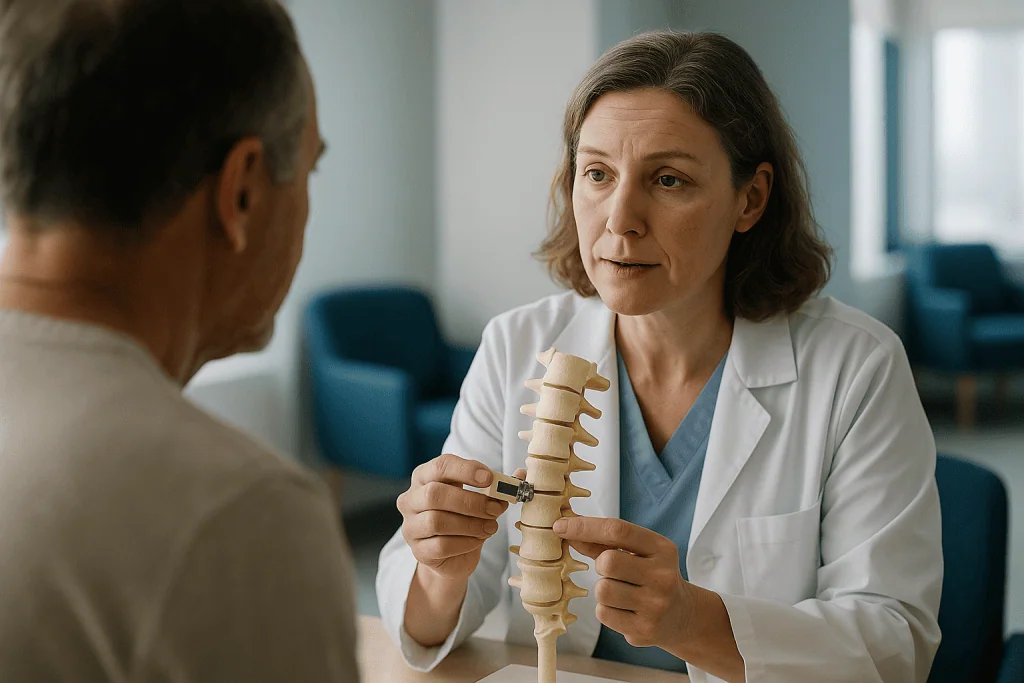
Cervical disc replacement, also called cervical disc arthroplasty, uses the same front-of-neck approach and the same disc removal. Instead of fusing, the surgeon fits an artificial disc, usually two metal endplates with a moving core between them, so the level continues to bend and rotate.
So the honest headline is this: the two operations share their most important step, decompressing the nerve or cord. Where they part ways is philosophy. Fusion trades motion for stability. Replacement keeps motion and accepts a mechanical device that must last. Almost every real difference between them, from recovery restrictions to long-term worries, flows from that single divergence.
What actually happens during each operation?
Both procedures happen under general anesthesia, lying on the back, with the head gently steadied. The surgeon makes a short horizontal incision along a natural skin crease on one side of the front of the neck. This route is chosen because it lets the surgeon move the windpipe and food pipe gently to one side and reach the spine without cutting through the thick neck muscles at the back (Johns Hopkins Medicine).
Once the front of the vertebrae is visible, an X-ray confirms the correct level. The disc is then removed piece by piece, along with any bone spurs pressing on the nerve root or the spinal cord. Many surgeons use an operating microscope for this part. Freeing the nerve is the therapeutic heart of both operations, and it is exactly the same in each.
Here the paths split. In ACDF, the surgeon measures the empty space, inserts a spacer packed with bone graft or a bone-stimulating material, and secures a thin titanium plate across the two vertebrae with screws. The hardware is scaffolding; the true fix is the living bone that grows through the spacer over the following months (Mayo Clinic).
In disc replacement, the surgeon prepares the flat surfaces of the two vertebrae, sizes the implant precisely, and seats an artificial disc whose endplates grip the bone above and below. The moving core between them allows the level to flex and turn. No plate is needed, because the device itself holds position.
The incision is then closed, often with dissolvable stitches. From the outside the two operations look nearly identical; a person waking up afterward would not be able to tell which one they had by feel alone.
Cervical fusion vs disc replacement: what is the real trade-off?
Fusion has a long track record. Surgeons have been fusing neck levels for decades, so its behavior over many years is well understood. A solid fusion is durable, needs no moving parts, and removes the painful, arthritic joint from the equation entirely. What you give up is a small amount of neck movement at that level, and you shift the mechanical work that level used to do onto its neighbors above and below.
That shifting of work is the whole reason disc replacement exists. The theory, and it is a sensible one, is that if the operated level keeps moving, the adjacent discs will be spared the extra strain and wear more slowly. The condition surgeons worry about is called adjacent segment disease: new degeneration at the level next to a fusion that becomes symptomatic. Some of this is simply the natural aging of a neck that was already wearing out; some may be the fusion’s fault. Untangling the two has proved difficult.
Replacement carries its own trade. A mechanical device sits in the spine for life. It can wear, loosen, or, in some people, get surrounded by unwanted new bone that gradually stiffens the level anyway, a process called heterotopic ossification. And because it relies on healthy bone to grip, it is unsuitable when the vertebrae are soft or the small joints at the back of the neck are badly worn.
An honest surgeon will frame it like this: neither operation is superior across the board. Each is the better tool for a particular neck. Your job as a patient is not to pick a winner in the abstract but to understand which anatomy you have, because that, far more than preference, decides the answer.
Who is usually offered a cervical artificial disc?
Picture the person most likely to hear “you’re a good candidate for replacement.” They are typically in their thirties to fifties, with a single herniated disc pressing on one nerve root, causing arm pain, tingling, or weakness in a specific pattern. This is cervical radiculopathy: irritation of a nerve root where it leaves the spine, producing symptoms along that nerve’s territory (Cleveland Clinic). Their X-rays show a neck that still moves normally at the affected level, their bone is dense, and the small paired joints behind the spine, the facet joints, are not worn out.

The pattern matters because an artificial disc only helps if there is motion worth preserving. A level that is already stiff, collapsed, and bridged by bone spurs will not suddenly become supple with a new device inside it. Surgeons look for a level with reasonable disc height, no instability on bending X-rays, and no significant kyphosis, which is a forward-bent alignment of the neck.
Symptom type plays a role too. Replacement is most often chosen when the problem is a nerve root rather than the spinal cord. When the cord itself is compressed, a condition called myelopathy that can cause clumsy hands, balance trouble, or a stiff, unsteady gait, many surgeons still lean toward fusion because it gives the cord the most predictable, stable environment to recover in.
People also need to have tried the non-surgical route first. Most herniated discs improve with time, activity modification, and physical therapy, and surgery is generally reserved for persistent or progressive nerve symptoms (MedlinePlus). An artificial disc is not a shortcut around that waiting period; it is one of two options at the end of it.
Who is not a candidate for cervical disc replacement?
This is where honest counseling saves people from disappointment. The list of reasons a surgeon might steer someone away from an artificial disc is longer than most brochures admit, and none of the reasons reflect on the patient. They reflect on the device’s engineering limits.
- Advanced facet joint arthritis. If the joints behind the disc are worn, keeping the level moving keeps those arthritic joints grinding. Fusion quiets them; replacement does not.
- Low bone density. Osteoporosis, a condition where bones lose mineral and become fragile, makes it hard for the implant’s endplates to anchor. The device can sink into soft bone.
- Instability or spondylolisthesis. If one vertebra has already slipped forward on the one below, the level needs to be stabilized, not kept mobile.
- Significant kyphosis. A neck bent forward at the operated level often needs the corrective leverage that a fusion with a plate provides.
- Active infection, prior neck radiation, or certain inflammatory arthritides. Each compromises bone healing or grip.
- Metal sensitivity. Uncommon, but relevant to a permanent implant.
- Multilevel severe spondylosis. Replacement is best studied at one or two adjacent levels; long stretches of collapsed discs are usually fused.
Age itself is not a hard cutoff. A physically active person in their sixties with good bone and a mobile level may qualify, while a younger person with worn facets may not. Surgeons decide from imaging: standing X-rays, bending views, an MRI, and sometimes a CT scan to assess bone spurs and joint wear, or a bone density scan when fragility is suspected.
If you are told you are not a candidate, it is reasonable to ask which of these factors applied. The answer will also tell you a great deal about why fusion is the sounder choice for your neck.
Cervical disc replacement vs ACDF side by side
Sometimes the most useful thing is to see the two operations lined up, feature by feature. The table below reflects how mainstream sources and surgical guidelines describe them in general terms; your surgeon may adjust any row for your specific situation.
| Feature | ACDF (fusion) | Cervical disc replacement |
|---|---|---|
| Approach and decompression | Front of neck; disc and bone spurs removed | Identical |
| What fills the space | Bone spacer plus plate and screws; bone heals into one unit | Movable artificial disc; no plate |
| Motion at the level | Eliminated once fused | Preserved, usually close to normal |
| Main long-term concern | Extra strain on neighboring discs; failure of bone to fuse (pseudarthrosis) | Device wear or loosening; unwanted bone growth stiffening the level |
| Ideal anatomy | Almost any, including worn facets, instability, soft bone, spinal cord compression | Mobile level, good bone, healthy facets, one or two levels, mainly nerve root symptoms |
| Track record | Decades of follow-up | Well studied over many years, but shorter overall history |
| Typical early restrictions | Often more cautious while bone knits; collar sometimes used | Often earlier return to gentle motion; collar less commonly used |
| Revision if problems arise | Well-established pathways | Device may need removal and conversion to fusion |
Two things jump out. First, the rows that matter most, decompression and symptom relief, read “identical” or close to it. Second, the deciding rows are anatomical. If you find yourself in the “ideal anatomy” column for replacement, you genuinely have a choice. If not, the table has already made it for you, and that is not a loss; it is the operation that fits.
One caution: online tables often add a row promising faster recovery or fewer future surgeries for one side. Those rows depend on data that is more mixed than the confident phrasing suggests, which is why they are absent here and discussed carefully in the next section.
What does the evidence actually show?
Cervical disc replacement earned its place through randomized trials that compared it directly against ACDF at one or two levels, following patients for years. Those trials were designed to prove non-inferiority, a statistical term meaning “at least as good as,” not “better than.” On the outcomes that matter most to patients, arm pain, neck pain, and function, the two operations performed similarly. Replacement met its non-inferiority target; in some analyses it edged ahead on certain measures, in others the difference was not meaningful.
The more interesting question is what happens to the neighboring levels. Here the evidence is genuinely mixed. Several long-term trial reports and pooled analyses found fewer subsequent operations at adjacent levels after replacement than after fusion. Others found the rates of visible adjacent-level degeneration on X-ray were similar, which suggests that some of what gets blamed on fusion is simply a neck aging as it would have anyway. A cautious reading is that replacement probably reduces, but does not eliminate, the chance of a second operation nearby, and that the size of that benefit is still being defined.
Two features of these studies deserve mention. Many were funded by device manufacturers, which does not invalidate them but is a reason to read the confident summaries skeptically. And the trials enrolled carefully selected patients with mobile levels and good bone, exactly the people described earlier. Results in that group do not automatically apply to someone with worn facets or osteoporosis, who would not have qualified.
So the fair summary is this: for the right patient, replacement is a proven, mainstream alternative to fusion with a plausible and partly demonstrated long-term advantage. For everyone else, fusion remains a very good operation with the longest track record in the field (Mayo Clinic). Neither statement should be inflated beyond that.
What are the downsides of disc replacement?
Because it is the newer option, disc replacement often gets described only in terms of what it preserves. It also has real limitations, and people deserve to hear them before, not after, surgery.
The first is that it is a mechanical implant. Metal-on-plastic or metal-on-metal surfaces can wear over decades. Wear debris can irritate surrounding tissue, and a component can loosen or shift. The devices in use today have been engineered against these problems and have held up well through the follow-up periods studied, but nobody yet has fifty years of data on a neck implant placed in a young adult.
The second is heterotopic ossification: bone forming where it should not, around the implant. In its mild forms it is a finding on X-ray with no symptoms. In its advanced form it bridges the level and effectively turns the replacement into a fusion, which removes the very advantage the operation was chosen for. It is more common in people whose levels were already showing bone-spur formation before surgery.
Third, a replacement can fail to relieve pain if part of the discomfort was coming from the facet joints rather than the disc. Fusion silences those joints; a moving implant leaves them working.
Fourth, revision is more involved. If a device needs to come out, the surgeon typically removes it and converts the level to a fusion, an operation through scar tissue in a delicate region.
Finally, replacement shares every risk of the shared front-of-neck approach: temporary difficulty swallowing, hoarseness from irritation of the nerve to the voice box, bleeding, infection, and, rarely, injury to the spinal cord or nerve roots (Johns Hopkins Medicine). Choosing the artificial disc does not sidestep any of those.
Why do some people want to avoid spinal fusion, and is the worry justified?
Type “why avoid spinal fusion” into a search box and a wave of alarm comes back. Much of it is borrowed from a different conversation, about lumbar fusion in the lower back for degenerative pain without nerve compression, where the evidence for benefit is weaker and the debate is legitimately heated. A single-level cervical fusion to decompress a pinched nerve or a compressed spinal cord is a different operation with a much clearer rationale, and the alarm does not transfer cleanly.
Still, three concerns about neck fusion are worth taking seriously. The first is pseudarthrosis: the bone fails to knit into a solid unit. Some people with a non-union feel fine and never need anything done; others develop persistent pain and need a second operation to complete the fusion. The chance rises with smoking, with the number of levels fused, and with conditions that impair bone healing (Mayo Clinic). This is one of the strongest arguments surgeons make for stopping smoking before a fusion.
The second is adjacent segment disease, covered above. It is real, it is partly a fusion effect and partly natural aging, and it does not affect most people within the follow-up periods studied.
The third is loss of motion. In reality, one fused level takes only a modest slice of total neck movement, and many people notice little difference once they have healed, though a two- or three-level fusion is more noticeable when checking a blind spot while driving.
Where the worry is overstated is the idea that fusion inevitably leads to a cascade of further surgeries or a rigid neck. Where it is understated is in people who smoke or have fragile bone, for whom non-union is a genuine risk. A good consultation names both.
ACDF recovery time and the first weeks after either surgery
The early days look remarkably similar for both operations, because the incision, the tissue disturbance, and the nerve decompression are the same. Many people go home the same day or after a single night, depending on the number of levels treated and their overall health (Mayo Clinic).
Expect a sore throat and some difficulty swallowing for the first week or so. The food pipe was gently moved aside during surgery, and it protests. Soft foods, small bites, and upright posture while eating help. Hoarseness is common and usually fades. The incision is typically small and heals along a skin crease.
Arm pain from the pinched nerve often eases quickly, sometimes noticeably by the time the anesthesia wears off, because the pressure is gone. Numbness and weakness take longer. Nerves recover slowly, over weeks to months, and some long-standing deficits may only partly return; this is true regardless of which implant was used.
The paths begin to diverge around activity. After fusion, surgeons are protecting a biological process. Bone takes several months to bridge the gap, and during that window many surgeons ask patients to avoid heavy lifting, overhead work, and impact activities, sometimes with a soft collar for comfort in the first weeks (Mayo Clinic). After replacement, the device holds itself, so gentle neck motion is often encouraged sooner and collars are used less.
Return to desk work commonly falls somewhere in the range of a couple of weeks to six weeks, with physically demanding jobs waiting longer, in line with typical guidance for disc surgery (Mayo Clinic). Driving resumes once the neck turns comfortably and no sedating pain medicine is being taken. Your surgeon’s instructions override any general range, because they know what was found and fixed.
What can you never do again after ACDF surgery?
This question carries a lot of quiet fear, and the honest answer is more reassuring than the internet suggests. After a healed single-level cervical fusion, there is very little that most people are told never to do again. The permanent changes are subtle: a small reduction in neck range of motion that most people adapt to without noticing, and a level of the spine that no longer needs to be protected because it is now solid bone.
The restrictions that do exist are concentrated in the healing window, the months while the fusion is forming. During that time surgeons commonly limit heavy lifting, sustained overhead work, contact sports, and activities with a high fall risk. Those limits lift progressively as follow-up X-rays show bone bridging the level. Ignoring them early is the surest way to end up with a non-union.
Longer term, the conversation shifts from “never” to “wisely.” People with multilevel fusions are sometimes advised to think carefully about activities involving repeated heavy axial loading of the neck or high-energy collisions, since the stiff segment concentrates force at its ends. Recreational cycling, swimming, running, gym work with sensible technique, and most sports return to the table for most people.
A few practical realities linger. The plate is permanent and will show on future imaging, though it rarely causes trouble. Airport scanners generally do not react to the small titanium plates used in the neck, but a card from your surgeon is easy to carry. Turning to check a blind spot may involve slightly more shoulder rotation after a two-level fusion.
After disc replacement, the long-term list is similar, with one addition: some surgeons advise avoiding very high-impact loading to protect the implant surfaces over decades. Ask your own surgeon for their list; it is shorter than you fear.
What people often get wrong
“Disc replacement is the modern one, so it must be better.” Newer is not the same as better. Replacement is a superb tool for a specific anatomy. Placed in a neck with worn facets or soft bone, it is a worse operation than fusion, not a more advanced one.
“Fusion means a stiff neck for life.” One level accounts for a modest fraction of total neck motion, and the surrounding levels compensate. Most single-level fusion patients cannot point to a movement they have lost once healed.
“Either operation will fix my neck pain.” Both are designed to relieve nerve and cord compression. Arm pain, tingling, and weakness respond best. Diffuse neck pain from arthritis, muscle strain, or posture responds far less predictably, whatever the implant. Surgeons who are honest about this are doing you a favor.
“The artificial disc will need replacing like a hip.” Neck implants carry far less load than a hip and have shown good durability through the years studied. Replacement of a worn device is possible but is not the expected course.
“If I choose fusion, the next level will definitely go.” Some neighboring degeneration happens in aging necks regardless of surgery. The added risk from fusion is real but is a probability, not a sentence.
“Surgery is the only way to deal with a herniated disc.” Most cervical herniations improve without an operation, over weeks to a few months, with activity, therapy, and time (MedlinePlus). Surgery earns its place when symptoms persist, weakness progresses, or the spinal cord is compromised.
“Numbness will vanish the moment the pressure is off.” Pain often does. Numbness and weakness recover on a nerve’s timetable, which is slow, and long-standing damage may only partly reverse.
Questions to ask your care team
A consultation goes better when you arrive with questions that are specific to this decision rather than generic. Consider bringing a short list like this, and write the answers down.
- Based on my imaging, am I a candidate for both operations, or does my anatomy point clearly to one? Which factor was decisive?
- Is my main problem a nerve root, the spinal cord, or both? How does that shape your recommendation?
- How mobile is the affected level on my bending X-rays, and how worn are the facet joints behind it?
- Has my bone density been assessed, and would low density change the plan?
- How many levels need treating, and does the number change which option you favor?
- What is the realistic goal: relieving arm pain, stopping weakness from progressing, protecting the spinal cord, or reducing neck pain? Which of those is least predictable?
- What activity restrictions will I have in the first weeks and months, and how will you decide when to lift them?
- If I have a fusion, how will you confirm it has healed? If I have a replacement, what will you watch for on follow-up X-rays?
- If the chosen operation does not work as hoped, what would the next step look like?
- What symptoms after surgery would you want to hear about the same day?
- Does smoking, diabetes, or any medicine I take affect healing, and what should I discuss with my prescribing clinician before surgery?
- Is there any reasonable case for continuing non-surgical treatment longer in my situation?
Notice that none of these ask the surgeon to name a winner in the abstract. They ask about your neck. A team that answers them clearly, including the uncertain parts, is a team you can work with. If the answers come back as slogans, it is fair to seek a second opinion before committing; that is normal practice for elective spine surgery and no reasonable surgeon objects to it.
When to call your doctor
Some changes after either operation are expected: a scratchy throat, mild swallowing difficulty, a hoarse voice, soreness around the incision, and stiffness in the shoulders. These usually settle over days to a couple of weeks. Other changes are not expected, and the right response is a phone call the same day or, for the most serious, emergency care.
Seek emergency help immediately for any of the following. Difficulty breathing, a rapidly swelling neck, or a feeling that the throat is closing can signal bleeding into the tissues in front of the spine, which is rare but urgent. Sudden new weakness in the arms or legs, loss of bladder or bowel control, or a marked change in balance or walking may indicate pressure on the spinal cord. Chest pain, shortness of breath, or a swollen, painful calf can point to a blood clot.
Call your surgical team the same day for: fever with chills; increasing redness, warmth, spreading swelling, or drainage from the incision; swallowing that is getting worse rather than better after the first week, or choking on liquids; new or worsening arm pain, numbness, or weakness after an initial improvement; severe headache that is worse when upright; or pain that escalates despite the plan you were given (Mayo Clinic).
Before surgery, the same principle applies. If, while waiting for an operation or trying non-surgical care, you notice progressive weakness, clumsiness in the hands, trouble with buttons or handwriting, unsteadiness, or changes in bladder function, contact your care team promptly rather than waiting for the scheduled date. Those signs can indicate spinal cord involvement and may change the urgency of treatment (Cleveland Clinic). Every decision about timing and next steps sits with your treating team; your job is simply to make sure they know what you are noticing.
Frequently asked questions
What are the downsides of disc replacement?
The main downsides are that a mechanical implant can wear or loosen over decades, unwanted bone can grow around it and stiffen the level, and revision usually means converting to a fusion through scar tissue. It also does not quiet painful facet joints the way fusion does. And it carries every risk of the shared front-of-neck approach, including temporary swallowing trouble and hoarseness.
Who is not a candidate for cervical artificial disc replacement?
People with significant facet joint arthritis, low bone density, a slipped vertebra or other instability, a forward-bent alignment at the level, active infection, prior neck radiation, metal sensitivity, or severe multilevel collapse are usually steered toward fusion. Age alone is not a cutoff; imaging findings decide. Ask your surgeon which factor applied if you are told replacement is not suitable.
What can you never do again after ACDF surgery?
For most people with a healed single-level fusion, almost nothing is permanently forbidden. Restrictions on heavy lifting, overhead work, and impact activities apply mainly during the months while bone is knitting and are lifted as X-rays show healing. People with multilevel fusions may be advised to be thoughtful about high-energy collisions. Your surgeon’s list will be specific and probably shorter than you expect.
Why do some people want to avoid spinal fusion?
The common worries are failure of the bone to fuse, extra wear on neighboring discs, and loss of motion. Non-union is a genuine risk, especially in smokers and people with fragile bone. Adjacent-level wear is real but partly natural aging. Motion loss from one level is modest. Much online alarm comes from lower-back fusion debates, which do not transfer cleanly to cervical decompression surgery.
How does cervical fusion vs disc replacement affect neck movement?
A single fused level removes a small slice of total neck motion, and the other levels compensate; most people notice little difference once healed, though multilevel fusions are more noticeable. An artificial disc is designed to keep near-normal movement at the treated level, provided unwanted bone does not grow around it over time, which happens in some patients.
What is a typical ACDF recovery time?
Many people go home the same day or after one night, return to desk work within roughly two to six weeks, and wait longer for physically demanding jobs, in line with general guidance for disc surgery from Mayo Clinic. The fusion itself takes several months to become solid, and activity limits are eased as follow-up X-rays confirm bone bridging. Individual timelines vary and your surgeon sets them.
Is disc replacement recovery faster than fusion?
The early recovery is similar because the incision and decompression are identical. Where replacement often differs is that gentle neck motion is encouraged sooner and collars are used less, since the device holds itself rather than waiting for bone to heal. Claims of dramatically faster recovery are not well supported; nerve healing proceeds at the same pace after either operation.
Can an artificial cervical disc be done at more than one level?
Yes, disc replacement has been studied and is commonly performed at one or two adjacent levels. Beyond that, evidence is thinner, and necks with three or more badly worn levels are usually fused. Some surgeons combine the two, fusing a collapsed level and replacing a mobile neighbor, when the anatomy supports it. The plan depends on imaging of each level.
Does either surgery help neck pain, or only arm pain?
Both operations are designed to relieve pressure on a nerve root or the spinal cord, so arm pain, tingling, and weakness respond most predictably. Diffuse neck pain from arthritis, muscle strain, or posture is far less reliably improved by either implant. A surgeon who sets this expectation clearly before surgery is giving you accurate information, not discouraging you.
Do I have to try non-surgical treatment before either operation?
Usually, yes. Most cervical herniated discs improve over weeks to a few months with activity modification, physical therapy, and time, according to MedlinePlus, so surgery is typically reserved for persistent or progressive nerve symptoms. Exceptions include progressive weakness or signs of spinal cord compression, where waiting can be harmful and your team may recommend moving sooner.
References
- Herniated disk: MedlinePlus Medical Encyclopedia
- Cervical spondylosis: NHS
- Cervical Radiculopathy (Pinched Nerve): Cleveland Clinic
This article is for general information only and is not a substitute for professional medical advice. Please consult a qualified doctor about your individual situation.

More from the Blog

How Scoliosis Surgery Straightens the Spine: Screws, Rods, Bone Graft and Correction
Scoliosis surgery is most often a spinal fusion. Through an incision, usually along the back, the surgeon anchors screws into the vertebrae of the…

Does a Scoliosis Brace Straighten the Spine? What Bracing Realistically Aims to Do
A scoliosis brace is not designed to straighten the spine permanently. Its realistic aim is to stop a moderate curve from getting worse while…

Can Exercise Replace a Scoliosis Brace? Bracing Myths Spine Specialists Correct
Exercise cannot replace a scoliosis brace for a growing child whose curve has reached the range where guidelines recommend bracing, usually about 25 to…

When Is Spine Surgery Actually Necessary? Red Flags, Failed Conservative Care and Nerve Damage
Spine surgery is usually necessary in three situations: urgent nerve compression with new bladder, bowel or leg weakness (a possible cauda equina syndrome); progressive…

Life After Spinal Fusion: Bending, Lifting, Desk Work and the Movements to Relearn
Life after spinal fusion usually means a few months of protected movement, then a gradual return to most ordinary activities. Bending, lifting and twisting…

Spinal Stenosis Surgery in Your Seventies: How Fitness, Not Age, Guides the Decision
Spinal stenosis surgery is not ruled out by age alone. Surgeons assess physical fitness, heart and lung health, frailty, bone quality and other medical…