

Chalazion Surgery Recovery: Bruising, Ointment and When Makeup and Contacts Return

Key Takeaways
- A chalazion is a blocked oil gland walled off by inflammation, not an infection, which is why heat and drainage work and oral antibiotics usually do not.
- The incision is almost always made on the inner surface of the eyelid, so stitches are rarely needed and a visible skin scar is uncommon.
- Eyelid bruising comes largely from the anesthetic injection and follows the standard purple-to-green-to-yellow sequence over roughly one to two weeks.
- The post-operative ointment protects the incision and cushions the cornea; finish the prescribed course, and do not shorten or extend it on your own.
- Eye makeup and contact lenses return only after the surgeon confirms the inner lid has sealed, commonly around the first follow-up rather than on a fixed day.
- A small firm spot that shrinks over several weeks is settling scar tissue; a lump that grows and swells again is the sign of recurrence to report.
Chalazion surgery recovery is usually brief. Most people wear a pad over the eye for a few hours, use a prescribed antibiotic eye ointment for several days, and see lid swelling and bruising fade over one to two weeks. Eye makeup and contact lenses generally return only after the surgeon confirms the eyelid has healed, commonly around the first follow-up visit.
The mirror is where it usually starts: a small, firm bead in the eyelid that has outstayed three weeks of warm flannels, refuses to drain, and has begun to blur one corner of your vision when you blink. Then the ophthalmologist says the word “drain,” and the questions arrive all at once. Will there be stitches? How purple will the lid go? When can I put mascara back on, and what about my contact lenses?
This is the article for that moment. Chalazion surgery recovery is one of the gentler recoveries in eye care, but it has a rhythm: a few hours under a pad, a few days of ointment, a week or two of watching a bruise change color. Knowing that rhythm in advance turns a slightly alarming morning into a manageable one.
What follows explains what actually happens under the lid, what the ointment is for, why bruising looks worse before it looks better, and which signs mean you should pick up the phone rather than wait.
What happens during chalazion surgery, and what chalazion surgery recovery really involves
A chalazion is a firm lump in the eyelid formed when one of the meibomian glands, the tiny oil glands that line the lid margin and keep tears from evaporating, becomes blocked and its oily contents leak into the surrounding tissue. The body walls that oil off as a slow, non-infected inflammatory swelling. That is why antibiotics alone rarely shrink a mature chalazion: there is usually no bacterial infection to treat, only trapped oil and the reaction around it (NIH/StatPearls).
The operation is formally called incision and curettage. Curettage simply means scraping out. After numbing drops and a small injection of local anesthetic into the lid, the surgeon places a small clamp that holds the eyelid steady and limits bleeding, everts the lid, and makes a short cut on the inner surface, the conjunctiva, directly over the lump. The soft, granular contents are scooped out with a tiny curved instrument. Because the cut sits on the inside of the lid, it usually needs no stitches and leaves no visible skin scar. Occasionally a chalazion points outward through the skin, and the surgeon makes the incision there instead, sometimes with a fine suture (Cleveland Clinic).
The whole procedure typically takes a matter of minutes, and most adults have it done awake in an outpatient room. Children, and adults who cannot tolerate having their eyelid handled, may be scheduled under general anesthesia so they stay still (Johns Hopkins Medicine).
Recovery, then, is really about three things: letting the small incision seal, keeping the surface of the eye protected while it does, and allowing the bruise from the anesthetic and the clamp to run its course. None of these requires bed rest. Most people go home within the hour and are back to desk work the next day, with the caveats covered in the sections that follow.
Who is usually offered chalazion surgery, and who is asked to wait
Surgery sits at the end of a ladder, not the start. Guidance from MedlinePlus and Cleveland Clinic is consistent: the first move is heat. A clean, warm compress held against the closed lid for roughly ten to fifteen minutes, several times a day, softens the congealed oil and often lets the gland drain on its own. A gentle massage of the lid toward the lashes after the compress can help. Many chalazia settle this way over a few weeks to a month or so (MedlinePlus; Cleveland Clinic).

People are generally offered a procedure when one or more of these apply:
- The lump has persisted for well over a month despite consistent compresses.
- It is large enough to press on the cornea and blur vision, a phenomenon called induced astigmatism, where the lid’s weight subtly reshapes the front of the eye.
- It is cosmetically troubling or repeatedly flares.
- It keeps recurring in the same spot, in which case the surgeon may also send a sample to the laboratory to confirm it is an ordinary chalazion and nothing else (NIH/StatPearls).
Who is asked to wait? Anyone whose lump is currently red, hot and tender, because that pattern suggests an active stye, an infected gland, rather than a settled chalazion. Cutting into acutely inflamed tissue bleeds more and heals less predictably, so the clinician usually treats the inflammation first and reassesses. Very small, painless lumps are also often left alone because a meaningful share resolve without any intervention. People taking blood thinners are not excluded, but the team will want to know, since eyelid bruising can be more pronounced; any change to those medicines is a decision for the prescribing clinician alone, never for the patient to make in the waiting room.
The first 24 hours after chalazion removal: pad, pressure and ointment
You will walk out with a pad taped over the eye. It is there for pressure and protection, not because anything is wrong. Eyelid tissue is loose and richly supplied with blood vessels, so a small incision can ooze for a while; firm, steady pressure through the pad encourages a clot to form and limits how much blood tracks into the surrounding skin as a bruise. Most surgeons ask for the pad to stay on for a few hours, sometimes until the next morning, and will tell you which (Johns Hopkins Medicine).
Someone else should drive you home. One eye is covered, the other may be watering, and depth perception is unreliable with a single eye even for an experienced driver.
Expect, in roughly this order, the numbness to wear off over a few hours, a dull ache or a feeling of grittiness as it does, and a mild, sticky, pink-tinged discharge when the pad first comes off. That small amount of blood-streaked fluid is normal. A steady drip of fresh red blood that soaks the pad is not, and belongs in the red-flag section later.
When the pad comes off, the lid will look puffy and the white of the eye may be pink. Wash your hands, then clean any crust from the lashes with a cotton pad moistened with cooled boiled water or sterile saline, wiping from the nose outward once and discarding the pad. Now the prescribed ointment begins. Some teams also suggest a cool compress, a clean cloth wrapped around something cold, applied over the closed lid for short spells during the first day, to blunt swelling. Sleep with your head slightly raised on an extra pillow that first night; gravity does a surprising amount of the work in keeping eyelid swelling down.
Eye ointment after chalazion surgery: what it does and how long it is used
The tube you take home is almost always a topical antibiotic ointment, sometimes combined with a corticosteroid. It has two jobs. The antibiotic component lowers the chance that skin or lid-margin bacteria colonize the fresh incision while it seals over the first few days. The greasy base does something less obvious but arguably more comfortable: it coats the raw inner surface of the lid so it glides over the cornea instead of scraping it with every blink. If a steroid is included, its role is to calm inflammation and swelling in the operated tissue (NIH/StatPearls).
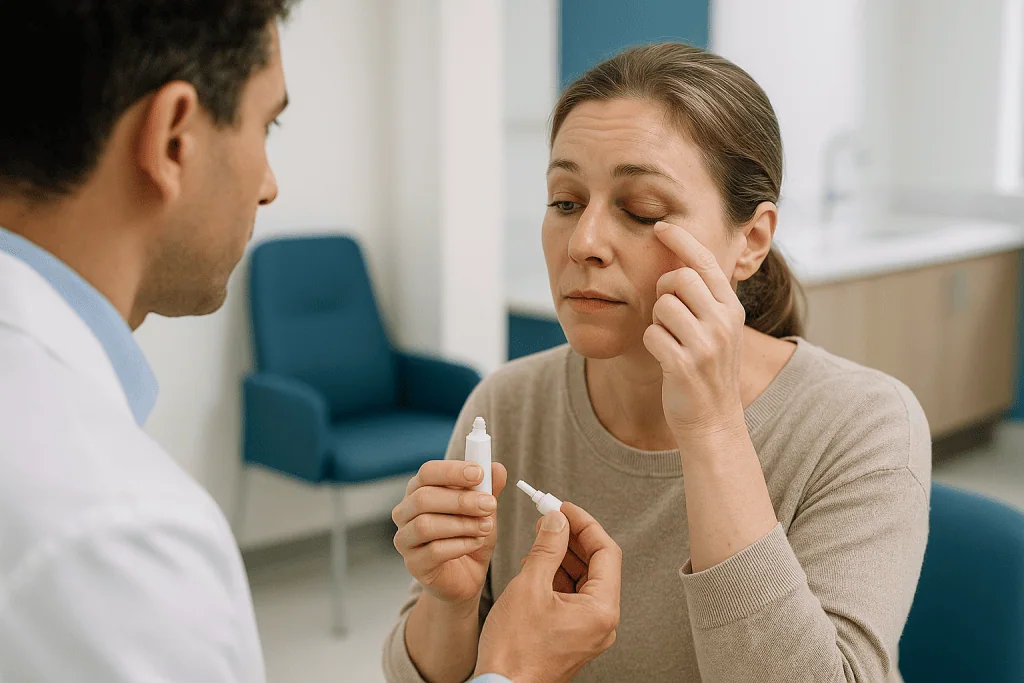
How it is applied matters more than most people expect. After washing your hands, tilt your head back, gently pull the lower lid down to make a small pocket, and squeeze a thin ribbon into that pocket without letting the tube tip touch the eye or the lashes. Close the eye for a moment so the ointment melts and spreads. Vision will blur for a few minutes, which is why many surgeons time the last application for bedtime.
How long it continues, and how often, is set by your surgeon, typically for a course of several days to about a week while the incision heals; this article deliberately gives no schedule, because the right one depends on what was done and what you were prescribed. Finish the course as directed even if the eye looks fine on day three, and do not stop early or extend it on your own. Steroid-containing drops and ointments in particular are prescribed for a defined period because prolonged, unsupervised use can raise pressure inside the eye in some people (Cleveland Clinic).
If the ointment stings sharply every time, causes new itching or lid swelling, or you develop a rash on the skin around the eye, stop guessing and call the clinic. Contact allergy to an ointment ingredient is uncommon but real, and the team may simply switch you to a different preparation.
Chalazion surgery bruising: why the lid turns purple, and how it fades
Bruising is the part of recovery that surprises people most, because the operation itself felt so small. Two things cause it. The local anesthetic is injected into a very thin, loosely woven layer of tissue, and the needle inevitably nicks a few of the many capillaries there. Then the clamp and the incision add a little more. Blood that escapes into eyelid tissue has nowhere firm to be contained, so even a small volume spreads visibly across the lid and sometimes into the skin below the eye.
The color sequence is the same as any bruise. Fresh blood looks red-purple. Over the following days, as red cells break down, hemoglobin is converted into biliverdin (green) and then bilirubin (yellow), before the body’s scavenger cells clear the pigment altogether. A lid that is deep plum on day two and a sickly yellow-green by day seven is not getting worse; it is simply moving through the chemistry. Patient guidance from Cleveland Clinic and MedlinePlus describes swelling and bruising as usually settling over the first week or two, with the discoloration fading last (Cleveland Clinic; MedlinePlus).
What helps: cool compresses in the first day or two, sleeping with the head raised, and avoiding anything that raises blood pressure in the head, such as heavy lifting, bending with the head below the heart, or vigorous exercise, during the first few days. People on anticoagulant or antiplatelet medicines commonly bruise more; that is expected and not a reason to alter the medicine without the prescriber’s say-so.
What does not help: pressing on or massaging the bruise, or applying heat in the first 48 hours, which dilates vessels and can extend the bleed. Warm compresses have a place later, once any oozing has clearly stopped and the surgeon gives the nod, to encourage the remaining swelling to soften and to help the neighboring glands keep draining.
Chalazion surgery recovery week by week: a typical timeline
Every eyelid heals at its own pace, and the surgeon who saw the size and position of your chalazion is the only person who can give you dates. The table below reflects the ranges commonly described in patient references from Cleveland Clinic, Johns Hopkins and MedlinePlus, offered as orientation rather than promise.
| Stage | What most people notice | What is usually asked of you |
|---|---|---|
| Day of surgery | Numb lid, pad in place, mild ache as anesthetic wears off, pink-tinged discharge when pad removed | Keep pad on as instructed, rest, head raised, someone else drives |
| Days 1–3 | Peak swelling and purple bruising, gritty feeling, blurry vision from ointment | Ointment as prescribed, cool compresses, lash hygiene, no rubbing, no makeup or contacts |
| Days 4–7 | Swelling receding, bruise turning green-yellow, incision on inner lid sealing | Continue ointment course, gentle showers keeping soap out of the eye, light activity |
| Week 2 | Residual firmness where the lump was, bruise nearly gone, comfort largely back | Follow-up visit if scheduled; surgeon decides on makeup, contacts and warm compresses |
| Weeks 3–6 | Remaining firmness softens gradually as inflammation resolves | Ongoing lid hygiene to reduce recurrence |
Two points from that table deserve emphasis. First, the small firm area that lingers after the swelling goes is scar tissue and settling inflammation, not necessarily the chalazion returning; it typically softens over several weeks. Second, the return of makeup and contacts is placed where it usually falls, around the follow-up, precisely because it is a clinical judgment about whether the inner incision has sealed, not a fixed number of days (Johns Hopkins Medicine). Most people are back to ordinary work within a day or two, provided that work does not involve dust, chemicals, or heavy exertion.
What to avoid after chalazion surgery: the short list that matters
Almost everything on this list serves one of two goals: keep the fresh incision from being disturbed, and keep the surface of the eye clean while it heals. Rubbing the eye tops the list. The inner lid has a small open wound for a few days, and a knuckle dragged across it can restart bleeding or introduce bacteria. If the eye itches, a cool compress over the closed lid is the substitute.
Water is the second concern. Swimming pools, hot tubs, lakes and the sea carry bacteria and irritants that have no business near a healing lid; most surgeons ask people to stay out of them until the follow-up visit confirms healing. Showers are fine from the next day if you keep shampoo and soap away from the eye and let clean water run over a closed lid rather than aiming a jet at it (Cleveland Clinic).
Then come the things that raise pressure in the head and encourage bleeding or swelling: heavy lifting, strenuous gym sessions, contact sports, and bending forward for prolonged periods. A few days of restraint is usually enough; your surgeon will say when to resume.
- Do not touch the eye or lashes without freshly washed hands.
- Do not share towels or pillowcases, and change your pillowcase after the first night.
- Do not apply eye makeup, false lashes or lash serums, or insert contact lenses, until cleared.
- Do not use leftover eye drops or ointments from a previous problem; use only what was prescribed for this procedure.
- Do not drive on the day of surgery, and not the next day either if the eye is still watering or vision is blurred.
- Do not apply heat to the lid in the first 48 hours unless specifically told to.
Dusty environments, woodworking, gardening with disturbed soil and smoky rooms are worth avoiding for the first week too. None of these prohibitions is permanent; they simply buy the incision the quiet few days it needs.
When can you wear eye makeup again after chalazion removal?
The honest answer is that there is no guideline-fixed number of days, and the surgeon’s clearance, often given at the first follow-up, is what counts. Patient guidance from Johns Hopkins and Cleveland Clinic frames it as waiting until the eyelid has healed and the surgeon confirms this, which for most uncomplicated inner-lid incisions falls around the end of the first week or into the second (Johns Hopkins Medicine; Cleveland Clinic).
The reasoning is worth understanding, because it also explains how to return sensibly. Mascara, eyeliner and eyeshadow are applied right at the lid margin, exactly where the meibomian gland openings sit. Pigment and wax can block those openings, and a mascara wand that has been in and out of the tube for months carries a bacterial load that a healing lid does not need. Since a blocked gland is how the chalazion began, this is not merely about the incision; it is about not restarting the problem.
When you are cleared, a few habits reduce that risk:
- Start with fresh mascara and liquid liner; discard the tubes that were open before surgery.
- Skip tightlining, applying liner along the inner waterline, for a few weeks longer, because it sits directly over the gland openings and near the incision site.
- Remove makeup completely every night with a gentle, oil-free remover and wash the lash line, since residual product is a common trigger for recurrent chalazia.
- Leave false lashes and lash glue until the lid is fully comfortable; the adhesive and the removal both irritate the margin.
Skin makeup on the rest of the face, foundation, concealer and powder, is generally less of a concern once the incision is inner-lid and sealed, but avoid dragging it across the lid itself while any bruising remains tender. Cover-up for the yellow-green stage of the bruise, applied to the cheek and below the eye rather than on the lid, is a compromise many people find reasonable. If the incision was made through the skin rather than the inner lid, expect the surgeon to be more conservative until any suture is out and the skin has knitted.
When can contact lenses go back in?
Contact lenses raise a different problem from makeup. A lens sits directly on the cornea and under the eyelid, so every blink drags the healing inner surface of the lid across it. Lenses also concentrate whatever ointment is in the eye, and a soft lens will absorb the greasy base and turn cloudy and uncomfortable. That is why most surgeons ask people to stay out of contacts for the entire ointment course and until the follow-up confirms the incision has sealed, a period that commonly runs about one to two weeks for an uncomplicated case (Johns Hopkins Medicine).
Practical steps for the interval:
- Dig out your glasses before surgery day, and if your prescription is out of date, sort it beforehand rather than squinting for two weeks.
- Do not wear a lens in the unoperated eye alone unless your surgeon agrees; imbalanced vision can cause headaches and misjudged steps.
- Open a fresh pair of lenses and a new bottle of solution when you resume; the old case should be discarded.
- Return with shorter wearing times for the first few days and remove the lens immediately if the lid feels scratchy, the eye reddens, or vision fogs.
There is a longer-term thread here as well. Contact lens wearers have more reasons than most to look after their meibomian glands, because oil deficiency makes lenses feel dry and lids feel heavy by afternoon. Warm compresses and lid-margin cleaning, once the surgeon approves restarting them, are the same habits that reduce the chance of another chalazion (NHS). Some ophthalmologists also suggest reviewing lens hygiene at the follow-up, since lids irritated by over-worn or poorly cleaned lenses are more prone to gland blockage. The decision about when, and whether, to resume lens wear belongs to the treating team, and if the eye remains irritable it is reasonable to ask whether a different lens type or a longer break makes sense.
How painful is chalazion removal surgery, and what helps afterward?
The most uncomfortable moment is usually the local anesthetic injection: a sharp sting and a sense of pressure lasting a few seconds, similar to a dental injection. After that, the lid is numb and most people feel the clamp’s pressure and some tugging but not pain. The operation itself is over within minutes (Cleveland Clinic).
When the anesthetic wears off, over a few hours, the typical description is a dull ache, a bruised feeling, and grittiness, as though an eyelash were caught under the lid. That gritty sensation comes from the incision on the inner surface rubbing the cornea with each blink, which is exactly what the greasy ointment is designed to cushion. It is usually most noticeable on the first evening and fades day by day.
What helps, in plain terms:
- A cool compress over the closed lid in short spells during the first day.
- Keeping the head raised at night for the first couple of nights.
- Using the prescribed ointment exactly as directed; a well-lubricated lid hurts less.
- Resting the eyes from long screen sessions, which reduce blink rate and dry the surface.
- An over-the-counter pain reliever if your surgeon or pharmacist says it is suitable for you, since some common painkillers can increase bruising and the team may prefer one type over another. This article gives no doses; follow the label and your clinician’s advice.
Pain that is severe, worsening after the first day rather than easing, or accompanied by light sensitivity and reduced vision is not part of the expected picture and should prompt a call. For children who have the procedure under general anesthesia, discomfort afterward is usually modest and handled with cuddles, quiet play, and whatever comfort measures the pediatric team recommends; parents should follow the discharge instructions given to them rather than general advice.
Will my eye go back to normal? Lumps, scars and the chance of recurrence
For the large majority of people, yes, the eyelid returns to its usual shape and function, and because the incision is made from the inside, there is typically no visible scar (NIH/StatPearls). Three things, however, can make the weeks after surgery feel less than “back to normal,” and each has an explanation.
The first is a residual firm spot. Once the swelling and bruise have gone, many people can still feel a small hard area where the lump was. This is the emptied gland capsule and surrounding inflammation gradually being remodeled into a little scar tissue, and it commonly softens and shrinks over several weeks. It is different from a chalazion re-forming, which tends to grow rather than shrink and may become visibly swollen again.
The second is that chalazia recur. The blocked gland has been emptied, but the underlying tendency, sluggish oil glands, eyelid-margin inflammation, or skin conditions such as rosacea or seborrheic dermatitis, has not changed. Daily warm compresses and lid-margin cleaning, once your surgeon says to restart them, are the mainstay of reducing recurrence, and the evidence for them is consistent across NHS and Cleveland Clinic guidance (NHS; Cleveland Clinic).
The third is subtle vision change. A large chalazion can press on the cornea and induce astigmatism; when the lump is removed, the cornea usually rebounds, and spectacle or lens prescriptions measured while the chalazion was present may no longer be accurate. If vision seems different a few weeks after surgery, a fresh eye test is worth mentioning to the team.
Very occasionally, a chalazion that returns in the same place more than once, or behaves unusually, is sent for laboratory examination to confirm it is what it appears to be. This is routine caution, not cause for alarm, and your surgeon will explain if it applies to you.
How risky is chalazion surgery? Complications and alternatives in plain language
Incision and curettage is a minor procedure with a low complication rate, and the risks it carries are mostly small and self-limiting (NIH/StatPearls). Still, “minor” is not “none,” and knowing the list lets you recognize the uncommon problem quickly.
- Bleeding and bruising: near-universal in mild form, rarely heavy. Blood-thinning medicines increase it.
- Infection: uncommon, because the lid has an excellent blood supply; the ointment is prescribed to lower the risk further.
- Incomplete removal or recurrence: the lump may re-form if not all of the contents were cleared or if a neighboring gland blocks.
- Lid notching or scarring: very rare, more relevant when a skin incision is needed or the chalazion sits right at the lash line.
- Loss of a few lashes near the site: uncommon and usually temporary.
- Corneal abrasion: a scratch on the eye surface from instruments or from rubbing afterward, which is uncomfortable but usually heals within days.
- Reaction to the anesthetic or the ointment: rare.
The main alternative is an injection of a corticosteroid directly into the chalazion. The steroid suppresses the inflammatory reaction around the trapped oil, and the lump often shrinks over the following weeks. It avoids an incision and is sometimes chosen for lumps close to the tear drainage system or in people who prefer not to have surgery. Its trade-offs include the possibility of lightening of the skin at the injection site, particularly in people with darker skin, and the possibility that more than one injection is needed (NIH/StatPearls). Continued warm compresses remain an option for lumps that are small and not troubling vision; a substantial share resolve without any procedure (MedlinePlus).
Which route suits you depends on the size, location and duration of the lump, your skin, your medicines and your preferences. Those are exactly the variables your treating team weighs, and the choice sits with them and you together.
What people often get wrong about chalazion surgery recovery
“It’s an infection, so antibiotics will clear it.” A chalazion is a blocked gland with trapped oil, not, in most cases, an infection. That is why oral antibiotics usually do little and why heat, drainage or steroid injection are the mainstays. The ointment after surgery protects a wound; it is not treating the lump (NIH/StatPearls).
“Bruising means something went wrong.” Eyelid tissue bruises with remarkable enthusiasm from the anesthetic injection alone. A purple lid on day two, turning yellow by the weekend, is the expected course, not a complication.
“If I can still feel a lump, the surgery failed.” A small firm area is normal for weeks as the emptied capsule scars down. Failure looks like a lump that grows and swells again, not one that slowly shrinks.
“Once it’s out, it’s gone for good.” The tendency that blocked the gland is still there. Lid hygiene afterward is what changes the odds of a repeat, and it is a habit, not a course.
“Popping it at home is the same thing, just free.” Squeezing a chalazion pushes inflammatory material deeper into the lid, can introduce infection, and can leave a worse scar than a controlled incision from the inside. Warm compresses and gentle massage are the only home measures that patient guidance supports (NHS).
“Heat helps everything, so I’ll use it straight after surgery.” Heat in the first day or two dilates vessels and can extend bleeding and bruising. Cool first; warm later, when the surgeon says.
“I’ll stop the ointment when it looks fine.” The incision seals from the inside outward and can look healed before it is. Finish the course you were given, and do not extend it on your own either, especially if it contains a steroid.
“Waterproof mascara is safer because it won’t run into the eye.” Waterproof formulas are harder to remove and leave more residue at the lash line, where the gland openings sit. A regular formula removed thoroughly each night is the kinder choice for someone prone to chalazia.
Questions to ask your care team before and after chalazion removal
A five-minute conversation before the procedure prevents most of the uncertainty afterward. These are the questions that, in practice, people wish they had asked.
Before the procedure
- Will the incision be on the inside of the lid or through the skin, and will there be a stitch?
- Is a steroid injection an option for my chalazion instead, and why do you recommend one approach over the other for me?
- Should I do anything differently with my regular medicines, particularly blood thinners? (Only the prescriber should answer this; do not adjust anything on your own.)
- Will you send anything to the laboratory, and if so, when will I hear?
- How long will I need the pad, and should someone stay with me afterward?
About the days after
- What exactly is in the ointment, how do I apply it, and for how many days?
- When should I use cool compresses, and when may I switch to warm ones?
- Which activities should I avoid, and for how long: exercise, swimming, dusty work, screen-heavy days?
- What is the earliest I may wear eye makeup and contact lenses, and will you confirm that at a follow-up or should I judge it myself?
- How much bleeding is normal on the first night, and what amount should make me call?
About the longer term
- How likely is this to come back, and what daily habits reduce that chance in my case?
- Should I have my glasses or lens prescription rechecked once the lid has settled?
- Is there an underlying skin or eyelid condition, such as blepharitis or rosacea, that we should be managing?
- Who do I contact out of hours if something worries me, and what number do I use?
Write the answers down, or ask for them in writing. Discharge instructions vary between surgeons for good reasons, and the sheet you leave with overrides anything general, including this article.
When to call your doctor: red flags after chalazion surgery
Most recoveries pass without a single phone call. A short list of signs, though, should prompt you to contact the clinic the same day, or seek urgent care out of hours, rather than waiting for the scheduled follow-up. Patient guidance from Johns Hopkins, Cleveland Clinic and MedlinePlus converges on the same warning signs (Johns Hopkins Medicine; MedlinePlus).
- Bleeding that does not stop: fresh red blood soaking through the pad or dripping steadily despite firm pressure for several minutes.
- Worsening pain: discomfort that increases after the first day instead of easing, or pain severe enough to keep you from sleeping.
- Signs of infection: spreading redness, heat and swelling of the lid or the skin around the eye, thick yellow or green discharge, or a fever.
- Vision changes: a drop in vision that does not clear when you blink away the ointment, double vision, or new sensitivity to light.
- An eye that will not open or a lid swelling so large it closes the eye, particularly if the swelling is tense and rapidly increasing.
- A sensation of something scratching the eye that persists beyond the first day or two, which may indicate a corneal abrasion or a loose suture.
- Signs of a reaction to the ointment: intense itching, rash or hives around the eye, or swelling of the lips or face.
- The lump returning quickly or growing within the first weeks, or any new lump on the same lid.
A brief note on proportion: a purple lid, a pink eye, a sticky lash line in the morning, mild grittiness, and blurred vision for a few minutes after each ointment application are all part of the expected picture and do not need a call. The difference is direction of travel. Expected recovery gets a little better every day from about day two onward. Anything that is getting worse, or that arrives suddenly and severely, deserves a clinician’s eyes on it. When you are unsure, ring; eye clinics would far rather reassure you over the phone than see a small problem grow. Every decision about treatment, including whether you need to be seen, rests with the team looking after you.
Frequently asked questions
What not to do after chalazion surgery?
Do not rub the eye, swim, use eye makeup or contact lenses, lift heavy weights, or apply heat to the lid in the first two days. Keep hands clean before touching the lashes, use only the ointment prescribed for this procedure, and avoid dusty or smoky environments for about a week. These restrictions are temporary and exist to let the small inner-lid incision seal undisturbed; your surgeon will tell you when each can be lifted.
Will my eye go back to normal after chalazion surgery?
For most people, yes. The eyelid returns to its usual shape, and because the incision is on the inside there is usually no visible scar. A small firm area may be felt for several weeks as scar tissue settles, and any vision change caused by the lump pressing on the cornea generally improves. Chalazia can recur, so daily warm compresses and lid cleaning, once approved by your surgeon, remain worthwhile.
How painful is a chalazion removal surgery?
The sharpest moment is the local anesthetic injection, which stings for a few seconds much like a dental injection. During the procedure most people feel pressure and tugging rather than pain. Afterward, a dull ache and a gritty feeling are typical for a day or two, eased by cool compresses, the lubricating ointment and, if your clinician agrees, an over-the-counter pain reliever taken as labeled.
How risky is chalazion surgery?
It is a minor procedure with a low complication rate. Bruising and mild bleeding are common and self-limiting; infection, incomplete removal, corneal scratch, lash loss near the site and lid scarring are uncommon. People on blood-thinning medicines bruise more. Alternatives include steroid injection into the lump and continued warm compresses. Your surgeon weighs these options against the size and position of your chalazion.
How long does chalazion surgery bruising last?
Eyelid bruising typically peaks in the first two to three days and fades over about one to two weeks, changing from purple to green to yellow as the blood pigment breaks down. Cool compresses in the first day or two, sleeping with the head raised and avoiding strenuous exertion help limit it. Bruising that keeps spreading, or a lid swelling so tense it closes the eye, should be reported.
What is the eye ointment after chalazion surgery for?
The ointment is usually a topical antibiotic, sometimes combined with a corticosteroid. The antibiotic lowers the chance of the fresh incision becoming infected, the greasy base coats the inner lid so it glides over the cornea instead of scraping it, and any steroid calms swelling. It is used for a defined course set by your surgeon; do not stop early or continue beyond what was prescribed.
What does chalazion removal aftercare involve day to day?
Keep the pad on as instructed, then clean crusts from the lashes with clean hands and a moistened pad once daily, apply the prescribed ointment, use cool compresses for the first day or two, and sleep with your head slightly raised. Shower with the eye closed and soap kept away. Avoid rubbing, swimming, makeup and contacts until your surgeon clears them, usually around the follow-up visit.
When can I wear makeup after chalazion surgery?
Only once your surgeon confirms the eyelid has healed, which for an uncomplicated inner-lid incision commonly falls around the end of the first week or into the second. Start with fresh mascara and liner, avoid lining the inner waterline for a few weeks longer, skip false lashes for now, and remove all product thoroughly each night, since residue at the lash line can block glands and encourage another chalazion.
Can a chalazion come back after surgery?
Yes. Surgery empties the blocked gland but does not change the tendency of the glands to clog, so a new chalazion can form in the same or a neighboring gland. Daily warm compresses and lid-margin cleaning, restarted when your surgeon approves, are the main ways to reduce that chance. A lump that recurs repeatedly in one spot may be sent for laboratory examination as routine caution.
Is chalazion surgery done differently for children?
The operation itself is the same incision and curettage, but children usually have it under a short general anesthetic because they cannot reliably keep still while the eyelid is handled. Recovery is similar: a pad for a few hours, a prescribed ointment, and some bruising. Comfort comes from quiet play, cool compresses if tolerated and the pediatric team’s discharge instructions, which parents should follow rather than general adult advice.
References
- MedlinePlus Medical Encyclopedia: Chalazion
- Cleveland Clinic: Chalazion
- NIH National Library of Medicine (StatPearls): Chalazion
- NHS: Stye
This article is for general information only and is not a substitute for professional medical advice. Please consult a qualified doctor about your individual situation.

More from the Blog

Preparing for Femto LASIK: Contact Lens Breaks, Corneal Mapping and Makeup Rules
Femto LASIK preparation usually means pausing contact lenses for a period set by your surgeon, commonly about two weeks for soft lenses and longer…

Diabetic Retinopathy Stage by Stage: How Retinal Damage Advances and When Treatment Begins
Diabetic retinopathy is graded in four stages: mild, moderate and severe nonproliferative retinopathy, in which small retinal blood vessels leak and close, followed by…

Who Can Wear Contact Lenses? Dry Eye, Astigmatism and Allergies at the Fitting Exam
Most people who need vision correction can wear contact lenses, including many with dry eye, astigmatism and seasonal allergies, provided a fitting exam confirms…

Preparing for LASEK: Contact Lens Breaks, Corneal Thickness Checks and Planning Days Off
LASEK preparation usually involves three things: pausing contact lenses for a period your surgeon sets (often a few weeks, longer for rigid lenses) so…

How Eye Alignment Is Measured: The Tests Behind a Strabismus Disorder Diagnosis
Eye alignment is measured with a short set of clinic tests. The cover test, in which one eye is covered while the examiner watches…

What PRK Results Usually Look Like Once Healing Finishes and How Long They Hold
PRK reshapes the cornea after its surface layer is removed, so vision is blurry for the first several days and sharpens gradually rather than…