

Who Is a Candidate for Presbyopia Surgery? Lens Clarity, Eye Health and Daily Habits
Key Takeaways
- Presbyopia comes from stiffening of the natural lens, so corneal laser procedures work around the problem while lens exchange removes it.
- Mayo Clinic notes presbyopia typically appears in the early to mid-40s and keeps progressing until about age 65, so any correction chosen early may need revisiting.
- A clear lens usually points toward corneal options, while early cataract usually points toward refractive lens exchange with a multifocal implant.
- Untreated dry eye is one of the most common reasons surgeons defer laser candidacy, because corneal procedures temporarily reduce tear production.
- Monovision can be trialed with contact lenses before any permanent surgery, revealing within days whether the brain accepts one eye for distance and one for near.
- Mayo Clinic states that vision can take 2 to 3 months to stabilize after LASIK, with fluctuations, dryness and night halos common during that period.
A good presbyopia surgery candidate is usually an adult whose glasses prescription has been stable, whose natural lens is still clear or is already developing cataract, whose corneas and retina are healthy, and whose daily tasks fit the visual trade-offs of the chosen method. Dry eye, uncontrolled eye disease and unrealistic expectations commonly lead surgeons to advise waiting. The decision rests with the examining eye team.
The menu is the giveaway. She holds it at arm’s length, tilts it toward the candle, then gives up and asks what the fish is. She is 47, has never worn glasses, and has just discovered that her reading arms are too short. A friend across the table says she “had her eyes done” and now reads her phone without cheaters. The question arrives before dessert: could I do that too?
It is a fair question, and the honest answer is longer than yes or no. Whether someone is a presbyopia surgery candidate depends on three things that have little to do with how much the reading glasses annoy them: how clear the natural lens still is, how healthy the rest of the eye is, and what the person actually does with their eyes from seven in the morning until bedtime.
This explainer walks through each of those, the surgical options that exist, what recovery usually looks like, and the questions worth asking before anyone books a slot.
Can you fix presbyopia with surgery?
Surgery can reduce dependence on reading glasses; it cannot give back the flexible lens of a 25-year-old. That distinction matters, because it shapes every conversation about candidacy.
Presbyopia is the age-related loss of the eye’s ability to focus on near objects. Mayo Clinic describes it as a normal part of aging that most people notice in their early to mid-40s and that keeps progressing until about age 65. Nothing has gone wrong; the lens has simply stiffened, the way a rubber band left in a drawer loses its snap.
Every surgical approach works around that stiff lens rather than restoring it. Some reshape the cornea so one eye favors distance and the other favors near. Some carve a multifocal pattern into the cornea. Some remove the natural lens and replace it with an artificial one built to split light between distances. Each trades something (usually a little sharpness, contrast or night-vision quality) for the convenience of reading without glasses.
So the truthful reply to “can you fix it” is: surgery can treat the inconvenience, with compromises, in the right eye. Whether yours is the right eye is what the examination decides, and it is the examining ophthalmologist, a doctor who specializes in medical and surgical eye care, who makes that call after measuring rather than guessing.
The rest of this article explains what they measure and why, so that the conversation in the consulting room starts from an informed place instead of from a friend’s dinner-table success story.
Why the eye loses near focus after 40
Behind the colored iris sits a clear, bean-shaped lens held by a ring of tiny fibers attached to a muscle. When you look at something close, the muscle contracts, the fibers slacken and the lens fattens, bending light more strongly so near print lands sharply on the retina at the back of the eye. Eye doctors call this accommodation.

Two changes undo it with age. The lens keeps adding layers throughout life, growing denser and less elastic, and the proteins inside it slowly stiffen. Mayo Clinic and Cleveland Clinic both describe this hardening of the lens as the core mechanism. The muscle still contracts; the lens just no longer responds. It is the difference between squeezing a fresh marshmallow and squeezing one left open overnight.
The result is predictable. Small print drifts out of focus first in dim light, then in daylight; phone screens get held farther away; eyes ache after an hour of close work. People who were nearsighted often notice it later, because taking their distance glasses off gives them built-in reading power. People who were slightly farsighted often notice it earlier, sometimes in their late 30s.
This mechanism explains why the natural lens is at the center of any candidacy discussion. If the problem is a stiff lens, then procedures that reshape the cornea are asking the front window of the eye to compensate for a fault farther back. Procedures that replace the lens deal with the cause directly, but at the price of removing a structure that, for most people in their 40s, is still perfectly clear. Neither is inherently better; they simply suit different eyes and different decades of life.
What a presbyopia surgery candidate assessment usually involves
A proper candidacy visit lasts longer than a routine glasses check, and it should. The surgeon is looking for reasons to say yes, reasons to say wait, and the specific measurements that decide which method fits.
Expect the following, in roughly this order:
- Refraction, the test that finds your exact glasses prescription, often repeated with dilating drops to relax the focusing muscle and expose any hidden farsightedness.
- Corneal mapping, a computerized scan of the curvature and thickness of the clear front window of the eye. Laser options depend on enough tissue and a regular shape.
- Tear film testing, because dry eye is one of the most common reasons laser candidacy is deferred and because surgery on the cornea can temporarily worsen it.
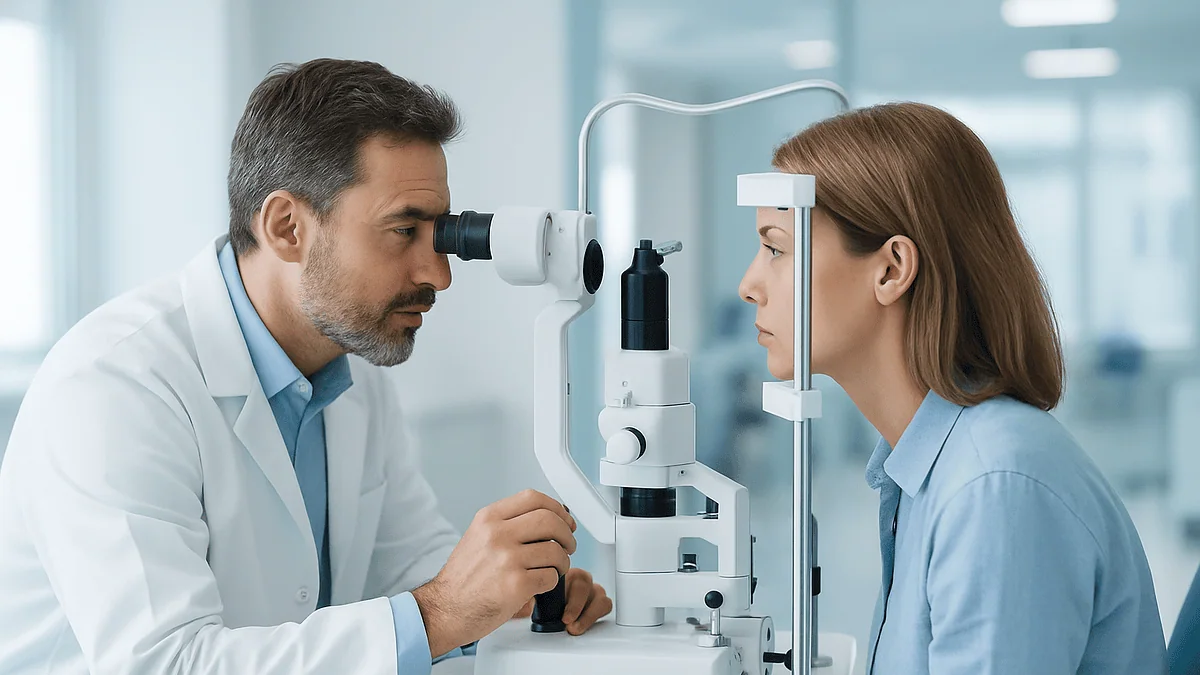
- Slit-lamp examination of the lens for early cataract, a clouding of the natural lens that changes which procedure makes sense.
- Pupil size in dim light, since large pupils are linked with more glare and halos after multifocal corrections.
- Dilated retinal examination and pressure check to rule out disease that would make any elective surgery unwise.
Mayo Clinic notes that contact lens wearers are usually asked to stop wearing lenses for a period before measurements, because lenses subtly reshape the cornea and can distort the scans. Your team will tell you how long for your lens type.
Then comes the conversation that many people find surprising: a detailed interview about your work, hobbies, driving, screen hours and what “good enough” vision means to you. A surgeon who skips this part is skipping half the assessment.
Who is usually a presbyopia surgery candidate, and who is asked to wait
The typical candidate is not defined by a birthday. Guidance from services such as the NHS emphasizes a stable prescription and a healthy eye rather than a fixed age, and that framing holds for presbyopia work too.

Surgeons commonly look favorably on someone who:
- is an adult whose glasses prescription has changed little over recent checks;
- has healthy corneas of adequate thickness and regular shape;
- has either a clear lens (pointing toward corneal options) or early lens clouding (pointing toward lens replacement);
- has a well-controlled tear film, or dry eye that has been treated to a stable baseline;
- has no active eye disease and no unstable general conditions such as poorly controlled diabetes;
- understands that the goal is less dependence on glasses, not glasses-free perfection.
People commonly asked to wait, or steered toward a different route, include those whose prescription is still shifting year to year; those with significant untreated dry eye; those with thin or irregular corneas; those with autoimmune conditions that slow healing; those who are pregnant or breastfeeding, when hormone shifts can temporarily change refraction; and those who need crisp, high-contrast vision at one distance for their work, such as night drivers or people who inspect fine detail, and who might not tolerate the compromises of a multifocal design.
A frank caution belongs here. “Wait” is not a rejection. Presbyopia keeps changing until roughly the mid-60s, so a correction chosen at 44 may need revisiting later, and some surgeons deliberately time lens-based surgery for when a cataract is beginning. The right answer for a given eye may simply be “not yet.”
Lens clarity: why early cataract changes the whole plan
Ask a refractive surgeon what single finding most often changes their recommendation, and many will say the state of the natural lens.
A cataract is a clouding of the lens that scatters light and blurs vision. MedlinePlus and Mayo Clinic describe it as another common consequence of aging, and it often begins subtly in the 50s or 60s, years before it needs treatment on its own. The overlap with presbyopia is not a coincidence: both come from the same lens growing older.
If the lens is still crystal clear, most surgeons hesitate to remove it purely for reading convenience, because a clear lens filters ultraviolet light, contributes a little residual focusing power and, most importantly, is irreplaceable. Corneal procedures leave it alone and can be adjusted later.
If the lens already shows early clouding, the calculation flips. Laser reshaping of the cornea would correct today’s prescription while a cataract slowly degrades the image from behind, and the cataract surgery that follows a few years later would require fresh calculations on an already altered cornea. In that setting, replacing the lens now with an artificial lens designed for multiple distances treats both problems in one operation. Mayo Clinic lists this lens-replacement route among the surgical options for presbyopia and notes it carries the same risks as cataract surgery.
Lens clarity also shapes expectations. Someone in their late 40s with a perfect lens who chooses a corneal method should expect the natural lens to keep aging behind the new correction. That is not a failure of the surgery; it is biology, and a good consultation will say so out loud.
Eye health conditions that change the answer
Presbyopia surgery is elective. That word sets a high bar: the rest of the eye should be in good enough shape that an operation for convenience does not risk something that matters more.
Several conditions routinely alter the recommendation:
- Dry eye. Laser procedures cut or ablate corneal nerves that drive tear production, so symptoms often worsen for a period afterward. Mayo Clinic lists dry eyes among the most common side effects of LASIK. Untreated dry eye is a leading reason to defer.
- Keratoconus or thin corneas. Keratoconus is a progressive thinning and bulging of the cornea; removing more tissue can accelerate it. Corneal mapping exists largely to catch this.
- Glaucoma. This is damage to the optic nerve, usually linked to eye pressure. Some corneal procedures alter how pressure is measured, and any surgery must not compromise monitoring.
- Retinal disease. Macular degeneration or diabetic retinal changes limit the sharpness any lens can deliver, and multifocal designs that reduce contrast may make things worse.
- Previous eye surgery or injury, which can leave irregular corneas that confound multifocal optics.
General health counts as well. Autoimmune conditions such as rheumatoid arthritis or lupus can impair corneal healing. Poorly controlled diabetes affects both healing and refraction. Certain medicines that dry the eye or affect healing are worth mentioning to the surgeon, and any change to them belongs with the prescribing clinician, not with the eye team and certainly not with a magazine.
None of these is an automatic “never.” Each is a reason for a longer conversation and, sometimes, treatment of the underlying problem first.
Presbyopia surgery options compared
Four surgical strategies dominate, plus the non-surgical options that remain sensible comparators. The table below summarizes what each does and who it tends to suit, drawing on the option lists published by Mayo Clinic and Cleveland Clinic. It is a map, not a menu; the surgeon matches the method to the eye.
| Approach | What it does | Typically considered for | Main trade-offs |
|---|---|---|---|
| Monovision (laser or contact lens) | Corrects one eye for distance, the other for near | People with clear lenses who tolerate a contact-lens trial of the same setup | Reduced depth perception; some never adapt |
| Multifocal corneal laser | Shapes the cornea into zones for different distances | Clear lens, adequate corneal thickness, moderate pupil size | Halos, reduced contrast, harder to reverse |
| Corneal inlay | Small implant in the non-dominant cornea to extend near focus | Selected eyes with little distance error | Haze, dry eye; removable but not always fully reversible |
| Refractive lens exchange | Removes the natural lens; implants a multifocal or extended-range artificial lens | Early cataract or older patients with high prescriptions | Cataract-surgery risks, glare and halos at night |
| Glasses or multifocal contacts | Optical correction only | Everyone; the default comparator | Inconvenience; no surgical risk |
Two points deserve emphasis. First, the safest and most reversible option in the table involves no surgery at all, and a candid surgeon will say so. Second, the row you land on is decided mostly by the lens-clarity and eye-health findings from the previous sections, which is why they came first.
Monovision laser eye surgery: the trial-first approach
Monovision is the oldest trick in the presbyopia toolkit and, in some ways, the most honest. One eye is set for distance, the other for near, and the brain learns to use whichever image is sharper for the task in hand. Mayo Clinic lists it as a surgical option and points out that it can be achieved with a laser procedure such as LASIK or with contact lenses.
The contact-lens version is the reason monovision is so useful in candidacy assessment. Before committing to a permanent corneal reshaping, a surgeon can fit lenses that reproduce the intended result and send the person home for a week or two of ordinary life. Driving at dusk, reading a recipe, watching a child at the far end of a sports field: the trial reveals within days whether the brain accepts the arrangement.
What it reveals varies enormously. Some people forget within an afternoon that their eyes are set differently. Others feel a persistent mismatch, describe distance as “slightly off,” or notice that judging steps and curbs takes more attention. Stereopsis, the fine depth perception that comes from two matched eyes, is measurably reduced in monovision, which is why people whose work depends on it, such as those operating machinery or driving professionally at night, are often steered elsewhere.
When the trial goes well, the laser step itself is standard corneal surgery: a thin flap or surface layer is treated so the cornea’s curvature changes by a fraction of a millimeter. Mayo Clinic describes the LASIK procedure as usually taking around 30 minutes or less for both eyes, under numbing drops.
The catch is longevity. The near eye may need a stronger setting as presbyopia progresses, and the natural lens keeps aging behind the correction. Monovision buys a decade of convenience more often than it buys a lifetime.
Refractive lens exchange for presbyopia: swapping the lens itself
Refractive lens exchange is cataract surgery performed before the cataract is the main problem. The surgeon makes a small incision at the edge of the cornea, softens and removes the natural lens with ultrasound, and places an artificial lens in the same capsule. The difference from routine cataract surgery lies in the lens chosen: a multifocal or extended-depth-of-focus design built to deliver usable vision across distances, rather than a single-focus lens.
Mayo Clinic includes this among the surgical treatments for presbyopia and is direct about the accounting: it carries the same risks as cataract surgery, and the multifocal designs can produce glare and reduced contrast, particularly at night. Cleveland Clinic similarly notes the possibility of halos with these lenses.
Who does it suit? Typically someone in their 50s or 60s whose lens already shows early clouding, someone with a prescription too large or corneas too thin for laser reshaping, or someone who wants a single procedure that will not need repeating when a cataract arrives. Because the natural lens is gone, presbyopia stops progressing, and future cataract is no longer possible in that eye.
Who is usually asked to think harder? Someone in their mid-40s with a perfectly clear lens, for whom removing healthy tissue for convenience is a heavier bargain; anyone with retinal disease that would limit the benefit of a multifocal design; and people who are highly sensitive to night-time glare in their daily lives.
One structural risk deserves plain language. Removing the lens changes the mechanics inside the eye, and in eyes that are long and nearsighted the chance of a retinal detachment afterward is higher than in the general population. That is a reason for a careful retinal examination beforehand, not necessarily a reason to refuse, and it is the surgeon’s job to weigh it for the eye in front of them.
Daily habits and jobs that shape the decision
Here is the part of candidacy that no scanner can measure. Two people with identical eyes can be a good and a poor candidate for the same procedure because of how they spend their days.
Consider the person who drives home on unlit roads three nights a week. Multifocal corneal and lens designs split incoming light between focal points, which is precisely what creates halos around oncoming headlights and softens contrast in low light. For a daytime commuter it may be a footnote; for a night driver it can be the whole story.
Consider the person who spends nine hours at a laptop. Screen work suppresses blinking and dries the eye, and corneal laser procedures temporarily reduce tear production further. A surgeon may want dry eye controlled first, may favor a lens-based option that leaves corneal nerves alone, or may simply advise that the first weeks after surgery will feel gritty and plan around it.
Consider the jeweler, the pathologist, the fly-tier, the person who reads fine print all day at a fixed close distance. A monovision or multifocal correction delivers “good enough” near vision for menus and phones; it is not designed to replace strong, single-purpose magnification. Some of these people end up happiest keeping a pair of task glasses.
Consider the swimmer, the boxer, the rugby player. Mayo Clinic advises avoiding swimming and hot tubs for a period after LASIK, and contact sports are commonly restricted while the cornea heals. Flap-based procedures carry a small long-term risk of flap displacement from direct trauma, which is one reason surface-based or lens-based approaches are sometimes preferred for people in combat sports.
Habits also predict tolerance. Someone who has worn multifocal contact lenses happily for years has, in effect, already passed a trial. Someone who abandoned them after a week has offered the surgeon valuable data too.
Does laser eye surgery hurt? What the day itself usually feels like
The most common question before the appointment is rarely about optics. It is about pain.
For laser procedures, Mayo Clinic describes numbing drops placed in the eye before treatment and a device that holds the eyelids open. People commonly report pressure rather than pain during the seconds when the suction ring is applied to create the flap, and a brief dimming of vision. The laser itself is silent apart from a clicking sound, and there is sometimes a faint smell that surgeons will warn you about so it does not alarm you. The whole thing, both eyes, is typically over in half an hour or less.
Lens exchange is likewise done under local anesthesia, usually with drops and sometimes a light sedative, as a day procedure; the NHS describes both laser and lens surgery as operations from which you normally go home the same day. People describe bright lights, movement and a sensation of water on the eye more than pain.
The hours afterward are a different matter. Mayo Clinic is specific that after LASIK the eye may itch, burn, feel gritty or water, that vision is blurry at first, and that mild discomfort is expected. Surface laser techniques, which remove the outer skin of the cornea rather than lifting a flap, tend to be more uncomfortable for the first few days while that layer regrows. Your team will give you a plan for comfort, and the single rule everyone hears is: do not rub the eye.
What surprises people most is how ordinary the day is. Arrive, be measured once more, lie under a machine for a few minutes, sit with your eyes closed for a while, get driven home. The anticipation is almost always worse than the event, and that is worth knowing before it is your turn under the lights.
Recovery after presbyopia surgery: the first days and weeks
Recovery is not one number. It is three overlapping timelines: comfort, function and stability.
Comfort usually settles first. After flap-based LASIK, Mayo Clinic notes that vision is often noticeably better by the next day, though hazy, and that the grittiness and watering ease over the first days. Surface laser and lens exchange can take longer to feel normal.
Function follows. Many people return to desk work within a few days, though screens feel tiring at first. Driving resumes once the team confirms vision meets the legal standard; that is a clinical judgment, not a calendar date. Mayo Clinic advises avoiding eye makeup, swimming and hot tubs for a period and skipping strenuous or contact sports until cleared.
Stability is the slow one. Mayo Clinic states plainly that it can take 2 to 3 months after LASIK before the eye heals and vision stabilizes, and that during that time fluctuations, dryness and night halos are common. Lens exchange has its own arc: the brain often needs weeks to months to adapt to a multifocal image, a process eye doctors call neuroadaptation, and near vision can improve over that period without anything changing in the eye.
A practical question that comes up repeatedly: can you cry after surgery? Yes. Tears are your own fluid and do not harm the healing cornea; in fact, lubrication is protective. What the team asks you to avoid is wiping or rubbing, so dab the cheek rather than the eye, and keep soap and shampoo out of the eye when you wash.
Follow-up visits are typically scheduled within the first day or two, then over the following weeks and months. Keep them even if everything feels fine; some of the things the surgeon checks, such as flap position or eye pressure while using steroid drops, produce no symptoms at all.
Risks and trade-offs, stated plainly
Elective surgery earns a plain accounting of what can go wrong, and the sources agree on the list even where they differ on emphasis.
Across corneal laser procedures, Mayo Clinic lists dry eye, glare and halos, undercorrection or overcorrection sometimes requiring a second treatment, astigmatism from uneven tissue removal, flap complications, and regression, in which the eye drifts back toward its original prescription. Rarely, vision can be worse than before surgery, and this is stated openly rather than buried.
For lens exchange, the risks are those of cataract surgery: infection inside the eye, swelling of the retina, clouding of the capsule behind the new lens that may later need a brief laser treatment, dislocation of the implant, and retinal detachment, with the last being more likely in long, nearsighted eyes. Multifocal implants add the optical trade-offs already described.
Then there are the compromises that are not complications at all but built-in features. Monovision reduces depth perception by design. Multifocal optics reduce contrast by design. Both approaches leave some tasks, such as threading a needle in poor light, better served by a pair of glasses. A surgeon who describes an option without its built-in compromise has described half of it.
Two pieces of perspective help. First, the non-surgical alternative of glasses or contact lenses carries none of these risks and remains the right choice for many, which is why it belongs in every comparison. Second, risk is personal: the same procedure carries a different risk profile in a dry-eyed night driver than in a well-lubricated daytime reader, which is the entire reason the assessment described earlier takes as long as it does.
Nobody can promise an outcome. What a good team can promise is a clear description of the range of outcomes and an honest opinion about where your eye is likely to fall within it.
What people often get wrong about presbyopia surgery
Some of the most persistent beliefs about this surgery are exactly backwards.
“If I had LASIK in my 20s, I won’t get presbyopia.” Presbyopia is a lens problem; LASIK reshapes the cornea. People who had laser correction for nearsightedness get presbyopia on schedule, and sometimes notice it more because they can no longer take glasses off to read.
“Surgery means never wearing glasses again.” The realistic aim, as Mayo Clinic frames the options, is reduced dependence. Many people keep a pair for fine print, dim light or long reading sessions, and are content.
“Reading glasses make your eyes weaker, so surgery is better than putting it off.” There is no evidence that reading glasses accelerate presbyopia. They simply do the focusing the lens no longer does. Delaying surgery costs nothing biologically.
“There’s an age limit, and after 60 it’s too late.” There is no upper age cut-off in mainstream guidance. Older eyes with early cataract are often better suited to lens exchange than younger eyes with a clear lens. The more meaningful limit is the lower one: a prescription that is still changing.
“Eye drops can do the same thing as surgery.” Mayo Clinic lists prescription drops that temporarily shrink the pupil to sharpen near vision as one option. They work for hours, not years, can dim vision in low light, and are a discussion for the prescribing clinician. They are an alternative to consider, not a substitute for the same result.
“The procedure is the same everywhere, so just pick the cheapest or fastest.” The procedure is only as good as the candidacy assessment that precedes it. The measurements, the trial of monovision, the honest conversation about night driving: these are where outcomes are decided, and they take time.
Questions to ask your care team
A consultation is a two-way examination. These questions tend to produce the most useful answers.
- Which of my measurements most influenced your recommendation, and were any borderline?
- How clear is my natural lens today, and how does that shape whether you suggest a corneal or a lens-based approach?
- What did my tear film testing show, and do you want dry eye treated before we go further?
- Can I trial the intended vision with contact lenses first, especially if you are proposing monovision?
- What will my vision realistically be like at night, on screens and for small print, and which of those tasks am I most likely to still need glasses for?
- What are the built-in compromises of this method, separate from the complications?
- How would you expect my vision to change over the next ten years as my lens keeps aging, and what could be done then?
- If the result is under- or overcorrected, what are the options, and how is that decided?
- Which of my medicines or health conditions matter for healing, and who should I speak to about them?
- What is the follow-up schedule, and what symptoms should make me call before the next scheduled visit?
- What would you recommend if I decided not to have surgery at all?
Write the answers down. People routinely leave eye appointments remembering the good news and forgetting the caveats, and the caveats are where candidacy lives. It is also entirely reasonable to seek a second opinion before elective surgery; a confident team will not mind.
One last question worth asking yourself rather than the surgeon: what, specifically, do I want to do without glasses? A clear answer (“read my phone at breakfast,” “see the golf ball and the scorecard”) gives the team something concrete to design toward. “Just not need them” gives them nothing.
When to call your doctor
Most recovery symptoms are expected and fade: grittiness, watering, blur that comes and goes, halos around lights, sensitivity to brightness. Some are not, and the difference matters because the serious problems after eye surgery are time-sensitive.
Contact your surgical team the same day, or emergency eye services if you cannot reach them, for any of the following:
- Pain that is increasing rather than settling, or severe pain at any point, particularly if the eye is red and vision is dropping.
- A sudden decrease in vision, or vision that was improving and then clearly worsens.
- A new curtain or shadow across part of your vision, a shower of new floaters, or flashes of light. Mayo Clinic identifies these as warning signs of retinal detachment, which needs urgent assessment.
- Thick discharge, a swollen lid or a feeling that something is stuck in the eye after a flap-based laser procedure, which can signal a displaced flap or infection.
- Nausea and vomiting with a painful, hard-feeling eye, which can indicate a pressure spike.
- Any direct blow to the eye during the healing period.
Beyond the surgical window, the same red flags apply to anyone with aging eyes, whether or not they have had surgery. Sudden vision loss, flashes and floaters, a curtain effect, or a painful red eye are reasons to seek care promptly rather than wait for a routine appointment.
Less urgent but still worth a call: dryness that is not improving after several weeks, night-time glare that makes driving feel unsafe, or near vision that has not reached what you were led to expect once the stabilization period your team described has passed. None of those is an emergency; all of them are things the treating team would rather hear about than have you tolerate silently.
Every decision described in this article, from whether to operate to which method to choose to when to intervene afterward, belongs with the examining and treating ophthalmologist who has your measurements in front of them.
Frequently asked questions
Can you fix presbyopia with surgery?
Surgery can reduce dependence on reading glasses but cannot restore the flexible lens of youth. Options include monovision laser correction, multifocal corneal reshaping, corneal inlays and refractive lens exchange with a multifocal implant. Each trades some sharpness, contrast or depth perception for near-vision convenience. Whether you are a suitable candidate depends on lens clarity, corneal health, tear film and daily visual demands, and that judgment rests with the examining ophthalmologist.
Is there a presbyopia surgery age limit?
Mainstream guidance sets no upper age limit. Older adults with early cataract are often better suited to lens exchange than younger people with a clear lens. The more meaningful threshold is stability: services such as the NHS emphasize a prescription that has stopped changing before elective refractive surgery. Because presbyopia keeps progressing until roughly the mid-60s, timing is a clinical decision made for each eye rather than a birthday.
How long does it take to recover from LASIK eye surgery?
Comfort usually improves within days, function within a week or two, and stability takes longer. Mayo Clinic notes vision is often better but hazy by the next day, and that it can take 2 to 3 months for the eye to heal and vision to stabilize, with dryness and night halos common meanwhile. Return to driving and sport is cleared by your team, not by a fixed date.
Does laser eye surgery hurt?
Numbing drops mean the procedure itself is usually described as pressure and brief dimming rather than pain, and both eyes are typically treated in about 30 minutes or less according to Mayo Clinic. Afterward, itching, burning, grittiness and watering are expected for the first days, and surface laser techniques tend to be more uncomfortable than flap-based ones while the outer layer regrows. Your team will provide a comfort plan.
Can you cry after LASIK?
Yes. Tears are your own fluid and do not damage the healing cornea; lubrication is actually protective in the early days. What matters is not rubbing or wiping the eye itself, so dab the cheek instead, and keep soap, shampoo and eye makeup away from the eye for the period your team advises. Mayo Clinic specifically cautions against rubbing after LASIK because it can disturb the corneal flap.
Is monovision laser eye surgery a good idea?
It suits some people very well and others not at all, which is why a contact lens trial of the same arrangement is usually recommended first. Monovision sets one eye for distance and one for near, reducing depth perception by design. People who drive professionally at night or rely on fine depth judgment are often steered elsewhere. The trial, not the theory, tells you which group you belong to.
Who is a good candidate for refractive lens exchange for presbyopia?
Typically someone whose natural lens already shows early clouding, whose prescription is too high or corneas too thin for laser reshaping, or who wants one operation that will not need repeating when cataract develops. Mayo Clinic notes it carries the same risks as cataract surgery and that multifocal implants can cause glare and halos. People with a perfectly clear lens or retinal disease are usually asked to weigh it more carefully.
Is laser eye surgery for reading glasses permanent?
The change to the cornea is permanent, but the eye behind it keeps aging. Presbyopia progresses until around the mid-60s and the natural lens may later develop cataract, so a correction made in the 40s can need adjusting or may be overtaken by lens changes. Some regression toward the original prescription also occurs in a proportion of eyes. Realistic expectation is years of reduced dependence, not a lifetime guarantee.
Why would a surgeon tell me to wait for presbyopia surgery?
Common reasons include a prescription still changing between visits, untreated dry eye, thin or irregular corneas, active eye disease, pregnancy or breastfeeding, or general conditions such as poorly controlled diabetes or autoimmune disease that affect healing. Sometimes the advice is to wait for early cataract to make lens exchange the more logical route. Waiting is a timing decision, not a rejection, and costs nothing biologically.
What are the alternatives to surgery for presbyopia?
Reading glasses, progressive or bifocal spectacles, and multifocal or monovision contact lenses remain the safest options with no surgical risk, and Mayo Clinic lists them first. Prescription eye drops that temporarily shrink the pupil to sharpen near vision are another option; they act for hours rather than years and can dim vision in low light. Any decision about drops belongs with the prescribing clinician.
References
This article is for general information only and is not a substitute for professional medical advice. Please consult a qualified doctor about your individual situation.

More from the Blog

Glare, Dryness and Ghosting After Astigmatism Correction: Normal Healing or a Call to Make?
Glare, halos, dry eyes and faint ghost images are among the most common astigmatism surgery side effects, and in most people they fade as…
How Patching and Glasses Retrain a Lazy Eye: What Amblyopia Treatment Actually Does
Patching treats a lazy eye by covering the stronger eye for a set number of hours each day, which forces the brain to use…

Choosing an Intraocular Lens: Questions to Bring to Your Ophthalmologist
Choosing an intraocular lens means weighing how you use your eyes each day against the trade-offs of each lens design. Monofocal lenses give one…

Do Children Outgrow Strabismus? Misconceptions That Delay Treatment
Most children do not outgrow true strabismus, a condition in which the two eyes point in different directions. Brief eye wandering in newborns that…

Which Symptoms After Vitrectomy Need a Same-Day Call: Pain, Pressure and a Curtain Over Vision
After a vitrectomy, call your eye surgeon the same day for worsening eye pain, a hard or pressured feeling in the eye with headache…

Who Gets an Intraocular Lens Outside Cataract Surgery? Refractive Lens Exchange Explained
Outside cataract surgery, an intraocular lens is usually considered for adults, typically over about 50, whose natural lens still focuses poorly because of presbyopia…