

Chickenpox in Adults: Why It Is More Serious and When Vaccination Makes Sense

Key Takeaways
- Before routine vaccination, adults made up about 5 percent of US chickenpox cases but roughly a third of the deaths, with a risk of dying around 20 times that of a child.
- Varicella pneumonia is the leading serious complication in adults, and smoking and pregnancy in the second or third trimester raise the risk further.
- Antiviral treatment is routinely offered to adults but not healthy children, and randomized trials show it works best when started within 24 hours of the rash.
- A person is contagious from one to two days before the rash until every blister has crusted, and about 90 percent of susceptible household contacts will catch it.
- A positive varicella-zoster IgG test in pregnancy is reassuring: it indicates immunity, so an exposure to chickenpox is not an emergency for that person.
- The varicella vaccine is a live vaccine, so it is not given in pregnancy or to people with significantly weakened immunity, and CDC guidance advises avoiding pregnancy for one month afterward.
Chickenpox in adults is usually more severe than in children: the rash is heavier, fever runs higher, and complications such as varicella pneumonia, encephalitis and serious bacterial skin infections are considerably more common. Adults without evidence of immunity can be vaccinated; CDC guidance recommends it particularly for healthcare workers, teachers, travelers and non-pregnant people of childbearing age. A clinician can confirm immunity with a simple blood test.
In January 2026, parents in the United Kingdom started receiving a new line on their toddlers’ vaccination letters: chickenpox. The NHS had added the varicella vaccine to its routine childhood schedule for the first time, three decades after the United States did the same. Within days, search traffic shifted in a direction nobody had quite predicted. The people typing questions were not parents. They were adults in their thirties, forties and fifties asking whether they had ever had chickenpox, whether they could catch it from a grandchild, and why everyone kept saying it was worse later in life.
Those are the right questions. As of January 2026, chickenpox in adults remains a genuinely different illness from the itchy week most of us remember from primary school, and the gap between the two is wider than most people assume. This piece walks through what the virus does, why the body handles it less gracefully with age, and what the evidence actually supports when it comes to vaccination.
What changed recently with chickenpox vaccination?
The headline change is British. From January 2026, the NHS began offering the chickenpox vaccine to young children as part of the routine immunization schedule, combined with the measles, mumps and rubella vaccine. Until then, the UK had reserved it for specific groups, such as healthy household contacts of people with weakened immune systems. The decision followed a recommendation from the UK’s vaccine advisory committee, which weighed decades of data from countries that had already taken the step.
The United States is the longest-running of those countries. Routine childhood varicella vaccination started there in 1995. In the years before it, the CDC estimates roughly 4 million people caught chickenpox each year, between 10,500 and 13,000 were hospitalized, and 100 to 150 died. Since the program matured, cases have fallen by more than 97 percent, and hospitalizations and deaths have dropped sharply in every age group, including adults who were never themselves vaccinated. That last point matters: when children stop circulating the virus, susceptible adults are exposed far less often.
Why does a childhood schedule change send adults to search engines? Partly because it surfaces an uncomfortable fact. Anyone who grew up before a routine program, or who simply never caught the virus as a child, may still be susceptible, and an unvaccinated adult population does not shrink on its own. The NHS has been explicit that the new program is for children, and that adults who want to know their own status should speak to a clinician. The sections that follow explain why that conversation is worth having.
Chickenpox symptoms in adults: what the illness looks like
Chickenpox is caused by the varicella-zoster virus, a member of the herpesvirus family that, once caught, stays in the body for life inside nerve cells. The first infection produces chickenpox. A reawakening years later produces shingles. The two are the same virus wearing different clothes.
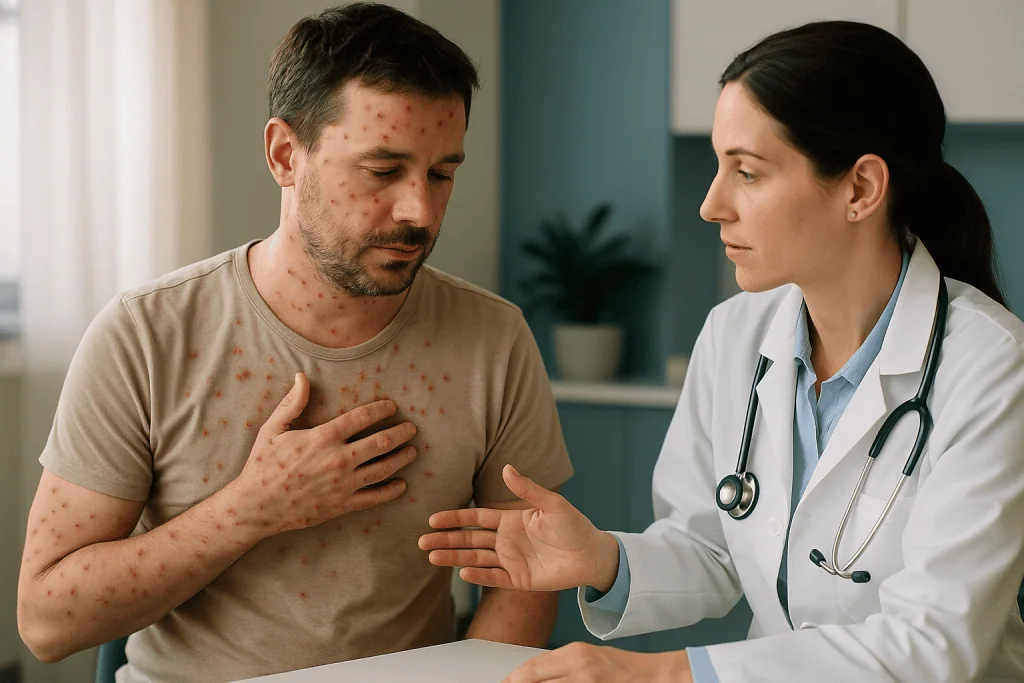
In adults, the illness tends to announce itself before the rash. One to two days of fever, headache, aching muscles, fatigue and loss of appetite are typical, and these early symptoms are often more pronounced than in children, who may skip straight to spots. Then the rash arrives, usually on the chest, back and face first, before spreading to the scalp, limbs, mouth, eyelids and even the genital area.
Each spot moves through a predictable sequence. It begins as a small red bump, becomes a thin-walled fluid-filled blister that classically looks like a dewdrop on a rose petal, clouds over, breaks, and crusts. New crops keep appearing for several days, so an adult in the thick of it will have bumps, blisters and scabs all present at once. That mixture is one of the features clinicians use to distinguish chickenpox from other rashes. The CDC describes a typical case as 250 to 500 lesions; adults often sit at the higher end of that range or beyond it.
Itching is intense. Mouth sores can make eating painful. Fever in adults more commonly climbs above 102°F (38.9°C), and the whole episode usually runs five to ten days before the last blister scabs over. People who had the vaccine but still catch a mild breakthrough infection often have fewer than 50 spots, little or no fever, and may never develop true blisters at all.
Why is chickenpox in adults more serious than in children?
The short answer is that the adult immune system reacts to the virus more forcefully, and much of the damage in severe chickenpox is caused by that reaction rather than by the virus alone. Varicella-zoster travels through the bloodstream to the skin, but it also reaches the lungs, liver and nervous system. In a young child, the immune response is brisk but proportionate. In an adult, the inflammatory response in the lungs can be vigorous enough to flood the air sacs, which is the mechanism behind varicella pneumonia.
Numbers make the difference concrete. Before vaccination, adults accounted for only about 5 percent of chickenpox cases in the United States but roughly a third of the deaths. Harvard Health puts the adult risk of dying from chickenpox at around 20 times that of a child. Hospitalization rates follow the same curve, rising steadily from the teenage years onward.
Several other factors stack the odds. Adults are more likely to smoke, which independently raises the risk of varicella pneumonia. They are more likely to be pregnant, to have diabetes, chronic lung disease or a condition treated with medicines that dampen immunity. Any of these makes a first encounter with the virus harder to contain.
There is also a timing problem. Because adult chickenpox is now uncommon in countries with routine childhood vaccination, it is sometimes not recognized quickly. The early fever and aches get labeled as flu, and the window in which antiviral treatment works best, generally the first 24 hours after the rash appears, can slip by. None of this means every adult case becomes dangerous. Most adults recover fully. The point is that the margin for a bad outcome is narrower, which is why guidance treats adult chickenpox as an illness that deserves a same-day phone call to a clinician rather than a week of waiting it out.
Adult chickenpox complications: pneumonia, encephalitis and skin infection
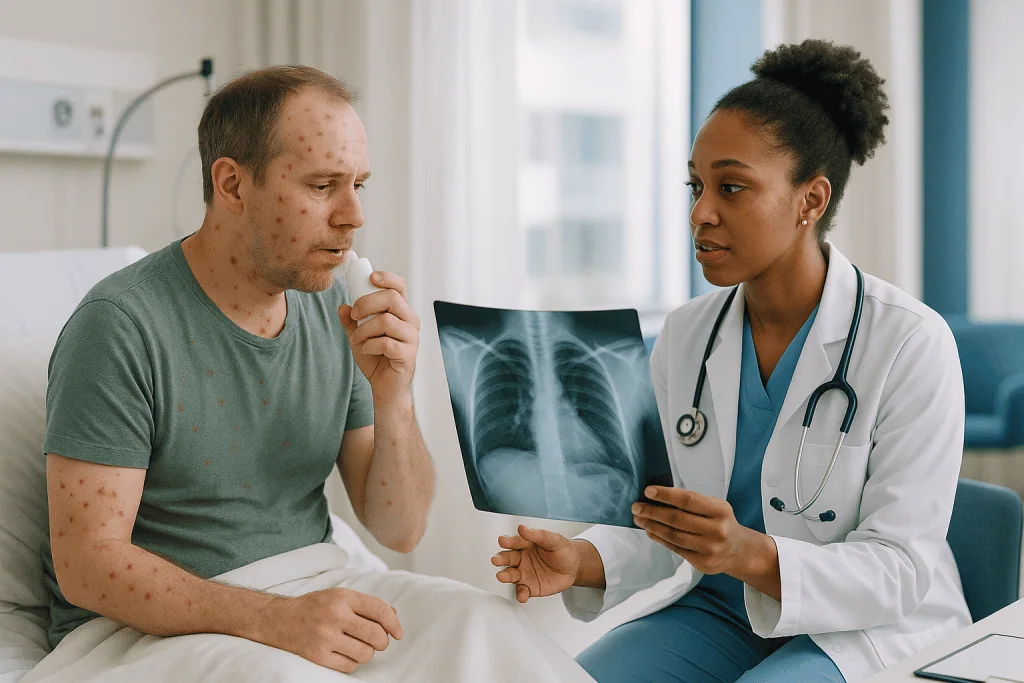
Four complications account for most of the serious trouble. Varicella pneumonia is the one clinicians watch for most closely in adults. It typically develops within a few days of the rash, with a dry cough, chest tightness and breathlessness. The risk is highest in smokers, pregnant people in the second and third trimester, and anyone with suppressed immunity. It can progress quickly and often requires hospital admission for intravenous antiviral treatment and oxygen.
Encephalitis, meaning inflammation of the brain, is rarer but can be severe. It may show up as confusion, a stiff neck, seizures or a sudden change in alertness. A milder relative, cerebellar ataxia, affects balance and coordination and is more common in children; adults are more prone to the diffuse encephalitis form.
Bacterial superinfection of the skin is the complication people underestimate. Scratched blisters are an open door for Streptococcus and Staphylococcus bacteria. Most of the time that means cellulitis, a spreading skin infection, but in a small number of cases it can escalate to necrotizing fasciitis or sepsis. Any spot that becomes hot, swollen, increasingly painful or surrounded by a widening red area needs prompt attention.
Hepatitis, inflammation of the liver, occurs in a minority of adults and is often silent, picked up only on blood tests. Bleeding problems from a drop in platelets, and inflammation of the heart muscle or kidneys, are documented but uncommon.
Finally, there is the long game. Everyone who has had chickenpox carries the virus for life, and about one in three people will develop shingles at some point, with risk climbing after 50. Shingles can leave behind post-herpetic neuralgia, nerve pain that persists for months. Catching chickenpox as an adult does not spare you that later chapter.
Chickenpox in children vs adults: a side-by-side comparison
Seeing the two age groups next to each other is the quickest way to understand why guidance treats them differently. The figures below draw on CDC, Harvard Health and Mayo Clinic descriptions of typical disease in otherwise healthy people; individuals vary, and underlying conditions shift risk in either group.
| Feature | Children (roughly 1–12 years) | Adults |
|---|---|---|
| Early symptoms before rash | Often mild or absent | One to two days of fever, headache, muscle aches, fatigue |
| Fever | Usually low-grade | Commonly higher, often above 102°F (38.9°C) |
| Number of spots | Typically 250–500 | Often at the upper end of that range or more |
| Duration of new spots | About 3–5 days | Frequently longer |
| Varicella pneumonia | Rare in healthy children | Much more common; highest in smokers and pregnancy |
| Neurological complications | Mostly cerebellar ataxia, usually recovers | Encephalitis more likely and more severe |
| Share of deaths before vaccination (US) | About 5% of cases, majority of cases overall | About 5% of cases, roughly a third of deaths |
| Antiviral treatment | Not routinely recommended for healthy children | Recommended; works best within 24 hours of rash onset |
| Scarring | Uncommon unless infected | More common because of heavier rash and longer healing |
Two patterns stand out. The first is that the adult disadvantage is not a matter of degree in one area; it runs across symptoms, complications and treatment urgency. The second is that treatment recommendations flip at adolescence. Healthy children generally do not need antiviral medicine for chickenpox, whereas for adults it is standard practice to offer it, because the expected benefit outweighs the small risk. That distinction alone explains why an adult with suspected chickenpox should not simply copy what their parents did for them.
How contagious is chickenpox, and how long is an adult infectious?
Chickenpox is among the most contagious infections known. It spreads through the air when an infected person breathes, coughs or sneezes, and through direct contact with blister fluid. In a household where one person has the virus and others are susceptible, the CDC estimates that around 90 percent of those susceptible contacts will catch it. The virus can even drift between rooms; airborne spread in hospitals has been documented when a patient with chickenpox was several beds away.
The timeline is worth memorizing. After exposure, the incubation period, meaning the stretch between catching the virus and the first symptoms, runs 10 to 21 days, most often around 14 to 16. A person becomes infectious one to two days before the rash appears, which is the uncomfortable part: adults often go to work, travel or visit relatives during exactly the window when they are shedding virus and feel merely run-down. Infectiousness continues until every blister has crusted over, which usually takes about five days after the rash begins but can be longer in adults with a heavier rash.
Shingles is part of this story too. A person with shingles cannot give someone shingles, but the fluid in shingles blisters contains live varicella-zoster virus. Someone who has never had chickenpox or the vaccine can catch chickenpox from direct contact with an uncovered shingles rash. Covered lesions reduce the risk substantially.
For adults who suspect they have chickenpox, the practical implications are clear. Stay away from workplaces, schools, healthcare settings, pregnant people and newborns until all spots have scabbed. Phone ahead before attending any clinic so staff can keep you apart from waiting rooms. If you have recently been exposed and are not sure you are immune, a clinician can advise within the first few days about options to reduce your risk of becoming ill.
How is chickenpox treated in adults, and can an oat bath help?
Treatment for adults rests on two layers: a prescription antiviral medicine to blunt the virus, and comfort measures to get through the itch and fever. The antiviral layer is where adults differ from children. Because adults face a higher complication rate, clinicians routinely offer an antiviral drug, and the evidence from randomized trials shows it shortens the illness and reduces the number of new lesions when started within 24 hours of the rash appearing. Started later, the benefit shrinks, though it may still be offered to people at high risk or with complications. Pregnant people, those with weakened immunity and anyone with pneumonia or neurological symptoms may need intravenous treatment in hospital. The specific medicine, its form and its timing are decisions for the treating clinician.
Comfort measures are not trivial; they reduce scratching, and less scratching means fewer bacterial infections and less scarring. A lukewarm bath with colloidal oatmeal, finely ground oats that disperse in water, is recommended by Mayo Clinic and the NHS for soothing itch. There is no evidence that it shortens the illness or affects the virus; its job is to make the skin feel calmer, and for that it works for many people. Baking soda in the bathwater, cool compresses, calamine lotion and loose cotton clothing serve the same purpose. Keeping fingernails short and wearing cotton gloves at night helps too.
For fever and aches, the NHS advises against non-steroidal anti-inflammatory painkillers during chickenpox because of a possible link with more serious skin infections, unless a doctor advises otherwise. Aspirin-containing products should never be given to children or teenagers with chickenpox because of Reye’s syndrome, a rare but dangerous swelling of the liver and brain. Ask a pharmacist or clinician which fever reducer is suitable for you, and drink plenty of fluids, particularly if mouth sores make eating difficult.
Is a positive varicella-zoster IgG test during pregnancy good or bad?
Good. A positive varicella-zoster IgG result means your blood contains long-lasting antibodies against the virus, which almost always indicates past infection or past vaccination and therefore immunity. IgG is the antibody class the immune system keeps in circulation for years after it has dealt with a threat; it is the body’s memory file. Many antenatal clinics check it early in pregnancy precisely because the answer shapes what to do if you are later exposed. A positive result means a chickenpox exposure, from a toddler at nursery for instance, is not an emergency for you.
The test that signals a current or very recent infection is IgM, a shorter-lived antibody. If you have a rash and symptoms, a clinician may order that one, or test the blister fluid directly. Do not try to interpret a mixed result yourself; the clinician who ordered it will put it in context.
A negative IgG in pregnancy is not a crisis either, but it changes the plan. The chickenpox vaccine is a live vaccine and is not given during pregnancy, so the advice is to avoid contact with anyone who has chickenpox or shingles, to report any exposure the same day, and to be vaccinated after delivery. CDC guidance asks people to avoid becoming pregnant for one month after vaccination.
Why the care? Chickenpox in pregnancy carries two distinct risks. For the pregnant person, varicella pneumonia is more common and more severe, especially in the later trimesters. For the baby, infection in the first half of pregnancy carries a small risk, around 1 to 2 percent when it occurs between about 13 and 20 weeks, of congenital varicella syndrome, which can involve skin scarring, limb underdevelopment and eye and brain abnormalities. Those figures are drawn from observational studies and are low in absolute terms, but they are the reason prompt reporting of exposure matters.
What is neonatal chickenpox?
Neonatal chickenpox is varicella infection in a baby during the first weeks of life, and the most dangerous version occurs when the mother develops her own chickenpox rash in the window from about five days before delivery to two days after. The timing explains the danger. When a pregnant person catches chickenpox well before birth, she makes antibodies and passes them across the placenta, so the baby arrives with some protection. If the rash appears only days before delivery, the virus crosses to the baby but the antibodies have not yet been made. The newborn is then exposed to a large dose of virus with no defense.
Historically, up to 30 percent of babies infected in this way died without treatment, mainly from overwhelming pneumonia and spread of the virus through the organs. Modern management has changed those outcomes considerably. Babies at risk are given varicella-zoster immune globulin, a preparation of ready-made antibodies collected from donors with immunity, as soon as possible after birth, and antiviral medicine if they develop symptoms. Decisions about who qualifies and when are made by the neonatal team.
Newborns can also catch chickenpox after birth from a sibling or visitor. Those whose mothers are immune usually have milder illness because of inherited antibodies, though premature babies and infants whose mothers are not immune are treated as high risk. The appearance is the same as in older children: fever and a spreading blistering rash, sometimes with poor feeding or lethargy.
The practical lesson for families is simple. Anyone with chickenpox or shingles should stay away from newborns until every lesion has crusted. If a pregnant person who is not immune is exposed in the final weeks of pregnancy, or develops a rash near her due date, the maternity team needs to know immediately, because the timing of delivery and the baby’s early care may be adjusted.
Chickenpox vaccine for adults: who is eligible and who should not have it?
The varicella vaccine is a live attenuated vaccine, meaning it contains a weakened form of the virus that trains the immune system without causing the full disease. In the United States, the CDC recommends it for all adults who do not have evidence of immunity. The guidance names several groups where vaccination is considered especially important: healthcare workers, teachers and childcare staff, college students, military personnel, international travelers, people who live or work in settings where transmission is likely, household contacts of people with weakened immune systems, and non-pregnant people of childbearing age. The vaccine is given as a short series rather than a single injection, and the clinician sets the interval.
Eligibility in the UK is narrower. The NHS has historically offered the vaccine to people who are in close contact with someone vulnerable, such as a healthy sibling of a child receiving chemotherapy, or healthcare workers without immunity. The January 2026 change extended routine vaccination to young children; it did not create a routine adult program. Adults in the UK who are uncertain about their immunity should discuss testing with their GP.
Because it is a live vaccine, some people should not receive it. The CDC lists pregnancy, moderate to severe illness at the time of the appointment, a severe allergic reaction to a previous dose or vaccine component, and significantly weakened immunity from disease or treatment, including high-dose steroid therapy, chemotherapy or untreated advanced HIV. People who have recently received blood products may need to wait. Common side effects are a sore arm, mild fever and occasionally a small number of spots near the injection site or elsewhere; serious reactions are rare.
None of this replaces an individual assessment. A clinician will weigh your history, any medications and, for women, pregnancy plans before recommending the vaccine.
How do I know if I am immune, and can adults get chickenpox twice?
Many adults genuinely do not know whether they have had chickenpox. Childhood memories are unreliable, parents’ recollections more so, and a mild case can pass for a handful of insect bites. The CDC defines evidence of immunity in a specific way: documentation of vaccination, laboratory confirmation of past disease, a positive antibody test, a diagnosis of chickenpox or shingles verified by a healthcare provider, or birth in the United States before 1980. That last criterion exists because the virus circulated so widely before vaccination that nearly everyone born then was exposed; it does not apply to healthcare workers, pregnant people or those with weakened immunity, who should be tested or vaccinated regardless of birth year.
If you fall outside those categories, a blood test for varicella-zoster IgG antibodies gives a reliable answer in most cases. One nuance: the test is less sensitive at picking up vaccine-induced immunity than infection-induced immunity, so a vaccinated person with a negative result is not necessarily unprotected. Clinicians interpret the result alongside the history.
Can adults get chickenpox twice? Second episodes are rare but documented. Most apparent repeats turn out to be a misdiagnosed first episode or a case of shingles mistaken for chickenpox. Genuine reinfection is more likely in people whose first illness was very mild or occurred in early infancy, and in those with weakened immunity. For practical purposes, a confirmed past infection is considered to confer lifelong protection against chickenpox, though not against shingles, which is the same virus reactivating from within rather than a new infection from outside.
If you have no evidence of immunity, the choice between testing first and vaccinating directly is one to make with a clinician. Giving the vaccine to someone who is already immune causes no harm.
What the evidence actually says, and how strong it is
Not every claim about chickenpox in adults rests on the same foundation. Grading the evidence helps separate what is settled from what is plausible.
Strong evidence from randomized controlled trials supports two things. First, the varicella vaccine prevents chickenpox: in trials and in post-licensure studies, completing the course is roughly 90 percent effective against any chickenpox and close to 100 percent effective against severe disease. Second, antiviral medicine started within 24 hours of the rash shortens the illness and reduces lesion counts in otherwise healthy adults and adolescents. Both findings have been replicated across multiple studies and are reflected in CDC and NHS guidance.
Strong observational evidence, meaning large population studies rather than trials, underpins the claim that adults fare worse. The pre-vaccine surveillance data showing adults make up a small share of cases but a large share of hospitalizations and deaths come from national reporting systems over many years. Likewise, the fall in cases of more than 97 percent after routine childhood vaccination in the United States, including fewer cases in unvaccinated adults, is drawn from decades of surveillance. These are not randomized data, but the size and consistency of the effect make them persuasive.
Moderate observational evidence supports the specific risk figures in pregnancy. The 1 to 2 percent estimate for congenital varicella syndrome after infection between roughly 13 and 20 weeks comes from prospective cohort studies of a few thousand pregnancies, which is enough to be confident the risk is low but not enough to pin down the decimal point.
Expert opinion and biological reasoning fill the remaining gaps. Why exactly adult lungs react more severely, how much smoking raises pneumonia risk in absolute terms, and the best management of antiviral treatment started after 24 hours are areas where guidance relies on clinical experience and mechanistic understanding more than on trials. Honest guidance says so, and so should any article about it.
Common myths about chickenpox in adults
Viral claims cluster around a few recurring ideas. Each has a kernel of truth and a misleading conclusion.
“It is better to catch it than to be vaccinated.” Natural infection does produce durable immunity, but it comes with the full complication risk described above, plus a lifelong reservoir of virus that can reactivate as shingles. The vaccine delivers protection against chickenpox without the acute illness, and the weakened vaccine strain reactivates as shingles less often than wild virus. Deliberately exposing anyone, child or adult, is advised against by the CDC.
“Adults cannot catch it from a child with shingles.” They can. Shingles blisters contain live varicella-zoster virus. Direct contact with uncovered lesions can give chickenpox to a susceptible person of any age.
“If I had it as a child I am safe from the virus for life.” You are protected from a second bout of chickenpox in almost all cases. You are not protected from shingles, which affects about one in three people who have had chickenpox and becomes more common with age.
“Chickenpox is just a mild childhood illness.” For most children it is. For adults the hospitalization and death rates are many times higher, and even before vaccination, when the disease was universal, it caused more than 10,000 hospital admissions a year in the United States.
“Antibiotics will treat chickenpox.” Chickenpox is viral; antibiotics have no effect on it. They are used only when a bacterial infection develops in the skin or elsewhere.
“An oat bath or a special diet will clear it faster.” Colloidal oatmeal soothes itch, which is valuable, but nothing applied to the skin or eaten changes how long the virus takes to run its course. Antiviral medicine from a clinician is the only intervention shown to shorten the illness.
When to see a doctor about chickenpox as an adult
Every adult with suspected chickenpox should contact a clinician on the day the rash appears, because antiviral treatment works best when started within 24 hours and because adult cases warrant closer watching than childhood ones. Telephone first rather than walking into a waiting room, so staff can arrange to see you away from others.
Seek urgent medical help, through emergency services if necessary, for any of the following red-flag signs:
- Breathlessness, chest pain or a persistent cough, which may signal varicella pneumonia
- Confusion, drowsiness that is hard to rouse, severe headache with a stiff neck, seizures or trouble walking, which may indicate encephalitis
- A spot or area of skin that is hot, swollen, rapidly spreading, very painful or oozing pus, suggesting bacterial infection
- Bleeding into the skin, bruising without injury or blood in the urine
- Fever that returns after settling, or lasts beyond four days
- Inability to keep fluids down, or signs of dehydration such as passing very little urine
- Any rash involving the eye with pain or vision change
Certain people should be in touch with a clinician at the first hint of exposure, before any symptoms, because preventive treatment may be offered: pregnant people who are not known to be immune, anyone with a weakened immune system from illness or medication, and the parents of newborns. The window for post-exposure options is measured in days, so do not wait for a rash.
If you take medicines that affect immunity, including steroid tablets or treatments for autoimmune conditions, do not stop or adjust them on your own because of exposure or infection. Tell the prescribing clinician what has happened and let them decide. The same applies to anyone considering vaccination: your medical history, medications and pregnancy plans all feed into the recommendation, and that decision belongs with the clinician who knows your record.
Frequently asked questions
Is a positive varicella-zoster IgG test during pregnancy good or bad?
It is good news. A positive IgG result shows you carry long-term antibodies to the virus, which indicates immunity from past infection or vaccination. It means a chickenpox exposure during pregnancy is unlikely to harm you or the baby. A negative result is not a crisis, but you would need to avoid contact with chickenpox or shingles, report any exposure promptly, and be vaccinated after delivery.
How is chickenpox treated in adults?
Adults are usually offered a prescription antiviral medicine, which trials show shortens the illness when started within 24 hours of the rash, alongside comfort measures for itch and fever. Severe cases, pregnancy, weakened immunity or complications such as pneumonia may need hospital treatment through a drip. The choice, form and timing of medicine rest with the treating clinician; antibiotics are used only if a bacterial skin infection develops.
What is neonatal chickenpox?
Neonatal chickenpox is varicella infection in a newborn, most dangerous when the mother’s rash appears between about five days before and two days after birth, because the baby receives the virus before protective maternal antibodies have formed. Untreated, it carried a death rate of up to 30 percent historically. Babies at risk are now given immune globulin and antiviral treatment, which has greatly improved outcomes.
Can an oat bath help with chickenpox?
Yes, for comfort. A lukewarm bath with colloidal oatmeal, which is finely ground oats, is recommended by Mayo Clinic and the NHS to soothe itching, and less scratching means fewer bacterial infections and less scarring. It does not act on the virus or shorten the illness. Cool compresses, calamine lotion and loose cotton clothing work in the same way; only antiviral medicine has been shown to shorten the course.
What are the first chickenpox symptoms in adults?
Adults typically notice one to two days of fever, headache, muscle aches, tiredness and loss of appetite before any spots appear, a prodrome that children often skip. The rash then starts on the chest, back and face as small red bumps that become fluid-filled blisters, cloud over and crust, with new crops appearing for several days. Fever in adults is often higher than in children.
Can adults get chickenpox twice?
Rarely. A confirmed past infection is considered to give lifelong protection against chickenpox in nearly everyone. Most reported second episodes turn out to be a misdiagnosed first illness or shingles mistaken for chickenpox. Genuine reinfection is more likely if the first episode was very mild, occurred in early infancy, or if the immune system is weakened. Past chickenpox does not protect against shingles, which is the same virus reactivating.
Who should get the chickenpox vaccine as an adult?
CDC guidance recommends the vaccine for all adults without evidence of immunity, and highlights healthcare workers, teachers and childcare staff, college students, military personnel, international travelers, household contacts of people with weakened immunity, and non-pregnant people of childbearing age. In the UK, the NHS offers it to adults only in specific circumstances, such as close contacts of vulnerable people. A clinician confirms eligibility.
What are the most common adult chickenpox complications?
Varicella pneumonia is the most frequent serious complication, especially in smokers and pregnant people. Bacterial skin infection from scratched blisters is the most common overall and occasionally becomes severe. Encephalitis, inflammation of the brain, is rare but more dangerous in adults than children. Liver inflammation and low platelet counts also occur. Later in life, about one in three people who have had chickenpox develop shingles.
How long is an adult with chickenpox contagious?
From one to two days before the rash appears until every blister has dried and crusted over, which usually takes about five days after the rash begins but can be longer in adults with heavier rashes. During that time, stay away from work, pregnant people, newborns and anyone with weakened immunity, and phone ahead before visiting any clinic so staff can keep you apart from other patients.
Does having had chickenpox as a child mean I cannot get shingles?
No, the opposite is true. Shingles is caused by the same varicella-zoster virus reawakening from nerve cells where it has rested since the original chickenpox infection, so only people who have had chickenpox or, less often, the vaccine can develop shingles. Risk rises after age 50 and with weakened immunity. Separate shingles vaccines exist for older adults; eligibility is a conversation for your clinician.
References
- CDC: About Chickenpox
- CDC: Clinical Overview of Chickenpox (Varicella)
- NHS: Chickenpox
- NHS: Chickenpox vaccine
This article is for general information only and is not a substitute for professional medical advice. Please consult a qualified doctor about your individual situation.

More from the Blog

Salmonella Infection in Pregnancy, Infants and Older Adults: Why Doctors Monitor More Closely
Salmonella usually causes a self-limited stomach illness, but in pregnancy, infancy and older age the margin for error is thinner. Dehydration develops faster, the…

Dengue Recovery Timeline: The Fever Phase, the Critical Window and When Strength Returns
Dengue usually follows three phases. A fever of 2 to 7 days comes first, then a critical window of roughly 24 to 48 hours…

Antibiotic Side Effects: The Common, the Rare and How to Protect Your Gut
Antibiotics side effects are usually mild and digestive: loose stools, nausea, bloating or a yeast infection, affecting roughly one in five people. Rarer problems…

Sun Poisoning: When Sunburn Becomes a Medical Problem
Sun poisoning is an informal name for a severe sunburn, or occasionally a sun-triggered rash, that produces whole-body symptoms: widespread blistering, fever, chills, headache,…
When a Household Member Is Treated for Tuberculosis: Contact Screening and Everyday Precautions
Living with someone with tuberculosis usually means the local health department or care team will offer you a TB skin or blood test, often…

Malaria Treatment During Pregnancy: Why the Plan Differs and How Mother and Baby Are Monitored
Malaria treatment in pregnancy differs because the parasite can lodge in the placenta, the mother is more prone to severe illness and low blood…