

Conscious Sedation in Dentistry: What You Feel, Remember and Need to Arrange
Key Takeaways
- During moderate (conscious) sedation you breathe entirely on your own and can respond to a normal speaking voice: that responsiveness is the defining line between it and deep sedation or general anesthesia.
- Sedation manages fear, not pain: the numbing still comes from a local anesthetic, which dentists typically inject only after the sedative has taken effect, so needle-phobic patients rarely register it.
- Several sedatives block memory formation, so a two-hour appointment can occupy twenty minutes of recollection, patients often insist they were asleep when they were talking the entire time.
- Inhaled sedation clears in minutes and is the only route after which some adults may drive; oral and IV sedation require a responsible adult escort and 24 hours without driving, alcohol, or major decisions.
- Untreated sleep apnea, heart or lung disease, liver or kidney impairment, and interactions with other sedating substances, including alcohol, cannabis, and some supplements, are the screening issues that most change a sedation plan.
- Continuous monitoring of oxygen, pulse, and blood pressure runs from the first dose until you meet formal discharge criteria, and practices offering moderate or IV sedation must generally hold a state permit to do it.
Conscious sedation in dentistry uses medication to make you deeply relaxed and drowsy while you stay awake enough to breathe on your own and respond to your dentist's voice. It does not block pain by itself, a local anesthetic does that, and many people remember little of the visit. Plan for a responsible adult to take you home afterward.
There’s a particular grip people use on a dental chair’s armrests, knuckles pale, shoulders somewhere near the ears. Dentists see it every day, and it has a cost: adults who dread the chair often cancel, reschedule, and cancel again until a small filling has quietly become a root canal.
That’s the problem conscious sedation was built to solve. Not the drilling itself, which a numbing injection handles perfectly well, but the hour of white-knuckled dread wrapped around it. Done properly, it’s one of the more carefully regulated corners of everyday dentistry, with monitoring rules, training requirements, and discharge criteria that would surprise most patients.
It’s also one of the most misunderstood. People arrive expecting to be “put under” and wake up confused that they were talking the whole time. So let’s separate what actually happens from what the waiting-room rumors say, what you’ll feel, what you’ll remember, and the logistics nobody warns you about until the day before.
What is conscious sedation, exactly?
Medicine’s formal name for it is moderate sedation, and the word “moderate” is doing real work. Sedation isn’t an on-off switch; it’s a dial. At one end sits mild relaxation: you’re calm but fully alert. At the other end sits general anesthesia, where you’re completely unconscious and a specialist manages your breathing. Conscious sedation lives deliberately in the middle.
According to MedlinePlus, at this depth you remain able to respond purposefully to spoken instructions, “open a little wider,” “turn toward me”, and, critically, you keep your own airway. You breathe for yourself. No breathing tube, no ventilator. Your protective reflexes, like coughing if something touches the back of your throat, stay largely intact.
What changes is your relationship with the experience. Time compresses. The edge comes off every sensation. Many patients describe it as watching the appointment through frosted glass: aware that things are happening, unbothered by any of them. Heart rate settles, muscles unclench, and the gag reflex, the saboteur of many dental visits, usually quiets down considerably.
The depth your dentist targets depends on the procedure, your anxiety level, and your health history. A short cleaning for a nervous patient might need only the lightest touch of the dial. A two-hour surgical extraction may call for something closer to the deeper edge of moderate, always with monitoring to match. That calibration, not any single medication, is what defines conscious sedation.
Are you asleep during conscious sedation?
No, and this surprises more patients than anything else. You may feel like you slept. You may even doze between instructions. But by definition, conscious sedation keeps you rousable: a normal speaking voice or a light touch brings you back, and you can answer questions and follow directions throughout.
The confusion is understandable, because the aftermath can genuinely feel like waking from a nap. Sedative medications commonly blur or erase memory of the appointment, so your brain fills the gap with the only explanation it knows: “I must have been asleep.” You weren’t. The dental team was talking with you, and you were answering: you simply didn’t file those minutes into long-term memory.
Why does staying rousable matter so much? Safety, mostly. A patient who responds to voice is a patient who is breathing adequately on their own. The moment someone can only be roused by repeated or painful stimulation, they’ve crossed into deep sedation: a different category with stricter training, equipment, and permit requirements in most U.S. states. Dental teams are trained to notice that drift and dial back, because sedation depth is a continuum and individual responses vary.
If the idea of being awake but relaxed still sounds worse to you than being fully unconscious, say so at the consultation. For some procedures and some patients, deep sedation or general anesthesia with an appropriately credentialed provider is a legitimate option: it’s just a different conversation, with different logistics and different risks.
Do you still feel pain with conscious sedation?
Here’s the honest division of labor: sedation handles fear; local anesthetic handles pain. They’re two different jobs done by two different medications, and conscious sedation almost never works alone.
Most sedatives used in dentistry have little or no pain-blocking effect of their own. What they do superbly is lower anxiety, relax muscles, and make you profoundly indifferent to what’s happening. The actual numbing still comes from a local anesthetic injected around the tooth: the same injection you’d get at any routine filling appointment.
The sequencing is the quiet genius of the arrangement. Your dentist typically starts the sedation first and gives the numbing injection only after the medication has taken hold. For people whose fear centers specifically on needles, this changes everything: the injection most patients dread becomes a moment they barely register and often don’t remember at all.
Two sensations do survive the process, and it’s worth knowing about them in advance:
- Pressure. Local anesthetic blocks pain signals but not deep pressure. During an extraction you may notice firm pushing or rocking. It shouldn’t hurt: it just feels odd.
- Vibration and sound. Drills conduct through bone. Sedated patients usually describe this as distant and unimportant rather than distressing.
If anything sharpens into actual pain, tell your dentist: that’s precisely why staying responsive matters. More local anesthetic can be added on the spot, and a well-run sedation appointment builds in that check.
Is conscious sedation the same as anesthesia?
They’re relatives, not twins. Anesthesiologists describe sedation and anesthesia as one continuum with four recognized depths, and the differences between neighboring levels are bigger than most patients assume. Johns Hopkins Medicine breaks the spectrum down roughly like this:
| Level | Your awareness | Your breathing | Typical memory |
|---|---|---|---|
| Minimal sedation | Relaxed but fully awake | Entirely your own | Usually complete |
| Moderate (conscious) sedation | Drowsy; responds to voice or light touch | Your own, no support needed | Often patchy or absent |
| Deep sedation | Mostly unresponsive; roused only by repeated stimulation | May need assistance | Usually none |
| General anesthesia | Fully unconscious, cannot be roused | Managed by the anesthesia provider, often with an airway device | None |
The practical consequences follow the row you’re in. General anesthesia typically requires an anesthesia professional, more equipment, longer recovery, and, for dentistry, often a hospital or surgical-center setting. Moderate sedation can be delivered in a dental office by appropriately trained and permitted clinicians, with recovery measured in hours rather than the better part of a day.
One more term you’ll hear: local anesthesia. That’s the numbing injection alone, with no sedation at all: you’re completely alert, just pain-free in one region. Most sedation dentistry pairs moderate sedation with local anesthesia, taking one tool from each shelf.
What types of sedation do dentists use?
Dentists work with a short list of well-studied medications, but the more useful way to understand your options is by routehow the medicine gets into you, because the route largely determines how the day goes. A note on our approach: we don’t name specific drugs in this magazine, because the right agent and amount are individual decisions that belong in a conversation with your own dental team.
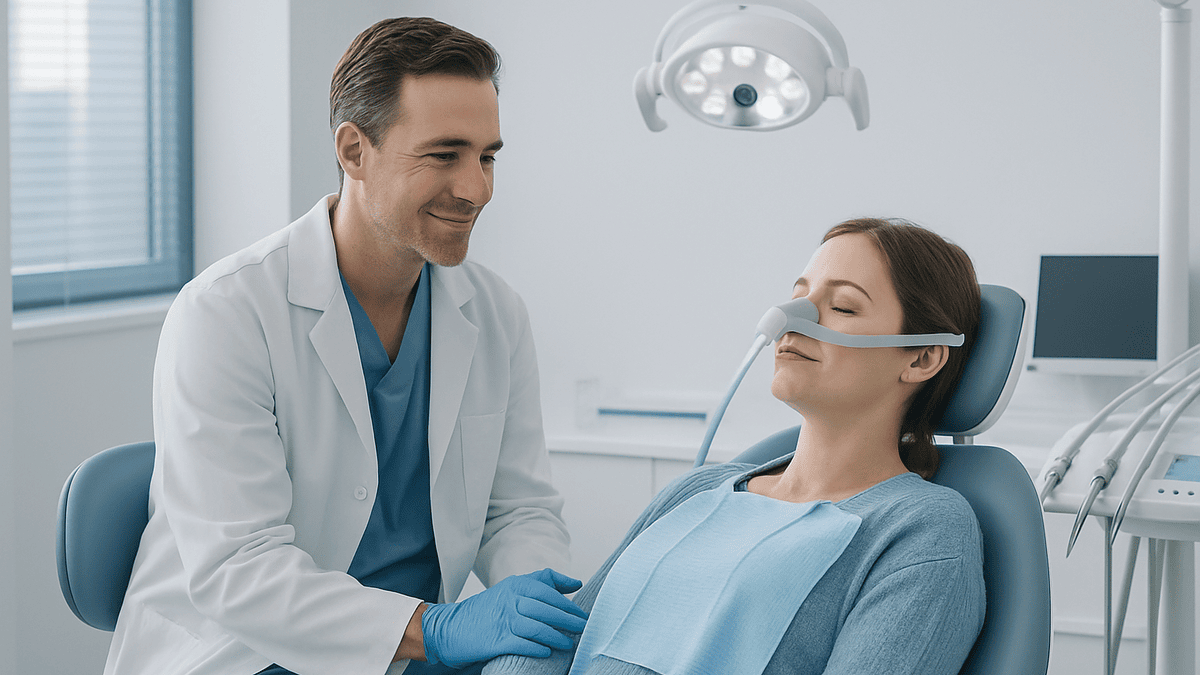
Inhaled sedation. A sedative gas blended with oxygen flows through a small mask over your nose. It works within minutes, the dentist can adjust the level continuously during the procedure, and, its signature advantage, it washes out of your system almost as fast as it arrived. This is the lightest option and the only one after which some adults are cleared to drive, subject to their dentist’s judgment.
Oral sedation. You take a prescribed tablet, usually about an hour before your appointment. It’s needle-free and simple, which makes it popular with anxious patients. The trade-offs: onset and depth are less predictable than other routes, the level can’t be fine-tuned once you’ve swallowed it, and grogginess lingers well past the appointment.
IV sedation. Medication flows through a small line in your hand or arm. This gives the most precise control, the dentist can deepen or lighten the effect within a minute or two, and typically produces the most complete memory gap. It requires specific advanced training and, in most states, a permit, along with continuous monitoring.
Which route fits you depends on your anxiety level, the procedure’s length, your medical history, and honestly, your logistics for the rest of the day.
Will you remember the appointment?
Probably not much of it, and for many patients, that’s the entire point. Several medications used for moderate and IV sedation cause what clinicians call anterograde amnesia: your brain simply stops recording new memories while the drug is active. You were awake, cooperative, even chatty. The recording just never made it to storage.
The effect varies by route and by person. Inhaled sedation, being the lightest, often leaves memory mostly intact, patients recall the appointment but describe it as pleasant and strangely brief. Oral sedation produces patchier results; many people remember arriving and leaving with a soft-focus blur in between. IV sedation tends to erase the most, and it’s common for patients to insist they were “out cold” for a procedure during which they answered questions and turned their head on request.
A few honest caveats the brochures skip:
- Amnesia isn’t guaranteed. Some people retain fragments: a snippet of conversation, the sensation of rinsing. These fragments are typically emotionally neutral, because the anti-anxiety effect was working even when the memory block wasn’t complete.
- The memory gap can extend past the chair. Patients sometimes have no recollection of the ride home or of instructions given at discharge. This is exactly why dental teams put aftercare directions in writing and give them to your escort, not just to you.
- Anything you say while sedated may be uninhibited and cheerfully forgotten. Dental staff have heard it all; nobody is judging.
If remembering matters to you, some patients genuinely want to stay oriented, tell your dentist. Depth can be kept lighter deliberately.
Who benefits most from sedation dentistry?
Severe dental anxiety is the headline reason, and it’s more common than the waiting room suggests, surveys consistently find that a meaningful share of adults delay or avoid dental care out of fear, and a smaller group avoids it almost entirely. For those patients, sedation isn’t a luxury; it’s the difference between getting treatment and letting problems compound for years.
But anxiety is only one entry on the list. Dentists also reach for sedation when:
- The gag reflex won’t cooperate. Some people gag at impressions, X-ray sensors, or any instrument past the front teeth. Sedation reliably dampens the reflex.
- The appointment is long or complex. Multiple extractions, implant placement, or full-mouth work can mean two or three hours in the chair. Sedation makes marathon visits tolerable and lets the dentist consolidate what would otherwise be several appointments.
- Local anesthetic has struggled before. A few patients report being hard to numb, sometimes because anxiety itself amplifies sensation. Calming the nervous system often improves how well numbing works subjectively.
- Sitting still is physically difficult. Movement disorders, severe TMJ pain that limits jaw opening time, or restlessness can all make precise dental work harder; sedation helps the patient and the dentist alike.
- A past experience left scars. People with traumatic dental histories, or trauma histories generally, for whom lying back while someone works near the airway is genuinely distressing, often find sedation makes care possible again.
One evidence-based note worth stating plainly: sedation manages anxiety for that appointment; it doesn’t cure dental phobia. Some patients find successful sedated visits gradually rebuild confidence, while others benefit from pairing sedation with behavioral approaches over time.
Who needs extra caution, or a different plan?
Conscious sedation has a strong safety record in appropriately screened patients, and that wordscreenedcarries the weight. Certain conditions change the math, which is why a thorough health history isn’t paperwork theater.
Obstructive sleep apnea tops the list. Sedatives relax the same throat muscles that already collapse during apnea episodes, so sedation can worsen airway obstruction. If you snore heavily, wake gasping, or use a positive airway pressure machine, your dentist needs to know: it affects medication choice, depth, monitoring, and sometimes the decision to treat in a hospital setting instead.
Significant heart or lung disease warrants extra evaluation, and sometimes coordination with your physician. So does liver or kidney impairment, which slows how the body clears sedatives, stretching out both the effect and the recovery.
Age matters at both ends. Older adults are often more sensitive to sedatives and clear them more slowly; careful, lighter dosing decisions and longer observation are standard. Young children follow separate, stricter guidelines entirely (more on that below).
Pregnancy generally shifts the conversation toward postponing elective sedation, treating urgent problems with local anesthesia alone, and involving the obstetric team when sedation is truly necessary.
Finally, your medicine cabinet is clinically relevantall of it. Other sedating medications, certain antidepressants, opioid pain relievers, sleep aids, alcohol, cannabis, and even some herbal supplements can interact with sedatives, deepening or unpredictably altering their effect. Disclose everything, including the things that feel too minor or too personal to mention. Your dental team isn’t grading you; they’re calculating margins of safety.
How will you be monitored during the procedure?
Watch a sedation appointment from the corner of the room and you’ll notice something reassuring: someone is always watching you back. Monitoring is where moderate sedation earns its safety record, and it’s governed by dental board rules and professional guidelines rather than office preference.
Expect several layers running simultaneously:
- A pulse oximeterthe soft clip on your fingertip, continuously tracks the oxygen level in your blood and your heart rate. If oxygen dips, an alarm sounds long before you’d show any visible sign.
- Blood pressure readings at regular intervals, since sedatives can nudge blood pressure downward.
- Breathing observation, and for deeper moderate sedation and IV work, many practices add monitoring of exhaled carbon dioxide, which flags shallow breathing even earlier than oxygen readings do.
- Responsiveness checks. Those periodic questions, “Doing okay? Squeeze my hand”, aren’t small talk. They verify you’re still at the intended depth and haven’t drifted deeper.
Behind the scenes, requirements go further. Practices administering moderate sedation must generally hold a state permit, maintain emergency equipment including oxygen and airway supplies, keep medications on hand that can reverse certain sedatives if needed, and train the team in responding to emergencies. A designated staff member monitors you as their primary job while the dentist works.
Monitoring doesn’t stop when the last instrument goes down. You’ll be observed through recovery until you meet explicit discharge criteria, stable vital signs, steady alertness, the ability to sit and stand safely. Nobody should be waved out the door on wobbly legs, and a good practice won’t try.
What does recovery actually feel like?
The first hour is the strangest. Expect heavy limbs, a woolly head, and conversation that feels like it’s arriving from the next room. Some people get briefly weepy or giggly as the medication fades: a normal, temporary effect, not a character revelation. Mild nausea, headache, or hiccups visit a minority of patients and usually pass within hours.
The timeline depends heavily on the route:
- Inhaled sedation: the gas clears within minutes once you’re breathing plain oxygen. Most people feel essentially normal within half an hour, which is why this route carries the fewest day-after restrictions.
- Oral sedation: plan on grogginess for the rest of the day. The tablet that took an hour to work also takes its time leaving; many patients nap through the afternoon.
- IV sedation: alertness returns fairly quickly, often within an hour, but coordination, judgment, and reaction time lag behind for the better part of 24 hours, whether or not you feel sharp.
That gap between feeling recovered and being recovered is the trap. MedlinePlus and dental professional guidance are consistent on the standard precautions after oral or IV sedation: no driving or operating machinery for 24 hours, no alcohol, no signing contracts or making significant decisions, and no being solely responsible for small children that day.
Layer the dental side on top: your mouth may still be numb from local anesthetic for a few hours, so stick to soft foods, chew away from the numb side, and check the temperature of hot drinks carefully: a numb lip can’t warn you it’s burning.
What you need to arrange before your appointment
Sedation appointments fail for logistical reasons more often than medical ones. A dentist who discovers at check-in that you drove yourself will, if they’re doing their job, cancel oral or IV sedation on the spot. Get these pieces in place the week before:
Your escort, non-negotiable. For oral or IV sedation, a responsible adult must bring you, stay reachable (many offices require them to remain on site), drive you home, and ideally stick around for a few hours afterward. A rideshare driver doesn’t count; they can’t take responsibility for you at discharge.
Fasting, per your team’s exact instructions. Deeper sedation usually comes with directions to stop food and sometimes liquids for a set window beforehand, because a full stomach raises the risk of vomiting and aspiration while sedated. Instructions vary by route and depth, follow the specific ones you’re given rather than a friend’s memory of theirs.
The rest of your day, cleared. Book the day off work after oral or IV sedation. Arrange childcare. Postpone anything requiring sharp judgment.
Small practical details that matter more than they seem:
- Wear a short-sleeved or loose-sleeved top: it makes blood pressure cuffs and IV access easy.
- Skip nail polish on at least one finger; the pulse oximeter reads through the nail.
- Bring glasses instead of contact lenses, and your complete medication and supplement list.
- Follow your team’s guidance on which regular medications to take that morning, don’t decide unilaterally.
- Avoid alcohol for at least 24 hours before, and be honest about recent cannabis or other substance use; both change how sedatives behave.
Confirm the escort twice. It’s the single most commonly forgotten piece.
What are the risks and side effects?
An honest risk conversation sits between two exaggerations: the brochure that mentions no downsides, and the online forum convinced every sedation is a brush with disaster. The evidence supports neither. In screened patients with proper monitoring, serious complications from moderate dental sedation are rare, but “rare” isn’t “zero,” and the common side effects deserve plain description.
Common and temporary: drowsiness lasting hours, nausea, headache, dizziness, hiccups, brief memory gaps extending past the appointment, and bruising or soreness at an IV site. Some patients feel emotionally raw or unusually tired into the next day.
Less common: a paradoxical reaction, agitation or restlessness instead of calm, which occurs in a small fraction of patients, somewhat more often in children and older adults. Vomiting during recovery happens occasionally, which is one reason fasting instructions exist.
The risk that drives all the rules: respiratory depression. Every sedative can slow breathing if the dose runs deeper than intended or the patient is unusually sensitive. This is precisely what continuous oxygen monitoring is designed to catch early, and why permitted practices keep oxygen, airway equipment, and reversal medications for certain sedative classes immediately at hand. Detected early, dips in oxygen are typically corrected quickly: the danger historically has come from sedation without adequate monitoring, not from sedation itself.
Your best risk-reduction tools are unglamorous: full disclosure of your health history and every substance you take, strict adherence to fasting and escort instructions, and choosing a practice that can clearly explain its sedation permit, its monitoring setup, and its emergency protocol. If those answers come slowly or vaguely, keep looking.
Sedation for children: what's different?
Everything gets stricter. Children aren’t small adults pharmacologically: their airways are narrower, their oxygen reserves smaller, and their responses to sedatives less predictable, so pediatric sedation guidelines, developed jointly by the major pediatric and pediatric dentistry professional bodies, are among the most detailed in outpatient medicine.
A few differences parents should expect and, frankly, insist on:
- Screening is more exhaustive. Expect detailed questions about snoring, sleep patterns, recent colds, asthma, and prematurity history. A child with an active respiratory infection will often be rescheduled, congested airways and sedation are a poor combination.
- Fasting rules are enforced without exception. A granola bar in the car can genuinely postpone the appointment. This isn’t rigidity; it’s aspiration prevention.
- Staffing requirements scale with depth. For moderate sedation, a trained observer monitors the child while the dentist works. For deep sedation or general anesthesia, current guidelines call for a second qualified provider, separate from the dentist doing the procedure, whose only job is the child’s sedation and airway.
- Recovery observation runs longer, and discharge criteria are explicit: the child must be back to an appropriate baseline, not merely awake enough to carry to the car.
Inhaled sedation remains the workhorse for mildly anxious kids because it’s light, adjustable, and quickly reversible. For extensive treatment in very young or very anxious children, some pediatric dentists recommend treatment under deeper sedation in a hospital or surgical center: a bigger production, but sometimes the safer and kinder path than multiple distressing attempts in the office.
Ask any pediatric practice how they monitor, who watches your child during the procedure, and what their emergency plan is. Good practices answer without flinching.
Questions worth asking at your consultation
The consultation before a sedation appointment is your chance to interview the practice, and the quality of the answers tells you as much as their content. A confident, well-run sedation practice will welcome every one of these:
- “What level of sedation are you planning, and why that level for me?” You want to hear reasoning tied to your procedure and history, not a one-size answer.
- “What route will you use, and what are my alternatives?” If only one option is ever offered to every patient, ask why.
- “Do you hold a state sedation permit, and what training does the team have?” Moderate and IV sedation require specific credentials in most states. This question is normal; no one should bristle at it.
- “How will I be monitored, and who is doing the monitoring while you work?” Listen for continuous oxygen monitoring and a designated team member.
- “What’s your emergency protocol?” Oxygen, airway equipment, reversal medications where applicable, and a rehearsed plan should all come up unprompted.
- “Given my medications and health conditions, what should change beforehand?” Bring your complete list and let them do this calculation.
- “What are your exact fasting and escort rules, in writing?”
- “What will recovery look like for me specifically, and when can I drive, work, and exercise?”
One more, underused question: “What happens if the sedation isn’t enough?” Occasionally a patient stays more alert or anxious than planned. Knowing in advance whether the team would adjust, reschedule, or refer for deeper sedation prevents an unpleasant surprise mid-appointment.
Take notes or bring someone who will. Pre-procedure conversations are exactly the kind of detail anxiety erases.
When to call your dentist, and when to seek urgent care
Most sedation recoveries are boring, which is the goal. But you and your escort should know the difference between expected grogginess and a genuine warning sign, especially in the first 24 hours.
Call 911 or go to the emergency department immediately for:
- Difficulty breathing, noisy or labored breathing, or bluish lips or fingertips
- A person who can’t be woken or responds only briefly before drifting off again, hours after the appointment
- Chest pain, a racing or irregular heartbeat, or fainting
- Signs of a serious allergic reaction, swelling of the face, lips, or throat; widespread hives; wheezing
- A seizure, or confusion that worsens instead of steadily improving
Call your dental office the same day for: vomiting that won’t settle, dizziness that persists or worsens rather than fading, bleeding from the surgical site that soaks gauze and doesn’t slow with firm pressure, or pain that escalates despite following aftercare instructions.
Call within a day or two for: fever, spreading swelling, a bad taste with increasing pain (possible infection at an extraction site), or numbness that hasn’t budged after the local anesthetic should long since have worn off.
Two practical notes. First, your escort matters here: a groggy patient is a poor judge of their own breathing and alertness, which is why guidelines ask a responsible adult to stay nearby for several hours. Second, the memory gap can swallow discharge instructions entirely, so keep the written aftercare sheet somewhere visible and let your escort hear the instructions firsthand. When in doubt, call; dental offices field these questions every day and would far rather hear from you unnecessarily than late.
Frequently asked questions
Are you asleep during conscious sedation?
No. Conscious sedation keeps you drowsy and deeply relaxed but rousable: you can respond to your dentist’s voice and follow simple instructions throughout. Many people believe afterward that they slept, but that’s usually the medication’s memory-blocking effect rather than true sleep. If you can only be roused with difficulty, that’s deep sedation, a separate category with stricter requirements.
Do you still feel pain with conscious sedation?
You shouldn’t, but not because of the sedation itself. Sedatives calm anxiety and dull awareness; a separate local anesthetic injection blocks the pain, usually given after the sedative takes effect. You may still notice pressure or vibration, which is normal and shouldn’t hurt. Because you stay responsive, you can signal your dentist if anything sharpens, and more numbing can be added immediately.
What drugs are used for conscious sedation in dentistry?
Dentists choose from a small set of well-studied sedative medications delivered by one of three routes: a sedative gas breathed through a nose mask, a prescribed tablet taken before the visit, or medication through an IV line. We don’t name specific agents here because the right choice depends on your health history, other medications, and the depth needed, ask your dental team to walk you through exactly what they plan to use and why.
Is conscious sedation the same as general anesthesia?
No. Conscious sedation is a middle point on a four-level continuum. You breathe on your own, keep protective reflexes, and respond to voice; recovery takes hours. Under general anesthesia you’re fully unconscious, your breathing is managed by an anesthesia professional, and recovery is longer. The two also differ in required training, equipment, setting, and cost, which is why they’re treated as distinct services.
Can I drive myself home after dental sedation?
After oral or IV sedation, no, plan on a responsible adult driving you and no driving for 24 hours, even if you feel alert, because reaction time and judgment lag behind subjective recovery. A rideshare alone typically doesn’t satisfy the escort requirement. Light inhaled sedation is the exception: it clears within minutes, and many dentists allow driving afterward, at their discretion.
Do I need to fast before conscious sedation?
Usually yes for oral and IV sedation, because a full stomach raises the risk of vomiting and aspiration while sedated. The exact window for stopping food and liquids varies with the route and depth planned, so follow the specific written instructions your dental team gives you rather than general rules you’ve heard. Fasting requirements are enforced strictly, arriving having eaten can mean rescheduling.
How long does grogginess last after sedation?
It depends on the route. Inhaled sedation wears off within about half an hour. Oral sedation commonly leaves you drowsy for the rest of the day, and many patients nap through the afternoon. After IV sedation you may feel alert within an hour, but coordination and judgment remain impaired for up to 24 hours, hence the standard advice to skip driving, alcohol, work, and important decisions until the next day.
Is conscious sedation safe for children?
It can be, under stricter rules than adult sedation. Pediatric guidelines require detailed screening (including sleep and breathing history), rigid fasting compliance, a trained observer dedicated to monitoring the child, and, for deeper sedation, a second qualified provider separate from the treating dentist. Light inhaled sedation is the most common choice for mildly anxious children; extensive treatment in very young children is sometimes safer done in a hospital setting.
Will I say embarrassing things under sedation?
Possibly, sedatives lower inhibitions, and some patients chat freely, but you’re unlikely to remember it, and dental teams genuinely aren’t fazed. More practically important: the same memory effect can erase your discharge instructions, so make sure aftercare directions are given in writing and that your escort hears them too. Anything decided or signed while recovering shouldn’t be, which is why major decisions wait 24 hours.
I have sleep apnea, can I still have dental sedation?
Often yes, but only with full disclosure and extra planning. Sedatives relax throat muscles that already collapse during apnea, so your dentist may choose a lighter depth, different route, enhanced monitoring, coordination with your physician, or treatment in a hospital setting. Tell your dental team about diagnosed apnea, heavy snoring, or a positive airway pressure machine before the appointment is booked: it materially changes the safety plan.
References
- MedlinePlus: Conscious sedation for surgical procedures
- MedlinePlus: Anesthesia
- NHS: Wisdom tooth removal
This article is for general information only and is not a substitute for professional medical advice. Please consult a qualified doctor about your individual situation.

More from the Blog
How Jaw Cyst Removal Surgery Protects Nearby Teeth and Nerves While the Cyst Comes Out
Jaw cyst removal surgery protects nearby teeth and nerves through planning and technique: three-dimensional imaging maps the cyst against tooth roots and the nerve…

Healing After Gingival Aesthetics: Soft Diet, Gentle Brushing and How the Gum Line Settles
Gum reshaping healing is usually quick compared with other dental surgery. Soreness and mild swelling are common for a few days, and the surface…
Living With Aesthetic Dental Work: Staining, Biting Habits and Long-Term Upkeep
Maintaining cosmetic dental work rests on three habits: protecting the bond line where restoration meets tooth, controlling biting forces such as grinding, nail-biting and…
Composite Bonding Results: Blending With Natural Teeth and What the Resin Cannot Change
Composite bonding results depend on how carefully tooth-colored resin is shade-matched, layered, and polished onto natural enamel; done well, it can disguise small chips,…
After Dental Trauma Care: Splints, Follow-Up Visits and How the Tooth Is Monitored
Dental trauma recovery usually involves a flexible splint worn for about two to four weeks depending on the injury, a soft diet, careful hygiene…

Who Is a Candidate for Laser Dentistry? Gums, Small Cavities and Sensitivity Explained
Laser dentistry candidates are usually adults and older children who need gum treatment (deep-pocket cleaning, reshaping, small soft-tissue procedures), have small or early cavities…