

CoolSculpting vs Liposuction: What Each Can Remove, Downtime and Who Suits Which Approach

Key Takeaways
- Cryolipolysis is the medical name for the technique sold as CoolSculpting; it cools a pinchable fat fold to trigger gradual cell death, while liposuction physically suctions fat out through a thin cannula.
- A single fat-freezing cycle reduces the fat layer in the treated zone by roughly 10 to 25 percent in published studies, whereas one liposuction session can remove hundreds of milliliters to several liters of aspirate.
- Neither approach removes visceral fat, tightens loose skin, treats cellulite or improves metabolic health, so both are contouring tools for people already at a stable, near-goal weight.
- Fat-freezing results begin around four to six weeks and settle by about three months, while liposuction results are masked by swelling and can take up to six months to finalize.
- Liposuction typically means one to two weeks off work, a compression garment for several weeks and four to six weeks without strenuous exercise; fat freezing usually means none of these.
- Paradoxical adipose hyperplasia, an uncommon reaction in which treated fat enlarges instead of shrinking, is the cryolipolysis complication most worth asking about, because it does not resolve without corrective surgery.
Cryolipolysis (the technique widely known by the trade name CoolSculpting) and liposuction both target pockets of fat under the skin, but they differ in scale. Fat freezing is non-surgical, removes a modest fraction of fat in a small area over weeks, and has little downtime. Liposuction is surgery that removes more fat in one session, with a recovery of weeks. Suitability depends on health, weight stability and goals, decided with a qualified treating team.
The changing room mirror is where this question usually starts. Someone has kept their weight steady for two years, runs three mornings a week, eats reasonably well, and still has a lower-belly bulge or a roll at the bra line that refuses to move. A friend mentions fat freezing. A cousin swears by the liposuction she had a decade ago. Both sound plausible. Neither comes with an honest, side-by-side explanation.
The coolsculpting vs liposuction debate tends to be argued with before-and-after photos rather than mechanisms, and that is exactly the wrong way round. One approach is a non-surgical device applied to the skin; the other is an operation with anesthesia and incisions. They remove different amounts of fat, on different timelines, with different risks.
What follows is the comparison a careful clinician would walk you through in an unhurried consultation: what actually happens to the fat, what the published evidence measures, what the days and weeks afterward look like, and who is usually asked to wait.
What the coolsculpting vs liposuction question is really asking
Start with a small but useful correction. CoolSculpting is a trade name for a technique whose medical name is cryolipolysis: controlled cooling of the skin to destroy fat cells underneath it. Liposuction is a surgical procedure in which a surgeon loosens fat and suctions it out through a thin tube. So the honest comparison is not brand versus brand; it is a non-surgical device treatment versus an operation. This article uses the generic term cryolipolysis, or fat freezing, from here on.
Both approaches share one target: subcutaneous fat, the layer that sits just under the skin and can be pinched between two fingers. Neither touches visceral fat, the deeper fat packed around the organs inside the abdominal wall, which is the type most strongly linked to heart disease and type 2 diabetes. That distinction matters, because a firm, rounded abdomen that cannot be pinched is usually visceral fat, and no body-contouring procedure addresses it (Cleveland Clinic).
The two also share a philosophy. Neither is a weight-loss treatment. Both are designed for people who are already near a weight they can maintain and want to reshape a specific area that diet and exercise have not changed. Professional bodies and major medical centers describe liposuction as body contouring, not obesity treatment, and the same framing applies to fat freezing (Mayo Clinic; NHS).
Where they part ways is scale, speed, invasiveness and recovery. Fat freezing removes a fraction of the fat in a hand-sized zone, gradually, with almost no time off. Liposuction removes considerably more, in one sitting, at the cost of anesthesia, incisions and a recovery measured in weeks. Everything else in this comparison flows from that trade-off.
How cryolipolysis (fat freezing) actually works
Fat cells are more sensitive to cold than the skin, nerves and blood vessels around them. Cryolipolysis exploits that gap. A gel pad is placed on the skin, then an applicator either draws the tissue in with gentle suction or rests flat against it, and cools the area to a temperature low enough to injure fat cells without freezing the skin itself. A typical session lasts roughly 35 to 60 minutes per applicator placement, and several placements may be needed for one body zone (Cleveland Clinic).
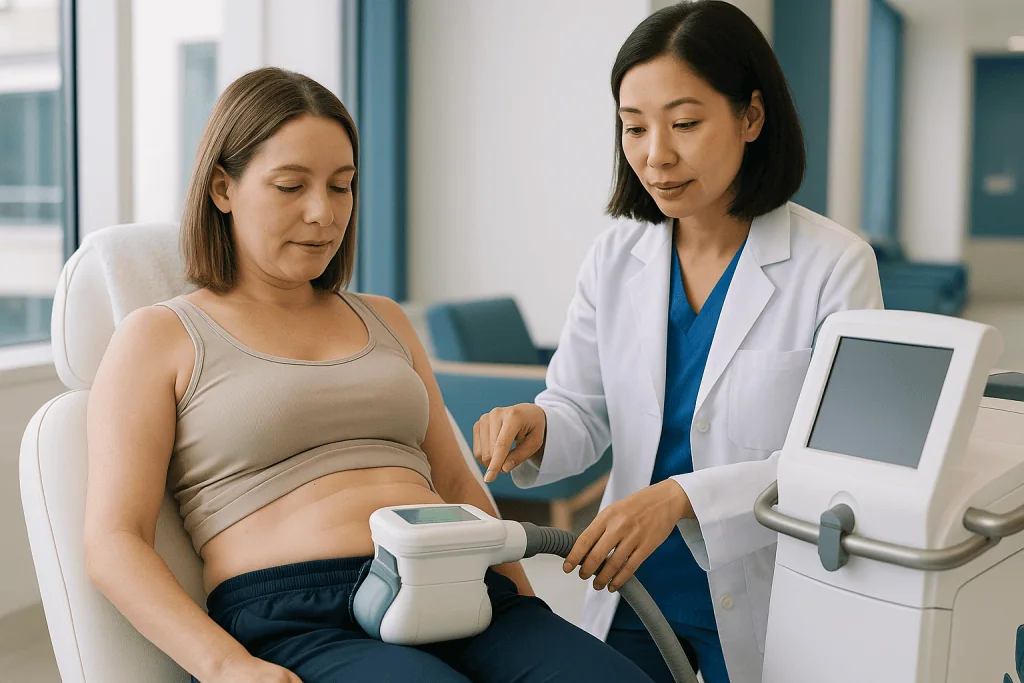
During the first few minutes most people describe intense cold, pulling and pinching, which fade as the area numbs. Afterward the clinician usually massages the treated tissue, which feels stiff and cold for a minute or two.
The cold triggers a process called apoptosis, a programmed, orderly cell death rather than a rupture. Over the following weeks the body’s immune cells clear the damaged fat cells, and the remaining fat layer in that zone becomes thinner. Because clearance is gradual, nothing visible happens on the day. Changes typically begin at around four to six weeks and continue to about three months, which is why clinicians schedule any follow-up assessment or repeat session months, not days, later (Cleveland Clinic).
Two limits follow directly from the mechanism. First, the applicator can only cool what it can reach, so the fat must be pinchable and fit the device; very thin layers or very large, firm areas are poor targets. Second, one session affects only the tissue under one applicator footprint. Treating a whole abdomen or both flanks means multiple placements, and many people have more than one session to a single area. A systematic review of published cryolipolysis studies found fat-layer reductions in the treated zone of roughly 10 to 25 percent per session measured by calipers or ultrasound, not a wholesale removal (NIH/PubMed, Ingargiola et al.).
How liposuction actually works
Liposuction is surgery, and it helps to picture it as such. The surgeon marks the areas to be treated while the person is standing, because fat pockets shift when lying down. Anesthesia is then given: local anesthesia with sedation for small areas, or general anesthesia when several regions are treated at once (Mayo Clinic).
Most modern procedures begin with the tumescent technique. A large volume of sterile saline containing a local anesthetic and a medicine that narrows blood vessels is infused into the fat layer, which firms it up, numbs it and dramatically reduces bleeding. Through small incisions, usually well under a centimeter, the surgeon passes a cannula, a thin hollow tube, back and forth to break up fat, which is then drawn out by a vacuum pump or syringe. Some surgeons add ultrasound or laser energy to liquefy fat before suctioning it; these are variations on the same operation rather than separate treatments, and the evidence does not clearly show one variant produces better results than another (Mayo Clinic; Cleveland Clinic).
The fat removed is measured in milliliters and liters, and the amount is deliberately limited. Removing very large volumes shifts fluid and electrolytes, increases the risk of complications and often requires an overnight hospital stay for monitoring. Surgeons commonly treat around five liters as the threshold for large-volume liposuction that demands extra precautions (Cleveland Clinic).
The incisions are closed or left open to drain, a compression garment is applied, and most people go home the same day. Unlike cryolipolysis, the fat is physically gone when you leave the operating room. What you cannot see yet is the result, because swelling fills the space for weeks. The body does not grow new fat cells in adulthood in any meaningful number, so removed cells do not return, though the ones that remain can still enlarge if weight rises (Mayo Clinic).
What can each remove? The honest numbers
Here is where marketing and evidence drift furthest apart, so the figures deserve care.

For cryolipolysis, the published measurements are of fat-layer thickness in the treated zone, not body weight. The systematic review by Ingargiola and colleagues pooled the available clinical studies and reported reductions in caliper-measured fat thickness of roughly 14 to 28 percent, and ultrasound-measured reductions of about 10 to 25 percent, after a single treatment cycle (NIH/PubMed). Translate that into everyday terms: if a lower-belly fold measures the width of four fingers, one session might bring it closer to three. The scale does not move. People who expect to drop a clothing size after one session are set up for disappointment.
For liposuction, the yardstick is volume aspirated. A small area such as the chin might yield well under 100 milliliters. An abdomen and flanks treated together can yield one to several liters, and anything approaching five liters is classified as large-volume with additional safety measures (Cleveland Clinic). Because total aspirate includes the infused tumescent fluid and some blood, the true fat removed is less than the number on the canister, and surgeons are more interested in shape than volume.
Crucially, neither figure equals weight loss. Even several liters of fat weighs only a few kilograms, and much of that is offset for weeks by swelling and retained fluid. Mainstream guidance is consistent: liposuction changes contour, not health markers, and it does not improve the metabolic risks associated with excess weight (NHS; Mayo Clinic).
The realistic comparison, then, is this. Fat freezing is designed for a discrete, pinchable pocket where trimming a fraction is enough. Liposuction is designed for larger or multiple areas, or where a more definite change in shape is wanted in one step, and where the person accepts surgery to get it.
Cryolipolysis vs liposuction at a glance
Tables flatten nuance, but a side-by-side view helps most people see which questions to ask next. Every figure below is a typical range described by the cited sources, not a guarantee for any individual.
| Feature | Cryolipolysis (fat freezing) | Liposuction |
|---|---|---|
| Type of treatment | Non-surgical device applied to skin | Surgery with incisions and anesthesia |
| Anesthesia | None | Local with sedation or general |
| Fat removed per treatment | Roughly 10–25% of the fat layer in the treated zone (NIH/PubMed) | Hundreds of milliliters to several liters of aspirate (Cleveland Clinic) |
| Areas per session | One applicator footprint at a time; several placements possible | Multiple regions in one operation |
| When change appears | Starts around 4–6 weeks, settles by about 3 months (Cleveland Clinic) | Swelling masks result; final shape can take up to 6 months (NHS) |
| Time off work | Usually none | Commonly 1–2 weeks (NHS) |
| Strenuous exercise | Same day or next day, as tolerated | Usually avoided for about 4–6 weeks (NHS) |
| Compression garment | Not needed | Worn for several weeks (Mayo Clinic) |
| Most common side effects | Numbness, redness, bruising, tenderness; rare paradoxical adipose hyperplasia | Bruising, swelling, numbness, contour irregularity, fluid collections; rare serious events |
| Effect on loose skin | None | None; may worsen laxity if skin has poor elasticity |
| Repeat treatments | Often needed for the same area | Revision surgery sometimes performed |
Read the table down the middle column and a pattern emerges: fat freezing trades power for convenience, liposuction trades convenience for power. Neither column is ‘better’; each answers a different question about how much change a person wants and what they are willing to go through for it.
Who is usually a candidate, and who is usually asked to wait
Both approaches attract the same ideal candidate: an adult in good general health, at a stable weight they can realistically maintain, with a specific fat pocket that persists despite reasonable diet and activity, and with skin elastic enough to tighten over a smaller volume. Clinicians also look for something less tangible, realistic expectations, because the largest source of disappointment in body contouring is a mismatch between what was imagined and what the procedure can physically do (Mayo Clinic).
Weight matters differently for each. For liposuction, guidance commonly describes candidates as being within about 30 percent of a healthy weight for their height, with skin that still has good tone (Mayo Clinic; NHS). People with a body mass index in the obesity range are typically advised that liposuction is not an appropriate substitute for weight management and that surgical risk rises with weight. Cryolipolysis has no strict weight cut-off, but the applicator must be able to draw in a pinchable fold, and outcomes in very large areas are modest, so it is usually reserved for people already close to their goal.
Several situations usually lead to a pause or a different conversation. For fat freezing specifically, conditions in which cold triggers a harmful reaction are contraindications: cryoglobulinemia, cold agglutinin disease and paroxysmal cold hemoglobinuria, all rare blood disorders in which cold causes abnormal clumping or breakdown of blood cells (Cleveland Clinic). Hernias at the treatment site, open wounds, active skin disease and pregnancy also rule an area out.
For liposuction, the surgical checklist is longer: heart or lung disease that raises anesthetic risk, diabetes that is poorly controlled, bleeding disorders or blood-thinning medicines that cannot safely be paused, a weakened immune system, and smoking, which impairs healing. Someone actively losing weight, recently pregnant, or planning pregnancy is often asked to wait until things have settled. A history of blood clots prompts extra assessment because surgery and reduced mobility raise clot risk (Mayo Clinic; NHS).
The decision, in every case, rests with the treating team after examination and a frank discussion of goals.
What the following days and weeks look like after fat freezing
The strange part of cryolipolysis is how ordinary the day of treatment feels. Most people walk out and go back to work or the school pickup. The treated area looks red, sometimes pale or blotchy where the applicator sat, and often feels firm, as if a small cold pack were still inside. That firmness eases within hours.
Over the first week, the common sensations are tingling, aching, tenderness to touch, bruising where suction was applied and, most noticeably, numbness. Reduced sensation in the treated zone is expected and can persist for several weeks before returning (Cleveland Clinic). Some people describe a deep itch or cramping around days three to seven that settles on its own. Because nothing has been cut, there are no wounds to dress and no garment to wear; ordinary showering and exercise resume as comfort allows.
Then comes the waiting, which is the part people underestimate. Because the body clears damaged fat cells gradually through the lymphatic system, the area looks essentially unchanged for the first month. Early softening or flattening tends to appear at four to six weeks, and the visible change continues to develop until roughly the three-month mark (Cleveland Clinic). Photographs taken under identical lighting are more reliable than the mirror for judging this, since day-to-day bloating and posture create noise.
At that three-month review, the clinician and the person decide together whether the change is sufficient or whether a further session to the same area is worth considering. Because each session removes only a fraction of the layer, repeat treatment is common rather than exceptional. The interval is dictated by biology, not preference: treating again before the first round has finished clearing gives no way to judge what the next round is adding.
Weight stability during this period matters. Fat cells that remain in the area still respond to overall energy balance, so a gain of a few kilograms can mask the reduction entirely.
Liposuction recovery time: what the following weeks look like
Liposuction recovery is a different animal, and the first 48 hours set the tone. Expect swelling, bruising that can look dramatic, and fluid leaking from the small incisions; surgeons often leave these open briefly for exactly that reason. Pain is usually described as deep soreness, like a hard workout multiplied, and is managed with medicines prescribed by the surgical team according to their protocol. A compression garment goes on immediately and is worn for several weeks to limit swelling and help the skin settle onto its new contour (Mayo Clinic).
Walking is encouraged from the first day, not for fitness but to keep blood moving in the legs and reduce the risk of a clot forming in a deep vein. Most people take one to two weeks off work, longer if the job is physical or several areas were treated (NHS). Driving waits until the person is off sedating medicines and can brake sharply without pain.
Weeks two to six bring steady improvement in comfort, but the mirror lags behind. Swelling can make the treated area look larger than before surgery for a spell, and this is where many people quietly panic. Numb patches, lumpiness and firmness under the skin are typical as internal healing tissue matures; gentle massage may be suggested by the team. Strenuous exercise and heavy lifting are usually held back for around four to six weeks to protect healing tissue and avoid worsening swelling (NHS).
The final contour is slow. Residual swelling can take months to resolve, and guidance commonly describes up to six months before the shape is considered settled (NHS). Skin gradually retracts over that time if it has good elasticity; if it does not, loose or rippled skin may become more apparent, which is one reason surgeons assess skin tone so carefully beforehand. Follow-up visits track healing, check for fluid collections and give the team a chance to catch problems early.
Risks and side effects, side by side
Any honest comparison spends as much time on what can go wrong as on what can go right.
Cryolipolysis has a favorable safety record overall, with side effects that are mostly mild and self-limiting: redness, bruising, swelling, tenderness, tingling and temporary numbness (Cleveland Clinic). Rare reports include skin discoloration and, unusually, small areas of frostbite-like injury when protective gel was misapplied. The complication that deserves the most attention is paradoxical adipose hyperplasia, a delayed reaction in which the treated fat, instead of shrinking, grows into a firm, enlarged, often applicator-shaped mass over two to five months. It is not dangerous to health but it is cosmetically distressing, does not resolve on its own, and is typically corrected surgically, usually with liposuction. Reported rates in the literature vary considerably between studies and appear to be higher in more recent series than in early reports, so a candid clinic will discuss it as a real, if uncommon, possibility rather than a footnote (NIH/PubMed).
Liposuction carries the risks of any operation plus some specific to the technique (Mayo Clinic; NHS): contour irregularities such as dents, waves or asymmetry; persistent numbness or altered sensation; seroma, a pocket of fluid that may need to be drained with a needle; infection; skin discoloration; and internal puncture if the cannula is passed too deeply, which is rare but can be serious. Fat embolism, in which loosened fat enters the bloodstream and lodges in the lungs, is a rare emergency. Blood clots in the legs, and fluid or electrolyte imbalance, particularly with large volumes or long procedures, are the reasons surgeons cap what they remove in one session and monitor closely afterward. Anesthesia itself carries small but real risks.
Neither list should read as a scare. Both procedures are performed routinely with low rates of serious harm when done by appropriately trained, credentialed practitioners in properly equipped settings, and that qualifier is the single most important safety variable a person controls.
Can either treat loose skin, cellulite or weight?
Three things people quietly hope for, and three things neither procedure reliably delivers.
Loose skin comes first, because it trips up the most people. Both cryolipolysis and liposuction remove volume from beneath the skin; neither tightens the skin itself. If the skin has good elasticity, it retracts over the smaller volume during the months that follow. If it has been stretched by pregnancy or significant weight loss, or has lost elasticity with age or sun exposure, removing the fat that was filling it can make the laxity more visible, not less (Mayo Clinic). Surgeons sometimes suggest that skin-removal procedures such as abdominoplasty, a tummy tuck, are the more appropriate option in that situation, and that is a separate operation with its own considerations.
Cellulite is second. The dimpled appearance on thighs and buttocks arises from fibrous bands tethering the skin to deeper tissue while fat pushes up between them. Reducing fat volume does not release the bands, so neither liposuction nor fat freezing is a cellulite treatment, and liposuction can occasionally make dimpling more prominent (Mayo Clinic).
Weight is third and most important for health. Fat removed by liposuction is subcutaneous, not the visceral fat associated with cardiovascular and metabolic risk, and studies have not shown improvements in blood pressure, cholesterol or insulin sensitivity that would be expected from genuine weight loss (NHS). Cryolipolysis removes far less and changes nothing metabolically. Anyone whose main goal is health, rather than the shape of a specific area, is better served by a conversation about nutrition, activity and, where appropriate, medically supervised weight management with their primary care clinician.
This is not a criticism of either procedure. A well-chosen body-contouring treatment does what it is designed to do. Problems arise only when it is asked to do something else.
Is CoolSculpting better than liposuction? What the evidence actually shows
The question people type is ‘which is better’, and the evidence-based answer is that they are not competing for the same job.
Head-to-head randomized trials comparing cryolipolysis directly against liposuction for the same body area are essentially absent. What exists are separate bodies of evidence. For cryolipolysis, the literature consists mostly of prospective and retrospective clinical series, several of them industry-sponsored, measuring fat-layer thickness before and after treatment; the systematic review by Ingargiola and colleagues judged the technique effective at reducing localized subcutaneous fat with a low complication rate, while noting the limited number of high-quality controlled studies (NIH/PubMed). For liposuction, decades of surgical experience and large registries support its ability to remove substantial volumes and reshape contour, with well-characterized complication rates that rise with volume, duration and the number of areas treated (Mayo Clinic).
So the honest framing is a set of questions, not a verdict:
- How much change is wanted? A subtle trim of one pinchable pocket favors fat freezing; a definite reshaping of an abdomen and flanks favors surgery.
- How much downtime can be absorbed? Days versus weeks is a genuine difference in a working life.
- Is surgery acceptable at all? Some people will not consider anesthesia and incisions for a cosmetic goal, and that preference is legitimate.
- Is the skin elastic enough? Poor skin tone limits both, but the larger volume change of liposuction exposes it sooner.
- How is the risk profile weighed? Rare but serious surgical events versus a rare but cosmetically significant paradoxical reaction.
The phrase ‘coolsculpting vs lipo results’ produces thousands of photo galleries, and almost none are comparable: different bodies, different lighting, different time points, different numbers of sessions. Treat them as illustrations of what is possible, never as evidence of what is typical. The person best placed to say which approach suits a particular body is a qualified clinician who has examined it.
What people often get wrong
Body contouring attracts myths the way a fresh wound attracts a scab, so here are the ones worth peeling off.
‘The fat comes back somewhere else.’ Fat cells destroyed by cold or removed by suction do not regenerate in adulthood in meaningful numbers. What does happen is that the remaining fat cells, everywhere, enlarge if weight rises, and areas that were not treated will then look proportionally fuller. That is weight gain, not migration. Stable weight preserves the result of either procedure (Mayo Clinic).
‘Fat freezing is a gentler kind of liposuction.’ They are unrelated mechanisms. One induces gradual cell death by cold; the other physically extracts tissue. Neither is a lighter version of the other, and one is not a stepping stone to the other.
‘You will see the result at the first follow-up.’ Cryolipolysis shows nothing for about a month and keeps changing until three months. Liposuction is hidden by swelling for weeks and settles over up to six months (Cleveland Clinic; NHS). Judging either early is the fastest route to needless worry.
‘Liposuction is a shortcut to losing weight.’ It removes subcutaneous fat for shape, not visceral fat for health, and the weight change is small once swelling resolves. Guidance from every major source describes it as contouring, not weight loss (NHS).
‘Non-surgical means risk-free.’ Paradoxical adipose hyperplasia is uncommon, but it is real, permanent without correction, and more likely to be discussed frankly by a well-run clinic than glossed over.
‘More sessions or more volume is always better.’ Surgeons cap volume because complication risk climbs with it. Fat-freezing clinicians wait a full clearance cycle before re-treating because earlier is not more effective, merely harder to assess.
‘The device does the work, so the operator does not matter.’ Applicator selection, placement, skin protection and candidate assessment are all operator judgments. For surgery, training and setting are the dominant safety variables.
Questions to ask your care team
A good consultation should feel less like a sales pitch and more like a conversation with someone who would happily talk you out of it. These questions help you tell the difference, and the answers belong in your notes before any decision.
- Based on your examination, which of these two approaches, if either, suits my body and goals, and why?
- What is your training and credentialing for this specific procedure, and in what kind of facility is it performed?
- What change in this area is realistic for me, in plain terms, and what would you consider a disappointing result?
- How elastic is my skin, and how likely is loose or rippled skin afterward?
- For fat freezing: how many applicator placements and how many sessions do you anticipate for this area, and how will we judge whether to repeat?
- For liposuction: roughly what volume do you expect to remove, which anesthesia will be used, and will I stay overnight?
- What are the specific complications you have seen with this procedure, how often, and how are they managed?
- Have you encountered paradoxical adipose hyperplasia, and how would it be handled if it occurred?
- Which of my medicines, supplements or health conditions need to be reviewed beforehand, and who coordinates that with my prescribing clinician?
- What does the recovery plan look like week by week, including work, exercise, driving and garment use?
- What symptoms should prompt me to call you immediately, and how do I reach someone after hours?
- What follow-up visits are included, and what happens if the result is uneven or needs revision?
- What are the alternatives, including doing nothing, and what would you do in my position?
One more, less comfortable question deserves a place: ‘If I did nothing, what would you expect to happen?’ A clinician who can answer that calmly, and who volunteers reasons you might wait, is demonstrating the judgment you are relying on. No answer here replaces the examination; every decision rests with the treating team.
When to call your doctor
Most recovery after either procedure is uneventful, but a few signs mean the same-day phone call is not optional.
After liposuction, contact the surgical team or seek urgent care for: fever or chills; spreading redness, warmth or increasing pain around an incision; pus or foul-smelling drainage; a rapidly enlarging, tense or painful swelling in the treated area, which can indicate bleeding or a fluid collection; calf pain, swelling or warmth in one leg, which can signal a deep vein clot; persistent vomiting or inability to keep fluids down; dizziness, fainting or a racing heart, which may reflect fluid or blood loss; and any wound that opens. Call emergency services immediately for sudden shortness of breath, chest pain, coughing up blood, confusion, or a bluish tinge to lips or skin, because these can indicate a clot or fat embolism in the lungs (Mayo Clinic; NHS).
After cryolipolysis, seek advice for: blistering, open skin or a dark, leathery patch over the treated area, which can indicate cold injury; pain that worsens rather than eases after the first week; signs of infection at the site; or a treated area that, weeks to months later, becomes firmer and larger rather than smaller, the pattern of paradoxical adipose hyperplasia (Cleveland Clinic).
For both, a general rule serves well: if a symptom is new, getting worse, or simply frightening, that is reason enough to call. Clinics expect these calls, and early assessment turns most problems into minor ones. Keep the after-hours number somewhere you can find it without your phone, and make sure the person driving you home has it too.
Frequently asked questions
Is CoolSculpting better than liposuction for the stomach?
Neither is universally better; they suit different goals. Fat freezing suits a small, pinchable lower-belly pocket where a modest reduction is acceptable and downtime must be minimal. Liposuction suits a larger or more defined change across the abdomen and flanks in one procedure, accepting surgery and weeks of recovery. A clinician’s examination of fat distribution and skin elasticity determines which, if either, is appropriate.
How do coolsculpting vs lipo results differ over time?
Fat-freezing results appear gradually, starting at around four to six weeks and maturing by about three months as the body clears damaged cells. Liposuction removes fat immediately, but swelling hides the outcome for weeks and the final contour can take up to six months to settle. Both results persist only if weight remains stable, because remaining fat cells still enlarge with weight gain.
Cryolipolysis vs liposuction: which removes more fat?
Liposuction removes far more. One fat-freezing cycle reduces the fat layer in the treated zone by roughly 10 to 25 percent, according to a systematic review of clinical studies. A liposuction session can remove hundreds of milliliters to several liters of aspirate across multiple areas, with surgeons applying extra precautions above about five liters. Fat freezing often requires repeat sessions to approach a comparable change in one area.
What is the typical liposuction recovery time?
Most people take one to two weeks off work, wear a compression garment for several weeks and avoid strenuous exercise for about four to six weeks, according to NHS and Mayo Clinic guidance. Bruising and swelling peak in the first days and gradually fade. Residual swelling can persist for months, and the final shape is usually considered settled by around six months. Individual timelines are set by the surgical team.
Does fat freezing hurt?
Most people describe intense cold, pulling and pinching during the first several minutes, which fade as the area numbs. After treatment, common sensations include aching, tingling, tenderness and temporary numbness that can last several weeks. Some notice cramping or deep itching in the first week. Severe or worsening pain, blistering or skin changes are not expected and should be reported to the clinic promptly.
Can fat come back after liposuction or fat freezing?
Destroyed or removed fat cells do not regenerate in adulthood in any meaningful number, so the treated area does not refill in the same way. However, the fat cells that remain, in the treated area and elsewhere, enlarge if weight rises, which can erase the visible result. Maintaining a stable weight is the main factor in preserving the outcome of either procedure.
Who should not have cryolipolysis?
People with rare cold-sensitive blood disorders, including cryoglobulinemia, cold agglutinin disease and paroxysmal cold hemoglobinuria, should not have fat freezing because cold triggers harmful reactions. Hernias at the site, open wounds, active skin conditions and pregnancy also rule an area out. Anyone with very little pinchable fat or with skin laxity as the main concern is usually advised that the technique will not help.
Is liposuction a good option if I am overweight?
Usually not as a weight-loss tool. Guidance describes candidates as being within about 30 percent of a healthy weight with good skin tone, and describes liposuction as body contouring rather than obesity treatment. Surgical and anesthetic risks rise with weight, and the procedure removes subcutaneous rather than visceral fat, so metabolic health does not improve. A primary care clinician can discuss weight-management options first.
What is paradoxical adipose hyperplasia?
It is an uncommon delayed reaction to cryolipolysis in which the treated fat enlarges into a firm, often applicator-shaped mass over two to five months instead of shrinking. It is not medically dangerous but is cosmetically distressing and does not resolve on its own; correction usually involves liposuction. Reported rates vary between studies, so it is worth asking any clinic how they discuss and manage it.
Will either procedure help with loose skin or cellulite?
No. Both remove fat volume beneath the skin without tightening the skin itself, so loose skin can look more noticeable after fat is removed, particularly after pregnancy or major weight loss. Cellulite is caused by fibrous bands tethering the skin, which neither procedure releases, and liposuction can occasionally make dimpling more visible. Skin-removal surgery is a separate option a surgeon may discuss.
References
This article is for general information only and is not a substitute for professional medical advice. Please consult a qualified doctor about your individual situation.

More from the Blog
Is Body Aesthetics Surgery Right for You? Weight Stability, Skin Quality and Overall Health
A body aesthetics surgery candidate is usually an adult whose weight has held steady for months, who does not smoke, whose long-term conditions are…

Does Hi Def Liposuction Build Muscle? Separating Fact From Marketing on Sculpted Abs
No. Hi def liposuction does not build muscle. It removes fat from the thin layer under the skin and sculpts what remains so that…
Which Patients Suit Fat Grafting? Donor Areas, Skin Quality and Volume Goals Explained
A good fat grafting candidate is generally a healthy, non-smoking adult at a stable weight who has enough surplus fat in a donor area…

Does Laser Liposuction Hurt? Anesthesia Options and Managing Soreness in the First Days
Laser liposuction is usually done under local anesthesia, so most people feel pressure, warmth and tugging rather than sharp pain during the procedure. Soreness…

How Vaginoplasty Is Performed: Anesthesia, Tissue Repair and Time in the Operating Room
Vaginoplasty is performed under general anesthesia and takes several hours. In the most common technique, penile inversion, surgeons remove the testes, preserve the nerves…

How Lymphedema Microsurgery Is Performed: Tiny Vessels, the Microscope and Operating Time
Lymphedema microsurgery reroutes or rebuilds lymphatic drainage rather than cutting swelling away. Under a high-power microscope, a surgeon either joins lymphatic vessels under a…