

Dental Crowns for International Patients: Planning Two Visits, Temporaries and Follow-Up
Key Takeaways
- A conventional crown needs two visits because a laboratory makes it from an impression, with a temporary crown typically worn for roughly 2–3 weeks in between according to Cleveland Clinic.
- Temporary crowns use softer material and intentionally weak cement, so sticky and hard foods and lifting floss straight up are the common ways they come off.
- Single-visit milled crowns are an established option in some clinics, but not every tooth is suitable, and no mainstream evidence shows them to be universally better or worse than laboratory crowns.
- A crowned tooth can still decay at the margin where crown meets natural tooth, so brushing and flossing remain essential.
- The CDC advises patients treated abroad to obtain complete records and arrange follow-up care at home before traveling, which for a crown means X-rays, material and cement details.
- Cleveland Clinic gives a commonly quoted crown lifespan of roughly 5–15 years, with grinding habits and hygiene strongly influencing the outcome.
Dental crowns for international patients are usually planned as two visits: the first shapes the tooth, records an impression and fits a temporary crown; the second, typically 2–3 weeks later, fits the permanent crown. Living with a temporary between visits, carrying treatment records and arranging follow-up near home are the key planning steps, and the timing decisions rest with the treating dentist.
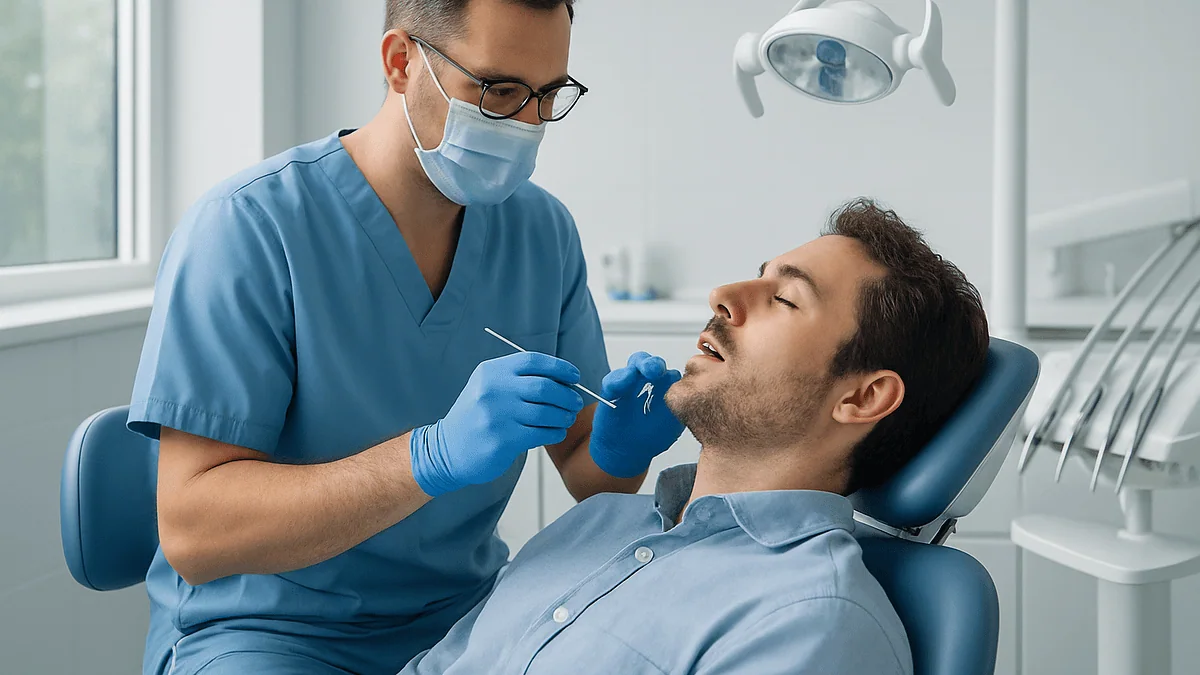
A man sits in a dental chair with his passport in his jacket pocket and a return flight on his phone. The dentist has just explained that the cracked molar needs a crown. His first question is not about porcelain or zirconia. It is about the calendar: how many appointments, how far apart, and what happens to the tooth in between.
That calendar question is what makes dental crowns for international patients different from the same treatment at a dentist down the road. The dentistry is identical. The logistics are not. A crown is normally made in a laboratory from a mold of the prepared tooth, which means a gap of days to weeks between preparation and fitting, and a temporary crown doing the work in the meantime.
This explainer walks through both visits, the temporary stage, what the following weeks usually feel like, and how to arrange follow-up care in two countries without leaving a gap in your care.
What a dental crown actually does, and what happens at each visit
A dental crown is a custom-made cap that covers the whole visible part of a tooth above the gum line. It restores shape, strength and bite surface when a filling alone cannot. Dentists usually recommend one when a tooth is cracked, heavily filled, weakened after root canal treatment (removal of the infected nerve tissue inside the tooth), or badly worn, according to Cleveland Clinic.
Think of the tooth as a stone pillar with a hairline fracture. Patching the crack with mortar helps a little; wrapping the whole pillar in a steel sleeve stops the forces from prying it apart. The crown is that sleeve.
The conventional process has three stages. First, the dentist trims the outer layer of the tooth so the crown has room to sit flush with its neighbors. Second, an impression (a mold or a digital scan) records the prepared tooth and the teeth it bites against. Third, a laboratory builds the crown from that record, and the dentist cements it in place at a later appointment.
Between stages two and three, a temporary crown made of acrylic or composite resin covers the prepared tooth. It protects the exposed dentin (the sensitive layer beneath enamel), keeps the tooth from drifting, and lets you chew on the other side with reasonable comfort.
Materials vary. Cleveland Clinic lists porcelain, ceramic, zirconia, metal alloys, and porcelain fused to metal. Each trades appearance against durability in slightly different ways, and the choice depends on where the tooth sits, how hard you bite, and how visible it is when you smile. That choice belongs in a conversation with the dentist who has examined you, not in a general article.
Why dental crowns for international patients are usually planned as two visits
The two-visit structure is not a sales device or a cautious habit. It follows from how most crowns are made. A laboratory technician needs the impression, the shade record and time to layer and fire ceramic or mill zirconia, then check the fit on a plaster or printed model. That work cannot be rushed into the same afternoon in most settings.

For someone who lives in the same city, the gap barely registers: a Tuesday appointment, then another Tuesday a fortnight later. For a patient who has flown in, the gap is the whole problem. It forces a choice between staying for the full interval, flying home with a temporary and returning, or asking whether a single-visit option is suitable.
Each path carries trade-offs. Staying means a long trip and the cost of time away from work and family. Flying home with a temporary means weeks of eating carefully and the risk of the temporary loosening on a different continent from the dentist who fitted it. A single-visit crown avoids both but is not suitable for every tooth or every clinic’s equipment, which the next sections cover.
The NHS, in its guidance on going abroad for medical treatment, stresses a point that applies squarely here: plan for aftercare before you travel, because complications and adjustments can arise after you are home, and the clinician who did the work may not be able to see you. That advice does not favor any country or provider. It simply describes a structural reality of treatment that spans borders.
Honest planning therefore starts with a question to the dentist: given this particular tooth, what is the realistic interval between visits, and what happens if something goes wrong in between?
How long does a dental crown take from first appointment to final fit?
The first appointment is typically the longer of the two. Numbing, shaping the tooth, taking the impression, choosing a shade and making the temporary crown often takes well over an hour, and more if the tooth also needs a core build-up (rebuilding missing tooth structure with filling material so the crown has something solid to grip).
Between appointments, Cleveland Clinic describes a temporary crown being worn for roughly two to three weeks while the laboratory makes the permanent one. Some laboratories work faster, some slower, and complex cases such as multiple crowns or crowns matched to a visible front tooth may take longer because of extra shade checks and try-ins.
The second appointment is often shorter. The dentist removes the temporary, cleans the tooth, tries the new crown, checks the bite and the contact with neighboring teeth, adjusts as needed, and cements it. If the fit is not right, the crown may go back to the laboratory, which adds another interval.
Here is where the phrase “how long does a dental crown take” needs an honest answer: the chair time is measured in hours, but the pathway is measured in weeks, and the pathway is what an international patient must plan around. A realistic worst case includes a second laboratory round, and a prudent itinerary leaves room for that rather than booking the flight home for the morning after the planned fitting.
Ask the dentist to write down the expected interval and the latest date by which they would want to see you for the fitting. A written plan is worth more than a verbal estimate when you are coordinating time off, accommodation and, possibly, a second trip.
Who is usually offered a crown, and who is asked to wait
A crown is generally recommended when a tooth has lost too much structure for a filling to hold reliably. Common reasons listed by Cleveland Clinic include a large cavity, a cracked or worn tooth, a tooth that has had root canal treatment, covering a dental implant, or anchoring a bridge (a false tooth held by crowns on neighboring teeth).

Some patients are asked to wait, and the reasons are clinical rather than bureaucratic. A tooth with an active infection at the root tip usually needs that infection treated first; cementing a crown over an unresolved problem can trap it. Gum disease that is not yet controlled makes the margins of a crown harder to keep clean and can undermine the result. A tooth that is loose because of bone loss may not be a sound foundation at all.
Timing also matters around other dental work. If a tooth has just had root canal treatment, the dentist may want to confirm that symptoms have settled before committing to a final crown. For implant crowns, the implant itself must first fuse with the bone, a process that takes months, so the crown stage is separated from the surgery by design.
Medical factors enter the picture too. People on certain medicines that affect clotting or bone, those with poorly controlled diabetes, and anyone with a condition that affects healing may be asked for a medical update before treatment, not because crowns are high-risk procedures but because the gum tissue around the prepared tooth needs to heal predictably.
None of this is a verdict on the patient. It is sequencing. The treating dentist weighs the state of the tooth, the gums, the bite and the general health picture, then decides whether a crown now, a crown later, or a different option altogether serves the tooth best.
Visit one: shaping the tooth, taking the impression, fitting the temporary
The first visit opens with a check that the treatment plan still fits what the dentist sees. An X-ray confirms the root and surrounding bone look healthy enough to support a crown. If the plan is sound, local anesthetic (an injection that numbs the tooth and gum) is given, and the appointment proceeds in a steady, unhurried sequence.
Shaping comes next. The dentist removes a thin layer of enamel from all sides and the biting surface of the tooth so the finished crown will be the same size as the original tooth, not bulkier. The amount removed depends on the material chosen; metal crowns need less space than layered porcelain, which is one reason material choice is decided before, not after, preparation.
If decay or an old filling leaves a hollow, the dentist fills it with a core material so the crown has a solid shape to sit on. Then the impression is taken, either with a tray of soft putty that sets in the mouth or with a handheld digital scanner that builds a three-dimensional image. A second record captures how the upper and lower teeth meet, so the laboratory can shape the biting surface correctly.
Shade selection follows, ideally in natural light, often with photographs sent to the technician.
Finally, the temporary crown is made chairside from acrylic or composite resin and attached with a weaker cement designed to be removed easily at the next visit. The dentist checks that you can close your teeth comfortably and that floss passes, sometimes with a little resistance, between the temporary and its neighbors.
Before leaving, make sure you have written instructions for the temporary stage and a way to contact the clinic. For an international patient, ask also for a copy of the X-ray, the material chosen and the planned cement, because a dentist at home may need those details if anything happens before visit two.
Living with a temporary crown while traveling between visits
A temporary crown is built to last weeks, not years, and it behaves accordingly. The resin is softer than ceramic, the cement is intentionally weak, and the fit is good rather than perfect. Treat it as a placeholder that needs gentle handling, especially if the interval between visits includes airports, hotel breakfasts and unfamiliar food.
Chewing is the main variable. Cleveland Clinic advises avoiding sticky foods such as chewing gum and caramel, which can pull a temporary off, and hard foods such as raw vegetables or ice, which can crack it. Chewing on the opposite side of the mouth is the simplest protective habit. Very hot or cold foods may trigger brief sensitivity because the prepared tooth has lost some of its insulating enamel.
Cleaning matters just as much. Brush normally, including the temporary. When flossing, slide the floss out sideways rather than lifting it straight up, which can catch the edge of the temporary and dislodge it.
Loosening does happen. If a temporary comes off, keep it, keep the area clean, and contact a dentist promptly rather than waiting for the planned second visit. An exposed prepared tooth can become sensitive, and neighboring teeth can drift within days, which may compromise the fit of the permanent crown. Dental adhesive from a pharmacy is sometimes used as a short-term measure, but the dentist who fitted the temporary, or a local dentist you can reach, should guide that decision.
If you are flying between visits, the CDC’s medical tourism guidance recommends carrying copies of your records and knowing in advance who to call if something goes wrong. For a temporary crown that means a local dentist’s details saved in your phone before you board, not searched for in a panic at a baggage carousel.
Two-visit, single-visit and implant crowns: a planning comparison
Not every crown follows the laboratory pathway. Some clinics use chairside CAD/CAM systems (computer-aided design and manufacturing) that scan the prepared tooth and mill a ceramic crown on site within the same appointment. Implant crowns add a third pattern, because the implant must heal in bone before any crown is made. The table below sets out how the three pathways differ for someone planning travel.
| Pathway | Typical appointments | Temporary stage | Planning notes |
|---|---|---|---|
| Conventional laboratory crown | Two visits, typically 2–3 weeks apart (Cleveland Clinic) | Yes, acrylic or resin temporary | Interval may lengthen if a try-in or remake is needed; plan a buffer |
| Chairside CAD/CAM crown | Usually one longer visit | Usually none | Depends on equipment and the tooth; not every case is suitable |
| Implant-supported crown | Surgery first, crown months later | Often a healing cap or temporary tooth | Two separate stages separated by bone healing; multiple trips or long stays |
The single-visit option sounds like the obvious answer for anyone with a flight to catch, so it is worth being precise about what the evidence supports. Milled ceramic crowns made chairside are an established technique, and mainstream sources such as Cleveland Clinic describe them as a legitimate option. What the evidence does not support is a blanket claim that they are better or worse than laboratory crowns in every situation. Front teeth needing subtle shade layering, teeth with margins below the gum that are hard to scan, and heavy grinders may be steered toward the laboratory route for reasons of appearance or strength.
The implant pathway deserves a separate note, since this article sits in a dental implants category. An implant crown is the final stage of a process that begins with placing a titanium post in the jaw and waiting for bone to fuse to it. The crown visit itself can resemble a conventional crown visit, but the overall timeline is set by biology, and no itinerary can shorten it.
Visit two: trying in, adjusting and cementing the final crown
The second visit is quieter than the first but no less important, because this is where fit becomes permanent. Many dentists numb the tooth again, although some patients with root-canal-treated teeth need little or no anesthetic since the nerve has already been removed.
The dentist eases off the temporary, cleans away residual cement and checks the prepared tooth. The new crown is then seated without cement for a try-in. Three things are examined. The margin, where crown meets tooth, should be smooth and closed so bacteria cannot lodge there. The contacts with neighboring teeth should allow floss to pass with light resistance, enough to stop food packing but not so tight that the crown will not seat. The occlusion (the way upper and lower teeth meet) should feel even when you bite and slide your jaw.
Small adjustments are routine. A thin marking paper shows high spots, and the dentist polishes them away in seconds. Larger problems, such as an open margin or a shade that looks wrong against the neighbors in daylight, may mean sending the crown back to the laboratory. That outcome is not a failure of care; it is the system working as intended before anything becomes permanent.
Once everyone is satisfied, the inside of the crown and the tooth are cleaned, a permanent cement or bonding resin is applied, and the crown is pressed into place. Excess cement is removed carefully, since leftover cement under the gum can inflame tissue later. A final bite check follows.
Before you leave, ask for the same records you requested at visit one, updated: the final material, the cement used, a post-fitting X-ray if one was taken, and the dentist’s recommended review timing. Those documents are what a dentist in your home country will want if the crown ever needs attention.
What the first days and weeks after a crown usually feel like
Most people leave the second visit able to eat normally within hours, once the numbness has worn off. The new crown may feel slightly large or unfamiliar to the tongue for a few days; that sensation usually fades as the brain recalibrates to the new surface.
Some sensitivity to heat and cold is common in the early period, particularly if the tooth still has a living nerve. Cleveland Clinic notes that this typically settles within a few days to weeks. Mild tenderness in the gum around the crown is also expected after the cleaning and cementing steps.
Two sensations deserve attention rather than patience. A crown that feels high, so that it hits before the other teeth when you close, can make the tooth ache and may need a quick adjustment; this is not something that improves by waiting. Pain on biting that is sharp and persistent, or sensitivity that worsens rather than eases over the first couple of weeks, can signal an irritated nerve and should be reported.
Day-to-day care is ordinary care. Brush twice a day with fluoride toothpaste, floss daily, and avoid using teeth as tools. Crowned teeth can still decay at the margin where crown meets natural tooth, which is why the usual hygiene applies with no exemptions.
Looking further out, Cleveland Clinic gives a commonly quoted lifespan of roughly 5–15 years for a crown, with wear, grinding habits and oral hygiene all influencing where an individual lands in that range. People who clench or grind at night are often advised to discuss a night guard, a custom plastic shield worn over the teeth during sleep, with their dentist. Whether that applies to you is a conversation for the treating team.
Dental crown follow-up appointments: arranging care across two countries
Follow-up is where international treatment most often falls short, not because of poor dentistry but because of geography. The dentist who shaped the tooth may be thousands of miles away when a margin starts to catch floss or a bite feels off. Planning for that before the first appointment is the single most useful thing a patient can do.
Start with records. The CDC advises patients receiving care abroad to obtain copies of all medical records, including details of what was done and with what materials, and to arrange follow-up care in their home country before they travel. For a crown that means X-rays, the material, the cement, and any laboratory information the clinic is willing to share.
Next, identify a dentist at home who is willing to review the crown. Some practices are hesitant to take on work they did not do; others are glad to help with a routine review. Having that conversation before treatment avoids a scramble later. Be candid with both dentists about the arrangement; most clinicians would rather coordinate than discover the other half of the story at a complication.
Agree on a review schedule. Many dentists like to see a new crown at the next routine check-up, often within six months, so they can look at the gum around the margin and confirm the bite has settled. If the clinic abroad offers remote follow-up by photograph or video, ask how that works, what it can and cannot assess, and what would trigger an in-person visit.
Finally, understand the clinic’s policy on remakes or adjustments. Dental crown follow-up appointments for an international patient may involve a return trip, a local adjustment, or both. Knowing in advance who does what, and how, turns a potential dispute into a plan.
Risks, complications and alternatives in plain language
Crowns are common and generally well tolerated, but they are not free of risk, and neutral language serves patients better than reassurance. Cleveland Clinic lists several possible complications, each worth understanding before you consent.
Sensitivity is the most frequent. The preparation removes enamel and can irritate the nerve inside a living tooth. Usually this settles; occasionally the nerve becomes inflamed enough to need root canal treatment later, even on a tooth that was comfortable before.
A chipped or cracked crown can occur, particularly with porcelain under heavy biting forces. Small chips may be smoothed or repaired; larger fractures may mean a new crown. A loose crown is often a cement problem and may be recemented if the underlying tooth is sound. A crown that falls out entirely should be kept and brought to a dentist.
Decay can develop at the margin, which is why hygiene remains essential. Gum irritation from excess cement or a slightly rough edge is usually fixable with cleaning or polishing. Allergic reactions to metals in some alloys are rare but documented.
Alternatives depend on the tooth. A large filling may suffice for moderate damage. An onlay or inlay (a laboratory-made partial restoration covering part of the tooth) preserves more natural structure than a full crown when the damage is confined. A veneer addresses appearance on front teeth but offers little structural protection. For a tooth that cannot be saved, extraction followed by an implant, a bridge or a removable denture are the broad categories.
None of these options is universally superior. The dentist’s job is to match the restoration to the amount of tooth that remains, the forces it will bear and the patient’s priorities. The patient’s job is to ask why this option and not the others.
What people often get wrong about dental crowns and international patients
A handful of misunderstandings crop up repeatedly in searches about dental crowns for international patients, and several of them can do real harm if left uncorrected.
The first is that a single-visit crown is always possible if you simply ask. It is an option in some clinics for some teeth, but not a universal one. The clinic needs the equipment, and the tooth needs to suit the technique.
The second is that a temporary crown is as sturdy as the final one and can be worn indefinitely. Temporaries are deliberately made of softer material and weaker cement. Wearing one for months invites leakage, decay at the margin and movement of neighboring teeth.
The third is that a crowned tooth cannot decay. The crown itself cannot, but the natural tooth beneath its edge can, which is why brushing and flossing remain non-negotiable.
The fourth is the belief that one country’s dentists are simply better than another’s. Searches asking whether dentists in one nation outperform those in another, or which European country is best for implants, have no evidence-based answer. No major guideline body ranks countries by dental quality, and training, regulation and individual skill vary within every country. What can be assessed is the individual clinician’s qualifications, the clinic’s infection control, the clarity of the treatment plan and the follow-up arrangements. The NHS’s guidance on treatment abroad focuses on exactly those practical checks rather than on national comparisons.
The fifth is that statistics will settle the decision. People ask what percentage of Americans have crowns, or whether one population has better teeth than another. Reliable, comparable figures are hard to come by, and even where survey data exist they describe populations, not the tooth in your mouth. The relevant evidence is your X-ray, your bite and your dentist’s assessment.
Questions to ask your care team before you book either visit
Good questions turn a consultation into a plan. The following are worth raising with the dentist before the first appointment, and they matter more, not less, when travel is involved.
- Why is a crown recommended for this tooth rather than a filling, an onlay or something else?
- Does the tooth need root canal treatment or a core build-up first, and how would that change the timeline?
- Which material do you recommend for this tooth, and why that one rather than the alternatives?
- Is a single-visit crown an option here, and if not, what makes this tooth unsuitable?
- How long do you expect between preparation and fitting, and what is the longest it might realistically take?
- What should I do if the temporary crown comes off or breaks while I am away?
- Who can I contact out of hours, and do you work with any way of reviewing remotely?
- What records will you give me, and will you share laboratory details with a dentist at home?
- How do you handle adjustments or a remake if the crown does not fit or does not feel right after I am home?
- When should the crown be reviewed, and what will the reviewing dentist be checking?
Write the answers down, or ask for them in writing. Memory fades quickly after a long appointment with a numb mouth, and the details that matter most, such as the interval between visits and the plan for a lost temporary, are precisely the ones that are easy to misremember.
One more question is worth asking of yourself: do I have room in my schedule for the pathway to take longer than planned? Honest answers to that question prevent the most common frustration international patients report, which is not a bad crown but a good crown fitted under time pressure that nobody needed to create.
When to call your doctor: red flags, including a crown that fell off abroad
Most of the sensations after a crown are mild and settle on their own, but some are signals to contact a dentist promptly, whether that is the clinic that treated you or a local dentist you can reach. Do not wait for a scheduled visit if any of the following occur.
- Severe or worsening toothache that is not eased by the measures your dentist suggested, or pain that wakes you at night.
- Swelling of the face, jaw or gum, especially if accompanied by fever or a general feeling of being unwell.
- A bad taste or discharge around the crowned tooth, which can indicate infection.
- Difficulty swallowing or breathing alongside dental swelling; this is an emergency and needs urgent medical care, not a dental appointment.
- A temporary or permanent crown that has come off, cracked or feels loose. Keep the crown, keep the area clean and seek care within days rather than weeks, because the prepared tooth is vulnerable and neighboring teeth can shift.
- A crown that feels high when you bite and has not settled after a day or two, since an uneven bite can injure the tooth.
- Sensitivity that increases rather than decreases over the first few weeks.
- Bleeding from the gum around the crown that does not stop with gentle pressure.
If a crown fell off abroad or after you returned home, a local dentist can usually assess the tooth, recement a sound crown or fit a new temporary while you coordinate with the original clinic. Bring your records; they shorten the visit and reduce guesswork.
Resources from MedlinePlus and the NHS describe general dental care, but no article can replace an examination. Every decision about your crown, including whether and when to adjust, repair or replace it, rests with the dentist who can see the tooth.
Frequently asked questions
Why do dental crowns for international patients usually need two visits?
Because most crowns are made in a laboratory from an impression of the prepared tooth, which takes time. The first visit shapes the tooth and fits a temporary; the second fits the permanent crown. Cleveland Clinic describes a typical gap of about two to three weeks. Some clinics offer same-day milled crowns for suitable teeth, which the treating dentist can advise on.
How long does a dental crown take from start to finish?
Chair time is a matter of hours across two appointments, but the full pathway is usually measured in weeks. Cleveland Clinic cites roughly two to three weeks of wearing a temporary while the laboratory works, and a remake or try-in can extend that. International patients should build a buffer into travel plans rather than booking a return flight for the day after the planned fitting.
Can I travel with a temporary crown while waiting for the permanent one?
Many people do, but a temporary needs careful handling. Avoid sticky and hard foods, chew on the other side, and slide floss out sideways. Carry your records and the contact details of a dentist you can reach wherever you will be, as the CDC recommends for care across borders. If the temporary comes off, keep it and seek dental care within days.
What should I do if my crown fell off abroad?
Keep the crown, keep the area clean, and contact a dentist promptly, either the treating clinic or a local one. An exposed prepared tooth can become sensitive, and neighboring teeth can drift, which may affect the final fit. A dentist can often recement a sound crown or fit a new temporary. Bring any records you have so the visit is faster and better informed.
What dental crown follow-up appointments are usually needed?
After the fitting visit, most dentists like to review a new crown at the next routine check-up, often within about six months, to inspect the gum at the margin and confirm the bite has settled. For international patients, the practical step is identifying a dentist at home willing to do that review before treatment begins and agreeing how adjustments or remakes would be handled.
Is a same-day crown as good as a laboratory crown?
Same-day crowns milled chairside from ceramic are an established option that mainstream sources such as Cleveland Clinic describe as legitimate. The evidence does not show them to be universally better or worse than laboratory crowns. Suitability depends on the tooth’s position, how visible it is, the margin location and biting forces, so the decision rests with the dentist who has examined you.
What percent of Americans have dental crowns?
No reliable, recent figure from a mainstream public health source is available to quote with confidence, so this article does not offer one. Surveys of adult oral health exist, but they rarely isolate crowns from other restorations in a comparable way. More importantly, population statistics describe groups, not whether your particular tooth needs a crown; that question is answered by an examination and X-ray.
Are dentists in one country better than another for crowns?
No guideline body ranks countries by dental quality, and training and skill vary within every country, so comparisons between nations have no evidence-based answer. What can be assessed is the individual clinician’s qualifications and registration, infection control, the clarity of the written plan and the follow-up arrangements. NHS guidance on treatment abroad focuses on those checks rather than national comparisons.
How long do dental crowns last?
Cleveland Clinic gives a commonly quoted range of roughly 5 to 15 years, with considerable variation between individuals. Grinding or clenching, oral hygiene, the material chosen and the tooth’s position all influence where a particular crown falls in that range. A crown is not guaranteed to reach any specific age, and regular reviews help catch wear or margin problems early.
Does a crowned tooth still need a root canal later?
Sometimes. Preparing a living tooth for a crown can irritate the nerve, and in a minority of cases the nerve becomes inflamed enough to need root canal treatment afterward, even if the tooth was comfortable before. Cleveland Clinic lists this among possible complications. Persistent or worsening pain after a crown should be reported to a dentist rather than waited out.
References
This article is for general information only and is not a substitute for professional medical advice. Please consult a qualified doctor about your individual situation.

More from the Blog
Peri-Implantitis Warning Signs: Bleeding, Pus and Implant Mobility That Mean a Prompt Visit
Peri-implantitis warning signs include gums around a dental implant that bleed when brushed or probed, redness or swelling, pus or a persistent bad taste,…
Getting Used to a New Dental Bridge: Sensitivity, Speech and Bite Adjustments in Early Weeks
The dental bridge adjustment period is the stretch of days to a few weeks in which a newly cemented bridge stops feeling foreign. Mild…

How Long Do Inlays and Onlays Last? Wear, Bonding Strength and When Replacement Is Discussed
Inlays and onlays usually last many years, and patient-facing sources place comparable restorations in roughly the five-to-fifteen-year range that Cleveland Clinic gives for crowns,…
3-on-6 Dental Implants: How This Full-Arch Alternative Differs From All-on-4
3-on-6 dental implants replace a full arch of teeth using six upright implants that support three separate ceramic bridges, while All-on-4 uses four implants,…

Who Needs Maxillofacial Prosthetics? Obturators and Facial Prostheses After Surgery Explained
Maxillofacial prosthetics treat openings and missing structures in the mouth, jaws and face left by cancer surgery, injury, infection or birth differences. An obturator…
Dental Bone Graft Warning Signs: Exposed Membrane, Persistent Swelling and When to Call
Dental bone graft failure signs include swelling or pain that worsens after the third day instead of easing, a membrane or grayish graft material…