

Dental Implant Brands: How Systems Differ: a Neutral, Evidence-Led Guide
Key Takeaways
- A systematic review of studies with at least ten years of follow-up found roughly 94–95% of dental implants still in place, across many different manufacturers' systems.
- The endosteal, screw-shaped titanium implant is the standard design worldwide; zirconia ceramic implants are the main metal-free alternative but carry a much shorter evidence record.
- Modern implant surfaces are deliberately roughened to help bone grip, yet osseointegration still typically takes about three to six months before an implant is fully load-ready.
- Implant parts are generally not interchangeable between systems, so keep a written record of your implant's manufacturer, model, diameter, and length for future repairs.
- Smoking, uncontrolled diabetes, and gum disease history raise implant failure risk far more than any brand choice, and peri-implantitis affects roughly one in five patients in some long-term studies.
- FDA clearance confirms an implant met a safety and equivalence standard: it is not a ranking, and no regulator or major medical body publishes a 'best implant brand' list.
Dental implant systems differ mainly in material (titanium versus zirconia ceramic), surface treatment, connection design, size range, and how widely replacement parts are available, not in dramatically different success rates. Long-term studies pooling many systems report roughly 95% survival at ten years, and independent head-to-head trials rarely show one brand clearly beating another. Clinician skill, bone health, and aftercare influence outcomes more than the logo on the box.
It usually starts at the kitchen table, the night after a treatment estimate lands. Three browser tabs are open. One declares a Swiss system the gold standard. Another crowns a different manufacturer. A third ranks a “top 10”, and, if you scroll to the footer, turns out to be published by a clinic that happens to sell number one.
That’s the awkward truth about searching for the best dental implant brand: almost everything ranking a winner has a stake in the result. No health regulator, dental school, or major medical organization publishes a brand leaderboard. Meanwhile, hundreds of implant systems from dozens of manufacturers are legally on the market, most of them small titanium screws that look nearly identical to the untrained eye.
So this guide takes a different route. Instead of ranking names, it explains what actually varies between systems, what the published evidence says about those differences, and which questions genuinely deserve your attention before anyone picks up a drill.
Why This Guide Won't Rank the "Top 10 Dental Implant Brands"
Type the phrase into any search engine and you’ll find confident lists. Look closer and a pattern emerges: most are written by dental practices, manufacturers, or marketing agencies, and the “winner” tends to be whatever system the author sells or places. That isn’t necessarily dishonest, clinicians often genuinely prefer the system they trained on, but it isn’t evidence, either.
Here’s what the evidence landscape actually looks like. Randomized trials directly comparing one commercial system against another are scarce, small, and short. Systematic reviews that pool long-term data generally find high survival across well-documented systems rather than a standout champion. And regulators such as the FDA clear implants for safety and equivalence: they do not certify that brand A outperforms brand B.
A ranking also implies the brand is the main variable in your outcome. The research says otherwise. Failure risk tracks far more closely with things like smoking, uncontrolled diabetes, gum disease history, bone quality, and the experience of the person placing the implant than with the manufacturer’s name etched on the fixture.
What patients actually need, and what the listicles skip, is a working understanding of the categories where systems genuinely differ. Material. Surface. Connection. Sizes. Research documentation. Parts availability. Those are knowable, checkable things, and they’re the backbone of everything that follows.
What Is a Dental Implant "System," Exactly?
A dental implant isn’t one object. It’s a small assembly, and the word “system” refers to the whole matched kit.
The fixture is the part most people picture: a threaded post, typically 3 to 5 millimeters wide and 6 to 16 millimeters long, placed into the jawbone where it fuses with bone over several months: a process called osseointegration. The abutment is a connector that screws into the fixture and rises above the gumline. The crown (or bridge, or denture attachment) is the visible tooth-shaped restoration fixed on top.
Around those three parts sits an ecosystem: precisely calibrated drills, torque instruments, healing caps, impression components, and digital planning libraries, all engineered to fit that manufacturer’s threads and tolerances. This is why “system” matters more than “brand”: you’re not buying a screw, you’re buying into a set of matched components your dentist will need again years from now if a part loosens or a crown needs replacing.
Nearly all modern systems are variations of the endosteal design, placed within the bone, which the National Institute of Dental and Craniofacial Research and Cleveland Clinic describe as the standard approach. Older subperiosteal frames that sat on top of the bone have largely disappeared, and specialized designs like extra-long zygomatic implants are reserved for severe bone loss cases in surgical centers.
How Implant Systems Differ at a Glance
Strip away the marketing and the meaningful differences between systems fit into a short list. The table below summarizes what varies and why a patient should care: it’s a more honest map than any brand ranking.
| What varies | The range you’ll see | Why it matters to you |
|---|---|---|
| Material | Commercially pure titanium, titanium alloy, zirconia ceramic | Titanium has decades of follow-up data; zirconia is metal-free and tooth-colored but newer |
| Surface treatment | Sandblasted, acid-etched, anodized, or combinations | Roughened surfaces bond to bone more predictably than the smooth designs of the past |
| Connection design | External hex, internal hex, conical (tapered) fit | Affects how securely the abutment seats and how well the joint seals against bacteria |
| Shape and threads | Tapered or parallel bodies, varied thread depth | Influences initial grip, especially in softer bone or immediate-placement cases |
| Size range | Standard, wide, narrow, and mini diameters; multiple lengths | More options let the clinician match your anatomy instead of forcing a compromise |
| Research documentation | A handful of studies to 30+ years of published follow-up | Longer track records mean fewer long-term unknowns |
| Parts availability | Regional distribution to worldwide networks | Determines how easily a repair happens in 10 or 20 years, wherever you live |
Notice what’s absent from that table: a column for success rate. That omission is deliberate, and a later section explains why the published numbers cluster so tightly across well-studied systems.
Titanium vs. Zirconia: The One Difference You Can Actually See
Material is the most tangible way systems differ, and it’s the rare choice a patient can weigh in on directly.
Titanium has been the workhorse since Swedish researcher Per-Ingvar Brånemark observed in the mid-twentieth century that bone bonds to it rather than rejecting it: a discovery that launched modern implant dentistry with the first patient treated in 1965. That head start matters: titanium implants carry decades of published follow-up, and Mayo Clinic and Cleveland Clinic both describe titanium as the standard material. True titanium allergy appears to be rare.
Zirconia is a strong, white ceramic. Its appeal is real: no metal, and no risk of a grayish shadow showing through thin or receding gums at the front of the mouth. Its limitations are also real. Most zirconia implants are one-piece designs, which restricts how the crown can be angled, and the long-term evidence base is measured in years rather than decades. Ceramics can also fracture in ways titanium doesn’t.
An honest summary of current evidence: titanium remains the better-documented default, while zirconia is a reasonable conversation for people with cosmetic concerns in the smile zone or a strong preference for metal-free dentistry, entered with clear eyes about the shorter track record. What the evidence does not support is the claim, common in advertising, that either material guarantees a better outcome.
Surface Treatments: Why Modern Implants Aren't Smooth
Run a fingertip across a modern implant (hypothetically: they ship sterile) and it would feel matte, almost frosted. That texture is engineered, and it’s where manufacturers spend much of their research budget.
Early implants had machined, relatively smooth surfaces. Bone attached to them, but slowly. Researchers then found that microscopically roughening the surface, by blasting it with fine particles, etching it with acid, oxidizing it electrically, or combining techniques, multiplies the surface area available for bone cells to grip. Moderately rough surfaces became the industry standard decades ago, and virtually every reputable system now uses some version of them.
Manufacturers market these surfaces under proprietary names and claim faster healing. Is that true? Partially. Laboratory and animal studies do show quicker early bone response on treated surfaces, and some clinical protocols now load implants sooner than the traditional timeline. But in patients, osseointegration still typically takes about three to six months before an implant is fully load-ready, according to Cleveland Clinic, and independent research has not shown that any one proprietary surface produces meaningfully higher long-term survival than its well-documented competitors.
One caveat worth knowing: some evidence suggests very rough surfaces may be harder to clean if gum disease develops around an implant later. Surface science, like most of implant dentistry, involves trade-offs rather than a single “best” answer.
Connection Design and Platform Switching, Translated Into Plain English
Deep inside every two-piece implant is a mechanical joint where the abutment meets the fixture, and engineers argue about its geometry the way audiophiles argue about speaker cables.
Three broad families exist. External connectionsa small hexagonal boss on top of the fixture, are the original design, still functional but less common in new systems. Internal connections recess the joint inside the fixture, lowering the pivot point and generally improving stability. Conical connections take that further with a tapered, friction-fit seal, similar to how a cork seats in a bottle, which laboratory studies suggest reduces micro-movement and bacterial leakage at the joint.
Then there’s platform switching: using an abutment slightly narrower than the implant top, which moves the joint, and the bacteria that colonize it, inward, away from the bone. Several studies associate this design with better preservation of the marginal bone that rings the implant.
How much should this influence your decision? Modestly. These are genuine engineering differences, and conical, platform-switched internal connections represent the current mainstream of new designs. But the measured clinical differences are small, often fractions of a millimeter of bone level, and every major manufacturer now offers some version of the modern configuration. The connection type is a good question to ask your dentist; it is a poor reason to switch dentists.
What Is the Newest Type of Dental Implant?
People searching this phrase usually hope a breakthrough has just arrived. The candid answer: there is no revolutionary new implant, but there are several genuinely recent developments worth understanding.
Zirconia ceramic implants are the newest mainstream material, discussed above, metal-free and tooth-colored, with a shorter evidence record than titanium.
Immediate protocols are the newest timelines. Traditionally, an extraction site healed for months before implant placement, then the implant integrated for months more before receiving a tooth. Increasingly, clinicians place an implant the day a tooth comes out, sometimes attaching a temporary crown the same day. Research shows this can work well in carefully selected cases with good bone and no infection, selection being the operative word.
Digital workflows are the newest process. Cone-beam 3D imaging, computer-guided surgical templates, intraoral scanning instead of goopy impressions, and milled custom abutments have made planning more precise, and every major manufacturer now builds systems around them.
What deserves skepticism is the reflex that newest means best. Medical devices earn trust through years of published follow-up, and an implant that has been tracked in patients for 20 years offers a kind of certainty no launch-year product can. If a dentist proposes something recently introduced, a fair question is simply: what published human data supports it, and over how many years?
What Is the Most Commonly Used Dental Implant?
Set brands aside and the answer is clear and boring in the best way: the endosteal, screw-shaped titanium implant, placed directly into the jawbone. Cleveland Clinic and the NIH’s dental research institute both identify it as the standard, and it accounts for the overwhelming majority of the hundreds of thousands of implants placed in the United States each year.
Its dominance is earned. The threaded screw shape grips bone immediately at placement, titanium integrates predictably, and the two-piece design (fixture plus separate abutment) gives the restoring dentist flexibility to angle and position the final crown. Sixty years of iteration have refined the recipe rather than replaced it.
The alternatives occupy niches:
- Subperiosteal implantsmetal frameworks resting on top of the bone under the gum, are largely historical, used rarely when bone is too thin for standard fixtures and grafting isn’t an option.
- Zygomatic implants anchor into the cheekbone for people with severe upper-jaw bone loss; they’re a specialized surgical undertaking, not a routine choice.
- Mini implants, narrower than about 3 millimeters, mainly help stabilize loose dentures or fit very tight spaces; evidence for them replacing standard implants tooth-for-tooth is more limited.
As for which commercial brand is most used, global market leadership shifts between a handful of large manufacturers and varies by country, and usage volume tells you about sales networks, not clinical superiority. The design category above is the answer that actually informs your care.
Which Implant Has the Highest Success Rate? An Honest Answer
This is the question behind every brand search, so it deserves a precise answer in three parts.
First, the overall numbers are strong. A systematic review of long-term studies published in the International Journal of Oral and Maxillofacial Surgery pooled patients followed for at least ten years and found implant survival around 94–95%, with an average follow-up of more than 13 years. Mayo Clinic likewise describes implant surgery as having a high overall success rate. Lower-jaw implants tend to fare slightly better than upper-jaw ones, because lower jawbone is usually denser.
Second, no brand demonstrably tops that table. The studies feeding those reviews used many different well-documented systems, and their results cluster tightly. Direct brand-versus-brand randomized trials are rare, typically small, and haven’t crowned a winner. Any clinic claiming its chosen brand has “the highest success rate” is quoting marketing, a single favorable study, or its own unaudited numbers.
Third, mind the difference between survival and success. Survival means the implant is still in the mouth. Success means it’s also healthy, no pain, no progressive bone loss, no inflamed tissue. Peri-implantitis, a gum-disease-like condition around implants, affects a meaningful share of patients over the long run; some studies estimate roughly one in five. An implant can survive while slowly failing, which is why the maintenance habits discussed later matter as much as anything decided on surgery day.
Premium vs. Value Systems: What the Price Difference Actually Buys
Implant fixtures from major research-driven manufacturers can cost a dental practice several times what generic or newer-market alternatives do, and part of that difference often reaches your bill. It’s fair to ask what the premium purchases.
Legitimately, it buys documentation: premium manufacturers fund long-term clinical studies, some spanning decades, so their systems carry fewer unknowns. It buys manufacturing consistency, tight machining tolerances at the fixture-abutment joint, where microscopic gaps can harbor bacteria. It buys logistics: worldwide distribution, meaning a dentist in another city or country can source a matching part in 2040. And it often buys manufacturer warranties on the components themselves.
What it does not buy is a guaranteed outcome. Every implant sold legally in the United States has cleared the same FDA safety bar, and a skillfully placed, well-maintained value-brand implant in a healthy non-smoker will generally outperform a premium fixture placed into infected gums or planned carelessly. The literature on failure risk points overwhelmingly at biology and technique, not price tier.
The pragmatic middle ground: cost-conscious choices are reasonable, but very obscure systems carry a specific practical risk, if the manufacturer folds or has no local distribution, future repairs become a scavenger hunt. Ask how long the system has existed, whether published long-term studies support it, and how parts would be sourced a decade from now. Those answers matter more than the sticker.
The Regulatory Floor: What FDA Clearance Does (and Doesn't) Mean
Marketing materials love the phrase “FDA-cleared,” so it’s worth decoding what that certifies.
In the United States, dental implants are regulated as medical devices, and most reach the market through the FDA’s 510(k) pathway. Under it, a manufacturer demonstrates that a new implant is substantially equivalent to devices already legally sold, similar materials, design, and intended use, supported by engineering and biocompatibility data. International standards govern the details, from the grades of titanium and titanium alloy used in fixtures to the mechanical fatigue testing implants must pass.
This system does real work. It keeps unsafe materials and untested geometries off the market, and it’s why the “is this brand safe?” question has a reassuring general answer: any implant legally sold in the US has met a meaningful safety and quality floor.
Understand the ceiling, too. Clearance is not a comparative judgment. The FDA does not rank implant brands, does not certify one system as more effective than another, and does not require the decades-long outcome trials that distinguish well-documented systems from newcomers. “FDA-cleared” therefore belongs in the same mental category as a restaurant passing health inspection, necessary, meaningful, and entirely silent on whether the food is any good.
The practical takeaway: use regulation to rule out worry about legally marketed systems, and use published long-term research, not clearance status, to distinguish among them.
Why the Hands Matter More Than the Hardware
If the evidence supports one strong opinion in this entire guide, it’s this: the variable that deserves your research hours is the clinician and your own health profile, not the manufacturer.
Consider what actually predicts implant failure in the published literature. Smoking is among the most consistent risk factors, associated with substantially higher failure and complication rates. Poorly controlled diabetes impairs the healing that osseointegration depends on. A history of periodontal (gum) disease raises the risk of peri-implantitis around the new implant. Insufficient bone volume, untreated infection at the site, heavy nighttime tooth grinding, and certain medical treatments affecting bone all appear repeatedly in failure analyses. Brand names do not.
Technique sits alongside biology. Accurate 3D imaging and planning, gentle handling of bone during drilling, correct implant positioning relative to nerves and sinuses, and well-fitted final restorations are skill-dependent, and studies of implant outcomes consistently reflect an operator effect.
This reframes the consumer question usefully. Instead of “which brand should I insist on?”, better questions are: How many implants does this clinician place yearly? What’s their training in implant surgery specifically? How do they plan cases, with 3D imaging? What happens if something fails, and who manages it? Have they treated cases like yours (smoker, previous gum disease, thin bone)?
A skilled clinician using their well-documented system of choice is a far better bet than any specific logo placed by unfamiliar hands.
Keep an "Implant Passport": Compatibility and Future Repairs
Here’s the practical detail almost no brand listicle mentions, and it may matter more to you in 2040 than anything else in this article: implant components are generally not interchangeable between systems, and often not even between different lines from the same manufacturer.
Threads, connection geometries, and screw dimensions are proprietary. If your crown loosens fifteen years from now, a common, fixable event, the dentist repairing it needs to know exactly which fixture sits under your gum: brand, model line, diameter, and platform size. With that information, the fix might take one appointment. Without it, the dentist is left detective-working from X-rays, comparing thread patterns against databases of implant silhouettes, ordering trial parts, or in stubborn cases recommending more invasive solutions.
The defense is a piece of paper (or a phone note). After placement, ask your dentist to record and give you:
- Manufacturer and specific system/model name
- Implant diameter and length
- Platform size and connection type
- Abutment details and the date of placement
- Any implant sticker labels from the packaging, many offices archive these in your chart
Store it wherever you keep vaccination records. People move cities, dentists retire, practices change hands, and dental records aren’t kept forever. This single habit converts the whole brand question into something concretely useful: not “which brand is best?” but “which system do I have, documented, in writing?” That answer will serve you for decades.
Questions Worth Asking Before You Say Yes
Consultations move fast, and it’s easy to leave with a treatment plan but no real information about the hardware. These questions take five minutes and tell you most of what this article covers, applied to your actual case.
- Which implant system do you use, and why did you choose it? A thoughtful clinician can answer specifically, documentation, connection design, parts availability, rather than defensively.
- How long has this system been on the market, and what long-term published research supports it? Decades of data is the strongest reassurance any system can offer.
- How many implants do you place per year, and what’s your training in implant surgery? Volume and formal surgical education both correlate with smoother outcomes.
- Will you use 3D imaging to plan my case? Cone-beam CT planning is standard for good reason.
- Given my health history, smoking, diabetes, gum disease, medications, what is my personal risk picture? The honest answer should be individualized, not a blanket success statistic.
- If the implant fails or a part breaks, who fixes it, and at whose cost? Clarify both the clinical plan and the financial one, including any manufacturer component warranty.
- What written record of my implant will I receive? Refer to the implant passport above; make it a condition, politely.
Notice that none of these questions is “do you use the best brand?” A clinician who answers the list above well has already demonstrated the things that predict success.
Living With Implants: The Maintenance the Brand Can't Do for You
An implant can’t get a cavity, and that fact lulls people into a costly misunderstanding: that once the crown is on, the work is done. The tissue around an implant remains living gum and bone, and it can become inflamed and recede just as it can around natural teeth.
The early stage, peri-implant mucositis, is gum inflammation around the implant, typically reversible with professional cleaning and better home care. Left alone, it can progress to peri-implantitis, where the supporting bone itself erodes. That stage is harder to treat and is a leading reason implants eventually fail after years of service. Long-term studies suggest peri-implantitis is common enough, affecting roughly one in five patients in some analyses, that maintenance should be treated as part of the treatment itself, not an optional epilogue.
The routine is unglamorous and effective. Brush twice daily, clean between the implant and neighboring teeth daily with floss, interdental brushes, or a water flosser, and keep the professional cleaning schedule your dental team recommends, often more frequent than the standard twice yearly for people with implants or a gum disease history. If you smoke, quitting improves the odds around the implant just as it does everywhere else in the body; the CDC identifies smoking as a major driver of gum disease.
Every manufacturer’s fixture depends on this same biology. Ten years from now, your flossing history will have influenced your outcome more than your brand choice did.
When to See a Doctor or Dentist
Some soreness, minor swelling, and light bleeding are expected in the first days after implant surgery, and your surgical team should give you a written picture of normal healing. Certain signs, however, fall outside normal and warrant a prompt call.
Contact your dentist or oral surgeon promptly if you notice:
- Pain that worsens after the first few days instead of easing, or pain that returns months or years later around an implant
- Swelling that keeps increasing after 48–72 hours, or gums around the implant that stay red, puffy, or bleed when you brush
- Pus, a bad taste, or persistent bad breath localized to the implant site
- An implant, abutment, or crown that feels loose or clicks, never wait to see if movement settles on its own
- Gum recession exposing the metal collar of the implant
Seek care urgently, same day, for numbness or tingling in the lip, chin, or tongue that persists after anesthesia wears off, fever with facial swelling, difficulty swallowing or breathing, or sinus symptoms after upper-jaw implant work, such as congestion on one side or air passing between mouth and nose. These can signal nerve involvement, spreading infection, or sinus perforation, all of which are more manageable the earlier they’re addressed.
Years down the road, don’t dismiss subtle changes. Peri-implantitis often progresses painlessly, which is exactly why scheduled dental checkups, where the tissue around implants is measured and X-rayed, catch what mirrors at home cannot.
Frequently asked questions
What are the top 10 dental implant brands?
No evidence-based top-10 list exists, rankings you find online are almost always published by clinics or marketers with a stake in the result, and no regulator or major medical organization ranks implant brands. Independent research shows well-documented systems perform similarly over the long term. A more useful approach is to ask which system your dentist uses, how long it has been on the market, and what published long-term studies support it.
What is the newest type of dental implant?
Zirconia ceramic implants are the newest mainstream material, metal-free and tooth-colored, while same-day placement protocols and digitally guided surgery are the newest techniques. None is automatically better than established options. Titanium implants carry decades of published follow-up, whereas newer designs have shorter track records. If a recently introduced product is proposed for you, ask what long-term human data supports it before deciding.
What is the most commonly used dental implant?
The endosteal, screw-shaped titanium implant placed directly into the jawbone is by far the most commonly used design, per Cleveland Clinic and NIH descriptions of standard care. Alternatives, subperiosteal frames, zygomatic implants, and mini implants, serve narrow niches such as severe bone loss or denture stabilization. Which commercial brand sells the most varies by country and reflects distribution networks, not proven clinical superiority.
Which type of dental implant has the highest success rate?
No specific brand or type has been proven to have the highest success rate. Long-term reviews pooling many systems report roughly 94–95% survival at ten years or more, with lower-jaw implants faring slightly better than upper-jaw ones because the bone is denser. Outcomes depend far more on the clinician’s skill, your bone and gum health, smoking status, and maintenance than on the manufacturer of the fixture.
Are zirconia implants better than titanium?
Not based on current evidence, titanium remains the better-documented standard, with decades of published follow-up. Zirconia’s genuine advantages are cosmetic and material: it’s white, so no gray shadow shows through thin gums, and it contains no metal. Its drawbacks include a shorter research record, mostly one-piece designs that limit restorative flexibility, and ceramic’s potential to fracture. It’s a reasonable option for specific situations, not a proven upgrade.
Do expensive implant brands last longer?
There’s no strong evidence that premium-priced implants survive longer than well-made, well-placed alternatives. Higher prices typically buy longer research documentation, tighter manufacturing tolerances, worldwide parts availability, and component warranties, legitimate values, but not guaranteed outcomes. Studies of implant failure point mainly to patient factors like smoking and gum health, plus surgical technique. A very obscure budget system does carry one real risk: difficulty sourcing matching parts years later.
How long do dental implants last?
Many implants last decades, and long-term studies following patients ten years or more find roughly 94–95% still in place. The fixture in the bone can potentially last a lifetime, though crowns on top often need replacement after 10–15 years from normal wear. Longevity depends heavily on daily cleaning, professional maintenance visits, not smoking, and managing conditions like diabetes: the tissue around an implant can still develop disease even though the implant can’t decay.
Are mini dental implants as good as regular implants?
Mini implants, narrower than about 3 millimeters, are not a full substitute for standard implants. Their best-supported role is stabilizing loose lower dentures and fitting spaces too tight for regular fixtures, often with less invasive placement. Because they’re thinner, they handle chewing forces less robustly, and long-term evidence for using them to replace individual teeth is more limited. Whether they suit you depends on your bone, bite, and goals.
How do I find out what brand of dental implant I have?
Start with the dental office that placed it: your chart should record the manufacturer, model, diameter, and length, and many offices archive the sticker labels from the implant packaging. If the practice has closed, a dentist can X-ray the implant and compare its silhouette and thread pattern against identification databases, though this takes effort and isn’t always conclusive. Once you learn the details, write them down and keep them permanently.
What are the signs of a dental implant problem?
Watch for gums around the implant that are red, swollen, or bleed with brushing; pain or tenderness that develops after healing was complete; pus or persistent bad taste; gum recession exposing metal; or any looseness in the implant or crown. Peri-implantitis, bone loss around an implant, often progresses painlessly, so regular dental checkups matter even when everything feels fine. Contact your dentist promptly about any of these signs; early treatment is far more effective.
References
This article is for general information only and is not a substitute for professional medical advice. Please consult a qualified doctor about your individual situation.

More from the Blog

All On 6 Recovery Timeline: Swelling, Soft Diet and When the Temporary Bridge Is Swapped
All on 6 recovery usually unfolds in stages: facial swelling and bruising peak within the first two to three days and settle over one…
Who Benefits Most From Dental Robotics? Tight Spaces, Full-Arch Cases and Limited Bone
Dental robotics most often helps when the margin for error is thin: a single narrow gap between healthy teeth, a full-arch case where several…

How Inlays and Onlays Are Placed: Shaping, Impressions, Lab Fabrication and Bonding Explained
An inlay onlay procedure usually takes two visits. First, the dentist numbs the tooth, removes decay or an old filling, and shapes the cavity…
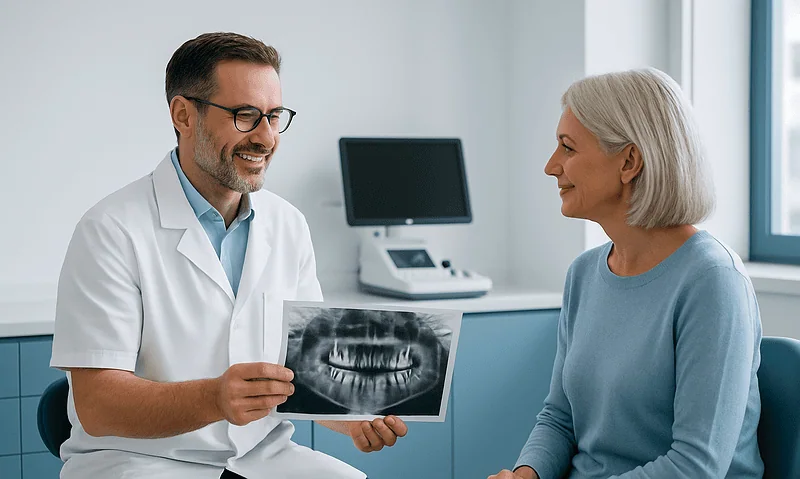
Imaging in Implantology: How Panoramic X-Rays and 3D Scans Guide Implant Position and Depth
Implantology imaging combines two-dimensional dental X-rays, most often a panoramic film, with a three-dimensional cone beam CT (CBCT) scan when the clinician needs to…

Why Jaw Growth Decides When Implantology Can Place an Implant in a Younger Patient
Dental implants for teenagers are usually postponed until the jaw has stopped growing, because an implant fuses to bone and cannot move with the…
How Mini Implants Are Placed: Flapless Insertion, Same-Day Denture Fitting and What to Expect
A mini implant procedure places one or more narrow titanium posts into the jawbone, usually through a small pierce in the gum rather than…