

Dental Implants vs Dentures: Function, Comfort and Long-Term Cost Compared
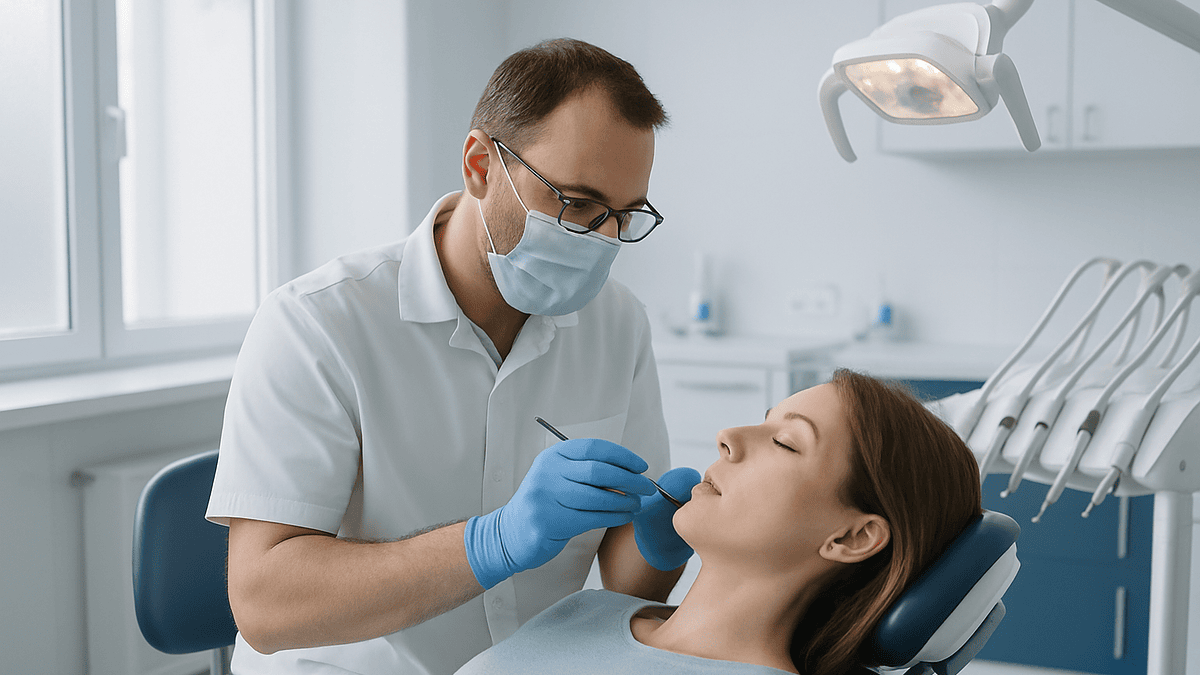
Key Takeaways
- Complete dentures typically deliver only about a fifth to a quarter of natural bite force, while implant-supported teeth come close to natural chewing.
- Jawbone shrinks fastest in the first six to twelve months after tooth loss, and conventional dentures don't stop it, implants transmit chewing load into bone and help preserve it.
- Published studies report implant survival above 90% at ten years, though the crown on top is a wear item that may need replacing after 10–15 years.
- Dentures usually need relining every year or two and full replacement after roughly five to ten years, which quietly narrows the long-term cost gap with implants.
- A snap-in overdenture on two to four implants (our guide range EUR 2,600–5,850 per jaw) fixes the loose-lower-denture problem at a fraction of fixed full-arch cost.
- Smoking, uncontrolled diabetes, and untreated gum disease, not age, are the factors most likely to make a dentist advise against implants.
Dental implants generally restore stronger chewing, feel closer to natural teeth, and help preserve jawbone, but they require surgery and a higher upfront cost. Conventional dentures cost less initially and avoid surgery, yet deliver a fraction of natural bite force and need periodic relining and replacement. Over a decade, implants often narrow the cost gap; the best choice depends on bone, general health, and budget.
Watch a family table long enough and you’ll spot it: the grandmother who quietly waves away the corn on the cob, the uncle who cuts his apple into slivers thin enough to read through. Nobody announces it. Tooth loss changes eating habits first, and conversation second, people with loose dentures often laugh with a hand over their mouth.
Roughly one in six adults over 65 has lost all of their natural teeth, according to US public health data, and nearly everyone who reaches that point faces the same fork in the road: removable dentures or fixed implants. The marketing on both sides is loud. The evidence is quieter, and more interesting.
This comparison looks at what each option actually does to your bite, your jawbone, and your bank account over ten years, including the hybrid options that most head-to-head articles skip entirely.
What happens to your jaw after the teeth come out?
Before comparing the two solutions, it helps to understand the problem they’re solving, and it’s bigger than a gap in your smile. Tooth roots do more than anchor teeth. Every time you chew, the root transmits force into the jawbone, and that mechanical stimulation tells the bone to keep rebuilding itself.
Remove the root and the signal stops. The alveolar ridge, the horseshoe of bone that once held your teeth, begins to shrink, a process called resorption. It happens fastest in the first six to twelve months after extraction and then continues slowly for years. Long-term denture wearers sometimes lose so much ridge height that the lower face visibly shortens and the chin appears to rotate forward, the look often described as a ‘collapsed’ profile.
This single biological fact drives almost every meaningful difference between dentures and implants. A conventional denture rests on top of the gum; it replaces the visible teeth but sends no load into the bone, so resorption continues underneath it. That’s the real reason dentures loosen over time: the foundation they were molded to fit keeps changing shape. An implant, by contrast, is anchored inside the bone and transmits chewing force the way a root did, which is why implant sites tend to hold their bone volume far better.
Neither option turns back the clock. But one slows it dramatically, and that difference compounds year after year.
How do dental implants actually work?
A dental implant is a small threaded post, usually titanium, placed surgically into the jawbone where a root used to be. Titanium has an unusual talent: living bone grows directly onto its surface and locks it in place, a process called osseointegration that typically takes two to six months. Once the post is fused, a connector (abutment) and a crown are attached on top.
The result behaves remarkably like a natural tooth. It doesn’t move when you bite, it doesn’t need to be taken out at night, and it doesn’t rely on neighboring teeth for support: a genuine advantage over bridges, which require grinding down healthy teeth on either side of the gap.
The numbers behind implants are strong by surgical standards. Published studies consistently report survival rates above 90% at ten years, and many implants last decades. Two caveats keep that statistic honest. First, ‘implant survival’ refers to the post in the bone; the crown on top is a wear item and may need replacement after 10–15 years. Second, success depends heavily on the patient, smoking, uncontrolled diabetes, and poor oral hygiene all measurably lower those odds.
Placement itself is usually done under local anesthesia and, according to Mayo Clinic and Cleveland Clinic patient information, most people describe the discomfort afterward as milder than a tooth extractionsoreness for a few days, managed with routine measures your dentist recommends.
How do modern dentures work, and what has changed?
It’s fair to say dentures carry an image problem inherited from a previous generation. Today’s versions are better than the ones your grandparents soaked in a glass: acrylic bases are molded from digital or high-precision impressions, teeth are more lifelike, and flexible partial frameworks have replaced some of the visible metal clasps.
The mechanics, though, haven’t fundamentally changed. A complete upper denture stays in place mainly through suction against the palate; a lower denture, with no palate to grip, relies on the shape of the ridge and the muscles of the cheeks and tongue, which is why lower dentures are notoriously the less stable of the two. Partial dentures clip onto remaining natural teeth.
Dentures have real, underrated strengths:
- No surgery, which matters for people whose health makes an operation unwise
- A much lower upfront cost and a faster route to a full smile, often weeks rather than months
- Easy modification if more teeth are lost later
- Full replacement of lost gum and lip support in one appliance, something implants sometimes need grafting to match
Their weakness is the moving foundation described earlier. Because the ridge keeps shrinking, the NHS and MedlinePlus both note that dentures need periodic relining or rebasing to restore the fit, and most sets need replacing after roughly five to ten years. A denture that fit beautifully in year one can rock and rub by year four through no fault of the wearer.
Implants vs dentures at a glance
Here is the honest head-to-head, before we go deeper on each row. Notice how often the answer is ‘it depends on what you value’, neither column sweeps the board.
| Factor | Dental implants | Conventional dentures |
|---|---|---|
| Chewing power | Close to natural teeth | Studies suggest roughly a fifth to a quarter of natural bite force |
| Stability | Fixed; doesn’t move | Can slip, especially the lower denture |
| Jawbone | Helps preserve bone at the implant site | Bone loss continues beneath the plate |
| Surgery required | Yes, plus 2–6 months healing | No |
| Upfront cost | High | Low to moderate |
| Typical lifespan | Post: often 15+ years; crown: 10–15 years | About 5–10 years, with relines between |
| Daily care | Brush and floss like natural teeth | Remove, clean, and soak; nightly removal usually advised |
| Taste and temperature | Unaffected | Upper plate covers the palate, which can dull both |
| Suitability | Needs adequate bone and reasonable general health | Suitable for almost everyone |
Two rows deserve special weight, in this writer’s opinion: chewing power and jawbone preservation. Slipping is annoying; eating a restricted diet for twenty years and losing facial bone are health issues. That’s the lens the rest of this article uses.
Which option lets you chew better?
Ask denture wearers what they miss and the answers are strikingly consistent: steak, raw carrots, crusty bread, whole apples. Chewing is where the two options separate most sharply, and the gap is bigger than most people expect.
Natural teeth generate substantial bite force because they’re anchored in bone. A complete denture floats on soft gum tissue, so pressing hard simply drives the plate into the gums, painful and unstable. Research on masticatory function suggests complete-denture wearers typically manage only around a fifth to a quarter of the chewing force of people with natural teeth. Implant-supported teeth, being bone-anchored, come much closer to natural performance; many patients with fixed full-arch restorations return to an essentially unrestricted diet.
Why does this matter beyond enjoyment? Diet quality. People who struggle to chew tend to drift toward soft, processed, often lower-fiber foods and away from fresh fruit, vegetables, nuts, and lean protein. Public health bodies including the CDC have long flagged the link between tooth loss, chewing difficulty, and poorer nutrition in older adults. A tooth-replacement decision is quietly a nutrition decision.
One nuance in fairness to dentures: a well-made, well-fitting denture on a healthy ridge performs far better than a worn, loose one, and skilled adjustment makes a real difference. But even the best conventional denture obeys physics: it isn’t attached to anything. If eating whatever you want ranks near the top of your priorities, the evidence points clearly toward some form of implant support, whether that’s full implants or the snap-in hybrid covered below.
Comfort, taste and speech: the differences you feel daily
Comfort is harder to measure than bite force, but three daily-life differences come up again and again in patient-reported outcomes.
Taste and temperature come first, and this one surprises people. A complete upper denture covers the roof of the mouth with acrylic. The palate contributes to taste perception and, more importantly, to sensing food temperature and texture, which is partly why some long-term wearers say hot soup and cold ice cream lose their edge. Implants and palate-free implant-retained designs leave the roof of the mouth uncovered.
Speech is second. New denture wearers often lisp on ‘s’ and ‘th’ sounds for a few weeks while the tongue relearns its landscape; most adapt, but a loose lower denture can keep clicking during speech indefinitely. Implant-supported teeth don’t move, so once healed, speech generally returns to normal.
Then there’s the psychology of removability. Dentures come out at night, dental guidance from the NHS and Cleveland Clinic recommends nightly removal and cleaning to keep the gum tissue healthy and reduce fungal irritation. Some people genuinely don’t mind the ritual. Others describe the glass on the nightstand as the thing they hated most, more than any physical discomfort. Implants ask the opposite of you: they stay in, and in exchange they demand the same disciplined brushing and flossing as natural teeth, every day, for life.
Neither profile is objectively better. One trades daily ritual for lower cost; the other trades higher cost and hygiene discipline for the feeling of simply having teeth again.
What is the downside of having dental implants?
Implants deserve their reputation, but an honest article has to spend real time on the drawbacks, and there are several.
Surgery is the obvious one. Implant placement is a genuine surgical procedure with the usual small risks: infection, bleeding, and, rarely, injury to nerves or sinus structures, which is exactly why 3D imaging and careful planning matter. Mayo Clinic lists these complications as uncommon but real.
Time is the second. Between extraction, possible grafting, osseointegration, and final restoration, a standard implant journey can run three to nine months. Same-day loading protocols shorten the wait for a fixed provisional, but biology still sets the healing schedule underneath.
The third downside gets far less airtime than it should: peri-implantitis. Implants can’t decay, but the gum and bone around them can become inflamed and infected, much like gum disease around natural teeth. Untreated, it destroys the supporting bone and can cost you the implant. Risk rises sharply with smoking, poor hygiene, and a history of periodontitis. An implant is not a fit-and-forget appliance; it’s a long-term maintenance commitment with professional cleanings and honest daily flossing.
Finally, cost and eligibility. The upfront price is several times that of a denture, insurance coverage varies enormously, and not every mouth qualifies without preparatory work such as grafting. None of these downsides makes implants a bad choice, but anyone who tells you they have no downsides is selling something.
Why would a dentist not recommend an implant?
It’s one of the most-searched questions on this topic, and it deserves a straight answer: a careful dentist declines to place implants more often than marketing would suggest. The common reasons fall into four groups.
- Not enough bone. Years of denture wear or advanced gum disease can leave the ridge too thin or short to hold an implant safely. Often this is fixable, bone grafting or a sinus lift can rebuild volume, but it adds months and cost, and occasionally the deficit is severe enough that alternatives like zygomatic implants or a well-made denture are the wiser route.
- Uncontrolled medical conditions. Poorly controlled diabetes impairs healing and raises infection risk; recent radiation therapy to the jaw and certain medicines that alter bone turnover also complicate placement. Your dentist will review your full medical and medication history with your physician: this step is not bureaucracy, it’s safety.
- Smoking. Smoking constricts blood flow to healing tissue and is one of the strongest predictors of implant failure and peri-implantitis in the literature. Many surgeons ask patients to stop, at minimum around the surgical window, and some decline elective placement in heavy smokers.
- Active gum disease or poor hygiene. Placing an implant into an infected, poorly maintained mouth is planting a tree in a swamp. Periodontal treatment comes first, always.
Here’s the reframe worth keeping: a dentist who says ‘not yet’ or ‘not you’ is usually protecting your outcome, not blocking it. Most of these barriers are modifiable, and a second clinical opinion with proper 3D imaging is reasonable if the first assessment felt rushed.
Is it worth getting dental implants at 70 years old?
Short answer: age by itself is almost never the deciding factor, and the evidence backs that up. Studies of implant outcomes in older adults show survival rates comparable to younger patients, provided general health and bone quality are adequate. Osseointegration doesn’t have a retirement age.
What actually matters at 70, or 80, is the same checklist that matters at 45: bone volume, gum health, smoking status, and how well conditions like diabetes are controlled. An active, healthy 74-year-old is frequently a better implant candidate than a 50-year-old smoker with untreated periodontitis.
The value question is worth taking seriously rather than dismissing. A 70-year-old today has, on average, well over a decade of life ahead, and those are years in which nutrition, comfortable eating, and confident speech carry heavy weight for quality of life. Chewing difficulty in older adults is linked to poorer dietary intake, and a solution that restores near-normal function pays dividends at every single meal. Framed that way, ten-plus years of better eating is not a trivial return.
Two age-related considerations do tilt the calculus for some people. Dexterity matters: implants need thorough daily cleaning, and for someone with significant arthritis or early cognitive decline, a removable appliance a caregiver can clean may be more practical. And anyone with complex cardiac or bleeding-risk conditions needs physician sign-off before elective surgery. Those are individual factors, though, not reasons to rule out an entire age group. The honest answer to ‘am I too old?’ is almost always ‘that’s the wrong question.’
What is a snap-in denture, and who is it for?
Most implants-versus-dentures articles present a binary choice. The clinically interesting territory sits in between, and the implant-retained overdenture: the ‘snap-in’, is its most accessible option.
The concept is simple: two to four implants are placed in the jaw, and a removable denture clips onto them with attachments that work like sturdy press-studs. The denture still comes out for cleaning, but while it’s in, it’s anchored to bone rather than floating on gum.
The functional jump is significant. The chronic problem of the wandering lower denture, the hardest case in removable prosthetics, essentially disappears, chewing force improves substantially because load passes into the implants, and the upper version can often be made without covering the full palate, giving taste and temperature sensation back. There’s meaningful professional consensus behind this: a two-implant overdenture is widely regarded in the prosthodontic literature as a preferred minimum standard of care for the edentulous lower jaw, rather than a luxury upgrade.
Costs sit between the extremes too: our guide range for an implant-retained snap-in denture is EUR 2,600–5,850 per jaw, a fraction of a fixed full-arch restoration, because it uses fewer implants and a removable prosthesis.
Who suits it best? People frustrated by a loose conventional denture; people who want implant stability without the price of All-on-4; and people whose bone supports two to four implants but not more without extensive grafting. The trade-off is that it remains removable, with the nightly cleaning ritual intact. For many patients, that’s a trade happily made.
All-on-4 and All-on-6: fixed teeth on four or six implants
At the top of the implant ladder sits the fixed full-arch restoration: a complete row of teeth permanently attached to four or six implants per jaw. Unlike a snap-in, it never comes out; only a dentist can remove it.
The engineering is clever. Rather than one implant per missing tooth, the All-on-4 concept uses four strategically placed posts, with the back ones angled to grip denser bone toward the front of the jaw. That angulation often sidesteps the areas where bone loss is worst, meaning many patients avoid grafting altogether. All-on-6 adds two more implants for extra load distribution, often favored in the upper jaw, where bone is naturally softer.
The headline appeal is the timeline: in suitable candidates, failing teeth can be removed, implants placed, and a fixed provisional bridge attached within a day or two: the ‘teeth in a day’ concept. The provisional is later swapped for a definitive bridge once the implants have fully integrated over several months. It’s worth being clear-eyed that the same-day teeth are provisional, that a soft-food diet is required during integration, and that candidacy depends on bone quality confirmed by 3D imaging, not on advertising.
Hygiene deserves a mention because it’s the part brochures skip: a fixed bridge must be cleaned underneath daily with interdental brushes or a water flosser, and it needs scheduled professional maintenance. Patients who do this well can expect excellent longevity; patients who don’t invite peri-implantitis under an expensive restoration. Fixed teeth are a privilege with homework attached.
How much do implants and dentures cost?
Now the question that brings most readers here. Implant pricing varies dramatically by country because it bundles surgical fees, materials, laboratory work, and imaging, and those costs differ far more between health systems than the components themselves do.
| Procedure | Turkey market average | Our guide range | UK typical | US typical |
|---|---|---|---|---|
| Single dental implant incl. crown | EUR 400–1,400 | EUR 500–1,800 | GBP 1,800–3,500 | USD 3,000–6,000 |
| Implant-retained snap-in denture (2–4 implants, per jaw) | EUR 2,000–4,500 | EUR 2,600–5,850 | GBP 3,000–7,000 | USD 6,000–18,000 |
| All-on-4 (per jaw, incl. fixed provisional) | EUR 2,500–6,500 | EUR 3,250–8,450 | GBP 10,000–18,000 | USD 18,000–30,000 |
| All-on-6 (per jaw) | EUR 3,000–8,000 | EUR 3,900–10,400 | GBP 12,000–20,000 | USD 24,000–38,000 |
| Dental bone graft (per site) | EUR 100–450 | EUR 130–600 | GBP 200–1,500 | USD 300–3,000 |
| Sinus lift | EUR 600–1,500 | EUR 800–1,950 | GBP 800–2,500 | USD 1,500–5,000 |
Prices last reviewed: August 2026. These are guide ranges for international patients, based on published market data – not a quote. Your exact price depends on your clinical assessment; you will receive a personalised treatment plan and fixed quote after consultation.
Conventional removable dentures aren’t included in our price guide, so we won’t invent figures for them. Their cost depends on materials (standard versus premium acrylic teeth, flexible versus cast frameworks), whether it’s a partial or complete set, and the health system you’re in, but they reliably sit well below implant options upfront, which is precisely why the long-term math in the next section matters.
The ten-year cost math: cheaper upfront isn't always cheaper
Comparing sticker prices is comparing a purchase with a subscription. Dentures are the subscription.
Here’s the pattern mainstream guidance describes. Because the ridge keeps resorbing under a denture, the appliance needs professional relining periodically, often every year or two, to restore its fit. Add adhesives, cleaning tablets, and occasional repairs for drops and cracks, and the running costs tick along quietly. Then, after roughly five to ten years, the denture itself typically needs replacing because the jaw it was built for no longer exists in the same shape. A 65-year-old choosing dentures may reasonably budget for two or three complete sets over the years ahead, plus everything between.
Implants front-load their cost. Once integrated, a well-maintained implant post often lasts decades; the recurring expenses are professional cleanings you’d want anyway and, eventually, a replacement crown after 10–15 years of wear. Over a decade, the gap between the two options narrows considerably, and over two decades, depending on how many relines and replacement dentures the alternative consumed, it can narrow a great deal more.
There are honest caveats on the implant side of the ledger too. A failed implant or a bout of peri-implantitis brings real repair costs, and preparatory grafting inflates the entry price. Insurance treatment of implants remains inconsistent in most countries.
The fair conclusion: dentures are genuinely cheaper for people on tight budgets or with shorter planning horizons, and nobody should be shamed for choosing them. But for someone in good health thinking in decades, the ‘expensive’ option is often less expensive than it looks, and it buys better function every single day in between.
When should you see a dentist or doctor?
Whichever route you take, or if you’re still living with failing natural teeth, certain signs mean it’s time to book an appointment rather than wait for the next scheduled visit.
For denture wearers, see your dentist promptly if you notice persistent sore spots or ulcers under the plate, a fit loose enough that adhesive no longer helps, cracked or worn denture teeth, redness or white patches on the gum beneath the denture, or clicking and slipping during normal speech. Any mouth sore or patch that hasn’t healed within about three weeks warrants professional examination regardless of cause: that’s standard NHS guidance, and it applies to everyone, denture or not.
For implant patients, contact your dentist without delay about gums that bleed when you brush around an implant, swelling or tenderness at the implant site, a bad taste or discharge, any feeling of looseness in an implant or its crown, or gum recession exposing metal. Peri-implantitis caught early is very manageable; caught late, it costs bone.
Some symptoms belong in urgent care rather than a dental diary: facial swelling that’s spreading or affecting your eye, difficulty swallowing or breathing, or fever alongside dental pain can signal a serious infection and need same-day medical attention.
And one appointment matters more than any of these: the one before you decide. A proper assessment with 3D imaging, a periodontal exam, and a review of your medical history is the only way to know which options your mouth actually supports. No article, this one included, can substitute for that.
How do you actually decide?
Strip away the marketing and the decision usually turns on four questions, in roughly this order.
What does your bone say? This is question one because it’s not a preference: it’s a constraint. Ample bone opens every door; significant resorption may mean grafting, tilted-implant protocols, or a snap-in on fewer implants. Get the imaging before you get attached to an answer.
What does your health say? Well-controlled chronic conditions rarely block implants; uncontrolled ones often do. Smokers should hear the failure statistics plainly and factor quitting into the plan. If surgery is genuinely unwise, a skilled conventional denture is a legitimate, respectable solution, not a consolation prize.
What do you value daily? If unrestricted eating, natural feel, and fixed teeth top your list, the evidence favors implant support and the premium buys something real. If low cost, no surgery, and simplicity matter more, dentures deliver those honestly. The snap-in overdenture exists precisely for the large group in the middle.
What’s your time horizon? Over a few years, dentures are clearly cheaper. Over fifteen or twenty, the recurring reline-and-replace cycle erodes much of that advantage while implants amortize.
If this writer may plant a flag: the most underweighted factor in this decision is bone preservation. Comfort can be adjusted and costs can be financed, but resorbed bone is hard to rebuild, which is why even one strategic decision, like anchoring a lower denture on two implants, pays biological dividends for decades. Choose with the next twenty years in mind, not the next invoice.
Frequently asked questions
What is the downside of having dental implants?
The main downsides are surgery, time, cost, and maintenance. Implant placement carries small surgical risks, healing takes two to six months before final teeth, and upfront prices are several times a denture’s. Implants can also develop peri-implantitis, gum and bone infection around the post, especially in smokers or with poor hygiene. They demand lifelong daily cleaning and regular professional care; they are not a fit-and-forget solution.
Why would a dentist not recommend an implant?
Usually because of insufficient jawbone, uncontrolled medical conditions such as poorly managed diabetes, heavy smoking, or active gum disease. Certain medicines affecting bone turnover and prior jaw radiation also complicate placement. Most of these barriers are modifiable, grafting can rebuild bone, gum disease can be treated, and smoking can be stopped, so a ‘no’ is often really a ‘not yet.’ A second opinion with 3D imaging is reasonable if the assessment felt rushed.
Is it worth getting dental implants at 70 years old?
For most healthy 70-year-olds, yes, age alone is not a barrier, and studies show implant success in older adults comparable to younger patients when bone and general health are adequate. With more than a decade of average life expectancy ahead, better chewing translates into better nutrition at every meal. The genuine considerations are dexterity for daily cleaning, medical clearance for surgery, and bone quality, individual factors, not birthdays.
What is the average cost of dentures compared to implants?
Dentures cost far less upfront; conventional sets aren’t in our price guide, so we won’t quote figures, but they reliably undercut implants initially. For comparison, our guide range is EUR 500–1,800 for a single implant with crown and EUR 2,600–5,850 per jaw for an implant-retained snap-in denture. Dentures then add recurring costs, relines every year or two and replacement roughly every five to ten years, which narrows the gap over time.
How long do dental implants last?
The implant post itself often lasts decades, published studies report survival above 90% at ten years, and many integrate for life with good care. The crown or bridge attached on top is a wear item, typically needing replacement after around 10–15 years. Longevity depends heavily on daily hygiene, professional maintenance, and not smoking; peri-implantitis is the main threat to an otherwise healthy implant.
How long do dentures last?
Most complete dentures last roughly five to ten years before needing replacement, according to mainstream dental guidance. The limiting factor isn’t the appliance wearing out so much as the jaw changing shape beneath it, bone resorption continues under a denture, loosening the fit. Between replacements, expect professional relines every year or two to restore fit, plus routine repairs for cracks and worn teeth.
Can you switch from dentures to implants later?
Often, yes, many implant patients are former denture wearers. The catch is that years of denture use accelerate bone loss, so the longer you wait, the more likely you’ll need bone grafting, a sinus lift, or tilted-implant techniques like All-on-4 to make placement possible. A 3D scan will show what your remaining bone supports. An existing denture can sometimes be converted to snap onto new implants.
Does getting a dental implant hurt?
Less than most people fear. Placement is done under local anesthesia, so you feel pressure but not pain during surgery, and sedation options exist for anxious patients. Afterward, most people report a few days of soreness and swelling that patient information from Mayo Clinic and Cleveland Clinic describes as comparable to, or milder than, a tooth extraction, managed with routine measures your dentist recommends.
Do dentures cause bone loss?
Dentures don’t cause bone loss, but they don’t prevent it either, and that distinction matters. Bone resorption begins when tooth roots are removed and chewing stimulation stops; a conventional denture rests on the gum and transmits no load into bone, so shrinkage continues underneath it. That’s why dentures loosen over the years. Implants are currently the only tooth replacement that transmits chewing force into the jaw and helps preserve bone volume.
What is a snap-in denture?
A snap-in (implant-retained) denture is a removable denture that clips onto two to four implants using press-stud-like attachments. It combines denture affordability with implant stability: it won’t slip during eating or speech, chewing force improves substantially, and upper versions can often skip the palate-covering plate. It still comes out for daily cleaning. Our guide range is EUR 2,600–5,850 per jaw, sitting between conventional dentures and fixed full-arch implants.
References
This article is for general information only and is not a substitute for professional medical advice. Please consult a qualified doctor about your individual situation.

More from the Blog
Who Benefits Most From Dental Robotics? Tight Spaces, Full-Arch Cases and Limited Bone
Dental robotics most often helps when the margin for error is thin: a single narrow gap between healthy teeth, a full-arch case where several…
How Inlays and Onlays Are Placed: Shaping, Impressions, Lab Fabrication and Bonding Explained
An inlay onlay procedure usually takes two visits. First, the dentist numbs the tooth, removes decay or an old filling, and shapes the cavity…
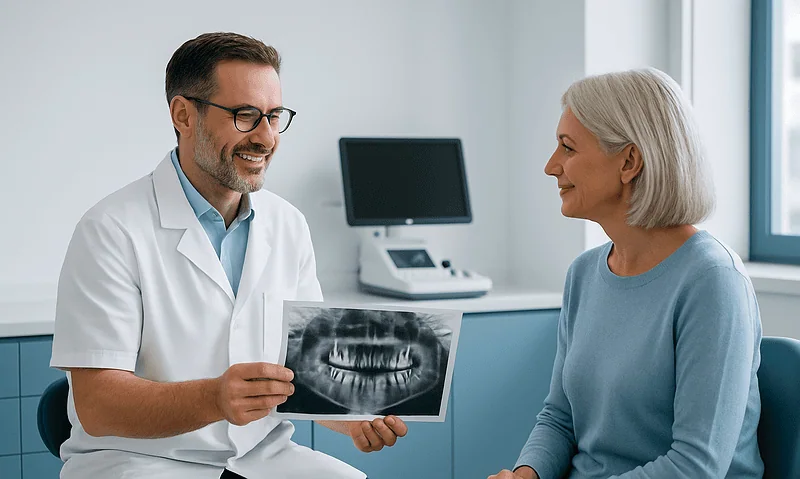
Imaging in Implantology: How Panoramic X-Rays and 3D Scans Guide Implant Position and Depth
Implantology imaging combines two-dimensional dental X-rays, most often a panoramic film, with a three-dimensional cone beam CT (CBCT) scan when the clinician needs to…

Why Jaw Growth Decides When Implantology Can Place an Implant in a Younger Patient
Dental implants for teenagers are usually postponed until the jaw has stopped growing, because an implant fuses to bone and cannot move with the…
How Mini Implants Are Placed: Flapless Insertion, Same-Day Denture Fitting and What to Expect
A mini implant procedure places one or more narrow titanium posts into the jawbone, usually through a small pierce in the gum rather than…

All On 4 Healing Timeline: Soft Diet Weeks, Bone Integration and the Final Bridge Switch
All-on-4 healing usually unfolds in stages. Swelling and soreness peak in the first two to three days and settle over one to two weeks,…