

Does Colon Cancer Always Need Chemotherapy After Surgery? How the Pathology Report Decides
Key Takeaways
- The pathology report, not the surgeon's impression in the operating room, sets the colon cancer stage that drives the chemotherapy decision; the small 'p' before pT and pN marks this.
- Stage I colon cancer is treated with surgery alone, stage III is usually offered adjuvant chemotherapy, and stage II is decided on high-risk features such as T4 growth, perforation and fewer than 12 nodes examined.
- The National Cancer Institute advises that at least 12 lymph nodes be examined; a 'node-negative' result based on fewer is less reassuring and counts as a high-risk feature at stage II.
- Mismatch repair deficient (dMMR) stage II tumors tend to recur less often and do not appear to benefit from fluoropyrimidine chemotherapy alone, so they are usually managed with surveillance.
- The IDEA collaboration found that lower-risk stage III disease (T1 to T3, one to three nodes) can be treated with three months of a particular combination instead of six, with far less oxaliplatin-related nerve damage.
- Surveillance after a reassuring report is an evidence-based standard with scheduled scans, CEA blood tests and colonoscopy, not a sign that the team has stopped trying.
No. Whether colon cancer needs chemotherapy after surgery depends mainly on the pathology report: how deeply the tumor grew, whether lymph nodes contained cancer, and features such as mismatch repair status. Stage I is usually treated with surgery alone, stage III is usually offered chemotherapy, and stage II is decided case by case. The treating team weighs these findings with overall health before recommending anything.
The envelope is thinner than you would expect for something this heavy. Two pages, a string of letters and numbers at the top, and one line the surgeon has circled in pen: pT3 N1a, 2 of 18 nodes. You are ten days out from the operation, still sleeping propped on pillows, and the question you did not think to ask before surgery is suddenly the only one that matters.
That circled line is the hinge of the whole chemotherapy after colon cancer surgery decision. It is not a verdict and it is not a guess. It is a count, made under a microscope, of what the tumor had already done by the time it came out. Everything the oncology team will suggest in the coming weeks flows from it.
This article walks through that report the way a tumor board reads it: what each field means, why some findings tip the balance toward treatment and others away from it, and where honest uncertainty still lives.
What actually happens to the tumor after it leaves the operating room?
The removed section of bowel, with its attached fat and lymph nodes, goes straight to a pathologist, a doctor who examines tissue under a microscope. The specimen is measured, opened, inked at the cut edges, fixed, sliced thinly and stained. From this, the pathologist builds the report that will steer the rest of your care.
The backbone of that report is the TNM system, a shorthand used worldwide. T describes how deeply the tumor grew through the bowel wall, from the inner lining (T1) to beyond the outer surface or into neighboring organs (T4). N records how many of the lymph nodes, the small bean-shaped filters that drain the bowel, contained cancer cells. M stands for metastasis, meaning spread to distant organs, which is usually assessed by scans rather than the surgical specimen. The National Cancer Institute’s treatment summary explains how these three letters combine into stages 0 through IV.
Beyond TNM, several lines carry real weight:
- Margins: whether the cut edges are free of tumor.
- Grade: how abnormal the cells look, from well differentiated (closer to normal) to poorly differentiated.
- Lymphovascular and perineural invasion: cancer cells seen inside tiny blood or lymph channels, or wrapped around nerves.
- Tumor deposits: clumps of cancer in the fat that are not inside a node.
- Mismatch repair (MMR) or microsatellite instability (MSI) status: a test of the tumor’s DNA repair machinery, covered later.
A small ‘p’ before the T and N, as in pT3, means the staging comes from pathology rather than from pre-operative scans. That distinction matters. Scans estimate; the microscope counts. It is common for the pathological stage to differ from what the pre-operative imaging suggested, in either direction, and the pathology version is the one that drives the adjuvant decision.
What is colorectal cancer, and why are colon and rectal cancers decided differently?
Colorectal cancer is cancer that begins in the large intestine, the last several feet of the digestive tract. The colon is the long, framed portion; the rectum is the final short segment before the anus. Most of these cancers start as polyps, small growths on the inner lining that can slowly turn malignant over years, which is why screening colonoscopy, with polyp removal, prevents so many cases, as the CDC and MedlinePlus both describe.
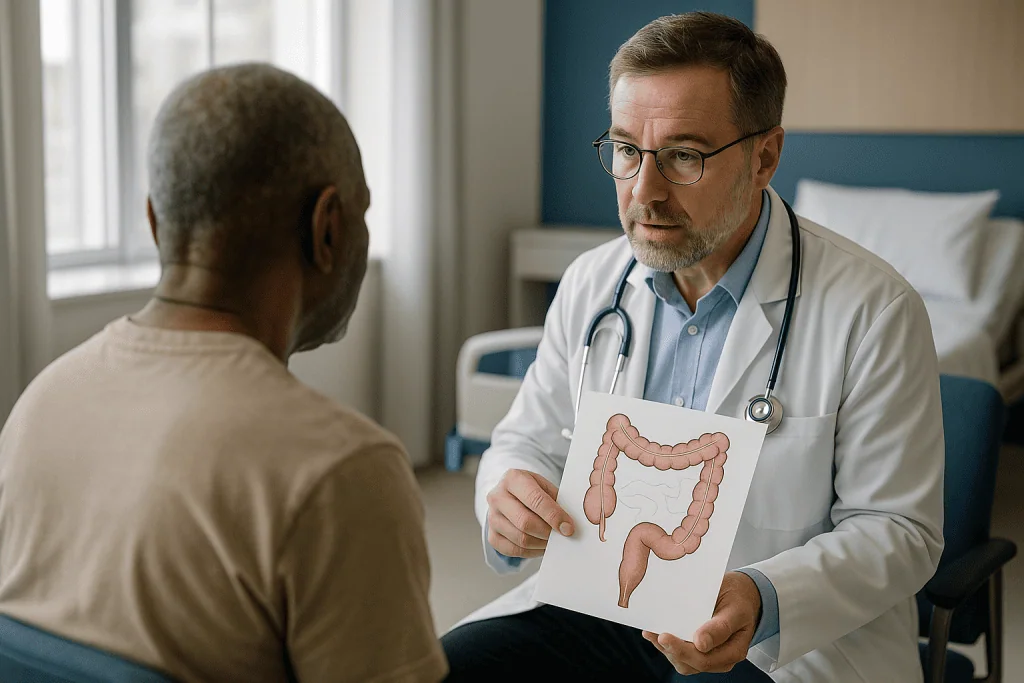
Although the two are often lumped together, colon and rectal cancers are treated in a different order, and the title question only applies cleanly to colon cancer. For a tumor in the colon, surgery usually comes first. The pathology report then answers whether chemotherapy should follow. The word for that follow-on treatment is adjuvant, meaning given after the main treatment to lower the chance of the cancer returning.
Rectal cancer is different because the rectum sits in the narrow pelvis, close to the bladder, reproductive organs and the muscles of continence. Surgeons have far less room to clear a wide margin. For that reason, many rectal cancers receive radiation, chemotherapy, or both before the operation, a strategy called neoadjuvant treatment, to shrink the tumor first. The Mayo Clinic and NHS overviews both describe this sequencing. If your diagnosis is rectal cancer, the logic in this article still helps you read the report, but the sequence of decisions will not match.
One more distinction worth holding onto: adjuvant chemotherapy for colon cancer is not given because something was left behind. In the scenario this article addresses, the surgeon has removed everything visible. Chemotherapy is being considered against cells that may have escaped before the operation and are too few to see on any scan. The pathology report is, in effect, an estimate of how likely those invisible cells are to exist.
How the chemotherapy after colon cancer surgery decision usually falls, stage by stage
Think of the stages as a scale of how far the tumor had traveled, and the chemotherapy question as a dial that turns with it.
Stage 0 and stage I. The tumor is confined to the inner layers of the bowel wall and no nodes are involved. Surgery alone is the standard treatment, and chemotherapy is not usually recommended, according to the National Cancer Institute’s patient treatment summary. Some very early cancers found inside a polyp can even be managed by colonoscopic removal alone if the margins are clear and no worrying features are present.
Stage II. The tumor has grown through the full thickness of the wall (T3) or beyond it (T4), but the lymph nodes are clear. This is the genuine gray zone. Guidelines do not recommend chemotherapy for everyone at this stage; they ask the team to look for high-risk features, which the next section covers in detail.
Stage III. One or more lymph nodes contain cancer, whatever the depth of the primary tumor. Here the evidence is clearest. Adjuvant chemotherapy is the standard recommendation because trials have shown it reduces the chance of recurrence, as summarized by the NCI and the NHS. The remaining debate at stage III is about how long to treat, not whether.
Stage IV. The cancer has spread to distant sites such as the liver or lungs. Treatment planning is entirely different and may involve chemotherapy, targeted therapy, immunotherapy and, in selected cases, surgery on the metastases. The stage-by-stage logic above does not apply.
Two things sit outside the stage number but still move the dial. The first is the patient: age, heart and kidney function, other illnesses, how surgery went and what the person wants. The second is time. Adjuvant chemotherapy is meant to start once surgical healing allows; the oncology team judges that moment at the first post-operative review rather than from a fixed calendar.
Stage 2 colon cancer chemotherapy: which high-risk features tip the balance?
Stage II is where two reasonable oncologists can look at the same report and weigh it differently, so it helps to know exactly which lines they are weighing. The National Cancer Institute’s summary and the Cleveland Clinic overview list the features that mark a stage II tumor as higher risk, and the table below translates them.
| Report finding | Plain meaning | Why it raises concern |
|---|---|---|
| pT4 | Tumor grew through the outer surface or into a neighboring organ | Cells had more opportunity to escape beyond the bowel |
| Fewer than 12 nodes examined | Not enough nodes were found to be confident they are all clear | Node-positive disease could have been missed, so the stage may be understated |
| Poorly differentiated or high grade | Cells look very unlike normal colon cells | Associated with more aggressive behavior |
| Lymphovascular or perineural invasion | Cancer seen inside small vessels or around nerves | Evidence of a route for spread |
| Obstruction or perforation at diagnosis | The tumor blocked or burst the bowel | Perforation can seed cells into the abdomen |
| Positive or close margins | Tumor at or very near the cut edge | Raises the chance of local recurrence |
One feature pushes the other way. A stage II tumor that is mismatch repair deficient (dMMR) or microsatellite instability high (MSI-H) tends to behave less aggressively, and the NCI summary notes that these tumors do not appear to benefit from fluoropyrimidine chemotherapy, the class most often used alone at this stage. In practice, a dMMR stage II tumor without T4 disease is usually managed with surveillance rather than treatment.
What this means at the clinic desk: a stage II report with no high-risk features and intact mismatch repair often ends in a recommendation to observe. A stage II report with T4 disease or a perforation often ends in an offer of chemotherapy. Reports in between are discussed at a multidisciplinary meeting, sometimes called a tumor board, where surgeons, oncologists and pathologists reach a shared view, and that view is then put to the patient as an option rather than an instruction.
Why does the lymph node count on a colon cancer pathology report matter so much?
Of all the numbers on the report, the node count is the one patients most often skip past, and the one oncologists read first. It answers two questions at once: were any nodes involved, and did the pathologist find enough nodes to trust that answer?
The National Cancer Institute’s treatment summary states that at least 12 lymph nodes should be examined to stage colon cancer adequately. The reasoning is statistical. If only six nodes are found and all are clear, there is a real chance that a seventh or eighth, never retrieved, held cancer. A ‘node-negative’ result built on too few nodes is therefore less reassuring than the same result built on twenty. That is why a low node count appears on the high-risk list for stage II even though it says nothing about the tumor itself; it is a comment on the certainty of the staging.
Node count depends on several things: the extent of the resection, the care taken by the pathologist in dissecting fat to find small nodes, and the patient’s own anatomy. Some people simply have fewer retrievable nodes, and prior radiation (relevant to rectal cancer) reduces the yield. A count below 12 is not a sign that something went wrong in the operating room.
When nodes are positive, the number matters too. Stage III is subdivided: one to three positive nodes is N1, four or more is N2, and tumor deposits in the fat without a node structure are recorded as N1c. These subdivisions feed into the question of how long chemotherapy should last, discussed below. A report reading ‘pT3 N1a, 1 of 22 nodes’ and one reading ‘pT4 N2b, 9 of 14 nodes’ are both stage III, yet they describe very different situations, and the treatment conversation will reflect that.
If your report lists fewer than 12 nodes, ask how the team is interpreting the result. It is a fair question and one they expect.
What is mismatch repair testing, and when does it change the answer?
Every colon cancer specimen now undergoes a test that did not exist in routine practice a generation ago. Mismatch repair, or MMR, is the cell’s spell-checker for DNA: a set of proteins that fixes copying errors as cells divide. When those proteins are missing, the tumor is called mismatch repair deficient (dMMR). A related test, microsatellite instability (MSI), detects the error-ridden DNA that results. The two labels describe the same biology, and the NCI summary treats them together.
The test matters for three separate reasons, which is why it appears on reports regardless of stage.
First, prognosis. Among stage II tumors in particular, dMMR disease tends to recur less often than tumors with intact repair, which shifts the risk-benefit balance away from treatment.
Second, which treatment. The NCI summary notes that dMMR tumors do not appear to benefit from fluoropyrimidine-only adjuvant chemotherapy. For stage III dMMR disease, chemotherapy is still generally recommended but the combination used is chosen with this in mind. In the metastatic setting, dMMR status predicts response to immunotherapy, drugs that lift the brakes on the immune system; that application is outside the adjuvant decision but explains why the test is universal.
Third, inherited risk. Most dMMR tumors arise by chance, but a minority point to Lynch syndrome, an inherited condition that raises the risk of colon, uterine and other cancers across a family. A dMMR result therefore usually triggers a referral for genetic counseling, and the Mayo Clinic overview describes this pathway. That referral is about your relatives and your future screening as much as about the tumor already removed.
If the MMR line on your report is blank or says ‘pending’, it is reasonable to ask when the result is expected. For stage II disease especially, the team may be waiting on it before giving a firm recommendation, and knowing that can take some of the sting out of a delayed answer.
What does adjuvant chemotherapy do, and how long does it usually last?
Adjuvant chemotherapy for colon cancer is built around a class of drugs called fluoropyrimidines (fluorouracil given by infusion, or capecitabine as a tablet that the body converts to the same compound). These interfere with the way rapidly dividing cells build DNA. For stage III and some higher-risk stage II disease, a second drug, oxaliplatin, is often added; it damages DNA directly by forming cross-links. Both are described by the NHS and Mayo Clinic in their treatment pages. The purpose is to reach cancer cells that may have already left the bowel but are too few to detect.
Treatment is given in cycles, each a block of drug days followed by recovery days, and the course has historically lasted about six months, as the NHS treatment page describes. That duration was questioned in a large international pooled analysis of six trials, the IDEA collaboration, published in the New England Journal of Medicine and indexed in PubMed. It compared three months of oxaliplatin-based chemotherapy with six months for stage III disease. Across all patients, three months could not be proven equivalent to six. But in the lower-risk stage III group (T1 to T3 tumors with one to three positive nodes), three months of the tablet-based combination performed similarly to six, with far less nerve damage. In the higher-risk group (T4 or four or more nodes), six months retained an advantage.
That study is why ‘how long’ now depends on the same report lines that decided ‘whether’. A low-risk stage III report may lead to a three-month offer; a high-risk one may lead to six. The oncologist chooses the drugs, the combination and the length, and may shorten or adjust mid-course if side effects demand it. None of that is set by the patient reading the report at home, and nothing here should be read as a schedule.
Before starting, many services test for DPD deficiency, an inherited shortage of the enzyme that breaks down fluoropyrimidines. People with the deficiency can have severe reactions to standard treatment, so the test informs whether and how the drug can be used safely. The NHS describes this screening on its chemotherapy pages.
Chemotherapy after colon cancer surgery decision: who is usually offered it, and who is asked to wait?
Stage sets the default; the person adjusts it. Here is how the two combine in most multidisciplinary discussions.
Usually offered chemotherapy:
- Stage III disease of any subtype, in someone fit enough to tolerate it.
- Stage II disease with T4 tumors, perforation, or several other high-risk features, particularly when mismatch repair is intact.
Usually managed with surveillance instead:
- Stage I disease.
- Stage II disease with no high-risk features.
- Stage II dMMR disease without T4 involvement, because of the lack of benefit noted earlier.
Usually asked to wait, or offered a modified plan:
- People still recovering from a complicated operation, such as a leak at the join or a wound infection, until healing is secure.
- People with significant heart, kidney or liver disease, or existing nerve damage, where a particular drug carries extra risk; a single-drug course rather than a combination may be discussed.
- Older or frail patients, for whom the expected benefit is weighed against the expected toll; chronological age alone is not a reason to withhold treatment, and fitness assessments are increasingly used.
Patient preference belongs on this list too. Adjuvant chemotherapy is an insurance policy against a recurrence that may never happen. Some people with a borderline report choose to accept months of side effects for a modest reduction in risk; others, after the same conversation, choose surveillance with scans and blood tests. Both are legitimate outcomes of a good discussion, and the NHS treatment page is explicit that the team should explain the expected benefit and the side effects so that the choice is informed.
What is not legitimate is a decision made without the report. If you are being pressed for an answer before the node count, margins and MMR status are back, ask for the discussion to be rescheduled once they are. The decision also does not expire if you need a few extra days to think; the team will tell you how much time is reasonable.
What is sigmoid colon resection surgery, and how do other colon operations compare?
The operation that produced the pathology report deserves a short explanation, because its details show up on the first page of the document.
A sigmoid colon resection, or sigmoidectomy, removes the S-shaped final segment of the colon that sits just above the rectum. The surgeon takes the tumor-bearing bowel along with a margin of healthy bowel on either side and the wedge of fat containing its blood supply and lymph nodes. The two cut ends are then joined, a connection called an anastomosis. MedlinePlus describes this and related procedures under the heading of large bowel resection, noting that the operation can be done through one larger incision or through several small ones with a camera (laparoscopic surgery), and that a typical hospital stay afterward is around three to seven days.
Other resections follow the same principle in a different location:
- Right hemicolectomy removes the ascending colon and part of the transverse colon, usually with the last stretch of small bowel.
- Left hemicolectomy removes the descending colon.
- Transverse colectomy removes the middle section.
- Total colectomy removes the entire colon, used for multiple tumors or certain inherited conditions.
Sometimes the ends cannot safely be joined straight away, most often after an emergency operation for obstruction or perforation. In that case the surgeon brings the bowel to the skin as a stoma, an opening through which stool collects in a bag. Many of these are temporary and reversed months later. A stoma on its own does not change the chemotherapy decision, though it does affect hydration and the practicalities of treatment.
The name of the operation, the approach and whether a stoma was formed are all recorded at the top of the pathology report. Below them, the length of bowel removed and the distance from tumor to each margin tell the pathologist, and you, how much clearance the surgeon achieved.
What to expect after colorectal surgery in the weeks before the decision
The timeline between the operation and the first oncology conversation has a rhythm most patients are not warned about. Knowing it helps.
The first days. Pain control, early walking and sips of fluid come first; enhanced recovery programs aim to get people out of bed on the first day. Bowel function returns gradually, often announced by gas before stool, and the diet advances from liquids toward soft food as it does. MedlinePlus lists the typical hospital stay as roughly three to seven days, with longer stays after open surgery or complications.
Going home. Expect fatigue that outlasts the pain, loose or frequent stools that settle over weeks, and a strict instruction not to lift heavy objects while the abdominal wall heals. MedlinePlus notes that full recovery can take several weeks.
The report arrives. The pathology result is usually ready for the first surgical follow-up visit. The surgeon will go through the stage and explain whether the case is going to a multidisciplinary meeting.
The meeting. Surgeons, medical oncologists, radiologists and pathologists review the report, the pre-operative scans and your medical history together. They produce a recommendation, which might be surveillance, a chemotherapy offer, or a request for further tests such as MMR status or a post-operative scan.
The oncology visit. If chemotherapy is on the table, a medical oncologist explains the proposed drugs, the duration, the expected benefit in your specific situation and the side effects. Blood tests, sometimes a DPD test and, for some drug combinations, a heart tracing follow. If you agree, treatment begins once the team is satisfied that wounds have healed and your energy and nutrition have recovered enough; that judgment is clinical and individual rather than a fixed number of weeks.
Across this stretch, the single most useful habit is to write down questions as they occur, because the visits are short and the information dense.
What are the risks and side effects being weighed against the benefit?
Any honest adjuvant discussion has two columns. The first is the reduction in the chance of recurrence, which is larger for stage III than stage II and larger for higher-risk reports than lower-risk ones. The second is what the treatment costs the body, and that column is predictable enough to describe.
Fluoropyrimidines commonly cause fatigue, nausea, diarrhea, mouth soreness and a drop in blood counts that raises infection risk. Capecitabine in particular can cause hand-foot syndrome, redness and peeling of the palms and soles. The NHS and Mayo Clinic pages on chemotherapy list these effects and note that most are manageable and reversible.
Oxaliplatin adds a distinctive problem: peripheral neuropathy, meaning numbness, tingling or pain in the hands and feet caused by nerve damage. Early on it is triggered by cold, so that a chilled drink or a cold doorknob can produce sharp tingling. With cumulative exposure it can become persistent, and for a minority it is long-lasting. This is the main reason the IDEA collaboration tested a shorter course: less oxaliplatin means less neuropathy, and the study reported substantially lower rates with three months than six. For someone whose job or hobby depends on fine hand control, this side effect may legitimately weigh more heavily than it does for someone else.
Rarer but serious risks include severe reactions in people with DPD deficiency, which is why screening is offered, and infection during periods of low white cell counts, which is why a fever during chemotherapy is treated as an emergency.
The alternative to adjuvant chemotherapy is not ‘nothing’. It is active surveillance: scheduled scans, blood tests for a tumor marker called CEA, and a follow-up colonoscopy, so that a recurrence, if it happens, is found early. For low-risk stage II disease the guidelines regard this as the appropriate standard, not a lesser option.
A good oncologist will put real figures in both columns for your report, and will say plainly when the figures are too close to call.
What is the recommended long-term diet after colon resection?
Diet after colon surgery moves in two phases, and patients often confuse advice meant for the first with advice meant for the second.
The healing phase. In the first weeks, MedlinePlus and most surgical teams recommend small, frequent meals, soft and lower-fiber foods, and plenty of fluids while the anastomosis heals and bowel rhythm returns. Right-sided resections, which remove the part of the colon that absorbs the most water, and stomas both increase fluid losses, so hydration is the single most important instruction. Foods that produce gas or very loose stools are usually reintroduced one at a time.
The long term. Once recovery is complete, there is no special ‘colon resection diet’. The guidance converges on the same pattern recommended for colorectal cancer prevention generally: plenty of vegetables, fruit and whole grains; fiber built back up gradually; limited processed meat and alcohol; and a healthy weight supported by regular physical activity. The CDC and Mayo Clinic frame these as risk-reduction measures rather than treatments, and no diet replaces chemotherapy or surveillance.
Some practical points come up repeatedly in follow-up clinics:
- Bowel habit after a sigmoid or left-sided resection often settles to near-normal; after a right-sided resection, stools may stay looser, which is physiology rather than a problem.
- Large raw salads, nuts and high-fiber foods are fine long term but are best reintroduced slowly rather than all at once.
- Over-the-counter supplements marketed for ‘gut health’ or ‘cancer’ have no evidence of benefit in this setting and can interact with chemotherapy; tell the oncology team about anything you take.
- During chemotherapy, diarrhea and taste changes may require a temporary return to blander, lower-fiber eating, with the team’s dietitian guiding the adjustments.
A referral to a dietitian is reasonable to request at any stage, particularly for people with a stoma, significant weight loss or diabetes.
What people often get wrong about chemotherapy after colon surgery
Several beliefs circulate in waiting rooms and online forums. Most contain a grain of logic and a larger error.
‘The surgeon got it all, so chemotherapy is pointless.’ Adjuvant chemotherapy is not aimed at tissue the surgeon could see. It targets cells that may have escaped before surgery and are undetectable on any scan. ‘Got it all’ and ‘may need chemotherapy’ are both true at once for stage III disease.
‘No chemotherapy means they have given up.’ The opposite is usually the case. A recommendation for surveillance after stage I or low-risk stage II disease reflects evidence that treatment would add side effects without meaningful benefit. It is a sign the report was reassuring.
‘Stage II always needs chemotherapy to be safe.’ Guidelines do not say this, and for dMMR stage II tumors the evidence points away from the usual drugs. The decision depends on the high-risk features listed earlier.
‘A positive lymph node means the cancer has spread everywhere.’ Nodes are the first filters the tumor reaches. Involvement raises the stage to III and raises the case for chemotherapy, but stage III is treated with the aim of removing all disease, and the NCI summary describes it as such. It is not stage IV.
‘Chemotherapy is always six months.’ Not any more for everyone. The IDEA collaboration showed that lower-risk stage III disease can be treated with three months of a particular combination with similar results, and oncologists now tailor duration to the report.
‘The percentages my oncologist quoted are a prediction about me.’ They are averages from trial populations with reports like yours. They describe the odds, not the outcome, and they are the right basis for a decision precisely because no one can see the individual future.
‘A supplement or special diet can do the same job.’ No dietary approach has been shown to reduce recurrence the way adjuvant chemotherapy does in stage III disease. Diet supports recovery; it does not substitute for evidence-based treatment or for surveillance.
Questions to ask your care team before you decide
The oncology consultation is dense, and good questions pull it toward your situation rather than the general case. These are the ones that tend to unlock the most useful answers.
- What is my exact pathological stage, and which lines on the report drove that?
- How many lymph nodes were examined, and how many were positive? If fewer than 12 were found, how does that affect your confidence in the staging?
- What is my mismatch repair or MSI status, and does it change the recommendation?
- Which high-risk features, if any, does my report show, and how much weight are you giving each one?
- Did the multidisciplinary meeting discuss my case, and was the recommendation unanimous?
- If you are recommending chemotherapy, what is the expected reduction in recurrence risk for a report like mine, in plain numbers?
- If you are recommending surveillance instead, what would the surveillance schedule look like, and what would prompt a change of plan?
- Which drugs are you proposing, for how long, and why that length rather than longer or shorter?
- What side effects are most likely for me given my other health conditions, and which would make you stop or modify treatment?
- Will I be tested for DPD deficiency before starting?
- How will treatment fit around my work, caring responsibilities or travel, and what support is available?
- Should I or my family be referred for genetic counseling?
- Is there a clinical trial, including trials of circulating tumor DNA testing, that I might be eligible for?
- How long do I have to make this decision, and who do I contact if I think of more questions?
Bring someone with you if you can, ask for a written summary, and do not hesitate to request a second appointment before committing. A treatment plan that a patient understands is one they can see through; one agreed to in a fog of numbers often is not. The team expects questions, and a decision reached together is the point of the whole process.
When to call your doctor: red-flag signs after surgery and during chemotherapy
Two separate sets of warning signs apply across this period, and both deserve a low threshold for picking up the phone.
After colon surgery, contact the surgical team the same day, or seek emergency care, for any of the following, which MedlinePlus lists among the signs of complications:
- Fever or chills, or shaking.
- Increasing abdominal pain, especially with a swollen or rigid belly.
- Redness, warmth, swelling or discharge from the wound, or a wound that opens.
- Persistent vomiting, or no gas or stool passed along with bloating and nausea.
- Bleeding from the rectum beyond small streaks, or black stools.
- Dark urine or very little urine, a sign of dehydration, particularly with a stoma or after a right-sided resection.
- A swollen, painful calf, or sudden breathlessness or chest pain, which can indicate a blood clot and is an emergency.
During chemotherapy, the oncology service will give you a 24-hour contact number. Use it without delay for:
- A temperature above the threshold your team specifies, or feeling shivery and unwell even without a thermometer reading; low white cell counts can turn an ordinary infection dangerous within hours, and the NHS treats this as an emergency.
- Diarrhea that does not settle with the measures you were given, or any diarrhea with dizziness.
- Mouth sores that prevent eating or drinking.
- Chest pain, palpitations or breathlessness, which can be a rare reaction to fluoropyrimidines.
- Numbness or tingling that affects walking, buttoning clothes or holding objects.
- Any bleeding or unusual bruising.
None of these signs should be interpreted at home. The team would rather hear from you about something that turns out to be minor than learn afterward about something that was not. Keep the contact numbers somewhere you and the people around you can find them.
Frequently asked questions
Does stage 2 colon cancer always need chemotherapy?
No. Stage II colon cancer, where the tumor has grown through the bowel wall but lymph nodes are clear, is treated with surgery alone unless the pathology report shows high-risk features such as T4 growth, perforation, poorly differentiated cells, vessel or nerve invasion, or fewer than 12 nodes examined. A mismatch repair deficient stage II tumor usually points toward surveillance. The treating team weighs these factors and offers, rather than imposes, a plan.
Does stage 3 colon cancer chemotherapy always last six months?
Not any more for everyone. Six months has been the traditional course, but the IDEA collaboration found that for lower-risk stage III disease (T1 to T3 tumors with one to three positive nodes) three months of an oxaliplatin and capecitabine combination gave similar results with less nerve damage. Higher-risk stage III disease still generally receives six months. The oncologist sets the drugs and duration based on the report and your health.
What does a colon cancer pathology report include?
A colon cancer pathology report records the operation performed, the length of bowel removed, the tumor’s size and depth (T stage), the number of lymph nodes examined and how many were positive (N stage), the margins, the grade, lymphovascular and perineural invasion, tumor deposits, and mismatch repair or microsatellite instability status. Together these produce the pathological stage, from which the chemotherapy recommendation is built.
What is colorectal cancer?
Colorectal cancer is cancer that begins in the colon or rectum, the final part of the digestive tract. Most cases start as polyps, small growths on the inner lining that can turn malignant over years, which is why screening with polyp removal prevents many cases. Colon and rectal cancers are staged similarly but treated in a different order: colon cancer usually has surgery first, while rectal cancer often has radiation or chemotherapy beforehand.
What is sigmoid colon resection surgery?
Sigmoid colon resection, or sigmoidectomy, removes the S-shaped segment of colon just above the rectum along with a margin of healthy bowel and the fat containing its lymph nodes. The cut ends are usually joined directly. It can be done through one incision or laparoscopically through several small ones. MedlinePlus lists a typical hospital stay of about three to seven days, with full recovery taking several weeks.
What to expect after colorectal surgery before chemotherapy is discussed?
Expect a hospital stay of several days, gradual return of bowel function, fatigue lasting weeks and restrictions on lifting. The pathology report is usually ready for the first surgical follow-up, after which the case often goes to a multidisciplinary meeting. If chemotherapy is proposed, an oncology visit covers drugs, duration, benefit and side effects, with blood tests and sometimes a DPD deficiency test before starting once healing allows.
How soon after colon surgery does chemotherapy start?
Adjuvant chemotherapy begins once the surgical team is satisfied that wounds have healed, bowel function has settled and nutrition and energy have recovered enough to tolerate treatment. That moment is a clinical judgment made at follow-up rather than a fixed number of weeks, and complications such as infection or a leak at the join can reasonably delay it. Your oncologist will explain the intended timing for your situation.
What is the recommended long-term diet after colon resection?
In the healing phase, small frequent meals, softer lower-fiber foods and generous fluids are usual, with fiber reintroduced gradually. Long term there is no special diet; the guidance mirrors general colorectal cancer risk reduction from sources such as the CDC and Mayo Clinic: vegetables, fruit, whole grains, limited processed meat and alcohol, and a healthy weight with regular activity. No diet or supplement replaces chemotherapy or surveillance.
Can I decline chemotherapy after colon cancer surgery?
Yes. Adjuvant chemotherapy is an offer, and an adult with capacity can decline it after an informed discussion. The oncologist should explain the expected reduction in recurrence risk for your report and the likely side effects so you can weigh them. Declining treatment does not end care; surveillance with scans, CEA blood tests and colonoscopy continues, and the decision can be revisited within the window your team describes.
Can a circulating tumor DNA test decide whether I need chemotherapy?
Not yet as a standard. Circulating tumor DNA (ctDNA) tests look for fragments of tumor DNA in the blood after surgery, and a positive result is associated with higher recurrence risk. Trials are testing whether the result can safely guide who receives or skips chemotherapy, especially at stage II. Until those results are established in guidelines, the pathology report remains the basis for the decision, and any ctDNA use is usually within a trial.
References
- Bowel cancer: Treatment, NHS
- Large bowel resection, MedlinePlus Medical Encyclopedia
- Colorectal (Colon) Cancer, Cleveland Clinic
This article is for general information only and is not a substitute for professional medical advice. Please consult a qualified doctor about your individual situation.

More from the Blog

After Sarcoma Surgery: Physiotherapy Milestones From the First Days to Full Movement
Physiotherapy after sarcoma surgery usually begins within the first day or two with breathing, circulation and gentle assisted movement, then progresses through protected range-of-motion…

Why Intravesical Therapy Often Follows TURBT and How the Treatment Course Runs
Intravesical therapy usually follows TURBT because the operation removes visible bladder tumours but cannot reliably clear microscopic cancer cells, and non-muscle-invasive bladder cancer tends…
Warning Signs During Liver Cancer Treatment: What to Report to Your Oncology Team
During liver cancer treatment, report a fever of 100.4°F (38°C) or higher, new yellowing of the skin or eyes, dark urine, unusual bruising or…

Removing Part or All of the Thyroid for Cancer: How Surgeons Weigh the Options
For thyroid cancer, surgeons choose between removing one lobe (partial thyroidectomy, also called lobectomy or hemithyroidectomy) and removing the whole gland (total thyroidectomy) based…
Pulmonary Rehabilitation After Lung Cancer Treatment: Rebuilding Stamina Safely
Pulmonary rehabilitation after lung cancer is a supervised program of graded exercise, breathing training, and education that helps people rebuild stamina once surgery, chemotherapy,…
How Long to Stay Near the Hospital After CAR-T Infusion: Planning as an International Patient
After a CAR-T infusion, most programs keep patients in hospital for roughly one to two weeks of monitoring, then ask them to remain within…