

Esotropia, Exotropia and Beyond: How Strabismus Disorders Differ and How Care Is Planned

Key Takeaways
- The four directional types of strabismus are esotropia (inward), exotropia (outward), hypertropia (one eye higher) and hypotropia (one eye lower), each with its own usual causes and ages of onset.
- Occasional eye wandering is common in babies under about three months, but the NHS advises that a turn present all the time or persisting beyond three months should be checked.
- Accommodative esotropia is driven by farsightedness, and full-strength glasses alone often straighten the eyes while worn, whereas infantile esotropia is largely unchanged by glasses.
- Intermittent exotropia typically shows up when a child is tired, unwell or in bright sunlight, and squinting one eye outdoors is a common early clue.
- Amblyopia affects up to 3 in 100 children according to the National Eye Institute, and strabismus is one of its two leading causes, which is why vision in each eye is checked before alignment is addressed.
- Eye-muscle surgery changes alignment but not the sharpness of an amblyopic eye, so patching or glasses frequently continue after the operation.
Strabismus is a misalignment of the eyes, and the main types of strabismus are named for the direction of the turn: esotropia (inward), exotropia (outward), hypertropia (upward) and hypotropia (downward). Each type has different usual causes and ages of onset, so care is planned individually by an eye specialist, using glasses, patching, prisms or eye-muscle surgery depending on the pattern found.
The photo was meant to be a keepsake: a four-year-old on a beach, squinting into the sun. Her father noticed something else. In frame after frame, one eye looked straight at the camera while the other seemed to wander toward her nose. He scrolled back through months of pictures. Sometimes it was there, sometimes not.
That moment, a parent studying a photo, an adult catching a stranger’s odd glance in a mirror, is how many people first meet the word strabismus. It sounds like one condition. It is closer to a family of them, and the different types of strabismus turn out to matter a great deal for what happens next.
This explainer walks through how an inward turn differs from an outward drift, why a vertical misalignment prompts different questions, what eye specialists actually look for, and how a care plan is assembled. It also separates the well-worn myths from what the evidence supports.
What are the four types of strabismus?
Strabismus is the medical term for eyes that do not point at the same target at the same time. Clinicians sort the types of strabismus first by direction, and that gives the four names people most often search for.
Esotropia is an inward turn, the pattern most people picture when they hear “crossed eyes.” Exotropia is an outward drift, sometimes called “wall-eyed” in older language. Hypertropia describes one eye sitting higher than the other, and hypotropia describes one eye sitting lower. Because a higher right eye and a lower left eye describe the same relationship, specialists usually name vertical deviations by the eye that sits higher.
Direction is only the first sorting layer. The same inward turn can behave very differently depending on whether it is present all the time or only when a child is tired, whether it began in infancy or at age three, whether glasses reduce it, and whether the angle stays the same in every direction of gaze. Those layers, covered later in this article, are what turn a label into a plan.
Two facts anchor everything that follows. According to the Cleveland Clinic, strabismus affects roughly 4 in 100 people in the United States, which makes it one of the most common eye conditions of childhood and far from rare in adults. And according to the NHS, about 1 in 20 children has a squint, the British term for the same condition. The takeaway is not alarm. It is that eye teams see these patterns every day, and the categories exist because they guide real decisions.
How the eyes normally stay aligned, and what goes wrong
Each eye is moved by six small muscles attached to its outer wall, like reins on a horse. Four run straight (up, down, in, out) and two run at an angle, tilting and rotating the eye. Three cranial nerves, which are nerves that leave the brain directly rather than through the spinal cord, carry the signals. The brain coordinates all twelve muscles so both eyes land on the same spot and the two slightly different pictures fuse into one three-dimensional image.

Alignment is therefore a control system, not a fixed setting. It depends on the muscles, the nerves, the brain’s ability to fuse images, and, less obviously, on focusing. When a child strains to focus on a near object, the same neural circuit that sharpens the lens also nudges the eyes inward. That link between focusing and convergence explains a whole category of inward turns.
Strabismus arises when any part of this loop fails. Sometimes a muscle or its nerve is weak or absent. More often, particularly in children, the muscles and nerves are structurally normal and the fault lies in the brain’s coordination or in an uncorrected focusing error. In adults, a new misalignment frequently traces back to a nerve problem, thyroid eye disease, trauma or a change in the orbit rather than to the muscles themselves.
This is why the first appointment involves so much more than looking at the eyes. The specialist is trying to work out which part of the loop is misbehaving, because an inward turn from a focusing error and an inward turn from a nerve palsy look similar from across a room and are managed in very different ways.
Esotropia: the inward turn, from infants to school age
Esotropia is the most frequently diagnosed form of childhood strabismus in the United States, and it comes in two broad flavors that specialists are careful to tell apart.
Infantile esotropia appears in the first months of life. The angle of the turn is usually large and constant, and glasses do not change it much because the child does not have a significant focusing error. MedlinePlus notes that this early-onset form often needs surgery on the eye muscles to bring the eyes together, though the timing is decided by the treating team based on the child’s measurements and general health.
Accommodative esotropia is a different story. It tends to appear between roughly two and four years of age in a child who is farsighted. The word accommodation simply means the eye’s focusing effort. A farsighted child must focus hard to see clearly, that focusing effort pulls the eyes inward, and the inward pull becomes visible as a turn. The turn is often worse for near work and may be intermittent at first.
The distinction matters because accommodative esotropia glasses do the heavy lifting. Once the full farsighted prescription is worn, the focusing effort drops and, for many children, the eyes straighten while the glasses are on. Some children still have a residual turn with glasses on, and that residual portion is what a surgeon would consider addressing.
Esotropia can also appear later, in adults, from a sixth-nerve palsy that weakens the muscle pulling the eye outward, or from certain neurological conditions. A new inward turn in an adult, especially with double vision, is assessed differently from a child’s turn and more urgently.
Exotropia: why the outward drift is often intermittent
Exotropia is the outward counterpart, and its personality differs from esotropia in a way parents often find confusing. The most common childhood form is intermittent exotropia: the eyes are straight most of the time, then one drifts outward when the child is tired, daydreaming, unwell or looking into the distance. Bright sunlight is a classic trigger, and squinting one eye shut outdoors is a clue many families recognize in hindsight.

Because the drift comes and goes, it is easy to dismiss and easy to miss during a short appointment. That is why specialists ask about photographs, ask when the drift is noticed, and may assess the child at the end of a long day rather than first thing in the morning.
Intermittent exotropia in children usually begins in the toddler and preschool years. While the eyes are straight, the child has normal two-eyed vision. When the eye drifts, the brain typically suppresses the image from that eye rather than seeing double, which is why children rarely complain. The concern over time is that the drift may become more frequent or constant and that control may weaken.
Constant exotropia, present all the time, is less common in young children. It can follow an intermittent phase, appear in a child with poor vision in one eye that has stopped working with its partner, or emerge in adults whose childhood alignment loosens with age.
Management is graded to control. A child who drifts occasionally and snaps back promptly may simply be monitored. A child whose eye is out for much of the day is more likely to be offered treatment, which the following sections explain.
Hypertropia, hypotropia and the "beyond" in the title
Vertical misalignments are less common than horizontal ones, and they tend to raise different questions. A hypertropia, one eye higher, often points to a problem with a specific muscle or nerve rather than to a general coordination issue.
The classic example is a weakness of the fourth cranial nerve, which controls the muscle that pulls the eye down and inward and also rotates it. A person may be born with this weakness or acquire it after a head injury. Families sometimes notice a head tilt long before they notice any eye turn, because tilting the head is the brain’s automatic way of compensating and keeping single vision. Old photographs showing the same tilt year after year are surprisingly useful evidence.
Other vertical patterns include dissociated vertical deviation, where one eye slowly floats upward when it is covered or when attention wanders, a pattern frequently seen alongside infantile esotropia. Restrictive causes, where scar tissue or an inflamed muscle physically limits movement, are more typical in adults. Thyroid eye disease is a common one; a fracture of the orbital floor is another.
Beyond simple direction, specialists also describe “A” and “V” patterns, in which the horizontal angle changes as the eyes look up or down, and cyclotorsion, a rotational misalignment that people experience as the world looking tilted. These are subtleties, but they change surgical planning.
The practical point for readers is this: a vertical or rotational misalignment, particularly one that is new, is a stronger prompt for a thorough neurological and orbital assessment than a stable childhood horizontal turn. It does not mean something serious is present. It means the team will want to be sure.
Types of strabismus at a glance: how they differ
Direction, timing and behavior overlap in real patients, but a side-by-side view helps make sense of the vocabulary that appears in clinic letters. The table below summarizes the common patterns described by MedlinePlus, the NHS and the Cleveland Clinic.
| Type | Direction of turn | Typical onset | Usual pattern | Common first steps |
|---|---|---|---|---|
| Infantile esotropia | Inward | First months of life | Large, constant, unchanged by glasses | Full assessment; surgery often considered by the team |
| Accommodative esotropia | Inward | Roughly ages 2 to 4 | Worse for near; linked to farsightedness | Full-strength glasses; treat any amblyopia |
| Intermittent exotropia | Outward | Toddler to preschool years | Drifts when tired, ill or in bright light | Monitoring; treatment if control weakens |
| Constant exotropia | Outward | Any age | Present all the time | Check vision in each eye; surgery may be discussed |
| Hypertropia / hypotropia | Up or down | Any age; often nerve or muscle related | Head tilt common; may cause double vision | Neurological and orbital assessment; prisms or surgery |
| Adult-onset (any direction) | Varies | Adulthood | Often sudden, with double vision | Urgent review of the cause; prisms, patching or surgery later |
Two further descriptors appear constantly. Comitant strabismus means the angle of misalignment is roughly the same in every direction of gaze, which is typical of childhood esotropia and exotropia. Incomitant strabismus means the angle changes depending on where the eyes look, which usually signals a weak or restricted muscle and pushes the team to search for a cause. Constant versus intermittent describes whether the turn is always present. A unilateral turn always affects the same eye; an alternating one switches between eyes, which tends to protect vision in both.
What is the most common cause of strabismus?
In children, the honest answer is that most strabismus has no single identifiable cause. The muscles and nerves are usually normal; what fails is the brain’s fine coordination of the two eyes, often with a strong family tendency. MedlinePlus notes that strabismus frequently runs in families and that most children with it have no other health problems.
Where a cause can be named, uncorrected refractive error, especially farsightedness, is the leading one in the preschool years, because of the focusing-convergence link described earlier. Poor vision in one eye from any cause, such as a childhood cataract or a scarred cornea, removes the incentive for that eye to stay aligned and can allow it to drift, typically outward.
Certain conditions raise the odds considerably. Cerebral palsy, Down syndrome, hydrocephalus (fluid buildup in the brain), prematurity and low birth weight all appear repeatedly in the evidence summarized by MedlinePlus and the Cleveland Clinic. A family history of strabismus or of amblyopia is one of the strongest predictors, which is why specialists ask about siblings, parents and grandparents.
In adults the balance shifts. New misalignment more often reflects an acquired problem: a stroke or small-vessel damage to one of the cranial nerves, diabetes affecting those nerves, thyroid eye disease, head trauma, or a tumor pressing on a nerve or muscle. Some adults also experience a childhood misalignment that was controlled for decades and gradually loosens, or a residual turn from surgery long ago.
Knowing the likely cause changes urgency more than it changes the eventual toolkit. A stable, comitant childhood turn is assessed on a routine timescale. A sudden incomitant turn with double vision in an adult is assessed promptly and often involves imaging and blood tests before any alignment treatment is planned.
At what age is strabismus abnormal?
Newborns are not born with steady eye alignment. The coordination develops over the early months, so occasional crossing or drifting in a baby under about three months old is common and usually not a cause for concern. The NHS advises that this early wandering usually stops by around three months of age, and that a child should be checked if a squint is present all the time or persists beyond that point.
After roughly three to four months, a turn that is constant, or that keeps returning, is considered abnormal at any age. There is no age at which a genuine misalignment is simply “normal for now.” This is one of the most important corrections to make, because the belief that children outgrow crossed eyes still circulates and delays assessment.
A separate phenomenon, pseudostrabismus, deserves a mention. Many infants have a wide, flat nasal bridge and a fold of skin at the inner corner of each eye that hides part of the white. The eyes look crossed in photos, particularly when the baby glances sideways, but they are perfectly aligned. As the face grows, the appearance fades. Distinguishing true esotropia from pseudostrabismus is quick for an eye specialist and impossible to do reliably at home, which is another reason a check is worthwhile rather than a reason to wait.
For adults, the age question flips. A misalignment that appears for the first time in adulthood is, by definition, a change, and the team’s first task is to find out why. Double vision that starts suddenly, is accompanied by headache, a droopy eyelid, weakness or numbness, or follows an injury is treated as urgent, a point revisited in the final section.
How strabismus is assessed: what actually happens at the visit
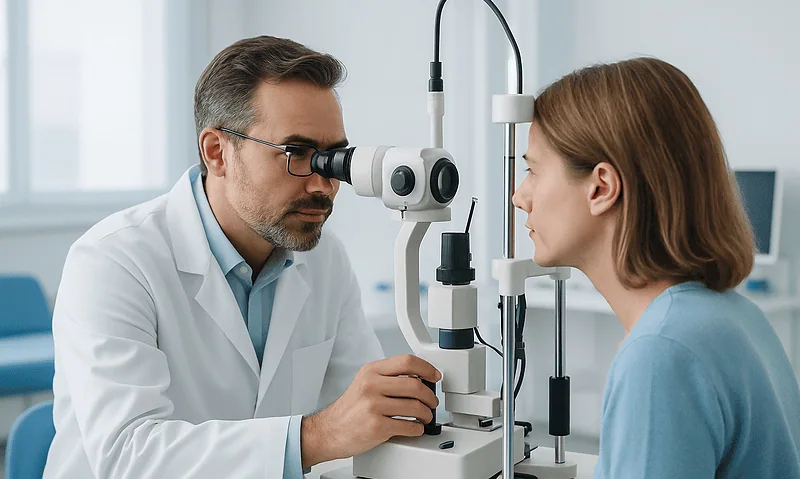
The assessment is longer than most people expect, and much of it looks like a game. For a child, the specialist or orthoptist (a clinician trained in eye movement and binocular vision) will check vision in each eye separately using pictures, letters or matching cards suited to age. This matters because reduced vision in one eye both causes and results from misalignment.
The central test is the cover test. The examiner covers one eye and watches the other. If the uncovered eye moves to take up fixation, it was not pointing at the target. Repeating this with a prism bar, a strip of wedge-shaped lenses that bend light by measured amounts, gives the size of the deviation in prism diopters, a unit of angular measurement. The test is done for distance and near, with and without glasses, and sometimes in different head positions.
Eye movements are checked in all directions to look for a muscle that overacts or underacts, which separates comitant from incomitant patterns. Depth perception and the ability to fuse two images are tested where age allows. The examiner also looks for a compensatory head tilt or turn.
Nearly every child then has drops that temporarily relax focusing and widen the pupil. This cycloplegic refraction reveals the true amount of farsightedness or astigmatism without the child’s own focusing masking it, and it lets the doctor examine the retina and optic nerve to exclude structural causes. Vision is blurry for the rest of the day, and light sensitivity is normal.
Adults undergo the same alignment measurements plus a targeted search for cause, which may include blood tests for thyroid or diabetes and imaging of the brain or orbits when the pattern or history suggests it.
Who is usually treated, and who is usually asked to wait
The decision to treat rests on three questions: is vision developing normally in both eyes, is the misalignment harming two-eyed vision or causing symptoms, and is the appearance affecting the person’s life. Different types of strabismus weight those questions differently.
Treatment is usually recommended when amblyopia is present. Amblyopia, sometimes called lazy eye, is reduced vision in an eye that is structurally healthy because the brain has learned to ignore its image. The National Eye Institute estimates it affects up to 3 in 100 children, and strabismus is one of its two leading causes. Mayo Clinic emphasizes that amblyopia treatment works best when started early in childhood, while the visual system is still developing, although older children can still benefit. A constant turn in a young child is therefore rarely left alone.
Treatment is also generally offered for infantile esotropia, for accommodative esotropia (in the form of glasses, at minimum), for a constant exotropia, and for any adult with troublesome double vision or a misalignment that affects eye contact, reading or work.
Watchful waiting is common, and appropriate, in several situations. A child with well-controlled intermittent exotropia who drifts briefly and rarely may be monitored at intervals for months or years. A very small angle that does not disturb binocular vision may be observed. An adult with a new turn from a nerve palsy is usually asked to wait, often with a temporary prism or patch for comfort, because many palsies improve on their own over months and surgery on a still-changing angle is unwise. The team, not a timetable, decides when observation should end.
How care is planned: glasses, patching, prisms and drops
A care plan is built in layers, and the order is deliberate: protect vision first, then align.
Glasses come first whenever a focusing error is found. In accommodative esotropia, the correct farsighted prescription can straighten the eyes by removing the effort that pulled them inward. Some children need bifocals if the turn is much larger for near work. Glasses also sharpen the image in a weaker eye, which is itself part of amblyopia treatment.
Patching the stronger eye forces the brain to use the weaker one. The schedule, from a couple of hours to most of the day, is set by the team according to age and severity and adjusted at each visit. Comfort helps compliance: soft adhesive patches, fabric patches over glasses, and pairing patch time with a favorite activity all appear in NHS and NEI guidance for families. An alternative to patching is a dilating eye drop placed in the stronger eye, which blurs its near vision so the weaker eye is used; the clinician chooses between these approaches and monitors both.
Prisms are wedge-shaped lenses, either ground into glasses or applied as a temporary press-on film, that bend incoming light so a misaligned eye receives a fused image. They do not straighten the eye; they relieve double vision, which makes them especially useful for adults and for people awaiting surgery.
Eye exercises, formally called orthoptic therapy, have a narrow evidence base. They help a specific problem called convergence insufficiency, where the eyes struggle to turn inward for reading. Mainstream guidance from the Cleveland Clinic and NHS does not support exercises as a treatment for constant strabismus. That distinction is worth remembering when programs promise to fix crossed eyes without medical care.
Strabismus surgery and recovery: what the following days and weeks look like
Eye-muscle surgery adjusts the pull of one or more of the six muscles. The surgeon reaches the muscle through a small incision in the conjunctiva, the clear membrane over the white of the eye, then either moves the muscle’s attachment backward to weaken it or shortens it to strengthen it. Nothing is done inside the eyeball, and the eye is not removed from its socket, a persistent fear that clinicians hear often. In children the operation is under general anesthesia; adults may have general or local anesthesia, and some surgeons use adjustable sutures that allow fine-tuning of the alignment shortly afterward.
The NHS describes the operation as a day procedure, with most patients going home the same day. In the first days the eye is typically red, watery and gritty, and mild aching is expected. The redness fades over a few weeks, and the NHS advises avoiding swimming for a few weeks while the incision heals. Children usually return to school within days once comfortable; the team gives individual advice on sport, screens and any drops prescribed to reduce infection risk or inflammation.
Surgery aligns the eyes; it does not by itself improve the vision in an amblyopic eye, so patching or glasses often continue afterward. Some people need more than one operation over their lifetime, either because the angle was very large or because alignment changes as they grow. Risks discussed at consent include infection, over- or under-correction, double vision while the brain adapts, and, rarely, damage to the eye itself.
An alternative for selected patterns is an injection of botulinum toxin into an overacting muscle, which weakens it temporarily. The NHS notes the effect wears off over roughly a few months; it is used mainly to test how the brain will respond to straighter eyes or to manage a palsy while it recovers.
What people often get wrong about strabismus
“Children grow out of it.” Infants under three months may have wandering eyes that settle. A true, persistent misalignment after that age does not resolve on its own, according to NHS and MedlinePlus guidance. Waiting risks amblyopia, which becomes harder to treat with age.
“Strabismus and lazy eye are the same thing.” They are related but distinct. Strabismus is a misalignment; amblyopia is reduced vision in an otherwise healthy eye. One can cause the other, and a child can have either alone. The treatments overlap but are not identical.
“Does strabismus ever go away?” It depends on the type. Accommodative esotropia is often fully controlled while glasses are worn, and some children’s need for glasses lessens in the teenage years. Intermittent exotropia can remain stable for decades. Many nerve palsies in adults recover over months. Constant infantile esotropia and constant exotropia do not disappear without treatment. The honest answer is “sometimes, and it depends on which type,” which is why classification matters.
“Adults cannot be treated.” This belief is outdated. Adults with long-standing misalignment can have surgery for double vision, eye strain, or the social effects of poor eye contact, and the Cleveland Clinic notes treatment is possible at any age. Restoring depth perception is less predictable in adults, but alignment is achievable.
“Exercises can fix crossed eyes.” Exercises help convergence insufficiency, not constant strabismus.
“Surgery will fix the vision.” Surgery changes alignment, not the sharpness of an amblyopic eye. Vision therapy for amblyopia continues separately.
“It is just cosmetic.” Misalignment affects depth perception, reading, driving and, in adults, causes double vision and fatigue. Cosmetic framing undervalues a functional problem.
Questions to ask your care team
A strabismus consultation covers a great deal, and families often leave with the diagnosis but without the context. Writing questions down in advance helps. The list below reflects what specialists say they wish patients asked.
- Which type of strabismus is this, in plain terms, and is it constant or intermittent, comitant or incomitant?
- Is there any sign of amblyopia, and how is the vision in each eye measured against what is expected for this age?
- Do you know, or suspect, a cause? Is any further testing needed to rule one out?
- What is the goal of treatment for us specifically: protecting vision, restoring two-eyed vision, relieving double vision, or improving alignment?
- If glasses are prescribed, should they be worn all the time, and how will we know they are working?
- If patching or drops are suggested, what schedule are you recommending, and how often will it be reviewed?
- If you are recommending observation, what changes should prompt us to come back sooner?
- If surgery is on the table, which muscles are involved, what is the likelihood of needing a second procedure, and what would recovery look like for our situation?
- Is there anything in our family history that affects the plan or means siblings should be checked?
- How will this affect school, reading, sport or driving, and is there anything teachers should know?
- Who do we contact between appointments with concerns, and how quickly?
Ask, too, for the measurements in writing. The angle of deviation and the vision in each eye are the numbers that will be compared at every future visit, and having them lets a family understand whether things are improving, stable or drifting.
When to call your doctor
Most strabismus is assessed and managed on a routine timescale, but some situations deserve a same-day call or an emergency visit.
For a child, contact the doctor promptly if an eye turn is present all the time after about three months of age, if a turn that used to come and go becomes constant, if the child begins tilting or turning the head to see, closes one eye repeatedly, or complains of double vision. A white or absent reflection in one pupil in photographs, in place of the usual red glow, should be reported the same day, because it can indicate a problem behind the pupil that needs urgent examination.
For an adult, a new misalignment or new double vision should be assessed promptly. Seek emergency care if it appears suddenly and is accompanied by any of the following: severe or sudden headache, a drooping eyelid, an enlarged pupil, weakness or numbness of the face or limbs, difficulty speaking, confusion, loss of balance, or if it follows a head injury. These combinations can indicate a stroke, an aneurysm or raised pressure inside the head, and time matters.
After strabismus surgery, call the surgical team if pain increases rather than settles, if vision worsens, if the eye becomes markedly more red or swollen after initially improving, if there is a thick discharge or a fever, or if the eye appears to have moved back or overshot noticeably. Redness and grittiness are expected; escalation is not.
Whenever there is doubt, the team that knows the history is the right first call. Nothing in this article replaces their judgment, and every decision about starting, changing or stopping treatment belongs with them.
Frequently asked questions
What are the four types of strabismus?
The four directional types are esotropia (an eye turning inward), exotropia (an eye turning outward), hypertropia (one eye sitting higher) and hypotropia (one eye sitting lower). Specialists then add further descriptors, including whether the turn is constant or intermittent, whether it began in infancy or later, and whether the angle changes with direction of gaze. Those details, rather than direction alone, shape the care plan.
Does strabismus ever go away?
Some types do settle or become controlled, others do not. Wandering eyes in babies under about three months usually resolve. Accommodative esotropia is often fully controlled while glasses are worn, and many adult nerve palsies improve over months. Constant infantile esotropia and constant exotropia do not disappear without treatment. Because the answer depends on the type, a specialist assessment is the only reliable way to know which situation applies.
What is the most common cause of strabismus?
In children, most strabismus has no single identifiable cause; the muscles and nerves are usually normal and the brain’s coordination of the two eyes is what falls short, often with a family tendency. Uncorrected farsightedness is the leading nameable cause in preschoolers. In adults, new misalignment more commonly results from nerve palsies, thyroid eye disease, diabetes, stroke or trauma, so the cause is investigated before alignment treatment is planned.
At what age is strabismus abnormal?
A constant eye turn, or one that keeps returning, is considered abnormal beyond about three months of age, according to NHS guidance. Before that, brief crossing or drifting is common as coordination develops. There is no later age at which a genuine misalignment is normal. Some babies have pseudostrabismus, where a wide nasal bridge creates the illusion of crossed eyes; an eye specialist can distinguish this quickly.
What is the difference between esotropia vs exotropia?
Esotropia is an inward turn and exotropia is an outward turn. Beyond direction, they tend to behave differently: childhood esotropia is more often constant and linked to farsightedness or early-onset coordination problems, while childhood exotropia is more often intermittent, appearing with fatigue, illness or bright light. The two are assessed with the same tests but often follow different treatment paths, with glasses playing a bigger role in esotropia.
Does intermittent exotropia in children always need surgery?
No. Many children with intermittent exotropia are monitored for months or years, particularly when the drift is infrequent and the eyes realign quickly on their own. Treatment, which can include glasses, patching or surgery, is generally considered when the eye is out for a large share of the day, when control is weakening, or when two-eyed vision is being lost. The treating team makes that judgment from repeated measurements over time.
Will a child with accommodative esotropia need glasses for life?
Not necessarily, but often for many years. Accommodative esotropia glasses work by correcting farsightedness so the focusing effort that pulled the eyes inward is reduced. Farsightedness commonly lessens through the teenage years, and some young people find their prescription falls. Others remain farsighted and continue to need correction to keep the eyes straight. Any change to glasses wear is decided by the eye team after measurement, never by trial at home.
How long does strabismus surgery recovery take?
Strabismus surgery is usually a day procedure, with most people going home the same day according to the NHS. The eye is typically red, watery and gritty for several days and the redness fades over a few weeks. Children often return to school within days once comfortable, and the NHS advises avoiding swimming for a few weeks. Individual timelines vary, and the surgical team gives specific guidance.
Can adults have strabismus treated?
Yes. Adults with long-standing or newly acquired misalignment can be treated with prisms, patching, botulinum toxin injections or eye-muscle surgery, depending on the cause and pattern. Reasons include double vision, eye strain, difficulty with eye contact and reading. Restoring full depth perception is less predictable in adults whose eyes were misaligned since childhood, but achieving alignment is possible, and the Cleveland Clinic notes treatment is available at any age.
Is strabismus the same as lazy eye?
No, although they are closely linked. Strabismus is a misalignment of the eyes. Lazy eye, or amblyopia, is reduced vision in an eye that is structurally healthy because the brain has learned to ignore its image. Strabismus can cause amblyopia when the brain suppresses the turned eye, and amblyopia can allow an eye to drift. A child can have one without the other, and each is treated with its own plan.
References
- MedlinePlus Medical Encyclopedia: Strabismus
- NHS: Squint
- Cleveland Clinic: Strabismus (Crossed Eyes)
- National Eye Institute (NIH): Amblyopia (Lazy Eye)
This article is for general information only and is not a substitute for professional medical advice. Please consult a qualified doctor about your individual situation.

More from the Blog
Preparing for an Eye Examination: Glasses, Old Reports, Medication Lists and a Driver
For an eye exam, bring the glasses and contact lenses you actually use, any previous prescriptions or eye reports, a complete list of your…

Laser, Injections or Vitrectomy: How Retina Specialists Match the Treatment to the Problem
Retinal treatment options fall into three main groups: laser, which seals tears or treats leaking blood vessels; injections into the eye, which block the…

Observation, Laser, Injections or Surgery: How Diabetic Retinopathy Treatment Is Chosen
Diabetic retinopathy treatment options are chosen by stage and by what is threatening sight. Early disease without swelling of the central retina is usually…

What Happens at a Contact Lens Fitting: Tear Film Checks, Trial Lenses and Wear Rules
A contact lens fitting appointment is a separate visit, or an add-on to an eye exam, in which an eye care professional measures the…

When an Intraocular Lens Needs Repositioning or Exchange: What Happens Next
An intraocular lens exchange is an operation to remove an artificial lens implanted during earlier cataract surgery and replace it with a new one.…

ILASIK Step by Step: The Femtosecond Flap, the Excimer Laser and the Minutes in Between
ILASIK is an all-laser, wavefront-guided form of LASIK. The typical procedure steps are: detailed corneal and wavefront mapping, numbing drops and an eyelid holder,…