

Facial Asymmetry Explained: Why Faces Are Uneven and How Facial Correction Is Planned

Key Takeaways
- Every human face is measurably asymmetric because it grows from two embryonic halves, and digitally mirrored faces are consistently rated as unnatural.
- Clinicians sort asymmetry into four layers, skeletal, soft tissue, muscular and nerve, and each layer points to a different specialist and approach.
- Sudden one-sided facial drooping is treated as a possible stroke until proven otherwise; the American Heart Association's FAST message exists for exactly this sign.
- Bell's palsy develops over one to three days and, according to the NHS, most people recover fully within about nine months, which is why surgery is deferred.
- Fillers add volume and botulinum toxin relaxes overactive muscle, but neither can move bone or restore a damaged nerve, and both are temporary.
- Corrective jaw surgery is generally delayed until facial growth is complete, because operating on a still-growing jaw can be undone by further growth.
Facial asymmetry treatment depends on the cause. Nearly every face is slightly uneven, and mild differences need no treatment at all. When the asymmetry comes from bone shape, soft-tissue volume, muscle imbalance or nerve weakness, options range from observation and physical therapy to injectables and surgery. A clinician first identifies the source. Sudden one-sided drooping is a medical emergency, not a cosmetic question.
The photo was taken at a cousin’s wedding, and it sat on her phone for a week before she zoomed in. One eyebrow rode higher than the other. The smile pulled slightly left. The jaw, she was now sure, was rounder on one side. By the weekend she had typed the phrase facial asymmetry treatment into a search bar and found a wall of clinic pages promising balance, harmony and a “more confident you.”
What those pages rarely explain is that the human face is built asymmetrically on purpose, by two halves of a body that never grow in perfect lockstep. The eyes read a face as a whole; a camera freezes it and invites a side-by-side audit that no one passes.
This explainer walks through why faces are uneven, which kinds of unevenness a clinician actually treats, how a correction plan is built, and, just as important, when a lopsided face is a signal to seek urgent care rather than a mirror to study.
Why almost every face is uneven
Hold a mirror vertically down the middle of a photograph of yourself and look at the two “whole” faces it creates. Most people find both versions strange. That reaction is the point: the brain has never seen a perfectly mirrored version of you, because one has never existed.
Faces grow from two embryonic halves that fuse in the midline during early pregnancy. From then on, the left and right sides develop under slightly different influences: the side you slept on as an infant, the side you chew on, the shoulder you hunch when you carry a bag, and the fact that the two halves of the brain drive facial muscles with subtly different intensity. The result is a face in which the eyes sit at marginally different heights, one nostril is a little wider, and the smile lifts unevenly. Clinicians regard this as normal anatomy rather than a defect.
Asymmetry also changes across life. Bone continues to remodel, fat pads in the cheek and temple thin at different rates, and skin loses elasticity unevenly, particularly on the side that receives more sun through a car window. A face that looked balanced at 25 can appear noticeably different at 55 without anything being wrong.
The distinction that matters to a treating team is between developmental asymmetry, which has been present and stable for years, and acquired asymmetry, which appears or worsens over weeks or months. The first is a question of preference. The second is a question of diagnosis. Everything that follows in a consultation flows from which category a person falls into, which is why the most useful thing a patient can bring to a first appointment is not a wish list but a handful of older photographs.
Asymmetrical face causes: bone, soft tissue, muscle and nerve
Clinicians tend to sort the causes of an uneven face into four layers, working from the inside out. Each layer points toward a different kind of specialist and a different kind of plan.

Skeletal causes involve the bones themselves. The lower jaw (mandible) may have grown longer on one side, the cheekbone may sit further forward, or the chin may be off-center relative to the midline of the face. Skeletal asymmetry is often congenital, meaning present from birth, or it develops during the growth spurts of adolescence. Conditions affecting the jaw joint (the temporomandibular joint, where the lower jaw meets the skull) can also alter how the jaw sits over time.
Soft-tissue causes sit in the fat, muscle bulk and skin. Fat pads may be fuller on one side, a chewing muscle may be thicker from years of one-sided chewing or nighttime clenching, or an old injury may have left a depression where tissue was lost.
Muscular causes involve how the muscles of expression fire. Some people have a smile that recruits the corner of the mouth more strongly on one side, or an eyebrow that habitually lifts higher. This is usually harmless, but it can also reflect a weaker or overactive muscle.
Nerve causes are the ones that change the conversation. The facial nerve controls the muscles of expression on its own side of the face. If it is inflamed, compressed, injured in surgery, or affected by a stroke, that half of the face weakens or droops. Bell’s palsy, a sudden inflammation of the facial nerve, is the most common example; Mayo Clinic describes it as causing sudden weakness on one side of the face, usually temporary.
Most people have a mix of layers. A careful examination separates them, because a filler cannot correct bone and surgery on bone will not fix a nerve.
Why is my face lopsided on one side? Sudden versus gradual
The single most important question a clinician asks is not how lopsided the face is but how fast it became that way.
Asymmetry that has been visible in photographs for years, that family members recognize as “just how you look,” and that has not changed recently is almost always developmental. It carries no medical urgency, and any decision to address it is elective, meaning chosen rather than required.
Asymmetry that appears over minutes to hours, particularly a drooping mouth or an eyelid that will not close, is a red flag. The American Heart Association’s FAST message (Face drooping, Arm weakness, Speech difficulty, Time to call emergency services) exists because sudden facial drooping is one of the classic signs of stroke. Bell’s palsy also comes on quickly, typically over one to three days according to the NHS, and the two cannot be told apart reliably at home. Both need same-day medical assessment; a stroke needs emergency services immediately.
Asymmetry that develops over weeks to months deserves a scheduled appointment. Possible explanations include jaw-joint problems that shift the bite, slow-growing lumps in the salivary glands or under the skin, dental infections that cause one-sided swelling, or a nerve being pressed by something that has grown. None of these is a reason for panic, and many turn out to be benign, but each is a reason to be examined rather than to book a cosmetic consultation.
A useful rule of thumb: if you are asking “why is my face lopsided?” about a face that looked the same a year ago, you are in cosmetic territory. If you are asking it about a face that changed this month, you are in medical territory first. The treating team can move you to the cosmetic conversation later, once the cause is clear.
How facial asymmetry treatment is planned: what actually happens at the assessment
A first appointment for facial asymmetry looks more like a detective exercise than a design session. The clinician’s aim is to locate the asymmetry in one or more of the four layers, then decide whether any of it warrants intervention.
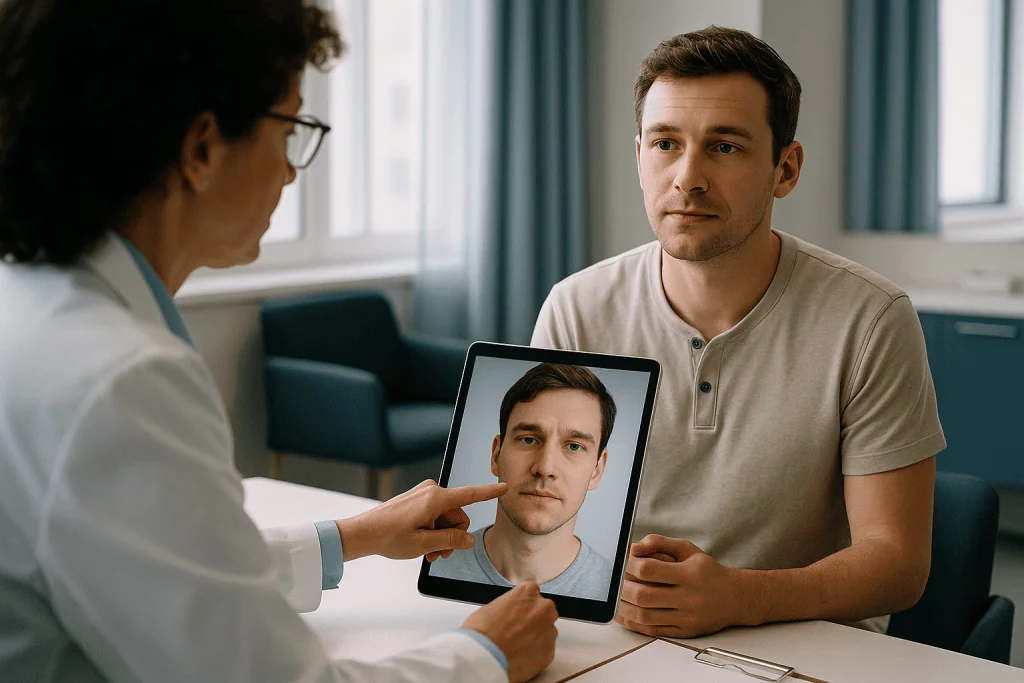
It usually begins with history. When did you first notice it? Do old photographs show it? Any injury, dental work, surgery, or episode of facial weakness? Do you clench or grind your teeth? Which side do you chew on and sleep on? These questions map the likely layer before anyone touches your face.
Examination follows. You will be asked to raise both eyebrows, close your eyes tightly, smile broadly, show your teeth, and puff out your cheeks. These movements test each branch of the facial nerve and reveal whether an uneven smile is a matter of muscle bulk or of weakness. The clinician will feel the jawline, cheekbones and chewing muscles, and may ask you to open and close your mouth while watching the jaw’s path.
Standardized photography comes next: front, both profiles, and often a view from below the chin. Many teams draw a vertical midline and horizontal reference lines on these images to measure how far key landmarks deviate. Some use three-dimensional surface scanning, which produces a digital model that can be mirrored to quantify left-right differences.
Imaging is added when bone is suspected. A plain dental panoramic X-ray or a cone-beam CT scan (a low-dose, three-dimensional X-ray of the face and jaws) shows whether the skeleton itself is uneven. If a nerve problem or a mass is suspected, referral to neurology, ear-nose-and-throat, or maxillofacial surgery may come before any discussion of correction.
Only after this mapping does the plan get built, and a good plan often ends with a recommendation to do nothing.
Which approach fits which kind of asymmetry?
The table below summarizes how clinicians commonly match the layer of asymmetry to the general category of approach. It describes categories, not recommendations, and the treating team decides which, if any, applies to an individual.
| Layer of asymmetry | Typical examples | Approaches commonly considered | Usual specialist |
|---|---|---|---|
| Skeletal | Jaw longer on one side; chin off midline; flattened cheekbone | Observation until growth is complete; orthodontics; corrective jaw surgery; implants or bone contouring | Oral and maxillofacial surgeon; orthodontist |
| Soft tissue (volume) | Fuller cheek on one side; hollow from old injury | Observation; temporary fillers; fat grafting; surgical contouring | Plastic surgeon; dermatologist |
| Muscular (overactivity) | Enlarged chewing muscle; brow that lifts higher | Habit change and physical therapy; botulinum toxin to relax an overactive muscle | Dermatologist; plastic surgeon; dentist for clenching |
| Nerve (weakness) | Bell’s palsy; post-surgical nerve injury; stroke | Treat underlying cause; eye protection; facial physical therapy; nerve or muscle transfer surgery in selected long-term cases | Neurologist; ENT/facial nerve surgeon |
Two patterns stand out. First, observation appears in every row. Many asymmetries are best left alone, and a team that suggests waiting is not dismissing you; it is often protecting you from a procedure that would not deliver what you imagine. Second, the specialist depends on the layer, which is why a person who begins with a cosmetic injector but turns out to have a skeletal or nerve cause is usually redirected.
Fillers and botulinum toxin sit in the soft-tissue and muscle rows only. They cannot move bone, and they cannot restore a nerve. Surgery sits mostly in the skeletal row and in selected long-standing nerve cases. Knowing which row you are in is the whole point of the assessment.
Non-surgical options: what injectables and therapy can and cannot do
For soft-tissue and muscular asymmetry, non-surgical approaches are usually the first thing discussed, and they are worth understanding precisely, because their limits are as important as their uses.
Dermal fillers are injectable gels, most commonly based on hyaluronic acid, a sugar molecule found naturally in skin, that add volume where tissue is deficient. If one cheek is flatter or one side of the jawline recedes, filler can be placed on the smaller side to bring it toward the larger one. The effect is temporary; the body gradually breaks down the material, and the treatment must be repeated to maintain the result. Filler adds; it cannot subtract, and it cannot correct a jaw that is genuinely longer.
Botulinum toxin is a purified protein that temporarily blocks the signal from nerve to muscle, relaxing the muscle it is injected into. When asymmetry comes from an overactive muscle, such as one chewing muscle bulked up from clenching or an eyebrow pulled higher by a stronger forehead muscle, relaxing the stronger side can even things out. According to Mayo Clinic, the effect typically lasts about three months or longer, after which regular follow-up injections are needed to maintain it. The same principle is used in some nerve cases: treating the healthy side to reduce the contrast with a weakened side.
Facial physical therapy, sometimes called neuromuscular retraining, teaches people to activate weak muscles and relax overactive ones through guided exercises, often with mirror or video feedback. It is most established in recovery from facial nerve weakness.
None of these options is proven to “train” a face into symmetry when the cause is bone. Devices marketed for this purpose, along with chewing gum regimes and jaw-exercise gadgets, have no supporting evidence in mainstream medical literature. The treating clinician can explain which, if any, of the evidence-based options fits your layer and what a realistic result looks like.
Facial asymmetry surgery: what actually happens in the operating room
Surgery enters the conversation mainly for skeletal asymmetry, for significant soft-tissue deficits that injectables cannot bridge, and for selected long-standing nerve weakness. It is planned, staged and rehearsed, and it looks quite different depending on the layer.
Corrective jaw surgery (orthognathic surgery, meaning surgery that repositions the jaw bones) is the main option when the lower or upper jaw has grown unevenly. Surgeons make controlled cuts in the bone through incisions inside the mouth, reposition the segments toward the midline, and fix them with small plates and screws. It is usually done under general anesthesia and almost always coordinated with an orthodontist, since moving the jaw changes the bite. Planning frequently uses three-dimensional scans and printed surgical guides.
Contouring procedures address a specific area rather than the whole jaw. A prominent angle of the jaw can be reduced, a flattened cheekbone or chin can be built up with a shaped implant or with bone grafted from elsewhere, and fat can be harvested from the abdomen or thigh, purified and injected into hollows (fat grafting). Some grafted fat is reabsorbed, so results settle over months and may need a second session.
Facial reanimation surgery is reserved for long-term nerve weakness that has not recovered. Options include transferring a nerve from elsewhere to power the weak side, or moving a small muscle with its own nerve and blood supply into the face to create movement. These are complex operations offered by specialized teams after a period of observation, since many nerve injuries recover on their own.
Across all of these, the surgeon aims for improvement toward balance rather than mathematical symmetry. Surgeons cannot make the two sides identical, and most will say so plainly. The relevant question in a consultation is what degree of change is realistic for your anatomy, and the honest answer is always a range.
When the cause is a nerve: Bell's palsy and facial paralysis
Nerve-related asymmetry deserves its own section because it is the type most often mistaken for a cosmetic problem and the type where timing matters most.
The facial nerve exits the skull just behind the ear and fans out across its side of the face, driving every muscle of expression from forehead to chin. Damage anywhere along its course weakens that half of the face: the brow drops, the eye may not close fully, the nasolabial fold (the line from nose to mouth corner) flattens, and the mouth droops. Speech, eating and eye protection can all be affected.
Bell’s palsy is the most common cause. It is thought to result from inflammation of the nerve, possibly triggered by a viral infection, and symptoms typically develop over one to three days, according to the NHS. Most people recover fully; the NHS states that most people make a full recovery within about nine months, with improvement often beginning within a few weeks. Clinicians commonly prescribe a short course of corticosteroids, medicines that reduce inflammation, and the evidence favors starting them early; the prescribing clinician decides whether and when this is appropriate. Protecting the eye that cannot close, with lubricating drops and taping at night, is a routine part of care because the cornea can be damaged if it dries out.
A minority of people are left with lasting weakness or with synkinesis, a condition in which nerve fibers regrow into the wrong muscles, so that smiling causes the eye to narrow or blinking pulls the mouth. Facial physical therapy and, in some cases, botulinum toxin to the overactive muscles are the established approaches. Surgical reanimation is considered only after recovery has clearly plateaued.
Other nerve causes include injury during surgery near the ear or salivary gland, tumors pressing on the nerve, and stroke. Because the initial appearance overlaps so heavily, any new one-sided facial weakness is assessed as a possible stroke until proven otherwise.
Uneven faces in babies and children
Parents notice asymmetry early, often in the first photographs, and the reassurance most families receive is grounded in how young skulls behave.
A newborn’s skull is made of plates that have not yet fused, which allows it to pass through the birth canal and to expand as the brain grows. That same softness means the head can flatten where it rests. Positional plagiocephaly, a flattening of one side of the back of the head from lying in the same position, is common, and because the skull base is connected to the face, it can pull one ear and one cheek slightly forward. According to the NHS, the shape usually improves naturally as the baby grows, becomes more mobile and spends less time lying down, and helmets are not routinely recommended because the evidence that they change the long-term outcome is limited. Encouraging supervised tummy time and varying the direction the baby faces in the crib are the standard advice.
Torticollis, a tightness of a neck muscle that tilts the head to one side, often accompanies plagiocephaly and is addressed with gentle stretching guided by a physical therapist. Treating the neck helps the head shape by allowing the baby to turn both ways.
Less commonly, asymmetry reflects craniosynostosis, in which one of the skull’s growth seams fuses too early and forces growth in other directions. This produces a characteristic shape that pediatricians are trained to recognize, and it is managed by specialist craniofacial teams. The distinction between positional flattening and early fusion is made by clinical examination and, if needed, imaging, not by parents at home.
Facial skeletal asymmetry that persists into childhood is generally observed until growth is complete, because operating on a growing jaw can be undone by further growth. Orthodontic approaches that guide growth are sometimes used in the meantime, and the pediatric team explains the pathway and the waiting in age-appropriate terms.
Who facial asymmetry treatment is usually for, and who is asked to wait
Because so much asymmetry is normal, clinicians spend as much time deciding whom not to treat as whom to treat.
People commonly considered for elective correction share a few features. Their asymmetry is stable and developmental, with a clear cause in one layer. It bothers them consistently rather than only in certain photographs or under certain lighting. Their expectations are realistic, meaning they want the two sides to be closer, not identical. They are in good general health, and, for skeletal work, they have finished growing, which for the jaw typically means the late teens or later.
Functional reasons strengthen the case. A jaw that is uneven enough to disturb the bite can cause difficulty chewing, uneven tooth wear or jaw-joint pain, and correcting it then becomes reconstructive rather than purely cosmetic. Nerve weakness that prevents the eye from closing is treated to protect vision, whatever the person feels about appearance.
Several groups are usually asked to wait or are steered elsewhere. Anyone with new or progressive asymmetry is investigated before any cosmetic discussion. People with recent Bell’s palsy are asked to allow time for recovery, since the majority improve substantially without surgery. Adolescents with skeletal asymmetry are followed until growth is complete. People whose distress about their appearance is out of proportion to what clinicians can see may be offered a conversation with a mental health professional, because body dysmorphic disorder, a condition in which a person is preoccupied with a perceived flaw others barely notice, is not helped by procedures and can be worsened by them.
Medical factors matter too. Bleeding disorders, uncontrolled diabetes, smoking and certain medications raise surgical risk and may lead a team to defer or decline. None of these is a judgment; they are the ordinary boundaries of safe practice, and the final call sits with the treating team.
What the following days and weeks usually look like
Recovery depends entirely on which row of the table you were in, so it helps to picture three different timelines.
After injectables, most people return to ordinary activities the same day. Mild swelling, redness or small bruises at the injection sites are common for a few days. Filler results are visible immediately and settle as swelling subsides over one to two weeks. Botulinum toxin takes several days to begin working and reaches its full effect over roughly two weeks; because the effect fades, Mayo Clinic notes that follow-up injections are typically needed to maintain it. Clinicians usually ask people to avoid pressing on treated areas and to skip vigorous exercise and alcohol briefly.
After corrective jaw surgery, the early days involve significant swelling that peaks around the second or third day and then gradually recedes over weeks. Eating is limited to liquids and soft foods for a period the surgeon specifies while the bone heals, and numbness in the lower lip and chin is common because sensory nerves run through the operated bone; it usually improves over months, though a small proportion of people have some permanent change in sensation. Most people take time off work or school, and the final appearance is judged only after several months, once swelling has fully resolved and orthodontic adjustments are complete.
After Bell’s palsy, the timeline is one of watching and protecting rather than recovering from a procedure. Improvement often begins within a few weeks; the NHS notes most people recover fully within around nine months. Eye care continues until the eyelid closes properly, and facial exercises may be introduced under a therapist’s guidance.
In every scenario, the treating team sets the schedule for follow-up, and these ranges are typical rather than promised. The most reliable sign that something is off is a change that goes against the expected direction: swelling that grows rather than shrinks, pain that intensifies rather than eases.
Risks and alternatives, in plain language
Every intervention on the face carries risk, and a trustworthy consultation spends real time on it. The risks scale with the invasiveness of the approach but never fall to zero.
Injectables carry bruising, swelling, lumps that can usually be felt more than seen, and asymmetry of a new kind if the amount or placement is uneven. Rarely, filler enters a blood vessel and blocks it; this can damage skin and, in very rare cases involving vessels around the eye, threaten vision. Injectors are trained to recognize this and treat it urgently. Botulinum toxin can spread to a neighboring muscle and produce a temporary drooping eyelid or an uneven smile, which resolves as the effect wears off.
Surgery adds the general risks of anesthesia, bleeding, infection and blood clots, plus procedure-specific ones. Jaw surgery can injure sensory nerves, alter the bite in unintended ways, or require a second operation if the bones heal in a slightly different position. Implants can shift or become infected. Fat grafts are partially reabsorbed, making the final volume unpredictable. Any facial incision leaves a scar, even when placed inside the mouth or in a hairline.
The most underappreciated risk is disappointment. Because true symmetry is impossible, a person expecting a mirrored face is likely to feel the procedure failed even when the surgeon considers it a good result. Clear, measurable goals agreed before treatment protect against this.
Alternatives are always on the table. Doing nothing is a legitimate choice for stable developmental asymmetry. Hairstyle, eyebrow shaping and makeup contouring change perceived balance without any medical risk. Orthodontics alone can improve some bite-related asymmetry. Physical therapy may be enough for muscular imbalance. Counseling helps when the distress is disproportionate to the finding. The treating team should present these alongside procedures, not as a footnote.
What people often get wrong about how to fix an uneven face
Search for how to fix an uneven face and you will meet a set of confident claims that do not survive contact with the evidence. Here are the ones clinicians correct most often.
“Chewing on the other side will even out my jaw.” Chewing habits can enlarge the chewing muscle on the favored side, and switching sides may slightly reduce that muscle over time. It cannot change the length or shape of the jawbone in an adult. The claim confuses muscle with skeleton.
“Facial exercises or jaw-training devices reshape the face.” There is no mainstream medical evidence that exercise gadgets, chewing gums marketed for the jawline, or face-yoga routines correct structural asymmetry. Exercise has a genuine role in nerve recovery under a therapist’s supervision, which is a different thing.
“Sleeping on one side caused my lopsided face.” In infants, sleep position genuinely shapes the soft skull. In adults, the bones are fixed. Sleep position may contribute to uneven skin creasing over decades but does not move bone or shift features.
“Filler fixes asymmetry permanently.” Filler is temporary and must be repeated. Presenting it as a one-time fix sets up disappointment.
“Symmetry equals attractiveness, so I need to be symmetrical.” Research on facial attractiveness finds that people prefer average asymmetry, not perfect symmetry; digitally mirrored faces are routinely rated as strange. Slight unevenness reads as natural.
“If it’s just cosmetic, I can skip seeing a doctor first.” The layer cannot be determined at home. A cosmetic injector treating what turns out to be a nerve problem or a growing mass delays the diagnosis that mattered.
“A good surgeon can make both sides match.” No surgeon can, and one who promises it is selling rather than counseling. Improvement toward balance is the realistic and honest goal.
Questions to ask your care team
A consultation goes better when the questions come from you as well as from the clinician. These are the ones that tend to produce the most useful answers, grouped by stage.
Before any plan is made, ask which layer or layers the asymmetry sits in and how the team reached that conclusion. Ask whether anything about your history or examination suggests a medical cause that needs investigation first. Ask whether waiting is a reasonable option and what the team would expect to happen if you did nothing.
When a specific approach is proposed, ask what degree of improvement is realistic in measurable terms, for example, how many millimeters closer to the midline, rather than in words like “balanced.” Ask what the approach cannot do. Ask how long the result is expected to last and what maintenance it requires. Ask who will perform the procedure, what their training is in this specific technique, and how the plan would change if the first attempt undercorrects or overcorrects.
On risk, ask which complications are common and minor, which are rare and serious, and what the team’s plan is if a serious one occurs. Ask about the recovery timeline for your specific procedure and when you can expect to judge the final result.
On alternatives, ask what non-procedural options exist and whether the team has patients who chose them. Ask whether a second opinion from a different specialty, such as orthodontics or neurology, would add anything.
On cost, ask for a written breakdown of what is included, what is not, and what follow-up or revision would involve; every team’s arrangements differ, and getting it in writing avoids surprises. Note that this article does not publish figures because they vary too widely to be meaningful.
Finally, ask for the plan in writing and take it home. A decision made a week after the consultation is usually a better one.
When to call your doctor
Most facial asymmetry is not urgent. The exceptions are specific, and they are worth knowing by heart.
Call emergency services immediately if one side of the face suddenly droops, especially with any weakness or numbness in an arm or leg, slurred or confused speech, sudden loss of vision, a severe headache unlike any before, or trouble walking. These are stroke warning signs, and the American Heart Association’s FAST guidance stresses that treatment works best the sooner it starts. Do not wait to see if it passes.
Seek same-day medical assessment if you develop new one-sided facial weakness without other stroke signs, cannot fully close one eye, notice drooling or changes in taste, or have pain behind the ear alongside weakness. These fit Bell’s palsy, and the treating clinician will want to examine you early.
Book a prompt appointment if asymmetry has appeared or clearly worsened over weeks or months, if you feel a lump in the cheek, jaw or neck, if your bite has changed, if one side of the face is persistently swollen, or if you have unexplained numbness, jaw locking or facial pain.
After a procedure, contact the treating team without delay if you notice skin that turns white, mottled or dusky over an injected area; severe or increasing pain; vision changes; swelling that grows rather than shrinks after the first few days; fever, spreading redness, or discharge from an incision; bleeding that does not stop with gentle pressure; or difficulty breathing or swallowing. Teams give written instructions for exactly this reason, and calling early is never an overreaction.
Everything in this article is background for a conversation, not a substitute for one. The treating team who has examined you is the only source of a plan that fits your face.
Frequently asked questions
Can you actually fix facial asymmetry?
Asymmetry can often be reduced but never eliminated, because no face is perfectly symmetric to begin with. What is achievable depends on the cause: temporary fillers or botulinum toxin for soft-tissue and muscular imbalance, surgery for skeletal differences, and treatment of the underlying condition plus therapy for nerve weakness. A clinician’s realistic goal is improvement toward balance, and any promise of matching sides should be treated with skepticism.
How much does facial symmetry surgery typically cost?
This article does not publish cost figures, because they vary so widely by procedure, region, facility and whether the work is classified as reconstructive or cosmetic that any number would mislead. Ask the treating team for a written, itemized breakdown covering the procedure, anesthesia, facility, follow-up visits and what happens if revision is needed. Insurance sometimes contributes when asymmetry affects function, such as a bite that impairs chewing.
Why is my face so lopsided on one side?
The most likely answer is ordinary developmental asymmetry that has always been there and that a photograph has made you notice. Other explanations include one-sided chewing or clenching that bulks a muscle, a jaw that grew unevenly, or past injury. Asymmetry that appeared recently or is worsening is different and needs a medical appointment, and sudden drooping requires emergency care because it can signal stroke or Bell’s palsy.
How long does it take to fix facial asymmetry?
It depends on the approach. Injectables show results within days to two weeks and must be repeated to maintain them. Corrective jaw surgery involves weeks of swelling and months before the final appearance settles, often alongside orthodontic treatment. Bell’s palsy follows its own course; the NHS notes most people recover fully within about nine months. None of these ranges is a promise, and the treating team gives the timeline for your plan.
What are the most common asymmetrical face causes?
Normal development is by far the most common cause, since the two halves of the face never grow identically. Beyond that, clinicians look at skeletal differences in the jaw or cheekbones, soft-tissue differences in fat and muscle bulk, muscular habits such as one-sided chewing or clenching, and nerve problems such as Bell’s palsy or facial nerve injury. Most people have a combination, and examination separates them.
Is there a way to fix an uneven face without surgery?
For soft-tissue and muscular asymmetry, non-surgical options exist: temporary fillers to add volume to the smaller side, botulinum toxin to relax an overactive muscle, and facial physical therapy for nerve-related weakness. Hairstyle, brow shaping and makeup contouring change perceived balance with no medical risk. Non-surgical methods cannot correct bone, and exercise gadgets and chewing gums marketed for jaw shaping have no supporting evidence.
Does sleeping on one side cause facial asymmetry in adults?
Not in any structural sense. Adult facial bones are fixed and do not shift with sleep position. Decades of pressing one side of the face into a pillow may contribute slightly to uneven skin creasing, but it does not move features or change bone. In infants the situation differs, because the soft, unfused skull can flatten where it rests, which is why varying a baby’s position is recommended.
Can facial asymmetry be a sign of stroke?
Yes. Sudden drooping of one side of the face is one of the classic stroke warning signs captured in the American Heart Association’s FAST message, along with arm weakness and speech difficulty. Anyone who develops sudden facial drooping should call emergency services immediately rather than waiting to see whether it improves. Bell’s palsy can look similar and also needs same-day assessment, but the two cannot be reliably told apart at home.
Will my baby's flat head or uneven face correct itself?
In most cases of positional flattening, yes. According to the NHS, the head shape usually improves naturally as the baby grows, gains head control and spends less time lying down, and helmets are not routinely recommended. Supervised tummy time and alternating the direction the baby faces help. A pediatrician should examine any asymmetry to rule out early fusion of a skull seam, which is managed differently by specialist teams.
What does facial asymmetry surgery involve and who performs it?
It depends on the layer being treated. Corrective jaw surgery repositions bone through incisions inside the mouth and is performed by oral and maxillofacial surgeons, usually with an orthodontist. Contouring, implants and fat grafting are commonly performed by plastic surgeons. Facial reanimation for long-standing nerve weakness is carried out by specialized facial nerve teams. In every case the surgeon aims for improvement toward balance, not identical sides.
References
This article is for general information only and is not a substitute for professional medical advice. Please consult a qualified doctor about your individual situation.

More from the Blog

Preparing for Face Aesthetics Surgery: Blood Tests, Anesthesia Review and Medicine Changes
Preparing for facial surgery usually means a pre-assessment visit where blood tests check clotting, blood count and kidney function, an anesthesia review covers your…

Supporting Someone After a Neck and Face Lift: Drains, Dressings and the First Days Home
In the first days after a neck and face lift, a helper's main tasks are keeping the head raised, emptying and recording any drains,…

Facial Augmentation With Fat Transfer or Implants: Which Option Suits Which Face?
Facial fat transfer uses a person's own fat, taken by gentle liposuction and injected into the face, to add soft, natural-looking volume; facial implants…

How Surgeons Sequence Combined Face Aesthetics Procedures: One Operation or Several?
Surgeons combine facial procedures in one operation when the areas heal on a similar timetable, the patient is medically well, and total anesthesia time…

How Surgeons Sequence Combined Face Aesthetics Procedures: One Operation or Several?
Surgeons may combine facial procedures such as a facelift, eyelid surgery and fat grafting in one operation when a person is healthy, does not…
Are Facial Implants Right for Your Face? Bone Structure, Skin Thickness and Age Considered
Facial implants are usually considered for adults whose bones have finished growing, who have a specific structural gap such as a recessed chin or…