

Female Hairline Transplants: Lowering and Reshaping, Planned for Women
Key Takeaways
- Female pattern hair loss usually widens the part while sparing the front edge, so many women who feel their 'hairline' is thinning actually need diagnosis and medical treatment, not hairline grafts.
- Transplanted hairs shed between roughly weeks two and six: an expected reset, with new growth typically starting around months three to four and maturing over 12 to 18 months.
- A feminine hairline curves and keeps the temple corners closed; copying the M-shaped male template is the most common aesthetic error in women's transplant work.
- Frontal fibrosing alopecia mimics a receding hairline but is a scarring condition, and grafts placed into active disease typically fail, which is why a dermatologic workup must precede surgery.
- FUT strip harvesting lets most women avoid shaving and hide the donor area under their own hair the same day, while FUE trades the linear scar for dot scars but usually requires trimming a donor zone.
- Hairline-lowering (forehead reduction) surgery can advance a lax scalp about 1–2 cm in one operation with immediate results, whereas a transplant avoids a frontal incision but takes a year to judge.
A female hairline transplant relocates a woman's own hair follicles, usually from the back of the scalp, to lower a naturally high hairline or rebuild thinning temples and edges. It suits women with a stable donor area and a confirmed diagnosis, since surgery cannot stop ongoing hair loss. Growth appears gradually, typically maturing over 12 to 18 months, and candidacy should be evaluated by a qualified physician.
There is a small ritual many women with a high hairline know by heart: pull a few strands forward, angle the part just so, check the mirror twice before a photo. Some have done it since middle school, long before the word “forehead” ever felt loaded. Others started recently, after noticing the temples pulling back or the front edge going wispy.
Those two stories look similar in a selfie but lead to very different medical conversations. One is about proportion: a hairline that has always sat high. The other is about change, which always deserves a diagnosis before a scalpel.
Hair restoration surgery was designed around male pattern baldness, and for decades women were an afterthought. That has shifted. Done well, hairline work for women is its own discipline, with different shapes, different graft choices, and a different definition of success. Done carelessly, it can put a man’s hairline on a woman’s face. Here is what the evidence, and good surgical planning, actually looks like.
Why a woman's hairline isn't just a man's hairline moved down
Look at a roomful of adults and the difference is obvious once you know to see it. A typical adult male hairline sits higher and recedes at the temples into an M-shape: that recession is a normal feature of male maturation, not necessarily balding. A typical female hairline sits lower on the forehead, runs in a soft, rounded or gently oval curve, and keeps the temple corners closed. Many women also have a subtle widow’s peak or small irregular “baby hairs” along the edge that make the border look feathered rather than drawn.
That anatomy dictates the surgery. A transplant plan borrowed from male work, straight lines, open temples, dense blunt edges, reads as masculine even when technically well executed. Female hairline design instead emphasizes three things: a lower, curved frontal border; rounded temple closure so the face is framed on the sides, not just the front; and a deliberately irregular front row built from single-hair grafts so the transition from bare skin to hair looks like it grew there.
The stakes are also different. Men’s transplants often chase coverage across a bald crown. Women’s hairline work chases framing: the few centimeters that change how the face is proportioned in photographs and in person. It is precision work measured in millimeters, which is exactly why the planning conversation matters more than the operating day.
High hairline or hair loss? The distinction that shapes everything
Two very different women walk into the same consultation. The first has had a high hairline her entire life; her mother has one too, her hair density is excellent, and nothing has changed since her twenties. The second had a lower hairline until her late thirties, and old photos prove it.
The first woman has a congenitally high hairline: a proportion, not a disease. She is often an excellent surgical candidate because the surrounding hair is stable, the donor area is dense, and the goal is purely geometric: bring the border down, typically one to two centimeters, and round the temples.
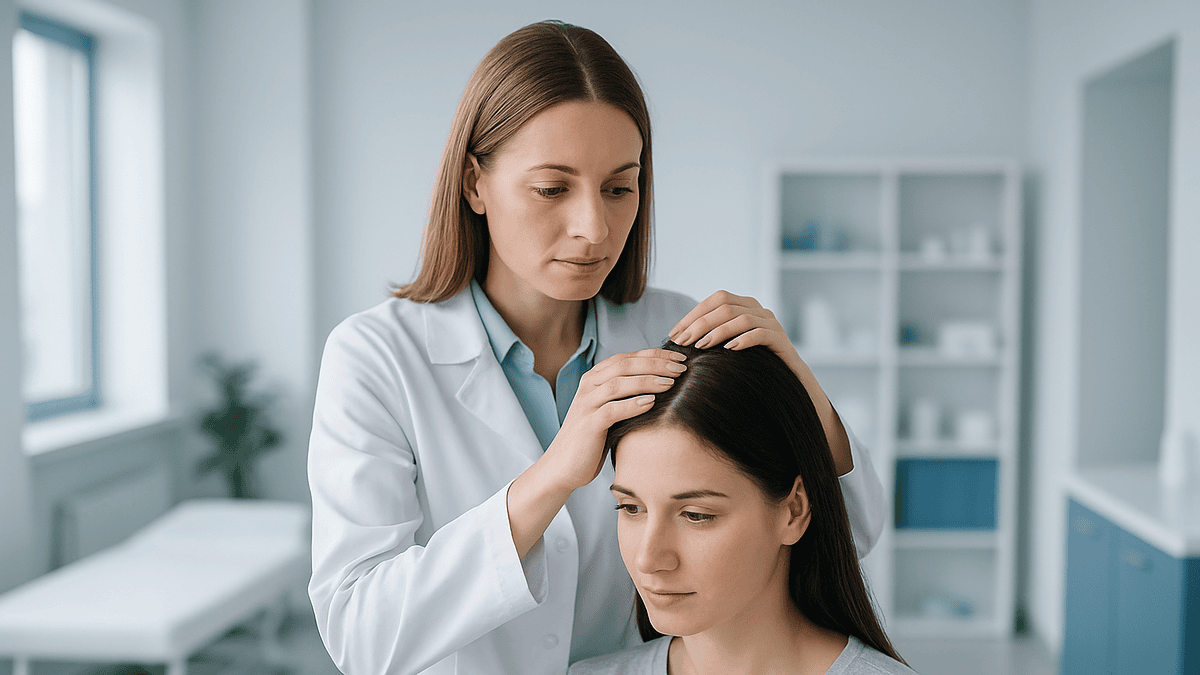
The second woman needs a workup before anyone discusses grafts. A changing hairline in a woman can signal several conditions with very different implications:
- Female pattern hair loss, which usually thins the part line and crown while sparing the frontal edge, meaning the hairline itself may not be the real problem.
- Traction alopecia from years of tight ponytails, braids, or extensions pulling at the margins.
- Frontal fibrosing alopecia (FFA), a scarring condition that slowly pushes the hairline backward, often taking the eyebrows with it.
- Telogen effluvium, a temporary diffuse shed after illness, childbirth, surgery, or significant stress, described by MedlinePlus and the NHS as commonly self-resolving.
Same mirror complaint, four different answers, only some of which involve surgery at all.
Why a diagnosis has to come before any transplant plan
Here is the uncomfortable truth reputable surgeons will tell you upfront: transplanting into the wrong scalp wastes grafts that can never be replaced. Donor hair is a finite bank account. Every follicle moved is a withdrawal, and there are no deposits.
Frontal fibrosing alopecia is the clearest example. Because it mimics a receding hairline, it is exactly the condition that sends women to transplant consultations, and it is inflammatory and scarring. Grafts placed into actively inflamed skin are attacked the same way the native hair was, and survival is typically poor. Dermatologists generally want scarring alopecias quiet and stable, often for an extended period confirmed by examination, before considering any surgical restoration, and some patients are never good candidates.
Traction alopecia sits at the other end of the spectrum. Caught early, it can improve simply by changing styling habits; caught late, the follicles are scarred and gone, and transplantation into that region can work well, provided the pulling stops for good.
The workup itself is straightforward. Mayo Clinic describes the standard tools: a medical and styling history, a scalp examination often with magnification (trichoscopy), a gentle pull test, blood tests to check thyroid function and iron stores, and occasionally a small scalp biopsy when scarring disease is suspected. None of it is dramatic. All of it protects the donor bank.
Who tends to be a good candidate, and who usually isn't
Candidacy is less about age and more about stability and supply. The women who tend to do well share a profile: a congenitally high hairline or a clearly diagnosed, stable, non-scarring cause of frontal thinning; a dense, reliable donor area at the back and sides of the scalp; realistic goals measured in centimeters, not fantasies of teenage density; and general health good enough for a long outpatient procedure under local anesthesia.
The harder conversations happen with women whose loss is diffuse. In classic female pattern hair loss, thinning affects the whole top of the scalp, and sometimes quietly affects the “donor” zone too. Harvard Health notes that female pattern loss is progressive and typically widens the part before it ever touches the hairline. If the donor hair is itself miniaturizing, transplanted follicles may thin later just as they would have in their original location. A careful surgeon examines the donor area under magnification precisely to catch this.
Other reasons a good surgeon says “not yet” or “not you”: active scarring alopecia, uncontrolled thyroid or iron issues driving the shedding, a recent major shed that may still recover on its own, unrealistic density expectations, or a pattern of loss still evolving rapidly. A declined consultation can sting in the moment. It is also, frequently, the best medical advice in the room.
Hairline transplant vs. hairline-lowering surgery: two different operations
Confusingly, “hairline lowering” describes two procedures that share a goal and almost nothing else. One is a transplant. The other, sometimes called forehead reduction, is an excisional surgery in which an incision is made along the hairline, a strip of forehead skin is removed, and the hair-bearing scalp is advanced forward and sutured in its new, lower position.
| Hairline transplant | Hairline-lowering (forehead reduction) surgery | |
|---|---|---|
| How it works | Individual follicles moved from donor area and implanted along a new front border | Scalp surgically advanced forward; strip of forehead skin removed |
| Typical advancement | Gradual; builds a new zone graft by graft | Often about 1–2 cm in a single operation, depending on scalp laxity |
| Time to visible result | Roughly 12–18 months for mature growth | Immediate lowering, once healed |
| Scar | Tiny dot scars (FUE) or a linear donor scar (FUT), hidden in hair | Fine incision line along the new hairline |
| Best suited to | Thinning edges, temple reshaping, irregular design goals; limited scalp laxity | Stable, dense congenitally high hairline with a flexible scalp |
Some women ultimately have both: lowering surgery for the big move, then a small transplant session later to soften the incision line and round the temples. Which path fits depends on scalp laxity, hair density, how much lowering is wanted, and tolerance for a frontal scar: a genuinely individual calculation.
How surgeons design a feminine hairline, millimeter by millimeter
The design session is arguably the most consequential hour of the entire process, and it happens with a marker, a mirror, and a ruler, not a scalpel.
A thoughtful plan starts with facial proportions. Artists have long divided the face into rough thirds, and a hairline that shortens an unusually long upper third is often the entire point of the surgery. But “lower” has limits: a border placed too low ages poorly and looks heavy, so surgeons typically negotiate the final line in the mirror with the patient standing, hair pulled back, from several angles.
Then comes shape. Feminine hairlines curve; they don’t angle. The frontal border arcs gently, the temples close in a rounded sweep rather than retreating, and a slight central dip or widow’s peak, if the patient wants one, keeps the line from looking stenciled.
Finally, texture. The front two or three rows are built exclusively from single-hair follicular units, angled sharply forward and slightly irregular in spacing, mimicking the fine transitional hairs of a natural edge. Behind them, two- and three-hair units add density so the hairline has substance when pulled back into a ponytail. Angle matters as much as position: hairs implanted too upright never lie naturally, and no styling product fixes geometry. This is why before-and-after photos of a surgeon’s hairline-only female cases, not crown work on men, are worth studying closely at consultation.
FUE or FUT? What each method means when your hair is long
Two harvesting methods dominate modern transplantation, and the trade-offs land differently for women than for men.
FUT (follicular unit transplantation), the “strip” method, removes a thin band of scalp from the back of the head; the follicles are dissected out under microscopes and the wound is closed in a line. The resulting linear scar sounds like the drawback, and for short-haired men it can be. For many women it is nearly irrelevant, because the surrounding hair covers it immediately. The larger advantage: no shaving of the donor area is required, so a woman can often return to work within days with her usual hairstyle and no visible sign of harvesting.
FUE (follicular unit excision) removes follicles one at a time with a small punch, leaving scattered dot scars instead of a line. Cleveland Clinic notes both techniques are standard and effective. The catch for women: FUE typically requires trimming or shaving the donor zone so the punch can engage each follicle. Skilled teams can sometimes work “unshaven” or shave a hidden horizontal band that longer layers conceal, but this is slower and not offered everywhere.
Graft survival between the two methods is broadly comparable in experienced hands; the honest deciding factors are scar preference, hair length, session size, and the specific team’s strengths. For hairline work, usually a modest graft count, either method can serve well.
What actually happens on procedure day
Demystifying the day removes most of the dread. A hairline transplant is an outpatient procedure performed under local anesthesia: you are awake, numb, and usually watching something on a screen for much of it. MedlinePlus describes sessions running several hours, and hairline cases commonly take the better part of a day once design, harvesting, dissection, and placement are counted.
The rhythm goes roughly like this. The final design is marked and photographed with you sitting upright, since scalp position shifts when you lie down. The donor area is numbed and harvested, strip or punches, per the plan. While technicians sort and trim grafts under magnification, the recipient zone is numbed and the surgeon creates tiny incisions, each one setting the angle, direction, and depth a future hair will follow. This site-making step is where the artistry lives; the grafts can only grow the way the incisions point.
Placement follows, graft by graft, often several team members working in sequence. Single-hair units go to the front rows, multi-hair units behind. The moment-to-moment experience is mostly boredom punctuated by pressure sensations; the initial numbing injections are the least pleasant part, and patients routinely eat lunch mid-procedure.
You leave the same day with post-care instructions, a spray or saline regimen for the grafts, and, this surprises people, a recipient area that looks like a field of tiny reddish dots rather than anything resembling hair.
Recovery, honestly: the first two weeks and the shed nobody warns you about
The early days are more logistics than pain. Expect swelling that can drift down toward the brow and eyelids around days two to four, pinpoint scabbing over each graft, numbness or tingling in the donor and recipient zones, and strict instructions about sleeping slightly elevated and not touching the grafts. Most women manage discomfort with simple measures their surgeon recommends and return to desk work within roughly three to seven days, sooner if the donor area is concealed by longer hair, a genuine FUT advantage.
Scabs typically lift with gentle washing by days 10 to 14. Then comes the part that rattles anyone who wasn’t warned: the transplanted hairs fall out. Between roughly weeks two and six, most grafted hairs shed. This is expected. The follicle, the living root, remains in place; the hair shaft it arrived with is simply released as the follicle resets its growth cycle. MedlinePlus and Cleveland Clinic both describe this shedding phase as a normal part of the process.
A related phenomenon, “shock loss,” can temporarily thin some native hairs near the surgical zone; these generally recover over several months, though it feels alarming in real time. Practical restrictions in the early weeks usually include no strenuous exercise for a week or two, no swimming, no hats that rub the grafts, delayed hair coloring, and, critically for women with a history of traction, no tight styles pulling on the healing edge.
The waiting game: when new hair actually grows
If there is one expectation to calibrate before surgery, it is this: a hairline transplant is a slow-release result. Nothing about it is instant, and month three is famously the emotional low point.
The typical arc runs like a season-by-season story. Months one to three are quiet: the shed has happened, the scalp has healed, and the mirror shows roughly what it did before surgery. Somewhere in months three to four, fine, soft, often lighter-colored hairs begin to emerge, uneven at first because follicles restart on their own schedules. Months six to nine bring the encouraging middle chapter: density visibly building, hairs thickening in caliber and picking up normal texture. MedlinePlus notes most people see the majority of new growth within six to nine months.
Full maturity takes longer, commonly 12 to 18 months, and hairline hairs can be among the last to soften into their final texture. Photographs taken monthly under the same lighting tell the story better than daily mirror checks, which mostly generate anxiety.
Patience matters for judgment, too. Any evaluation of whether the design worked, whether density is sufficient, or whether a small second session would help belongs at the one-year mark, not before. Surgeons who promise assessable results at month four are selling optimism, not physiology.
Risks, limitations, and what the evidence really supports
Transplantation moves hair; it does not manufacture it, halt an underlying condition, or guarantee a particular look. Keeping those limits in view makes the genuine risks easier to weigh.
The recognized surgical risks, per MedlinePlus and Cleveland Clinic, include bleeding, infection, scarring (the linear donor scar with FUT, dot scarring with FUE), temporary or occasionally persistent numbness, folliculitis, small inflamed bumps as new hairs emerge, and shock loss of nearby native hair. Serious complications are uncommon in healthy patients under local anesthesia, but “uncommon” is not “never,” and a candid surgeon will walk through all of them.
The aesthetic risks deserve equal billing, because they are harder to undo. Poor angle control produces hair that grows upright instead of lying forward. An overly straight or overly dense front row looks manufactured. A masculine design, open temples, sharp corners, is the classic error when a surgeon inexperienced with women applies male templates. Revision is possible but consumes more of the finite donor supply.
On effectiveness: well-selected patients treated by experienced teams generally see high graft survival, and modern follicular unit techniques are established, mainstream procedures. What the evidence does not support is transplantation as a treatment for active scarring alopecia, unstable diffuse loss, or a still-shifting pattern. And because female pattern loss is progressive, many physicians pair surgery with ongoing medical management of the underlying condition: a conversation for a prescriber, tailored to the individual.
When to see a doctor about hairline changes
Before any cosmetic consultation, some hairline changes warrant a medical visit in their own right, ideally with a primary care physician or dermatologist, not a surgical salesperson.
Make an appointment promptly if you notice any of the following:
- A hairline that is measurably moving backward, especially with old photos as evidence, or thinning that also involves the eyebrows: a pattern that can suggest frontal fibrosing alopecia.
- Redness, scaling, itching, burning, tenderness, or small bumps along the hairline, which point toward inflammatory or scarring processes that need treatment first.
- Sudden or patchy loss, which Mayo Clinic notes can signal conditions such as alopecia areata or a medical trigger.
- Heavy diffuse shedding, noticeably more hair on the pillow, brush, or shower drain for more than a few months, which can accompany thyroid disorders, iron deficiency, recent childbirth, illness, or new medications.
- Hair loss alongside fatigue, menstrual changes, unexplained weight change, or new facial hair growth, since hormonal conditions can drive both.
Why the urgency? Timing changes outcomes. Inflammatory and scarring alopecias respond best when treated early, before follicles are permanently lost. Traction alopecia caught early may recover without any procedure. And treatable systemic causes, thyroid, iron, postpartum shifts, deserve correction before anyone evaluates you for surgery. The NHS offers the same core advice: sudden, patchy, or distressing hair loss merits a professional look. A transplant consultation is never the right first stop for a changing scalp.
Alternatives worth an honest look before you book surgery
Surgery should be the deliberate choice after the alternatives have been genuinely considered, not the default because an ad appeared at a vulnerable moment.
For diagnosed female pattern hair loss, evidence-supported medical treatments exist and are the usual first line; Harvard Health and Mayo Clinic both describe options a physician can prescribe or recommend based on your history. Those conversations belong with a prescriber, since suitability, side effects, and expectations are individual.
Beyond medication, several non-surgical routes address the same visual complaint:
- Styling changessofter parts, strategic layers, and looser styles, cost nothing and, in early traction alopecia, can allow actual regrowth.
- Scalp micropigmentation, a cosmetic tattooing technique, can reduce the contrast between scalp and hair along a thin edge, though it adds the illusion of shadow, not actual strands.
- Hairline powders, fibers, and tinted sprays offer inexpensive daily camouflage many women find entirely sufficient.
- Toppers and partial pieces have improved dramatically and can frame the face convincingly without any procedure.
Low-level laser devices are marketed widely; the evidence base is mixed and modest, so treat bold claims with skepticism and ask a dermatologist what current studies actually show. None of these routes forecloses surgery later. In fact, stabilizing underlying loss first often makes an eventual transplant plan smaller, cheaper, and more durable: a sequencing point good surgeons raise themselves.
Questions that separate a careful surgeon from a sales pitch
The consultation is your audition of them, not the reverse. A few questions reliably reveal how a practice thinks.
Start with diagnosis: “What do you believe is causing my hairline pattern, and how did you rule out scarring alopecia?” A physician who examines your scalp under magnification, asks about styling history, eyebrows, and health changes, and is willing to send you for blood work or a biopsy before quoting a graft count, is practicing medicine. One who quotes a price in the first ten minutes is practicing retail.
Then probe experience with women specifically. Ask to see hairline-only female cases, including photos at one year with hair pulled back, since a curtain of styled hair hides mediocre work. Ask who designs the hairline, who makes the recipient sites, and how much of the procedure is performed by the surgeon versus technicians: the honest answer varies by practice and you deserve to know it.
Finally, ask about the future: “If my loss progresses, what happens to this design in ten years, and how much donor hair are we preserving for later?” Long-term thinking is the hallmark of quality. So is willingness to say no. Paradoxically, the surgeon who declines to operate on you today, pending a dermatology workup or a period of stability, is often demonstrating exactly the judgment you would want holding the blade later.
Frequently asked questions
Do hairline transplants actually work for women?
Yes, in well-selected candidates, typically women with a congenitally high hairline or stable, non-scarring frontal thinning and a healthy donor area. Follicular unit techniques are established, mainstream procedures, and graft survival is generally high in experienced hands. Results are poor, however, when surgery is applied to active scarring alopecia, unstable diffuse loss, or an undiagnosed condition, which is why the medical workup matters more than the technique.
How much can a transplant lower a female hairline?
Most plans lower the border by roughly one to two centimeters, sometimes combined with rounding the temples. Going dramatically lower risks an unnatural, heavy look that ages poorly and consumes donor hair that may be needed later. For women wanting a larger single move with a flexible scalp, hairline-lowering (forehead reduction) surgery can advance the scalp about 1–2 cm at once; some patients combine both approaches.
Will I have to shave my head for the procedure?
Usually not entirely. With FUT strip harvesting, no shaving of the donor area is needed and surrounding hair covers the closure immediately. FUE typically requires trimming or shaving at least a band of the donor zone, though some teams offer unshaven or hidden-band approaches that longer layers conceal. The recipient hairline area itself generally does not need shaving for a frontal case. Ask each practice exactly what they require.
Is a hairline transplant painful?
The procedure itself is done under local anesthesia, so most patients feel pressure rather than pain; the numbing injections at the start are typically the most uncomfortable moment. Afterward, expect soreness, tightness (especially with FUT), swelling around days two to four, and itching as the scalp heals, generally manageable with measures your surgeon recommends. Most women return to desk work within about three to seven days.
Why did my transplanted hair fall out after a few weeks?
That shedding is expected and does not mean the grafts failed. Between roughly weeks two and six, most transplanted hair shafts are released as the relocated follicles reset their growth cycle: the living roots stay in place. New hairs typically begin emerging around months three to four, thicken through months six to nine, and mature by 12 to 18 months. If shedding comes with redness, pus, or pain, contact your surgeon.
Are transplant results permanent for women?
The grafts are generally durable because donor hair from the back of the scalp tends to be more resistant to pattern loss. Two caveats apply: if the underlying condition progresses, native hair around the grafts can keep thinning, changing the overall look; and in some women with diffuse loss, the donor area itself is affected, meaning grafts may thin over time. This is why surgeons assess donor stability and often recommend ongoing medical management.
Can a transplant fix traction alopecia from tight braids or ponytails?
Often, yes, once the pulling has stopped permanently and the loss is confirmed stable. Early traction alopecia may regrow on its own after styling changes, so physicians usually wait before operating. Long-standing traction loss involves scarred follicles that will not recover, and transplantation into those edges and temples can restore framing effectively. Continuing tight styles after surgery, however, can damage the new grafts just as it did the originals.
How many grafts does a female hairline case usually take?
It varies widely with the area being built, but hairline lowering and temple rounding commonly fall somewhere in the range of several hundred to around two thousand grafts, modest compared with large male coverage cases. The front rows use single-hair grafts for softness, with multi-hair units behind for density. An exact number should come only after an in-person examination of your scalp, donor density, and design goals, never from a photo quote alone.
Is there an ideal age for a female hairline transplant?
There is no single ideal age; stability matters more than the number. A woman in her twenties with a lifelong congenitally high hairline and no signs of progressive loss can be a reasonable candidate, while a woman of any age with actively changing, undiagnosed thinning is not, yet. Surgeons are appropriately cautious when a loss pattern is still evolving, since a design that fits today may not fit the scalp of the future.
When can I color, heat-style, or wear my hair pulled back after surgery?
Follow your own surgeon’s timeline, but common guidance runs like this: gentle washing per instructions in the first two weeks, no hair dye for roughly four to six weeks while the grafts and skin heal, cautious heat styling once scabs have cleared, and no tight ponytails, braids, or extensions pulling on the new hairline for at least several weeks, longer if traction contributed to your loss in the first place.
References
- Hair transplant: MedlinePlus Medical Encyclopedia
- Female pattern baldness: MedlinePlus Medical Encyclopedia
- Hair loss: NHS
This article is for general information only and is not a substitute for professional medical advice. Please consult a qualified doctor about your individual situation.

More from the Blog

What to Ask Before an Unshaven (U-FUE) Hair Transplant: Trimming, Graft Limits and Sessions
Before an unshaven FUE hair transplant, ask exactly how your donor hair will be trimmed (fully unshaven, a partial shave or a hidden window),…
Who Is a Good Candidate for DHI Hair Transplant? Hairline Refinement and Small-Area Density
A good DHI hair transplant candidate usually has stable pattern hair loss, a healthy donor area at the back and sides of the scalp,…
Hair Operations After 60: How Age, Scalp Laxity and Health Conditions Change the Plan
People over 60 can often have hair transplant surgery, because age alone is not the deciding factor. Surgeons weigh scalp laxity, how much stable…

Hair Transplant Cost: Turkey vs USA vs UK: the Honest Comparison Table
A hair transplant in Turkey typically costs a fraction of the same procedure in the USA or UK. Our guide range for an all-inclusive…
Which Female Hair Transplant Side Effects Are Normal? Redness, Scabbing and Swelling Explained
After a female hair transplant, a tight or achy scalp, pinkness, small scabs around each graft, mild forehead swelling and temporary shedding of the…
DHI Hair Transplant Recovery: When Scabs Lift, When Hats Are Allowed and When Sport Returns
After a DHI hair transplant, the tiny crusts around each graft usually loosen and lift over roughly one to two weeks, helped by the…