

Fever, Wound Redness or Bowel Trouble After Appendectomy: What to Watch and When to Call

Key Takeaways
- A mild temperature in the first 24 to 48 hours after appendectomy is usually an inflammatory response or minor lung collapse, while a fever appearing or returning from day three onward is the pattern associated with infection.
- MedlinePlus discharge guidance uses a fever of 101°F (38.3°C) or higher as a threshold for contacting the surgical team.
- Deep pelvic abscesses typically surface between days five and fourteen with returning fever, deep lower abdominal ache and sometimes diarrhea, and they are more common when the appendix had already burst.
- Mayo Clinic advises limiting activity for about 3 to 5 days after laparoscopic appendectomy and 10 to 14 days after open surgery, with the NHS describing a return to normal activities within a couple of weeks for keyhole cases.
- Healthy wound redness stays as a narrow band that fades over the first week; infected redness spreads outward, often with cloudy drainage, and a daily photograph in the same light shows the difference clearly.
- Bowel function commonly pauses for two or three days after abdominal surgery, but cramping pain with a distended belly, vomiting and no passage of gas is a different picture that needs same-day assessment.
A mild temperature in the first 24 to 48 hours after appendectomy is common and usually reflects the body's response to surgery, not infection. A fever of 101°F (38.3°C) or higher, a temperature that appears after day two, or one paired with spreading wound redness, pus, worsening belly pain, vomiting or no bowel movements should be reported to the surgical team the same day.
It is three in the morning, two days after the operation, and the thermometer reads 99.8°F. You turn it over, read it again, and start running the arithmetic every post-surgical patient runs: is this the ordinary ache of a body that has just had an organ removed, or the first sign that something is going wrong under the dressing?
Appendectomy is one of the most frequently performed emergency operations in the world, and most people go home within a day or two feeling sore but relieved. Yet the week that follows is full of small, ambiguous signals. A warm forehead. A pink rim around an incision. Three days without a bowel movement. Each of these can be perfectly normal, and each can occasionally matter.
This guide is about telling the two apart. It explains why a low fever after appendectomy is expected early on, what a true infection looks like, how bowels behave after abdominal surgery, and the specific signs that should prompt a phone call rather than another night of watching the thermometer.
Why a mild fever after appendectomy is common in the first 48 hours
Surgery is a controlled injury, and the body responds to injury the way it responds to any threat: it raises its thermostat. Cutting through skin, handling the bowel and removing an inflamed appendix all release signaling proteins called cytokines, the chemical messengers that tell the brain’s temperature center to run a little hot. The result is a modest rise, often in the 99°F to 100.4°F range, that peaks in the first day or two and then drifts back to normal.
Anesthesia adds its own contribution. Lying flat and breathing shallowly during and after an operation lets small areas at the base of the lungs partially collapse, a condition called atelectasis. It is one reason nurses are so insistent about deep breaths, coughing and getting out of bed early. Those small collapsed segments are a classic source of low-grade warmth in the first 48 hours.
There is also the appendix itself. Many people arrive at surgery already feverish because the organ was inflamed or had leaked. Removing the source helps, but the inflammatory tide does not turn off the moment the surgeon closes the skin. According to Mayo Clinic’s overview of appendicitis treatment, a short course of antibiotics is often given around the time of surgery, and longer courses are typical when the appendix had ruptured, precisely because inflammation and bacteria do not vanish instantly.
So the first rule is about pattern rather than a single number. A temperature that is slightly elevated on day one, lower on day two and normal by day three is behaving the way surgical physiology predicts. A temperature that is normal on day one and climbing on day four is doing the opposite, and that reversal is what deserves attention.
What actually happens during an appendectomy, and why it shapes recovery
The appendix is a finger-shaped pouch attached to the first part of the large intestine in the lower right abdomen. An appendectomy removes it, and the two main ways of doing that explain much of what people feel afterward.
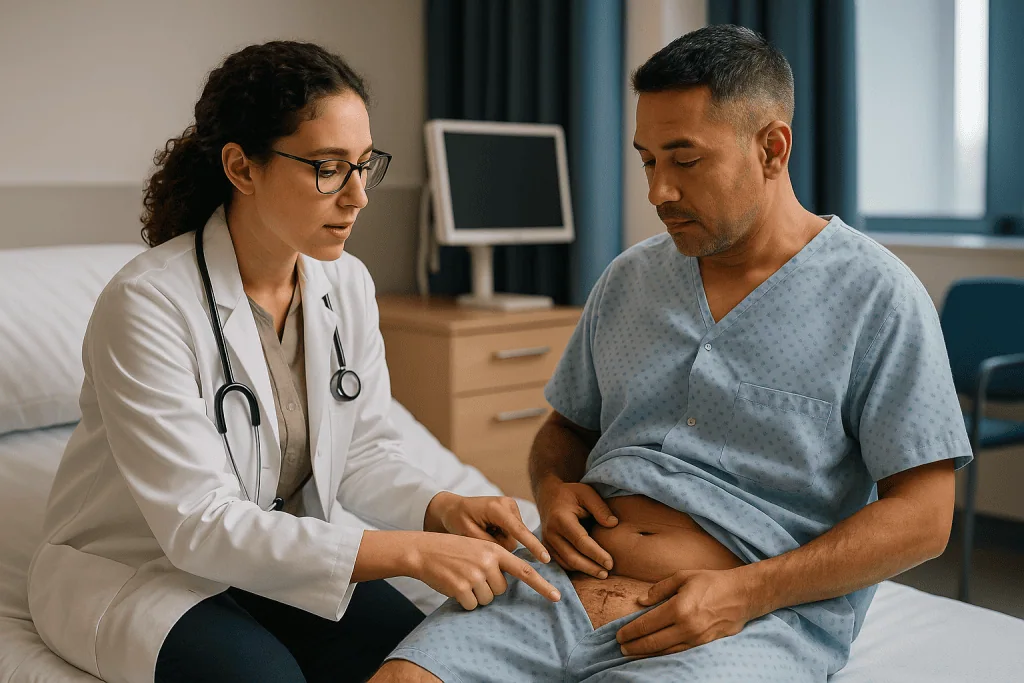
In a laparoscopic appendectomy, the surgeon makes several small incisions, usually three, inflates the abdomen with carbon dioxide gas to create working space, and operates through a camera and slender instruments. The appendix is sealed at its base, detached and withdrawn through one of the small ports. In an open appendectomy, a single larger incision is made directly over the appendix. Open surgery is more likely when the appendix has burst, when there is a collection of pus, or when scarring from previous operations makes keyhole access difficult.
Both approaches leave behind the same internal event: a stump where the appendix joined the bowel, a disturbed layer of fatty tissue, and a peritoneum (the thin lining of the abdominal cavity) that has been irritated. That irritation is why bowel function often pauses for a day or two, why the belly feels bloated, and why shoulder-tip pain is so common after laparoscopy. The carbon dioxide used to inflate the abdomen can irritate the diaphragm, and the brain reads that signal as coming from the shoulder.
MedlinePlus notes that after an uncomplicated laparoscopic procedure, many people go home within a day, while a ruptured appendix typically means a longer stay for antibiotics and observation. The surgical approach, the state of the appendix at the time of surgery and whether pus was found all set the baseline for what a normal recovery looks like. Knowing which situation applied to you is the single most useful piece of context when interpreting a fever or a sore wound later.
What are the signs of infection after an appendectomy?
Infections after appendectomy fall into two broad groups, and they behave differently.
The first is a surgical site infection at the skin: bacteria establishing themselves in the incision. The CDC describes the hallmark features as redness that spreads outward from the wound edges, increasing rather than decreasing pain at the site, warmth, swelling, and drainage that is cloudy, yellow or green rather than clear or faintly pink. A wound that was improving on day three and is suddenly angrier on day five is a textbook description. Skin infections usually declare themselves between the third and tenth day, when the initial surgical soreness should be fading.
The second group is deeper and more serious: an intra-abdominal abscess, which is a walled-off pocket of pus inside the belly, most often in the pelvis or near where the appendix used to sit. The NHS lists this as a recognized complication, more likely when the appendix had already burst before surgery. The signals are less visual and more systemic. People describe a fever that returns after it had settled, often spiking in the afternoon or evening, a deep pelvic or lower abdominal ache, loss of appetite, nausea, and sometimes diarrhea or an urge to pass stool frequently because the pocket is pressing on the rectum.
A third, less common possibility is a leak from the appendix stump, which can produce the same picture as an abscess but tends to appear earlier and feel worse, with a rigid, exquisitely tender abdomen.
The practical lesson is that infection is rarely a single symptom. It is a cluster, and above all a trajectory: things that were getting better start getting worse. One isolated reading or one slightly pink incision is far less informative than the direction of travel over 24 hours.
Fever after appendectomy: how to read the pattern, not just the number
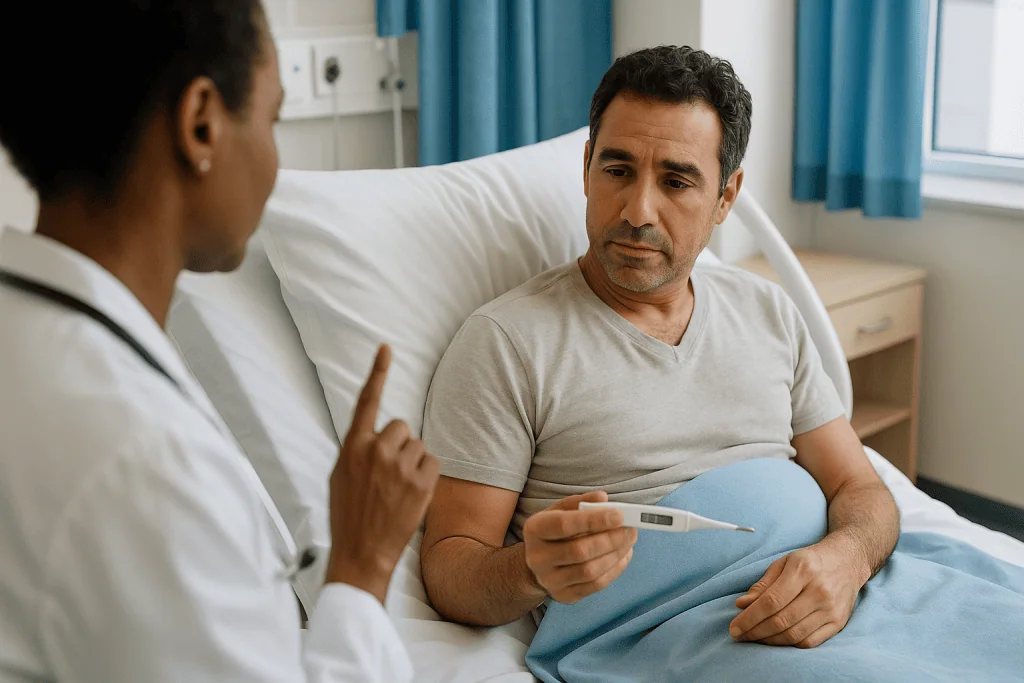
Clinicians almost never judge a post-operative temperature in isolation. They ask three questions: how high, how many days out, and what else is happening. The table below summarizes how those three variables typically combine, drawing on the discharge guidance published by MedlinePlus and Mayo Clinic.
| Timing | Temperature | Accompanying signs | Usual interpretation |
|---|---|---|---|
| Days 0–2 | Below 100.4°F (38°C) | Soreness, mild bloating, fatigue | Expected inflammatory response; monitor |
| Days 0–2 | 100.4°F to 101°F | Shallow breathing, no wound changes | Often lung-related; deep breathing and walking help; mention at follow-up |
| Any day | 101°F (38.3°C) or higher | Any | Call the surgical team the same day |
| Day 3 onward | New or returning fever | Wound redness, drainage, deep pain, diarrhea | Possible wound infection or abscess; needs assessment |
| Any day | Fever with rigid belly or vomiting | Rapid pulse, confusion, faintness | Emergency evaluation |
Two patterns deserve emphasis. The first is the early, modest fever that fades, which MedlinePlus and most discharge leaflets treat as part of ordinary healing. The second is the late or recurrent fever, which is the signature of a deep collection. A person who was afebrile on day two and feverish on day five is not experiencing a continuation of surgical inflammation; something new is happening.
Measure consistently. Oral readings taken after a hot drink, or armpit readings taken loosely, generate noise that makes the pattern harder to see. Taking a reading at the same time each morning and evening and writing it down turns a vague worry into a chart your surgeon can actually use.
Wound redness after appendectomy: healing blush or spreading infection?
Every incision goes through a stage that looks alarming to someone who has never watched a wound heal. In the first few days, the skin edges turn pink or faintly red for a few millimeters on either side. This is the inflammatory phase of healing: blood vessels widen to deliver immune cells and building materials, which makes the area warm, slightly swollen and tender to the touch. By about a week, that pink rim should be narrowing, not widening.
The features that separate a healing blush from an infected wound are direction and texture. Healthy redness stays confined to a thin band and gradually fades. Infected redness spreads outward, often with an irregular leading edge, and the skin may feel tight or firm underneath. Clear or lightly blood-tinged fluid in the first 48 hours is common. Thick, cloudy, yellow or green drainage, or an unpleasant odor, is not. A wound that pulls apart or gapes, especially if fluid wells up from below, needs a clinician’s eye promptly.
Laparoscopic ports add a specific wrinkle. The umbilical incision, the one hidden in the navel, is the most common site for minor infection because the skin fold is warm, moist and harder to keep clean. Cleveland Clinic’s guidance on appendicitis recovery emphasizes keeping incisions clean and dry and following the team’s specific instructions about showering and dressing changes, since those instructions vary with the type of closure used.
Skin glue and dissolvable stitches can cause a localized reaction that mimics early infection, with a small red bump around a stitch end. These are usually tender but not spreading and often resolve as the material dissolves. The honest answer is that a photograph taken each morning in the same light is worth more than any description. Comparing day three with day five tells you in seconds whether the border is retreating or advancing.
Bowel trouble after appendectomy: constipation, gas and the occasional loose stool
The gut dislikes being handled. After any operation inside the abdomen, the intestine tends to go quiet for a day or two, a state called post-operative ileus (a temporary slowing of bowel movement rather than a blockage). The anesthetic, the opioid medicines often used for early pain, reduced walking and reduced eating all deepen the pause. The result is the familiar trio of bloating, trapped gas and no bowel movement for two or three days.
Most of this resolves on its own as activity returns. Passing gas is the first reassuring milestone, and the care team usually wants to see it before advancing the diet. Walking, even slow laps of the kitchen, is the single most effective nonpharmacological nudge. Fluids and fiber help once eating resumes. If your team has suggested a stool softener or laxative class, the decision about whether and how to use it sits with them, since the right choice depends on what other medicines you are taking.
Constipation is uncomfortable; obstruction is dangerous, and the two can be confused. Obstruction, where the bowel is actually blocked, is uncommon early after appendectomy but produces a very different picture: cramping waves of pain, a visibly distended belly, vomiting, and no passage of gas at all. That cluster is a reason to call, not to wait.
Loose stools can appear for the opposite reason. Antibiotics disturb the normal gut bacteria and can cause mild diarrhea that settles when the course ends. Persistent or watery diarrhea, especially with fever or a deep pelvic ache, deserves a conversation, because a pelvic abscess sitting near the rectum can irritate the bowel and produce frequent small stools. The NHS notes that abscesses are more common after a burst appendix, so anyone whose surgery involved perforation should be particularly alert to this combination.
Who is more likely to run into trouble, and who is asked to wait for surgery
Not every appendectomy carries the same risk profile. The clearest dividing line is whether the appendix had already perforated. When it has burst, bacteria have spilled into the abdominal cavity, and the chance of a deep abscess and a longer antibiotic course rises accordingly. Mayo Clinic and the NHS both describe longer hospital stays and extended antibiotics in this situation. People in this group should expect a slower recovery and a lower threshold for calling about fever.
Other factors that raise the likelihood of wound or deep infection are well established across surgical guidelines: diabetes, obesity, smoking, long-term steroid or immune-suppressing medicines, poor nutrition and advanced age. None of these makes a complication inevitable; they shift the odds and justify closer follow-up.
There is also a group who are deliberately asked to wait. When someone arrives with an appendix that has formed an inflammatory mass or a contained abscess, operating immediately can be technically difficult and riskier. Surgeons may instead treat with antibiotics and, when needed, drain the abscess through the skin under imaging guidance. Once the inflammation settles, usually over several weeks, the team decides whether to remove the appendix later, a planned operation called an interval appendectomy. Whether every patient needs that delayed operation is debated in the surgical literature, which is why the decision is individualized and rests with the treating surgeon.
A smaller number of adults with uncomplicated appendicitis are now offered antibiotics alone as a first approach. The NHS acknowledges this option while noting that some people treated this way develop appendicitis again and later require surgery. Anyone on that pathway, rather than recovering from an operation, has a different set of warning signs, chiefly the return of the original right-sided pain and fever, and should discuss them specifically with their team.
Pelvic abscess and deep infection: the complication that hides
A skin infection announces itself. A deep abscess, by contrast, is quiet at first, and that is what makes it the complication surgeons think about most when a patient calls with a fever a week after going home.
The mechanism is straightforward. When an inflamed or ruptured appendix leaks, bacteria and inflammatory fluid pool in the lowest part of the abdominal cavity, which in a person lying down is the pelvis. The body walls this off with a fibrous capsule to contain it, and the result is a pocket of pus that the immune system cannot fully clear and antibiotics penetrate poorly. The NHS identifies abscess formation as a recognized complication of appendicitis, particularly after perforation.
Symptoms usually emerge between the fifth and fourteenth day. Classic descriptions include a fever that had settled and then returns, often in a swinging pattern that climbs in the evening; a dull, deep ache low in the belly or pelvis that is hard to point to with a finger; a general sense of being unwell with poor appetite; and sometimes frequent loose stools or an uncomfortable urge to pass stool, because the pocket presses on the rectum. Some people notice pain on passing urine for the same reason.
Diagnosis typically involves blood tests looking at white cell count and inflammatory markers, and imaging, most often an ultrasound or CT scan. Management depends on size and location. Small collections may respond to antibiotics alone; larger ones are usually drained, either through the skin with a needle or catheter placed under imaging guidance, or less commonly with a second operation. The choice of approach, the type of antibiotic and the duration are all decisions for the treating team based on the scan and cultures.
The point for patients is not to memorize the mechanics but to recognize the pattern: feeling better, then worse, with a returning fever, is not normal healing and is worth a same-day call.
How long does it take to recover from a laparoscopic appendectomy?
The honest answer has two parts: when you can function, and when you are fully healed. They are weeks apart.
Mayo Clinic advises limiting physical activity for roughly 3 to 5 days after laparoscopic appendectomy and 10 to 14 days after an open operation. The NHS describes most people returning to normal activities within a couple of weeks after keyhole surgery, with recovery from open surgery or from a complicated appendicitis taking longer. Those ranges describe typical experiences, not guarantees, and a ruptured appendix, an abscess or a wound infection can extend any of them.
A rough map of what people commonly report looks like this. In the first two or three days, the dominant sensations are incisional soreness, bloating and shoulder-tip discomfort from the laparoscopic gas, which usually fades within 48 to 72 hours. Most people are walking around the house, eating light meals and showering within the first few days, following the team’s wound-care instructions. By the end of the first week, many are off stronger pain medicines and managing with simpler options chosen by their prescriber, and sedentary work from home often feels feasible.
Weeks two and three bring a return to driving, once the person can brake hard without hesitation and is no longer taking medicines that impair reaction time, and to most desk-based jobs. Light exercise such as brisk walking is generally encouraged throughout. Heavier lifting, core workouts and contact sports are the last to return; many surgeons ask people to avoid lifting anything heavier than a few kilograms for several weeks to protect the healing fascia, the tough connective tissue layer beneath the skin, and to reduce the risk of a hernia at a port site.
The internal scar continues maturing for months. Occasional twinges when stretching or coughing at six or eight weeks are common and usually reflect that remodeling rather than a problem, provided they are mild and not accompanied by fever or swelling.
Sleeping after appendectomy: when can you lie on your side again?
Sleep is the recovery question people are often too embarrassed to ask and the one that affects quality of life most in the first week.
There is no medical rule that forbids side-sleeping after appendectomy. The limitation is comfort and protection of the incisions. Most people find lying on their back with the head and knees slightly raised the easiest position for the first few nights, because it keeps the abdominal wall relaxed and avoids pressure on the wounds. Rolling toward the left side is often tolerated sooner than the right, since the incisions and the surgical bed sit on the right, though with laparoscopy the ports are spread across the abdomen and individual experience varies.
A practical approach is to let pain be the guide. If turning onto a side is uncomfortable, wait another night or two; if it feels fine, there is no evidence that it harms healing. A pillow hugged against the abdomen when coughing, laughing or changing position splints the muscles and reduces the sharp pull on the incision. Getting out of bed by rolling to the side first and then pushing up with the arms, rather than sitting straight up, spares the abdominal wall.
Sleep disruption itself is normal for a week or so. Pain, the unfamiliar position, bloating and the lingering effects of anesthesia all fragment rest. Short naps are reasonable, but try to keep daytime walking going, both for bowel function and for the risk of blood clots, which rises with prolonged immobility after any operation.
Stomach sleeping is the one position almost everyone finds impossible early on, and most people naturally avoid it until the wounds no longer hurt when pressed, often two to three weeks. If a position causes a new, sharp or bulging sensation at an incision rather than ordinary soreness, mention it at follow-up, as a small hernia at a port site is one of the recognized longer-term complications of laparoscopic surgery.
Is pain 4 weeks after appendectomy normal?
By the fourth week, the vast majority of people are back at work, exercising lightly and rarely thinking about their incisions. So pain at this point raises a fair question, and the answer depends entirely on its character.
Mild, intermittent discomfort is common and usually benign. Scar tissue forming at the port sites and deep inside the abdomen can tug when you stretch, twist or cough. Nerve endings cut during surgery regrow unevenly and can produce brief electric or itchy sensations around the incisions for weeks or months. A dull ache after a long day on your feet or after resuming heavier activity often reflects muscle and fascia that are still regaining strength. None of these patterns suggests a problem if they are stable or slowly improving, and if there is no fever, no swelling and no change in bowel habit.
Pain that should prompt a review has a different shape. It is new or worsening rather than fading; it is constant rather than triggered by movement; it is deep and hard to localize rather than at the skin; or it comes with any of the systemic signs discussed earlier. A tender lump at an incision, particularly one that enlarges when standing or straining and flattens when lying down, may be an incisional hernia. Ongoing pain in the lower right abdomen with fever weeks after surgery can indicate a late abscess or, rarely, inflammation of a retained portion of the appendix, called stump appendicitis.
Persistent pain also has non-surgical explanations that are easy to overlook: constipation that never fully resolved, a urinary infection, or in women a gynecological cause that was present all along. The surgical team is best placed to sort through these, and a four-week follow-up visit is precisely the right place to raise lingering pain. Bringing a simple record of when it occurs, what triggers it and how it has changed over the past two weeks makes that conversation far more productive.
What people often get wrong about recovery after appendectomy
Myths cluster around any common operation, and several of them lead people either to panic unnecessarily or to ignore something real.
“Any fever means infection.” The early, low-grade temperature of the first two days is overwhelmingly a normal inflammatory response or minor lung atelectasis. It is the late, returning or high fever that signals infection, which is why the day count matters as much as the number.
“If the wound looks fine, I cannot have an infection.” Deep abscesses form inside the abdomen, well away from the skin. Pristine incisions and a pelvic abscess coexist regularly, particularly after a ruptured appendix.
“Antibiotics after surgery will stop anything from going wrong.” Antibiotics reduce the risk of infection and are often given around the time of the operation, as Mayo Clinic describes, but they do not eliminate it, and they cannot clear a walled-off collection of pus that needs draining. Finishing a prescribed course exactly as the prescriber directed is important, and so is reporting new symptoms even while taking it.
“Keyhole surgery means nothing was really done inside.” Small incisions on the skin conceal the same internal operation. The bowel was handled, the peritoneum was irritated and a stump was sealed. Bloating, ileus and fatigue are the body’s response to that, not a sign of a bad surgeon.
“Lying still protects the wound.” Early walking lowers the risk of pneumonia, blood clots and constipation and does not threaten properly closed incisions. The things to avoid are heavy lifting and straining, not movement.
“Losing the appendix damages the immune system or digestion.” The appendix may play a minor role in gut immunity and in harboring beneficial bacteria, but MedlinePlus and other mainstream sources are clear that people live entirely normally without it, with no change to diet or digestion required once recovery is complete.
Questions to ask your care team before you go home
The discharge conversation often happens quickly, sometimes while you are still groggy. Writing questions down beforehand, or asking a companion to take notes, means the answers are there at two in the morning when you need them. These are the questions that most often turn out to matter.
- Was my appendix intact, inflamed or ruptured, and was any pus found? This single fact determines how closely to watch for a deep abscess.
- What temperature threshold do you want me to call about, and does that change after the first 48 hours?
- Am I going home on antibiotics, for how long, and what should I do if I vomit a dose or develop diarrhea while taking them?
- How are my incisions closed: stitches, staples, glue or strips? When can I shower, and should the dressings be changed or left alone?
- What should the wounds look like at one week, and what changes would you want to see?
- What is normal for my bowels in the first few days, and at what point does constipation or diarrhea become something to report?
- What is the plan for pain relief, how long do you expect I will need it, and what are the signs that pain is no longer the ordinary kind?
- When can I drive, return to work, lift my children or groceries, and exercise?
- Is there a follow-up appointment, who do I call out of hours, and when should I go directly to an emergency department rather than wait for a call back?
- Were there any findings during surgery, such as an unusual appearance of the appendix sent for laboratory examination, that I should ask about at follow-up?
None of these questions has a universal answer. Thresholds for calling, wound-care instructions and activity timelines vary with the operation performed and the surgeon’s practice, and the team that operated on you is the right source for your specific plan.
When to call your doctor after appendectomy: red-flag signs
Most recoveries are uneventful, and most calls to a surgical unit end with reassurance. That is exactly why making the call is the right choice when any of the following appear; the team would far rather hear about a false alarm than see a real problem a week late.
Call the surgical team the same day if you notice a fever of 101°F (38.3°C) or higher, a threshold MedlinePlus uses in its discharge guidance; a temperature that returns or rises after it had settled, particularly from day three onward; redness around an incision that is spreading, with increasing warmth, swelling or pain; thick, cloudy, yellow, green or foul-smelling drainage, or a wound that has opened; pain that is getting worse rather than better, or a new deep ache in the pelvis or lower abdomen; no bowel movement after three days despite the measures your team suggested, or no passage of gas with a swollen belly; persistent or watery diarrhea, especially alongside fever; persistent nausea or inability to keep fluids down; or pain or burning on passing urine with fever.
Seek emergency care immediately, rather than waiting for a call back, if you develop severe abdominal pain with a rigid or board-like belly; repeated vomiting with a distended abdomen and no gas passing; a fast heartbeat, dizziness, fainting or confusion; shortness of breath or chest pain, which can signal a blood clot in the lung; a swollen, painful calf; or heavy bleeding from a wound that does not stop with firm pressure.
Trust the trajectory. The most reliable signal across every complication described in this article is a recovery that reverses direction: a person who was improving on day two and worse on day five. Whatever the specific symptom, that pattern earns a phone call. The decision about what to do next, whether that is reassurance, a wound check, blood tests or a scan, belongs to the clinicians who know your operation.
Frequently asked questions
What are the signs of infection after an appendectomy?
Spreading redness, warmth, swelling and cloudy or foul-smelling drainage at an incision point to a skin infection, usually between days three and ten. A fever that returns after settling, a deep pelvic or lower abdominal ache, loss of appetite and frequent loose stools suggest a deeper abscess inside the abdomen. The common thread is a recovery that was improving and then reverses, which should always be reported to the surgical team.
Is a low-grade fever normal the first night after appendectomy?
Yes, a temperature below about 100.4°F (38°C) in the first day or two is common and usually reflects the body’s inflammatory response to surgery or small areas of lung collapse from shallow breathing. Deep breaths, coughing and walking help. A reading of 101°F (38.3°C) or higher, or a fever that persists or returns after day two, is the pattern that warrants a call.
How long does it take to recover from a laparoscopic appendectomy?
Mayo Clinic advises limiting physical activity for roughly 3 to 5 days after laparoscopic appendectomy, and the NHS describes most people returning to normal activities within a couple of weeks. Heavy lifting and strenuous exercise usually wait longer to protect the healing abdominal wall. A ruptured appendix, abscess or wound infection extends these typical ranges, and your surgeon’s specific instructions take precedence.
What is the laparoscopic appendectomy recovery time compared with open surgery?
Open appendectomy generally takes longer because the single larger incision cuts through more muscle and fascia. Mayo Clinic suggests limiting activity for 10 to 14 days after open surgery versus 3 to 5 days after laparoscopy, and the NHS notes that recovery from open or complicated cases is slower. Internal healing continues for weeks in both, so occasional twinges beyond these windows are common.
When can I sleep on my side after an appendectomy?
There is no medical prohibition on side-sleeping; comfort is the only limit. Many people prefer their back with the head and knees raised for the first few nights, then roll onto a side as incision soreness eases, often within the first week. Hugging a pillow against the abdomen when turning reduces pulling on the wounds. Stomach sleeping usually feels impossible until the incisions no longer hurt when pressed.
Is it normal to have pain 4 weeks after appendectomy?
Mild, intermittent pain triggered by stretching, coughing or activity is common at four weeks as scar tissue matures and cut nerves regrow, and it is usually benign if it is stable or improving. Pain that is new, worsening, constant, deep and hard to localize, or paired with fever, swelling, a lump at an incision or bowel changes should be reviewed by the surgical team.
How many days without a bowel movement after appendectomy is too many?
A pause of two to three days is common after abdominal surgery because handling the bowel, anesthesia and opioid pain medicines all slow it down. Passing gas is the reassuring early sign. Many teams ask to hear from you if there is no bowel movement after three days despite their suggested measures, and sooner if the belly is distended, you are vomiting or no gas is passing.
Can I have an abscess even if my incisions look perfectly healthy?
Yes. An intra-abdominal abscess forms inside the belly, most often in the pelvis, far from the skin, so incisions can look flawless while a collection of pus is developing. The NHS lists abscess as a recognized complication, more likely after a burst appendix. Returning fever, a deep lower abdominal ache and frequent loose stools five to fourteen days after surgery are the typical clues.
Does diarrhea after appendectomy mean something is wrong?
Not necessarily. Antibiotics given around surgery often disturb gut bacteria and cause mild loose stools that settle when the course ends. Diarrhea becomes more significant when it is persistent or watery, when it appears alongside a returning fever, or when it comes with a deep pelvic ache, because an abscess pressing on the rectum can produce frequent small stools. That combination deserves a same-day call.
What is shoulder pain after laparoscopic appendectomy, and how long does it last?
The carbon dioxide gas used to inflate the abdomen during keyhole surgery can irritate the diaphragm, and the brain interprets that signal as pain at the shoulder tip, a phenomenon called referred pain. It is common and usually fades within 48 to 72 hours as the gas is absorbed. Walking and gentle movement help. Shoulder pain accompanied by shortness of breath or chest pain is a different matter and needs urgent assessment.
References
- Appendectomy: MedlinePlus Medical Encyclopedia
- Appendicitis: Complications (NHS)
- Appendicitis (Cleveland Clinic)
This article is for general information only and is not a substitute for professional medical advice. Please consult a qualified doctor about your individual situation.

More from the Blog

What Are the Warning Signs of a Bile Leak After Gallbladder Surgery? A Rare Risk Explained
A bile leak after gallbladder surgery is an uncommon complication in which bile escapes from the sealed duct stump or a bile duct into…

Fecal Incontinence After Childbirth: Why It Happens and How Pelvic Floor Specialists Help
Fecal incontinence after childbirth usually results from stretching or tearing of the anal sphincter muscles, or of the nerves that control them, during vaginal…

How Long Does Relief From Achalasia Balloon Dilation Usually Last? Realistic Expectations
Relief from pneumatic balloon dilation for achalasia typically lasts years rather than months, but it is rarely permanent. Large randomized follow-up found roughly four…

Is Gallbladder Surgery Different for Older Adults? How Age and Heart Conditions Shape the Plan
Gallbladder surgery is not fundamentally different for older adults, but the planning around it is. Surgeons weigh frailty, heart and lung conditions, medicines such…

Why Fecal Incontinence Happens: Muscle, Nerve and Stool Factors Specialists Look For
Fecal incontinence usually happens when one or more of three systems fails: the sphincter muscles that close the anus, the nerves that sense stool…

Laparoscopic Appendectomy Step by Step: Anesthesia, Three Small Incisions and Closing Up
A laparoscopic appendectomy removes the appendix through three small abdominal incisions under general anesthesia. The surgeon inflates the abdomen with carbon dioxide, inserts a…