

Follow-Up After Kidney Cancer Treatment: Why Imaging and Lab Tests Continue
Key Takeaways
- Follow-up has two jobs at once: finding recurrence before it causes symptoms and protecting the remaining kidney, and the same visit usually serves both.
- No routine blood test detects kidney cancer recurrence; imaging of the chest and abdomen does that work while labs track eGFR, hemoglobin and calcium.
- Surveillance is front-loaded because most recurrences appear in the first few years, then tapers, often continuing for 5 years or longer in higher-risk disease.
- The lungs are the most common site of spread, which is why the chest is imaged even after an operation on the kidney.
- A mass on a CT report is a description, not a diagnosis; whether it is solid, enhances with contrast and has grown matters more than the word itself.
- About two in three kidney cancers are diagnosed while confined to the kidney, according to the NCI SEER program, and stage remains the strongest guide to risk.
Follow-up after kidney cancer treatment continues because the disease can return in the kidney bed, the remaining kidney, the lungs, bones or elsewhere, usually without symptoms at first. Periodic CT, MRI or ultrasound scans look for early change, while blood tests track kidney function, blood counts and calcium. Most schedules are densest in the first few years, then taper, and are tailored to your stage and treatment by your care team.
The scar has faded to a pale line. The appetite is back, the stairs no longer leave you winded, and the word cancer has slipped out of daily conversation. Then a letter arrives with an appointment for another scan, and the quiet returns for a moment: wasn’t that supposed to be finished?
That question is the reason kidney cancer follow up scans exist. Surgery or ablation removes what can be seen. Follow-up watches for what cannot be seen yet, and for the everyday health of the kidney you have left. It is less a verdict repeated every few months than a habit of checking, the way a pilot walks around the plane before every flight regardless of how the last one went.
This guide explains what the scans and blood tests look for, why the schedule is heavier at the start and lighter later, what a mass or a stable finding on a report actually means, and which changes should prompt a call rather than a wait.
Why do kidney cancer follow up scans continue after treatment seems complete?
Kidney cancer is removed by surgery in most people whose disease is confined to the kidney, either by taking out the whole organ (a radical nephrectomy) or by cutting out the tumor and leaving the rest (a partial nephrectomy). Pathologists then examine the tissue and report a stage, which describes how large the tumor was and whether it had grown beyond the kidney, and a grade, which describes how abnormal the cells looked. Those two findings set the tone for everything that follows.
The trouble is that a scan sees lumps, not cells. A few cancer cells that escaped before surgery can sit in the lung, bone or liver for months or years below the threshold any imaging can detect. Renal cell carcinoma, the most common type of kidney cancer, is known for this quiet behavior; the NCI notes that it can spread to the lungs, bones, liver and brain, and recurrences occasionally surface long after the original operation.
There is a second reason. The remaining kidney is now doing the work of two, and people who have had a nephrectomy carry a higher chance of reduced kidney function over time. Blood pressure, diabetes and certain pain relievers all press on that single organ. Follow-up therefore has two jobs running side by side: watching for cancer and protecting kidney health.
Early detection matters because a small, isolated recurrence may be treated with surgery, ablation or focused radiation, while widespread disease is usually managed with drugs. The scan does not change what is there. It changes how early your team knows about it, and how many options remain open when they do.
What actually happens at a kidney cancer follow-up visit
A follow-up appointment is usually less dramatic than the anxiety leading up to it. It typically starts with a conversation: new pain, weight change, cough, blood in the urine, tiredness out of proportion to your days. Your clinician will check blood pressure, because hypertension both damages the remaining kidney and can be a side effect of some cancer medicines, and will examine the surgical site and abdomen.

Blood is often drawn the same day or shortly before, so the numbers are ready to discuss. If imaging is due, the scan is usually done before the visit so a radiologist, a doctor trained to read images, can write a formal report. That report compares the new pictures with the previous ones, which is why keeping scans in one place or bringing copies matters: a radiologist looking at a 6-millimeter lung nodule needs to know whether it was 6 millimeters last time as well.
The words on the report are then translated. No evidence of recurrence means nothing suspicious was seen at the resolution of the scan. Stable means something was noted before and has not changed. Indeterminate means the finding cannot be classified yet and usually leads to a repeat scan rather than a biopsy.
Many people find the wait between scan and appointment the hardest part of the cycle. Asking in advance how and when results will reach you, and whether a phone call is possible if the report is clear, can take some of the weight off. The visit ends with a plan: the next date, the next tests and what to do if something changes in between.
Which imaging tests are used: CT scan after nephrectomy, MRI and ultrasound
Three imaging tools do most of the work, and each has a different strength.
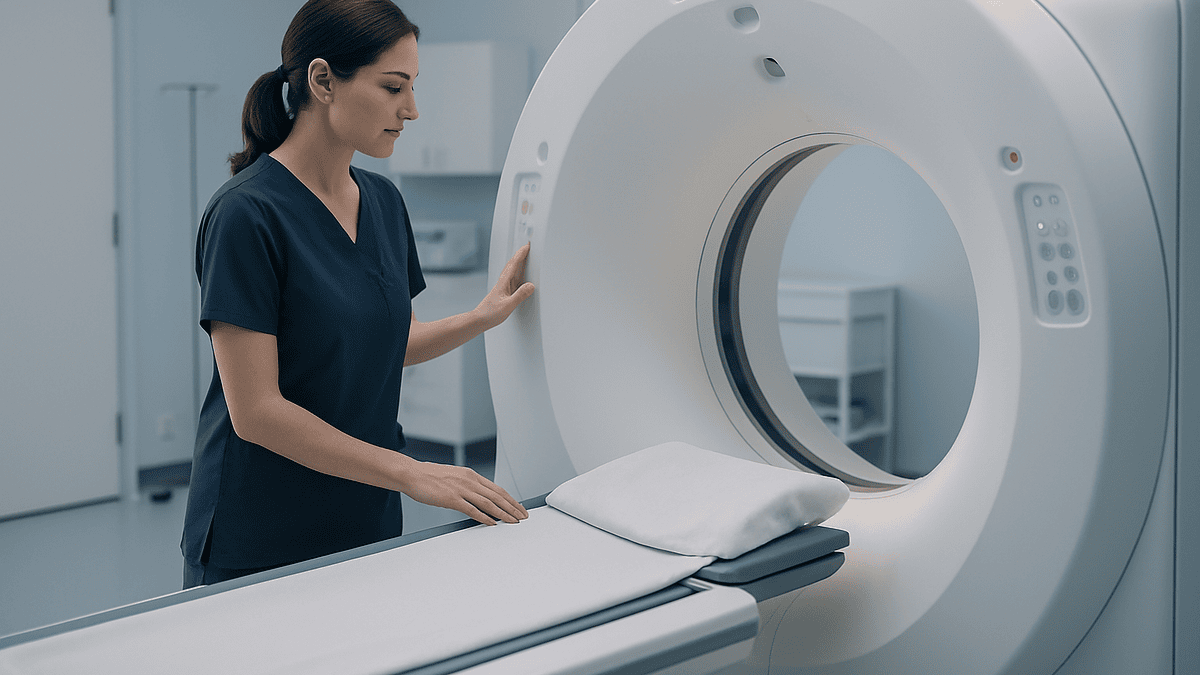
Computed tomography, or CT, is a rotating X-ray that builds cross-sectional pictures of the body. A CT scan after nephrectomy is the workhorse of kidney cancer follow-up because it shows the kidney bed, the other kidney, the liver, lymph nodes and the lungs in a single pass. Contrast dye injected into a vein makes blood vessels and tumors stand out, which is why your team checks kidney function first: contrast is cleared by the kidneys and is used cautiously when function is reduced.
Magnetic resonance imaging, or MRI, uses magnets and radio waves rather than radiation. It is often chosen when CT contrast is a concern, when a cyst needs closer characterization, or when radiation exposure is being minimized in a younger person facing many years of scans. Ultrasound uses sound waves, involves no radiation and no contrast, and can follow a known simple cyst or a small mass under surveillance, though it does not show the lungs.
A plain chest X-ray still appears in some lower-risk schedules because the lungs are the most common site of spread and a chest film is quick and low in radiation. Bone scans and PET scans are not routine; they are reserved for specific symptoms or unclear findings.
Radiation is a fair thing to ask about. Harvard Health reports that a single abdominal CT delivers roughly the equivalent of a few years of natural background radiation. That is one reason guideline schedules taper over time and lower-risk patients are often moved to MRI, ultrasound or longer intervals. The aim is enough imaging to catch a treatable recurrence, and no more.
What the blood tests check, and why your remaining kidney gets its own report card
Imaging looks for cancer; blood tests mostly look after you. The most watched value is serum creatinine, a waste product filtered by the kidneys, which is converted into an estimated glomerular filtration rate, or eGFR, a number that approximates how much blood the kidneys clean each minute. After a radical nephrectomy the eGFR falls, then usually partially recovers as the remaining kidney adapts. Your team is less interested in a single reading than in the trend.

A urine test for protein sits alongside it. Protein leaking into urine is an early sign that a solitary kidney is under strain, and it is also a known effect of some targeted cancer drugs. Blood pressure readings complete this kidney-health trio.
Several other values do double duty. A complete blood count checks hemoglobin, the oxygen-carrying protein in red cells; anemia can follow surgery, but a new or worsening drop can also accompany recurrence. Calcium is checked because kidney cancer can raise blood calcium through hormone-like substances the tumor makes, a paraneoplastic effect, meaning a problem caused by the cancer at a distance rather than by its physical presence. Liver enzymes, alkaline phosphatase and lactate dehydrogenase can rise with spread to the liver or bone, although all of these change for ordinary reasons too.
What labs cannot do is replace the scan. No reliable blood test finds kidney cancer recurrence early, and no tumor marker is in routine use for this disease, which is why imaging remains central even when every blood value is normal. A normal panel is reassuring about your general health. It is not, by itself, an all-clear.
Who is followed closely, and who is usually asked to wait and watch
Follow-up intensity is matched to the chance of recurrence, and that chance is read mainly from the pathology report.
People with small tumors confined to the kidney, low grade and clean surgical margins sit in a lower-risk group. Their schedules lean on fewer scans and longer gaps, with the remaining kidney’s health taking a larger share of attention. People whose tumors were large, high grade, had invaded fat, veins or lymph nodes, or showed aggressive subtypes such as sarcomatoid features are followed more closely in the first years, when recurrence is most likely. They are also the group in whom adjuvant treatment, meaning medicine given after surgery to lower the chance of return, is discussed.
Then there are people who have not had treatment at all. Small solid kidney masses, generally those within the lowest size stage in the NCI system, which is about 4 centimeters or less, may be placed on active surveillance: a deliberate plan of repeat imaging rather than immediate surgery. This is commonly offered when the mass is small, when age or other illnesses make surgery riskier than the tumor, or when a person prefers to watch. The NCI describes active surveillance as an option for small renal masses because many grow slowly and some turn out not to be cancer. Growth beyond an agreed size or pace, new symptoms or a change in the person’s health can prompt a shift toward treatment.
People treated with ablation, where heat or cold destroys the tumor through a needle, are usually scanned more often in the first year because the treated area is harder to interpret and repeat treatment is sometimes needed. In every group, the plan is a starting point that the treating team adjusts as results arrive.
How often are kidney cancer follow up scans done, and for how long?
There is no single international schedule, and honest guidelines admit that the evidence for one interval over another is modest. What the major frameworks share is a shape: more frequent imaging in the first 2–3 years, when most recurrences appear, then a tapering to yearly or less, often continuing for at least 5 years and sometimes longer for higher-risk disease. The NHS describes check-ups every few months at first, becoming less frequent over time, and the NCI ties the intensity to stage and grade.
| Situation | Typical pattern in years 1–3 | Typical later pattern | Notes |
|---|---|---|---|
| Lower risk after surgery | Abdominal imaging with chest imaging roughly once a year | Yearly or spaced out; kidney checks continue | MRI or ultrasound may replace CT |
| Intermediate or higher risk after surgery | Chest and abdominal CT roughly every 3–6 months | Every 6–12 months, often to 5 years or beyond | Adjuvant therapy may be discussed |
| Active surveillance of a small mass | Imaging within the first 3–6 months, then every 6–12 months | Yearly if stable | Growth pace guides decisions |
| After ablation | Early scan to confirm treatment, then every few months | Yearly | Treated area can look unusual |
| On medicine for advanced disease | Scans roughly every 2–4 months to judge response | Set by response and side effects | Labs more frequent than scans |
Intervals are typical ranges from guideline frameworks summarized by the NCI and NHS; your own plan is set by your team.
Two things the table does not show. Schedules are edited: a worrying lung nodule brings the next scan forward, while a run of clear results and a healthy remaining kidney can stretch the gaps. And many people stay in some form of follow-up for life, not because cancer risk stays high but because a single kidney deserves a yearly look at its numbers. Ask which of these two purposes each test is serving; it changes how you hear the results.
What the first weeks and months after surgery usually look like
The calendar after surgery has a rhythm that most people recognize once it is spelled out.
In the first 2 weeks the focus is the wound and the body’s recovery: pain that steadily eases, walking a little more each day, watching for fever or redness. Blood tests during the hospital stay and shortly after show how the remaining kidney is coping; a rise in creatinine is expected early and usually settles.
Somewhere in the following weeks comes the pathology conversation. This is the visit where stage and grade are explained, where the risk group is set and where the shape of your surveillance is first sketched out. If adjuvant therapy is relevant, referral to a medical oncologist, a doctor who treats cancer with medicines, generally happens here.
The first follow-up scan usually falls within the first several months. Its purpose is partly to catch anything early and partly to establish a baseline: the new anatomy of your abdomen, the appearance of the surgical bed and any small, benign-looking nodules that will need to be recognized as old acquaintances on later scans. Baselines matter because a lung nodule seen for the first time on scan three, with nothing to compare against, causes far more worry than one quietly unchanged since scan one.
By the end of the first year most people have settled into their interval, know which tests to expect and have learned how their own body reacts to the fortnight before a scan. Mayo Clinic notes that recovery from kidney surgery varies and that returning to usual activity takes some weeks. The practical advice from people who have done this is simple: put the dates in the calendar, then live around them, not for them.
What does a mass on a kidney CT scan indicate?
Mass is a radiologist’s neutral word for a lump that takes up space. It is not a diagnosis, and on a kidney it covers a wide range, from a harmless fluid-filled cyst to a cancer. Whether the finding is new in someone under surveillance or a first-ever result, the report usually answers three questions that decide what happens next.
Is it fluid or solid? Simple cysts, thin-walled sacs of fluid, are common, especially with age, and are almost always benign. Radiologists grade cysts on the Bosniak scale, a system from I to IV that ranks how complex a cyst looks and therefore how likely it is to harbor cancer. Low categories are usually left alone; higher categories are followed or treated.
Does it enhance? Enhancement means the mass brightens after contrast dye, a sign that it has its own blood supply. Solid, enhancing masses are treated as potentially cancerous until proven otherwise, because most of them are. Yet a meaningful minority of small solid masses are benign growths such as oncocytomas or angiomyolipomas, and CT cannot always tell the difference. A suspicious mass is a starting point, not a sentence.
How big is it, and has it changed? Size and growth pace matter more than almost anything else in small masses, which is why comparison with older imaging is essential.
Biopsy of a kidney mass is used selectively, since imaging often guides the decision on its own. A finding in the remaining kidney after treatment raises the specific question of a new tumor versus spread, and your team may add MRI or a dedicated kidney CT protocol before deciding. Mayo Clinic and the NCI both frame small renal masses as a spectrum, with surgery, ablation and surveillance all legitimate paths depending on the details.
What are the chances of kidney cancer spreading, and where does it usually go?
The question usually arrives at 2 a.m., and the honest answer has two parts: it depends heavily on stage, and most kidney cancers are found before spread.
The NCI’s SEER cancer registry program reports that about two in three kidney cancers are diagnosed while still confined to the kidney, with a smaller share having reached nearby nodes or tissues and a smaller share still having spread to distant sites at diagnosis. Those groups behave very differently afterward, which is exactly why follow-up is stratified rather than uniform.
Where does kidney cancer go when it does spread? The lungs first and most often, then bones, liver, distant lymph nodes, the adrenal gland and the brain, according to the NCI. Renal cell carcinoma is also unusual in that it can reappear in unexpected places, including the pancreas and thyroid, sometimes many years later. Follow-up scans of the chest and abdomen cover the most likely territory; bone or brain imaging is added if symptoms point there.
The factors that push the risk up are the ones on the pathology report: larger tumor size, higher grade, invasion into fat or into the veins that drain the kidney, cancer in lymph nodes, and certain subtypes. Tumors small enough to fall in the lowest stage carry a low chance of recurrence; the risk climbs with each of those features.
What follow-up does not do is change whether cells escaped before surgery. That was decided before the operation. What it changes is timing. A single lung nodule found at 1 centimeter on a routine scan sits in a different treatment landscape than several found because of a cough, and this early-detection logic, rather than any promise about outcomes, is the evidence-based reason the scans continue.
Follow-up when you are taking medicine: immunotherapy and targeted therapy checks
Some people leave surgery with a prescription as well as a schedule. Two drug classes dominate kidney cancer treatment, and each brings its own monitoring.
Immune checkpoint inhibitors are antibodies that release a brake on the immune system so it can attack cancer cells. They may be offered after surgery for higher-risk disease, or in combination for advanced disease. Because the released immune system can also turn on healthy tissue, follow-up blood tests check the thyroid, liver, adrenal glands, blood sugar and kidney function, and clinicians ask specifically about new diarrhea, rash, breathlessness, joint pain and profound fatigue. These effects can appear months into treatment or even after it stops, so lab checks generally continue for a period after the last dose.
Tyrosine kinase inhibitors are tablets that block signals tumors use to grow blood vessels. Their footprint is different: raised blood pressure, protein in the urine, thyroid changes, hand-foot skin reactions, mouth soreness, diarrhea and liver enzyme changes. Blood pressure is checked more often at the start, and urine protein joins the routine panel.
Scans on treatment serve a different purpose from surveillance scans. They ask whether the disease is responding, stable or growing, usually on an interval of a few months set by the oncologist. Reports use size-based criteria, and a tumor that shrinks a little, stays the same or even grows slightly while the person feels well may all be reasons to continue; that interpretation belongs to the prescribing clinician.
Two cautions. Never adjust or pause a cancer medicine because a lab value or scan worries you; contact the team, since some side effects are managed by a planned interruption and others in other ways. And mention every supplement and over-the-counter product you take, because several interact with these drugs.
Can you live a long life after kidney cancer? What the evidence honestly shows
Many people do, and this is the place to be precise about what that sentence rests on.
Kidney cancer found while confined to the kidney is among the more treatable solid cancers, and the NCI notes that the outlook depends chiefly on stage, grade and general health. Population statistics by stage are published by cancer registries, and your team can walk you through the ones that fit your report. They are averages from people diagnosed years ago, before some current treatments existed, and they describe groups, not individuals. Used well, they orient; used badly, they frighten or falsely reassure.
Three evidence-based observations are more useful than any single number. First, most recurrences declare themselves within the first few years, which is why surveillance is front-loaded, and clear scans over that period are genuinely meaningful even though late recurrence can occur. Second, the biggest threats to a long life after low-stage kidney cancer are often the ordinary ones: heart disease, stroke, diabetes and chronic kidney disease, all of which press harder on a single kidney. Blood pressure control, not smoking, a healthy weight and avoiding routine use of nonsteroidal anti-inflammatory painkillers, which stress the kidneys, are unglamorous but well supported. Third, advanced disease is now a managed, often long-running condition for many people rather than a short one, with several drug classes and sequences available, though responses vary and no clinician can promise how any individual will do.
Follow-up serves all three points. It catches recurrence early, it monitors the kidney and cardiovascular risks that accumulate over decades, and it keeps a treatment relationship alive so that a change is acted on quickly. The most honest answer to the question is that many people do live long lives, that stage is the best available guide, and that the check-ups are part of how.
What people often get wrong about kidney cancer follow-up
A clear scan means I am done. A clear scan means nothing was visible at that resolution on that day. It is good news, and it is also why the next scan is scheduled. Follow-up is a sequence, and the value lies in comparison.
If the blood tests are normal, I do not need the scan. No routine blood test reliably detects kidney cancer recurrence. Labs protect the remaining kidney and flag general problems; imaging finds recurrence.
Every nodule on the report is cancer. Small lung nodules, adrenal nodules and liver spots are common in adults who have never had cancer. Most are scars, benign growths or cysts. Radiologists flag them precisely so they can be compared next time, and stable over several scans is the usual ending.
More scans are always safer. Each CT adds a small radiation dose and a chance of an incidental finding that leads to further tests with their own risks. Guideline schedules taper for a reason.
A partial nephrectomy means my kidneys are fine. Preserving tissue helps, but any kidney surgery, plus age, blood pressure and diabetes, can lower filtration over years. The eGFR trend still matters.
Recurrence would cause symptoms first. Early recurrence in the lung or kidney bed is usually silent, which is the whole argument for imaging people who feel well.
If it comes back, there is nothing to do. Isolated recurrences are sometimes treated with surgery, ablation or focused radiation, and widespread disease has several drug classes; the options depend on where and how much, which is why finding it early is worth the effort.
Surveillance of a small mass is doing nothing. Active surveillance is a decision with a plan and exit criteria, chosen because many small masses grow slowly and some are benign.
Questions to ask your care team
Written questions survive the appointment better than remembered ones. These are the ones that tend to change how people experience follow-up.
- What stage and grade was my tumor, and which risk group does that put me in?
- Which tests are checking for cancer, and which are checking my kidney health?
- How often will I have imaging, for how long, and what would make you change that plan?
- Will scans be CT, MRI or ultrasound, and why that choice for me?
- How and when will I receive results, and can I get a call if the scan is clear?
- What is my eGFR now, what was it before surgery, and what do you want it to do?
- Which medicines and supplements should I avoid or use cautiously with one kidney?
- Am I a candidate for adjuvant treatment, and what would it involve?
- If a scan shows something uncertain, what usually happens next?
- Which symptoms should prompt a call before the next appointment, and who do I call?
- Who coordinates my care if I see a urologist, an oncologist and a kidney specialist?
A few of these deserve context. The eGFR question matters because Mayo Clinic and others treat protection of the remaining kidney as part of survivorship care, not an afterthought. The results question matters because uncertainty in the gap between scan and visit is a widely shared source of distress. And the coordination question matters more as time passes: a person with one kidney, a cancer history and rising blood pressure benefits from someone owning the whole picture.
Bring a companion if you can, or ask whether you may record the conversation. Request a copy of the pathology report and each imaging report; these are yours, and having them makes every future conversation, including any second opinion, easier and more accurate.
When to call your doctor: kidney cancer recurrence symptoms and other red flags
Follow-up appointments are scheduled for a world where nothing changes between them. Bodies are less tidy. The rule is simple: a new, persistent or worsening symptom does not wait for the next scan.
Contact your care team promptly for blood in the urine; new or persistent pain in the flank, back or bones, especially pain that wakes you at night; a cough or breathlessness that lingers beyond a couple of weeks or brings up blood; unexplained weight loss or loss of appetite; night sweats or fevers without an obvious cause; a lump you can feel in the abdomen or elsewhere; swelling of one leg; new headaches, confusion, weakness on one side or changes in vision; or nausea, excessive thirst and constipation together, which can point to high calcium. These are the kidney cancer recurrence symptoms clinicians ask about, and they overlap with what people mean when they search for stage 4 symptoms. Most of the time they have ordinary explanations. They are still reasons to be checked rather than reasons to worry alone.
Seek urgent same-day care for chest pain, sudden severe breathlessness, coughing up more than streaks of blood, a swollen painful calf, a sudden severe headache, a seizure, sudden weakness or trouble speaking, or a fever with shaking chills, particularly if you are taking immunotherapy or targeted drugs.
If you are on cancer medicines, also report new diarrhea, a spreading rash, yellowing of the skin or eyes, severe fatigue or any symptom your treatment team told you to watch for, without changing or stopping the medicine yourself.
The team decides what needs a scan, a blood test or simply reassurance. Your job is to make the call.
Frequently asked questions
How often are follow-up scans done after kidney cancer surgery?
Typically every few months in the first 2–3 years for higher-risk disease and about yearly for lower-risk disease, tapering afterward and often continuing to 5 years or longer. The NHS describes check-ups every few months at first, becoming less frequent. Your team sets the exact interval using stage, grade, kidney function and how you are doing.
Can you live a long life after kidney cancer?
Many people do, particularly when the cancer was confined to the kidney at diagnosis. The NCI notes that outlook depends mainly on stage, grade and general health. Registry statistics describe groups rather than individuals, so ask your team to put them in context, and remember that protecting your remaining kidney and heart health matters for the decades ahead.
What are the chances of kidney cancer spreading?
It depends on stage. The NCI SEER program reports that about two in three kidney cancers are diagnosed while still confined to the kidney, where recurrence risk is low. Larger tumors, higher grade, invasion of fat or veins and involved lymph nodes raise the chance of later spread, which is why those cases are scanned more often.
What are the symptoms of stage 4 kidney cancer?
Advanced kidney cancer can cause persistent cough or breathlessness, bone pain, unexplained weight loss, fatigue, fevers, blood in the urine, a lump in the abdomen or symptoms of high calcium such as thirst, nausea and confusion. Many of these have ordinary causes, but any that are new or persistent after treatment should be reported to your care team promptly.
What does a mass on a kidney CT scan mean?
A mass is simply a lump that takes up space, not a diagnosis. Radiologists ask whether it is fluid or solid, whether it brightens with contrast dye, and whether it has grown compared with older scans. Simple cysts are almost always benign, solid enhancing masses are treated as potentially cancerous, and some small solid masses turn out to be benign growths.
Is a CT scan after nephrectomy always done with contrast?
Not always. Contrast dye helps tumors and blood vessels stand out, but it is cleared by the kidneys and used cautiously when kidney function is reduced. Your team checks your eGFR beforehand and may switch to MRI, ultrasound or a non-contrast protocol if contrast is a concern. The choice is made case by case.
What is a typical kidney cancer surveillance schedule for a small mass that has not been treated?
Active surveillance usually involves imaging within the first several months to establish a baseline and then repeat scans roughly every 6–12 months while the mass remains stable, according to frameworks summarized by the NCI. Growth beyond an agreed size or pace, new symptoms or a change in general health can prompt a move toward treatment.
What are the early kidney cancer recurrence symptoms to watch for?
Early recurrence is usually silent, which is the main reason scans continue in people who feel well. When symptoms do appear they include a lingering cough or breathlessness, new bone or flank pain, blood in the urine, unexplained weight loss, fevers or night sweats. Report any of these to your team rather than waiting for the next scheduled scan.
Are repeated follow-up CT scans safe given the radiation?
The dose from each scan is small but not zero; Harvard Health estimates an abdominal CT is equivalent to roughly a few years of natural background radiation. That is why schedules taper, why MRI or ultrasound is sometimes substituted, and why lower-risk patients are scanned less often. For most people the benefit of finding a treatable recurrence early outweighs this risk.
Why do I still need scans if my blood tests are normal?
Because no routine blood test can detect kidney cancer recurrence reliably, and no tumor marker is in standard use for this disease. Blood tests mainly monitor your remaining kidney, blood counts and calcium. Imaging is the only tool that can find a small recurrence in the lung, kidney bed or elsewhere before it causes symptoms.
References
This article is for general information only and is not a substitute for professional medical advice. Please consult a qualified doctor about your individual situation.

More from the Blog

Limb-Sparing Surgery for Sarcoma: How the Tumor Is Removed and Function Is Preserved
Limb-sparing surgery for sarcoma removes a bone or soft-tissue tumor together with a rim of healthy tissue around it, then rebuilds what was taken…
Swallowing Trouble During Esophageal Cancer Treatment: What to Report and When
Swallowing problems during esophageal cancer treatment are common and usually come from the tumor narrowing the esophagus, from radiation-related soreness and swelling, or from…

Immunotherapy Infusion Day: Blood Work, the Infusion and the Monitoring Afterward
On an immunotherapy infusion day, most people have blood drawn first, then wait while the team reviews results and the pharmacy prepares the drug.…

How Targeted Therapy Is Given: Daily Tablets, Infusions and the Routine Between Visits
Targeted therapy is given in one of several ways, depending on the medicine: as daily tablets or capsules taken at home, as infusions through…

Does External Radiation Therapy Make You Radioactive? Myths About Hugging and Contact
External beam radiation therapy does not make you radioactive. The machine delivers a beam only while it is switched on, and nothing radioactive is…

Radioactive Iodine After Thyroid Cancer Surgery: How the Treatment Day Unfolds
Radioactive iodine treatment after thyroid cancer surgery usually means swallowing a single capsule or liquid in a nuclear medicine unit, after one to two…