

Hand Arthritis: Osteoarthritis vs Rheumatoid, and What Protects Grip

Key Takeaways
- A hard lump at the last joint of a finger almost always means osteoarthritis, because rheumatoid arthritis rarely attacks the fingertip joints.
- Morning stiffness is a clock: under 30 minutes points toward osteoarthritis, an hour or more toward rheumatoid arthritis.
- A 1 kilogram pinch at the thumb tip loads the thumb base joint with roughly 12 kilograms, which is why thick handles and palm-twisting caps protect it.
- Starting disease-modifying treatment within about three months of rheumatoid symptoms measurably reduces bone erosions compared with later treatment.
- Hand exercise programs of 10 to 15 minutes, two or three times a week for 8 to 12 weeks, improve pain and grip in randomized trials without accelerating joint damage.
- Methotrexate for hand osteoarthritis rests on one 2023 trial of 97 people with inflamed joints; it is not approved for that use and no guideline recommends it.
Hand arthritis is joint damage or inflammation in the fingers, thumb or wrist. Osteoarthritis wears down cartilage, usually at the fingertip joints and thumb base, with brief morning stiffness and bony knobs. Rheumatoid arthritis is an autoimmune disease that inflames the knuckles and wrists on both sides, with stiffness lasting an hour or more. Exercise, splints and early, clinician-guided treatment protect grip best.
A reader wrote to us last month about her mother, who can still thread a needle but can no longer twist the cap off a water bottle. She wanted to know whether the new medicine she had seen in a headline was the answer. That headline is why hand arthritis is suddenly everywhere in search: as of February 2026, two research threads have collided with a viral wellness idea. Trials have begun borrowing rheumatoid arthritis drugs, methotrexate and denosumab among them, to test them in hand osteoarthritis, and social media has decided that grip strength is a window into how long you will live.
Both threads contain real science. Both have been stretched well past what the data support. The practical questions underneath them have not changed: is the stiffness in your fingers wear and tear or an immune attack, and what can you do this week to keep your hands useful for decades?
Here is what the evidence actually shows, graded by how strong it is, and what a hand that still opens jars at 85 usually has in common.
What is hand arthritis, and how common is it?
Arthritis is an umbrella word for more than 100 conditions that damage or inflame joints; it is a description, not a single disease. The hand gives arthritis plenty to work with: 27 bones and roughly 29 joints, each lined with cartilage, the smooth, rubbery tissue that lets bone glide on bone, and wrapped in a synovium, the thin membrane that produces lubricating fluid.
Two conditions account for most hand arthritis. Osteoarthritis (OA) is a failure of cartilage repair: the cushion thins, the underlying bone thickens and sprouts spurs, and the joint stiffens. Rheumatoid arthritis (RA) is an autoimmune disease, meaning the immune system mistakenly attacks the body; in RA the target is the synovium, which swells, floods the joint with inflammatory cells and, if unchecked, eats into bone.
The numbers are large. According to the CDC, about one in four US adults, more than 50 million people, report doctor-diagnosed arthritis of some form. Hand OA is the most common site after the knee: X-ray changes appear in the majority of people over 70, although only a fraction of those joints hurt. RA is rarer, affecting roughly 0.5 to 1 percent of adults worldwide, with women outnumbering men about two to three to one; the hands and wrists are involved in the great majority of cases, often from the first months.
Other conditions also settle in the hands and are worth naming once, because they are treated differently: gout, where uric acid crystals trigger sudden, hot, red attacks; psoriatic arthritis, which can swell an entire finger like a sausage; and carpal tunnel syndrome, which is a pinched nerve, not arthritis, despite the overlapping numbness and clumsiness.
What changed recently
Three developments explain the current surge of interest, and each deserves a date and a dose of caution.
In October 2023, the Lancet published the Australian METHODS trial, a randomized, placebo-controlled study of 97 adults with painful hand OA and ultrasound-confirmed synovitis (inflammation of the joint lining). Participants taking methotrexate, the anchor drug of RA care, reported a modest but statistically significant reduction in pain at six months compared with placebo. It was a single, small trial, it has not yet been replicated at scale, and it enrolled only people whose OA had an inflammatory component.
In 2024, a phase 2 trial from Belgium reported that denosumab, a bone-protecting injection licensed for osteoporosis, slowed the development of new erosions in erosive hand OA, an aggressive subtype in which the central part of the joint collapses. Phase 2 means the study tested whether a signal exists, not whether the drug should be prescribed for this purpose.
Neither drug is approved for osteoarthritis anywhere. Both remain investigational or off-label for that use, which means any decision about them belongs to a treating rheumatologist weighing an individual patient, not to a headline. Guidance from the NHS and from the NIH’s NIAMS institute, both updated within the past two years, still lists the same mainstays for hand OA: exercise, joint protection, splints, heat, topical and oral anti-inflammatories and, for selected joints, injections or surgery.
The third development is softer. A 2015 observational study of nearly 140,000 adults in 17 countries found that weaker grip predicted earlier death. That finding has resurfaced in short videos as proof that squeezing a ball will extend your life. It is a marker, not a lever; we return to that distinction later.
Osteoarthritis vs rheumatoid arthritis in the hands: how to tell them apart
Clinicians often make a confident first guess within a minute of looking at a pair of hands, because the two diseases choose different joints and behave on different clocks. The table below collects the distinctions that matter most. None is absolute, and the two conditions can coexist in one person, which is one reason imaging and blood tests still earn their place.
| Feature | Osteoarthritis | Rheumatoid arthritis |
|---|---|---|
| Underlying problem | Cartilage breakdown and bone remodeling | Autoimmune inflammation of the synovium |
| Favorite joints | Fingertip joints (DIP), middle finger joints (PIP), thumb base | Knuckles (MCP), PIP joints, wrists; fingertip joints usually spared |
| Pattern | Often one hand or scattered joints; the dominant hand may be worse | Typically symmetrical, both hands at once |
| Morning stiffness | Usually under 30 minutes, eases with movement | Often an hour or longer, worse after rest |
| What the swelling feels like | Hard, bony knobs (Heberden and Bouchard nodes) | Soft, warm, boggy swelling over the knuckles |
| Whole-body symptoms | Rare | Fatigue, low-grade fever, weight loss, dry eyes, nodules under the skin |
| Blood tests | Normal; used to rule other things out | Rheumatoid factor and anti-CCP antibodies often positive; raised ESR or CRP |
| X-ray signs | Narrowed joint space, bone spurs, dense bone | Erosions at joint margins, thinning of nearby bone |
| Typical onset | Over 50, more often after menopause | Any age, peak 30 to 60 |
Two quick bedside clues help. Pressing gently across all four knuckles at once, the so-called squeeze test, tends to be painful in early RA and painless in OA. And the fingertip joint is almost diagnostic: a hard lump at the last joint of a finger points to OA, because RA rarely goes there.
Arthritis in fingers: symptoms that point one way or the other
Hand OA tends to announce itself through tasks rather than pain at rest. Turning a key, wringing a cloth or opening a jar produces a deep ache at the base of the thumb, and later a grinding sensation, called crepitus, when the joint moves. Over months, firm knobs appear: Heberden nodes at the fingertip joints and Bouchard nodes one joint further down. They can be tender while forming, sometimes with a small fluid-filled cyst that ridges the fingernail, and then settle into painless bumps. Stiffness is worst for the first few minutes after waking or after an hour of stillness and loosens with use.

Early RA feels different. The swelling is soft and warm, sitting over the knuckles and the middle finger joints, and the hand feels full and tight rather than knobbly. Rings stop fitting in the morning. Stiffness is measured in hours, not minutes, and it comes with a weariness out of proportion to a bad night. Both hands are usually involved, often with the wrists and the balls of the feet. Tendons can be inflamed too, producing a finger that catches or locks (trigger finger) or a wrist that aches on the thumb side.
Some symptoms belong to neither and should redirect the conversation. A joint that turns scarlet, hot and exquisitely painful overnight suggests gout or infection. A single finger swollen along its entire length, especially with pitted nails or a patch of psoriasis, suggests psoriatic arthritis. Numbness, pins and needles or dropping objects without joint swelling points to a nerve problem such as carpal tunnel syndrome.
Timing matters as much as the pattern. Symptoms that have crept in over years are more typical of OA; symptoms that arrived over weeks and keep spreading to new joints need prompt assessment, because inflammatory arthritis is most treatable early.
Why does hand osteoarthritis hit the thumb base and fingertip joints?
Mechanics explain part of it. The joint at the base of the thumb, where the first metacarpal meets the trapezium bone, is shaped like a saddle so the thumb can swing and rotate. That freedom costs stability. Biomechanical studies estimate that a pinch of about 1 kilogram at the thumb tip generates roughly 12 kilograms of compressive force at the saddle joint, a lever effect that repeats thousands of times a day in texting, writing and gripping. Cartilage has no blood supply of its own and repairs slowly, so decades of concentrated load gradually outpace maintenance.
Load alone does not account for the fingertip joints, which carry little weight, and it does not explain why hand OA clusters in families. Twin and family studies suggest heredity accounts for a large share of the risk, higher than for knee OA. Women are affected more often than men, and the sharpest rise in new cases comes in the years around menopause, which has long raised the question of whether falling estrogen changes cartilage or bone turnover. The evidence there is observational and still unsettled.
A smaller group develops erosive hand OA, in which inflammation is more prominent, the joint center collapses on X-ray in a shape radiologists call a gull wing, and pain and deformity progress faster. This subtype is the one researchers have targeted with methotrexate and denosumab, precisely because it behaves more like an inflammatory disease.
Metabolic factors appear to contribute as well. People with obesity, high blood pressure or type 2 diabetes have higher rates of hand OA even though their hands bear no extra weight, which hints that low-grade inflammation circulating in the blood reaches the joints. That association, again, comes from observational data; it suggests that general cardiovascular health is not irrelevant to your fingers, without proving that treating one fixes the other.
Can rheumatoid arthritis affect the fingers, and what does it do over time?
Yes, and the fingers are usually among the first places it shows. In most people with RA the knuckles (metacarpophalangeal joints) and the middle joints of the fingers (proximal interphalangeal joints) are affected within the first year, almost always alongside the wrists. The fingertip joints are largely spared, which is one of the reasons a hard lump at the end of a finger argues against RA.
What happens inside the joint is a sustained siege. The inflamed synovium thickens into a tissue called pannus, which releases enzymes that dissolve cartilage and burrow into the bone at the joint margins, producing the erosions seen on X-ray. The same inflammation stretches the ligaments and tendon sheaths that keep the fingers aligned. Over years of uncontrolled disease, that laxity produces the classic deformities: fingers drifting toward the little-finger side (ulnar drift), a finger bent backward at the middle joint and forward at the tip (swan-neck), or the reverse (boutonniere). Inflamed tendons can fray and rupture, most often the ones that straighten the ring and little fingers.
These deformities are far less common than they were a generation ago, and the reason is timing. Randomized trials and long-term cohorts consistently show that starting disease-modifying treatment within about three months of symptom onset, a period rheumatologists call the window of opportunity, reduces erosions and preserves function compared with later treatment. Modern treat-to-target strategies, in which medicines are adjusted every few months until inflammation is suppressed, have made the badly twisted rheumatoid hand increasingly rare in countries with access to care.
RA in the hands also comes with company. Carpal tunnel syndrome is more frequent because the swollen wrist lining compresses the median nerve, and small, firm rheumatoid nodules can form over the knuckles or the elbows. Both are signals, not emergencies, but each is worth mentioning to the treating team.
How is hand arthritis diagnosed?
Most of the diagnosis happens in conversation and examination: which joints hurt, how long the morning stiffness lasts, whether the swelling is bony or soft, whether both hands are involved and whether there is fatigue, rash or recent infection. A clinician will press each joint, watch the fingers open and close, and squeeze across the knuckles.
Plain X-rays remain the workhorse. In OA they show narrowed joint spaces, bone spurs and dense bone beneath worn cartilage. In RA they show erosions nibbled from the joint margins and thinning of bone near the joint, although early RA often has normal X-rays, which is why a normal film does not rule it out. Ultrasound can see what X-rays cannot: thickened synovium, increased blood flow in an inflamed joint and small erosions months before they appear on film. MRI does the same in more detail and is reserved for unclear cases.
Blood tests help with RA but not with OA, which has no blood marker. Rheumatoid factor is an antibody found in about 70 to 80 percent of people with RA, but it also appears in some healthy older adults and in other conditions. Anti-CCP antibodies (antibodies against cyclic citrullinated peptide) are present in a similar proportion and are far more specific, in the region of 95 percent, meaning a positive result rarely occurs without RA. Inflammatory markers such as ESR and CRP measure the general level of inflammation and are used to track treatment. Roughly one in four people with RA test negative for both antibodies; they still have RA, and their diagnosis rests on the clinical picture.
When gout is a possibility, uric acid is measured and, if a joint is swollen, fluid may be drawn and examined for crystals, the only way to confirm it with certainty.
Hand arthritis treatment: what actually helps osteoarthritis
There is no medicine that regrows cartilage, so hand OA care is built around reducing pain, keeping joints moving and protecting them from avoidable overload. Guidance from the NHS, NIAMS and Mayo Clinic lines up on the core package: education, hand exercises, splints for the thumb base, heat or paraffin wax for stiffness, and anti-inflammatory medicines applied to the skin before medicines swallowed.
Topical nonsteroidal anti-inflammatory drugs (NSAIDs), such as diclofenac gel, are recommended first because the hand joints lie close to the surface and the medicine reaches them with little entering the bloodstream. Oral NSAIDs, including ibuprofen and naproxen, work for flares but carry stomach, kidney and heart risks that rise with age and duration, so how long and whether to use them is a decision for the prescribing clinician. Acetaminophen (paracetamol) is safer for most people but, in trials, helps OA pain only modestly.
A corticosteroid injection into the thumb base joint can quiet a flare for weeks to a few months; it is a bridge, not a repair, and clinicians limit how often one joint is injected. Hyaluronic acid injections, widely marketed for knees, have not shown consistent benefit in hand joints and are not routinely recommended. Glucosamine and chondroitin supplements, despite their popularity, have failed to beat placebo convincingly for hand OA in randomized trials.
Surgery is reserved for joints that stay painful and disabling despite everything above. The thumb base is most often treated by removing the trapezium bone (trapeziectomy), which reliably relieves pain at the cost of some pinch strength. Painful fingertip joints are usually fused, trading motion for a stable, pain-free joint; middle finger joints can sometimes be replaced. Each of these is a conversation with a hand surgeon about what you need your hands to do.
Treating rheumatoid arthritis of the hands: why early matters
RA treatment has a different goal: not comfort alone but switching off the immune attack before it erodes bone. The tools are disease-modifying antirheumatic drugs, or DMARDs, medicines that dampen the immune system rather than simply mask pain.
Methotrexate is the first-choice DMARD in nearly every guideline, backed by decades of randomized trials showing fewer erosions and better function than placebo or older agents. It requires regular blood monitoring of liver and blood counts, is avoided in pregnancy, and is often paired with folic acid to reduce side effects; the schedule, monitoring and any combination are set entirely by the prescribing rheumatologist. Other conventional DMARDs include sulfasalazine, hydroxychloroquine and leflunomide.
When methotrexate alone does not reach the target, biologic DMARDs are added. These are engineered proteins that block specific inflammatory messengers: TNF inhibitors such as adalimumab, etanercept and infliximab; drugs targeting interleukin-6 such as tocilizumab; and others acting on immune cells. Targeted synthetic DMARDs, the JAK inhibitors such as tofacitinib and baricitinib, are tablets that interrupt signaling inside immune cells; regulators have added warnings about cardiovascular and cancer risk in certain higher-risk groups, so their use is individualized. Short courses of corticosteroids are used as a bridge while slower medicines take hold.
What ties all of this together is treat-to-target: measuring disease activity every few months with joint counts and blood markers and adjusting therapy until inflammation is in remission or close to it. Cohort data show that people who reach remission early keep more grip strength and have fewer hand deformities a decade later.
Hand therapy runs alongside the medicines. Exercises during quiet periods maintain tendon glide, and splints support inflamed wrists and realign drifting fingers. Stopping or changing any DMARD because the hands feel better, or because of something read online, is one of the most common ways erosions return; any change belongs in a conversation with the treating team.
What the evidence actually says about hand arthritis care
Not all recommendations stand on the same footing. Here is how the main options grade when judged by the type and consistency of the studies behind them.
- Strong evidence (multiple randomized trials, consistent results): DMARDs, including methotrexate and biologics, for slowing erosions and preserving function in RA; early treatment within months of onset outperforming delayed treatment.
- Moderate evidence: hand exercise programs for OA, which in pooled trials produce small to moderate improvements in pain, grip and function over 8 to 12 weeks; thumb base splints, which in randomized trials reduced pain and improved function at 12 months; topical NSAIDs for short-term OA pain; oral NSAIDs for flares, with well-documented risks.
- Low to moderate, short-term only: corticosteroid injection at the thumb base, with benefit measured in weeks to a few months rather than years.
- Low or inconsistent: acetaminophen for OA pain (small effect); hyaluronic acid injections in hand joints; glucosamine and chondroitin; dietary patterns such as a Mediterranean-style diet, which show associations in observational studies and modest effects in small trials for RA symptoms, with little direct hand OA data.
- Single trials or early-phase, not practice-changing yet: methotrexate for hand OA with synovitis (one trial of 97 people, 2023); denosumab for erosive hand OA (phase 2, 2024); a short course of prednisolone for inflamed hand OA (one positive trial in 2019, not adopted as routine because of steroid risks). A well-run trial of hydroxychloroquine in hand OA, published in 2018, found no benefit, a reminder that borrowing from RA does not always work.
- Observational only: the link between weaker grip strength and earlier death, and between metabolic conditions and hand OA. These identify risk markers; they do not prove that changing the marker changes the outcome.
The pattern is instructive. For RA, the medicines carry the strongest evidence. For OA, the strongest evidence belongs to the unglamorous measures: moving, supporting and protecting the joint.
What protects grip: exercises for arthritis in hands and the splints that help
Grip is not a single muscle but a chain: forearm muscles, tendons sliding through tight tunnels, small muscles inside the hand, and joints stable enough to transmit force. Arthritis weakens the chain at the joint link, and pain teaches the brain to grip less, which deconditions the rest. Exercise interrupts that spiral.
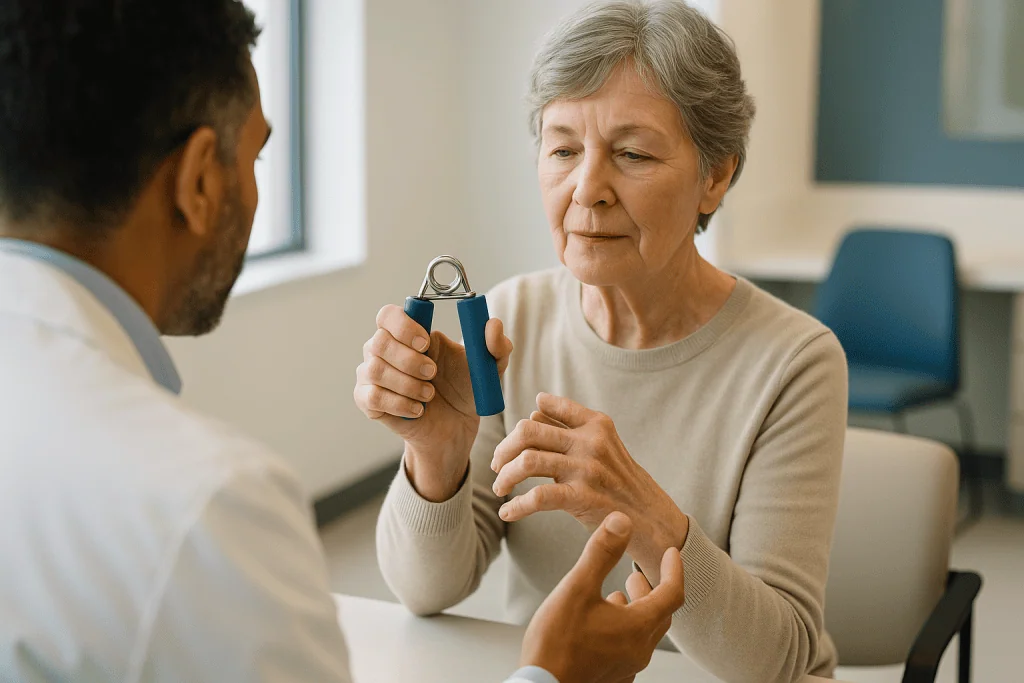
The programs tested in trials are modest. Most used sessions of 10 to 15 minutes, two or three times a week for 8 to 12 weeks, and combined three ingredients: range-of-motion moves, tendon glides and gentle strengthening. A typical set includes making a loose fist and opening the hand wide; touching the thumb to each fingertip in turn; bending only the top two joints of the fingers into a hook, then a full fist, then a flat tabletop; lifting each finger off a table; squeezing soft therapy putty or a sponge; and bending the wrist up and down with the forearm supported. The useful rule for intensity: discomfort during the exercise is acceptable if it settles within a day; sharp pain or swelling the next morning means the load was too much. In RA, hot, swollen joints rest; exercise resumes as the flare settles.
Splints protect what exercise builds. A thumb orthosis that steadies the base joint during pinching tasks, worn for activity rather than all day, improved pain and function at one year in randomized trials and is one of the best-supported tools in hand OA. In RA, resting wrist splints at night ease morning stiffness, and small ring splints hold a swan-neck finger in a workable position.
Joint protection fills the rest of the day. Carry bags over the forearm rather than hooked on fingers. Use the heel of the hand to push doors. Swap thin handles for thick ones and twist caps with the palm instead of the fingertips. Each change shaves force off a joint that, remember, multiplies a tip pinch roughly twelvefold.
How to live with arthritis in your hands day to day
Living well with hand arthritis is less about any single trick than about building a rhythm the joints can tolerate. Pacing comes first: alternating heavy and light tasks, breaking a long typing session into shorter blocks and spreading household jobs across the week rather than compressing them into one punishing afternoon. People who plan rest before pain arrives usually accomplish more than those who push until a joint forces them to stop.
Warmth helps stiffness, and it is cheap. A basin of warm water for a few minutes in the morning, a heated wheat bag or a paraffin wax bath loosens joints before exercise; cold packs work better on a hot, swollen RA joint. Sleep deserves attention because poor sleep lowers pain thresholds measurably, and arthritis pain disrupts sleep, a loop worth breaking with the help of a clinician if it persists.
Whole-body habits reach the hands. Smoking roughly doubles the risk of developing RA and blunts the response to several DMARDs, so stopping is one of the most evidence-backed things a person with RA can do. For OA, the observational link with metabolic health suggests that managing blood pressure, blood sugar and weight serves the fingers as well as the heart, even if no trial has yet proved a direct effect on hand pain. A Mediterranean-style eating pattern has modest trial support for RA symptoms and strong support for cardiovascular health, which matters because RA itself raises heart risk.
Work and technology adaptations are underused. Voice dictation, an ergonomic keyboard, a vertical mouse, lever taps and electric can openers remove hundreds of small pinches a day. An occupational therapist can assess a workstation or kitchen in an hour and often changes more than a new prescription would.
Finally, a flare plan agreed with the care team, covering which medicine to use, when to splint and when to call, turns a frightening bad week into a managed one.
Common myths about hand arthritis
Cracking your knuckles causes arthritis. No study has found this. The pop is a gas bubble forming in joint fluid. The best-known evidence is a physician who cracked the knuckles of one hand for 60 years and not the other, then compared X-rays: no difference. Larger surveys agree, although habitual cracking may be linked to slightly weaker grip and hand swelling.
Hand osteoarthritis is just old age, so nothing helps. Age raises risk, but splints, exercise and joint protection have randomized-trial support for pain and function at any age, and surgical options exist for joints that fail.
Exercise wears the joints out faster. Trials of hand exercise show less pain and better function, not more damage. Cartilage needs movement to receive nutrients from joint fluid; immobility stiffens joints and weakens the muscles that protect them.
Cold or damp weather causes arthritis. Weather can change how a joint feels, and some studies link falling barometric pressure to more pain, but no climate causes or prevents the disease itself.
A special diet or supplement will reverse it. Glucosamine, chondroitin and collagen have not consistently beaten placebo for hand OA. Eating patterns rich in vegetables, fish and olive oil have modest evidence for RA symptoms and good evidence for the heart; none rebuilds cartilage.
Copper bracelets and magnets relieve arthritis. A randomized trial comparing copper bracelets and magnetic wrist straps with inactive versions in people with RA found no difference in pain, inflammation or medicine use.
Methotrexate is now a treatment for hand osteoarthritis. One small trial showed a modest pain benefit in a specific inflamed subgroup. It is not approved for OA, guidelines have not adopted it, and whether it is ever appropriate for an individual is a specialist decision, never a self-treatment one.
Rheumatoid arthritis only affects older people. Onset peaks between 30 and 60, and a form of inflammatory arthritis also occurs in children.
When to see a doctor about hand arthritis
Most hand osteoarthritis can be assessed and managed in primary care, but some patterns should not wait, because the difference between early and late treatment in inflammatory arthritis is measured in permanent joint damage.
Arrange a prompt appointment, ideally within days to a couple of weeks, if you notice any of the following:
- Soft, warm swelling of the knuckles or middle finger joints in both hands, especially with morning stiffness lasting more than 30 to 60 minutes
- Joint pain that arrived over weeks rather than years, or that keeps spreading to new joints
- Hand symptoms accompanied by unexplained fatigue, low-grade fevers, weight loss or a new rash
- A finger that locks, catches or can no longer straighten, or a sudden loss of the ability to lift a finger, which can signal a tendon problem
- Numbness, tingling or weakness in the thumb, index and middle fingers, particularly at night
Seek same-day care, through urgent care or an emergency department, if a single joint becomes red, hot, swollen and severely painful over hours, particularly with fever or after a cut or puncture near the joint. Infection inside a joint and acute gout can look alike, and the first needs urgent treatment.
If you already have a diagnosis, contact your rheumatology or orthopedic team rather than adjusting anything yourself when a medicine seems to stop working, when you develop a new infection, mouth ulcers, unusual bruising or breathlessness on a DMARD, or when you are planning a pregnancy. Never stop or change a prescribed arthritis medicine on your own; several of them rebound badly, and the dose, timing and monitoring are decisions that belong to the clinician who prescribed them.
And see someone, without urgency but without delay, when hand pain is quietly changing your life: when you avoid handshakes, stop cooking the dishes you love or wake most nights with aching fingers. That is the point at which splints, therapy, medicines and surgical options can be lined up before grip is lost rather than after.
Frequently asked questions
What is arthritis?
Arthritis is a general term for more than 100 conditions that damage or inflame joints. The two most common in the hand are osteoarthritis, in which cartilage wears away and bone thickens, and rheumatoid arthritis, in which the immune system attacks the joint lining. Gout and psoriatic arthritis also affect the hands. Each has a different cause and a different treatment, so the label matters less than the specific type.
Can rheumatoid arthritis affect the fingers?
Yes, and usually early. Rheumatoid arthritis most often inflames the knuckles, the middle finger joints and the wrists, typically in both hands at once, while sparing the fingertip joints. Untreated, the inflammation erodes bone and stretches ligaments, which can leave fingers drifting sideways or bending abnormally. Early treatment with disease-modifying medicines, started within the first few months, greatly reduces the chance of those changes.
What are the treatment options for osteoarthritis of the hand?
Treatment focuses on pain relief and joint protection, since no medicine rebuilds cartilage. The core measures are hand exercises, a thumb splint for pinching tasks, heat for stiffness and anti-inflammatory gels applied to the skin. Oral anti-inflammatories, acetaminophen and corticosteroid injections are used for flares under a clinician’s direction. For joints that stay disabling, surgery such as thumb base trapeziectomy or finger joint fusion is an option.
How can I tell osteoarthritis vs rheumatoid arthritis in my hands?
Look at which joints are involved and how long morning stiffness lasts. Osteoarthritis produces hard, bony knobs at the fingertip and middle joints and the thumb base, with stiffness that eases within half an hour. Rheumatoid arthritis causes soft, warm swelling of the knuckles and wrists in both hands, stiffness lasting an hour or more and fatigue. Only an examination, X-rays and sometimes blood tests can confirm which it is.
What are the early arthritis in fingers symptoms I should notice?
Early osteoarthritis usually shows as a deep ache at the thumb base when pinching or twisting, brief morning stiffness and small tender bumps forming near the fingertip joints. Early rheumatoid arthritis shows as puffy, warm knuckles, rings that no longer fit in the morning, stiffness lasting an hour or more and tiredness. Symptoms that arrive over weeks and spread to new joints deserve a prompt medical appointment.
Do exercises for arthritis in hands really help, or do they wear the joints out?
They help. Pooled randomized trials of hand exercise programs show small to moderate improvements in pain, grip strength and daily function over 8 to 12 weeks, with no evidence of faster joint damage. Programs combine range-of-motion moves, tendon glides and gentle strengthening for 10 to 15 minutes, two or three times a week. Discomfort that settles within a day is acceptable; sharp pain or next-day swelling means less load is needed.
How to live with arthritis in the hands without giving things up?
Pace tasks rather than pushing through, warm the hands before activity, and change how force reaches the joints: thick handles, palm twisting, bags over the forearm and lever taps. Wear a thumb splint for heavy pinching jobs and keep up a short exercise routine. Address sleep, smoking and overall metabolic health, which all influence symptoms. An occupational therapist can adapt a kitchen or workstation in a single visit.
Does cracking your knuckles cause hand arthritis?
No study has shown that it does. The sound is a gas bubble forming in the joint fluid, not bone grinding. The most cited evidence comes from a physician who cracked only one hand’s knuckles for 60 years and found no difference between hands on X-ray, and larger surveys reached the same conclusion. Habitual cracking may be associated with slightly weaker grip, but not with osteoarthritis.
Can hand arthritis be reversed?
Worn cartilage and bony nodes in osteoarthritis do not grow back, but pain, stiffness and grip can improve substantially with exercise, splints, medicines and, where needed, surgery. In rheumatoid arthritis the picture is more hopeful: modern disease-modifying treatment can put the inflammation into remission and stop erosions from progressing, especially when started within the first few months, although bone already lost is not restored.
Is methotrexate used for hand osteoarthritis?
Not routinely. A 2023 randomized trial of 97 adults with hand osteoarthritis and ultrasound-confirmed joint inflammation found a modest reduction in pain at six months with methotrexate compared with placebo. It was a single small study, the drug is not approved for osteoarthritis, and guidelines have not adopted it. Whether it could ever suit an individual is a decision for a rheumatologist, never something to try on one’s own.
References
- Osteoarthritis (MedlinePlus)
- Rheumatoid Arthritis (MedlinePlus)
- Rheumatoid arthritis (NHS)
- Osteoarthritis (NIH National Institute of Arthritis and Musculoskeletal and Skin Diseases)
This article is for general information only and is not a substitute for professional medical advice. Please consult a qualified doctor about your individual situation.

More from the Blog

What to Bring and How to Dress Your Baby for a Pavlik Harness Fitting Appointment
For a Pavlik harness fitting appointment, dress your baby in a short-sleeved bodysuit and a fresh diaper, skip pants and tight sleepers, and bring…

Hip Replacement Abroad: Costs, Safety Checks and Aftercare Planning
A total hip replacement abroad typically falls within a guide range of €9,100–16,900 for international patients, often well below typical UK (£11,000–17,000) or US…

Does Cracking Your Knuckles Cause Arthritis?
No, the available evidence does not show that cracking your knuckles causes arthritis. Studies comparing habitual knuckle crackers with people who never crack have…

Before Complex Joint Reconstruction: Why Old Implant Records and Scans Shape the Plan
Preparing for revision joint surgery starts with gathering the records of your original implant, including the manufacturer name, model and sizes from your operative…

How Robotic Knee Replacement Works: What the Robot Does and What Your Surgeon Still Decides
In robotic knee replacement, the surgeon builds a plan from a CT scan or mapped points on the knee, then a robotic arm or…

Joint Hypermobility: When Being Bendy Is a Problem
Joint hypermobility means one or more joints move beyond the usual range, and for most people it causes no trouble at all. It becomes…