

Healing After Hair Transplant Repair: Normal Crusting and Tenderness vs Signs to Call Your Team
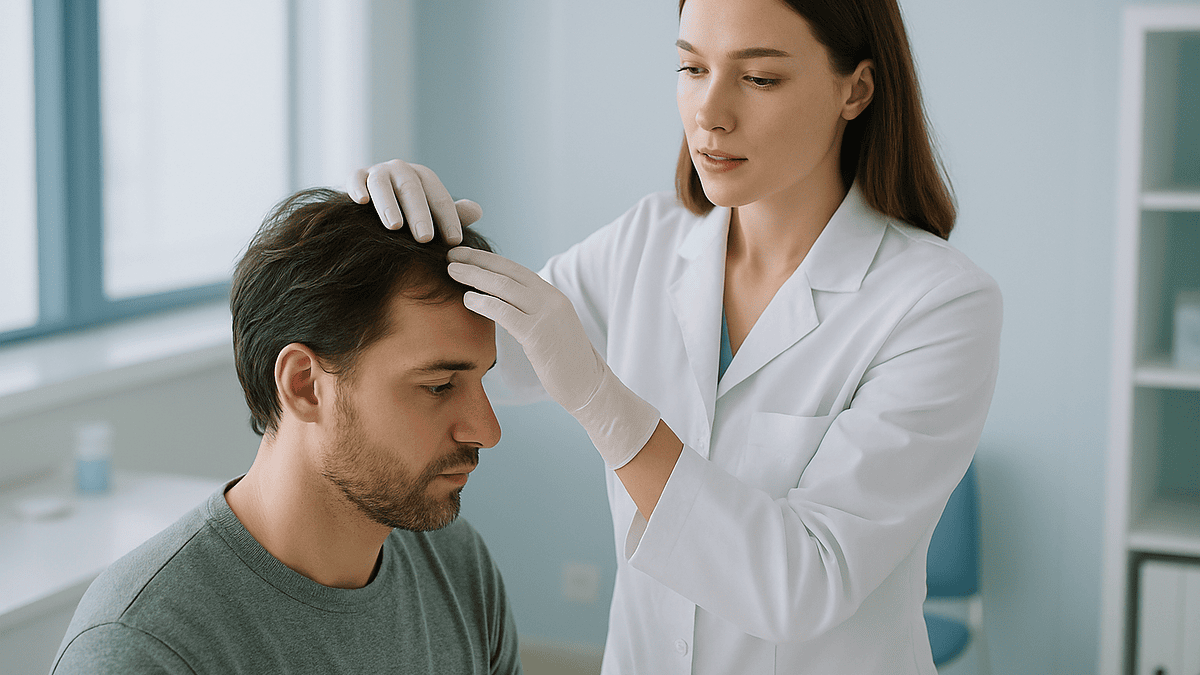
Key Takeaways
- The crust that falls off a graft carries the dead hair shaft, not the follicle, which anchors within the first days and stays behind.
- MedlinePlus describes transplanted hair shedding within a few weeks of surgery and new growth appearing at roughly 3 to 4 months, so results are usually judged at about a year rather than earlier.
- Grafts placed into old scar tissue sit in skin with fewer blood vessels, so repair sites commonly heal more slowly and less evenly than fresh scalp.
- Normal tenderness peaks in the first days and eases steadily; pain that improves and then worsens, or localises to one hot, firm spot, is a reason to call.
- Johns Hopkins lists spreading redness, warmth, increasing pain, pus and fever as the hallmarks of surgical site infection; steady pinkness that fades week by week is not one of them.
- Transplanted follicles largely keep their donor resistance to DHT, but native hair around them keeps thinning over the following decade, which is why medical therapy is often discussed alongside repair.
After hair transplant repair, fine crusts around each graft, mild tenderness, scalp tightness and patchy numbness are expected during the first one to two weeks, and the transplanted hairs commonly shed before regrowing. Spreading redness, pain that worsens rather than eases, pus, fever, bleeding that will not stop or a rapidly swelling area are not part of normal healing and should be reported to your surgical team the same day.
Three mornings after a repair procedure, a man in his forties stands under the bathroom light with a hand mirror angled behind his head. He is not looking at the new hairline. He is looking at the old strip scar that was just re-excised, now stitched into a thin line, and at a hundred tiny brown flecks across the crown where grafts were placed. Is that crust supposed to be there? Should it still throb when he turns his neck?
Those two questions are the whole story of hair transplant repair healing. Someone who has already been through one surgery, and possibly one disappointment, tends to watch every flake and every ache with a level of scrutiny a first-time patient never brings. That vigilance is useful. It only becomes a burden when nobody has explained which findings are ordinary tissue repair and which ones deserve a phone call.
This explainer draws the line as clearly as current evidence allows, without promising any particular result.
What hair transplant repair healing actually involves
A hair transplant moves follicles, the small skin structures that grow individual hairs, from a donor area (usually the back and sides of the scalp) into thinning or bald areas. Repair surgery is any procedure that corrects the outcome of an earlier transplant: lowering or softening an unnatural hairline, redistributing large old grafts, placing follicles into a visible donor scar, or harvesting from a different area because the original donor zone was over-used.
The biology of healing is the same as for any skin wound. In the first minutes, tiny blood vessels clamp down and a clot forms around each graft, which is what later dries into a crust. Over the following days, white blood cells clear debris and new capillaries begin to grow toward the transplanted follicle. Within roughly a week, the graft is anchored by developing connective tissue; before that point it relies on the surrounding fluid for oxygen, which is why early handling matters so much.
Repair adds a few extra layers. When old grafts are removed, each removal leaves a small punch wound that must close on its own. When a strip scar is excised and re-closed, a longer linear wound has to knit together under tension. When follicles are placed directly into scar tissue, they land in a bed with fewer blood vessels than healthy skin.
MedlinePlus describes the standard recovery pattern for hair transplant surgery: the scalp is tender for several days, dressings may be needed for a day or two, and transplanted hairs typically fall out within a few weeks before new growth begins. Repair patients follow the same arc, with the caveat that scarred or previously operated skin can take longer to settle. Every timeline in this article is a typical range, not a guarantee, and your own surgical team’s instructions override anything written here.
Why repair surgery heals differently from a first transplant
Scar tissue is honest about its limits. Compared with untouched scalp, it contains fewer blood vessels, less elastic fibre and a thinner layer of the fat that normally cushions follicles. A graft placed into a mature strip scar therefore competes for oxygen in a poorer neighbourhood. Surgeons often place grafts more sparsely in scar than in virgin skin for exactly this reason, and healing in that zone can lag behind the rest of the head by days or longer.

Previously operated skin is also less predictable in three practical ways:
- Numbness may already exist from the first surgery, so new sensory changes are harder for you to judge.
- Old grafts that are removed leave small open wounds at the same time as new grafts are healing nearby, so the scalp carries two kinds of injury at once.
- The donor zone may have less spare density, which means the surgeon may harvest from the beard or chest, and those sites have their own crusting and tenderness patterns.
None of this makes repair healing dangerous by default. It makes it slower and less uniform. One patch of crust may drop at day ten while a strip-scar segment still looks pink and slightly firm at week three. Cleveland Clinic notes that redness and swelling after hair transplant surgery generally settle over the first few weeks, and that a linear donor scar is a permanent feature that fades rather than disappears. For repair work, reading those two statements as “gradual and uneven” rather than “quick and tidy” sets realistic expectations.
Your team should tell you before the procedure which areas were treated in which way. Ask for a simple sketch. It transforms a confusing mirror image into a map you can follow.
Who is usually offered repair, and who is asked to wait
Repair is typically considered when an earlier transplant left a result that is visibly unnatural or has failed to blend with the surrounding hair. Common reasons include a hairline set too low or too straight, large “pluggy” grafts from older techniques, a wide or stretched donor scar, patchy growth, or misdirected hairs that grow at the wrong angle. Some patients also seek repair after continued thinning around a transplant made the original pattern look isolated.
Several groups are usually asked to wait, or to address something else first:
- Anyone whose most recent transplant was less than roughly a year ago. MedlinePlus and Cleveland Clinic both describe new growth appearing over 3 to 4 months and continuing for many months afterwards, so judging failure earlier can be premature.
- People whose hair loss is still progressing rapidly. If native hair keeps receding, a repair can be outpaced by the underlying condition. Mayo Clinic notes that medical treatments for pattern hair loss aim to slow or stabilise thinning, and stability is often preferred before further surgery.
- Those with active scalp inflammation such as folliculitis (infection or irritation of hair follicles) or an unrelated skin condition on the scalp, which raises wound-healing risk.
- Patients with uncontrolled medical conditions that affect healing, notably poorly controlled diabetes, current smoking or bleeding disorders, until these are reviewed.
- Anyone whose remaining donor supply is too limited; in that situation surgeons may discuss scalp micropigmentation, medical therapy or hairpieces rather than more surgery.
Timing decisions are individual and belong with the surgeon who examines you. The purpose of the waiting periods is not to withhold treatment but to avoid operating on a moving target or on tissue that is not ready.
What the first 72 hours after hair transplant repair look like
The first three days are about protecting clots and keeping fluid down. Expect the following as ordinary findings:
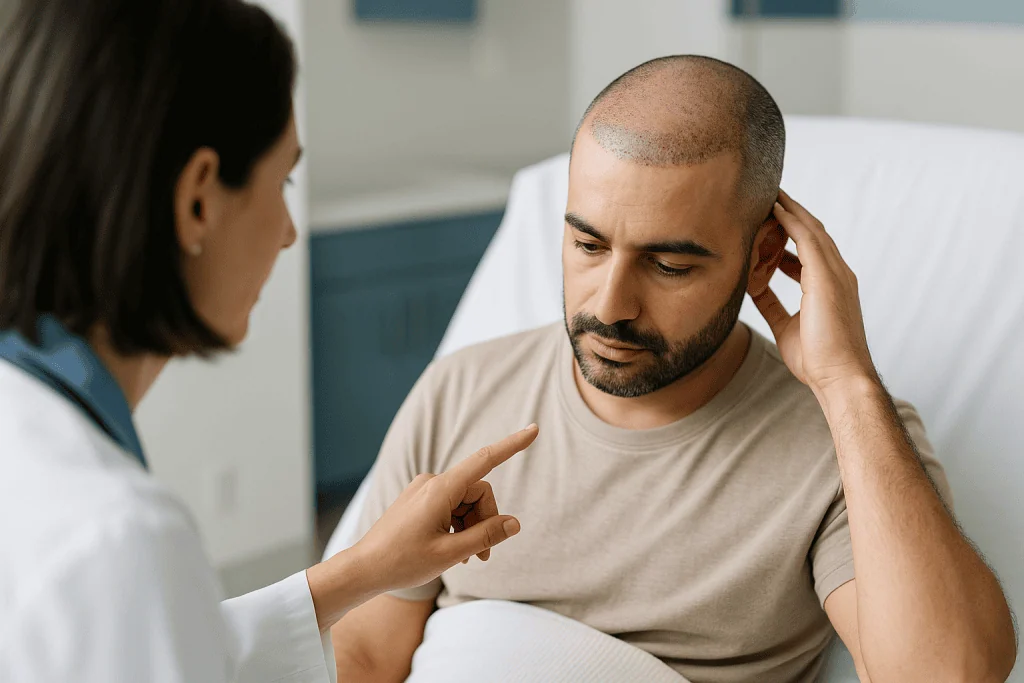
- Pinpoint bleeding or oozing from a few graft sites in the first 24 hours, easily controlled with gentle pressure through gauze as your team directs.
- Tightness across the donor closure if a strip scar was re-excised, worse when you look down or laugh.
- Swelling that may travel forward to the forehead and even the eyelids by day two or three. This is gravity acting on tissue fluid and is a well-recognised feature of scalp surgery; MedlinePlus lists swelling and tenderness among the expected effects of the procedure.
- A pink, slightly shiny recipient area, sometimes with a faint yellow tinge from the fluid that accompanies healing.
Sleep is usually the hardest part. Most teams ask patients to keep the head elevated on several pillows, or in a recliner, for the first few nights to limit swelling and to avoid rubbing grafts against fabric. A travel pillow around the neck helps some people stop rolling onto the recipient zone.
Pain is normally described as soreness rather than sharp pain, more marked at the donor area than the recipient area. It should be at its worst on the first night and gradually ease. Your team will tell you which over-the-counter or prescribed medicines they prefer; some common pain relievers thin the blood slightly, so the choice matters and is theirs to make.
A short bandage or headband over the donor area is common for a day or two. Do not remove or adjust it on your own schedule. If it becomes soaked with blood rather than lightly spotted, that is a same-day phone call, not a wait-and-see.
Hair transplant scabs falling off: what normal crusting looks like
Each graft site forms a small crust from dried blood, plasma and a rim of dead surface skin. The crust is a biological bandage: it seals the tiny channel, keeps bacteria out and keeps moisture in while new skin cells migrate underneath. Picking it off early exposes the graft before it has grown its own blood supply, which is why every set of aftercare instructions treats crusts with such respect.
Normal crusting has a recognisable pattern:
- Uniform, tiny, brown or reddish-brown dots, one per graft, sometimes with a short hair stub poking through.
- Firm to the touch in the first days, then softening and loosening as gentle washing begins.
- A gradual fall-away, often starting at the edges of the recipient zone, with the small hair frequently coming off attached to its crust. Losing the hair shaft this way is expected; the follicle itself stays behind.
- Faint pinkness in the skin revealed underneath, fading over the following weeks.
Most surgical teams expect crusts in healthy scalp to have lifted within the first two weeks with the washing routine they prescribe. In repair cases, crusts over scar tissue or over sites where old grafts were removed can be larger and slower to release, because those wounds are wider than a fresh graft channel.
What is not normal is a change in character rather than in timing. A crust that grows rather than shrinks, one that turns honey-yellow and weeps, one surrounded by a widening red halo, or a cluster of crusts that merge into a thick plaque with an unpleasant smell all point away from simple healing. Johns Hopkins describes these features, along with warmth and increasing pain, as typical signs of a surgical site infection, and they warrant assessment rather than home management.
Tenderness, tightness and numbness: what is usually expected
Tenderness after repair follows the anatomy of the procedure. The donor area hurts more than the recipient area because it involves either a linear excision or hundreds of small punch wounds in a region rich in nerve endings. The recipient zone tends to feel tight, hot or prickly rather than truly painful, especially once swelling arrives on day two or three.
Numbness deserves its own explanation because it alarms people. The scalp is supplied by sensory nerves that run from the back of the head forward and from the temples upward. Both strip excision and dense graft placement can bruise or cut fine branches of these nerves. The result is a patch of skin that feels wooden, tingly or oddly itchy. Cleveland Clinic lists altered sensation among recognised effects of hair transplant surgery, and it typically improves over weeks to months as nerve endings regrow; a small area may remain permanently less sensitive, more often after strip surgery than after follicular unit extraction (FUE, where follicles are removed one by one).
Itching arrives with healing, usually toward the end of the first week, as histamine is released and new skin cells crowd in. It is a good sign biologically and a maddening one practically. Cool compresses held above, not on, the grafts and the saline sprays many teams provide are the usual answers. Scratching is not.
The key distinction with tenderness is trajectory. Normal soreness peaks early and eases steadily, even if slowly. Pain that plateaus and then climbs again after day three, pain concentrated in one spot that feels hot and firm, or pain accompanied by a fever pattern breaks that trajectory and should be reported. Repair patients with pre-existing numbness may notice heat and firmness before they notice pain, so watch the skin as well as the sensation.
Hair transplant recovery week by week after a repair procedure
Timelines vary with the technique used, the amount of scar involved and your own healing. The ranges below reflect the standard pattern described by MedlinePlus and Cleveland Clinic for hair transplant surgery, adjusted with the caveat that repair sites often sit at the slower end.
Days 1 to 3. Oozing stops, crusts form, swelling builds and migrates toward the forehead. Sleeping elevated is the main task.
Days 4 to 7. Swelling peaks and starts to drain. Gentle washing usually begins under instruction. Crusts soften. Itching starts. The donor area, especially a re-closed strip, remains the most tender region.
Days 8 to 14. Crusts lift, frequently taking hair stubs with them. Redness fades toward pink. Most people are back to desk work and routine social contact, although a hat may be needed for sun. Many teams allow light exercise around now, and heavier exertion later.
Weeks 2 to 6. Shock loss: the transplanted hairs shed. MedlinePlus states that transplanted hair falls out within a few weeks of surgery. Nearby native hairs may shed too. The scalp can look nearly bare again. This is the psychologically hardest stretch and the medically least eventful.
Months 3 to 4. Fine, often pale new hairs begin to appear, according to both Cleveland Clinic and MedlinePlus.
Months 6 to 12. Hairs thicken and darken. MedlinePlus offers an estimate that many people see about 60 percent of new growth by 6 to 9 months; this is that source’s own general figure, not a promise, and repair sites in scar tissue may run behind it. Surgeons usually reserve judgement about the final appearance until at least a year.
If your own course is slower than this, that alone is not a red flag. Slow and steady is common in repair. Change of direction, a wound that was improving and then worsens, is the finding that matters.
Shock loss after hair transplant: why the hair falls out before it grows
Around the second or third week, many patients watch the transplanted hairs slide out in the shower and assume the grafts have failed. They almost always have not. The follicle, the root structure that produces hair, survives the move; the hair shaft attached to it does not. Trauma pushes follicles from the growing phase (anagen) into a resting phase (telogen), the shaft is released, and the follicle pauses before restarting. MedlinePlus describes this shedding as an expected part of recovery, with new growth following in the subsequent months.
Native hairs adjacent to the surgical field can shed for the same reason, a phenomenon usually called shock loss. Swelling, changes in local blood flow and the general stress of surgery are enough to push some healthy neighbouring follicles into rest as well. Those hairs typically return as the follicles cycle back, though a follicle already weakened by pattern hair loss may not.
Repair patients face two extra wrinkles. First, if old grafts were removed rather than simply added to, the scalp will genuinely have fewer hairs in that spot for months, and the visual contrast can be stark. Second, shedding in previously transplanted hair that is being left in place is common and usually temporary, but it can make the interim appearance worse than it was before the repair. Knowing this in advance, and having a plan for hats, styling or scalp concealers if you wish, prevents a needless panic.
Hair grows roughly a centimetre a month in most people, so even after regrowth begins around month three or four, visible coverage builds slowly. Photographs taken monthly under the same light are more honest than daily mirror checks, and your surgeon will usually want them at follow-up.
Can I touch my grafts after 7 days? Washing and handling
By about day seven, most grafts have developed enough connective tissue and early blood supply to resist gentle contact, which is why many aftercare protocols relax the rules around this point. “Gentle” is the operative word. Dragging a fingernail, a comb or a towel across the recipient zone can still disturb a crust and the graft beneath it. Handling decisions belong to your surgical team, who know how densely and how deeply the grafts were placed, and their instructions supersede any general timeline.
A typical progression, which your team will adapt:
- First few days: no direct washing of the recipient area; the donor area may be rinsed under instruction, and saline mist is often used to keep grafts moist.
- Around days 4 to 7: pouring diluted, non-medicated shampoo over the grafts and patting, never rubbing, then rinsing with a cup or low-pressure shower.
- Second week: soft fingertip pads in circular motions to encourage crusts to lift; pat dry with a clean towel or let the scalp air-dry.
- After crusts have gone: normal washing resumes, still avoiding hot water, hard nails or forceful styling for a while.
Repair sites in scar tissue and sites where old grafts were removed may need the earlier, gentler stage for longer. Ask specifically about those areas rather than applying one rule to the whole head.
Two items are worth special mention. Hats should be loose and clean, and your team will say when they may be worn. Hair dye, heavy products and hair dryers on a hot setting are generally deferred until healing is well established, both because chemicals irritate raw skin and because heat increases blood flow in a way that can provoke bleeding at fresh sites. Swimming in pools or open water is usually postponed until the skin has fully closed, since chlorine, salt and microorganisms all reach the graft channels directly.
How to heal faster after a hair transplant: what the evidence supports
Nothing legitimately accelerates the biological schedule of wound healing, but several everyday choices reliably stop it from slowing down. Evidence from general surgical recovery, rather than from hair transplant trials specifically, points to these:
- Do not smoke or vape nicotine. Nicotine narrows small blood vessels and carbon monoxide displaces oxygen, both of which starve healing tissue. This matters more, not less, in repair cases where grafts sit in scar with a marginal blood supply. Your team will say how long before and after surgery to abstain.
- Limit alcohol, which dilates vessels, raises bleeding risk in the first days and disturbs sleep.
- Sleep with the head raised for the first several nights to reduce swelling.
- Keep the scalp out of direct sun for the first weeks. Healing skin lacks its normal pigment protection and can burn easily; sunburn on fresh grafts is painful and can leave lasting discoloration.
- Avoid heavy exertion, bending and straining for the period your team specifies, since raised blood pressure in the head can trigger bleeding at graft sites and stretch a strip closure.
- Eat adequate protein and stay hydrated. NIH’s Office of Dietary Supplements notes that deficiencies of iron, zinc and certain vitamins are linked with hair changes, but there is no good evidence that taking these above normal dietary intake speeds recovery in someone who is not deficient. Supplements should be discussed with your team, because some, including high-dose vitamin E and fish oil, may increase bleeding tendency.
Products marketed to “boost” graft survival, whether sprays, oils or devices, lack robust evidence in this setting. Some, notably essential oils and alcohol-based lotions, can irritate healing skin. The most valuable thing you can do is the least glamorous: follow the written protocol, keep follow-up appointments and photograph your progress so that your surgeon can compare like with like.
Medicines your team may discuss, and what they do
Several categories of medicine come up around repair surgery. This section explains mechanism and typical timing only; whether any is right for you, and in what form, is a decision for the prescribing clinician.
Antibiotics. Some surgeons give a short course around the operation to lower the chance of bacterial infection in the many small wounds created; others do not, reflecting a lack of consensus in the evidence. If prescribed, they are taken exactly as directed and the course is finished even when the scalp looks fine.
Anti-inflammatory steroids. A brief course is sometimes used to reduce forehead and eyelid swelling in the first days. Steroids dampen the immune response and can raise blood sugar, so they are not suitable for everyone.
Pain relievers. Your team will specify which are acceptable, because some common anti-inflammatory painkillers reduce platelet function and can increase oozing at graft sites early on.
Medicines for ongoing hair loss. Two are widely discussed. Topical minoxidil is thought to widen small blood vessels and prolong the growing phase of follicles; Mayo Clinic describes it as a treatment that can slow loss and promote regrowth in some people, with a temporary increase in shedding when first started and a need for continued use to keep any benefit. Oral finasteride blocks an enzyme that converts testosterone to dihydrotestosterone (DHT), the hormone that miniaturises follicles in pattern hair loss; Mayo Clinic lists reduced libido and other sexual side effects among its recognised adverse effects, and it is not used in pregnancy. Many surgeons discuss these because native hair around a transplant keeps following its genetic course, and stabilising it can protect the overall pattern.
Do not start, stop or change any of these on your own. If you were already taking a hair-loss medicine before repair, ask your team explicitly whether and when to pause or continue it around the surgery.
Normal healing vs hair transplant infection signs: a side-by-side
Most worry after repair comes from not knowing which column a finding belongs in. The table below sets ordinary healing beside the features that Johns Hopkins and MedlinePlus describe for surgical site infection and related complications. It is a guide to what to report, not a tool for diagnosing yourself.
| Finding | Usually part of normal healing | Reason to call your team |
|---|---|---|
| Crusts | Small, uniform, brown, shrinking over about two weeks | Enlarging, yellow and weeping, merging into thick plaques, foul smell |
| Redness | Diffuse pink that fades week by week | Spreading red area, hot to touch, sharply bordered, or red streaks |
| Pain | Soreness that peaks early and eases | Pain that improves then worsens, or throbbing in one firm spot |
| Swelling | Forehead or eyelid puffiness days 2 to 4 that drains away | Sudden tense swelling, a growing lump, or swelling with fever |
| Bleeding | Pinpoint spotting in first 24 hours, stops with light pressure | Soaking dressings, bleeding that will not stop after firm pressure |
| Bumps | Occasional small pimple as a hair breaks through the skin | Many pus-filled bumps, spreading or recurring clusters |
| Sensation | Numbness, tingling or itching that slowly improves | New severe pain, or numbness with skin turning dusky or grey |
| Whole body | Tiredness for a few days | Fever, chills, feeling generally unwell |
Two entries deserve a comment. Folliculitis, described by MedlinePlus as inflammation or infection of hair follicles that produces small red or white-headed bumps, is one of the more common later issues and usually responds to simple measures your team will advise; a handful of bumps is different from a spreading crop. Skin that turns dusky, grey or black, particularly at the donor closure or in a densely packed recipient area, can signal that blood supply has failed, and that needs same-day assessment. Neither should be treated at home with leftover creams or antibiotics.
What people often get wrong about hair transplant repair healing
“If the crusts fall off, the grafts fell out.” The crust carries the dead hair shaft, not the follicle. Follicles anchor within days; shafts are shed within weeks. A graft that is truly dislodged in the first days usually bleeds noticeably, which is why early spotting is checked but late crust loss is expected.
“Shedding means the surgery failed.” MedlinePlus describes transplanted hair falling out in the weeks after surgery as the normal precursor to regrowth. Judging results before roughly a year, especially in scar tissue, is judging a race at the first bend.
“Red means infected.” Pink or red skin is the visible sign of the extra blood flow that healing requires. Infection announces itself through change: spreading borders, heat, worsening pain, pus or fever, as Johns Hopkins outlines for surgical site infections.
“Repair heals like a first transplant.” Scar has fewer vessels, removed grafts leave wider wounds, and pre-existing numbness dulls your own warning system. Slower and less even is the expected pattern, not a sign that something is wrong.
“More products speed things up.” There is no robust evidence that oils, sprays or supplements above normal dietary needs shorten graft healing. Some irritate raw skin or increase bleeding risk. The protocol you were handed is the evidence-based intervention.
“Once repaired, hair loss is finished.” Transplanted follicles largely keep their donor resistance to DHT, but the native hair around them continues its genetic course. Mayo Clinic frames medical therapy as slowing or stabilising loss, which is why surgeons often raise it alongside surgery.
“Any surgeon can fix any result.” Donor hair is finite. Ethical repair planning is as much about what remains in reserve as about what is placed today, and sometimes the honest answer includes non-surgical options.
What happens 10 years after a hair transplant?
The transplanted follicles, in most people, keep behaving like the skin they came from. Hair at the back and sides of the scalp is generally resistant to dihydrotestosterone, the hormone that drives pattern hair loss, and MedlinePlus notes that this donor-dominant behaviour is the reason the procedure works at all. A follicle moved from that zone to the crown continues to grow hair that thins with age at the slow rate of the donor region, rather than at the fast rate of its new address.
Everything around those follicles, however, keeps aging in its own way. Over a decade:
- Native hair that was not transplanted continues to follow its genetic course. If the pattern progresses, a transplanted hairline can end up sitting in front of a widening thin zone behind it, which is a common reason people seek repair or additional sessions later.
- Hair shafts everywhere become finer with age, so overall density in the transplanted area can look lower than it did at year two, even with the same number of surviving follicles.
- A strip donor scar may widen or become more visible as hair at the back thins with age; FUE punch marks usually remain small but can show if surrounding hair is cut very short.
- Grafts placed at a very low or juvenile hairline may look increasingly out of proportion with an aging face, one of the classic reasons for repair.
Medical therapy is often the bridge across those years. Mayo Clinic describes minoxidil and finasteride as treatments that can slow loss for many people, with benefit lasting only as long as they are used. Whether either is appropriate for you long term, and how to balance its side-effect profile against its role in protecting your result, is a discussion to have with your prescribing clinician rather than a decision to make from an article.
Planning a repair with the ten-year view in mind, keeping donor hair in reserve and designing a hairline that will suit you at sixty, is what separates a good correction from a result that will itself need correcting.
Questions to ask your care team before and after repair
Repair patients often arrive with more knowledge than first-time patients and fewer clear answers. These questions help turn that knowledge into a plan. Bring them written down; consultations move quickly.
Before the procedure
- Exactly which areas will be treated, and how: grafts added, grafts removed, scar excised, scar grafted?
- How much donor hair do I have left after this, and what does that mean for any future needs?
- Which parts of my scalp do you expect to heal more slowly, and what will they look like along the way?
- Should I pause or continue any medicines or supplements I take, and for how long? Who makes that call for my prescription medicines?
- What is your policy on antibiotics and anti-swelling medicine around surgery, and why?
For the first two weeks
- When may I start washing, and is the routine different for scar sites versus fresh graft sites?
- When may I touch the grafts, wear a hat, exercise, and sleep flat?
- What should the donor closure look like on days three, seven and fourteen?
- Who do I call out of hours, and what counts as urgent?
For the months that follow
- When do you want photographs, and under what lighting?
- At what point will you assess the result, and what happens if growth in scar tissue is sparse?
- Do you recommend medical therapy for my native hair, and who will monitor it?
Notice what is missing from this list: any question about guaranteed density, percentage growth or how the result compares with another surgeon’s. Reputable teams describe ranges and uncertainties. A conversation that offers only certainty is a reason to slow down and ask more, not fewer, questions.
When to call your doctor
Most of what you will see and feel after hair transplant repair belongs to normal healing, and most calls to surgical teams end with reassurance. Make the call anyway when something on this list appears; the purpose of follow-up is precisely to sort ordinary from urgent, and repair patients, with their slower and less even healing, are the group in which early review pays off most.
Contact your surgical team the same day if you notice:
- Bleeding that soaks through a dressing or does not stop after several minutes of firm, steady pressure.
- Redness that spreads outward from a graft area or along the donor closure, especially with heat or a raised, firm border.
- Pain that was improving and then worsens, or throbbing focused in one hot, tender spot.
- Pus, cloudy fluid or a foul smell from any site, or crusts that turn thick, yellow and weeping.
- A rapidly enlarging, tense swelling under the skin, which may indicate a collection of blood.
- Skin that turns dusky, grey or black, particularly at the donor closure or in a densely grafted patch.
- Fever, chills or feeling generally unwell in the days after surgery.
- Sutures or staples that have opened, exposing the wound edges.
Seek emergency care immediately, rather than waiting for a call back, for difficulty breathing, swelling of the lips or tongue, a widespread rash or faintness after taking any newly prescribed medicine, since these can indicate a severe allergic reaction. Sudden severe headache, confusion, chest pain or a swollen, painful calf are also emergencies unrelated to the scalp but possible after any surgery.
Johns Hopkins summarises surgical site infection signs as redness, delayed healing, fever, pain, tenderness, warmth or swelling, plus drainage of pus. Those words describe change, not appearance. A scalp that looks dramatic but is steadily improving is usually fine; one that looked fine and is now heading the wrong way is not. Your treating team, not a mirror or a forum, decides which is which.
Frequently asked questions
How long does it take for hair transplants to heal?
Skin-level healing, with crusts gone and redness fading, typically takes about two weeks, while the full course from shedding to visible regrowth runs many months. MedlinePlus describes transplanted hair falling out within a few weeks, new growth beginning around three months and most people seeing a large share of growth by six to nine months. Repair sites in scar tissue often sit at the slower end of those ranges, and your surgeon will usually assess the result at about a year.
Can I touch my grafts after 7 days?
Usually gentle fingertip contact during washing is allowed around this point, but only on your surgical team’s instruction. By about a week most grafts have enough connective tissue and early blood supply to tolerate light touch, yet nails, combs and rubbing towels can still dislodge crusts. Sites in scar or where old grafts were removed may need the gentler routine for longer, so ask specifically about those areas rather than applying one rule to the whole scalp.
How to heal faster after a hair transplant?
You cannot speed the biology, but you can avoid slowing it. Not smoking or vaping nicotine matters most, because nicotine narrows the small vessels new grafts depend on. Limiting alcohol, sleeping with the head raised, keeping the scalp out of direct sun, avoiding heavy exertion for the period your team specifies and eating adequate protein all support normal healing. Extra supplements and marketed sprays lack good evidence and some increase bleeding or irritation.
What happens 10 years after a hair transplant?
Transplanted follicles usually keep growing because they retain the DHT resistance of the donor area they came from, as MedlinePlus explains. The surrounding native hair, however, continues its genetic course, so the area behind or around a transplant may thin over time, hair shafts become finer with age, and a strip scar can become more visible. Many surgeons discuss long-term medical therapy for that reason, a decision that sits with your prescribing clinician.
When do hair transplant scabs fall off after a repair?
In healthy scalp, most teams expect crusts to loosen and lift over the first two weeks with the prescribed washing routine. After repair, crusts over excised scar or over sites where old grafts were removed are often larger and can take longer, because those wounds are wider than a fresh graft channel. Slow release is common; a crust that grows, weeps yellow fluid or develops a spreading red border is the finding to report.
What are the signs of infection after a hair transplant?
Johns Hopkins describes surgical site infection as redness that spreads, warmth, increasing pain or tenderness, swelling, pus or cloudy drainage, delayed healing and fever. After a hair transplant the equivalent picture is a widening red halo around graft sites or the donor closure, crusts that turn thick and yellow, a foul smell, or many pus-filled bumps. Steady pinkness that fades week by week is normal; a change for the worse is not.
Is shock loss after hair transplant permanent?
Usually not. Shock loss describes native hairs near the surgical field shedding because trauma and swelling push their follicles into a resting phase; the follicle survives and typically regrows hair over the following months. Transplanted hairs shed for the same reason before regrowing. Native follicles already weakened by pattern hair loss may not fully return, which is one reason surgeons often discuss stabilising medical therapy alongside repair.
Why does my forehead swell after hair transplant surgery?
Fluid released by healing tissue drains downward under gravity, so swelling that begins on the scalp often moves to the forehead and sometimes the eyelids around days two to four before clearing. MedlinePlus lists swelling among expected effects of the procedure. Sleeping with the head raised limits it. Sudden tense swelling, a growing lump under the skin or swelling with fever is different and should be reported the same day.
What does hair transplant recovery week by week look like after repair?
Days one to three bring oozing, crust formation and building swelling; days four to seven see swelling peak, washing begin and itching start; days eight to fourteen see crusts lift and redness fade; weeks two to six bring shedding of transplanted hair; months three to four bring fine new growth, thickening through months six to twelve. MedlinePlus and Cleveland Clinic describe this general arc, and repair sites in scar commonly run slower.
Does numbness after a hair transplant go away?
For most people, yes, gradually. Fine sensory nerve branches in the scalp are bruised or cut during strip excision or dense graft placement, producing patches that feel wooden or tingly. Cleveland Clinic lists altered sensation among recognised effects, and it generally improves over weeks to months as nerve endings regrow. A small area may stay less sensitive, more often after strip surgery. Numbness with skin turning dusky or grey needs same-day review.
References
This article is for general information only and is not a substitute for professional medical advice. Please consult a qualified doctor about your individual situation.

More from the Blog
Questions to Ask Before Robotic Hair Surgery: Who Places the Grafts and How Results Are Checked
Before robotic hair surgery, ask who performs each stage: the robot usually harvests follicular units, but a surgeon or trained technicians still make recipient…
Why the Cause of Hair Loss Sets the Plan: Tests Before Non-Surgical Hair Restoration
Before non-surgical hair restoration, clinicians usually confirm the cause first: a history and scalp examination, a gentle pull test, magnified scalp imaging (trichoscopy), and…
Who Is a Candidate for Laser Hair Therapy? Early Thinning vs Long-Standing Bald Areas
A laser hair therapy candidate is usually an adult with early to moderate hereditary (pattern) thinning, where follicles have shrunk but are still alive,…
How Scalp Micropigmentation Is Done: Pigment Dots, Session Spacing and Matching Your Hair Shade
Scalp micropigmentation is a cosmetic tattooing technique in which a trained practitioner deposits thousands of tiny pigment dots into the upper layer of the…
Hair Transplant Repair for International Patients: Photo Review, Staged Sessions and Follow-Up
Hair transplant repair for international patients usually begins with a remote photo review, followed by an in-person examination that checks the donor area, scar…
Hair Transplants for a Receding Hairline: Timing, Design and Realistic Density
A hair transplant can restore a receding hairline by moving follicles from the back of the scalp, where hair is genetically resistant to balding,…