

Hearing and Vision Test Apps: How Accurate Are Phone Screenings?
Key Takeaways
- In validation studies, a hearing test app used with its listed headphones in a quiet room agreed with clinic audiometry within about 10 dB at most pitches and detected hearing loss with roughly 80 to 95 percent sensitivity.
- Phones test air conduction only, so they cannot distinguish treatable conductive loss, such as earwax or middle-ear fluid, from permanent sensorineural loss.
- Over-the-counter hearing aid software in earbuds is authorized only for adults aged 18 and older with perceived mild to moderate hearing loss, not for children or for sudden, one-sided or severe loss.
- The 1/3/6 rule means newborns are screened by one month, diagnosed by three months and receiving intervention by six months, using tests no phone can replicate.
- A vision test app can match a printed chart within about one line for acuity, yet it cannot measure eye pressure or view the retina, so glaucoma and diabetic retinopathy can coexist with a perfect score.
- Sudden hearing loss in one ear is a same-day medical concern because management works best when started within about two weeks.
Hearing test apps and vision test apps are useful screening tools, not diagnoses. In validation studies, smartphone hearing tests taken with the recommended headphones in a quiet room agreed with clinic audiometry in roughly 80 to 95 percent of cases; vision apps measure sharpness of sight with similar agreement but cannot see the retina or measure eye pressure. Any sudden, one-sided or unexpected result needs a professional examination.
Picture a man in his late fifties sitting at his kitchen table, earbuds in, tapping the screen every time he hears a faint beep. Three minutes later his phone hands him a number and a color-coded verdict. He has never had his hearing checked in a clinic. Now a gadget he bought for music has told him his left ear is “mild to moderate.”
That scene is why the hearing test app is one of the most searched health tools right now. Over the past two years, regulators in the United States have allowed consumer earbuds to carry hearing-aid software and built-in screening tests, and app stores have filled with free audiometry tools, frequency sweeps and “hearing number” trackers. Vision test apps have followed the same path. As of February 2026, millions of people are screening their own ears and eyes with a device that was never designed as a medical instrument.
So the honest question is not whether these apps work. It is how well, under what conditions, and what they quietly miss.
Why hearing test apps are trending: what changed recently
Two dated shifts explain the surge. On October 17, 2022, a federal rule took effect in the United States creating a category of over-the-counter hearing aids for adults with perceived mild to moderate hearing loss, removing the requirement for a medical exam or professional fitting. The NIH’s National Institute on Deafness and Other Communication Disorders (NIDCD) describes the category and its limits in plain terms: adults only, mild to moderate loss only.
Then, in late 2024, the first software feature that turns a pair of mainstream wireless earbuds into an over-the-counter hearing aid was authorized, bundled with a phone-based hearing test that generates a personal hearing profile. Once a test lived inside a product people already owned, screening stopped being something you scheduled and became something you did while waiting for coffee to brew.
The scale of the problem explains why public health bodies have welcomed the attention. The World Health Organization estimates that more than 1.5 billion people live with some degree of hearing loss, about 430 million of them at a disabling level, and projects that the disabling figure could approach 700 million by 2050. WHO has published its own free screening app that uses a digits-in-noise test rather than pure tones, a design choice we will return to.
Uptake of actual treatment remains low. NIDCD data suggest that fewer than one in three adults aged 70 and older who could benefit from hearing aids have ever used them. A screening tool in everyone’s pocket could narrow that gap. It could also generate a wave of anxious, unverified results. Both outcomes are already happening, which is why accuracy, not novelty, is the question worth answering.
How a hearing test app actually works
Most hearing test apps imitate pure-tone audiometry, the standard clinic test. Audiometry means measuring the quietest sound you can reliably detect at different pitches. The app plays single tones, usually between 250 and 8,000 hertz (hertz is the number of sound vibrations per second), starting audible and stepping quieter until you stop responding. The softest level you detect about half the time is your threshold, recorded in decibels hearing level (dB HL), a scale where 0 represents the average young healthy ear and higher numbers mean more sound is needed.
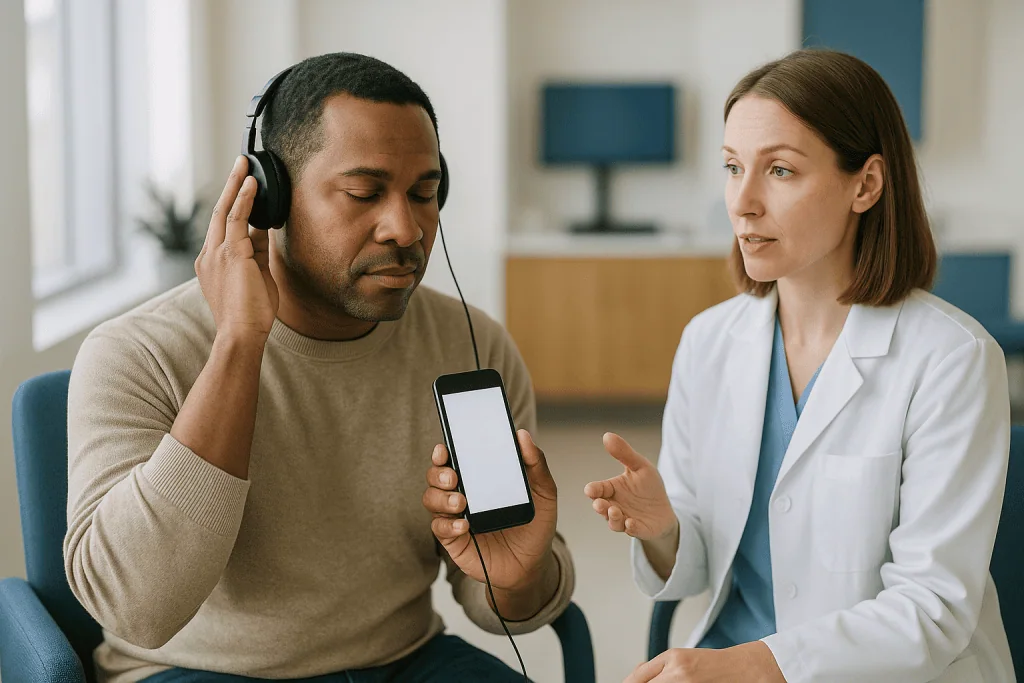
Plotted across pitches, those thresholds form an audiogram, the familiar line graph. Many apps average the thresholds at four speech-relevant pitches into one figure, sometimes marketed as a “hearing number.” Clinicians call this the pure-tone average, and it maps loosely onto categories: roughly under 20 dB HL is normal, 20 to 34 mild, 35 to 49 moderate, and so on in the WHO grading system.
The weak link is calibration. A clinic audiometer is checked against a reference so that “40 dB” really is 40 dB at your eardrum. A phone cannot know what headphones you plugged in, how worn the ear cushions are, or whether you nudged the volume. Better apps restrict you to specific headphone models they have measured in a lab and refuse to run if the volume setting is wrong.
Background noise is the second problem. A quiet living room still hums at 35 to 45 decibels, enough to mask low-pitched test tones and make a normal ear look mildly impaired. Some apps sample the room with the microphone and pause if it gets too loud; many do not.
Digits-in-noise tests sidestep both issues. You hear spoken numbers against a background hiss and type what you heard. Because the test measures the ratio between speech and noise rather than absolute loudness, headphone quality and volume matter far less.
What the evidence actually says about hearing test app accuracy
Grade the evidence before you trust the number. Nearly every study of smartphone audiometry is a validation study: a group of volunteers, often fewer than 200, takes the app test and a clinic test on the same day, and researchers compare the two. That is observational, cross-sectional data. It can tell you how closely the app tracks the gold standard. It cannot tell you whether using the app changes anyone’s health.
Within that limit, the findings are fairly consistent. Under good conditions, meaning the recommended headphones and a sound-treated or genuinely quiet room, app thresholds land within 10 dB of clinic thresholds at most pitches for most people. Sensitivity for detecting hearing loss worse than 25 to 40 dB HL, in other words the share of people with real loss the app correctly flags, usually falls between about 80 and 95 percent. Specificity, the share of people with normal hearing the app correctly clears, ranges more widely, often 70 to 95 percent, and drops when rooms are noisy or headphones are uncalibrated.
Low pitches are the least reliable, because that is where room noise intrudes. High pitches, where age-related loss typically starts, tend to agree better. Digits-in-noise apps show strong correlation with pure-tone averages in adults and are less sensitive to equipment, though they measure a different thing: speech understanding in noise rather than threshold.
What is missing is outcome evidence. No large randomized trial has shown that population screening through apps leads to earlier treatment, better communication or slower cognitive change. The U.S. Preventive Services Task Force concluded in 2021 that evidence was insufficient to recommend for or against routine hearing screening in asymptomatic adults aged 50 and older, a judgment that applies to the clinic test as much as the phone.
So the fair summary: moderate-quality evidence that a well-run hearing test app is a reasonable screen; weak evidence about real-world home conditions; no evidence yet about outcomes.
What a phone hearing test cannot measure
A clinic hearing assessment is not one test but a bundle, and the app reproduces only the first item. Understanding the rest explains why an abnormal app result is a question, not an answer.
Otoscopy comes first: a clinician looks into the ear canal. Impacted earwax is one of the most common reversible causes of muffled hearing, and the NHS lists it alongside infection and fluid as everyday culprits. An app will faithfully record the hearing loss that wax causes and tell you nothing about why.
Bone conduction testing comes next. A small vibrator placed behind the ear sends sound straight to the inner ear, bypassing the eardrum and middle ear bones. Comparing bone and air results separates conductive hearing loss, a mechanical problem in the outer or middle ear that is often treatable, from sensorineural hearing loss, damage to the inner ear or nerve that is usually permanent. Headphones can only test air conduction, so an app cannot make that distinction.
Tympanometry measures how the eardrum moves under gentle pressure changes and detects fluid or stiffness. Speech audiometry checks how many words you recognize at a comfortable loudness, which predicts how well a hearing aid might help far better than tones alone. None of these have smartphone equivalents.
Asymmetry matters too. A clinic test is interpreted by someone trained to notice that one ear is markedly worse than the other, a pattern that can point to conditions needing imaging. An app may simply color one ear orange and move on.
Finally, phones struggle at the extremes. Very high frequencies above 8,000 hertz, sometimes used to catch early noise damage, and very low thresholds near 0 dB HL are hard to deliver reliably through consumer hardware. The app can tell you something is off. It cannot tell you what, where or how urgently.
Can I turn my phone into a hearing aid?
Partly, and the details decide whether that is a good idea. Three different things get lumped under this question.
The first is a general amplification feature built into phone operating systems, which routes the phone microphone to connected earbuds and boosts volume. Regulators treat this kind of tool as a personal sound amplification product, meant for situational use by people with normal hearing, such as listening to a lecture from the back row. It is not tuned to your hearing loss and is not a medical device.
The second is dedicated over-the-counter hearing aid software now authorized for certain earbuds. This uses the results of a built-in hearing test app to shape amplification pitch by pitch. It falls within the over-the-counter hearing aid category NIDCD describes: intended for adults aged 18 and older who perceive mild to moderate hearing loss. Studies comparing these devices with prescription hearing aids are still few and small; early laboratory data suggest meaningful speech-in-noise benefit for mild loss, with gaps in battery life, feedback control and fit for all-day wear.
The third is a prescription hearing aid fitted by an audiologist, which remains the standard for moderate-to-severe loss, for children, and for anyone whose loss is sudden, one-sided or accompanied by pain, drainage or dizziness. The over-the-counter rule itself lists those as reasons to seek medical evaluation rather than self-fit.
Why does it matter which path you take? A 2023 randomized trial in older adults found that a structured hearing intervention slowed cognitive decline over three years in participants at higher baseline risk, though not in the healthier volunteers. That is one trial, in one subgroup, and it tested professional care rather than earbuds. It does suggest that treating hearing loss properly can have consequences beyond conversation, which is exactly why the device choice deserves a clinician’s input rather than an app store rating.
What is the 1/3/6 rule for hearing loss?
The 1/3/6 rule has nothing to do with phones, yet it surfaces in the same searches because parents worry about the same thing adults do: catching a problem early. It is the benchmark for newborn hearing care in the United States and much of the world. Every baby should have a hearing screen by one month of age, any baby who does not pass should have a full diagnostic evaluation by three months, and any child confirmed with hearing loss should begin early intervention by six months.
The timing is not arbitrary. Roughly one to three in every 1,000 babies are born with detectable hearing loss, and the language-learning circuits of the brain are most adaptable in the first year. Children who receive hearing aids, cochlear implants or sign-based support before six months show language outcomes far closer to their hearing peers than children identified later. The CDC coordinates this through Early Hearing Detection and Intervention programs, and several states are already pushing toward a tighter 1/2/3 schedule.
Newborn screening uses two automated methods. Otoacoustic emissions measure faint sounds the healthy inner ear produces in response to clicks. Automated auditory brainstem response records the nerve’s electrical reply to sound through small scalp sensors. Neither requires the baby to do anything except sleep. Both are impossible to replicate with a phone.
This is the right place to say it plainly: no hearing test app is validated for infants, and apps for older children are far less reliable than for adults because children fatigue, guess and tap at random. If a child’s screen was passed at birth but a parent later notices delayed speech, inconsistent response to name, or turning the television up, the next step is a pediatric audiology referral, not a phone game. Hearing loss can also appear after birth, through infection or genetics, so passing the newborn screen does not close the question forever.
Does tinnitus affect hearing test results?
Tinnitus is the perception of sound, usually ringing, hissing or buzzing, when no external sound is present. NIDCD estimates that between 10 and 25 percent of adults experience it, and it can absolutely interfere with a tone-based hearing test, in the clinic and even more so on a phone.
The mechanism is simple. If your tinnitus sits at roughly 4,000 hertz and the app plays a faint 4,000-hertz tone, you may struggle to decide whether you heard the test or your own ear. Some people respond to every presentation at that pitch, producing a falsely good threshold. Others stop responding because they cannot separate the two, producing a falsely poor one. Audiologists handle this by using warbling or pulsed tones, which sound distinctly different from steady tinnitus, and by coaching the patient. Most apps play steady tones and offer no coaching.
There is a second, more important point. Tinnitus is very often a symptom of underlying hearing loss, especially noise-related or age-related sensorineural loss. So when a person with ringing ears gets a poor app result, the result may be entirely genuine rather than an artifact. The app cannot tell you which.
Digits-in-noise tests are less disturbed by tinnitus, because recognizing a spoken number is a different task from detecting a pure tone. Taking that kind of test as a second opinion on your own phone is a sensible move.
A few patterns move tinnitus from annoyance to red flag: ringing in only one ear, tinnitus that pulses in time with your heartbeat, or tinnitus that arrives suddenly alongside a drop in hearing. Those warrant a clinician, and a clinic audiogram will be interpreted with your tinnitus in mind. Supplements and “tinnitus relief” sound apps have, at best, low-quality evidence behind them; management plans belong with the person treating you.
Vision test app: what it can check and what it cannot
A vision test app mostly measures visual acuity, meaning how sharply you resolve detail at a set distance. Most reproduce a Snellen or tumbling-E chart on the screen: you cover one eye, stand a measured distance away and identify letters or the direction an E points. “20/20” means you read at 20 feet what a standard eye reads at 20 feet; 20/40 means you need to be at 20 feet to read what a standard eye reads at 40.
Apps add a few extras. An Amsler grid, a square of fine lines, checks whether straight lines appear wavy or missing, which can hint at problems in the macula, the central part of the retina. Color vision plates test for red-green deficiency. Some apps estimate contrast sensitivity or attempt a rough refraction, an estimate of the lens prescription you might need.
Calibration bites again. The app must know your screen’s physical size, so it typically asks you to hold a credit card against the display to scale the letters. It must also trust your viewing distance, which most people misjudge by a foot or more. Screen brightness, glare and automatic text scaling all shift results.
The larger limitation is what no screen can show. A vision test app cannot measure intraocular pressure, the fluid pressure inside the eye that matters in glaucoma. It cannot view the optic nerve or the retinal blood vessels, where diabetic retinopathy and macular degeneration first appear. It cannot detect cataract reliably, since early cataract often leaves acuity near normal.
Glaucoma deserves one more sentence. It typically steals peripheral vision first and causes no symptoms until damage is advanced, so a person can read every line on an app chart with perfect scores while losing sight. That is the single strongest argument that a vision test app is a supplement to eye care, never a substitute.
How accurate is a vision test app compared with an eye exam?
For plain acuity, the research is encouraging. Validation studies of smartphone acuity tests, several conducted in community settings in low-resource countries where portable screening matters most, found agreement with standard printed charts within about one chart line for most participants, with repeat testing on the same person giving similar results. That is good enough to flag someone who has slipped from 20/20 to 20/60 and to track change over time.
Once again, these are cross-sectional validation studies, not trials of outcomes. They tested acuity under supervised conditions with a trained helper setting distance and lighting. Unsupervised home use introduces the same drift problems as the hearing apps, and the published evidence for self-administered home vision tests is thinner and more mixed.
Refraction estimates from phone cameras or interactive tests are a different story. Agreement with a clinician’s refraction is inconsistent, errors of half a diopter or more are common, and eye care professional bodies caution against using an app-derived prescription for glasses. A prescription also depends on checks of eye alignment and binocular function that a phone does not perform.
What a comprehensive eye exam adds is the part you cannot see yourself. Mayo Clinic describes the typical components: acuity and refraction, a check of eye muscle movement, a slit-lamp examination of the front of the eye, measurement of eye pressure, and a dilated examination of the retina and optic nerve. For adults without symptoms or risk factors, Mayo Clinic suggests a full exam every five to ten years in the twenties and thirties, every two to four years from 40 to 54, every one to three years from 55 to 64, and every one to two years from 65. Anyone with diabetes needs a dilated exam at least yearly, because retinopathy is painless and treatable when caught early.
The verdict mirrors hearing: reliable for one measurement, blind to the diseases that matter most.
Phone screening versus clinic testing at a glance
Put the four options side by side and the pattern is obvious. Phones measure one dimension well under controlled conditions; clinics measure several and, crucially, explain why.
| Tool | What it measures | Accuracy evidence | What it misses | Sensible next step |
|---|---|---|---|---|
| Hearing test app (pure tone) | Air-conduction thresholds, 250–8,000 Hz, pure-tone average | Observational validation; roughly 80–95% sensitivity in quiet with listed headphones | Cause of loss, conductive vs sensorineural, earwax, asymmetry work-up | Repeat in quiet; book clinic test if abnormal, asymmetric or sudden |
| Digits-in-noise app | Speech understanding in background noise | Strong correlation with pure-tone average in adults; less equipment-dependent | Exact thresholds by pitch, cause | Useful cross-check; same referral rules |
| Clinic audiometry | Air and bone thresholds, speech scores, tympanometry, otoscopy | Reference standard, calibrated equipment | Nothing within hearing; may refer for imaging | Discuss results and options with audiologist or physician |
| Vision test app | Visual acuity, Amsler grid, color plates | Within about one chart line of printed charts when supervised | Eye pressure, retina, optic nerve, reliable refraction | Full eye exam at recommended intervals; sooner for any symptom |
| Comprehensive eye exam | Acuity, refraction, alignment, pressure, dilated retina | Reference standard | Nothing within vision | Follow the interval your eye clinician sets |
Notice the column that never appears for apps: cause. Every clinical pathway, whether that is clearing wax, treating infection, prescribing lenses or starting glaucoma drops, begins with knowing why a number is off. An app result is the starting line of that conversation. It is a genuinely useful starting line, and the table should not read as dismissal. A person who would never have booked an audiogram but who sees “moderate” on a screen and makes the appointment has been served well by the technology.
How to get an honest result from a hearing test app
Most inaccuracy in home testing is avoidable, and the fixes cost nothing but patience.
Start with the room. Switch off fans, air conditioning, dishwashers and the television, and wait for traffic to pass. If the app offers a noise check, trust it when it tells you to move. Late evening is often quieter than daytime.
Use the headphones the app names. Developers who publish a list have measured those models and built corrections into the test; a different pair can be off by 10 dB or more, which is the difference between “normal” and “mild.” Wired earphones generally behave more predictably than wireless ones, whose volume handling varies. Set the volume exactly where the app instructs and do not touch it mid-test. Earbuds should sit firmly; a loose fit leaks low frequencies.
Resist the temptation to game it. Tapping when you think a tone is due rather than when you hear it inflates your score, and repeating the test five times until a kinder number appears tells you only about your persistence. One careful test per ear, repeated a week later under the same conditions, is more informative than a dozen rushed attempts.
Treat the two ears as separate results. A difference of 15 dB or more between ears at several pitches is a pattern worth a clinician’s eye regardless of what the overall score says.
Keep a record. The genuine strength of a hearing test app is longitudinal: the same test, same headphones, same room, every six or twelve months. A steady line is reassuring. A line that drifts upward is a reason to book an appointment, even if every individual result still sits in a “normal” band.
If you have tinnitus or no listed headphones, add a digits-in-noise test as a second opinion. When the two methods agree, you can trust the picture more. When they disagree, let a professional settle it.
How to improve hearing loss naturally: what is realistic
Search engines are full of promises here, so start with the biology. Sensorineural hearing loss involves damage to the hair cells of the inner ear, the microscopic sensors that convert vibration into nerve signals. In humans, those cells do not grow back. No food, supplement, exercise or sound therapy has been shown in randomized trials to regenerate them, and studies of popular supplements such as ginkgo, zinc and antioxidant vitamins for established hearing loss have produced small, inconsistent or null results.
That is not the same as saying nothing helps. Several reversible causes of poor hearing are common and respond well to ordinary care: impacted earwax, middle ear fluid after a cold, and ear infections. The NHS advises against cotton buds and ear candles and recommends having wax assessed and removed by a clinician if it is causing symptoms.
Prevention is where the strong evidence lives. Noise is the leading preventable cause of hearing loss worldwide. Occupational standards treat 85 decibels averaged over eight hours as the limit of safe exposure, and every 3-decibel increase halves the safe time. WHO’s safe listening guidance suggests keeping personal audio below about 60 percent of maximum volume and limiting sessions to roughly an hour, and using hearing protection at concerts, with power tools and around firearms. Noise damage is cumulative and painless until it is not.
Cardiovascular health matters too, though the evidence is observational. People with diabetes, high blood pressure and smoking histories show higher rates of hearing loss, consistent with the inner ear’s dependence on a rich blood supply. Managing those conditions for your heart may help your ears; it is not a hearing treatment in itself.
For loss that is already present, the realistic path is to manage it well: amplification matched to your audiogram, communication strategies, and treating any ear condition a clinician identifies. Hearing well with help is a far better outcome than hoping for a natural fix that the evidence does not support.
Common myths about hearing and vision test apps
Viral claims travel faster than validation studies. Here are the ones that most need correcting.
“A free app audiogram is as good as a clinic test.” Under ideal conditions the thresholds often agree closely, but the clinic test includes bone conduction, speech testing and a look in the ear. The app reproduces perhaps a quarter of the assessment.
“I passed the app, so my hearing is fine.” A pass reduces the likelihood of significant loss; it does not rule out early high-frequency damage, hidden hearing loss affecting speech in noise, or problems in one ear that an averaged score smooths over. If you struggle in restaurants despite a normal score, your experience outranks the number.
“Earbuds with hearing features replace hearing aids.” They are authorized only for adults with perceived mild to moderate loss. Severe loss, children, and anyone with sudden or one-sided symptoms fall outside that category.
“A vision test app can write my glasses prescription.” App-based refraction is inconsistent, and a prescription depends on alignment and binocular checks a phone does not perform. Treat the acuity score as a screen only.
“If my eyes test 20/20, I don’t need an eye exam.” Glaucoma, diabetic retinopathy and early macular degeneration can all coexist with perfect acuity. The dilated exam exists precisely to find what acuity testing cannot.
“Tinnitus invalidates the whole test.” It can distort thresholds at its own pitch, yet it is frequently a sign of real hearing loss. The right response is professional testing with tinnitus-aware methods, not ignoring the result.
“Hearing loss is just aging and nothing can be done.” Age-related loss is common and permanent, and it is also highly manageable with amplification. Treating it is linked in observational studies, and in one randomized trial subgroup, with better outcomes for communication and cognition.
When to see a doctor about hearing or vision
A screening app earns its place when it sends the right people to the right door at the right speed. These are the situations where that door should open quickly, regardless of what any app says.
Treat the following as same-day or emergency hearing concerns:
- Hearing in one ear drops suddenly, over minutes to a few days. Sudden sensorineural hearing loss is treated as urgent because management is most effective when started within about two weeks, and ideally within days.
- Hearing loss arrives with vertigo, severe dizziness, facial weakness or a severe headache.
- Hearing loss follows a head injury, a blast or a very loud event and does not settle within a day.
- Ear pain, fever, or discharge of fluid, pus or blood from the ear canal.
Book a routine appointment, within weeks rather than months, for: an abnormal or asymmetric app result on a quiet, careful repeat; tinnitus in only one ear or tinnitus that pulses with your heartbeat; gradual difficulty following speech in groups; a child who seems not to respond to sound or whose speech is delayed; or any plan to buy over-the-counter hearing devices if you have never had a clinic assessment.
For vision, seek emergency care for sudden loss of sight in one or both eyes, a shower of new floaters with flashes of light, a shadow or curtain across part of your vision, severe eye pain with halos around lights and nausea, or new double vision. See an eye clinician soon for any gradual blur, distortion on an Amsler grid, or if you have diabetes and are overdue for a dilated exam.
Whatever an app reports, decisions about testing, devices, drops, surgery or medicines belong with the clinician examining you. Bring your screenshots. They are useful context. They are not the diagnosis.
Frequently asked questions
How accurate is a hearing test app compared with a clinic test?
Under good conditions, a hearing test app typically matches clinic thresholds within about 10 dB and detects hearing loss with roughly 80 to 95 percent sensitivity. Accuracy falls sharply in noisy rooms or with uncalibrated headphones, and low pitches are least reliable. The evidence comes from small observational validation studies, not large trials, and no app can determine the cause of a hearing loss.
Can I turn my phone into a hearing aid?
Partly. Phone amplification features are personal sound amplifiers, not medical devices. Certain earbuds now carry authorized over-the-counter hearing aid software that shapes sound using a built-in hearing test; this category is intended only for adults aged 18 and older with perceived mild to moderate hearing loss. Children, severe loss, and sudden or one-sided symptoms need professional evaluation, and device choice should be discussed with a clinician.
What is the 1/3/6 rule for hearing loss?
The 1/3/6 rule is the newborn hearing benchmark: screen by one month of age, complete diagnostic testing by three months for any baby who does not pass, and start early intervention by six months if hearing loss is confirmed. It exists because language development depends on hearing in the first year. Newborn screening uses otoacoustic emissions or automated brainstem response testing, neither of which a phone app can perform.
Does tinnitus affect hearing test results?
Yes, tinnitus can make steady test tones hard to distinguish from the ringing, producing falsely good or falsely poor thresholds near the tinnitus pitch. Clinics use pulsed or warbling tones to reduce this; most apps do not. Tinnitus is also frequently a sign of genuine hearing loss, so a poor result may be real. One-sided or pulsing tinnitus should be assessed by a clinician.
How can I improve hearing loss naturally?
Permanent sensorineural hearing loss cannot be reversed by diet, supplements or exercises; randomized evidence for these is weak or absent. Reversible causes such as earwax, middle-ear fluid and infection can be treated by a clinician. Prevention is where evidence is strongest: keep personal audio below about 60 percent volume, use hearing protection in loud settings, and manage blood pressure, diabetes and smoking, which are linked to hearing loss in observational studies.
Is a vision test app accurate enough to replace an eye exam?
No. A vision test app measures visual acuity reasonably well, often within one chart line of a printed chart when supervised, but it cannot measure eye pressure, view the retina or optic nerve, or produce a reliable glasses prescription. Glaucoma and diabetic retinopathy can be present with perfect acuity, so the app supplements rather than replaces the dilated eye exam your clinician recommends.
What headphones should I use for a hearing test app?
Use a model the app specifically lists, because developers measure those headphones and build corrections into the test. Unlisted headphones can shift results by 10 dB or more, enough to move a score between normal and mild loss. Wired earphones generally behave more predictably than wireless ones. Set the volume exactly as instructed, ensure a snug fit, and do not adjust anything during the test.
What does a hearing number from an app mean?
A hearing number is usually the pure-tone average: your thresholds at four speech-relevant pitches averaged into one figure in decibels hearing level. In WHO grading, under 20 is considered normal, 20 to 34 mild, 35 to 49 moderate, and higher values more severe. It is a useful summary for tracking change over time, but it hides differences between ears and pitches and says nothing about cause.
How often should I repeat a phone hearing or vision test?
For tracking, repeating a hearing test app once or twice a year under identical conditions, same headphones and quiet room, is more informative than frequent retakes. A steadily rising line is a reason to book a clinic test even if each result is labeled normal. Vision apps follow the same logic, but they do not change the recommended schedule for comprehensive eye exams set by your eye clinician.
Can a vision test app detect glaucoma?
No. Glaucoma is diagnosed through eye pressure measurement, examination of the optic nerve and formal peripheral vision testing, none of which a phone performs. The condition typically damages side vision first and causes no symptoms until advanced, so a person can score perfectly on an acuity app while losing sight. Adults with risk factors such as family history, diabetes or age over 60 should follow the exam intervals their eye clinician advises.
References
- World Health Organization: Deafness and hearing loss fact sheet
- NIH NIDCD: Over-the-Counter Hearing Aids
- NIH NIDCD: Tinnitus
- NHS: Hearing tests
This article is for general information only and is not a substitute for professional medical advice. Please consult a qualified doctor about your individual situation.

More from the Blog
Immunotherapy for Cancer: What It Is, Who Qualifies and How It Is Given
Immunotherapy for cancer is a group of treatments that help a person's own immune system recognize and attack cancer cells, rather than killing those…
Smart Scales and Bioimpedance: How Accurate Is Your Body Fat Reading?
Bioimpedance (BIA) smart scales estimate body fat by sending a tiny electrical current through the body, and they are moderately accurate at best. For…
How a Pacemaker Works and How It Is Fitted
A pacemaker is a small battery-powered device placed under the skin near the collarbone and connected to the heart by thin wires called leads.…

Period and Fertility Apps: How Accurate Are Their Predictions and Who Sees Your Data?
A period tracking app is usually accurate to within a day or two for people with regular cycles, but predictions drift when cycles vary,…
AI Medical Diagnosis: How Accurate Are the Systems, Study by Study?
AI medical diagnosis systems can be highly accurate on narrow, well-defined tasks such as reading mammograms or classifying skin lesions, where some tools match…
AI Medical Diagnosis: How Accurate Are the Systems, Study by Study?
AI medical diagnosis tools can match specialists on narrow, image-based tasks such as reading retinal photographs or mammograms, with sensitivity above 90% in large…