

How a Basal Cell Carcinoma Excision Heals: Dressings, Stitches and Scar Maturation
Key Takeaways
- A stitched excision wound usually has a sealed surface within about two weeks, while a wound left open typically needs four to six weeks or longer to fill in.
- Surface sutures come out anywhere from a few days to about three weeks depending on site, with the face earliest and the back, shoulders and legs latest.
- A wound at the moment of stitch removal is far from full strength, so lifting and stretching limits continue for weeks afterward.
- Scars typically look reddest and firmest at six to eight weeks and can keep fading and softening for up to two years.
- Skin grafts depend on a padded bolster dressing left undisturbed for about a week while new blood vessels grow in, and a dusky purple color at that first check is often normal.
- Fresh scars pigment easily in sunlight, so daily broad-spectrum SPF 30 or higher on the healed site during the first year is one of the few things that reliably changes the final look.
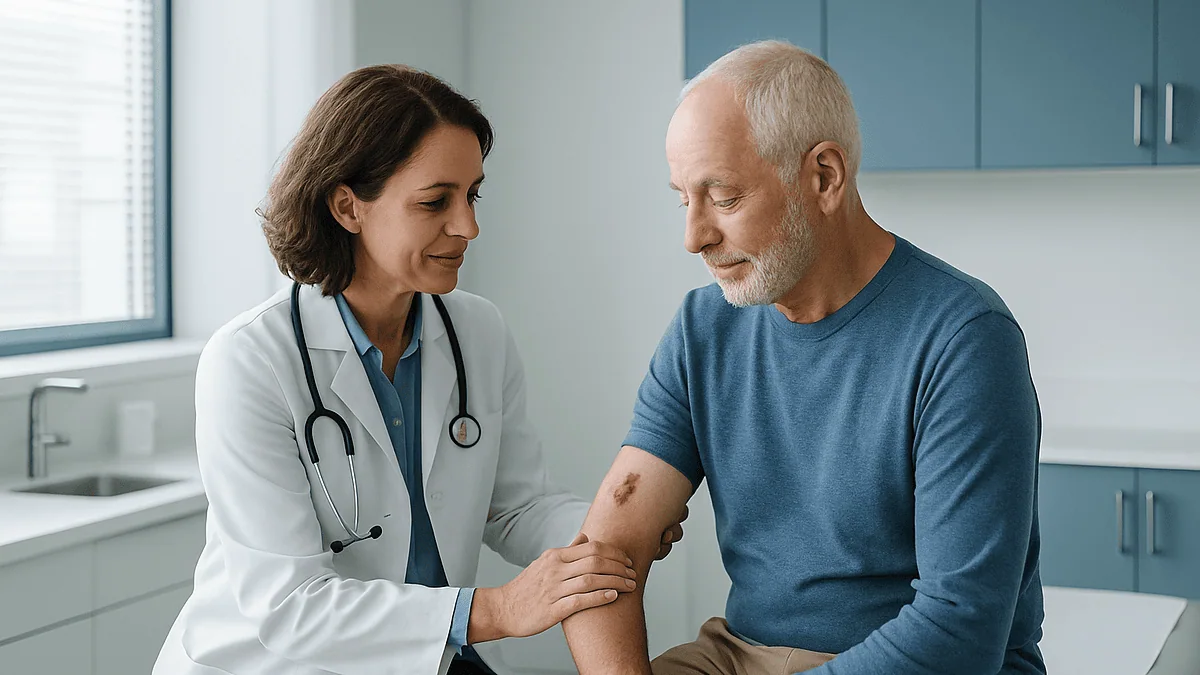
After a basal cell carcinoma excision, a stitched wound usually has a sealed surface within about two weeks, with surface sutures removed anywhere from a few days to three weeks depending on the site. Wounds left open to heal on their own, or repaired with a skin graft, typically take four to six weeks or longer to fill in. The scar keeps softening and fading for months, sometimes up to two years.
The stitches are out, the tape is off, and there in the bathroom mirror is a pink line where a pearly bump on the cheek used to be. Now the second-guessing starts. Is that redness normal? Why does it still feel tight? How long is this really going to take?
Ask three people about basal cell carcinoma surgery healing time and you will get three answers, because there is no single wound. A neat line of stitches on the forearm, a hollow left to fill in on the temple and a skin graft on the nose are each running on a different clock.
This guide walks through those clocks: the first two days under a pressure dressing, the week or two until sutures come out, the month or more an open wound needs, and the long, quiet months in which a scar remodels itself. It also sorts out which changes are ordinary and which deserve a phone call.
What actually happens during a basal cell carcinoma excision
Excision means the surgeon removes the visible tumor plus a rim of surrounding normal-looking skin, called a margin, so that microscopic tendrils of cancer are less likely to be left behind. The whole thing happens under local anesthetic, a numbing injection that switches off the nerves in that patch of skin while you stay awake. Most people describe the injection as a sharp sting for a few seconds, after which the area registers pressure but not pain.
Two main approaches exist. In a standard excision, the surgeon draws an ellipse around the lesion, cuts it out in one piece, closes the wound and sends the tissue to a laboratory. The margin report comes back days later. In Mohs surgery, a technique in which the tumor is removed in thin layers and each layer is examined under a microscope while you wait, the surgeon keeps going only in the exact spots where cancer remains. That is why Mohs is often chosen for the face, ears and other places where skin is precious, and why the appointment can stretch across several hours (Mayo Clinic).
Once the tumor is out, the surgeon decides how to close the gap. A small wound becomes a straight line of stitches. A larger one might need the edges loosened and slid together, a flap of nearby skin rotated in, or a graft borrowed from elsewhere. Sometimes the best choice is no closure at all, letting the body fill the hole from the base up. Each option sets its own healing clock, and that clock, not the diagnosis, is what the rest of this article is about.
Basal cell carcinoma surgery healing time: the honest overview
Basal cell carcinoma is the most common skin cancer, it grows slowly, and it very rarely spreads to other parts of the body (Johns Hopkins Medicine). That biology shapes recovery. Because the tumor is usually removed while still small, most excision wounds are modest, and healing is more a matter of patience than of medical drama.
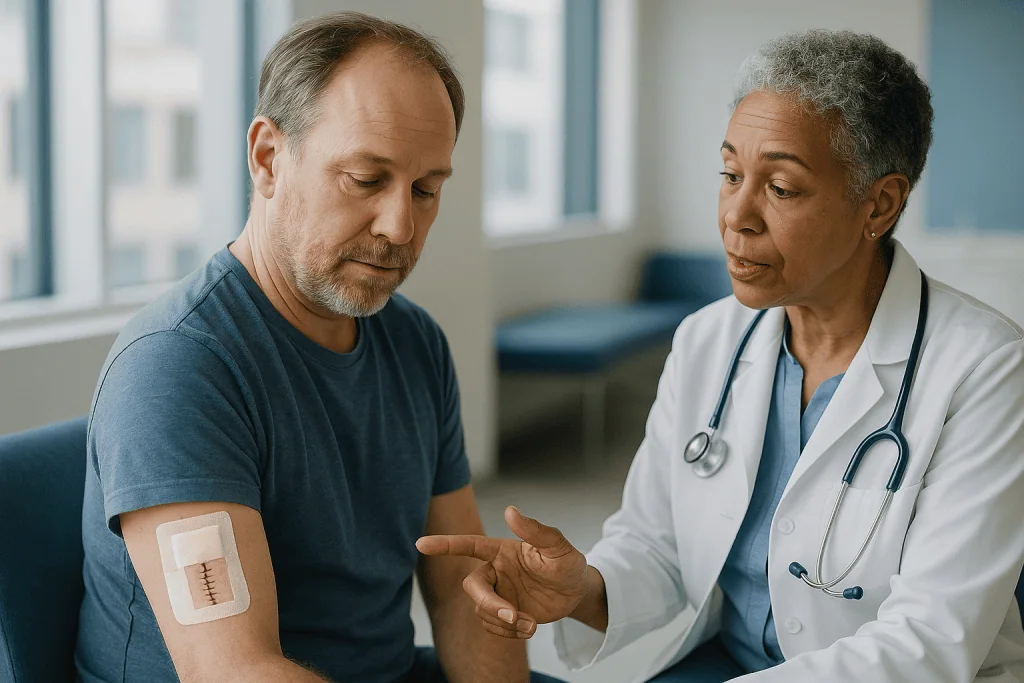
Three broad timelines cover most people. A wound closed with stitches usually has a sealed surface within about two weeks, and the sutures themselves come out somewhere between a few days and three weeks depending on location, with the face at the early end (MedlinePlus). A wound left open generally takes around four to six weeks to fill in, longer if it is deep or on the lower leg (Cleveland Clinic). A graft or flap sits in between for surface healing but takes months for swelling and color to settle.
Then comes the part nobody warns you about: the scar. Skin that looks “healed” at week three is still busy underneath, laying down and reorganizing collagen, the protein scaffolding of skin. The NHS notes that a scar can keep fading for up to two years (NHS). The redness at month two is not the final result. Neither is the firmness at month four.
Two caveats sit over all of these numbers. They are typical ranges from mainstream guidance, not a promise about your wound. And the site matters as much as the size: shins heal slowly, eyelids swell impressively, and skin over a joint gets stretched with every movement. Your surgical team’s instructions override anything you read here, this article included.
Who is usually offered excision, and who is asked to wait
Most people with a confirmed basal cell carcinoma are offered surgery of some kind, because cutting the tumor out lets a pathologist confirm that the edges are clear. Standard excision suits well-defined tumors on the trunk and limbs. Mohs surgery is more often suggested for the face, ears, hands and genitals, for tumors with fuzzy edges, for aggressive growth patterns on the biopsy report, and for cancers that have come back after earlier treatment (Mayo Clinic).
Not everyone goes straight to the procedure room. Somebody with an active skin infection near the lesion is usually asked to clear it first. People taking blood-thinning medicines, drugs that reduce the blood’s ability to clot, should not stop them on the strength of a magazine article; the surgical team weighs bleeding risk against clotting risk and gives specific instructions. A person who is very frail, or whose tumor sits where surgery would leave a difficult defect, may be offered alternatives instead.
Those alternatives include scraping and cautery, where the tumor is scraped away and the base treated with heat; cryotherapy, freezing with liquid nitrogen; radiation therapy delivered over several sessions; and, for thin superficial tumors, prescription creams that either provoke an immune reaction against the cancer or interfere with cancer cell division (Mayo Clinic). Each trades something, often a somewhat higher chance of the tumor returning, for a different kind of wound or no wound at all.
“Wait” also has a gentler meaning here. Because basal cell carcinoma grows over months and years rather than days, scheduling an excision several weeks out is routine and does not usually change the outcome (Johns Hopkins Medicine). Urgent does not mean emergency. The sequence is always set by the team who has seen your biopsy.
The first 48 hours: pressure dressing, oozing and bruising
You will leave the clinic with a bulky dressing pressed over the wound. Its job is compression: the padding squeezes tiny blood vessels shut so the wound does not ooze into the tissue and form a hematoma, a pocket of trapped blood that stretches the skin and delays healing. Most surgeons ask for this first dressing to stay dry and untouched for roughly 24–48 hours (MedlinePlus).
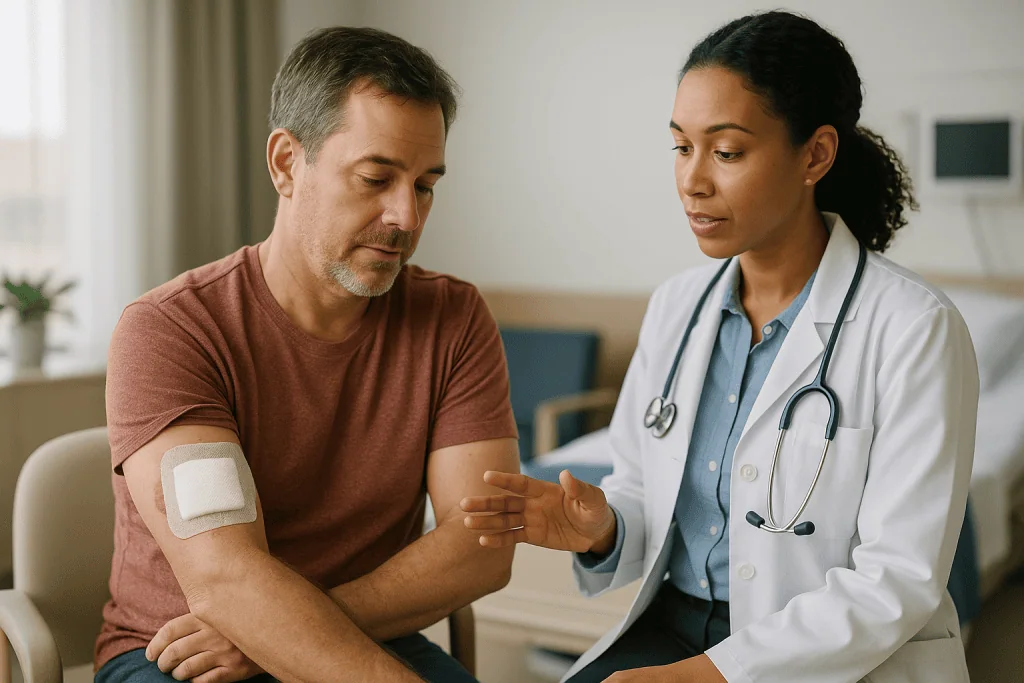
Some pink or blood-tinged staining on the gauze is ordinary. A steady drip is not. If bleeding comes through, the standard advice is to press firmly on the dressing with a clean cloth for around 20 minutes by the clock, without lifting to check, and to call the team if it has not stopped (Cleveland Clinic).
Swelling and bruising follow their own choreography. They tend to build for two or three days before easing, and gravity moves them downhill, so a temple excision can produce a black eye and a nose repair can puff up the upper lip. Sleeping with your head raised on an extra pillow for the first nights helps. So does skipping the gym: bending, lifting and straining raise blood pressure in the head and neck and can restart bleeding.
The numbed area wakes up over a few hours. What arrives is usually a dull ache or tightness rather than sharp pain, and it is often at its worst on the first evening. Your team will tell you which pain relievers fit your medical history; some over-the-counter anti-inflammatory tablets thin the blood slightly, which is one reason the question is worth asking rather than guessing.
Stitches, dissolving sutures and glue: when do they come out?
Stitches, or sutures, hold the skin edges together until the wound can hold itself. There are two kinds, and many excisions use both. Deep, dissolving sutures sit below the surface, take the tension off the skin and break down over weeks to months. Surface sutures made of nylon or a similar material are the ones you can see, and these are removed at a follow-up visit.
How soon depends on where they are. Facial skin has a rich blood supply and heals quickly, so those sutures come out early to avoid track marks; the back, shoulders and legs are under more tension and are left longer. MedlinePlus gives a span of a few days to about three weeks, and the surgeon chooses the day for your particular wound (MedlinePlus). Removal takes a minute or two and feels like a small tug.
Some surgeons use skin glue or adhesive strips instead of, or alongside, surface sutures. Glue flakes away on its own over one to two weeks; strips are left until they lift at the edges. Neither should be picked at.
A point that surprises people: a wound at the moment of suture removal is nowhere near full strength. The edges are stuck together with new tissue that is still fragile, which is why teams often apply supportive tape afterward and ask you to avoid stretching or heavy lifting for a while longer. A wound that gapes after sutures come out, called dehiscence, is uncommon but real, and it happens most on the back and around joints. Treat “stitches out” as a milestone, not a finish line.
How long does a wound take to heal without stitches or grafting?
Sometimes the surgeon chooses not to close the wound at all. This is called healing by secondary intention: the body fills the defect from the bottom and edges with granulation tissue, a red, bumpy, blood-rich layer, and then grows new skin across the top. It sounds alarming and looks alarming for a week or two. On the right sites it produces results that are hard to tell from a stitched line.
Which sites? Concave ones. The temple, the hollow beside the nose, the inner ear and the inner corner of the eye often heal well this way, because the wound contracts and the surrounding skin drapes into the dip. Convex places such as the tip of the nose or the shin do less well and are more often grafted.
The timeline is the trade-off. Where a stitched wound seals in two weeks, an open wound is typically filling in over about four to six weeks, and deep or large wounds, or those on the lower leg, can take several weeks longer (Cleveland Clinic). Expect three stages: a wet, glistening base in week one, a shrinking red crater in weeks two to four, and a pink, slightly shiny patch that gradually flattens and pales after that.
Care is simple but must be consistent. The wound is kept moist with a thin film of a petroleum-based ointment and covered with a non-stick dressing, changed once or twice a day after gentle washing (MedlinePlus). Moist wounds close faster than dry, scabbed ones, and the ointment stops the dressing from tearing off new tissue. With no stitch-removal visit to mark progress, many teams schedule a check at around a week and again at three or four weeks.
Flaps and skin grafts: Mohs surgery healing time when the repair is bigger
When a tumor leaves a gap too wide to pull shut, the surgeon borrows skin. A flap is a piece of nearby skin, still attached at one end so it keeps its own blood supply, that is rotated or slid into the defect. A graft is skin fully detached from a donor site, often behind the ear or near the collarbone for facial work, and laid into the wound to grow a new blood supply from below.
Grafts are the more delicate of the two. For the first several days the graft survives only on fluid seeping in from the wound bed; new capillaries grow in over roughly a week. During this window the graft must not shift, so it is usually sewn down and covered with a padded bolster dressing that stays in place, undisturbed, for about a week (Cleveland Clinic). A graft that looks purple, dusky or crusted at that first check is often still viable, and the surgeon, not the mirror, is the judge.
Flaps carry their own blood and are more forgiving, but they swell more. A rotated flap on the nose can look puffy and slightly pin-cushioned for months as the tissue beneath scars and contracts; teams often wait six months or more before deciding whether any refinement is worth discussing.
This is the honest answer to the Mohs surgery healing time question: the layer-by-layer removal itself changes nothing about healing. The repair does. A Mohs wound closed in a line heals like any stitched wound; one that needed a graft heals on graft time, with color matching that keeps improving for a year or more. The donor site, meanwhile, heals like a small stitched excision of its own.
Basal cell carcinoma surgery healing time by closure type
Nobody’s wound reads a table, but a side-by-side view makes the pattern clear: the surface closes in weeks, the scar matures in months, and the closure method sets which end of each range you are likely to sit at. The figures below are typical ranges drawn from the sources cited in this article, not targets.
| Closure type | Surface usually sealed | Key early milestone | Scar still visibly changing |
|---|---|---|---|
| Straight-line stitches | About 2 weeks | Surface sutures out at a few days to 3 weeks, site dependent | Up to about 2 years |
| Open wound (secondary intention) | About 4–6 weeks; longer if deep or on the lower leg | Granulation base established by week 1–2 | Up to about 2 years |
| Skin graft | About 2–3 weeks once the bolster is removed | Bolster dressing off at about 1 week | Color match improving for 12 months or more |
| Local flap | About 2 weeks | Sutures out at 1–2 weeks | Swelling settles over 6–12 months |
Three variables push a wound toward the slow end of its range. Location is the first: the lower leg has the poorest blood supply of any common excision site and is notorious for lingering wounds, while the face heals fastest. Tension is the second: skin on the back, shoulders and over joints is pulled with every movement, which is why sutures stay in longer there and why gaping is more common. The third is the person: smoking narrows small blood vessels, poorly controlled diabetes slows every stage of repair, and some medicines, including long-term steroids, dampen the inflammatory phase that healing depends on (MedlinePlus).
Read the table as a map of expectations, then hand it to your team and ask where they think your wound will fall. Their answer will be more specific than any range printed here.
Wound care after skin cancer surgery: showering, ointment and dressings
Once the pressure dressing comes off, care settles into a routine most people find almost boringly simple. Wash your hands. Clean the wound gently with lukewarm water and mild soap, letting the water run over it rather than scrubbing. Pat dry with a clean towel. Apply a thin layer of a plain petroleum-based ointment, then cover with a fresh non-stick dressing. Repeat once or twice daily, or as your team instructs (MedlinePlus).
Two habits from older first-aid lore do more harm than good. Hydrogen peroxide and rubbing alcohol damage the very cells trying to knit the wound together, and standard guidance now advises against both (MedlinePlus). Letting a wound “breathe” until it scabs over is the second: a scab is a dry crust that new skin cells have to tunnel under, whereas a moist, covered wound lets them glide straight across.
Showering is generally fine after the first 24–48 hours, with the wound rinsed briefly and re-dressed afterward. Soaking is a different matter. Baths, swimming pools, hot tubs and open water are usually off-limits until the surface has fully closed, both because soaking softens new tissue and because pool and lake water carry bacteria.
Activity restrictions depend on where the wound is. A forearm excision barely limits daily life, while a wound on the back or calf may come with instructions to avoid lifting, stretching or vigorous exercise for one to two weeks or until sutures are out. Ask what “heavy” means for your situation; carrying a toddler counts.
Watch, too, for the ointment itself becoming the problem. A rash spreading beyond the wound edges, itchy and red, is more often a contact reaction to an ointment or adhesive than an infection. Mention it at your check rather than switching products on your own.
Skin cancer excision scar: what scar maturation really looks like
Scar formation follows a script written by biology, and knowing the script saves a lot of worry. In the first six to eight weeks a healed excision typically gets redder, firmer and often slightly raised. This is the proliferative phase, when the body floods the site with new blood vessels and lays down collagen quickly and messily. It is the point at which many people conclude the scar has “gone wrong.” It has not. It is doing exactly what scars do.
From roughly the third month onward the remodeling phase takes over. Disorganized collagen is broken down and re-laid in tidier bundles, excess blood vessels retreat, and the scar softens, flattens and pales. The NHS notes that a normal fine-line scar can continue to fade for up to two years (NHS). Judging a skin cancer excision scar at three months is like reviewing a house while the scaffolding is still up.
Two types of scar overshoot. A hypertrophic scar is raised and red but stays within the original wound boundary; it is common on the chest, shoulders and back and usually improves over a year or two. A keloid grows beyond the wound edges and is more likely in people with darker skin tones and a family history of them (NHS). Both are worth showing your team early, since options such as steroid injections or silicone dressings tend to work better on young scars. The evidence for silicone is real but modest, and no product should be presented as a guarantee.
What you can do is unglamorous. Protect the scar from the sun, since new scar tissue pigments easily; the CDC recommends broad-spectrum sunscreen of SPF 30 or higher plus shade and clothing (CDC). Once the surface is fully closed and your team agrees, gentle daily massage with a bland moisturizer may help the scar soften, though the trials behind that advice are small.
Is it painful to have basal cell carcinoma removed?
The short answer is that removal is uncomfortable rather than painful, and the discomfort is front-loaded. The local anesthetic injection is the sharpest moment: a sting and a feeling of pressure that lasts a few seconds per needle pass. Surgeons often inject slowly to soften this. Once the skin is numb you feel tugging, pressure and sometimes the vibration of instruments, but not cutting. If you feel sharp pain during the procedure, say so; more anesthetic can be added.
Afterward the ache is usually mild to moderate for the first one to three days and then fades to tightness and itch. Wounds under tension, such as on the back, and those near cartilage, such as the ear and nose, tend to be sorer. Most people manage with over-the-counter pain relief chosen in consultation with their team, and a cool compress held near, not on, the dressing helps swelling.
Numbness is a different sensation and often a longer one. Cutting through skin severs the fine nerve endings within it, and they regrow slowly, at a pace measured in millimeters per month. A patch of reduced feeling around an excision scar, sometimes with odd tingling or electric flickers as nerves reconnect, can persist for months and occasionally longer (Cleveland Clinic). It is rarely a sign of anything wrong, but new or spreading numbness after the first week is worth reporting.
Itching, which peaks as the wound closes and again during scar remodeling, is a nuisance rather than a warning. Cool compresses and keeping the area moisturized once healed usually settle it. Scratching a fresh scar does not, and it can reopen edges that are still knitting.
What people often get wrong about basal cell carcinoma removal recovery
Recovery from basal cell carcinoma removal is surrounded by confident advice, much of it wrong. A few corrections, in rough order of how often they come up.
- “No stitches means they did a poor job.” Leaving a wound open is a deliberate choice for concave sites and often gives a better result than a stretched closure. The trade is a longer healing time, not a lower standard.
- “Let it scab; a scab means it is healing.” A dry scab slows healing and worsens scarring. Moist, covered wounds close faster (MedlinePlus).
- “Stitches out means healed.” The wound at suture removal is far from full strength. Follow the lifting and stretching advice for the weeks afterward.
- “The scar you see at three months is the scar you get.” Scars remodel for up to two years and are at their reddest and firmest early on (NHS).
- “Basal cell carcinoma is not real cancer, so no follow-up is needed.” It is cancer, and having one raises the chance of developing another; regular skin checks are standard advice (Mayo Clinic).
- “Vitamin E or a special cream will erase the scar.” No cream erases a scar. Evidence for vitamin E is poor, and it causes contact rashes in some people. Silicone has modest supporting evidence at best.
- “Once it is closed, sun does not matter.” Fresh scars darken easily in sunlight and stay dark. Sun protection through the first year is one of the few things that reliably changes the final look (CDC).
One more, subtler mistake: comparing your wound with a friend’s. A forearm line and a nose graft share a diagnosis and nothing else. The only useful comparison is with the range your own team gave you, checked against how your wound looked last week rather than how someone else’s looked last year.
Questions to ask your care team
Good questions turn a rushed follow-up into a plan. Bring these written down; nobody remembers them in the chair.
- How was my wound closed, and what does that mean for how long the surface will take to seal?
- When exactly will surface stitches come out, and who removes them?
- Were the margins clear on the pathology report, and if not, what happens next?
- What should the wound look like at one week and at one month, so I know what counts as normal?
- Which dressing and ointment routine do you want me to follow, and for how long?
- When can I shower, bathe, swim and exercise, and what does “heavy lifting” mean for this site?
- Are any of my regular medicines relevant to bleeding or healing? I will not adjust anything without your say-so.
- Which warning signs do you want a phone call about, and which number do I use out of hours?
- When can I start sun protection directly on the wound?
- How often should I have skin checks from now on, and what should I be looking for at the scar and elsewhere?
- If the scar ends up raised, thick or tight, what options exist, and when is the right time to raise them?
Two of these deserve emphasis. The margins question matters because a report showing tumor at the edge may mean a second procedure, and knowing early avoids a nasty surprise weeks later. The follow-up question matters because a first basal cell carcinoma is a marker of skin that has already absorbed a lifetime of ultraviolet exposure; the ongoing job is surveillance, and your team should tell you the interval they want rather than leaving it to chance.
When to call your doctor
Most excision wounds heal without incident, and most calls to a surgical nurse end with reassurance. Call anyway if you notice any of the following, because early treatment of a wound problem is quick and late treatment is not.
- Bleeding that soaks through the dressing and does not stop after 20 minutes of firm, uninterrupted pressure.
- Redness spreading outward from the wound edges, especially with warmth, increasing swelling or a red streak tracking away from the site.
- Thick yellow or green discharge, a foul smell, or a wound that becomes more painful after the third day instead of less.
- Fever, chills or feeling generally unwell in the first two weeks.
- Wound edges that separate, stitches that pull through, or a graft or flap that turns black, dry and hard rather than dusky purple.
- Rapid, tense swelling under the wound within the first two days, which can signal a collecting hematoma.
- A rash spreading around the dressing, which may be a reaction to adhesive or ointment.
- Any change in vision, or an eyelid that will not close, after surgery near the eye.
Seek emergency care rather than waiting for a call back if bleeding is heavy and will not slow, if there are signs of a severe allergic reaction such as facial swelling or breathing difficulty, or if a high fever comes with confusion or rapid breathing.
Longer term, contact your team without waiting for the next scheduled check if the healed scar develops a new pearly or translucent bump, a sore that bleeds and never quite closes, or a firm nodule beneath it. These can be ordinary scar changes, but they are also how a recurrence declares itself, and the team who removed the original tumor is best placed to tell the difference (Mayo Clinic). Between checks, a monthly look at your own skin in good light is a habit worth keeping.
Frequently asked questions
How urgent is it to have basal cell carcinoma removed?
It is important but rarely an emergency. Basal cell carcinoma grows slowly over months to years and very seldom spreads, so scheduling removal several weeks after diagnosis is routine and does not usually change the outcome (Johns Hopkins Medicine). Leaving it for years is different: the tumor keeps enlarging locally and can invade cartilage or bone, making the eventual wound larger.
Are you a cancer survivor if you had basal cell carcinoma?
Yes, by the definition most cancer organizations use, including the NIH’s National Cancer Institute, which counts anyone from the moment of diagnosis onward. Some people feel the word overstates a small skin procedure, and that is a personal choice. The practical point is that having had one basal cell carcinoma makes another more likely, so ongoing skin checks are part of your care.
Is it painful to have basal cell carcinoma removed?
Most people describe it as uncomfortable rather than painful. The numbing injection stings for a few seconds; after that you feel pressure and tugging, not cutting. Soreness afterward is usually mild to moderate for one to three days, then fades to tightness and itch. Your team will advise which pain relievers suit your medical history and other medicines.
How long does it take for a wound to heal after basal cell carcinoma removal without stitches or grafting?
A wound left open to heal on its own typically fills in over about four to six weeks, longer if it is deep, large or on the lower leg (Cleveland Clinic). It looks raw and red for the first two weeks, then shrinks steadily. Kept moist and covered, these wounds often leave scars that are hard to distinguish from stitched ones.
Is Mohs surgery healing time different from a standard excision?
Not for the same repair. Mohs surgery removes the tumor in layers checked under a microscope, but healing is set by how the wound is closed, not how the cancer was removed. A Mohs wound stitched in a line seals in about two weeks like any excision; one repaired with a graft follows graft timelines, with color settling over a year or more (Cleveland Clinic).
When can I exercise or swim during basal cell carcinoma removal recovery?
Light walking is fine from day one. Lifting, bending, straining and vigorous exercise are usually restricted for one to two weeks, or until sutures are out, particularly for wounds on the back, legs or near joints where stretching can reopen the edges. Swimming, baths and hot tubs wait until the surface has fully closed, because soaking softens new tissue and pool water carries bacteria (MedlinePlus).
Why is my skin cancer excision scar still red and raised months later?
Because scars get worse before they get better. Redness and firmness peak around six to eight weeks as new blood vessels and collagen flood the site, then fade during remodeling, which the NHS says can continue for up to two years (NHS). Show your team if the scar is spreading beyond the wound edges or thickening rather than softening, since early options work best.
What does wound care after skin cancer surgery involve if I have dissolving stitches?
Dissolving stitches sit beneath the surface and break down over weeks to months, so there is nothing to remove. Care is the same as for any closed wound: gentle washing after the first 24–48 hours, a thin layer of plain ointment, a non-stick dressing, and no soaking (MedlinePlus). Occasionally a dissolving stitch works its way to the surface as a small spot; your team can trim it.
Can I fly after basal cell carcinoma surgery?
Usually yes, since the procedure is done under local anesthetic and does not itself raise clot risk, but ask your team before booking. The practical concerns are bleeding in the first 48 hours, arranging suture removal or wound checks at the right time, and knowing whom to contact if the wound looks wrong away from home. Keep dressings and ointment in your carry-on bag.
Will the numbness around my basal cell carcinoma scar go away?
Usually it improves, but slowly. Cutting skin severs fine nerve endings that regrow at a pace measured in millimeters per month, so a patch of reduced or odd sensation can persist for months and occasionally longer (Cleveland Clinic). Tingling or brief electric flickers are signs of nerves reconnecting. Report numbness that is new or spreading after the first week.
References
This article is for general information only and is not a substitute for professional medical advice. Please consult a qualified doctor about your individual situation.

More from the Blog

Who May Be a Candidate for Proton Therapy: Tumors Near Critical Organs and Younger Patients
People most often considered for proton therapy have a tumor sitting close to organs that tolerate radiation poorly, such as the brainstem, spinal cord,…
Chemotherapy Port vs PICC Line: How Each Is Placed, Maintained and Removed
A chemo port is a small reservoir implanted under the skin of the chest and connected to a large vein; a PICC line is…

Autologous vs Allogeneic Stem Cell Transplant: Own Cells or Donor Cells, and Who Gets Which
An autologous stem cell transplant returns a person's own previously collected blood-forming cells after high-dose treatment, while an allogeneic transplant uses cells from a…
Life After Thyroid Cancer Surgery: Hormone Replacement, Energy and Daily Routine
After a total thyroidectomy for thyroid cancer, the body can no longer make thyroid hormone, so most people take a daily synthetic version of…

Low Blood Counts During Lymphoma Treatment: Precautions and the Symptoms That Need a Call
Lymphoma chemotherapy and some immunotherapies temporarily lower white cells, platelets and red cells, and the infection risk usually peaks about one to two weeks…
Hot Flashes and Fatigue on Hormone Therapy: Practical Ways the Care Team Helps
Hot flashes and fatigue are among the most common side effects of cancer hormone therapy because these treatments lower or block estrogen or testosterone,…