

How a Fibroblast Plasma Session Works: Numbing, the Dot Pattern and What You Feel
Key Takeaways
- The "plasma" in a plasma pen is ionized air in a hair's-breadth gap between tip and skin, not anything derived from blood.
- Each dot is a tiny burn through the epidermis with heat reaching the upper dermis; "non-surgical" does not mean "no wound."
- The visible pull in fresh photos comes mostly from immediate heat-shrinkage of collagen, while any rebuilding by fibroblasts unfolds over months and is harder to measure.
- Topical anesthetics blunt the sharp sting well but reach heat-sensing fibers less completely, so most people describe the session as hot rather than sharply painful.
- Grid spacing borrows from fractional laser principles: untouched skin between dots supplies the cells that reheal each spot, and over-dense dots raise pigment and texture risk.
- Post-inflammatory hyperpigmentation is the most common lasting complication, is more likely in deeper skin tones and after sun exposure, and can take months to fade according to Cleveland Clinic.
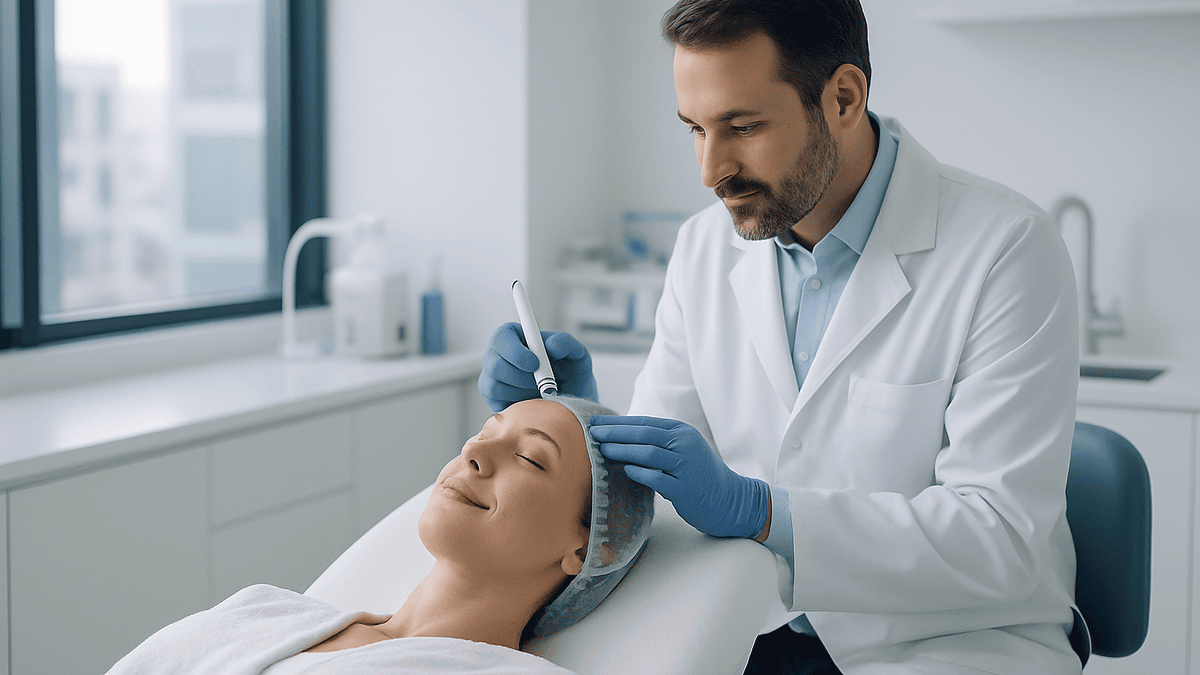
A fibroblast plasma pen ionizes the thin layer of air between its metal tip and the skin, creating a tiny electrical arc that vaporizes a pinpoint of the outer skin without the tip touching it. A numbing cream is applied first, then dots are placed in a grid so the small wounds contract and signal fibroblasts to lay down new collagen while healing. Most people describe heat plus a sharp, snapping sting.
The video is forty seconds long. A gloved hand hovers a slim silver wand just above a woman’s upper eyelid, and with each faint click a brown speck appears, then another, until the lid looks dusted with cinnamon. The caption promises “non-surgical” and “no downtime.” You watch it twice, then open a search tab and type the question that brought you here: how fibroblast plasma pen works, and whether that grid of dots is as painless as the smiling face suggests.
It is a fair question, and a harder one to answer honestly than most of those videos admit. A plasma session sits in a strange middle ground. It is not a cream and not a scalpel. It creates real wounds, deliberately, in a pattern that borrows from wound-healing biology that dermatologists have understood for decades.
What follows is the version a careful clinician would tell a friend: what the device physically does, why the numbing step matters more than the marketing suggests, why the dots are spaced the way they are, and what your skin actually feels at each stage.
How a fibroblast plasma pen works: the arc, not the metal
Start with the word plasma, because it confuses almost everyone. In this setting, plasma has nothing to do with blood. It is the fourth state of matter: a gas so energized that electrons are stripped from atoms, which is the same physics behind a lightning bolt or the glow inside a neon sign.
The pen holds a small high-voltage generator. When the operator brings the fine tip within a fraction of a millimeter of the skin, the electrical field becomes strong enough to ionize the air in that gap. A tiny arc jumps across. That arc carries heat, and the heat does two things at once. It vaporizes a pinpoint of the epidermis, the outer protective layer of skin, leaving a dry, carbonized dot. And it delivers a controlled thermal pulse into the papillary dermis, the upper part of the living layer beneath, where collagen fibers and fibroblasts sit.
Fibroblasts are the cells that build and repair the skin’s structural scaffold; they manufacture collagen, elastin and the gel-like matrix around them (Cleveland Clinic). The device is named for them because the entire premise rests on provoking those cells to respond to injury.
Two effects are proposed. The first is immediate: heat causes existing collagen fibers to shrink, which is why the skin around each dot visibly puckers within seconds. The second is delayed: the wound-healing cascade recruits fibroblasts to deposit fresh collagen over the following weeks and months (MedlinePlus). Whether that second effect is large enough, and durable enough, to matter cosmetically is the real scientific question, and this article will come back to it without hedging.
Do you touch the skin with a plasma pen?
Strictly, no. The tip is meant to hover, and the arc does the work. That distinction is not a technicality; it is the whole design. Devices that press an electrode against skin, such as electrocautery tools used in minor surgery, spread heat by direct conduction and produce wider, deeper burns. A plasma arc is a concentrated point of energy that spends itself in the topmost layers before conduction can carry it far.
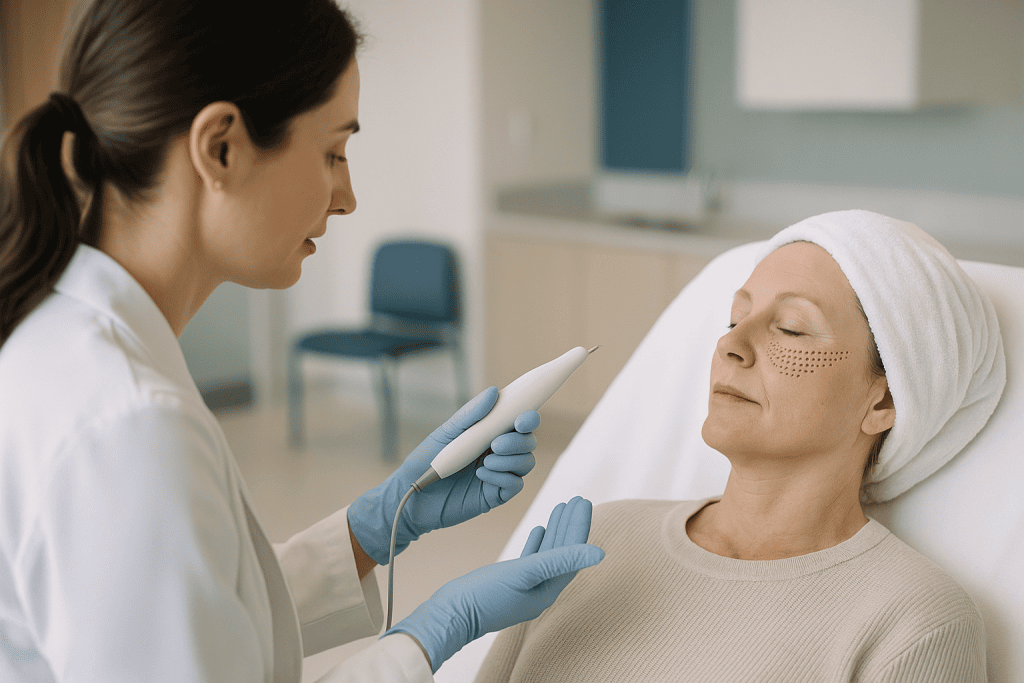
In practice, the gap is so small that the tip will occasionally brush the surface, especially over curved areas like the eyelid crease or the corner of the mouth. A steady operator minimizes this because contact changes the character of the wound from a crisp, superficial dot to something less predictable. It is one of several reasons that hand skill, not the brand of pen, determines a great deal of the outcome.
The gap also explains the sound. Each dot is accompanied by a faint snap or crackle, sometimes with a wisp of smoke and a smell many people compare to a hair being singed. That is the epidermis vaporizing, and it is normal.
People sometimes ask whether the arc penetrates the way a needle does. It does not. A microneedling needle physically pierces to a set depth and leaves a channel; the plasma arc removes a shallow disc of tissue and heats what lies just beneath, without a puncture track. This is why plasma dots form a dry crust rather than bleeding, and why the two treatments behave differently as they heal, a difference explored in the comparison table further down.
Why fibroblasts are the target, and what tightening means at cell level
Skin loosens with age for reasons that are well described. From adulthood onward the dermis thins, collagen production slows, existing collagen fibers become fragmented and cross-linked, and elastin fibers lose their recoil (MedlinePlus, Harvard Health). Sun exposure accelerates every one of those changes. The result is skin that stretches more easily and springs back less: crepey eyelids, softened jawline definition, fine lines that stay put after the expression that made them has passed.
Fibroblasts sit at the center of this story. They are the resident builder cells of connective tissue, and in youthful skin they continuously turn over collagen. In aged skin they become less active, partly because the fragmented collagen around them no longer gives them the mechanical tension they need to stay in a building mode (Cleveland Clinic).
Any controlled injury to the dermis interrupts that quiet. The wound triggers inflammation, then a proliferative phase in which fibroblasts migrate in, multiply and lay down new collagen, then a remodeling phase that reorganizes and strengthens those fibers over months (MedlinePlus). Laser resurfacing, chemical peels and microneedling all lean on this same sequence. The plasma pen is one more way of pressing the same biological button.
So when a practitioner says “tightening,” they are describing two overlapping ideas: the instant shrinkage of heated collagen, which contributes most of the dramatic look in those before-and-after videos, and the slower rebuilding, which is more modest and harder to measure. Knowing which is which helps you read marketing claims with clearer eyes.
The numbing step: what the cream does and what it cannot
Almost every plasma session begins with a topical anesthetic, usually from the local anesthetic class that includes lidocaine. These medicines work by blocking sodium channels in nerve endings so that pain signals cannot form and travel (MedlinePlus). The cream is spread over the treatment area and left in place while it takes effect, sometimes under a thin occlusive film to help it absorb; how long it is left, and which product is used, is a clinical decision for the practitioner.
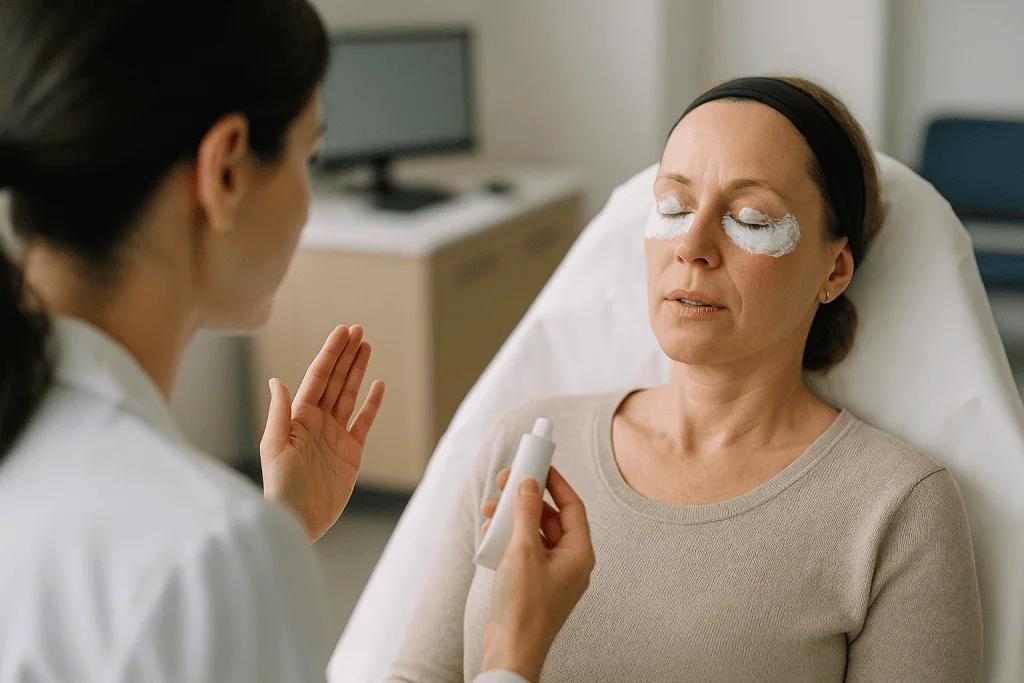
The numbing is genuinely useful, but two limits are worth understanding before you sit down.
First, topical anesthetics act mainly on the epidermis and the very upper dermis. That is exactly where the arc vaporizes tissue, so the sharp component of each dot is dulled. The heat, however, spreads slightly deeper, and warmth is sensed by different nerve fibers that the cream reaches less completely. This is why most people describe the session as “hot” more than “painful.”
Second, the eyelids, the upper lip and the skin around the nostrils are densely supplied with sensory nerves and have thin skin. Numbing there is less complete than on a cheek or the abdomen, so expectations should be set accordingly.
A responsible practitioner will also ask about allergies to local anesthetics, about any heart rhythm or liver conditions, and about other medicines you take, because topical anesthetics are absorbed into the bloodstream in small amounts. That conversation, and any decision about which anesthetic to use, belongs to the treating team, not to a product label or an online guide.
The dot pattern: why a grid, and why the spacing matters
Watch a skilled operator and you will notice they are not scribbling. They lay dots in deliberate rows, then often a second offset row, building a pattern that looks like a fine mesh. The logic is borrowed from fractional laser resurfacing, where treating a fraction of the skin surface while leaving intact skin between the injured columns speeds healing and lowers scarring risk (Mayo Clinic).
Each plasma dot is a small full-thickness wound of the epidermis. The untouched skin between dots is not merely spared; it is the source of the cells that will migrate across and re-epithelialize each spot. If dots are placed too densely, those islands of healthy skin shrink and healing slows. If dots overlap, the wound becomes confluent, deeper heat accumulates, and the risk of texture change and pigment problems rises.
The pattern also drives the immediate visual effect. Because heated collagen contracts toward the center of each dot, a grid of dots pulls the skin between them taut in every direction, like tightening laces on a shoe. Operators often use a “spray” technique, holding the pen slightly further away to create a scattered field of shallower dots, in the hollow of the lid, and a tighter “dot” technique along a fold where they want more pull.
Spacing is adjusted for skin thickness and location. Eyelid skin is among the thinnest on the body, so dots there are typically spaced more generously and applied with lower energy than on the neck or abdomen. There is no universal template; the operator is reading your skin as they go.
What you feel during the session, stage by stage
Here is the honest sensory map, drawn from how people commonly describe it and from the biology of what is happening.
Cleansing and mapping. The area is cleaned, any makeup or oils removed, and the practitioner may draw a light outline. Nothing to feel yet beyond cold antiseptic.
Numbing. The cream can tingle or feel cool. Some people notice mild redness as it absorbs. The skin gradually feels thick and distant to the touch.
Test dots. A careful operator places a few dots at the edge of the area to check your comfort and how your skin reacts. Expect a short, bright pinprick of heat, similar to a spark from a fireplace landing on your hand, gone almost instantly.
The main pass. Dots arrive in rhythm, several per second. The dominant sensation is warmth building over the area, punctuated by sharper snaps where numbing is thinner. On eyelids, many people feel a reflexive urge to flinch or tear up even when discomfort is low; that is a protective reflex, not a sign of injury. The smell of singed skin is noticeable.
Afterward. Once the pen stops, the area feels hot and tight, much like a fresh sunburn. Swelling begins within the first hour, and around the eyes it can be pronounced. The dots darken to small brown crusts. A cooling gel or a barrier ointment is often applied.
Discomfort varies widely between people, and any decision about additional pain control during or after the session rests with the practitioner and, where relevant, your doctor.
Who a plasma session is usually for, and who is asked to wait
Plasma treatment is generally considered for mild skin laxity in small, well-defined areas: the upper eyelid hood, fine lines around the eyes and mouth, and small areas of loose skin on the neck or abdomen. It is not a substitute for surgical lifting when laxity is significant; the amount of skin it can contract is limited by how much heat thin skin can safely receive.
People are commonly asked to postpone or avoid treatment when:
- They have a history of keloid or hypertrophic scarring, because any deliberate wound can trigger the same response.
- Their skin is naturally darker in tone. Heat injury carries a meaningfully higher risk of post-inflammatory hyperpigmentation, a lasting darkening of healed skin, in deeper skin tones, and this risk is well documented across resurfacing procedures (Cleveland Clinic, Mayo Clinic).
- They are pregnant or breastfeeding, mainly because safety data are lacking and pigment changes are more likely during pregnancy.
- They have an active infection, cold sore, eczema flare or open lesion in the area, since treating inflamed skin invites complications.
- They have diabetes with poor wound healing, an autoimmune skin condition, or take medicines that suppress immunity or increase photosensitivity. Anyone on prescribed medicines should discuss timing with the prescribing clinician rather than pause anything on their own.
- They have had a recent sunburn or tan, or cannot avoid sun exposure during healing.
A thorough consultation is not a formality. In many jurisdictions, this kind of energy-based procedure is offered in settings with widely varying oversight, and national health services advise checking a practitioner’s training, insurance and complication planning before any non-surgical cosmetic procedure (NHS). The final judgment about suitability sits with the person treating you.
Does fibroblast plasma really work? What the evidence shows
This is where honesty matters most. The mechanism is plausible and shares its biological rationale with better-studied resurfacing methods. Heat-induced collagen contraction is real and measurable; the wound-healing cascade that follows dermal injury is textbook physiology (MedlinePlus).
What is thin is the outcome evidence specific to handheld plasma pens. Published work consists largely of small case series and modest single-center studies, many focused on the upper eyelid, often with short follow-up and without a control group treated some other way. Large randomized trials comparing plasma pens against sham treatment, laser or surgery over several years are lacking. That does not mean the treatment does nothing; it means the size and durability of the benefit are not established to the standard used for medical claims.
Two further cautions apply. First, immediate contraction produces a striking short-term look that flatters before-and-after photos taken within weeks, while longer-term results are quieter and less often photographed. Second, regulatory clearance varies by device and by country, and many handheld pens sold to practitioners and consumers have not been evaluated by a regulator specifically for skin tightening. Asking which named device will be used, and what it is cleared for, is reasonable.
Mainstream guidance on wrinkles and skin laxity lists treatments with a longer evidence trail, including topical retinoids, chemical peels, laser resurfacing, and surgical options, each with its own trade-offs (Mayo Clinic). A plasma pen belongs in the conversation as one option among these, described with the uncertainty it deserves, rather than as a proven replacement for any of them.
Microneedling vs fibroblast vs laser resurfacing: how they compare
People searching “which is better, microneedling or fibroblast” usually want a single winner. There isn’t one, because the three most common non-surgical resurfacing approaches injure the skin in different ways and suit different goals. The table sets them side by side in neutral terms.
| Feature | Fibroblast plasma pen | Microneedling | Fractional ablative laser |
|---|---|---|---|
| How the injury is made | Electrical arc vaporizes pinpoints of epidermis and heats upper dermis; no skin contact | Fine needles physically puncture to a set depth; no heat unless radiofrequency is added | Light energy vaporizes columns of tissue and heats surrounding dermis |
| Typical target | Small areas of mild laxity, eyelid hooding, fine lines | Texture, acne scars, overall tone; laxity effect is modest | Wrinkles, sun damage, scars, laxity across larger areas (Mayo Clinic) |
| Visible surface effect | Brown crusts in a grid that shed over days | Pinpoint bleeding and redness; no crusting | Raw, weeping, swollen skin that peels as it heals (Mayo Clinic) |
| Pigment-change risk | Present; higher in deeper skin tones | Lower, since little heat is involved | Present; higher with ablative settings and deeper skin tones |
| Evidence base | Small studies, limited follow-up | Moderate, mainly for scars and texture | Larger and longer-standing |
| Typical setting | Varies widely by country and provider oversight | Clinics and some at-home devices | Medical clinics under clinician supervision |
A useful way to think about it: microneedling is a mechanical treatment with heat left out, laser is a heat treatment with precise depth control, and the plasma pen is a heat treatment whose depth depends heavily on the operator’s hand. Which trade-offs suit you is a decision for a consultation, not a comparison chart.
Plasma pen healing stages: what the following days and weeks usually look like
Because each dot is a small burn, recovery follows the ordinary phases of wound healing described by MedlinePlus: an inflammatory phase with redness and swelling, a proliferative phase in which new epidermis grows across and fibroblasts build collagen beneath, and a remodeling phase that continues quietly for months after the surface looks healed.
The first day or two. Swelling peaks, and around the eyes it can be dramatic enough that lids look puffy or partly closed. The area feels hot and tight. The dots are dark brown and dry.
Roughly the first week. Swelling subsides. The crusts begin to lift at their edges and shed on their own, revealing pink, shiny new skin beneath. This mirrors the timeline Mayo Clinic describes for ablative resurfacing, where treated skin dries and peels over the first week and the surface is generally closed within one to two weeks, though individual healing varies and no practitioner can promise a date.
The following weeks. The pink fades gradually toward normal color. Mayo Clinic notes that after resurfacing procedures, redness can persist for several months in some people. Strict sun protection through this window is the single most useful thing you can do, because new skin pigments unevenly when exposed to ultraviolet light (Cleveland Clinic).
Months onward. Any collagen remodeling happens here, invisibly. If a second session is being considered, practitioners generally wait until this remodeling has had time to run its course before deciding.
Picking or scrubbing crusts, applying unapproved products, or resuming makeup before the surface is closed are the most common ways people turn a routine recovery into a complicated one. Aftercare instructions from your treating team override anything general written here.
What are the downsides of using a plasma pen? Side effects in plain language
Every deliberate wound carries risk, and plasma pen side effects fall into three groups: expected, uncommon but recognized, and rare but serious.
Expected. Swelling, redness, heat, crusting, itching as the surface heals, and a period of pink or blotchy skin afterward. These are part of the process rather than complications.
Uncommon but recognized. The most consequential is post-inflammatory hyperpigmentation, in which healed dots or the whole treated field turn darker than surrounding skin. It is more likely in deeper skin tones, after sun exposure during healing, and when energy or density was too high. Cleveland Clinic notes that this darkening can take months to fade and in some cases persists longer. The reverse, hypopigmentation, where dots heal paler than surrounding skin, is less common but can be permanent and is especially visible on tanned or darker skin. Texture changes, including a faint pitted or “grid” appearance where dots healed unevenly, are also reported. Infection can follow any open wound, and reactivation of cold sores is a known trigger around the mouth.
Rare but serious. Scarring, including raised hypertrophic scars, deeper burns from prolonged or overlapping arcs, and injury to the eye when treating eyelids without adequate protection. Reports of harm have tended to cluster around untrained operators, at-home devices and treatment of unsuitable skin.
Alternatives exist across a spectrum. Topical retinoids and sun protection address early changes slowly; chemical peels, microneedling and laser resurfacing offer other routes to controlled injury with different risk profiles; surgical procedures address true laxity directly (Mayo Clinic). A frank consultation should place a plasma pen in that spectrum rather than presenting it in isolation.
What people often get wrong about how a fibroblast plasma pen works
Misconceptions travel faster than physics, so a few corrections are in order.
“It uses plasma from your blood.” No. The confusion with platelet-rich plasma is understandable, but the pen uses ionized gas, not any blood product. Nothing is drawn from you or injected.
“Non-surgical means no wound.” Each dot is a small burn through the epidermis. “Non-surgical” describes the absence of incisions, not the absence of injury or downtime.
“The pen touches the skin.” The arc jumps across an air gap. Contact is a technique error, not the method.
“Results are permanent.” Skin keeps aging after any procedure, and the collagen that contracts or rebuilds is subject to the same slow decline as the rest (MedlinePlus). Published follow-up on plasma pens is short, so durability is simply not well characterized.
“More dots, better lift.” Density beyond what the skin can heal raises the risk of pigment change and texture problems without adding proportional benefit. Restraint is the skilled choice.
“It works the same on every skin tone.” Heat-based procedures carry higher pigment-change risk in deeper skin tones, a point consistently made in mainstream guidance on resurfacing (Cleveland Clinic, Mayo Clinic).
“It’s proven because a study exists.” A handful of small case series is a starting point for research, not the level of evidence behind established treatments. Saying so is not skepticism for its own sake; it is what the literature currently supports.
“The device brand is what matters.” Operator training, patient selection, energy settings and aftercare have far more influence on outcome and safety than the logo on the pen.
Questions to ask your care team before a fibroblast session
A good consultation should leave you with clear answers to each of these. Bring the list; nobody minds a prepared patient.
- What is your training in energy-based skin procedures, and how many treatments of this specific area have you performed?
- Which named device will be used, and what has it been cleared for by the relevant regulator in this country?
- Looking at my skin tone, history and the area I want treated, what is my personal risk of pigment change or scarring, and would you treat a small test area first?
- What numbing will be used, how will you check it is working, and what should I tell you about my medical history and medicines beforehand?
- How many dots, at what spacing and energy, are you planning, and why that plan for me?
- What will the area look like at day two, day seven and week four, and what is the range of recovery I should plan around, understanding it is not a promise?
- What exactly should I put on the skin afterward, and what should I avoid, including makeup, exercise, heat and sun?
- Which signs mean I should contact you urgently, and how do I reach you outside office hours?
- Who manages a complication such as infection or lasting pigment change, and is a medical practitioner available if one arises?
- What are my alternatives, including doing nothing for now, and how do their risks and evidence compare?
National health services recommend confirming a practitioner’s qualifications, insurance and complication arrangements before any non-surgical cosmetic procedure, and choosing a setting where a medically trained person is accountable for your care (NHS). Any decision to go ahead, adjust the plan or stop remains with you and the team treating you.
When to call your doctor after a plasma pen treatment
Most recoveries are uneventful, and heat, swelling, itching and crusting are expected. Some signs, however, point to a problem that needs medical attention rather than reassurance from a message thread. Contact your treating practitioner or a doctor promptly if you notice:
- Spreading redness beyond the treated area, increasing warmth, or streaks tracking away from the site, which can signal infection.
- Yellow or green discharge, a foul smell, or crusts that become soft, wet and honey-colored rather than dry.
- Pain that worsens after the second day instead of easing, or pain out of proportion to what you were told to expect.
- Fever, chills or feeling generally unwell.
- Clusters of small blisters, particularly around the mouth or nose, which may indicate a cold sore reactivation that spreads readily across healing skin.
- Any change in vision, eye pain, sensitivity to light, or a feeling that something is in the eye after eyelid treatment.
- Swelling that closes the eye completely, or swelling of the lips or tongue, or any difficulty breathing, which requires emergency care.
- Raised, thickened, firm or dark-red areas developing in the healed skin over the following weeks, which may be early scarring.
- Pigment darkening or lightening that is progressing rather than fading.
Bring the name of the device, the settings if you know them, and the date of treatment so the clinician can judge what is happening. Do not apply home remedies, steroid creams or bleaching products on your own initiative; the decision about how to manage any complication belongs to the doctor examining you.
Frequently asked questions
Does fibroblast plasma really work?
It has a plausible mechanism but a thin evidence base. Heat contracts collagen immediately, and controlled injury does trigger fibroblasts to make new collagen, which is standard wound biology. However, published studies of handheld plasma pens are mostly small case series with short follow-up and no comparison group, so the size and durability of the cosmetic benefit are not established to the standard behind longer-studied treatments like laser resurfacing.
Do you touch the skin with a plasma pen?
No. The tip is held a fraction of a millimeter above the skin and the electrical arc jumps across the air gap, vaporizing a pinpoint of the outer layer. Direct contact is a technique error that spreads heat by conduction and creates a wider, less predictable wound. Occasional brushing over curved areas like the eyelid can happen, which is one reason operator skill influences results so heavily.
What are the downsides of using a plasma pen?
Expected downsides include swelling, crusting and a period of pink or blotchy skin. Recognized complications include post-inflammatory hyperpigmentation, which is more likely in deeper skin tones and can persist for months, permanent pale spots, grid-like texture change, infection and cold sore reactivation. Rarer but serious problems include scarring and eye injury during eyelid treatment. Untrained operators and at-home devices account for a disproportionate share of reported harm.
Which is better, microneedling or fibroblast?
Neither is universally better; they injure skin differently. Microneedling punctures mechanically without heat, suits texture and scars, has lower pigment-change risk and a moderate evidence base. Fibroblast plasma uses heat to contract and remodel small areas of mild laxity, with higher pigment risk and a smaller evidence base. Which trade-offs fit your skin tone, goals and tolerance for downtime is a consultation decision.
What does a plasma pen feel like during treatment?
Most people describe building warmth punctuated by brief, sharp snaps, comparable to small sparks landing on the skin. Topical numbing dulls the sharpness but reaches heat-sensing nerves less completely. Eyelids, lips and the area around the nostrils are more sensitive because the skin is thin and densely innervated. Afterward the area feels hot and tight, like a fresh sunburn, and swelling develops within the first hour.
What are the plasma pen healing stages?
Healing follows the standard wound phases described by MedlinePlus. Swelling and heat dominate the first day or two, then dry brown crusts lift and shed over roughly the first week to reveal pink new skin, a timeline similar to what Mayo Clinic describes for ablative resurfacing. Pinkness fades over the following weeks, sometimes months, while collagen remodeling continues invisibly. Sun protection throughout is essential.
Why is numbing cream used before a plasma session?
Because each dot is a small burn, and topical anesthetics from the local anesthetic class block pain signals in the outer skin where the arc does its work. The cream reduces the sharp component of each dot considerably but is less effective against the sensation of heat. Which anesthetic is used, how it is applied and whether it is appropriate given your medical history are decisions for the practitioner.
Why are the dots placed in a grid pattern?
The grid leaves intact skin between each wound, and that healthy skin supplies the cells that regrow the surface of each dot, speeding healing and lowering scarring risk. It also creates an even pull in all directions as heated collagen contracts toward each spot. Overlapping or overly dense dots accumulate heat, slow healing and increase the chance of pigment and texture problems.
Is a plasma pen safe for darker skin tones?
Heat-based resurfacing carries a higher risk of lasting pigment change in deeper skin tones, a point made consistently in mainstream guidance on resurfacing procedures. Post-inflammatory hyperpigmentation can take months to fade, and hypopigmentation can be permanent. Many practitioners advise caution or a small test area first. Whether treatment is appropriate for your skin is an individual clinical judgment made during consultation.
Who should not have fibroblast plasma treatment?
People with a history of keloid or raised scarring, active infection or cold sores in the area, recent sunburn or tan, pregnancy or breastfeeding, poorly controlled diabetes, autoimmune skin disease, or medicines that suppress immunity or increase light sensitivity are commonly asked to postpone or avoid it. Anyone taking prescribed medicines should discuss timing with their prescribing clinician rather than stopping anything on their own.
References
This article is for general information only and is not a substitute for professional medical advice. Please consult a qualified doctor about your individual situation.

More from the Blog
How to Prepare for Microneedling: Sun, Retinoids and the Two Weeks Before Your Session
Preparing for microneedling usually means keeping the skin out of strong sun and free of sunburn or tan for the two weeks beforehand, pausing…
IPL Photorejuvenation Results: Why Spots Darken Before They Fade and How Sessions Build
IPL photorejuvenation results usually appear gradually. Treated brown spots often turn darker and coffee-ground-like for several days before flaking away over one to two…

Surface Reconstruction Recovery: Early Supervised Walking, Physical Therapy and Milestones
Surface reconstruction recovery after ocular surface surgery usually unfolds in stages: the corneal surface layer re-covers over days, comfort and light sensitivity settle over…

Before Aesthetic Filling: Blood Thinners, Alcohol and Supplements Your Doctor Will Review
Before dermal fillers, clinicians typically review anything that increases bruising or bleeding: prescribed anticoagulants and antiplatelet drugs, over-the-counter anti-inflammatory painkillers, supplements such as fish…
Reconstruction After Cancer or Infection: How Grafts, Flaps and Staged Surgery Are Planned
Reconstructive surgery after cancer or infection rebuilds tissue removed by a tumor operation or destroyed by infection, using skin grafts, flaps of tissue moved…

Why Hands Show Age Early: Volume Loss, Visible Veins and Sun Spots and How Each Is Treated
Hands show age early because their skin is thin, has very little fat beneath it, and spends decades in sunlight without protection. Over time…