

How a Rhytidectomy (Facelift) Is Performed: SMAS Work, Incisions and Skin Redraping

Key Takeaways
- Modern facelifts carry the lift in the SMAS, a fibrous layer under the skin, and lay the skin back down without tension, which is why a well-done result does not look pulled.
- Incisions run from the temple hairline, around the ear (in front of or behind the tragus) and into the hair behind it, with a separate incision under the chin only when the neck muscle is tightened.
- SMAS plication, SMASectomy, SMAS flaps and deep plane dissection are different ways to tighten the same layer, and published comparisons have not shown one to be consistently superior.
- Platysmaplasty is a distinct step that stitches the two halves of the neck muscle together through a chin incision; a facelift alone does not correct the front of the neck.
- Hematoma is the most common complication and, according to Mayo Clinic, usually appears within the first day, which is why sudden one-sided swelling is an urgent call.
- Terms such as Cinderella facelift, liquid facelift and lunchtime lift are marketing labels rather than defined surgical procedures, and there is no single best age for a rhytidectomy.
A rhytidectomy, or facelift, is performed under general anesthesia or sedation with local numbing. The surgeon makes incisions hidden along the temple hairline, around the ear and into the hair behind it, lifts the skin, then tightens the deeper SMAS layer that supports the cheek and jaw. The skin is redraped without tension, excess is trimmed and the incisions are closed, often with small drains and a dressing.
The surgeon has not said much yet. She stands beside the exam chair, presses two fingertips just below the cheekbone and guides the tissue gently upward and back toward the ear. In the mirror, the jawline you remember reappears for about three seconds. Then she lets go, and the question that has been circling for months finally lands: what would it actually take to do that, and keep it there?
Search for rhytidectomy procedure steps and you tend to get one of two things: glossy promises or a surgical textbook. Neither answers what most people really want to know, which is what happens to their face, layer by layer, once they are asleep.
This explainer walks through that operation the way a surgeon would describe it to a colleague, translated into plain language: where the cuts go, what the SMAS is and why it carries the lift, how the skin is laid back down, and what the weeks afterward usually look like. The decisions, as always, stay with you and your treating team.
What actually happens during a rhytidectomy? The procedure steps in plain language
Strip away the vocabulary and a facelift is a repositioning operation, not a stretching one. Gravity, sun exposure and the slow loss of fat and bone support let the soft tissue of the midface and jaw drift downward over decades. A rhytidectomy (the medical name for a facelift, from the Greek for wrinkle and removal) moves that tissue back toward where it sat and removes the skin that has become surplus in the process.
The operation follows a fairly consistent sequence. After anesthesia, the surgeon marks the incision lines, most of them in the hairline and the natural folds around the ear. The skin is lifted away from the layer beneath it, a fibrous sheet called the SMAS, or superficial musculoaponeurotic system, which wraps the muscles of facial expression like a stocking. That layer is then tightened, folded or shifted upward and back and secured with stitches. Only after the deep layer is doing the work is the skin redraped over it, trimmed and closed.
Mayo Clinic describes the operation as generally taking about two to four hours, longer when neck work, eyelid surgery or fat grafting are added. Most people go home the same day or after one night, depending on the surgeon’s preference and the anesthesia used.
The order matters more than any single step. Older facelift techniques tightened skin alone, which produced the windswept look people still fear and which relaxed quickly, because skin is elastic and was never designed to hold a load. Modern approaches ask the SMAS to bear the tension and let the skin simply follow. The rest of this article looks at each of those steps in turn, including what surgeons argue about among themselves.
Anesthesia, marking and the first hour
Before any incision, there is a quiet stretch of preparation that patients rarely hear about. With the person sitting upright, the surgeon draws the plan in surgical marker: the incision path, the direction the SMAS will be lifted, areas of fat to preserve or trim and any asymmetry that already exists between the two sides. Marking upright matters because the face changes shape the moment someone lies flat and gravity stops pulling in its usual direction.
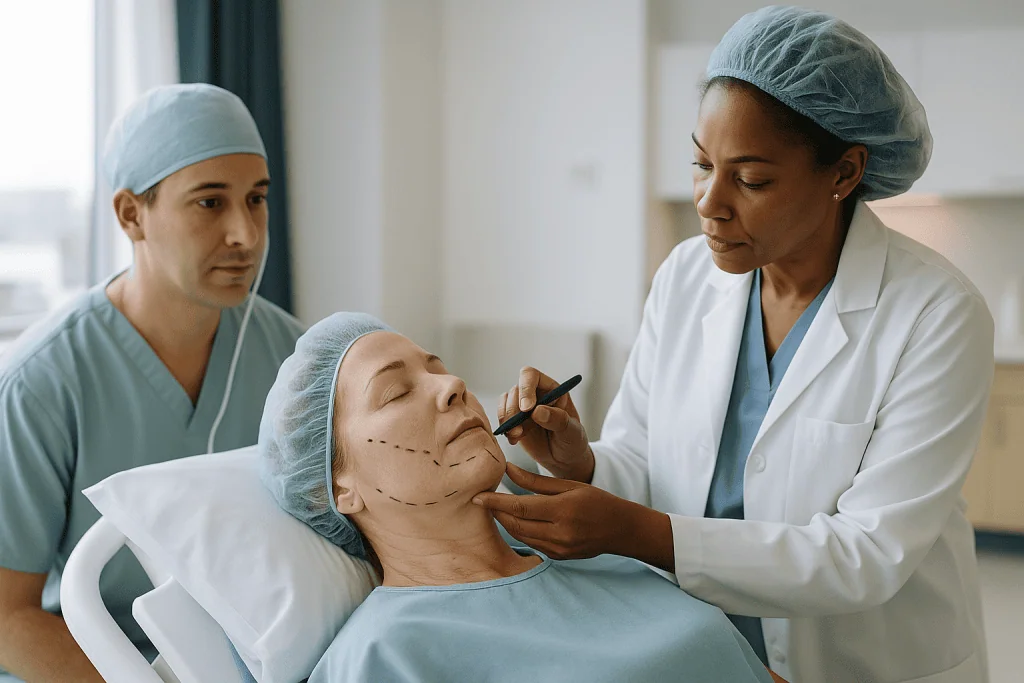
Facelifts are performed either under general anesthesia, where the person is fully asleep with breathing supported, or under intravenous sedation combined with local anesthetic, sometimes called twilight anesthesia, where the person is deeply relaxed but breathing on their own. MedlinePlus and Mayo Clinic both describe these two options as standard; the choice depends on the length of the operation, other procedures planned, the patient’s health and the anesthesia team’s judgment.
Whichever route is used, the surgeon then injects a dilute mixture of local anesthetic and a vessel-constricting agent under the skin of the face and neck. This tumescent infiltration, as it is known, does two jobs at once: it numbs the tissue and it narrows small blood vessels so the surgeon can see clearly and bleeding stays low. It is one reason facelift blood loss is usually modest despite the size of the area.
Hair is not shaved. Strands along the incision lines are combed away or taped, because preserving the hairline is part of the point. The face is cleaned with antiseptic, sterile drapes are placed and a final check confirms the plan on both sides. Only then does the first incision begin, usually at the temple.
Facelift incision placement: where the cuts go and why
Ask a surgeon what separates a good facelift from a detectable one and incision placement will come up early. The incisions are long, often running from the temple to the hairline behind the ear, but they are designed to sit where light, hair and the folds of the ear disguise them.
The classic path has four parts. It starts inside the temporal hairline or along its edge, chosen so the sideburn is not pulled upward. It travels down in front of the ear, either just in front of the tragus (the small cartilage flap that partly covers the ear canal) or tucked behind its edge so the scar hides in the shadow of the canal. It curves under the earlobe, then runs up behind the ear in the crease where the ear meets the scalp, before turning back into the hair behind the ear. A short separate incision under the chin is added when the neck muscle needs tightening.
Each choice carries a trade-off. A scar behind the tragus is nearly invisible but can distort the tragus or pull hair-bearing cheek skin onto it if the skin is closed under tension. A scar in front of the tragus avoids that risk but is more exposed. Incisions inside the hairline hide well yet can shift the hairline if a large amount of skin is removed; incisions along the hairline edge preserve its position but sit in plainer view.
Shorter variants exist. A so-called short-scar or mini facelift stops the incision before the hair behind the ear and lifts less tissue, which suits people with early jowling and little loose neck skin. Which layout fits which face is an anatomical decision, and it is a fair question to ask your surgeon to draw the plan on a photograph before you agree to it.
What is the SMAS, and why surgeons lift it rather than the skin
Pinch the skin of your cheek and you can feel it move over something firmer beneath. That something is the SMAS. The superficial musculoaponeurotic system is a continuous layer of fibrous tissue and thin muscle that sits under the fat of the face, connects upward to the muscle of the forehead and downward to the platysma muscle of the neck, and anchors the skin to the deeper structures through many tiny fibrous strands.

Surgeons care about this layer for a mechanical reason. Skin is elastic; it stretches, then slowly gives. The SMAS is far less elastic and behaves more like a hammock. When the hammock sags, the fat pads of the cheek slide down and forward, creating the jowl along the jaw and deepening the fold that runs from nose to mouth. Pulling the skin tight over a sagging hammock flattens the surface for a while but does nothing to the load underneath, so the sag returns and the skin, now stretched beyond its design, looks unnaturally smooth or pulled.
Repositioning the SMAS itself lifts the fat pads back over the cheekbone and off the jawline. The skin can then be laid down without tension, which is what allows a result to look like the person’s own face at an earlier point rather than a different face.
The SMAS is also the map surgeons use to stay safe. The branches of the facial nerve, which move the eyebrow, close the eye, lift the lip and turn down the corner of the mouth, run beneath the SMAS for most of their course. Working on top of it is anatomically forgiving; working beneath it requires precise knowledge of where those branches surface. That distinction drives the debate covered in the next two sections.
SMAS facelift technique: plication, SMASectomy and SMAS flaps
Once the skin has been lifted off the SMAS across the cheek and along the jaw, the surgeon has to decide how to tighten that layer. Three families of technique cover most operations, and surgeons choose among them based on how thick the SMAS is, how much laxity exists and where the loose tissue needs to travel.
SMAS plication is the simplest. Plication means folding: the surgeon gathers the loose SMAS into a fold that runs from the cheek toward the ear and stitches the fold down, shortening the layer without removing any tissue. Because nothing is cut beneath the surface, the nerves stay protected and recovery tends to be straightforward. It suits thinner faces with moderate sagging.
SMASectomy removes a strip of SMAS, typically a crescent along the line between the sagging cheek fat and the fixed tissue in front of the ear. The two cut edges are then sewn together, which lifts the cheek and jowl in one movement. Removing a strip rather than folding it avoids bulk in fuller faces.
A SMAS flap, sometimes called imbrication, involves cutting into the SMAS, lifting it as a sheet a short distance from the underlying tissue and then advancing that sheet upward and backward before suturing it to firm tissue near the ear and cheekbone. The direction of that pull is a matter of surgical judgment: more vertical to lift the midface, more horizontal to sharpen the jawline. Extended versions carry the dissection further toward the nose.
None of these is universally superior. Comparative studies published in surgical journals indexed on PubMed have struggled to show consistent long-term differences between them, partly because faces, surgeons and outcome measures vary so widely. What the evidence does support is the principle they share: the lift lives in the SMAS, not the skin.
Deep plane vs SMAS facelift: what the difference really means
Few phrases in aesthetic surgery generate as much marketing heat as deep plane. Understanding what it actually describes helps you ask sharper questions.
In a standard SMAS facelift, the surgeon separates skin from SMAS over a broad area, then tightens the SMAS as described above. The skin and the SMAS are handled as two separate layers. In a deep plane facelift, the surgeon lifts skin and SMAS together as a single, thicker unit and instead dissects beneath the SMAS, in the plane between it and the muscles of expression. From there the surgeon releases the retaining ligaments: short, tough bands that tether the soft tissue to the cheekbone and jaw and that resist any lift attempted above them. Once those ligaments are released, the whole composite flap can move as one piece, and it is secured in its new position at the deep layer.
Advocates argue this releases the midface more completely, softens the fold beside the nose and avoids the thin, poorly supplied skin flap that can result from separating skin widely. Critics point out that it puts the dissection directly in the layer where facial nerve branches emerge, demands more experience and has not shown clearly better durability in controlled comparisons. Both positions have support in the surgical literature, and reviews on PubMed generally conclude that surgeon experience with a given technique influences results more than the technique label.
There is also a middle ground. Many surgeons perform a SMAS flap that becomes sub-SMAS only in the cheek, or release selected ligaments without a full deep plane dissection. If a surgeon proposes one approach, a reasonable question is why it fits your anatomy specifically, rather than why it is better in general.
Skin redraping and closure: why tension is the enemy
With the SMAS secured, the surgeon turns to the step the whole operation is named for, and it is less dramatic than most people imagine. The lifted skin is laid gently back over the newly positioned deep layer. It is not pulled; it is redraped, in roughly the same upward and backward direction as the SMAS, then allowed to settle.
What is now surplus becomes obvious. The skin overlaps the incision line in front of and behind the ear, and the surgeon marks and trims that excess in stages, tacking it at a few key points first, most importantly at the top of the ear and the point where the ear meets the scalp behind, so that neither the earlobe nor the hairline is dragged out of position. The earlobe is a tell-tale: pulled downward or forward, it produces the so-called pixie ear that signals a facelift closed under tension.
Closure uses a combination of fine sutures at the skin edge and sometimes small staples within the hair, where they do not show and are easy to remove. Around the tragus, the skin is often thinned so the cartilage keeps its natural shape.
Small drainage tubes may be placed under the skin behind the ear to carry away fluid and blood that would otherwise collect; Mayo Clinic notes these are usually removed within a day or two. A soft padded dressing wraps the face and neck overnight to apply gentle, even pressure.
The reason surgeons speak about tension so insistently comes back to healing. Skin closed tight has less blood flow at its edges, scars more widely, can lose hair along the line and, in the worst case, may not survive. Skin laid down without strain heals as a fine line. The lift has already been done underneath; the skin’s only job now is to heal.
Rhytidectomy vs platysmaplasty: what happens in the neck
People searching for the difference between rhytidectomy and platysmaplasty are often asking a practical question: will a facelift fix my neck? The honest answer is that a facelift moves the jawline and cheek, and a separate step is needed for the front of the neck.
Platysmaplasty is surgery on the platysma, a thin sheet of muscle that runs from the collarbone up over the front of the neck and blends into the SMAS of the lower face. In youth its two halves meet near the midline under the chin. With age they can separate and slacken, producing the vertical bands many people notice when they clench their jaw, while fat above and below the muscle blunts the angle between chin and neck.
Through a short incision hidden in the crease under the chin, the surgeon removes excess fat if needed, then brings the two edges of the platysma together with a row of stitches, sometimes cutting the muscle partly across at the level of the throat to let the upper portion tighten more sharply. This corset-like repair defines the angle of the neck from the front. The sideways pull of the facelift SMAS work then tightens the platysma from the sides, so the two procedures complement each other.
Many surgeons treat the neck as part of a cervicofacial rhytidectomy, the full name for a facelift that includes the neck, rather than as a separate operation. Someone with early jowls and a firm neck may need no neck work at all; someone whose main concern is the neck may be offered a neck lift with platysmaplasty and only a limited facelift. Which combination is appropriate depends on where the laxity actually is, and that assessment belongs to the examining surgeon.
Rhytidectomy procedure steps at a glance
The sequence below summarizes a typical cervicofacial rhytidectomy as described by Mayo Clinic, Cleveland Clinic and MedlinePlus. Individual surgeons vary the order and the technique, so treat this as a map rather than a script for your own operation.
| Step | What happens | Why it matters |
|---|---|---|
| Marking | Incisions and lift direction drawn with the patient sitting up | Gravity changes the face when lying down; upright marks are accurate |
| Anesthesia | General anesthesia or IV sedation with local; tumescent injection under the skin | Comfort, safety and reduced bleeding |
| Incisions | Temple hairline, around the ear, behind the ear into the hair; under the chin if the neck is treated | Scars hidden in hair and natural folds |
| Skin elevation | Skin lifted off the SMAS over cheek, jaw and neck | Exposes the supporting layer for repositioning |
| SMAS work | Plication, SMASectomy, SMAS flap or deep plane release and suspension | Carries the lift; protects the skin from tension |
| Neck | Fat contouring and platysmaplasty through the chin incision when needed | Restores the angle between chin and neck |
| Redraping and trimming | Skin laid back without pull; excess removed in stages | Natural contour, fine scars, earlobe and hairline preserved |
| Closure and dressing | Fine sutures and staples in hair; drains and a padded wrap | Even pressure and fluid removal reduce swelling and collections |
Two features of this table deserve emphasis. First, the skin appears near the end, not the beginning, which reverses the intuition most people bring to the word facelift. Second, the neck is a distinct step with its own incision and its own muscle, which is why a facelift alone rarely satisfies someone whose main concern is under the chin.
Mayo Clinic’s estimate of roughly two to four hours covers this sequence on both sides; adding eyelid surgery, brow lifting or fat grafting extends it, and your surgeon should give you a personalized estimate before the day.
Who a facelift is usually for, and who is usually asked to wait
There is no single right age for a rhytidectomy, and the surgeons who take their work seriously will say so. What they look for is a pattern of change, not a number: loose skin and descended tissue along the jaw and neck, deepening folds beside the mouth, a blurred jawline, all in someone whose skin still has enough elasticity to redrape smoothly and whose general health can carry a several-hour operation.
Mayo Clinic frames the ideal candidate in terms of realistic expectations and stable health. The operation addresses sagging and excess skin. It does not change skin texture, fine lines, sun damage or pigment, and it does not restore lost volume on its own, which is why fat grafting or other volumizing approaches are sometimes discussed alongside it.
Several groups are commonly asked to wait or to prepare first. People who smoke or use nicotine are a consistent concern: Mayo Clinic notes that smoking raises the risk of poor wound healing, hematoma and skin loss after a facelift, because nicotine narrows the small vessels that keep the thin skin flap alive. Uncontrolled high blood pressure raises bleeding risk during and after surgery. Bleeding disorders and medicines or supplements that affect clotting need review with the prescribing clinician well ahead of time; no one should stop a prescribed medicine on their own for a cosmetic operation. Significant weight fluctuation is another reason to pause, since large gains or losses after surgery change the skin envelope and can undo the result.
Surgeons also listen for the reason behind the request. A recent divorce, a job loss or pressure from someone else are situations where many surgeons suggest time rather than surgery. Body dysmorphic disorder, a condition in which perceived flaws cause distress out of proportion to their visibility, is a recognized reason to recommend against cosmetic surgery and toward other support.
Facelift recovery timeline: what the first days and weeks usually look like
The night after surgery is mostly about the dressing. Your face and neck are wrapped, your head is kept elevated and someone stays with you. The dressing usually comes off at the first follow-up visit, when the surgeon checks for any collection of blood beneath the skin, and the drains, if used, are typically removed within a day or two, according to Mayo Clinic.
Swelling and bruising are the dominant features of the first week. Mayo Clinic describes them as commonly peaking in the first few days and then easing over the following weeks; the skin of the cheeks and in front of the ears usually feels numb and tight, and the ears themselves may feel oddly unfamiliar because the sensory nerve that supplies them has been stretched. Pain is usually moderate and managed with medicines chosen by your surgical team; the need for stronger analgesia should prompt a call rather than an extra dose.
Stitches in front of the ear generally come out within the first week, with those behind the ear and in the hair following a few days later; MedlinePlus and NHS guidance describe removal over roughly the first week to ten days. Most people feel comfortable appearing in public, often with camouflage makeup, at around two to three weeks, a range both Mayo Clinic and Cleveland Clinic give, and desk-based work commonly resumes in that window. Vigorous exercise, heavy lifting and anything that raises blood pressure sharply are usually held for several weeks because they increase the risk of late bleeding.
The slower story unfolds over months. Firmness along the jaw softens, numbness recedes, scars fade from pink toward skin tone and small asymmetries in swelling settle. NHS guidance suggests the final appearance can take several months to emerge. The face you see at three weeks is not the face you will see at six months, and your team will tell you which changes are expected and which they want to look at.
What are the risks of a facelift? Nerves, hematoma and healing
Every operation carries risk, and a facelift’s risks are specific enough to be worth understanding before consent. Mayo Clinic, Cleveland Clinic and the NHS list a consistent set.
Hematoma, a collection of blood under the skin, is the most common complication. Mayo Clinic notes it usually forms within the first day after surgery and causes rapidly increasing swelling, tightness and pain, typically on one side. It is treated by returning to the operating room to release the blood and stop the bleeding, and prompt treatment protects the overlying skin. Men, people with high blood pressure and people on blood-thinning medicines have higher rates in surgical series.
Nerve injury comes in two kinds. Sensory numbness of the cheek and ear is expected and usually temporary. Injury to a branch of the facial nerve, which controls movement, is uncommon; it can weaken the eyebrow, the eyelid closure or the lower lip, and Mayo Clinic describes it as usually temporary but occasionally permanent. The great auricular nerve, which supplies feeling to the lower ear, is the nerve most often affected in facelift surgery according to surgical references, which is why surgeons take particular care over the muscle behind the ear.
Skin healing problems include widened or thickened scars, hair loss along incision lines and, rarely, loss of a patch of skin where blood supply was too thin, a risk concentrated in smokers. Asymmetry, contour irregularities, fluid collections, infection and prolonged swelling round out the list, alongside the general risks of anesthesia and, with any longer operation, blood clots in the legs.
Alternatives exist along a spectrum. Skin resurfacing, injectable volume, muscle-relaxing injections and thread lifts address different problems and carry their own uncertainties; none repositions the SMAS. A candid consultation compares what each can and cannot change rather than presenting surgery as the only route.
What people often get wrong about facelifts
The myths around this operation are durable, and a few of them steer people toward poor decisions.
The first is that a facelift tightens skin. As this article has laid out, modern rhytidectomy repositions the SMAS and treats the skin as a covering to be laid back without strain. If a surgeon describes the operation mainly in terms of removing skin, ask what happens to the deeper layer.
The second is that terms like Cinderella facelift, lunchtime lift, liquid facelift or one-stitch lift describe defined procedures. They do not. These are marketing labels applied variously to thread lifts, injectable treatments, limited mini lifts or short-recovery packages, and there is no standardized surgical technique behind any of them. The evidence base for thread lifts in particular is limited, with short follow-up in most published series, and results are generally described as modest and temporary. When a name sounds like a fairy tale, ask for the anatomical description of what will actually be done.
The third is that there is a best age, and that going earlier always means a subtler result. Age is a poor proxy for tissue quality. Some people in their forties have marked jowling and good skin; some in their seventies have modest laxity and are in excellent health. Surgeons assess anatomy and health, not birthdays.
The fourth is that a facelift stops aging. It does not. Mayo Clinic is explicit that results are not permanent: the tissues continue to age from their new position, sun exposure and smoking accelerate that, and some people choose further surgery years later. A facelift resets a clock; it does not remove it.
The last is that a mini facelift is a lesser version for the cautious. It is a different operation for a different pattern of aging, suited to early jowls without neck laxity. Choosing it for the wrong face produces disappointment, not subtlety.
Questions to ask your care team before a rhytidectomy
A good consultation should leave you able to describe your own operation. These questions help get there, and the answers you receive tell you as much about the surgeon as about the surgery.
- Which layer will you tighten, and how: plication, SMASectomy, a SMAS flap or a deep plane release? Why does that approach suit my anatomy in particular?
- Can you draw the incision plan on my photograph, including whether the scar in front of the ear will sit in front of or behind the tragus, and how you will protect my hairline and earlobe?
- Do I need neck work, and if so, will that include platysmaplasty through an incision under the chin?
- Which anesthesia do you recommend for me, who will provide it, and will I stay overnight?
- What is your own rate of hematoma and facial nerve weakness, and how do you manage them if they occur?
- Which of my current medicines and supplements need review before surgery, and who will coordinate that with the clinicians who prescribe them?
- What will the first two weeks look like, when will I see you, and how do I reach the team after hours?
- What will this operation not change about my face, and what other options address those things?
- If I am unhappy with an aspect of the result, how and when is that assessed?
Notice that none of these ask whether a surgeon is the best or promises a particular look. Those are questions no honest surgeon can answer. What a good surgeon can do is explain their reasoning, show representative work with its limitations and describe complications in specific terms. Bring a written list, take notes or bring someone with you, and expect the plan to be reviewed again on the day of surgery. Any decision to proceed, delay or choose a different approach rests with you and the treating team.
When to call your doctor after a facelift
Most of the early recovery from a rhytidectomy is uncomfortable but uneventful. A handful of changes are different, and your surgical team will want to hear about them the moment they appear rather than at the next scheduled visit. Keep the after-hours number where you can reach it.
Call urgently, day or night, for sudden swelling that is increasing on one side of the face or neck, especially with tightness, pain that is escalating rather than settling, or a firm, bulging area under the skin. Mayo Clinic notes a hematoma usually declares itself within the first day, and timely treatment protects the skin above it. Treat any dark purple or dusky patch of skin, particularly behind the ear, in the same way.
Also call promptly for fever, spreading redness or warmth around an incision, thick or foul-smelling drainage, an incision that has opened, new weakness of the eyebrow, eyelid or corner of the mouth that was not present when you left the recovery area, or difficulty closing an eye. Chest pain, shortness of breath, or a swollen, painful calf are signs of possible blood clot and are reasons to seek emergency care immediately, not to wait for a callback.
Less alarming but still worth reporting: numbness that seems to be spreading rather than shrinking, bruising that appears far from the surgical area, persistent nausea that prevents you from drinking, or any question about a medicine you have been asked to take or pause. No one should adjust prescribed medicines during recovery without speaking to the prescriber.
If in doubt, call. Surgical teams would far rather examine a normal recovery than miss a treatable problem. Every judgment about what a symptom means, and what to do about it, belongs to the clinicians who know your operation.
Frequently asked questions
What is a Cinderella facelift?
A Cinderella facelift is a marketing name, not a defined medical procedure. It has been used to describe thread lifts, injectable combinations and short-recovery mini lifts, so two providers using the phrase may mean entirely different things. None of these repositions the SMAS the way a surgical rhytidectomy does, and published evidence for thread lifts is limited and short-term. Ask for an anatomical description of exactly what would be done before considering any treatment sold under this label.
What is the difference between rhytidectomy and platysmaplasty?
A rhytidectomy lifts the cheek and jawline by tightening the SMAS layer through incisions around the ear; a platysmaplasty tightens the platysma muscle of the front of the neck through a small incision under the chin. They address different areas and are often combined in a cervicofacial rhytidectomy, but someone with early jowls and a firm neck may need only the facelift, while someone whose concern is neck banding may be offered platysmaplasty with a limited lift.
What is the best age for a rhytidectomy?
There is no best age. Surgeons assess the pattern of sagging, skin elasticity, general health and expectations rather than a birthday. Some people show marked jowling in their forties with excellent skin; others reach their seventies with modest laxity and good health and are still suitable candidates. Mayo Clinic frames candidacy around realistic expectations and stable health, and results are not permanent at any age, so the timing decision belongs to you and your treating team.
What is the average cost of a facelift?
This magazine does not publish price figures, because the total depends on the extent of the operation, the type of anesthesia, whether neck work or other procedures are added, the facility and the surgeon’s fees, and it varies widely between regions. Cosmetic surgery is generally not covered by health insurance. Ask any surgeon you consult for a written, itemized estimate that includes anesthesia, facility charges, follow-up visits and how any complication requiring further surgery would be handled.
How long does facelift surgery take?
Mayo Clinic describes a facelift as generally taking about two to four hours, and longer when it is combined with a neck lift, eyelid surgery, brow lift or fat grafting. Time in the facility is greater because of anesthesia preparation and recovery afterward, and some surgeons keep patients overnight. Your surgeon should give you an estimate tailored to the specific combination of steps planned for you rather than a general figure.
Is a deep plane facelift better than a SMAS facelift?
Neither has been shown to be consistently better in comparative studies. A deep plane facelift moves skin and SMAS as one unit after releasing the retaining ligaments beneath, while a SMAS facelift separates the two layers and tightens the SMAS on top. Advocates of each describe advantages, but reviews indexed on PubMed generally find that surgeon experience with a given technique influences results more than the technique label. Ask why a proposed approach fits your anatomy specifically.
Where are facelift incisions placed, and will the scars be visible?
Incisions are placed in the temple hairline, along the natural folds in front of the ear (in front of or just behind the tragus), under the earlobe, in the crease behind the ear and into the hair behind it. When the neck is treated, a short incision sits in the crease under the chin. Scars usually mature to fine lines hidden by hair and ear contours, though they can widen or thicken in some people, particularly if skin was closed under tension.
What does the facelift recovery timeline look like for returning to work?
Most people feel comfortable in public, often with camouflage makeup, at around two to three weeks, a range given by Mayo Clinic and Cleveland Clinic, and desk-based work commonly resumes in that window. Swelling and bruising peak in the first few days and ease over the following weeks; stitches are removed over roughly the first week to ten days. Strenuous exercise is typically held for several weeks, and the final result continues to settle over months.
Does a facelift hurt, and what anesthesia is used?
A facelift is performed under general anesthesia or intravenous sedation combined with local anesthetic, so there is no pain during the operation. Afterward, Mayo Clinic describes discomfort as usually moderate, with tightness and numbness across the cheeks and ears more prominent than sharp pain. Your surgical team chooses and manages any pain medicines. Pain that is increasing rather than settling, particularly on one side, is a warning sign that needs a prompt call rather than more medication.
How long do facelift results last?
Results are not permanent. Mayo Clinic is explicit that the face continues to age after surgery, so tissues gradually loosen again from their new position, and sun exposure, smoking and large weight changes speed that process. Many people find the improvement remains noticeable for years because the face is compared with where it would otherwise have been, and some choose further surgery later. No surgeon can promise a specific duration for an individual.
References
This article is for general information only and is not a substitute for professional medical advice. Please consult a qualified doctor about your individual situation.

More from the Blog

What Is Included in a Mommy Makeover? The Standard Combinations, Explained
A mommy makeover is not one operation but a customized combination of cosmetic procedures performed in a single session. The standard package pairs a…

Non-Surgical Facial Rejuvenation vs a Facelift: Where Injectables and Energy Devices Stop
Non-surgical facial rejuvenation and a facelift treat different problems. Injectables soften expression lines and replace lost volume; energy devices such as radiofrequency, focused ultrasound…

The Eye Exam Before Blepharoplasty: Dry Eye Tests, Vision Checks and Why They Matter
A blepharoplasty eye exam is the ophthalmic assessment done before cosmetic or functional eyelid surgery. It typically includes a vision check, a dry eye…

Dimpleplasty Risks Explained: Asymmetry, Infection and Dimples That Fade or Deepen
Dimple surgery, or dimpleplasty, carries mostly local and cosmetic risks rather than life-threatening ones. The problems patients most often report are uneven or mismatched…

What Are the Risks of a Brow Lift? Numbness, Hair Loss at Incisions and Uneven Brows
The main brow lift risks are temporary or lasting numbness across the forehead and scalp, hair thinning or a bald strip along incisions hidden…

Are Lip Lift Results Long-Lasting? How the Upper Lip Ages After Surgery
A lip lift removes a narrow strip of skin beneath the nose, and because removed skin does not grow back, the shorter distance between…