

How a Smile Makeover Is Planned: Photographs, Digital Impressions and Smile Design

Key Takeaways
- A smile makeover is a coordinated plan, not a single procedure, and reputable planning begins with a disease check because restorations bonded to unhealthy teeth or gums fail early.
- Standardized photographs at rest, smiling, in profile and with lip retractors each answer a different design question, from how much tooth shows at rest to whether the front teeth can be lengthened.
- A digital impression is a 3D computer model captured by an intraoral scanner; it measures shape and bite precisely but cannot diagnose decay or gum disease.
- The in-mouth mock-up made from temporary resin lets you test speech, lip comfort and appearance before any enamel is removed, which is why skipping it to save a visit is a poor trade.
- Enamel does not regrow, so a plan reached through alignment, whitening and bonding preserves more tooth than one built on veneers or crowns, even if it takes longer.
- Whitening results are not permanent and typically last from a few months to about three years according to the NHS, which is why whitening is done before color-matched restorations.
A smile makeover is planned in stages: a dental health examination first, then a set of standardized photographs, a digital scan of the teeth, and a computer-aided smile design that maps proposed tooth shapes onto your own face. Most plans include a removable mock-up so you can preview and adjust the design before any tooth is altered. The treating dentist decides what is clinically safe.
She had practiced the closed-lip smile for so long that it appeared automatically in every photograph, even the ones she was happy in. What finally sent her to a dental appointment was not a wedding or a job interview but a video call in which she watched herself talk for forty minutes and realized she never once showed her teeth.
People arrive at the smile makeover planning process from very different places. Some have a single dark tooth that draws every eye. Some have worn edges, gaps, old fillings that no longer match, or teeth that healed crooked after a childhood injury. What they share is a question that sounds simple and is not: what would actually be done, and how would anyone know in advance that it would look like me?
The honest answer is that good planning is slower and more methodical than most people expect, and that the slow part is where the safety lives.
What a smile makeover actually is, and what it is not
“Smile makeover” is not a procedure. It is an umbrella phrase for a coordinated plan that may combine several dental treatments to change how the teeth and gums look when a person talks, laughs and rests their lips. The plan might involve one treatment or five; the word describes the coordination, not the content.
That distinction matters because it shapes expectations. A person who wants whiter teeth needs a very different conversation from a person whose front teeth have been ground short by years of night-time clenching. Both may be told they are candidates for a “makeover,” yet the clinical work, the risk and the reversibility differ enormously.
Underneath the cosmetic vocabulary sits ordinary dentistry. Whitening, bonding with tooth-colored resin, porcelain veneers, crowns, orthodontic alignment, reshaping of the gum edge and replacement of missing teeth are all established treatments with their own indications and limits, described in plain language by sources such as Cleveland Clinic and the NHS. What the smile makeover planning process adds is sequencing: deciding which of these, in what order, on which teeth, and with how much irreversible change.
One more thing it is not: a shortcut around disease. Decay, gum inflammation and bite problems are addressed before cosmetic work, not alongside it, because cosmetic materials bonded onto unhealthy foundations fail early. Every reputable pathway starts with health, and the sections that follow trace that order deliberately.
How the smile makeover planning process works, step by step
Think of the process as a funnel that narrows from “everything is possible” to “this is precisely what will be done to tooth number nine.” The stages tend to run in a consistent order, even though the tools used at each stage vary between practices.
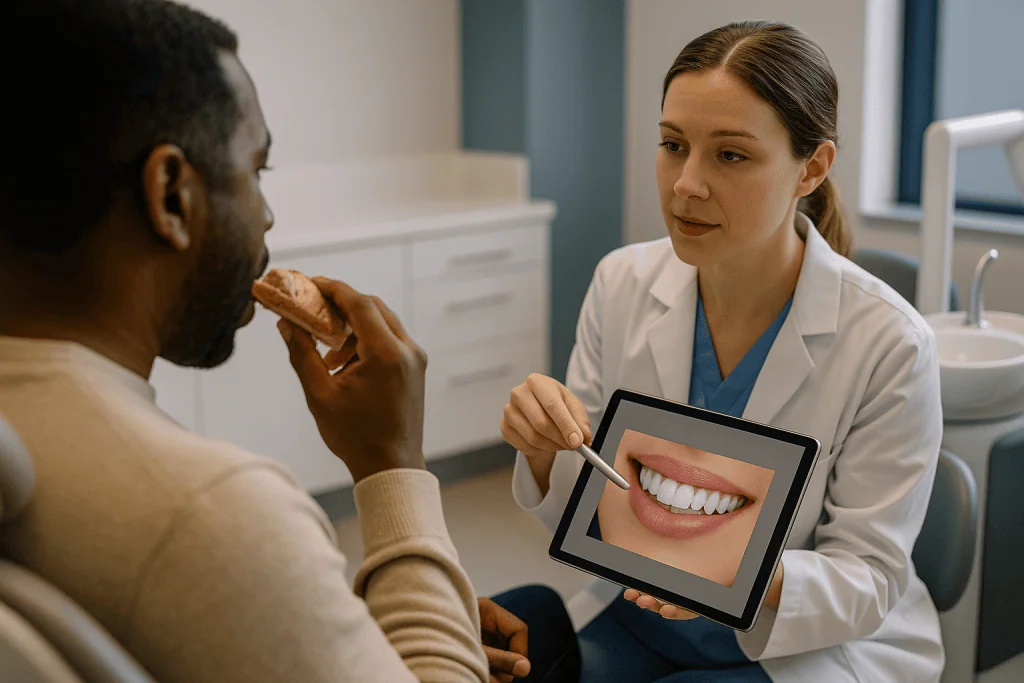
The first stage is an examination and conversation. The dentist checks the teeth, gums, bite and jaw joints, usually with X-rays, and asks what bothers you and why. The second stage is documentation: a standardized set of photographs of the face and teeth, plus a digital impression, which is a three-dimensional computer model of your teeth made by an intraoral scanner (a small handheld camera) or, in some practices, by a traditional putty mold that is then scanned.
The third stage is design. Using the photographs and the 3D model, the dentist or a dental technician proposes new tooth shapes and positions, often on screen, sometimes also as a wax model on a plaster copy of your teeth. The fourth stage is the trial: the design is transferred into your mouth as a temporary, removable mock-up so you can see it, speak with it and photograph it.
Only after those four stages does the fifth begin, which is the actual treatment sequence. Orthodontics or gum treatment, if needed, usually comes first because it changes the canvas. Whitening tends to precede bonding or veneers because those materials are color-matched to the finished shade and cannot be lightened later. Restorative work follows, and a maintenance plan closes the loop.
The order is not ceremony. Each stage generates information the next stage depends on, and skipping any of them means guessing.
Why the smile makeover consultation starts with health, not looks
People are sometimes surprised that a cosmetic consultation opens with a gum probe and a set of X-rays rather than a discussion of tooth shape. The reason is structural. Every cosmetic material, whether resin, porcelain or a crown, depends on the tooth and gum beneath it, and disease in that foundation undermines the result.
Gum disease is the clearest example. Inflamed gums bleed, recede and change level, which moves the visible edge of the tooth and exposes the margin of any restoration placed against it. The National Institute of Dental and Craniofacial Research describes gingivitis as reversible with treatment and good home care, while periodontitis, the deeper form, involves bone loss around the teeth that may need professional management before anything else is contemplated.
Tooth decay under an old filling, a cracked tooth, or a bite in which the front teeth take excessive force all belong in the same category: they change the plan or postpone it. A person who grinds at night, for instance, may be advised to address that habit and wear a protective appliance before porcelain is bonded to teeth that will be loaded every night.
The consultation also covers medical history. Some conditions and medicines affect healing, bleeding or saliva, and a dry mouth raises decay risk around new restorations. None of these are reasons to be turned away in principle, but they shape sequencing and material choice. The Mayo Clinic summarizes how oral and general health interact, which is why an honest health history is part of good aesthetic planning rather than a formality to be rushed through.
What the smile makeover photographs capture and why there are so many
The photography session can feel excessive. Full face at rest, full face smiling, a profile, a three-quarter view, close-ups of the teeth with the lips pulled back by small plastic retractors, the upper and lower arches shot in a mirror, and sometimes a short video of you speaking. Each frame answers a specific question.
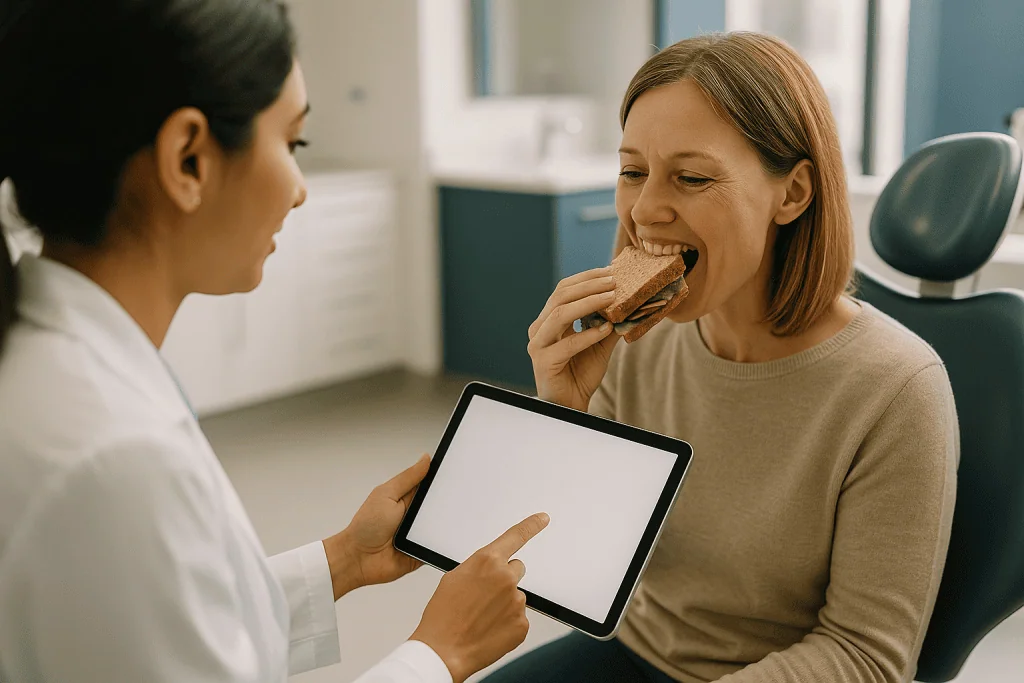
The resting face shows how much tooth is visible when the lips are relaxed, which sets the baseline for how long the front teeth should appear. The full smile shows the “smile line,” the curve the upper lip makes, and how much gum is displayed above the teeth. The profile reveals whether the front teeth lean forward or backward relative to the lip, which governs how much they can be built out or must be kept flat. The three-quarter view is the angle most people are photographed at in real life, and it exposes asymmetries a straight-on shot hides.
Retracted close-ups document color, surface texture, wear, chips and gum contours without the lips in the way. The mirror shots of the arches record the bite from above and below. Video captures the dynamic smile, because the face in motion behaves differently from the face holding still for a camera, and lip movement during speech affects whether the edges of the teeth show.
Consistent lighting, distances and angles matter because these images are compared against later ones. They become the reference for the design, the record against which the mock-up is judged, and the baseline for discussing what did or did not change. Standardization is what turns a photo into a measurement.
How digital dental impressions replace the tray of putty
For decades, a dental impression meant a tray of cold, setting putty pressed over the teeth while the patient breathed through the nose and counted the seconds. Digital dental impressions do the same job with an intraoral scanner: a wand-shaped camera passed slowly over the teeth and gums, capturing thousands of images that software stitches into a three-dimensional model in real time.
Both approaches produce a copy of the teeth. The physical mold is poured in plaster or scanned into a computer; the digital scan is already a file. That file can be measured to fractions of a millimeter, rotated on screen, superimposed on the photographs and sent to a laboratory without shipping a box. It is also easy to repeat: if a scan misses a region, the wand goes back over that area rather than the whole impression being remade.
Neither method is inherently “better” for every situation. Scanners struggle with saliva, blood and deep subgingival margins, which is the term for the edge of a tooth preparation that sits below the gum line; conventional impressions still have a role there. Many practices use both.
The scan also records how the upper and lower teeth meet. A bite registration, taken by asking you to close naturally while the scanner or a soft material records the contact, tells the designer where teeth can be lengthened without colliding with their opposites. A tooth edge that looks lovely on screen but strikes the lower incisors on every closure will chip, so the model of the bite is as important as the model of the smile.
None of this replaces the examination. A scan documents shape; it does not diagnose disease.
What digital smile design means in practice
Digital smile design describes the use of software to draw proposed tooth shapes over the patient’s own photographs and 3D scan. The principle is older than the software; dentists have long sketched over prints or built wax onto plaster models. What the digital version adds is scale, speed and the ability to check the drawing against real measurements.
The designer begins with reference lines. A horizontal line across the pupils and a vertical midline of the face give the frame; the smile should generally relate to these rather than to the nose or chin alone, which are frequently off-center. The curve of the lower lip during a smile suggests how the edges of the upper teeth might follow it. The width of the smile and the visible corners of the mouth define how many teeth take part.
Tooth proportion is next. The central incisors, the two front teeth, set the tone; canines, the pointed corner teeth, frame the arch. Classical proportions are a starting point, not a rule, and a face with soft, rounded features usually looks wrong with square, angular teeth. Good design borrows from the patient’s existing shapes and family resemblance rather than importing a template.
The result is a two-dimensional overlay and, increasingly, a three-dimensional model that can be printed. This is where the planning becomes concrete and where the patient should be involved. A screen mock-up is a proposal, not a promise, and it has a known weakness: pictures flatter. Which is exactly why the next stage exists.
The trial smile: testing the design in your mouth before anything permanent
A mock-up, sometimes called a trial smile, is the design transferred temporarily onto your actual teeth. The technician makes a wax-up, which is a model of the proposed teeth built in wax on a copy of your arch, or prints the digital design. From that, a thin silicone mold is made, filled with temporary resin and seated over your unaltered teeth for a minute or two. When it comes off, the resin stays on, and you are looking at the plan in a mirror.
Nothing is drilled at this stage. The resin sits on top of the enamel and peels away at the end of the visit, or after a short period at home in some protocols. Because the material is added rather than subtracted, teeth that are proposed to become smaller cannot be fully previewed this way, which is a limitation worth understanding.
The trial answers questions no screen can: does the lip close comfortably, do the S and F sounds still come cleanly, does the longer edge look right when you laugh, does the person in the mirror still look like you? Adjustments made here cost nothing but time. Adjustments made after porcelain is bonded cost tooth structure.
| Planning tool | What it shows | What it cannot show |
|---|---|---|
| Photographs | Face-to-teeth relationships, color, lip dynamics | Bite contacts, hidden decay |
| X-rays | Decay, bone levels, root health | Appearance, color |
| Digital impression | Precise 3D shape and bite | Disease, soft-tissue health |
| Smile design overlay | Proposed proportions on your face | How it feels or sounds |
| Mock-up | Real-life look, speech, lip comfort | Reductions in tooth size |
Who a smile makeover is usually for, and who is usually asked to wait
The people most likely to be offered a coordinated cosmetic plan share a few features: healthy gums or gum disease that has been treated and stabilized, a stable bite, realistic expectations, and a specific concern that dentistry can plausibly address. Worn edges, discoloration that whitening cannot shift, chipped or uneven front teeth, small gaps and mild crowding all sit comfortably within that range.
Several groups are commonly asked to wait or to take a different route first. Active gum disease is the most frequent reason, as discussed earlier. Untreated decay or infection is another. People under about eighteen are often asked to defer irreversible work because the jaws and gum levels are still changing, and a veneer edge that matches the gum today may sit visibly wrong in a few years; the same logic applies to anyone whose orthodontic treatment is not finished.
Pregnancy is generally a time to postpone elective dental work that is not needed for health, and X-rays and some materials are deferred; routine cleaning and treatment of urgent problems continue. People with heavy night-time grinding, an uncontrolled dry mouth, or very high decay activity may be offered bonding or orthodontics rather than porcelain because the risk of fracture or new decay at the margins is higher.
A less obvious group is anyone whose main hope is that the smile will fix something the smile did not cause. Dentists are trained to listen for this, and a good consultation includes a frank talk about what a changed appearance can and cannot do. Deferral is not refusal; it is sequencing, and the decision rests with the treating team.
Which treatments a smile makeover plan may combine
Once the design is agreed, the plan translates it into individual treatments, matched tooth by tooth to the problem being solved. Understanding each one in a sentence makes the treatment letter far less intimidating.
Whitening uses a peroxide-based gel to lighten the tooth’s own structure. The NHS notes that results are not permanent and typically last from a few months up to about three years depending on habits such as smoking and coffee, tea or red wine intake. It changes color only, not shape, and it does not lighten existing fillings or crowns.
Bonding adds tooth-colored resin directly to the tooth to close small gaps, repair chips or lengthen edges; little or no enamel is removed, and it can be repaired or removed later. Veneers are thin shells of porcelain or resin bonded to the front of teeth; the Cleveland Clinic describes them as commonly lasting a decade or more but explains that most designs require some enamel to be removed, which is permanent.
Crowns cover the whole tooth and are reserved for teeth that are heavily filled, cracked or root-treated. Orthodontics, with braces or clear aligners, moves the teeth themselves and often reduces how much restorative work is needed afterward. Gum contouring reshapes the gum edge where teeth look short because gum covers them. Implants or bridges replace teeth that are missing.
Most plans use two or three of these. The skill lies in choosing the least invasive combination that reaches the agreed design, which is the subject of the next section.
Reversibility, risks and alternatives: the part of the plan that matters most
If one idea deserves priority in the whole smile makeover planning process, it is this: enamel does not grow back. Every cosmetic option sits somewhere on a spectrum from fully reversible to permanent, and the plan should say plainly where each proposed treatment falls.
Whitening and orthodontic alignment leave the tooth structure intact. Bonding adds material and can generally be removed. Veneers usually require enamel reduction, meaning the tooth will need some form of covering for the rest of its life. Crowns remove more still. A design that can be reached with alignment and bonding rather than veneers spends less of a finite resource, even if it takes longer.
Risks are real and should be described in ordinary words. Temporary tooth sensitivity after whitening or preparation is common. Veneers and crowns can chip, debond or, less often, lead to nerve irritation that requires root canal treatment. Gum recession over years can expose a restoration margin. Bonding stains and wears faster than porcelain. Orthodontics carries its own risks, including root shortening and relapse without retainers. The Cleveland Clinic outlines the trade-offs for veneers in accessible terms.
Alternatives always exist, including doing nothing. Some people find that treating gum disease, professional cleaning and a course of whitening changes their view of what else they want. Others choose to address a single problem tooth rather than the whole arch. The plan should present these options alongside the more comprehensive one so the choice is informed. The final decision belongs to the patient and the treating team together, never to the mock-up.
What to expect in the weeks after a smile makeover plan is approved
Once the mock-up is accepted, the calendar fills in, and the shape of the following weeks depends on which treatments were chosen. A few patterns hold across most plans.
Preparatory work comes first. Gum treatment, if needed, must settle before restorations are shaped to the gum edge. Orthodontic phases run on their own timeline, from months to a year or more depending on the movements planned, and cosmetic restorations wait until teeth are in their final positions. Whitening precedes color-matched work and is usually completed over a few weeks using custom trays at home under a dentist’s supervision, according to the NHS; a short waiting period follows so the shade stabilizes before matching.
Restorative visits typically come in pairs. At the first, teeth are prepared, a final impression or scan is taken, and temporary restorations made from the approved design are fitted, so you leave with a working version of the plan. The laboratory stage that follows is commonly quoted as a matter of weeks by sources such as the Cleveland Clinic. At the second visit the finished pieces are tried in, checked for fit, color and bite, and bonded.
Mild sensitivity to cold and slight gum tenderness in the days after preparation are common and usually settle. A bite check a week or two later catches high spots that only reveal themselves during real chewing. A review visit, a night guard where grinding is a factor, and a routine hygiene schedule complete the plan. These timelines are typical ranges, not promises, and the treating team will tailor them.
What people often get wrong about smile makeover planning
The first and most consequential misunderstanding is that the digital preview is the outcome. It is a proposal drawn on a photograph. Real teeth have translucency, real gums move, real lips do not hold still. The mock-up in the mouth is the honest test, which is why skipping it to save a visit is a poor trade.
A second misconception is that whiter is always better. Tooth color exists on a natural range, and the sclera of the eye, the white part, is a useful anchor: teeth noticeably brighter than the eye whites tend to read as artificial in ordinary light. Design that respects age and skin tone ages better.
Third: veneers are not the default. Many people arrive asking for them because the word is familiar. Alignment plus whitening plus minor bonding reaches a similar visual endpoint for a large share of front-tooth concerns while preserving enamel. Veneers are a superb tool for the right indications, not a starting assumption.
Fourth, cosmetic work is not maintenance-free. Porcelain does not decay, but the tooth around it does; gum health, cleaning between teeth and regular professional review remain necessary, as the MedlinePlus dental health overview describes for everyone.
Fifth, speed is not a virtue in planning. A plan compressed into one visit is a plan without a mock-up, without shade stabilization after whitening and without time for gum treatment to settle. Finally, no dentist can promise how a result will look or how it will make you feel. Anyone who does has moved from planning into selling, and that is a signal to pause.
Questions to ask your care team before agreeing to a plan
A good consultation leaves room for questions, and the most useful ones are about reversibility, sequence and maintenance rather than about materials by brand. Taking a written list is sensible; many people find they forget half their concerns once the mirror is in front of them.
- Which of the proposed treatments are reversible, which add material, and which permanently remove enamel?
- Is there a less invasive route to a similar design, even if it takes longer?
- Will I see a mock-up in my mouth before any tooth is prepared, and can I take it home or photograph it?
- What in my examination or X-rays needs treating first, and how will that change the timeline?
- How will my bite be checked so that lengthened front teeth do not chip?
- What is the expected lifespan of each restoration, what usually causes early failure, and what would repair involve?
- Do I need a night guard, and why?
- How will the color be chosen, and what happens if I whiten later?
- What is the maintenance schedule afterward, and what should I do differently at home?
- What are the realistic alternatives, including doing less or nothing for now?
Listen for answers that acknowledge uncertainty. “Veneers commonly last a decade or more but can chip” is an honest answer; “they will last forever” is not. Ask, too, whether the person doing the design is the person doing the treatment, and how disagreements about the mock-up are resolved. The plan is yours to approve or decline, and a team confident in its work will welcome the scrutiny.
When to call your doctor or dentist during smile makeover planning or treatment
Most of the planning phase involves no discomfort at all. Once treatment begins, mild cold sensitivity and gum tenderness for a few days are expected. Certain signs, though, warrant a prompt call rather than waiting for the next scheduled visit.
Contact your dentist promptly if you notice pain that is worsening rather than easing after a few days, pain that wakes you at night, or a tooth that has become tender to bite on when it was not before. Swelling of the gum or face, a bad taste, pus, or a pimple-like spot on the gum near a treated tooth can indicate infection and should be assessed. A temporary or permanent restoration that comes loose or falls off needs attention quickly, because the underlying tooth is exposed and may shift or become sensitive. Sharp edges that cut the tongue or cheek, a bite that feels suddenly wrong, or a restoration that clicks against its opposite deserve an adjustment visit.
Seek urgent medical care, through emergency services if necessary, for swelling that spreads to the eye, neck or floor of the mouth, difficulty swallowing or breathing, fever with facial swelling, or bleeding that does not stop with firm pressure. These are uncommon but serious.
Also speak to your dentist or physician before starting any elective dental phase if your medical situation changes: a new diagnosis, a new medicine that affects bleeding or bone, or a pregnancy. The CDC and WHO both frame oral health as part of general health, and your treating team needs the full picture to keep the plan safe. Every decision about proceeding, pausing or changing course rests with them, informed by you.
Frequently asked questions
What is a smile makeover, exactly?
A smile makeover is a coordinated plan that may combine several dental treatments to change how the teeth and gums look. It is a description of the planning and sequencing, not a single procedure. Options within a plan can include whitening, bonding, veneers, crowns, orthodontic alignment, gum reshaping and replacement of missing teeth, chosen tooth by tooth according to the problem being addressed and the person’s oral health.
What happens at a smile makeover consultation?
The first visit usually involves a full dental examination, including gums, bite and X-rays, followed by a conversation about what concerns you and why. Standardized photographs and often a digital scan are taken. The dentist explains what needs treating first, which cosmetic options are realistic, and how reversible each is. No irreversible work is done at this visit; it is about gathering information and setting expectations.
How does digital smile design work?
Digital smile design uses software to draw proposed tooth shapes over your own photographs and, increasingly, your 3D scan. The designer sets reference lines across the pupils and down the facial midline, then proposes tooth lengths and proportions that suit your lips and face. The result is a proposal that can be printed and turned into a temporary mock-up for testing in the mouth before any decision is final.
Are digital dental impressions better than traditional molds?
Neither method is best for every situation. A digital scan is quicker to repeat, easy to measure and can be sent electronically to a laboratory, while conventional putty impressions may still perform better when the margin of a preparation lies below the gum or when saliva and bleeding interfere with scanning. Many practices use both, and the choice depends on the tooth being recorded rather than on preference alone.
Can I preview my new smile before anything is done to my teeth?
Yes, in most planning pathways. A temporary resin mock-up is molded over your unaltered teeth from the approved design so you can see it, speak with it and photograph it. It peels off afterward. The main limitation is that a mock-up adds material, so it cannot fully show teeth that are planned to become smaller. Ask specifically whether a mock-up is part of your plan.
How long does the smile makeover planning process take?
There is no fixed timeline; it depends on what must be treated first. Gum treatment, orthodontic alignment and whitening each add weeks to months before restorative work begins. Whitening with dentist-supervised custom trays typically runs over a few weeks according to the NHS, and laboratory fabrication of veneers or crowns is commonly quoted in weeks by the Cleveland Clinic. Your dentist can give a range specific to your plan.
Do veneers ruin your teeth?
Veneers do not ruin teeth, but most designs require a thin layer of enamel to be removed, and that change is permanent, so the tooth will always need some covering afterward. The Cleveland Clinic notes veneers commonly last a decade or more, though they can chip or debond. Whether veneers are the right tool depends on the problem; alignment, whitening and bonding may reach a similar result while preserving enamel.
Should I whiten my teeth before or after cosmetic work?
Before, in almost every plan. Bonding, veneers and crowns are color-matched to the surrounding teeth and cannot be lightened later, so whitening first sets the target shade. A short waiting period usually follows whitening so the color stabilizes before matching. Because whitening is not permanent, the NHS notes that results fade over months to a few years, and touch-ups may later be needed around fixed restorations.
Who should not have a smile makeover right away?
People with active gum disease, untreated decay or infection, an unstable bite or unfinished orthodontic treatment are usually asked to complete that care first. Younger people whose jaws and gum levels are still changing are often advised to postpone irreversible options. Elective cosmetic work is generally deferred during pregnancy. Heavy grinding or a very dry mouth may steer the plan toward less fracture-prone or more repairable choices.
What should I expect in the weeks after a smile makeover?
Mild cold sensitivity and slight gum tenderness for a few days after tooth preparation are common and usually settle. Temporary restorations are worn while final pieces are made, then fitted and checked for bite and color. A follow-up visit catches high spots, and a night guard may be advised if grinding is a factor. Regular cleaning and professional review continue, because the natural tooth around any restoration can still decay.
References
This article is for general information only and is not a substitute for professional medical advice. Please consult a qualified doctor about your individual situation.

More from the Blog
Tooth Decay Treatment Visit: Numbing, Removing Damaged Tissue and Restoring the Tooth
A cavity treatment procedure usually has three steps: the dentist numbs the area with a local anesthetic, removes the softened, decayed part of the…

Gum Recession Treatment Results: How Grafted Gum Matures and What It Can and Cannot Restore
Gum graft results develop in stages: the graft attaches over the first one to two weeks, swelling and a pale or reddish look settle…
How to Read a Smile Makeover Plan: Questions About Each Step and Temporary Teeth
A smile makeover treatment plan is a written, sequenced document that lists each proposed procedure, the order it will happen in, what temporary teeth…
What Happens During a Root Canal? Cleaning, Shaping and Sealing the Canals Step by Step
A root canal procedure treats infection or inflammation inside a tooth by removing the soft tissue in its center, cleaning and shaping the narrow…

How Aesthetic Dentistry Is Planned: Smile Assessment, Imaging and Treating Decay First
Aesthetic dentistry treatment planning follows a fixed order: first a full smile assessment of the teeth, gums, bite and facial proportions; then imaging such…

When Aesthetic Dentistry Makes Sense and When Gum Health Has to Come First
Cosmetic dentistry usually makes sense once your gums are healthy and stable, any decay or infection has been treated, and a specific feature of…