

Porcelain Veneers Myths: Ruined Teeth, Fake Looks and Other Claims Explained Honestly
Key Takeaways
- Conventional porcelain veneers require permanent removal of a thin layer of enamel, so the tooth will always need some covering afterward.
- Cleveland Clinic gives typical lifespans of about 10–15 years for porcelain veneers and 4–8 years for composite, with wide individual variation.
- Decay still happens at veneer margins and on uncovered surfaces, which is why cleaning between teeth and regular check-ups matter as much as before.
- Whitening gels do not change the color of porcelain, so whitening is usually done before veneers are shade-matched, not after.
- Grinding is a leading reason veneers chip; many dentists want bruxism managed with a night guard before and after treatment.
- The “filed-down pegs” images online usually show crown preparations or aggressive work, not a conservative veneer preparation that stays within enamel.
Most porcelain veneers myths do not hold up. Veneers do not rot the tooth underneath, but conventional veneers do require removing a thin layer of enamel, which is permanent. They need not look fake when shaped and shaded to the face. They can chip, stain at the edges and need replacing over time, and they do not treat decay, gum disease or grinding. A dental examination, not a rumor, decides suitability.
The screenshot folder tells the story. One photo shows a friend’s wedding smile, even and bright, with teeth that were not quite that straight last year. The next is a video still, captioned in capital letters, of someone peeling back a lip to show small, filed-down pegs where teeth used to be. Same procedure, two completely different verdicts, and now you are supposed to decide.
Porcelain veneers myths thrive in that gap. The glossy version leaves out the drilling; the horror version leaves out the context. Neither explains what actually happens to a tooth under a veneer, why some results look painted on while others pass unnoticed, or why a dentist might turn you down.
This explainer works through the claims one at a time and holds each against what mainstream dental references actually say. Some myths collapse quickly. A few turn out to be partly true, and those deserve the most attention.
What is a porcelain veneer, and what actually happens in the chair?
A veneer is a thin shell, usually porcelain (a dental ceramic) or composite resin (a tooth-colored plastic filled with glass particles), bonded to the front surface of a tooth to change its color, shape or length. Think of it less as a cap and more as a false fingernail engineered to last years rather than weeks.
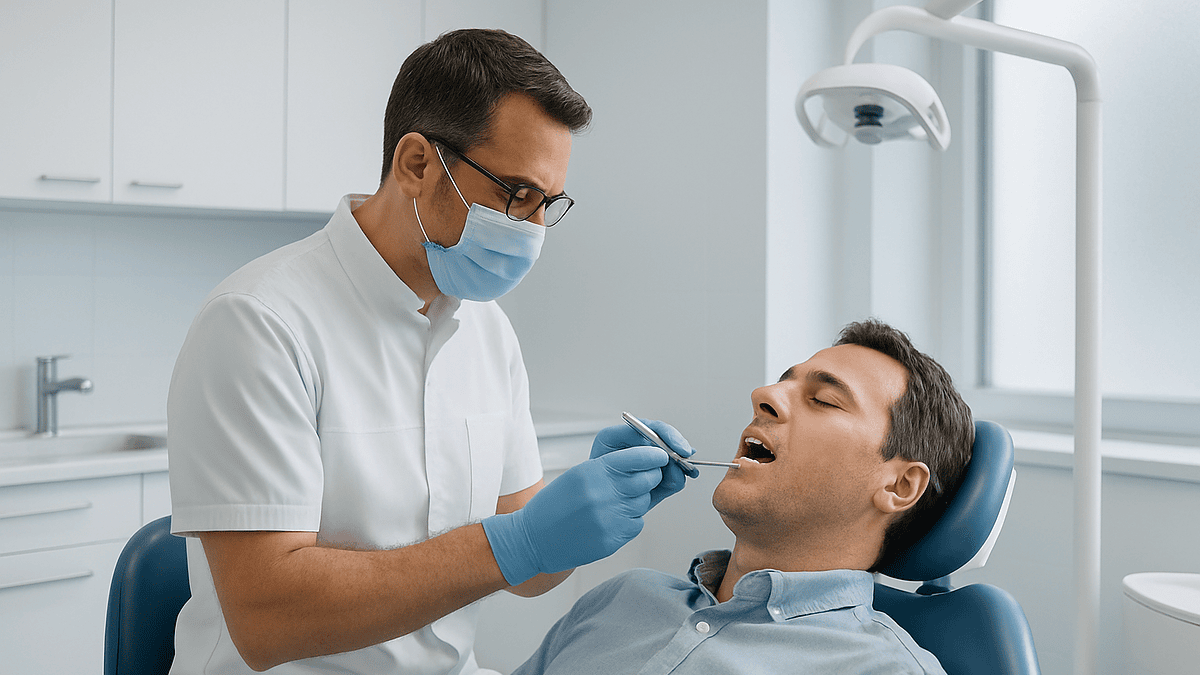
The process unfolds over several visits. First comes an examination of the teeth and gums, photographs, and either putty impressions or a digital scan. Many dentists then make a wax or resin mock-up so you can see a proposed shape in your own mouth before anything is drilled.
At the preparation visit, the dentist removes a thin layer of enamel, the hard outer coating of the tooth, so the finished veneer sits flush rather than bulging outward. Local anesthetic is commonly used. A new impression goes to a laboratory, and temporary veneers are fitted while the porcelain is made, a stage usually measured in weeks; your dentist can give a specific estimate.
At the fitting visit the dentist tries each veneer in place, checks shade and fit, then etches the enamel with a mild acid gel, applies a bonding agent and seats the veneer with a resin cement that hardens under a blue light. Excess cement is trimmed and the bite is checked.
What matters most for myth-busting is this: the tooth remains alive, the nerve is not deliberately touched, and most of the tooth is left as it was. Only the front face is reshaped. That single fact explains both why veneers are not the catastrophe some videos suggest and why they are still a permanent decision.
Why porcelain veneers myths spread, and which ones matter most
Veneers are an unusual treatment in one respect: almost everyone has seen the result, and almost no one has seen the process. A smile reveal takes four seconds on a phone screen. The months of planning, the drilling, the temporaries and the follow-up checks never make the edit. Myths grow in the footage that was cut.

Not all porcelain veneers myths carry the same weight, and it helps to rank them. At the top sits the belief that veneers are harmless, reversible or “just a cover.” They are not. Conventional veneers involve permanent enamel removal, which turns a cosmetic choice into a lifelong maintenance commitment. Anyone who signs up believing otherwise has not consented in any meaningful sense.
Close behind is the opposite myth, that veneers destroy teeth and leave you with stumps. This one scares people away from a procedure that, done conservatively on healthy teeth, is well established in mainstream dentistry. Fear built on a misread photograph is still fear built on an error.
A second tier covers expectations: that veneers fix crooked teeth, gum problems or grinding; that they never stain or chip; that they last forever. These myths do not cause harm on the day of treatment, but they cause disappointment later, when a chipped edge or a dark line at the gum arrives uninvited.
The lowest tier is aesthetic: veneers look fake, veneers are only for celebrities, veneers all look the same. These are matters of taste and craft, not safety, and they are the easiest to settle by looking at mock-ups and asking the right questions.
The sections that follow take the myths in roughly that order, starting with the one that matters most.
Do veneers ruin your teeth? What enamel removal really means
Start with the honest part of this claim. Enamel does not grow back. Once a dentist reshapes the front of a tooth for a veneer, that tooth will need a veneer, or some other covering, for the rest of its life. Cleveland Clinic lists this irreversibility among the main drawbacks of porcelain veneers, and it belongs at the top of any consent conversation.
Now the exaggerated part. The amount removed for a conventional veneer is small: a fraction of a millimeter from the front surface, often compared to the thickness of a fingernail, with the aim of staying within enamel rather than cutting into dentin, the softer, more sensitive layer beneath. The nerve is not touched. The biting edge and back of the tooth are usually left alone.
The alarming images of small, tapered pegs that circulate online generally show something different: teeth prepared for full crowns, which wrap around the whole tooth and require far more reduction, or veneers prepared aggressively on teeth that were already heavily filled. Those are real outcomes of real decisions, but they are not what a conservative veneer preparation looks like.
Can veneers still harm a tooth? Yes, in specific ways. If preparation runs deep into dentin, sensitivity can persist. If a veneer margin is rough or sits below the gum, plaque collects there and the gum becomes inflamed. If cement at the edges breaks down, bacteria can creep beneath the shell and cause decay that is hard to see. None of these is inevitable; all depend on planning, technique and the care the tooth receives afterward.
So the fair answer to “do veneers ruin your teeth” is no, but they do change them permanently, and that change deserves the same seriousness as any other irreversible choice.
Do veneers look fake? Why some do and most need not
The “fake” look has a recipe, and once you know it you will spot it everywhere. Take ten teeth, make them identical in shape, choose a shade whiter than the whites of the eyes, remove all translucency so the porcelain is flat and opaque, and build them slightly too thick so the lip sits forward. The result reads as a row of bathroom tiles.

Natural front teeth do none of those things. They vary slightly in length and width from one to the next. The biting edges are a little translucent, almost gray-blue in some light, while the part near the gum is warmer and more saturated. Surfaces carry subtle texture that scatters light rather than reflecting it like glass. Porcelain can reproduce all of this, because ceramists layer different translucencies much as a painter layers glazes, but only if someone asks for it.
Two decisions drive most of the difference. The first is shade. A veneer chosen to harmonize with the face and the surrounding teeth tends to disappear; one chosen from the brightest tab on the shade guide tends to announce itself. The second is thickness. Veneers placed with very little enamel removal have to carry their bulk outward, which can make the teeth look larger and the lip fuller than before. That is sometimes the goal, and sometimes a surprise.
Preview tools matter here. A diagnostic wax-up, a mock-up worn in the mouth, or digital smile images let you judge shape and shade before a single tooth is touched. Studying them in daylight, not just clinic lighting, is worth the extra minute.
One caveat belongs in every conversation about appearance: “natural” and “fake” are preferences, not clinical findings. Some people want a visibly uniform, bright result and are pleased with it. The myth is not that veneers can look artificial; it is that they must.
How long do porcelain veneers last, and what wears them out?
Nothing bonded to a tooth lasts forever, and veneers are no exception. Cleveland Clinic gives a typical lifespan of roughly 10 to 15 years for porcelain veneers and around 4 to 8 years for composite ones, with the usual caveat that individual results vary widely. Those figures describe averages across many patients, not a guarantee for any particular mouth.
What shortens the life of a veneer is rarely the porcelain itself. Dental ceramic is hard and chemically stable. The weak points are the bond, the edges and the habits of the person wearing it.
Grinding and clenching come first. Bruxism, the medical term for grinding or clenching the teeth, often during sleep, puts repeated heavy loads on the thin edges of front teeth. Mayo Clinic notes that bruxism can damage teeth and dental restorations, which is why many dentists want it identified and managed, often with a night guard, before cosmetic work begins.
Next come point loads: cracking ice, biting fingernails, opening packets with the teeth, chewing pens. Porcelain tolerates spread-out chewing forces well but can chip under a sudden, concentrated force at the edge.
Gum recession is the quiet one. As gums move over years, the junction between veneer and root can become visible as a line, and the exposed root surface is more vulnerable to decay. Daily cleaning and regular reviews slow this process but cannot freeze it.
Finally, acid. Frequent acidic drinks soften enamel around the margins, and an enamel edge that erodes leaves the veneer edge standing proud.
When a veneer does reach the end of its life, replacement usually means removing the old shell and refining the preparation, so each cycle consumes a little more tooth. That is the practical reason the “how long do porcelain veneers last” question deserves an honest answer before treatment rather than after.
Porcelain veneers vs composite, whitening and braces: a plain comparison
Veneers sit in the middle of a spectrum of options, from the fully reversible to the fully permanent. Seeing them side by side clarifies what a veneer is actually for.
| Option | What it changes | Enamel removed? | Typical lifespan (source) | Reversible? |
|---|---|---|---|---|
| Teeth whitening | Color only | No | Not permanent; NHS says effects can last up to about 3 years but vary | Yes |
| Composite bonding or composite veneers | Color, small chips, gaps, minor shape | Little or none | About 4–8 years (Cleveland Clinic) | Often, if no enamel removed |
| Porcelain veneers | Color, shape, length, illusion of alignment | Usually a thin layer | About 10–15 years (Cleveland Clinic) | No |
| Orthodontics (braces or aligners) | Actual tooth position and bite | No | Long term with retainers | Teeth can drift without retention |
| Crowns | Full coverage of a weakened tooth | Substantial, all surfaces | Varies with tooth condition | No |
The porcelain veneers vs composite question is the comparison most people actually face. Composite is sculpted directly on the tooth in a single visit, usually with little or no enamel removal, and it can be repaired in the chair if it chips. Its drawbacks are durability and stain: resin is softer and more porous, so it dulls and discolors sooner. Porcelain is made in a laboratory over two or more visits, bonds to prepared enamel and holds its gloss far longer, but a fracture generally means a remake and the preparation is permanent.
Neither is universally “better.” Composite suits a small chip, a single tooth or someone who wants to trial a new shape before committing. Porcelain suits larger color changes and people who want longevity and accept irreversibility.
Two sequencing points follow. Whitening, if wanted, generally comes first so veneers can be matched to the lighter shade. And if teeth are crooked enough that a veneer would need heavy reduction to look straight, orthodontics beforehand can mean smaller veneers, or none at all.
Who is usually a candidate for porcelain veneers, and who is asked to wait?
Veneers are a cosmetic layer on a foundation, and dentists assess the foundation first. The usual candidate has healthy gums, teeth free of active decay, enough enamel on the front surfaces to bond to, and a concern a veneer can genuinely address: discoloration that whitening has not shifted, chipped or worn edges, small gaps, mildly uneven shapes or a single tooth that does not match its neighbors.
Being asked to wait is common and is not a rejection. Typical reasons include:
- Active gum disease or bleeding gums. Veneers placed on inflamed tissue tend to end up with visible margins once the gums heal and shrink, and the underlying disease still needs treatment.
- Untreated decay or failing fillings, which have to be dealt with first because a veneer seals nothing.
- Unmanaged grinding or clenching. Many dentists want a night guard in use before investing porcelain in a high-load mouth.
- Teeth that are heavily filled or structurally weak, where a crown, which covers the whole tooth, may be the safer restoration.
- Younger people whose teeth and gum lines are still maturing, since veneers placed early may need redoing as the gum position settles.
- Crowding or bite problems that would force very aggressive preparation to create the illusion of straightness, where orthodontics first can reduce how much tooth is sacrificed.
Some reasons are about expectations rather than anatomy. A person who wants teeth whiter than the clinician thinks will look natural, or who expects veneers to change the face in ways they cannot, is better served by a longer conversation than by a faster appointment.
The decision to proceed, defer or choose something else rests with the treating dental team after an examination, which is also where the reader of any article, including this one, should take their list of questions.
Myth: teeth under veneers cannot get cavities
A veneer covers the front face of a tooth. The back, the sides, the biting edge and the root remain natural, and the junction where porcelain meets enamel runs around the whole restoration. Every part of that is available to plaque, the sticky bacterial film that causes decay when it is fed sugar and left undisturbed.
The National Institute of Dental and Craniofacial Research describes tooth decay as a process in which acids produced by plaque bacteria dissolve the mineral of the tooth over time. Porcelain does not dissolve, but the tooth around and beneath it does, and decay at the edge of a veneer is a well-recognized reason for veneers to fail. Because it starts under or beside the shell, it is often invisible until it has progressed.
This is why the maintenance advice for veneered teeth is simply the advice for all teeth, taken seriously: brushing twice daily with fluoride toothpaste and cleaning between the teeth every day. The NHS sets dental check-up intervals anywhere from 3 months to 2 years depending on individual risk, not on a fixed calendar, and people with new veneers often land toward the more frequent end at first.
Two habits deserve special mention. Flossing around a veneer is safe; a well-finished margin will not catch floss, and if it does, that is worth reporting rather than avoiding. Sugary or acidic drinks sipped slowly over the day are harder on margins than the same drink finished in a few minutes, because the acid exposure is prolonged.
The myth here is comforting but costly. A veneer changes what a tooth looks like; it does nothing to change what a tooth needs.
What the first days and weeks after veneers usually look like
The timeline has two chapters: life with temporaries and life with the finished veneers.
Temporaries are made of acrylic or composite and are held with weak cement on purpose, so they come off easily at the next visit. That makes them fragile. Most dentists suggest soft foods, biting with the back teeth and avoiding anything sticky until the fitting visit. Temporaries may look bulkier and less translucent than the final result; they are a placeholder, not a preview of shade.
After bonding, the first sensation many people report is strangeness rather than pain. The teeth feel smoother and slightly larger to the tongue, and “s” and “f” sounds can take a day or two to settle as the lips relearn the shape. Cleveland Clinic notes that sensitivity to hot and cold is common after enamel removal and usually fades over days to a few weeks; sensitivity that worsens instead of easing is a reason to go back.
The bite is checked at the fitting visit, but it is normal to notice a high spot only once the anesthetic has worn off and you have eaten a few meals. A quick adjustment solves this, and leaving it unaddressed can overload one veneer.
Within the first weeks, dentists commonly ask you to:
- Avoid biting directly into very hard foods with the front teeth, such as ice, hard crusts or bones.
- Resume normal brushing and flossing immediately; nothing about the bond requires a gap in cleaning.
- Wear a night guard if one has been recommended, especially if grinding was identified beforehand.
- Attend a review appointment so margins, gum response and bite can be rechecked.
These are typical patterns reported in mainstream references, not guarantees. Individual healing, bite forces and gum health all shift the picture, and your own dentist’s instructions take precedence over any general article.
Myth: porcelain veneers never stain, chip or come off
Porcelain earns its reputation for stain resistance honestly. Its glazed surface is non-porous, so coffee, tea and red wine do not soak in the way they do with composite resin or with natural enamel over time. That is the true half of the myth.
The untrue half concerns the edges. Where a veneer meets the tooth there is a thin line of resin cement, and resin can pick up stain over the years. If the margin is slightly rough or the enamel beside it erodes, a brown line can appear at the gum or along the edge. Smokers and heavy consumers of staining drinks see this sooner. Professional polishing can improve it; a visibly stained margin sometimes means replacing the veneer.
Chips are the second reality. Porcelain is hard but brittle, like a ceramic plate: it resists wear beautifully and shatters under a sharp impact. Falls, sports injuries, grinding and the point-load habits described earlier are the usual culprits. Small chips can sometimes be smoothed or patched with composite; larger fractures generally need a new veneer.
Debonding, when a veneer comes away intact, is the third. It is less common with modern adhesives but still happens, more often on teeth with little enamel left to bond to. An intact veneer that falls off can often be rebonded if it is kept safe and clean, so save it rather than discarding it.
A related misunderstanding concerns whitening. Bleaching gels work on natural tooth structure and, as the NHS points out, do not change the color of veneers, crowns or fillings. If the surrounding teeth are whitened after veneers are placed, the veneers may end up darker than their neighbors. Whitening first, then matching the veneers, is the usual sequence, and it is a fair question to raise at planning.
Myth: veneers can fix any dental problem
Veneers are masks, in the most literal sense. They change what the front of a tooth looks like. They do not move teeth, heal gums, stop grinding or strengthen a tooth that has lost most of its structure. Each of those limits generates its own myth.
Crowding is the big one. Social media is full of “instant braces” results, where crooked teeth appear straight after veneers. What has happened is that the teeth that stuck out were ground back and the teeth that sat behind were built out, creating an even front surface over an uneven foundation. Mild cases can be handled this way with little harm. More significant crowding means heavy reduction of some teeth, sometimes into dentin or close to the nerve, to chase a straight line. Orthodontics, which actually repositions teeth, is often the more conservative route even though it takes longer.
Gum disease is next. Red, puffy or receding gums signal inflammation or bone loss, and porcelain does nothing for either. Veneers placed over untreated gum disease tend to look worse within a short time as the gums shrink and expose margins.
Grinding does not stop because the teeth are now ceramic. Mayo Clinic lists damaged restorations among the consequences of bruxism, and veneers in an unmanaged grinder are among the restorations most likely to chip.
Finally, a tooth that is mostly filling, has a large crack or has darkened after root canal treatment may be better served by a crown, which encircles and supports the whole tooth, than by a veneer that relies on sound enamel for its bond.
The useful question is not “can veneers fix this?” but “what is the underlying problem, and what treats it?” A dentist who asks that question before reaching for porcelain is doing the job properly.
What people often get wrong: more porcelain veneers myths in brief
Several smaller porcelain veneers myths do not need a full section but do need correcting, because they come up in nearly every consultation.
- “No numbing is needed, so no drilling happens.” Local anesthetic is routinely offered for conventional preparation because enamel removal close to dentin can be uncomfortable. The absence of an injection usually means a no-prep technique or very minimal reduction, not an absence of change.
- “No-prep veneers are fully reversible.” Sometimes. Removing bonded porcelain without touching enamel is difficult, and some so-called no-prep cases still involve light polishing of the surface. Ask specifically what reversal would involve.
- “Veneers weaken teeth.” A bonded porcelain veneer on a well-prepared tooth restores much of the stiffness lost to preparation. The tooth is altered, not left fragile, provided enamel remains and the bond is sound.
- “You have to veneer every visible tooth.” A single discolored or chipped tooth can be treated alone and matched to its neighbors. Full arches are a choice, not a requirement.
- “Any shade is fine if you want it.” Very bright shades exist, but opaque white porcelain can look flat and may require more enamel removal to hide a dark underlying tooth. The trade-off is worth understanding.
- “You cannot eat normally.” People with veneers eat ordinary diets. The restrictions are the same ones that protect natural teeth: no ice-cracking, no tearing packets, no fingernails.
- “Veneers and crowns are the same thing.” A crown covers the whole tooth and needs much more reduction; a veneer covers the front. Confusing the two is the root of many “ruined teeth” stories.
- “Once placed, they need no follow-up.” Margins, gums and bite change over years. Routine dental reviews are how small problems stay small.
Each of these is a detail, but details are where consent lives.
Questions to ask your care team before saying yes
A good consultation leaves you with more precise questions, not fewer. These are the ones that tend to surface the information that matters.
- What exactly is the problem we are treating, and is a veneer the most conservative option for it compared with whitening, bonding or orthodontics?
- How much enamel will you remove from each tooth, and will any preparation extend into dentin?
- Can I see a mock-up or wax-up in my own mouth before any tooth is prepared, and can I photograph it to view in daylight?
- Which shade are you recommending and why, and should whitening happen first?
- Do I show signs of grinding or clenching, and will I need a night guard before or after treatment?
- Are my gums healthy enough to proceed now, or is there treatment to complete first?
- What happens if a veneer chips, stains at the edge or comes off? What can be repaired and what must be replaced?
- What is the likely lifespan in a mouth like mine, and what will replacement involve for the tooth?
- How will you check the bite after fitting, and when will my review appointments be?
- If I decide to stop before preparation, what has already become irreversible?
Two habits improve the answers you get. Write the questions down beforehand, because clinic rooms are poor places for recall. And notice how the answers are framed. A clinician who explains limits, discusses alternatives and is comfortable with “wait” as an answer is giving you what you need to decide. One who promises an outcome is not.
The final decision, including the decision not to proceed, sits with you and your treating dental team together, informed by an examination of your own teeth rather than by anyone else’s results.
When to call your doctor
Most issues after veneers are minor and can wait for a routine appointment: a slightly rough edge, mild cold sensitivity in the first days, a bite that feels a little unfamiliar. Some signs warrant a same-day call to your dental team or doctor.
- Pain that is severe, throbbing, keeps you awake or is getting worse rather than better after the first few days.
- Swelling of the gum, face or jaw, or a bad taste or discharge near a veneered tooth, which can indicate infection.
- Fever alongside any dental pain or swelling.
- A veneer or temporary that has cracked, loosened or come off. Keep the piece, avoid chewing on that tooth and arrange an early visit.
- Sensitivity to hot, cold or biting that persists beyond the first few weeks or worsens over time.
- Gums that bleed persistently, recede noticeably or darken along a veneer edge.
- A bite that feels high on one tooth and causes aching in the tooth or jaw when you chew.
Seek emergency care immediately, rather than a dental appointment, if a dislodged fragment has been inhaled and you have coughing, wheezing or difficulty breathing, if swelling makes it hard to swallow or breathe, or if a facial injury that broke a veneer also caused loss of consciousness, a possible jaw fracture or bleeding that will not stop.
Swallowing a small veneer fragment is usually harmless and passes without treatment, but mention it when you call.
For everything else, your treating team is the right judge of what is normal in your mouth. This article explains the territory; it cannot examine a tooth. Any decision about repairing, replacing or removing a veneer, or about managing pain or infection, rests with the clinicians who can see it.
Frequently asked questions
Do veneers ruin your teeth?
No, but they change them permanently. A conventional veneer requires removing a thin layer of enamel from the front of the tooth, and enamel does not grow back, so the tooth will always need a covering. The nerve is not touched and most of the tooth stays natural. Problems such as decay at the margins or persistent sensitivity are possible but depend on planning, technique and aftercare, not on the procedure itself.
How long do porcelain veneers last?
Cleveland Clinic gives a typical range of roughly 10 to 15 years for porcelain veneers, compared with about 4 to 8 years for composite. These are averages, not promises. Grinding, biting hard objects, gum recession, acidic drinks and decay at the edges all shorten that span, while good cleaning, a night guard where needed and regular dental reviews help a veneer reach the upper end.
Porcelain veneers vs composite: which should I choose?
It depends on the problem and your priorities. Composite is applied in one visit, usually with little or no enamel removal, and is easy to repair, but it stains and wears sooner. Porcelain lasts longer and resists stain better but needs enamel preparation and a laboratory stage, and a fracture usually means replacement. Your dentist can match the option to the tooth after an examination.
Do veneers look fake?
They can, but they do not have to. The artificial look usually comes from identical shapes, an overly bright opaque shade, missing translucency at the edges or excess thickness. Porcelain layered to mimic natural teeth, shaded to suit the face and previewed with a mock-up tends to pass unnoticed. Whether a uniform bright result is desirable is a matter of personal taste rather than a clinical judgment.
Does getting porcelain veneers hurt?
Preparation is usually done under local anesthetic, so most people feel pressure rather than pain. Afterward, Cleveland Clinic notes that sensitivity to hot and cold is common and usually settles over days to a few weeks. Pain that is severe, worsening, accompanied by swelling or fever, or that persists well beyond that window is not expected and should be reported to your dental team promptly.
Can teeth with veneers still get cavities?
Yes. A veneer covers only the front surface, so the back, sides, biting edge, root and the margin around the veneer remain exposed to plaque. Decay at the edge of a veneer is a recognized reason veneers fail and can be hard to see. Twice-daily brushing with fluoride toothpaste, daily cleaning between teeth and check-ups at the interval your dentist advises remain essential.
Can I whiten my teeth after getting veneers?
Whitening gels lighten natural tooth structure but, as the NHS notes, do not change the color of veneers, crowns or fillings. If you whiten after veneers are placed, the untreated teeth may become lighter than the veneers. For that reason whitening is usually completed first, and the veneers are then matched to the new shade. Raise the sequence with your dentist during planning.
Can porcelain veneers be removed later?
They can be removed, but the tooth cannot be returned to its original state if enamel was prepared. Removal usually involves grinding the porcelain away and then placing a new veneer or crown. Veneers placed with little or no preparation are sometimes described as reversible, but detaching bonded porcelain without affecting enamel is difficult, so ask exactly what reversal would involve in your case.
Can I get veneers if I grind my teeth?
Possibly, but grinding must be addressed first. Mayo Clinic lists damaged restorations among the consequences of bruxism, and the thin edges of front veneers are especially vulnerable. Many dentists want a night guard in regular use before treatment and expect it to be worn afterward. In some cases of heavy wear a dentist may recommend waiting or choosing a different restoration.
Do veneers need special care or a special toothpaste?
No special products are required. Standard advice is brushing twice daily with a fluoride toothpaste, cleaning between the teeth every day and attending dental reviews at the interval your dentist sets, which the NHS says can range from 3 months to 2 years depending on risk. Avoid using the front teeth to crack ice, bite nails or open packaging, which protects natural teeth as much as veneers.
References
- Cleveland Clinic: Dental Veneers
- NIH National Institute of Dental and Craniofacial Research: Tooth Decay
This article is for general information only and is not a substitute for professional medical advice. Please consult a qualified doctor about your individual situation.

More from the Blog

Realistic Results in Aesthetic Dentistry: What Shade, Shape and Symmetry Can Change
Cosmetic dentistry realistically changes three things: shade (whitening lightens natural enamel, not fillings or crowns, and fades over months to a few years), shape…

Can You Eat After a Root Canal? From the Temporary Filling to the Day the Crown Is Fitted
Yes, you can eat after a root canal, but most dentists ask you to wait until the local anesthetic has fully worn off, usually…
Which Restorative Dental Treatment Fits the Damage? Filling, Crown, Root Canal or Implant
The right choice among a filling, crown, root canal or implant depends mostly on how much healthy tooth remains and whether the nerve inside…

Does Laser Dentistry Still Need Numbing? Anesthesia and Comfort by Procedure
Laser dentistry often reduces, but does not eliminate, the need for numbing. Small, shallow cavities and minor gum procedures treated with erbium or diode…

Recovering From Laser Dentistry: Gum Tenderness, Hot Foods and the First Day
After laser gum treatment, mild tenderness, slight swelling and sensitivity to temperature are common for the first day or two, and gums usually settle…

When Is an Impacted Tooth Monitored, Exposed or Removed? How Dentists Decide
An impacted tooth is usually monitored when it is free of pain and disease and sits where it is unlikely to harm neighboring teeth.…