

How ACDF Surgery Is Performed: The Front-of-Neck Approach, Disc Removal and the Fusion

Key Takeaways
- ACDF reaches the disc through the front of the neck by moving the windpipe and food pipe aside rather than cutting any muscle or bone on the way in.
- The surgeon confirms the correct disc level with an X-ray in the operating room before removing anything, a step that guards against wrong-level surgery.
- A single-level ACDF typically takes one to two hours of operating time, with each additional level adding to that, according to the referenced patient guidance.
- Sore throat, swallowing difficulty and hoarseness are common early effects of retraction and usually settle within days to weeks.
- Pain relief can arrive within weeks, but the bone fusion itself generally takes three to twelve months, which is why lifting limits outlast the pain.
- ACDF is designed to relieve arm symptoms and protect the spinal cord; its effect on neck pain alone is less predictable, and surgeons say so.
ACDF surgery is done through a small incision at the front of the neck. The surgeon gently moves the windpipe, food pipe and blood vessels aside, removes the damaged disc, clears bone spurs or disc fragments pressing on nerves or the spinal cord, then fills the space with a bone graft or cage, usually secured by a small plate, so the two vertebrae fuse into one solid bone over months.
The MRI report sits on the kitchen table, and one phrase keeps catching the eye: “disc protrusion with nerve root compression, C5-C6.” For weeks the arm has tingled through every meeting, and now a surgeon has used the letters ACDF. The first instinct is to type them into a search bar. The second is to wonder how anyone operates on a spine by going through the front of the throat.
That second question is the right one to ask, and understanding how ACDF surgery is done takes most of the mystery out of it. The operation has been performed since the 1950s, and its logic is simple: the disc that is causing trouble sits at the front of the spinal column, so the surgeon approaches it from the front, where there is no bone or spinal cord in the way.
This explainer walks through each stage, from the position of the incision to the slow biology of bone fusion, and is honest about what the evidence does and does not show.
How ACDF surgery is done, step by step
ACDF stands for anterior cervical discectomy and fusion. In plain language: anterior means from the front, cervical means the neck, discectomy means removing a disc, and fusion means joining two bones into one. Each word describes one stage of the operation.
The patient is asleep under general anesthesia, lying on their back with the neck in a neutral, slightly extended position. A surgeon makes a horizontal or slightly angled incision on one side of the front of the neck, often tucked into a natural skin crease. The length depends on how many disc levels are being treated; a single level typically needs an incision of a few centimeters.
Beneath the skin, the surgeon does not cut through muscle. Instead, the tissues are separated along natural planes. The windpipe (trachea) and food pipe (esophagus) are moved gently to one side, the carotid artery and jugular vein to the other. This creates a corridor straight to the front of the spine.
Once the correct disc is confirmed with an X-ray taken in the operating room, the surgeon removes the disc material, then clears any bone spurs or disc fragments pressing on the spinal cord or nerve roots. The empty disc space is filled with a spacer, usually a bone graft or a small cage packed with bone, and a thin metal plate is often screwed to the front of the two vertebrae to hold everything still.
The retractors are released, the tissues fall back into place, and the skin is closed with sutures or glue. According to the patient-education references listed at the end of this article, a single-level ACDF typically takes one to two hours of operating time, with additional levels adding to that.
Why go through the front of the neck?
People are often startled that a spine operation starts at the throat rather than the back of the neck. The anatomy explains the choice.
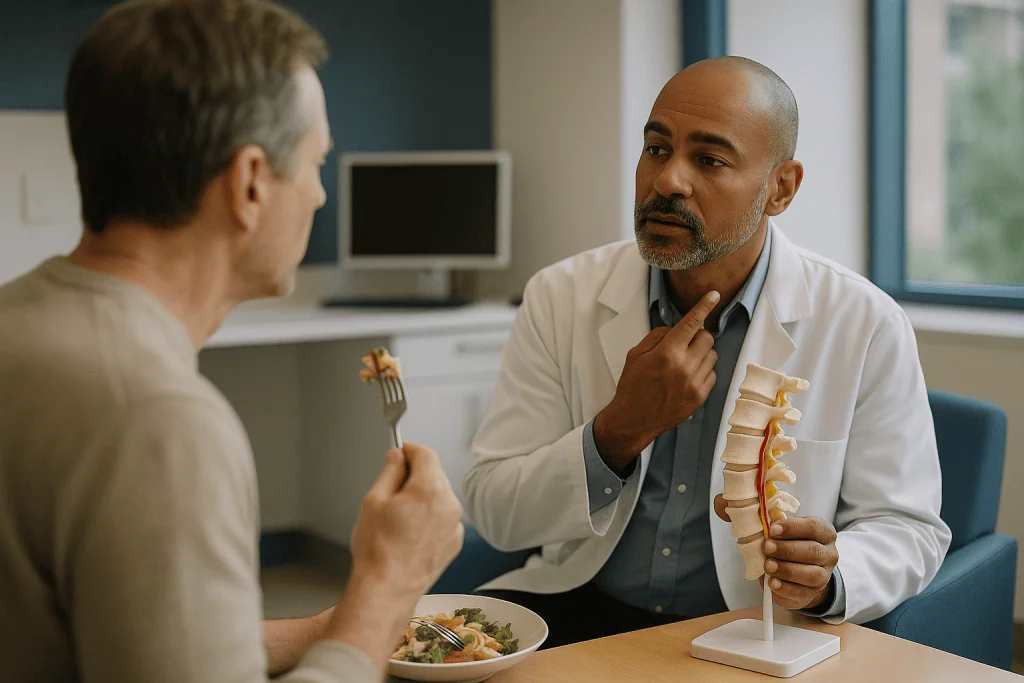
The cervical spine is a stack of seven vertebrae with a disc between each pair. The spinal cord runs through a bony canal behind the discs. When a disc herniates or a bone spur forms, the compression almost always happens at the front of that canal, where the disc sits. Reaching that spot from behind would mean working around the spinal cord itself. Reaching it from the front puts the problem directly in view, with the cord safely behind it.
The front of the neck also offers a soft-tissue route with no bone to remove on the way in. The surgeon passes between the muscles and structures rather than through them. This is why postoperative neck muscle pain is generally milder after an anterior approach than after many posterior cervical operations, a point made in the NHS and MedlinePlus patient resources referenced below.
There are trade-offs. The windpipe, food pipe, voice-box nerves and major blood vessels all live in that corridor, and they are moved aside by retractors for the duration of the operation. Temporary sore throat, difficulty swallowing and hoarseness are the predictable consequences, and they are discussed in detail further on.
Some problems are better treated from behind. Compression coming from thickened ligaments at the back of the canal, or disease spanning many levels, may push a surgeon toward a posterior approach or a combination. Which route fits a particular neck is a judgment for the treating team, based on imaging and examination.
Who is ACDF usually for, and who is usually asked to wait?
ACDF treats two broad problems: a nerve root being pinched as it leaves the spine (cervical radiculopathy) and the spinal cord itself being squeezed (cervical myelopathy). The first typically causes arm pain, tingling or weakness in a pattern that follows one nerve. The second can affect balance, hand coordination and bladder control, because the cord carries signals to the whole body below the neck.
Candidates usually share a few features. Imaging shows compression at a specific level that matches the symptoms. For radiculopathy, symptoms have persisted despite a reasonable trial of nonsurgical care, often described as six to twelve weeks in the referenced guidance. For myelopathy, surgeons tend to act sooner, because cord compression that progresses can leave lasting deficits, and the goal is to stop decline rather than guarantee recovery of what has been lost.
Who is usually asked to wait, or steered elsewhere? Neck pain alone, without arm symptoms or cord signs, is a weak reason for fusion; the evidence that ACDF reliably relieves axial neck pain is limited, and most surgeons say so plainly. People whose imaging findings do not match their symptoms are also asked to pause, because operating on a disc that is not the culprit helps no one.
Active infection, poorly controlled diabetes, heavy smoking and certain bone conditions raise the risk of the fusion failing to knit. Teams may ask for these to be addressed first. Smoking in particular impairs bone healing, and stopping before surgery is one of the few modifiable factors that patients control directly.
None of this is a checklist for self-selection. The decision rests with the treating team, weighing symptoms, scans, overall health and personal goals together.
Before the operation: imaging, planning and the anesthesia conversation
A good ACDF is largely planned before anyone enters the operating room.
An MRI scan is the key study. It shows soft tissue, including the disc, the spinal cord and the nerve roots, and lets the surgeon see exactly where the compression sits. A CT scan is sometimes added because it shows bone in finer detail, which matters when bone spurs rather than soft disc are doing the squeezing. Plain X-rays taken while bending the neck forward and back can reveal instability between vertebrae, which affects how many levels need fusing.
The preoperative assessment covers general health. Blood tests, a heart tracing and sometimes a chest X-ray are routine for anyone having general anesthesia. People taking blood thinners, diabetes medicines or certain supplements will receive instructions from the surgical and anesthesia teams about what to pause and when; these instructions should come from them, not from any article.
The anesthesia conversation deserves attention. Anesthetists need to know about previous problems with anesthesia, loose teeth, sleep apnea and reflux, because the breathing tube passes right beside the surgical field. Some teams use neuromonitoring during the operation, which involves small electrodes that track nerve and spinal cord signals so the team is warned of any change in real time.
Patients are typically asked to shower with an antiseptic wash, stop eating and drinking for a set period beforehand and arrive with a list of current medicines. Arranging someone to drive home and help for the first few days is practical planning, not pessimism.
Ask what the plan is if the surgeon finds something unexpected. Most teams will have discussed contingencies, such as adding a level, and want you to understand them in advance.
Removing the disc: what "discectomy" actually involves
Once the front of the spine is exposed, the surgeon confirms the level with an intraoperative X-ray. Counting vertebrae by feel alone is unreliable, and wrong-level surgery is a known error that this step is designed to prevent.
Small pins are placed into the vertebrae above and below the disc and attached to a distraction device, which gently opens the disc space a few millimeters. This improves the view and restores some of the height that a collapsed disc has lost.
The disc itself has two parts. The tough outer ring, called the annulus fibrosus, is incised with a scalpel. The soft inner core, the nucleus pulposus, is then removed piece by piece with small grasping instruments and curettes, which are spoon-shaped scrapers. The surgeon works from front to back under magnification, using a microscope or surgical loupes, until the back wall of the disc space is reached.
Behind that back wall lies a thin, strong band called the posterior longitudinal ligament, and behind that is the dura, the membrane surrounding the spinal cord. Herniated disc fragments often slip through or under this ligament. The surgeon carefully opens or removes the ligament to find and extract any fragments pressing on the cord or nerves.
Cartilage covering the bony surfaces above and below is scraped away to expose bleeding bone. This matters for the next stage, because bone fuses to bone, not to cartilage. The endplates are prepared evenly so the graft or cage will sit flat with good contact on both sides.
Bleeding is controlled throughout with gentle pressure, bone wax and small electrical cautery. Blood loss in a typical ACDF is modest, and transfusion is uncommon, according to the referenced patient information.
Decompressing the nerves and spinal cord
Taking out the disc is only half of the job. The purpose of the operation is to give the compressed nerve tissue room, and that often means removing bone as well.
Where a disc has degenerated, the body responds by laying down extra bone at the edges of the vertebrae. These bone spurs, medically called osteophytes, narrow the openings where nerve roots exit the spine. Using a high-speed drill with a tiny burr, fine punches and curettes, the surgeon trims these spurs back until the nerve root is free along its path out of the canal. This part is sometimes called a foraminotomy, meaning widening of the foramen, the bony tunnel each nerve passes through.
For myelopathy, the attention is on the central canal. The surgeon removes any bar of bone or disc running across the back of the disc space and checks that the dura has resumed its normal rounded contour, which indicates the cord is no longer indented. A blunt probe is often passed gently around the margins to confirm nothing remains.
Why so meticulous? Residual compression is one of the more common reasons symptoms persist after surgery. Surgeons therefore spend a disproportionate share of operating time on this stage, often under the microscope, because millimeters matter.
What decompression cannot do is reverse damage already done. A nerve that has been compressed for months may recover slowly, over many weeks, or only partly. Spinal cord changes visible on MRI as a bright signal sometimes persist. The honest framing, used in the NHS and MedlinePlus guidance referenced below, is that surgery removes the cause of ongoing injury and gives the nervous system the best chance to recover, without guaranteeing how much recovery will follow.
The fusion: graft, cage and plate explained
With the disc gone, there is a gap between two vertebrae. Left empty, it would collapse and the bones would grind. The fusion fills that gap and, over time, turns two bones into one.
A spacer is placed into the prepared disc space. It can be a block of bone or a cage, which is a small hollow box made of plastic polymer, titanium or carbon fiber composite, packed with bone material. The spacer restores disc height, keeps the nerve openings widened and provides a scaffold for new bone to grow across.
The bone material itself comes from several possible sources, and surgeons choose based on the case rather than one being universally best.
| Graft type | Where it comes from | Practical points |
|---|---|---|
| Autograft | The patient’s own bone, usually a small piece from the hip | Living bone cells; requires a second incision with its own soreness |
| Allograft | Processed donor bone from a tissue bank | No second incision; screened and sterilized; relies on the body’s cells to grow into it |
| Synthetic or biologic substitutes | Manufactured materials, sometimes with bone-growth proteins | Avoids donor sites; evidence varies by material and level |
A thin titanium plate is usually fixed across the front of the two vertebrae with screws. The plate acts like an internal splint, stopping movement while the bone heals. Some surgeons use cages with built-in anchors instead of a separate plate. Either way, the metal is permanent and does not need removing.
The fusion is not complete when you leave the operating room. Bone grows at biological speed, and the referenced guidance describes solid fusion as taking several months, often three to twelve.
Is ACDF major surgery, and how long does it take?
Two of the most searched questions deserve direct answers.
Is ACDF major surgery? Yes, in the sense that it is performed under general anesthesia, involves the spine and carries real risks that require informed consent. It is also one of the more routine spinal operations, with a small incision, little muscle disruption and a short hospital stay. Many people go home the day after surgery, and some centers discharge the same day for straightforward single-level cases, according to the patient resources referenced below. Calling it “minor” would be wrong; calling it one of the better-tolerated spine operations is fair.
How long does the operation take? The referenced patient information describes one to two hours of operating time for a single level. A two-level ACDF typically takes longer, often two to three hours, because each additional disc requires its own discectomy, decompression and graft placement. Total time away from the family, including anesthesia induction and recovery room, is longer than the surgical time alone.
Is spinal fusion major surgery in general? Fusions elsewhere in the spine, particularly multi-level lumbar operations, often involve larger incisions, more blood loss and longer stays. ACDF sits at the gentler end of that spectrum, which is why people sometimes receive mixed messages when they read about “spinal fusion” broadly and assume it all applies to the neck.
Perspective helps. The MedlinePlus overview of spinal fusion describes the operation, the hospital stay and the recovery in measured terms, and it is worth reading alongside your surgeon’s specific plan. The number of levels, your general health and whether the operation is for radiculopathy or myelopathy all shape how major it will feel for you.
The first days after surgery: swallowing, voice and the collar
Waking from an ACDF, most people notice the throat before the neck. That is the predictable result of the windpipe and food pipe having been held aside for an hour or more.
Difficulty swallowing, called dysphagia, is common in the first days. Food may feel as if it sticks, and larger pills can be awkward. Soft, moist foods and small sips help, and the sensation usually settles over days to weeks, with the referenced sources describing persistent trouble as uncommon. Hoarseness or a weaker voice reflects irritation of the nerve to the voice box, and it, too, generally resolves. Tell the team if either worsens rather than improves.
Neck pain at the incision is usually mild to moderate and managed with the medicines your team prescribes. Shoulder-blade and upper-back aching is frequent and is partly a response to the change in neck alignment. Arm symptoms often ease quickly, sometimes before you leave hospital, though numbness may linger longer than pain.
Many people are up and walking within hours of surgery. Walking is encouraged because it reduces the risk of blood clots and lung complications. Lifting is restricted, typically to light household objects, and twisting or bending the neck forcefully is discouraged while the graft settles.
Whether you wear a soft or rigid collar depends on your surgeon’s preference and how many levels were fused. Some surgeons skip collars entirely for single-level plated fusions; others use them for comfort or for a few weeks of protection. Follow the instructions you were given rather than comparing with other patients.
The incision is usually covered with a small dressing and heals into a fine line in a skin crease. Keep it clean and dry as instructed, and watch for the warning signs listed later in this article.
ACDF surgery recovery time: the weeks and months of fusion
Recovery from ACDF happens on two timelines that do not match. The soft tissues heal within weeks. The fusion takes months. People feel better long before the bone has finished its work, and that gap is where many recovery mistakes happen.
In the first two weeks, the throat settles, the incision heals and energy returns gradually. Fatigue after general anesthesia is normal and can last longer than people expect. Short, frequent walks are more useful than one ambitious outing.
Between roughly two and six weeks, many people return to desk-based work and light daily activity, a range described in the referenced patient guidance. Driving is usually permitted once you are off strong pain medicines and can turn your head comfortably to check mirrors; your team will advise. Physical therapy, when prescribed, usually begins in this window and focuses on posture, gentle range of motion and strengthening the muscles that support the neck.
From six weeks to several months, the restrictions ease in stages. Heavier lifting, overhead work and contact sports are typically held back until follow-up X-rays show bone bridging across the disc space. The referenced sources describe fusion as generally solid between three and twelve months, with variation by age, number of levels, bone quality and smoking status.
Follow-up visits with X-rays track that progress. The images are what tell the team when the fusion is mature, not how you feel. A person who feels excellent at eight weeks still has an immature fusion, which is why the lifting advice continues even when the pain has gone.
Permanent change is modest. Fusing one level reduces total neck rotation slightly, and most people do not notice it in daily life. Multi-level fusions reduce motion more noticeably.
ACDF surgery risks and how teams work to reduce them
Every operation carries risk, and honest consent means naming them without exaggeration. The following are the complications discussed in mainstream patient guidance, grouped by likelihood rather than drama.
Common and usually temporary: sore throat, difficulty swallowing, hoarseness and neck or shoulder-blade soreness. These stem from the approach itself and generally resolve over days to weeks.
Less common: infection at the incision, bleeding or a blood collection (hematoma) in the neck, and a leak of spinal fluid if the dura is nicked during decompression. A neck hematoma is taken seriously because swelling can press on the airway; it is one reason patients are observed closely in the first hours and asked to report breathing difficulty immediately.
Fusion-related: the bone may fail to knit, called pseudarthrosis or nonunion. It is more likely with multi-level fusions, smoking and certain medical conditions, and it does not always cause symptoms. Hardware can occasionally loosen or shift, and the graft can subside into the vertebra, losing some height.
Nerve-related: persistent or new weakness, numbness or, rarely, spinal cord injury. Damage to the nerve controlling the voice box can leave lasting hoarseness in a small proportion of cases. Injury to the food pipe is rare but significant.
Long term: the levels above and below a fusion carry slightly more load, and some develop wear over years, a phenomenon called adjacent segment disease. Whether this is caused by the fusion or simply reflects the underlying tendency to disc degeneration remains debated in the literature.
Teams reduce these risks with intraoperative X-ray confirmation of the level, magnification, neuromonitoring where used, careful hemostasis, antibiotic prophylaxis and clear postoperative instructions. Your own contribution, chiefly not smoking and following activity limits, affects the fusion directly.
Alternatives to ACDF your surgeon may discuss
ACDF is one option, not the only one, and a thorough consultation will usually touch on the others.
Nonsurgical care comes first for most radiculopathy. Time, activity modification, physical therapy and medicines that reduce inflammation or calm nerve pain allow many herniated discs to shrink and symptoms to settle. The NHS guidance on cervical spondylosis referenced below describes this conservative pathway. Steroid injections around the nerve root are sometimes offered for temporary relief, though the evidence for lasting benefit is mixed.
Cervical disc arthroplasty, also called artificial disc replacement, uses the same front-of-neck approach and the same discectomy and decompression. Instead of fusing, the surgeon implants a device that preserves motion at that level. It suits selected patients, typically younger people with one or two levels of soft disc herniation and little arthritis or instability. It is not suitable where the joints are badly worn or the spine is unstable.
Posterior cervical foraminotomy approaches from the back of the neck and removes a small piece of bone to free a single nerve root without fusing anything. It avoids the swallowing issues of the anterior approach and preserves motion, but it cannot remove a disc herniation sitting centrally in front of the cord.
Posterior laminectomy or laminoplasty opens or reshapes the back of the canal and is used for multi-level cord compression, often in older patients with widespread narrowing.
Corpectomy removes an entire vertebral body along with the discs above and below, used when compression comes from behind the vertebra itself rather than just the disc.
No option is universally superior. The right one depends on where the compression is, how many levels, the alignment of the neck, bone quality and your priorities. These comparisons belong in the consultation room, with your scans on the screen.
What people often get wrong about anterior cervical discectomy and fusion
Myths cluster around this operation. Here are the ones worth correcting.
“They cut through the throat.” The surgeon makes a skin incision and then separates tissues along natural planes. The windpipe and food pipe are moved aside, not cut. The soreness afterward comes from retraction, not division.
“I won’t be able to move my neck.” A single-level fusion removes a small fraction of total neck motion. Most people do not notice the difference in daily life. Multi-level fusions reduce motion more, and your surgeon can give you a realistic picture for your case.
“Once I feel better, the fusion is done.” Symptom relief and bone healing run on different clocks. Pain often eases within weeks; the bone takes months. Lifting restrictions exist to protect the graft during that gap.
“The metal will need to come out.” The plate and screws are designed to stay permanently. Removal is only considered if hardware causes a specific problem, which is uncommon.
“Surgery will fix my neck pain.” ACDF is designed to relieve arm symptoms and protect the spinal cord. Its effect on neck pain alone is less predictable, and surgeons generally say so. Expectation setting matters.
“My numbness should vanish immediately.” Pain often resolves quickly because the pressure is gone. Numbness and weakness depend on nerve recovery, which happens slowly over months and may be incomplete if the nerve has been compressed for a long time.
“Fusion causes the next disc to fail.” Adjacent levels do carry a bit more load, and some wear over years. Whether that reflects the fusion or the person’s underlying disc biology is genuinely unresolved in the research, so neither certainty is justified.
“Everyone needs a hard collar.” Practice varies. Some surgeons use none for a plated single level. Follow your own team’s instructions.
Questions to ask your care team before ACDF
A consultation goes better when you arrive with specific questions. These are the ones that tend to matter most, and your surgeon should welcome them.
- Which level or levels are you planning to operate on, and how confident are you that they match my symptoms?
- Is my problem mainly a pinched nerve root, spinal cord compression or both, and how does that change the urgency?
- What would happen if I chose to wait, and what signs would make waiting unsafe?
- Am I a candidate for disc replacement or a posterior operation instead, and why do you favor fusion in my case?
- What type of graft and cage will you use, and will any bone be taken from my hip?
- Will you use neuromonitoring during the operation?
- How long do you expect the surgery to take, and will I stay overnight?
- Will I need a collar, and for how long?
- What activities are restricted, and until what point: a number of weeks, or until X-rays show fusion?
- When can I drive, return to my type of work and resume exercise?
- Which of my current medicines or supplements should I stop before surgery, and who gives me those instructions?
- What swallowing or voice changes should I expect, and when should I worry?
- How will you know the fusion has healed, and what happens if it does not?
- Who do I call, day or night, if something feels wrong after I go home?
Write the answers down or bring someone to listen with you. The details that feel clear in the room are the ones that blur by evening.
If anything you read online conflicts with what your team tells you, raise it with them rather than quietly choosing between the two. Your team knows your scans; an article does not.
When to call your doctor after ACDF surgery
Most recoveries are uneventful, but a few signs need prompt attention. Your discharge paperwork will include a contact number; keep it where you can find it.
Call emergency services immediately if you have difficulty breathing, a rapidly swelling neck or a feeling of the throat closing. Swelling or bleeding in the neck can press on the airway and is treated as an emergency, particularly in the first days after surgery.
Contact your surgical team urgently for any of the following:
- New or worsening weakness in the arms or legs, or new difficulty walking or with balance
- Loss of bladder or bowel control, or new difficulty passing urine
- Fever, chills, or redness, warmth, increasing pain or discharge at the incision
- Clear fluid leaking from the wound, or a severe headache that is worse when upright and eases lying down, which can indicate a spinal fluid leak
- Swallowing that is getting worse rather than better, inability to swallow liquids, or choking when eating
- Hoarseness that persists beyond a few weeks or worsens
- Calf pain, swelling or redness, or sudden chest pain and breathlessness, which can signal a blood clot
- Severe neck pain that does not respond to your prescribed medicines, or a sudden change in neck position or a clicking sensation
- Numbness or tingling that is spreading rather than receding
For milder concerns, such as a sore throat that is slowly improving or stiffness between the shoulder blades, note them for your follow-up visit, but do not hesitate to call if you are unsure. Teams would rather hear about a false alarm than miss a real one.
Every judgment about your recovery, including whether a symptom is expected or concerning, rests with the surgeons and nurses who know your operation. Use their guidance over anything you read here.
Frequently asked questions
Is ACDF surgery major surgery?
Yes, ACDF is major surgery in the sense that it involves general anesthesia, the spine and real risks that require informed consent. It is also one of the better-tolerated spinal operations: the incision is small, no muscle is cut on the way in, and many people leave hospital the same or next day according to the referenced patient guidance. The number of levels fused and your general health shape how major it feels.
How long does a 2-level ACDF surgery typically take?
A two-level ACDF typically takes around two to three hours of operating time, longer than the one to two hours described for a single level in the referenced patient information. Each extra disc needs its own removal, decompression and graft placement. Total time in the surgical department, including anesthesia and the recovery room, is longer than the operating time alone, so families should plan for several hours.
What is the average life expectancy after ACDF surgery?
ACDF does not change life expectancy. It treats nerve or spinal cord compression in the neck, which is not a life-threatening condition in itself, and there is no evidence that the operation shortens life. Serious complications are uncommon and are discussed during consent. Life expectancy after surgery is governed by the same factors as before: age, heart and lung health, and other medical conditions, not by the fusion.
Is spinal fusion major surgery in general?
Spinal fusion is considered major surgery wherever it is performed, but the scale varies widely. Multi-level lumbar fusions often involve larger incisions, more blood loss and longer hospital stays. ACDF sits toward the gentler end of that range because of the small front-of-neck incision and soft-tissue approach. Reading about spinal fusion broadly can give a more daunting picture than a single-level neck fusion warrants.
What is the typical ACDF surgery recovery time?
Soft-tissue recovery takes weeks while bone fusion takes months. Many people return to desk work and light activity within two to six weeks, a range described in the referenced patient guidance. Heavier lifting and sports are usually restricted until follow-up X-rays show bone bridging across the disc space, generally between three and twelve months. Your surgeon’s timeline is specific to your levels, bone quality and health.
What are the main ACDF surgery risks?
The common risks are temporary sore throat, swallowing difficulty and hoarseness from retraction of the throat structures. Less common risks include infection, bleeding or a neck hematoma, spinal fluid leak, failure of the bone to fuse, hardware problems and nerve or spinal cord injury. Over years, levels next to the fusion may develop wear. Your surgeon will discuss how these apply to your case during consent.
What does anterior cervical discectomy and fusion mean in plain language?
Anterior means from the front, cervical means the neck, discectomy means removing a disc, and fusion means joining two bones into one. Together, the term describes an operation in which the surgeon reaches a damaged neck disc from the front of the throat, removes it, frees the compressed nerves or spinal cord, and fills the gap with bone graft and a cage so the two vertebrae heal into a single bone.
Will I lose neck movement after ACDF?
A single-level fusion removes a small fraction of total neck motion, and most people do not notice the difference in daily life. The remaining discs compensate. Fusing two or more levels reduces movement more noticeably, especially rotation and tipping the head back. Your surgeon can describe the realistic change for your specific levels, and physical therapy helps you make the most of the motion that remains.
Why do I have trouble swallowing after ACDF?
The food pipe is held aside by retractors for the duration of the operation, and the resulting swelling and irritation make swallowing feel awkward for a time. Soft, moist food and small sips help in the first days. The sensation usually improves over days to weeks. If swallowing is getting worse rather than better, or you cannot manage liquids, contact your surgical team promptly rather than waiting for a scheduled visit.
Does the plate and screws in my neck need to be removed later?
No, the titanium plate and screws are designed to stay in place permanently. They act as an internal splint while the bone fuses and then simply remain embedded in the healed bone. Removal is only considered if the hardware causes a specific problem, such as loosening or irritation of the food pipe, which is uncommon. Titanium is compatible with MRI scanning, though always tell imaging staff about implants.
References
- Spinal fusion – MedlinePlus Medical Encyclopedia
- Herniated disk – MedlinePlus Medical Encyclopedia
- Cervical spondylosis – NHS
This article is for general information only and is not a substitute for professional medical advice. Please consult a qualified doctor about your individual situation.

More from the Blog

When Does Juvenile Scoliosis Move From Monitoring to Bracing or Surgery? The Decision Points
Juvenile scoliosis is usually monitored while the curve stays below about 20 to 25 degrees, braced when a still-growing child's curve reaches roughly 25…

Which Spine Operation Fits Which Problem? Decompression, Fusion and Disc Surgery Compared
Decompression, fusion and disc surgery treat different mechanical problems. Decompression removes bone or ligament that is squeezing nerves, usually for spinal stenosis. Disc surgery…

Which Symptoms After Spine Surgery Need a Same-Day Call? Wound, Bladder and Leg Changes
Call your surgical team the same day if you notice new or worsening leg weakness, numbness spreading between the legs or around the genitals,…

Who Benefits From the Schroth Method? Curve Size, Age and Growth Stage Considerations
The Schroth method is usually considered for people with idiopathic scoliosis and mild to moderate curves, most often growing adolescents with Cobb angles roughly…

Who Is Suitable for Endoscopic Disc Surgery? Herniation Type, Location and Prior Surgery
An endoscopic disc surgery candidate is typically an adult with a single, imaging-confirmed lumbar disc herniation that presses on one nerve root, causing leg…

How Long Does an Artificial Disc Last? Wear, Motion Over Time and Realistic Expectations
Nobody can promise a fixed number of years for an artificial disc. Published follow-up now stretches to roughly seven to ten years for several…