

How Alopecia Areata Treatment Is Planned: Topical, Injectable and Systemic Options in Sequence

Key Takeaways
- In alopecia areata the immune system pushes hair follicles into a dormant state without destroying them, which is why regrowth remains possible even after years of loss.
- The NHS notes that in many cases of limited patchy alopecia areata hair regrows within about a year without treatment, so watchful waiting is a legitimate first step.
- Intralesional corticosteroid injections are typically repeated roughly every 4–8 weeks, with regrowth judged over months rather than weeks.
- JAK inhibitors are the first medicines approved specifically for severe alopecia areata, but they act body-wide, require blood monitoring and carry warnings about infection and clots.
- Lower vitamin D levels have been observed in some people with alopecia areata, yet no study shows that supplementing reverses the hair loss, and no food has been proven to trigger it.
- Alopecia areata is associated with thyroid disease, vitiligo and atopic conditions, which is why a dermatologist may ask about other symptoms or order a thyroid blood test.
Alopecia areata treatment is usually planned in steps that match how much hair is affected and how fast it is changing. Small patches are often watched or treated with topical corticosteroids; stubborn patches may get corticosteroid injections; widespread or rapidly progressing disease may be considered for systemic medicines such as JAK inhibitors. Because hair regrows slowly, each step is typically judged over months, and the sequence is decided with a dermatologist.
It usually starts with a barber, a hairdresser or a partner. Someone notices a smooth, coin-sized bald spot at the back of the head, the skin inside it looking oddly healthy, and says, quietly, “Has that always been there?” By the time most people reach a dermatology appointment, they have already searched alopecia areata treatment options late at night and found a jumble of promises: miracle oils, strict diets, injections that “work in weeks,” and a new class of pills that sounds too good to be true.
The honest picture is calmer and more orderly than the internet suggests. Dermatologists do not reach for the strongest medicine first. They size up the pattern, the pace and the person, then move through treatments in a rough sequence, from creams to injections to systemic medicines, pausing at each step long enough for slow-growing hair to show whether anything is changing.
This explainer walks through that sequence the way a clinician thinks about it, and it is candid about what the evidence does and does not show.
Why alopecia areata treatment options are planned in a sequence, not chosen off a menu
Alopecia areata is an autoimmune condition, meaning the body’s immune system mistakenly attacks its own hair follicles, the tiny pockets in the skin that grow each hair. The follicles are not destroyed. They are pushed into a resting state and stop producing hair while the immune attack continues. That single fact shapes the entire treatment plan: because the follicle survives, regrowth stays possible, and the goal of every treatment is to quiet the immune activity long enough for the follicle to restart.
Dermatologists think in tiers. The first tier is the least invasive option that could plausibly work for the amount of hair involved. The next tier is only considered when the first has been given a fair trial or when the disease is clearly outrunning it. Skipping straight to the most powerful medicine exposes someone to more side effects than their situation may justify, and it gives up the chance to see whether the condition settles on its own, which it often does in limited patchy disease according to the NHS and the National Institute of Arthritis and Musculoskeletal and Skin Diseases (NIAMS).
Three variables drive where a person starts:
- Extent: a couple of patches versus most of the scalp, eyebrows or body hair.
- Pace: stable for months versus new patches appearing every few weeks.
- Person: age, other health conditions, pregnancy plans and how much the hair loss is affecting daily life.
A teenager with two quiet patches and an adult who has lost half the scalp in three months may both have alopecia areata, but they will not walk out with the same plan. Understanding that logic makes the rest of the sequence, and the waiting it involves, far easier to live with.
What actually happens in the follicle during alopecia areata
Picture the hair follicle as a small factory with a security perimeter. In healthy skin, the growing part of the follicle enjoys what immunologists call immune privilege: it hides certain surface markers so patrolling immune cells leave it alone. In alopecia areata, that perimeter fails. Immune cells called T lymphocytes cluster around the bulb of the follicle, a pattern pathologists describe as a swarm of bees on a biopsy, and release chemical signals that force the follicle out of its growth phase.

The result is not scarring. The follicle stem cells, which sit higher up in the skin, are largely spared. That is why the bald patch feels smooth and looks healthy rather than shiny or pitted, and why people sometimes see fine white or colorless hairs reappearing first: pigment cells recover more slowly than the hair shaft itself, as NIAMS describes.
Hair growth itself is slow. Scalp hair grows roughly a centimeter a month, and a follicle that has been shut down needs weeks to rebuild a hair before anything is visible at the surface. Cleveland Clinic notes that noticeable regrowth after treatment commonly takes a few months. This biology sets the clock for every treatment decision: nothing, however potent, can be fairly judged in a fortnight.
The same mechanism explains a puzzling feature of the condition. Because the immune attack can switch on and off, hair can regrow in one patch while a new patch opens elsewhere. Treatment aims to interrupt the attack, but it cannot rewrite the underlying tendency of the immune system to target follicles, which is why relapse remains possible and why long-term plans matter more than quick fixes.
What triggers alopecia areata?
Nobody has found a single trigger, and anyone who claims to sell you one deserves skepticism. What the evidence supports is a two-part story: an inherited tendency plus something that tips the immune system.
The inherited part is real but partial. MedlinePlus reports that alopecia areata runs in families in some cases and that a number of genes involved in immune regulation have been linked to it. Having a relative with the condition raises the likelihood, yet most people with alopecia areata have no affected family member, and most relatives of affected people never develop it.
The condition also keeps company with other autoimmune diseases. NIAMS and Cleveland Clinic list thyroid disease, vitiligo (loss of skin pigment in patches), type 1 diabetes and atopic conditions such as eczema and asthma as occurring more often in people with alopecia areata. This is why a dermatologist may ask about fatigue, weight change or skin changes elsewhere, and sometimes orders a blood test for thyroid function.
What about stress? Many people can name a difficult period that preceded their first patch, and NIAMS acknowledges that stress may be associated with flares in some people. The evidence is inconsistent, and plenty of patches appear during calm stretches of life. Treating stress as the cause can leave people blaming themselves for an immune process they did not create.
Viral illness, hormonal shifts and seasonal changes are also discussed as possible triggers, but none has been proven to cause the disease. The practical takeaway is modest: know your family history, mention other health changes to your care team, and be wary of any explanation that arrives with a product attached.
Who is usually treated first, and who is usually asked to wait
The first decision in the sequence is often whether to treat at all, and that surprises people. For a small number of patches that appeared recently, the NHS notes that hair frequently regrows within about a year without any treatment. In that setting, a dermatologist may offer watchful waiting, sometimes with a mild topical corticosteroid to hedge, and a review appointment a few months out.

Who tends to move toward active treatment sooner?
- People whose patches are enlarging or multiplying over weeks rather than months.
- People with involvement of eyebrows or eyelashes, which affects appearance and eye protection.
- Adults with extensive scalp loss, sometimes described as alopecia totalis (all scalp hair) or alopecia universalis (all body hair).
- Anyone for whom the hair loss is causing significant distress, regardless of extent.
Who is more often asked to pause or to stay on the gentlest step? Young children, because many treatments have limited safety data in that age group and because spontaneous regrowth is common. People who are pregnant, planning pregnancy or breastfeeding, since several systemic medicines are not used in those circumstances. People with certain infections, blood count abnormalities or a history of blood clots, whose risk profile changes what is reasonable to prescribe.
Waiting is not the same as doing nothing. It is a deliberate, time-limited step with a planned review, and it protects people from side effects they may never have needed to take on. If new patches appear during the waiting period, that observation itself becomes information, and the plan is adjusted. The treating team, not the calendar, decides when the wait has gone on long enough.
Topical treatment: what creams and foams can and cannot do
The first active rung is usually a topical corticosteroid, a cream, ointment, foam or lotion that dampens inflammation where it is applied. Corticosteroids are synthetic versions of hormones the body makes, and in the skin they reduce the activity of the immune cells crowding the follicle. NIAMS and Cleveland Clinic both list them as a common first-line option for limited patches, particularly in children, where injections are harder to tolerate.
Topicals suit small, accessible areas. They are less useful when patches are numerous or the scalp is largely bare, simply because coverage becomes impractical and the medicine does not penetrate deeply enough to reach follicles under thick scalp skin as reliably as an injection does. Side effects are mostly local: thinning of the skin, visible small blood vessels and acne-like spots with prolonged use, which is why a prescriber sets a review point rather than an open-ended supply.
Topical minoxidil, a medicine originally developed for blood pressure that widens blood vessels and appears to lengthen the growth phase of hair, is sometimes added. NIAMS describes it as a supportive option that may help hair regrow once the immune attack is quieting, rather than a treatment that stops the attack itself. It is not a standalone answer for active alopecia areata.
Two expectations matter here. First, time: several months is a fair trial for a topical, given how slowly hair rebuilds. Second, honesty about limits: if patches keep spreading despite consistent use, that is not a failure of effort; it is a signal that the disease needs the next rung. Any change to how a topical is used, or whether to continue it, belongs to the prescribing clinician.
Steroid injections for alopecia areata: what the appointment actually involves
For adults with a limited number of stubborn patches, intralesional corticosteroid injections are often the workhorse of the second rung. “Intralesional” simply means injected into the affected area itself. A dermatologist uses a fine needle to place small amounts of corticosteroid just beneath the skin surface across the patch, delivering anti-inflammatory medicine directly to the follicles rather than relying on a cream to soak through.
Patients commonly ask what it feels like. Most describe brief stinging with each small injection, comparable to a series of quick pinches, over a few minutes. Some clinics apply a numbing cream first or use a spray coolant. Afterward the area may look slightly raised or pink for a short while, and mild tenderness for a day is not unusual.
Sessions are typically repeated at intervals of several weeks, with NIAMS and Cleveland Clinic describing roughly every 4–8 weeks, so the medicine can keep working while the follicle rebuilds a hair. Regrowth, when it happens, usually becomes visible over a few months at the injection sites, and a dermatologist looks for fine new hairs before deciding whether to continue, adjust or stop.
The main local side effect is a temporary dent in the skin, called atrophy, where fat under the skin thins at an injection site. It usually recovers over months. Lighter or darker skin discoloration can also occur. Because the total amount injected is kept modest, body-wide effects are uncommon, though a prescriber will still weigh other conditions such as diabetes.
Injections work best when patches are few and the scalp is otherwise well covered. If the disease is widespread or spreading fast, injecting dozens of sites every month is neither practical nor kind, which is when the conversation turns to clinic-based or systemic options.
Contact immunotherapy and other clinic-based options for more extensive disease
When patches are too many to inject but the case is not severe enough, or the person is not suitable, for systemic medicine, dermatologists have a middle ground. Topical immunotherapy, described by NIAMS and the NHS, involves painting a chemical onto the scalp that deliberately provokes a mild allergic rash. The theory is counterintuitive but grounded: a controlled allergic reaction appears to distract or reset the immune cells attacking the follicles. The chemical is first applied to a small test area to sensitize the skin, then applied weekly at gradually adjusted strengths in a clinic.
This approach demands patience and tolerance. An itchy, sometimes blistering rash is the intended effect, not a complication, and treatment continues for months before regrowth is judged. Swollen lymph nodes in the neck, skin darkening or lightening, and occasionally a more widespread eczema-like reaction can occur. It is not offered everywhere because it needs trained staff and careful handling of the chemical.
Other options sit alongside it. Short courses of oral corticosteroids are sometimes used to halt a rapid flare, but NIAMS notes that hair often falls out again when they are stopped and that long-term use carries well-known risks to bone, blood sugar and blood pressure, so they are a brake rather than a plan. Anthralin, a tar-like cream that irritates the skin, is used by some dermatologists for patchy disease, with staining of skin and fabric as the main drawback. Light-based therapies have been studied with mixed results and are not standard.
None of these is a guaranteed step. They are tools a dermatologist may reach for depending on extent, availability and how a person has responded so far, and the decision to try or to move on sits with the treating team.
JAK inhibitors for alopecia areata: how systemic treatment works
The newest rung in the sequence is a class of oral medicines called Janus kinase (JAK) inhibitors. Janus kinases are enzymes inside immune cells that relay inflammatory signals from the cell surface to the nucleus. In alopecia areata, the signals that keep T cells attacking the follicle travel along this pathway. Block the enzyme and the message is muted, allowing follicles to re-enter their growth phase. NIAMS and Cleveland Clinic describe JAK inhibitors as the first medicines specifically approved for severe alopecia areata, with approval for adults and, for one agent, adolescents.
Because these medicines act throughout the body, they are reserved for severe or rapidly progressive disease and for people who have not done well on earlier steps. Before prescribing, a clinician typically checks blood counts, liver and kidney function, cholesterol and screening for infections such as tuberculosis and hepatitis, and asks about heart disease, cancer history and clotting history. Regular blood monitoring continues during treatment.
Side effects reported in trials and product information include upper respiratory infections, acne, headache and raised cholesterol, and the class carries regulatory warnings about serious infections, blood clots, cardiovascular events and cancers based on studies in other conditions, mostly in older adults with additional risk factors. Weighing those risks against the impact of severe hair loss is a genuinely individual conversation.
Timelines follow hair biology. Trials assessed regrowth over months, and the response is judged on how much scalp is covered, not on the first few hairs. A further reality: hair loss can return after stopping, so people who respond are often continuing treatment long term under supervision. Starting, continuing or stopping a JAK inhibitor is a decision made only with the prescribing clinician.
Comparing alopecia areata treatment options side by side
Seeing the sequence laid out in one place helps most people understand why their dermatologist started where they did. The table below summarizes typical roles; it is not a ranking, and individual plans vary.
| Option | Usually considered for | How it works | Typical time to judge | Main drawbacks |
|---|---|---|---|---|
| Watchful waiting | Few recent patches, especially in children | Allows spontaneous regrowth, which the NHS notes is common within about a year | Months, with planned review | Uncertainty; possible spread |
| Topical corticosteroids | Limited patches; children | Reduce local immune activity in the skin | Several months | Skin thinning with prolonged use; limited penetration |
| Topical minoxidil | Add-on once inflammation is settling | Prolongs the hair growth phase | Several months | Does not stop the immune attack; scalp irritation |
| Intralesional corticosteroid injections | Adults with a limited number of persistent patches | Delivers anti-inflammatory medicine directly to follicles | Repeated roughly every 4–8 weeks; regrowth over months (NIAMS) | Pain; temporary skin dents; discoloration |
| Topical immunotherapy | Extensive patchy disease not suited to injections | Controlled allergic reaction redirects immune response | Many months | Itchy rash; lymph node swelling; limited availability |
| Short oral corticosteroid course | Rapid flares needing a brake | Body-wide suppression of inflammation | Weeks | Regrowth often lost after stopping; systemic risks |
| JAK inhibitors | Severe or rapidly progressive disease in eligible adults and adolescents | Blocks intracellular signaling that drives follicle attack | Months, with blood monitoring | Infection, clot and cardiovascular warnings; relapse after stopping |
Two patterns stand out. Every option takes months to evaluate, because none can speed up hair growth beyond its natural pace. And each step up the ladder trades broader reach for broader risk. That trade-off, more than any single medicine, is what a dermatologist is managing when they plan alopecia areata treatment options over time.
What the following weeks and months usually look like after treatment starts
The most common frustration is silence. A person starts a cream or has their first injections, checks the mirror daily, and sees nothing for weeks. This is expected. A follicle that has been shut down must first complete its resting phase, then build a new hair shaft beneath the skin before a tip breaks the surface. Cleveland Clinic and NIAMS both describe visible regrowth after treatment as typically taking a few months.
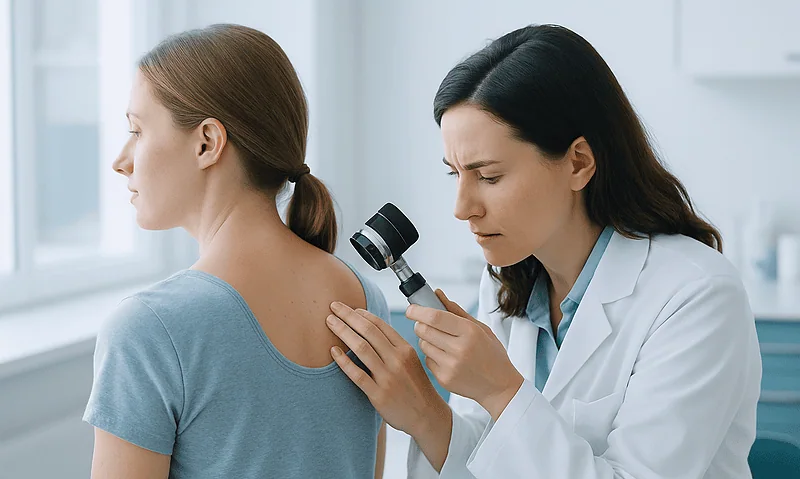
When regrowth does begin, it rarely looks like the old hair. Fine, soft, often white or pale hairs appear first; pigment tends to return later, sometimes over many months. Patches may fill in unevenly, and it is common for one area to respond while another lags or a new patch appears. A dermatologist examines the edges of patches, sometimes with a handheld magnifier, looking for signs that the process is settling: fewer short broken “exclamation mark” hairs at the margins and the arrival of new fine hairs in the center.
A realistic timeline for a limited case on topical or injectable treatment often runs like this: a first review around 2–3 months to check for early hairs and side effects; a decision at roughly 6 months about whether the current rung is working; and, if not, a discussion about the next step. Systemic treatment follows a similar rhythm of months, with blood tests layered in.
Everyday life continues throughout. Washing, gentle styling and sun protection of bare scalp are all fine, and none of them causes patches. What helps most during this stretch is a written plan with dates for review, so that the waiting feels purposeful rather than passive.
Can alopecia areata go away on its own, and does it come back?
Yes, it can settle without treatment, and this is one of the more hopeful facts about the condition. The NHS states that in many cases of patchy alopecia areata the hair grows back within about a year, and NIAMS notes that the course is unpredictable, with periods of regrowth and periods of loss that can alternate over years. Spontaneous regrowth is more likely when patches are few, small and recent, and when the person is otherwise well.
The flip side is relapse. Because the underlying immune tendency does not disappear when a patch fills in, new patches can appear months or years later, sometimes after a long quiet stretch. Some people have a single episode and never another; others cycle through episodes across their lifetime. Certain features are associated with a more persistent course in the medical literature summarized by NIAMS and Cleveland Clinic: very extensive loss, onset in early childhood, nail changes such as pitting, and a pattern of loss along the back and sides of the scalp.
What this means for treatment planning is subtle. A dermatologist is not only asking “what will regrow this patch” but “what is the likely long-term pattern for this person.” Someone with a limited, first episode may reasonably be watched. Someone with extensive, recurring disease may be steered toward longer-term strategies and honest conversations about maintenance.
No clinician can promise a patch will not return, and no treatment has been shown to prevent future episodes once stopped. What the evidence supports is that regrowth is possible even after long periods of loss, because the follicles remain alive, and that a thoughtful plan can shorten episodes and reduce their impact.
Can vitamin D reverse alopecia, and are there foods to avoid?
Vitamin D deserves a careful answer because the question is reasonable and the marketing around it is not. Vitamin D plays a role in immune regulation and in the hair follicle cycle, and several studies have found lower blood levels in people with alopecia areata than in comparison groups. That is an association, not proof of cause. Low vitamin D is common in the general population, particularly with limited sun exposure, and the studies do not show that correcting a deficiency regrows hair.
The NIH Office of Dietary Supplements fact sheet on vitamin D describes its established roles in bone and calcium metabolism and reviews the evidence for other claimed benefits, most of which remain unproven. If a blood test shows deficiency, a clinician may address it for general health reasons. Taking high amounts in the hope of reversing alopecia areata is not supported by evidence, and excess vitamin D can cause harm, including raised calcium levels. Any supplement decision belongs in a conversation with the treating team.
The food question follows the same logic. There is no diet proven to treat alopecia areata, and no specific food has been shown to trigger it. Because the condition is associated with other autoimmune diseases, a small number of people also have celiac disease, an immune reaction to gluten that damages the small intestine; for them, a gluten-free diet is needed for the celiac disease itself, not as a hair treatment. For everyone else, eliminating food groups adds cost, restriction and sometimes nutritional gaps without evidence of benefit.
A balanced diet with adequate protein, iron and overall nutrition supports healthy hair growth in general, and severe deficiencies can cause a different kind of hair shedding. That is worth checking. It is not the same as a food plan that treats an autoimmune attack on follicles.
What people often get wrong about alopecia areata treatment options
Some myths cost money. Others cost months. A few cost people their sense of self.
“It’s contagious or caused by poor hygiene.” Neither is true. Alopecia areata is an immune process, as MedlinePlus and NIAMS explain. It cannot be caught, and it is not the result of how someone washes their hair.
“The bald patch means the follicles are dead.” They are not. The follicles are dormant, not destroyed, which is precisely why regrowth remains possible even years later.
“If a cream didn’t work in a month, it doesn’t work.” Hair biology makes a month meaningless. Every option in the sequence needs months to be judged fairly, and abandoning a treatment early can lead people to conclude nothing helps.
“The strongest medicine is the best starting point.” Systemic treatments carry systemic risks. For limited disease that may settle on its own, starting there means accepting side effects for a benefit the person might have had anyway.
“A hair transplant will fix it.” Transplants move follicles from one area to another. In alopecia areata the immune system can attack transplanted follicles too, and the pattern of loss shifts, so surgery is not a standard treatment for this condition.
“Stress caused it, so relaxing will fix it.” The link between stress and flares is inconsistent in the evidence, and reducing stress, while good for wellbeing, is not a treatment for the immune process.
“Once it regrows, it’s over.” It may be, but relapse is common enough that a long-term plan matters.
Understanding these corrections does not change the disease, but it does change how people experience the sequence: with less self-blame, more patience and a clearer sense of when a step has genuinely been given its chance.
Living well while treatment runs its course: camouflage, sun and mental health
Treatment plans unfold over months, and life does not pause. Practical support during that time is part of good care, not an afterthought.
Camouflage is legitimate medicine for many people. Wigs and hairpieces, scalp-colored fiber powders, spray concealers and, for eyebrows, cosmetic pencils or semi-permanent tattooing are all used widely. None of them interferes with topical or injected treatment when used sensibly, and a dermatologist or dermatology nurse can advise on timing around injection sites. Hats and scarves do not cause or worsen patches; the idea that the scalp needs to “breathe” to regrow hair has no basis.
Bare scalp burns quickly. Sunscreen or a hat protects skin that has never been exposed before. For people who lose eyelashes, wraparound glasses help keep dust and wind out of the eyes, and lubricating drops can ease dryness. Loss of nasal hair can increase sneezing and a runny nose; these small effects are real and worth mentioning to the care team.
The emotional weight is not small either. Hair is bound up with identity, age and how others read us, and NIAMS explicitly recognizes that alopecia areata can affect emotional wellbeing and quality of life. Anxiety, low mood and social withdrawal are common enough that many dermatology services ask about them routinely. Speaking with a counselor, joining a peer support group or simply telling a few trusted people what is happening can reduce the isolation, and there is no rule that says distress must match the number of patches.
A person who is coping well is also better placed to give a slow treatment the months it needs, and to make clear-headed decisions when the next step is discussed.
Questions to ask your care team about alopecia areata treatment options
A good consultation leaves you knowing where you are in the sequence and what would move you to the next rung. Bringing questions written down helps, because appointments are short and hair loss conversations can be emotional.
- How extensive is my alopecia areata right now, and how would you describe its pace?
- Is watchful waiting a reasonable option for me, and for how long before we review?
- Which step in the sequence are you recommending, and why that one rather than the one before or after?
- How many months should we allow before deciding whether this treatment is working?
- What specific signs of regrowth or spread will you look for at the review?
- What side effects should I expect, which ones should I report right away, and how will you monitor for them?
- Do I need any blood tests, either to look for associated conditions such as thyroid disease or before starting a systemic medicine?
- If this step does not work, what is the likely next option, and what would rule me in or out of it?
- How does this plan change if I am planning a pregnancy, breastfeeding or managing another health condition?
- What is the plan if hair regrows and then falls out again?
- Is there anything I am doing at home, including supplements or diet changes, that I should stop, continue or discuss?
- Who do I contact between appointments if something changes quickly?
It is also fair to ask about camouflage options, psychological support and whether a nurse specialist is available. The answers will differ from person to person, and every decision about starting, changing or stopping a treatment rests with the clinician who knows your full history.
When to call your doctor
Alopecia areata itself is not dangerous, but some situations need prompt attention, either because they suggest a different diagnosis or because a treatment may be causing harm.
Contact your care team soon if you notice:
- Hair loss spreading rapidly over a few weeks, or new loss of eyebrows, eyelashes or body hair.
- A patch that is red, scaly, crusted, pus-filled, painful or shiny and scarred, since these features are not typical of alopecia areata and can point to infection or a scarring hair disorder that needs different treatment.
- Hair loss along with unexplained fatigue, weight change, palpitations, feeling unusually hot or cold, or new skin pigment changes, which can suggest an associated condition such as thyroid disease.
- Persistent low mood, anxiety or thoughts of self-harm related to the hair loss.
If you are on a systemic medicine such as a JAK inhibitor or oral corticosteroid, seek urgent medical advice for fever, a cough that will not settle, shortness of breath, chest pain, swelling or pain in one leg, sudden severe headache, unusual bruising or bleeding, yellowing of the skin or eyes, or a rash that spreads quickly. These can be signs of serious infection, a blood clot or a reaction that needs same-day assessment.
After corticosteroid injections, call if an injection site becomes increasingly painful, hot or swollen over the following days rather than settling.
None of these signs means something is definitely wrong, but each is a reason to be seen rather than to wait for the next scheduled review. Your treating team can decide whether the plan needs adjusting, and that judgment always sits with them.
Frequently asked questions
What triggers alopecia areata?
No single trigger has been identified. Alopecia areata develops when an inherited tendency toward immune dysregulation combines with factors that are still poorly understood. It runs in some families and is associated with other autoimmune conditions such as thyroid disease and vitiligo. Stress is often blamed, but the evidence linking it to flares is inconsistent, and many patches appear during calm periods. Viral illness and hormonal change are discussed as possible triggers without firm proof.
Can alopecia areata ever go away?
Yes. The NHS notes that in many cases of patchy alopecia areata hair regrows within about a year, sometimes without treatment, because the follicles are dormant rather than destroyed. The course is unpredictable, though: some people have a single episode, while others experience repeated cycles of loss and regrowth over years. Extensive loss, early childhood onset and nail changes are associated with a more persistent pattern, so long-term planning with a dermatologist matters.
Can vitamin D reverse alopecia?
There is no evidence that vitamin D reverses alopecia areata. Some studies have found lower vitamin D levels in people with the condition, but this is an association, not proof of cause, and correcting deficiency has not been shown to regrow hair. If a blood test shows deficiency, a clinician may address it for general health. Taking large amounts in the hope of treating hair loss is unsupported and can cause harm, including raised calcium levels.
What foods should I avoid if I have alopecia areata?
No specific food has been shown to cause or worsen alopecia areata, and no diet has been proven to treat it. A small number of people also have celiac disease, an autoimmune reaction to gluten, and for them a gluten-free diet is needed for that condition rather than for hair. For everyone else, cutting out food groups adds restriction without evidence of benefit. A balanced diet with adequate protein and iron supports hair health generally.
How do steroid injections for alopecia areata work?
A dermatologist injects small amounts of corticosteroid just beneath the skin of each patch, placing anti-inflammatory medicine directly around the affected follicles. This calms the immune cells attacking the follicle so it can re-enter its growth phase. Sessions are typically repeated roughly every 4–8 weeks, and regrowth is judged over months. The main local side effect is a temporary dent in the skin at injection sites, which usually recovers over time.
Are JAK inhibitors for alopecia areata a first-line treatment?
No. JAK inhibitors are oral medicines reserved for severe or rapidly progressive alopecia areata in eligible adults and adolescents, usually after topical and injectable options have been considered. They block signaling enzymes inside immune cells that drive the attack on follicles. Because they act throughout the body, they require blood tests before and during treatment and carry warnings about infection, blood clots and cardiovascular events. The decision to use one rests with the prescribing clinician.
How long does alopecia areata treatment take to show results?
Months, regardless of the treatment. A dormant follicle must complete its resting phase and build a new hair beneath the skin before anything is visible, so Cleveland Clinic and NIAMS describe visible regrowth typically taking a few months. Many dermatologists schedule a first review around 2–3 months to look for early fine hairs and side effects, and make a decision about whether to continue or change course at roughly 6 months.
Why do the new hairs come in white?
Pigment cells in the follicle recover more slowly than the cells that build the hair shaft, so the first regrowth is often fine and white or pale. Color usually returns gradually over months as the follicle’s pigment machinery restarts, though in some people regrown hair stays lighter than before. White regrowth is generally a positive sign that the follicle has restarted, not an indication that the treatment has gone wrong.
Is alopecia areata contagious or caused by stress?
It is not contagious. Alopecia areata is an autoimmune condition in which the body’s own immune cells attack hair follicles; it cannot be passed from person to person and is unrelated to hygiene. Stress is often blamed, and some people notice flares during difficult periods, but the evidence is inconsistent and many patches appear without any obvious stressor. Treating stress as the sole cause can lead to unwarranted self-blame.
Can a hair transplant fix alopecia areata?
Hair transplantation is not a standard treatment for alopecia areata. Transplants move follicles from one part of the scalp to another, but in alopecia areata the immune system can attack transplanted follicles as readily as the originals, and the pattern of loss shifts unpredictably. Surgery is generally considered only in very stable, long-inactive cases, and even then with caution. Medical treatment aimed at the immune process remains the mainstay.
References
- Alopecia Areata: Diagnosis, Treatment, and Steps to Take. National Institute of Arthritis and Musculoskeletal and Skin Diseases (NIH)
- Alopecia Areata. Cleveland Clinic
- Alopecia areata. MedlinePlus Genetics
- Hair loss. NHS
This article is for general information only and is not a substitute for professional medical advice. Please consult a qualified doctor about your individual situation.

More from the Blog

Folliculitis vs Acne: How Dermatologists Tell Them Apart and Why the Treatments Differ
Folliculitis and acne both produce red bumps and pustules, but they are different conditions. Acne involves clogged pores with blackheads or whiteheads, oil, and…
Preventing Cellulitis From Coming Back: Skin Care, Swelling Control and Foot Fungus Checks
Preventing recurrent cellulitis usually rests on three habits: caring for the skin barrier with daily moisturizer and prompt treatment of cuts, controlling chronic leg…

Is Rosacea Autoimmune, Does It Itch, and Does It Get Worse with Age?
Rosacea is not classified as an autoimmune disease. Current evidence describes it as a chronic inflammatory skin condition driven by an overactive innate immune…

Is It Eczema or Another Dermatitis? How Dermatologists Tell Atopic and Contact Types Apart
Eczema (atopic dermatitis) and contact dermatitis can look nearly identical, but they arise differently. Atopic eczema is a chronic, inherited tendency toward a leaky…

How Fast Melanoma Spreads: Growth Rates, Stages and Why Early Detection Matters
Melanoma spreads at very different speeds. Many melanomas grow slowly for months or even years within the top layer of skin, but once cells…

Tranexamic Acid for Skin: Topical vs Oral for Melasma: What Dermatology Trials Show
Tranexamic acid is a synthetic amino-acid derivative that quiets the signals sun-damaged skin sends to pigment cells, and small randomized trials suggest it can…