

How an Afro Hair Transplant Is Performed: Curved Punches, Curl-Aware Extraction and Placement

Key Takeaways
- Afro-textured follicles curve in a C or J shape beneath the skin, so a straight punch aimed along the visible hair can cut the root, an injury called transection.
- Curved punches, slightly wider punch diameters and shallow scoring are the three standard extraction adjustments, supported by surgeon experience rather than large randomized trials.
- Taking and examining a handful of test grafts before the main extraction is how a surgeon learns the depth and bend of a particular person's follicles.
- Transplanted hairs shed between roughly two and six weeks after surgery and regrow from around six months, with the full result visible within six months to a year, according to the NHS.
- Central centrifugal cicatricial alopecia, a scarring hair loss common in Black women, must be controlled before any transplant, and a scalp biopsy is often needed to detect it.
- Keloids are more common in darker skin, so a personal history of raised scars from piercings or acne directly shapes the choice between strip and individual-punch harvesting.
An afro hair transplant uses the same follicular unit extraction or strip principles as any hair transplant, adapted to hair that curves beneath the skin. Surgeons typically use curved or slightly wider punches, remove a few test grafts first to check the follicle's path, and place grafts at the acute angle and curl direction the scalp already grows in. Candidacy, technique and timelines are decided by the treating team.
The barber tilts the mirror a little further back than usual, and there it is: the crown that used to be a tight, even carpet now shows scalp under the shop lights. He has read that hair transplants work, then read somewhere else that they don’t work on Black hair. Both cannot be true.
Neither is. What is true is that an afro hair transplant technique has to solve a problem straight hair never poses. A tightly coiled strand does not sit in the scalp like a pin in a cushion; it hooks and curls under the surface, so the root is rarely where the visible hair suggests it should be. Cut in a straight line and you slice through the very thing you are trying to move.
This explainer walks through how surgeons account for that curve, from the punches they choose to the angle at which each graft goes back in, and who is usually asked to wait.
Why afro-textured hair changes the surgery before the first graft is taken
Look at a single coiled hair under magnification and the shaft is not round. It is flattened, closer to a ribbon than a rod, and it twists as it grows. Below the skin, the follicle that produces it follows a similar logic: rather than descending straight down, it bends in a C or J shape, so the bulb at the bottom can sit a few millimeters to one side of the point where the hair exits.
That geometry is the whole reason a separate conversation about technique exists. A hair transplant moves follicular units, the tiny natural bundles of one to four hairs that share a root system, from a donor area (usually the back and sides of the head) to a recipient area that has thinned. Every step depends on lifting those units out intact. When the follicle curves, the standard tools and angles designed for straight hair are more likely to cut across the root, an injury surgeons call transection.
Other differences stack on top of the curve. Afro-textured hair tends to emerge at a sharper, more acute angle to the scalp. The skin of the scalp can feel thicker and less mobile. People with darker skin are more likely to form keloids, the raised scars that grow beyond the original wound, according to Cleveland Clinic, and to develop darkened patches where skin has healed. Each of these shapes a decision the surgeon makes later.
There is one point in the curl’s favor. A coiled hair covers more visible scalp per strand than a straight one, because it does not lie flat. Surgeons planning coverage often take that into account, which is why graft counts quoted for straight hair are not a useful yardstick here.
How the afro hair transplant technique works, step by step
The day itself looks much like any hair transplant, with the curl-specific decisions tucked inside each stage.
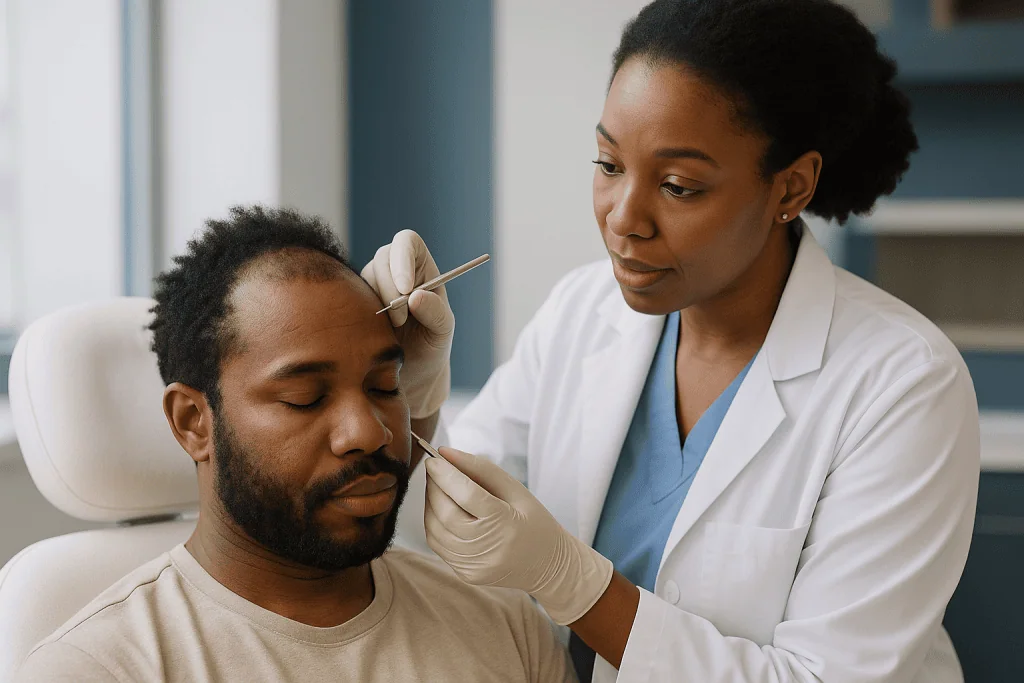
It starts before surgery. A dermatologist or surgeon examines the scalp, often with a handheld magnifier, to confirm the type of hair loss. In people of African descent this matters more than usual, because two common causes, traction alopecia and central centrifugal cicatricial alopecia, behave very differently from ordinary pattern hair loss and can rule a transplant out for now. A small biopsy is sometimes taken to settle the question.
On the day, the new hairline is drawn and agreed while the patient is sitting up, so it can be judged from the angles other people actually see. The donor area is trimmed. A local anesthetic is injected to numb the scalp; MedlinePlus and the NHS both describe hair transplants as local anesthetic procedures, with the patient awake. Many surgeons then inject a dilute fluid to firm up the skin, a step called tumescence, which makes the tissue easier to work with and can straighten the follicle’s path slightly.
Extraction follows, either graft by graft with a punch or as a single strip. Assistants sort the grafts under microscopes and keep them cool in a holding solution. The surgeon then makes the recipient sites, tiny slits or holes at the chosen angle and direction, and the grafts are placed one at a time.
MedlinePlus puts the whole session at roughly four to eight hours, and Mayo Clinic notes that more than one session may be needed depending on the area to be covered. The patient goes home the same day with instructions for washing and sleeping.
Curved punches and test grafts: the heart of afro hair FUE
Follicular unit extraction, or FUE, removes each follicular unit individually with a punch, a hollow circular blade about the width of a pencil lead. With straight hair, the surgeon lines the punch up with the visible shaft, presses down, and the follicle sits neatly inside the cylinder. With coiled hair, that same movement follows a straight line while the follicle bends away from it. The result can be a graft with its lower portion sheared off.
Three adjustments have become standard practice among surgeons who work regularly with afro-textured hair. None of them is proprietary, and none has been tested in large randomized trials; the evidence is largely surgeon experience, case series and anatomical studies, which is worth knowing when you read confident marketing.
The first is the curved or curled punch, a cylinder whose cutting edge arcs so it can be rotated around the bend of the follicle rather than through it. The second is diameter: a slightly wider punch leaves more room for the follicle to curve inside it without contact, at the cost of a marginally larger dot scar. The third is depth control, scoring only the upper skin and then freeing the deeper part of the graft with gentler traction instead of driving the blade all the way down.
Before committing to hundreds of grafts, careful surgeons take a handful as a test. Those first grafts are examined under the microscope: are the bulbs intact, which way does this person’s follicle bend, how deep does it go? The punch, angle and depth are adjusted, and only then does the main extraction begin. A test-graft habit is one of the most practical questions a patient can ask about, because it is how a surgeon learns the map of a particular scalp rather than assuming it.
FUE or FUT for a curly hair transplant? A neutral comparison
The NHS describes two ways of harvesting donor hair. FUE, above, takes grafts one by one. Follicular unit transplantation, or FUT, removes a thin strip of scalp from the back of the head, closes the wound with stitches or staples, and has technicians dissect the strip into individual units under a microscope.
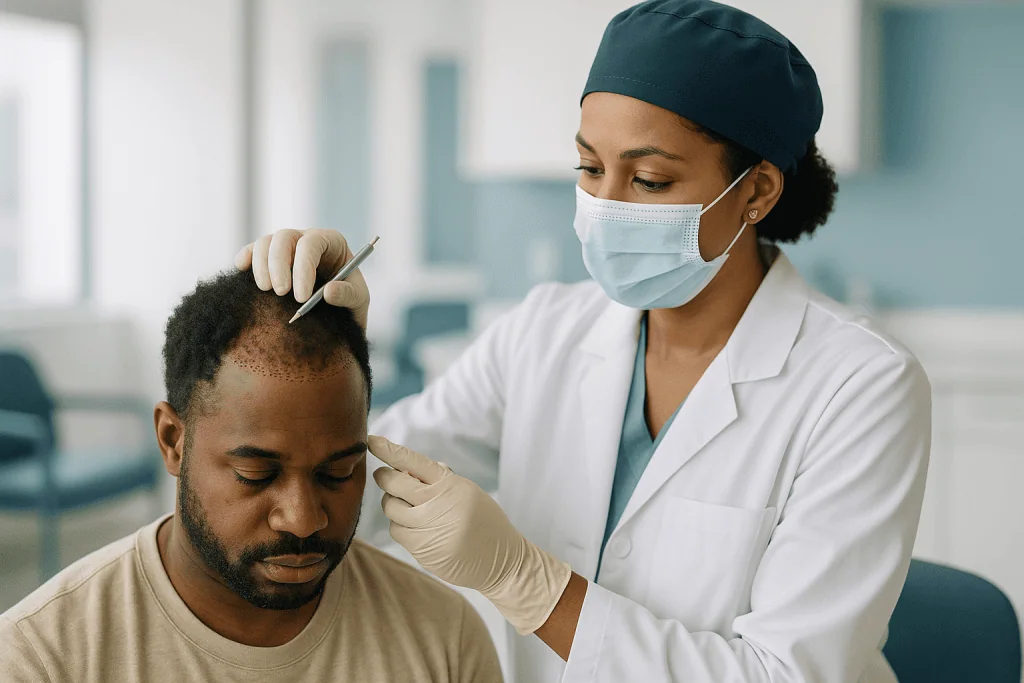
For coiled hair, each has a logic. Under a microscope, a technician can see the whole curve of the follicle and cut around it, which is why some surgeons still favor strip harvesting when curl is extreme. FUE avoids a linear scar, which matters if keloids run in the family, but its tiny dot scars can heal lighter or darker than the surrounding skin.
| Consideration | FUE (individual punches) | FUT (strip) |
|---|---|---|
| How donor hair is removed | Hundreds of small circular punches | One strip, then microscope dissection |
| Visibility of the follicle’s curve | Not seen until graft is out; relies on test grafts and curved punches | Seen directly during dissection |
| Donor scar pattern | Many small dots, may show as light or dark spots on darker skin | One linear scar, hidden by hair unless worn very short |
| Keloid consideration | Smaller wounds, but many of them | Longer single wound; history of keloids weighs heavily |
| Hair length after healing | Can usually be worn shorter | Usually needs enough length to cover the line |
The choice is not a ranking. It turns on how the follicle behaves in the test grafts, the patient’s scar history, how short they wear their hair, and what the team is most practiced in. Those are questions for the consultation, not a decision to arrive with.
Placement: hairline design and angle in an African American hair transplant
Extraction gets the attention, but placement is where a transplant ends up looking either like hair or like a transplant.
The hairline comes first. Natural hairlines in people of African descent are often flatter and sit lower on the forehead, with less of the deep temporal recession that gives a receding hairline its M shape. That is a tendency, not a rule; old photographs, the pattern of remaining fine hairs and the shape of the face all guide the drawing. Surgeons build in slight irregularity, because a ruler-straight line reads as artificial from across a room.
Angle is the next decision. Recipient sites are made with tiny blades or with implanter pens, needle-like devices that make the hole and place the graft in one motion. Each site is cut at the acute angle the surrounding native hair already grows at, and pointed in its direction of curl. Get that wrong and the new hair stands up against its neighbors, which coiled hair makes obvious because it does not lie down.
Grafts are then sorted by size. Single-hair units go at the very front where a soft, feathered edge is wanted; two- and three-hair units sit behind to build density. Coiled grafts are fiddly to seat because the curl catches on the edge of the site, so placement tends to be slower and more deliberate.
For women whose hairline has thinned at the temples and edges from years of tight styling, placement often means rebuilding a narrow band rather than covering a wide area. The principles are identical; the geometry is simply more delicate, and the long-term result depends on those edges no longer being pulled.
Who an afro hair transplant is usually for, and who is usually asked to wait
Mayo Clinic and the NHS are both plain that hair transplants are not suitable for everyone, and the reasons cluster into a few groups.
The people most commonly considered are adults with stable pattern hair loss, the inherited, hormone-driven thinning that affects both men and women, who still have a dense donor area at the back and sides. Transplants are also considered for hair lost to scars from burns, surgery or injury, and for traction alopecia once the pulling has stopped and the scalp shows no sign of ongoing inflammation.
Being asked to wait is not a rejection. Young adults whose loss has only just begun are often deferred, because a hairline built at twenty may sit stranded in front of a receding tide at thirty-five. Anyone in a phase of active, spreading shedding is usually asked to let the pattern settle first, sometimes with medical treatment guided by a dermatologist.
Some situations count against surgery more firmly. Active scarring alopecia is the most important one in this population and has its own section below. A history of large keloids weighs heavily. Uncontrolled diabetes, bleeding disorders or medicines that thin the blood raise wound-healing and bleeding risks, and the surgeon will want those managed with the prescribing clinician first. Very limited donor hair, whether from diffuse thinning or previous surgeries, limits what can be moved.
Expectations belong on the list too. A transplant redistributes existing hair; it does not create new follicles. Someone hoping for the density of their teenage years, or for a single procedure to end the matter forever, is usually steered toward a longer conversation before any date is set.
Why the diagnosis comes first: traction alopecia and CCCA
Two conditions come up again and again in Black patients, and both can make a transplant either possible or pointless depending on timing.
Traction alopecia is hair loss caused by repeated pulling: tight braids, weaves, locs, ponytails, wigs glued or clipped along the edges. Early on it is reversible once the tension stops. If the pulling continues for years, the follicles can scar and stop producing hair. A transplant can restore those edges, but only if the styling that caused the loss has genuinely ended; otherwise the new grafts are pulled out in turn.
Central centrifugal cicatricial alopecia, usually shortened to CCCA, is a scarring form of hair loss that typically begins at the crown and spreads outward, and it is seen most often in women of African descent. Scarring alopecia means inflammation destroys the follicle and replaces it with scar tissue. Grafts placed into a scalp where that inflammation is still active are placed into hostile ground; they may fail, and the surgery can flare the condition.
This is why the dermatology visit is not a formality. A scalp biopsy, a small sample of skin examined under a microscope, is often the only way to tell early CCCA from ordinary pattern thinning, because from the outside they can look alike. If CCCA is found, the first job is to control the inflammation with prescription treatment. Only once the dermatologist judges the disease inactive, over a period they determine, does a transplant come back onto the table.
Skipping this step is the single most common way an afro hair transplant goes wrong, and it has nothing to do with punches.
Keloids, hyperpigmentation and how darker skin heals after a transplant
Every hair transplant makes wounds: hundreds or thousands of tiny ones in the donor and recipient areas, or one longer one if a strip is taken. How skin closes those wounds varies, and skin of color follows some recognizable patterns.
A keloid is a scar that keeps growing after the wound has healed, rising above the skin and spreading beyond the original edges. Cleveland Clinic notes they are more common in people with darker skin. A personal or family history of keloids, including from piercings, acne or minor cuts, changes the risk conversation, and some surgeons will do a small test procedure and wait to see how it heals before committing.
Post-inflammatory hyperpigmentation is the darkening that can follow any irritation or injury to skin with more melanin. The dot scars of FUE can heal slightly darker or slightly lighter than the surrounding scalp, which is invisible under hair but can show if the head is shaved close. Sun exposure in the early weeks tends to deepen it, so covering the scalp outdoors is standard advice.
Coiled hair adds one more healing quirk. As transplanted hairs regrow through the skin, their curl can turn them back on themselves, producing ingrown hairs and small inflamed bumps around the follicle, a condition called folliculitis. The NHS lists folliculitis among recognized transplant complications for everyone; it is simply more familiar in curly hair. It is usually minor, but it is one of the reasons the team asks to see the scalp rather than diagnose by text message.
None of this rules out surgery. It changes how the team plans wound size, technique and follow-up, which is why a full scar history belongs in the first consultation.
How painful is an afro hair transplant, and what does the day feel like?
The honest answer is that the sharpest part is the beginning. Hair transplants are performed under local anesthetic, as the NHS and Mayo Clinic describe, meaning the scalp is numbed while the patient stays awake. The numbing injections themselves sting for a short while, and people often describe the tumescent fluid as a spreading pressure rather than pain. Once the area is numb, extraction and placement are generally felt as tugging, tapping and the sound of instruments rather than as hurt.
Because the session can run four to eight hours by MedlinePlus’s estimate, the discomfort that patients remember most is often boredom and stiffness from lying or sitting still, with breaks for food and the bathroom.
Afterwards, the scalp feels tight and tender for a few days, more so in the donor area if a strip was taken. Swelling can drift down toward the forehead and around the eyes. The NHS lists a tight, achy or swollen scalp, temporary numbness, itching as the wounds heal and small crusts around each graft among the expected effects. The team may suggest a pain reliever suitable for the individual; which one, and how it is taken, is their call, not a magazine’s.
Numbness can linger longer than soreness. Small sensory nerves in the scalp are disturbed by the injections and incisions and can take weeks to recover, which people sometimes mistake for a problem. Persistent or worsening pain is a different matter and belongs in the red-flag section below.
People with coiled hair sometimes ask whether the curved-punch approach hurts more. There is no evidence that it does; the anesthetic, not the punch shape, determines what is felt.
What the first days and weeks after an afro hair transplant usually look like
The first three days are about protecting grafts that are not yet anchored. Sleeping propped up, avoiding rubbing, and gentle washing according to the team’s instructions are the priorities. Tiny crusts form around each graft, and the recipient area looks red and dotted. The NHS suggests many people can return to work after about three days, though anyone whose job involves helmets, heavy sweating or dust is usually asked to wait longer.
For someone with coiled hair, two styling habits need a pause. Anything that presses or pulls on the grafts, including durags, tight caps, wave brushes, braids and glued lace fronts, is generally kept off the scalp until the team gives the all-clear. Oils and heavy products that sit on the crusts are usually held back too.
Then comes the part that alarms people who were not warned. Between roughly two and six weeks, according to the NHS, the transplanted hairs shed. The follicles have been shocked by the move and drop their shafts while the root stays put. The scalp can look much as it did before surgery, and this is expected.
New growth typically starts around six months, and the NHS gives six months to a year as the window in which the full result becomes visible. Early regrowth in coiled hair is often finer and can look straighter or looser than the person’s usual texture; surgeons commonly observe that the familiar curl asserts itself as the hairs thicken over the following months, though this is a clinical observation rather than a trial finding.
Follow-up visits are spaced through this period so the team can check healing, catch folliculitis early and answer the inevitable question of whether it is working yet.
What happens 10 years after a hair transplant?
People searching this question are really asking two things: will the moved hair stay, and what will the rest of the head do?
The moved hair generally stays. Follicles taken from the back and sides carry the characteristics of their original location, a principle called donor dominance, which is why those areas are chosen: in pattern hair loss they are usually resistant to the hormonal signal that shrinks follicles on the crown and hairline. Transplanted hairs still gray, still respond to illness and still respond to pulling, but they do not inherit the fate of the hair that was lost around them.
The native hair is another story. Pattern hair loss is progressive. A hairline built at thirty may look excellent at forty, but the untreated crown behind it can keep thinning, and the transplanted zone can end up as an island. Mayo Clinic notes that more than one surgery may be needed over time, and this is the main reason.
This is where medication enters most long-term plans, described here by mechanism only. Topical minoxidil widens small blood vessels and appears to prolong the growth phase of the follicle. Oral finasteride blocks the enzyme that converts testosterone into dihydrotestosterone, the hormone that miniaturizes susceptible follicles; it is used in men, and Mayo Clinic describes both as needing months of use before any effect can be judged. Whether either is appropriate, and for how long, is a decision for the prescribing clinician, weighed against side effects and the individual’s health.
For coiled hair specifically, the decade-long risk that no medicine addresses is tension. Edges rebuilt by surgery and then braided tight can be lost a second time.
What people often get wrong about the afro hair transplant technique
The myths around this topic pull in opposite directions, and both extremes cause harm.
The first is that afro-textured hair cannot be transplanted. It can. The curved follicle raises the risk of transection and demands more care in extraction, but curved punches, test grafts and microscope dissection exist precisely to manage it. Refusing on the basis of hair type alone is not a medical judgment.
The second is the mirror image: that any surgeon, or any robotic device, can handle coiled hair automatically. Robotic FUE systems work by imaging the visible shaft and predicting the follicle’s path; a follicle that bends beneath the surface defeats that prediction more often than a straight one. Experience with this specific hair type is a fair thing to ask about, without expecting anyone to claim to be the best at it.
The third is that more grafts equal a better result. Coiled hair covers more scalp per strand, and the donor area is finite. Taking too much can thin the back of the head visibly and leaves nothing for the future thinning described above.
The fourth is that the new hair will grow in straight. Early regrowth is often finer and looser, but the follicle has not changed; it simply has not yet produced a full-caliber shaft.
The fifth is that a transplant treats scarring alopecia. It does not. It can replace hair lost to CCCA only after the disease is controlled, and it can worsen the condition if done during a flare.
The last is that dark skin hides scars. Dark skin can hide a linear scar under hair, but it is also more likely to form keloids and to darken where it heals, so scar planning matters more, not less.
Questions to ask your care team before an afro hair transplant
A good consultation should leave you knowing why this plan fits your scalp rather than a template. These questions help draw that out.
- What exactly is causing my hair loss, and has scarring alopecia been ruled out? Was a biopsy considered?
- How often do you treat tightly coiled hair, and what do you do differently for it?
- Will you take test grafts first and examine them before the full extraction? What happens if the transection rate is high?
- Which punch type and diameter do you plan to use, and why that choice for my hair?
- Are you recommending FUE or a strip for me, and what in my history led to that?
- I have had keloids or dark healing marks before; how does that change the plan and the follow-up?
- How will you draw my hairline, and can I see it and photograph it before anesthetic is given?
- How many grafts do you expect to move, and how much donor hair will that leave for later?
- What will the donor area look like if I shave my head or wear a low fade?
- What is my plan for the native hair around the transplant over the next decade, and does it involve medication I should discuss with a dermatologist?
- When can I return to braids, locs, weaves, durags or wave brushing, and what must I stop permanently if I had traction alopecia?
- Who do I contact if something looks wrong in the first two weeks, and how quickly will I be seen?
Write the answers down. A team that welcomes these questions is telling you something about how it will handle the ones you have not thought of yet.
When to call your doctor after an afro hair transplant
Most of what follows a hair transplant is uncomfortable rather than dangerous: tightness, itching, crusts, swelling that drifts toward the eyes, patches of numbness, and the expected shedding of the new hairs a few weeks in. The NHS lists these as common. A few signs are different, and the team wants to hear about them the same day rather than at the next scheduled visit.
Call your care team promptly if you notice:
- Redness that spreads outward from the donor or recipient area, especially with warmth, increasing pain, or pus, which can signal infection
- A fever or feeling generally unwell in the days after surgery
- Bleeding that does not stop after ten minutes of steady, gentle pressure
- Pain that worsens after the first few days instead of easing, or pain that is not controlled by what the team advised
- Swelling that keeps increasing rather than settling, or swelling that closes an eye
- Clusters of painful, pus-filled bumps around the new hairs, which may be folliculitis needing treatment
- A scar that becomes thick, raised, itchy or keeps growing beyond the wound edges in the weeks after healing, which may be an early keloid
- Sudden new shedding of your original hair well beyond the transplanted area
Seek emergency care immediately for difficulty breathing, swelling of the lips or tongue, a widespread rash or faintness after any medicine or dressing, as these can indicate a serious allergic reaction.
Keep the team’s contact details somewhere you can find them at night. Whether a symptom is ordinary healing or an early complication is a judgment for the people who performed the procedure and can examine the scalp, and it is a decision that should always stay with them.
Frequently asked questions
Is a hair transplant for Black hair different from other hair transplants?
The principles are the same, but the execution changes. Coiled hair curves beneath the skin and exits at a sharper angle, so surgeons use curved or wider punches, take test grafts to map the follicle’s path, and place grafts at the acute angle and curl direction of the surrounding hair. Higher keloid and hyperpigmentation tendencies in darker skin also influence how wounds are planned and followed up.
How painful is a FUE hair transplant?
The numbing injections at the start sting briefly; after that, the procedure is generally felt as tugging and pressure under local anesthetic. The NHS describes a tight, sore, swollen scalp for a few days afterwards, along with itching and crusting as grafts heal. Patches of numbness can last weeks. Pain that worsens after the first few days is not typical and should be reported to the team.
Who is a poor candidate for a hair transplant?
People with active scarring alopecia such as CCCA, those in a phase of rapid unstable shedding, very young adults whose pattern has not settled, and anyone with too little donor hair are usually asked to wait or advised against surgery. Uncontrolled diabetes, bleeding disorders, a history of large keloids and unrealistic expectations are also weighed. Mayo Clinic and the NHS both note transplants are not suitable for everyone.
What did Elon Musk use to regrow his hair?
He has never publicly described any medical treatment, so the honest answer is that nobody outside his care knows. Comparing early and later photographs has led many to assume a hair transplant, but that is inference, not record. Reading a public figure’s hairline tells you nothing about your own scalp; a dermatologist’s examination does, and it is where any personal plan should start.
What happens 10 years after a hair transplant?
Transplanted follicles usually keep the traits of the donor area and continue growing, while untreated native hair around them can keep thinning. Mayo Clinic notes that more than one surgery may be needed over time for this reason. Long-term plans often include medication that a dermatologist prescribes and monitors. For coiled hair, resuming tight braids or weaves can undo restored edges years later.
Can women with traction alopecia have their edges transplanted?
Often, yes, provided the pulling has stopped and the scalp shows no ongoing inflammation. Traction alopecia from tight braids, weaves and glued wigs can scar follicles permanently, and grafts can rebuild the temples and edges. The result lasts only if the styling that caused the loss is not resumed, which is a conversation the team will have before any date is set.
Will transplanted afro hair keep its curl?
Yes. A follicle moved from the back of the head keeps producing the hair it always did. Early regrowth after the shedding phase is commonly finer and can look straighter or looser, which surgeons often observe settles into the person’s usual texture as the shafts thicken over the following months. That pattern is a clinical observation rather than a trial finding.
Does afro hair FUE leave visible scars on dark skin?
FUE leaves many tiny dot scars in the donor area that can heal slightly lighter or darker than the surrounding scalp. They are hidden by hair of ordinary length but may show with a very close shave. Cleveland Clinic notes keloids are more common in darker skin, so a personal history of raised scars should be shared before choosing between FUE and strip harvesting.
When can I wear a durag, braids or a wave brush after surgery?
Anything that presses on or pulls the grafts is usually kept off until the team confirms the grafts are anchored and crusts have cleared. Durags, tight caps, brushing, braids and glued lace fronts all fall into that category early on. The exact timing is set by the surgeon based on how the scalp is healing, and someone with a history of traction alopecia may be asked to avoid tight styles permanently.
Why are test grafts taken before a curly hair transplant?
Because the follicle’s bend and depth cannot be seen from the surface. Removing a few grafts first and examining them under a microscope shows whether the bulbs are intact, which way this person’s follicles curve, and how deep they sit. The surgeon adjusts punch type, diameter, angle and depth accordingly before committing to the full extraction, lowering the risk of cutting through roots.
References
This article is for general information only and is not a substitute for professional medical advice. Please consult a qualified doctor about your individual situation.

Planning This Treatment in Turkey
Our full guide for international patients: techniques, hospital stay, recovery and cost.
More from the Blog
Preparing for Scalp Micropigmentation: Skin Type Review, Tanning, Alcohol and What to Pause
Scalp micropigmentation preparation usually starts with a skin type review covering tone, scarring tendency and any active scalp condition, followed by a few weeks…
Crown Hair Transplant: Why the Vertex Is the Hardest Zone to Restore
A crown hair transplant is considered the most technically demanding restoration because hair at the vertex grows in a spiral whorl that requires a…
What Donor Assessment Before Hair Transplant Repair Reveals: Remaining Capacity and the Plan
Donor area assessment before hair transplant repair is a structured examination of the scalp, beard and sometimes body hair that remains available after earlier…
3,000-Graft Hair Transplants: What That Session Actually Covers
A 3,000-graft session is a large hair transplant, delivering roughly 6,000 to 7,500 individual hairs, since each graft contains one to four. It can…

FUE vs FUT: Scars, Yield and Recovery: the Neutral Comparison
FUE removes follicles one at a time, leaving tiny dot scars and a quicker donor-area recovery; FUT removes a thin strip of scalp, leaving…
What to Ask Before Aesthetic Scalp Surgery: Photos, Hairline Goals and What the Plan Covers
Before hairline lowering surgery, also called forehead reduction, ask how far your hairline can realistically move given your scalp laxity, where the incision will…