

How Are Goals Set in Pediatric Physical Therapy for Cerebral Palsy and Developmental Delay?

Key Takeaways
- The CDC reports that cerebral palsy affects about 1 in 345 children and that more than half walk independently, which is why therapy goals vary so widely between children.
- The GMFCS assigns one of five levels based on everyday mobility, is usually stable after about age two, and anchors what a realistic next goal looks like.
- A well-written goal names the task, the setting, the amount of help and a time frame, and explains why it matters to the family, rather than stating an intention such as 'improve balance.'
- A systematic review indexed in PubMed found that an accurate early diagnosis or high-risk designation for cerebral palsy can be made before six months of corrected age when imaging, neurological examination and movement assessment are combined.
- The interventions with the strongest evidence in cerebral palsy are goal-directed, task-specific and practiced intensively; passive stretching alone rates weakly.
- Cerebral palsy does not progress, so any loss of previously acquired skills, new pain or a sudden change in tone is a red flag that needs medical evaluation rather than more therapy.
Goals in pediatric physical therapy for cerebral palsy and developmental delay are set together by the therapist, the family and, when possible, the child, after a functional evaluation that often uses the Gross Motor Function Classification System. Goals target everyday activities the family values, are written to be specific and measurable, and are reviewed and rewritten as the child grows or circumstances change.
The first appointment usually ends with a question that catches parents off guard. Not “What is wrong?” or “What do we do?” but something closer to: “What would you like to be different at bedtime, at the playground, at your kitchen table?” One mother I spoke with for a family-health feature remembered answering, after a long pause, that she wanted her son to sit in the shopping cart without her hand behind his back. That single sentence became the first written goal on his plan.
Pediatric physical therapy for cerebral palsy, and for children whose motor development is simply running behind, does not begin with exercises. It begins with a negotiation about what matters. The therapist brings measurement tools and a working knowledge of how movement typically develops. The family brings the day-to-day reality no clinic can see.
This explainer walks through how that negotiation works, what a well-written goal looks like, how progress is measured, and why the target keeps moving on purpose.
What pediatric physical therapy for cerebral palsy is actually trying to do
Cerebral palsy is a group of lifelong conditions affecting movement and posture, caused by a disturbance in the developing brain before, during or shortly after birth. The brain injury itself does not get worse, but the way it shows up in muscles, joints and everyday function changes as a child grows. Physical therapy works on that second part: it cannot alter the original injury, so it focuses on what the child can do with the body they have.
The CDC describes cerebral palsy as the most common motor disability of childhood, affecting roughly 1 in 345 children in the United States, and notes that more than half of children with the condition walk independently. Those two figures matter for goal-setting because they describe a population that is enormously varied. A therapist working with a toddler who is nearly walking and a therapist working with a child who uses a powered wheelchair are practicing the same discipline toward very different targets.
Physical therapy for this population does several jobs at once. It teaches motor skills through repeated, task-specific practice, because the developing brain strengthens the pathways a child uses most. It manages the secondary effects of altered muscle tone, such as tightness around the hips and ankles, which tend to accumulate over years. It fits and trains the use of equipment, from standing frames to walkers. And it coaches families, because a child spends roughly an hour or two a week with a therapist and the rest of the week at home, at daycare or at school.
Goals are the thread that ties these jobs together. Without them, therapy becomes a list of exercises with no way to know whether any of it is working.
Why goals come before exercises: what the first evaluation looks like
The initial evaluation is longer than most families expect, often spread across more than one visit, and much of it looks like play. The therapist is watching how the child moves between positions, how they use their hands to steady themselves, how their trunk responds when they reach sideways, and whether one side of the body is doing more of the work than the other.

Standardized measures sit underneath the play. For children with cerebral palsy, the most widely used is the Gross Motor Function Measure, a scored observation of skills such as rolling, sitting, crawling, standing and walking. The therapist also assesses passive range of motion at the hips, knees and ankles, muscle tone, strength where the child can cooperate with testing, and balance. For babies, developmental screening tools compare observed skills with the typical ages at which they appear, using the milestone ranges published by public health bodies such as the CDC.
Then comes the interview. Therapists trained in family-centered care ask open questions about routines: getting dressed, mealtimes, bath time, getting into the car, playing with siblings. They ask what the child enjoys and what the family has already tried. Several formal tools structure this conversation. The Canadian Occupational Performance Measure, despite its name, is used across pediatric rehabilitation to have parents rate the importance of specific activities and their satisfaction with how those activities currently go.
Only after the measurements and the interview are laid side by side does goal-writing start. The evaluation tells the therapist what is physically possible in the near term; the interview tells them what would actually change the family’s day.
GMFCS levels explained: how a five-level scale shapes every goal
The Gross Motor Function Classification System, usually shortened to GMFCS, is a five-level scale describing how a child with cerebral palsy moves in everyday settings, with an emphasis on sitting, walking and the use of mobility aids. It is not a test of potential and not a measure of intelligence. It describes current function so that goals, equipment and expectations can be pitched realistically.
Levels are assigned within age bands because typical function changes with age. A two-year-old at Level II looks different from a ten-year-old at Level II, but the relationship to peers is comparable.
| GMFCS level | Typical everyday mobility | Examples of goal areas often prioritized |
|---|---|---|
| I | Walks without limitations; may have reduced speed, balance or coordination in running and jumping | Higher-level skills such as stairs without a rail, sports participation, endurance |
| II | Walks with limitations; may use a rail on stairs or a device on uneven ground and long distances | Community walking, uneven surfaces, carrying objects while walking |
| III | Walks using a hand-held mobility device indoors; often uses wheeled mobility for distance | Transfers, walker efficiency, self-propelled wheelchair skills |
| IV | Self-mobility with limitations; may use powered mobility; usually needs physical assistance for transfers | Supported standing, assisted transfers, powered mobility training, positioning |
| V | Transported in a manual wheelchair; limited ability to maintain head and trunk posture against gravity | Comfort, positioning, tolerance of standing frames, participation through adapted seating |
Long-term studies of children with cerebral palsy have produced motor development curves for each level, showing that gross motor skills tend to plateau at different ages depending on the level. Therapists use these curves, cautiously, to help families understand what a realistic next step looks like rather than to close doors. A child’s level is usually stable after about age two, which is one reason it anchors the goal-setting conversation.
Physical therapy goals for cerebral palsy: what a good goal actually sounds like
A weak goal reads like a wish: “improve balance” or “increase strength.” A strong goal names a task, a setting, a level of help and a time frame. Most pediatric therapists write goals using some version of the SMART framework, meaning specific, measurable, achievable, relevant and time-bound, and many pair it with Goal Attainment Scaling, a method that defines in advance what “a little better,” “expected” and “much better than expected” would look like for that particular child.
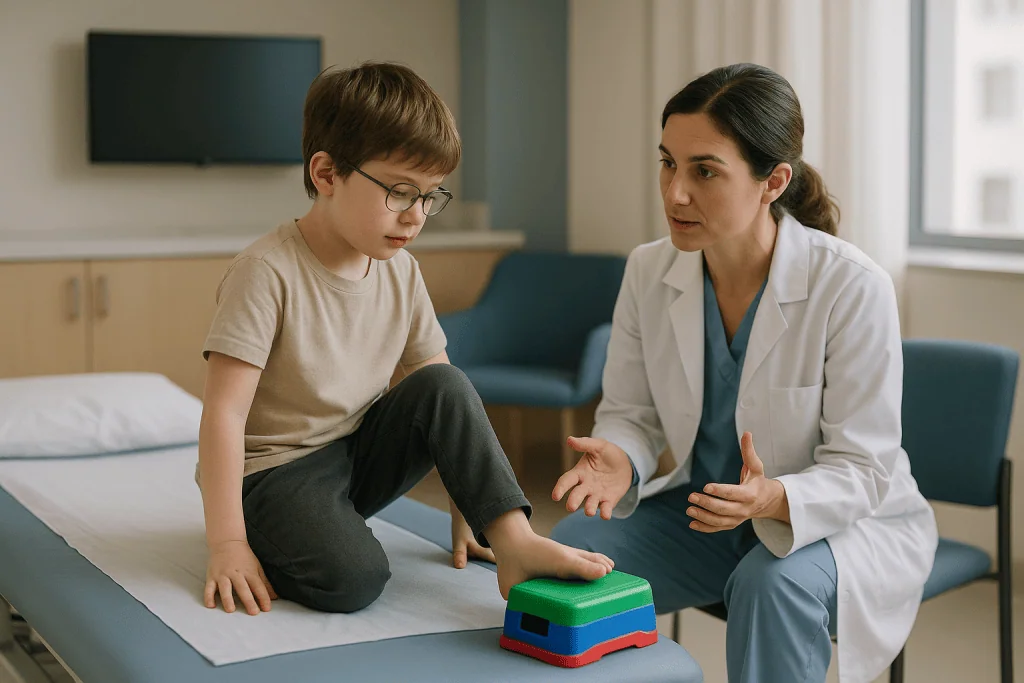
Compare these two versions of the same intention. First: “Improve sitting.” Second: “Within twelve weeks, sit on a bench with feet flat and no hand support for two minutes while playing with both hands, so that she can join circle time at preschool.” The second version tells everyone, including the child’s teacher, exactly what success looks like and why anyone cares.
The “why” is not decoration. A widely used framework in childhood disability, sometimes called the F-words, reminds teams to write goals around function, family, fitness, fun, friends and future, rather than around impairment alone. Stretching a tight calf muscle is not a goal; being able to stand at the sink to brush teeth is.
Good goals also respect the child’s own voice. School-age children can and should say what they want to be able to do, and their answers are often more concrete than adults expect: climb onto the school bus without the lift, keep up with a cousin at the pool, sit on the floor with friends instead of in a chair. Therapists often keep a mix of short-term goals, measured over weeks, and long-term goals stretching across a school year, so families can see movement without waiting a year for evidence.
Developmental delay physical therapy: how goals differ when there is no cerebral palsy diagnosis
Developmental delay means a child is reaching milestones, such as sitting, crawling or walking, noticeably later than the typical age range without a specific diagnosis explaining why. Some of these children are later diagnosed with cerebral palsy or another condition; many catch up. Goal-setting for this group has a different flavor because the trajectory is genuinely uncertain.
The evaluation leans more heavily on norm-referenced developmental tests that place a child’s motor skills at an age equivalent and compare them with peers. A therapist might find, for example, that a fourteen-month-old is performing gross motor skills more typical of a nine-month-old. The CDC’s developmental milestone materials are written for parents and give the ages by which most children reach each skill; therapists use more detailed clinical versions of the same idea.
Goals for developmental delay tend to follow the typical sequence of motor development more closely, because the working assumption is that the child can move through it, just later. A plan might target sitting without hands, then transitions in and out of sitting, then pulling to stand, each with a measurable definition. Family coaching takes up a large share of the plan, because frequent short practice woven into daily routines is thought to matter more than the clinic hour itself.
Where the two groups converge is in the emphasis on participation. A child with a global delay who is not yet walking still needs to reach toys, sit at the table with siblings and get around a room. The goal is written around that activity, not around a milestone for its own sake. Therapists also stay alert to signs that would prompt re-referral to a pediatrician or neurologist, such as asymmetry, stiffness or loss of previously acquired skills.
Who is usually referred early, and who is usually asked to wait and watch
Referral patterns have shifted considerably. For decades, cerebral palsy was typically diagnosed between one and two years of age, once delayed milestones and abnormal tone became unmistakable. The NHS still notes that symptoms often become clear within the first two to three years. A systematic review published in a pediatrics journal and indexed in PubMed concluded that, in infants with known risk factors, an accurate early diagnosis or a designation of “high risk of cerebral palsy” can be made before six months of corrected age by combining brain imaging, a standardized neurological examination and a structured assessment of spontaneous movements.
That review reshaped who gets referred to physical therapy early. Babies born very preterm, babies who had a significant brain injury around birth, and babies with clearly abnormal movement patterns are now often seen by a therapist in the first months of life, sometimes while still attending a neonatal follow-up clinic. The rationale is that the brain is most adaptable early, and that practicing movement during this window may make the most of that adaptability.
Who is asked to wait? Children whose milestones fall within the broad normal range, even at its later edge, are usually monitored through routine developmental checks rather than referred. A child who is not walking at fourteen months but is cruising along furniture, has symmetrical movement and normal tone is commonly rechecked rather than enrolled. “Wait and watch” in this context means scheduled reassessment with clear criteria for referral, not indefinite reassurance.
Families sometimes hear “let’s see how things go” as dismissal. Asking what specifically will be checked at the next visit, and what finding would trigger a referral, turns a vague plan into an accountable one. Any decision to refer or to wait sits with the child’s pediatrician or specialist team.
Which major goal of therapy is appropriate for children with cerebral palsy?
People searching this exact question are often preparing for an exam or trying to make sense of a plan that lists a dozen small objectives. The honest answer is that the overarching goal, across guidelines and across the research literature, is to maximize the child’s function and participation in ordinary life while preventing avoidable secondary problems. Normalizing movement, once a central aim, has largely been retired as a primary goal, because decades of outcome data showed that children learn tasks best by practicing the tasks themselves, in whatever movement pattern works for them.
Underneath that umbrella sit three recurring themes. The first is activity and participation: getting somewhere, doing something, being with someone. The second is body health: keeping joints mobile enough to sit, stand and be cared for comfortably, maintaining cardiovascular fitness, and protecting bone density through weight-bearing where possible. The third is family capacity: a caregiver who can safely lift, transfer and position a child, and who knows how to build practice into a normal day, extends therapy far beyond the clinic.
The balance among these shifts with GMFCS level and age. For a preschooler at Level I, the plan may be almost entirely about activity and participation. For a teenager at Level V, comfort, positioning and preventing hip displacement may be the dominant concerns, with participation goals built around adapted seating and supported standing during family activities.
Guidance from the NHS and major academic medical centers consistently frames treatment for cerebral palsy as managing and controlling symptoms and helping a child be as independent as possible, rather than reversing the underlying condition. Goals written with that framing tend to be more honest, more achievable and, in the long run, more motivating.
What the first weeks of therapy usually look like
Once goals are written, the early weeks follow a rhythm that surprises families with how ordinary it feels. Sessions for infants and toddlers are typically forty-five minutes to an hour, often weekly, though frequency varies widely by need, age and local service models; the plan agreed with the therapist is the only reliable guide for a particular child.
Most of a session is task practice disguised as play. A child working on sit-to-stand may spend twenty minutes retrieving toys from progressively higher surfaces. A child working on walker skills may navigate a hallway obstacle course built from cushions. The therapist adjusts difficulty constantly, because motor learning research suggests skills stick best when the task is hard enough to require effort but not so hard that the child fails repeatedly.
Hands-on work still happens. The therapist may guide a movement a few times to show the child what it feels like, check joint range, or fit and adjust an orthosis, which is a brace that supports or aligns a joint. But the ratio has shifted over the past two decades toward the child doing rather than being done to.
The home program arrives early, usually in the first two or three visits, and is deliberately short. Three or four activities woven into existing routines tend to be followed; a page of exercises tends to be abandoned. Therapists often ask parents to film a routine at home so the next session can start from real life rather than from a clinic mat.
Progress in these first weeks is usually measured in small increments: a second longer in standing, one fewer hand for support, a transition that used to need a lift now needing only a steadying touch. Families are encouraged to notice these, because the big milestones arrive on their own schedule, if at all.
How progress is measured and when goals get rewritten
Goals without reassessment are just intentions. Most pediatric physical therapy plans build in a formal review at a set interval, commonly somewhere between three and six months, with informal checks each session. The interval itself is a clinical judgment rather than a rule and will differ from one service to another.
At a formal review, the therapist repeats the standardized measures used at baseline. For cerebral palsy, that often means re-scoring the Gross Motor Function Measure and recording range of motion. Because that measure has published minimal clinically important differences for each GMFCS level, a change can be interpreted as meaningful or within measurement noise rather than guessed at. For Goal Attainment Scaling, the therapist and family simply rate where the child landed on the scale they wrote together months earlier.
Three outcomes are possible. If a goal is met, it is retired and replaced with the next functional step. If it is partially met, the team asks why: was the goal too ambitious, was practice at home difficult to fit in, did an illness or a growth spurt interrupt progress? If a goal is not met and the reason is not fixable, it is rewritten, sometimes toward a compensatory strategy, such as an equipment solution, rather than the original motor skill.
Plateaus deserve a specific mention. Motor development curves for cerebral palsy show that gross motor skills tend to level off in mid-childhood, earlier for higher GMFCS levels. A plateau is not a failure of therapy or of the child. It is a signal to shift goals toward maintaining what has been gained, building fitness and endurance, and expanding participation. Many services move to episodic care at this point, with intensive blocks around specific goals rather than indefinite weekly sessions.
Where medicines, braces and surgery fit around therapy goals, and what the evidence rates highly
Physical therapy rarely works alone. Several other treatments sit around it, and their timing is often planned to serve a specific therapy goal.
Medicines that reduce muscle tone are one example. Injected botulinum toxin, a class of medicine that temporarily weakens overactive muscles at the point where nerve meets muscle, is sometimes used before a block of intensive therapy or serial casting, a technique in which a series of casts gradually lengthens a tight muscle. The effect is temporary, typically fading over a few months, which is exactly why therapists schedule goal-directed practice during the window. Oral muscle relaxants work differently, acting on the nervous system as a whole. Whether, when and how any of these are used is a decision for the child’s prescribing physician, weighed against side effects and the child’s specific goals.
Orthoses, or braces, most often at the ankle, are fitted to support alignment during standing and walking. Orthopedic surgery, including procedures that lengthen tendons or realign bones, is generally considered when tightness or deformity is limiting function or comfort and cannot be managed otherwise. Selective dorsal rhizotomy, a neurosurgical procedure that cuts selected sensory nerve rootlets to reduce spasticity in the legs, is offered in carefully selected children. Each of these is followed by a period of physical therapy with its own rewritten goals.
What does the evidence favor most strongly? A large systematic review of interventions for cerebral palsy, indexed in PubMed, graded interventions using a traffic-light system and gave its strongest support to goal-directed, task-specific training practiced at high intensity, including approaches such as constraint-induced movement therapy for the arm and treadmill or overground walking practice for the legs. Passive approaches, including prolonged passive stretching on its own, received weak or uncertain ratings. Newer tools such as robotic gait trainers and virtual-reality games appear promising in small studies but have not consistently outperformed conventional task practice, so they are best understood as ways to increase practice dose rather than as breakthroughs in themselves.
How to care for a child with cerebral palsy at home: families as goal partners
Caring for a child with cerebral palsy is, in practical terms, where most therapy happens. Therapists increasingly describe their role as coaching rather than delivering treatment, and the most useful home strategies share a few features.
Practice hides inside routines. A child working on standing balance stands at the sink for toothbrushing instead of sitting. A child working on transitions climbs into the car seat with a steadying hand rather than being lifted. A toddler working on crawling has toys placed just out of reach on the floor during play. None of these add time to the day; they convert existing minutes into practice.
Positioning matters between practice too. Children who spend long periods in one posture, whether in a chair or on the floor, accumulate stiffness. Therapists usually recommend varying positions through the day and may prescribe a standing frame, a device that supports a child upright for a set period, to give hips and legs time bearing weight.
Behavior and mood are part of the picture. Children with cerebral palsy have higher rates of sleep difficulties, pain, fatigue and, for some, anxiety or attention problems than peers. A child who refuses a home exercise may be tired, uncomfortable or simply five years old. Therapists generally advise stopping a practice that provokes distress and reporting it, because pain is a red flag for hip problems or ill-fitting equipment rather than something to push through. Where behavior consistently gets in the way, the pediatrician may involve psychology or developmental specialists.
Finally, caregivers have bodies too. Lifting and transferring a growing child is a common cause of back injury in parents. Asking the therapist to teach safe lifting techniques and to review equipment as the child grows is a legitimate therapy goal in its own right.
What people often get wrong about therapy goals for cerebral palsy and developmental delay
Misunderstandings about goal-setting can cost families months of frustration. A few come up repeatedly.
“More therapy is always better.” Intensity matters, but the evidence points to intensity of practice of a specific task, not simply more hours in a clinic. A child attending several sessions a week with vague goals may progress less than a child in a focused block with clear targets and daily home practice. Families who chase hours often burn out, and so do children.
“If she doesn’t walk, therapy has failed.” Walking is one goal among many, and for some GMFCS levels it is not a realistic primary target. A child who learns to drive a powered chair independently, transfer with less help and sit comfortably through a school day has achieved substantial functional goals. Motor development curves exist precisely so that expectations can be set honestly.
“Stretching alone will keep the muscles from tightening.” Passive stretching on its own has weak evidence for preventing contractures. Weight-bearing, active movement, positioning and, when indicated, casting or medical management together do more than stretching in isolation.
“The therapist sets the goals.” Goals written without the family’s routines in view tend to be abandoned. Families are entitled to say a goal does not matter to them and to propose one that does.
“A plateau means we should stop.” Plateaus are expected and usually signal a shift in goals, not an end to care. Fitness, participation and equipment goals often become more valuable as motor skills level off.
“Early referral means the diagnosis is certain.” Babies are often referred as “high risk” before a diagnosis is confirmed. Early therapy is a reasonable response to risk, not a verdict, and some children referred early are later found not to have cerebral palsy.
Questions to ask your care team about your child's therapy goals
Families who arrive with questions tend to leave with clearer plans. These are worth writing down before the evaluation or the next review.
- What did you find on today’s assessment, and which standardized measures did you use? Can we see the scores and what they mean?
- Which GMFCS level best describes my child right now, and what do the motor development curves for that level suggest about the next year or two?
- How will each goal be measured, and what would “met,” “partly met” and “not met” look like at the next review?
- How often will we formally review goals, and can we request an earlier review if something changes?
- Which two or three activities should we build into our daily routine, and can you show us how to do them safely in our own home setting?
- What signs would tell us to stop a home activity and call you?
- How does this therapy plan connect with occupational therapy, speech therapy, orthopedics or neurology, and who coordinates across them?
- If medicines, braces, casting or surgery are being considered, how would the therapy goals change before and after?
- What equipment might help now, and how will we know when it needs adjusting as my child grows?
- How can my child take part in setting their own goals as they get older?
- What does a plateau mean for this plan, and how would you approach it?
- How do we handle sessions or exercises that upset my child?
A useful habit is to bring one goal from home to every review, phrased in plain language: something you wish were easier this month. The therapist’s job is to translate it into a measurable target or to explain, honestly, why it is not yet within reach and what would need to change first. That two-way translation is the whole point of the process.
When to call your doctor
Physical therapy is a low-risk treatment, but the conditions it supports can produce problems that need prompt medical attention. Families should contact the child’s pediatrician or specialist team, rather than waiting for the next therapy visit, if any of the following appear.
- New or worsening pain, particularly in the hips, back or legs, or a child who cries when moved, positioned or dressed. Hip displacement is common in children with cerebral palsy, especially at higher GMFCS levels, and is often silent until it hurts.
- Loss of skills the child previously had, such as a child who could sit or walk becoming unable to. Cerebral palsy itself does not progress, so regression needs urgent evaluation for another cause.
- A sudden change in muscle tone, new asymmetry in movement, or a limb held in an unusual posture.
- Skin redness, blistering or breakdown under a brace, cast or seating system that does not fade within a short time after removal.
- Swelling, warmth or redness in a limb, or a limb the child suddenly refuses to bear weight on.
- Signs of fracture after a fall or an ordinary transfer, including swelling, deformity or guarding; low bone density raises fracture risk in children who bear little weight.
- Seizures, new or increased in frequency, or unusual episodes of staring, jerking or unresponsiveness.
- Fever with irritability, a child who is unusually drowsy or hard to wake, or breathing that appears labored.
- Difficulty swallowing, frequent coughing or choking during meals, or unexplained weight loss.
Call emergency services for a seizure lasting more than five minutes, any serious difficulty breathing, a child who cannot be roused, or an injury with obvious deformity. For anything less acute, the pediatrician and the therapy team are the right first contacts; the therapist can adjust or pause the plan, but decisions about investigation and treatment sit with the child’s medical team.
Frequently asked questions
Which major goal of therapy is appropriate for children with cerebral palsy?
The overarching goal is to maximize function and participation in everyday life while preventing avoidable secondary problems such as joint contractures and hip displacement. Normalizing movement patterns is no longer the primary aim; children learn tasks best by practicing them in whatever way works for their bodies. Specific goals then follow from the child’s GMFCS level, age and the family’s daily priorities.
How to care for a child with cerebral palsy at home between therapy sessions?
Build practice into existing routines rather than adding exercise time: standing at the sink to brush teeth, climbing into the car seat with a steadying hand, reaching for toys placed slightly out of range. Vary positions through the day, use any prescribed equipment as advised, stop activities that cause pain and report them, and ask the therapist to teach safe lifting to protect your own back.
What are the common behavior problems seen in children with cerebral palsy?
Sleep difficulties, fatigue, irritability linked to pain, and higher-than-average rates of attention problems and anxiety are reported in children with cerebral palsy. Refusing home exercises is often a sign of discomfort or tiredness rather than defiance. Persistent behavior changes should be raised with the pediatrician, who may involve developmental or psychology specialists alongside the therapy team.
What are the recent advancements in the treatment of cerebral palsy?
The most consequential change is earlier detection: combining brain imaging, a standardized neurological examination and structured movement assessment allows a high-risk designation before six months of corrected age, opening the door to early therapy. Treatment research has shifted toward intensive, goal-directed task practice. Robotic and virtual-reality tools show promise as ways to increase practice, but have not consistently outperformed conventional task training.
What are physical therapy goals for cerebral palsy in a toddler?
Toddler goals usually center on mobility transitions and play: sitting without hand support, moving between floor and standing, cruising or walking with or without a device, and getting to toys and people independently. Each is written as a measurable task with a time frame, and paired with a short home program woven into daily routines such as mealtimes and bath time.
How does developmental delay physical therapy differ from therapy for cerebral palsy?
For developmental delay without a specific diagnosis, goals tend to follow the typical sequence of motor milestones more closely, since the assumption is that the child can move through it later than peers. Family coaching takes a large share of the plan. Therapists also monitor for asymmetry, stiffness or regression that would prompt referral back to the pediatrician or a neurologist.
What are GMFCS levels and why do they matter for goal-setting?
The Gross Motor Function Classification System describes everyday mobility in five levels, from walking without limitation at Level I to being transported in a wheelchair at Level V. It is not a test of intelligence or potential. Because published motor development curves exist for each level, therapists use it to set realistic next-step goals and to explain expected plateaus honestly.
How often are physical therapy goals reviewed?
Informal checks happen every session, and formal reviews commonly occur somewhere in the range of three to six months, though the interval is a clinical judgment and varies by service and by the child’s needs. At a formal review the therapist repeats the baseline measures, rates each goal as met, partly met or not met, and rewrites the plan accordingly.
Does a plateau in progress mean therapy should stop?
No. Motor development curves for cerebral palsy show that gross motor skills tend to level off in mid-childhood, earlier at higher GMFCS levels, and this is expected rather than a failure. A plateau usually prompts a shift toward maintaining gains, building fitness and endurance, adjusting equipment and expanding participation, often delivered as focused blocks rather than indefinite weekly sessions.
Can a child help set their own therapy goals?
Yes, and most therapists encourage it from preschool age onward. Children often name concrete, motivating targets such as climbing onto the school bus, keeping up at the pool or sitting on the floor with friends. Involving the child improves engagement with practice, and formal tools exist to capture children’s own ratings of how important and how difficult specific activities are.
References
This article is for general information only and is not a substitute for professional medical advice. Please consult a qualified doctor about your individual situation.

More from the Blog

Why Do Videos of Movement Episodes Help? Preparing for a Pediatric Movement Assessment
Videos help because movement episodes in children are brief, unpredictable and hard to describe, and a clinician rarely witnesses one in clinic. A steady,…

Grommets (Ear Tubes): What They Are, What They Do and Whether They Fall Out
Grommets, also called ear tubes or tympanostomy tubes, are tiny hollow cylinders placed through the eardrum during a short operation. They let air into…

How Long Does Kawasaki Disease Recovery Take? Fever Settling, Peeling Skin and Tired Weeks
Kawasaki disease recovery usually unfolds over weeks rather than days. When treatment is given within the first 10 days of fever, the fever typically…

Bronchiolitis in Babies: Is It Contagious, How Serious Is It, and How Is It Treated?
Bronchiolitis very rarely kills. It is a common viral chest infection in babies under two, and most cases are mild and clear on their…

How Can Parents Comfort a Child With Viral Croup? Calm Positions, Fluids and Rest
To comfort a child with croup, stay calm and hold the child upright on your lap, because crying and lying flat can tighten the…

Bronchiolitis Warning Signs: Fast Breathing, Blue Lips and Feeding Drops Needing Urgent Care
Take a child with bronchiolitis to hospital, or call emergency services, if breathing becomes fast or labored with the chest sucking in, there are…