

How Cholecystitis Is Treated: Antibiotics, Pain Relief and Timing Gallbladder Removal

Key Takeaways
- Gallstones block the gallbladder's outflow in roughly 90 to 95 percent of cholecystitis cases, which is why removing the gallbladder, not antibiotics, is the definitive treatment.
- Initial hospital care combines intravenous fluids, fasting, pain relief and usually antibiotics, with a severity grade guiding whether surgery happens this admission or later.
- For fit patients, current guidance favors keyhole gallbladder removal within about a week of diagnosis rather than a planned operation several weeks later.
- People too unwell for anesthesia may have a drain placed through the skin into the gallbladder as a bridge, with surgery reconsidered once they recover.
- Typical recovery is around two weeks after laparoscopic surgery and six to eight weeks after open surgery, with early walking reducing clot risk.
- Pain that stops on its own usually means the stone has shifted, not that the condition has resolved; recurrent attacks are common when the gallbladder stays.
Cholecystitis, inflammation of the gallbladder, is usually treated in hospital with intravenous fluids, a period without food, pain relief and, when infection is suspected, antibiotics. For most people whose inflammation is caused by gallstones, the definitive treatment is removing the gallbladder, ideally within about a week of diagnosis. People too unwell for surgery may have a drain placed first, with the surgical team deciding timing individually.
It usually starts after dinner. Someone pushes their plate away, rubs the right side of their upper belly and says the ache from last month is back, only this time it is not fading. Two hours later they are sweating, the pain has crept toward the shoulder blade, and a family member is looking for car keys. By morning an emergency department clinician is saying the word cholecystitis, and the questions arrive all at once: Is this an infection? Do I need surgery? Tonight?
If you are trying to understand how is cholecystitis treated, the honest answer is that it is a sequence rather than a single act. The first steps calm the inflammation and protect the rest of the body. The decisive step, for most people, is an operation to remove the gallbladder. The interesting part, and the part guidelines have argued over for decades, is when that operation should happen.
This explainer walks through each stage, what the evidence supports, and which decisions belong firmly with the team looking after you.
How is cholecystitis treated? The whole pathway in one picture
Think of treatment as three overlapping layers. The first is supportive care: stabilizing the person, correcting dehydration, controlling pain and letting the gut rest. The second is infection control, meaning antibiotics when the clinical picture suggests bacteria have joined the inflammation. The third is source control, which in plain terms means dealing with the gallbladder itself, almost always by removing it.
Cholecystitis is the medical term for inflammation of the gallbladder, the small pear-shaped pouch tucked under the liver that stores bile. Bile is the greenish digestive fluid the liver makes to help break down fat. When the gallbladder cannot empty, pressure builds, the wall swells, and the tissue becomes inflamed and vulnerable to infection. Gallstones block the outflow in the great majority of cases; Cleveland Clinic puts the figure at roughly 90 to 95 percent.
Once a scan confirms the diagnosis, the treating team asks a set of questions in a fairly predictable order. How severe is the inflammation? Is there evidence of infection spreading? Is the person fit for an anesthetic? Are there stones in the main bile duct as well as the gallbladder? The answers sort people into pathways: early surgery, delayed surgery after the inflammation settles, or a drainage procedure for those too unwell to operate on safely.
Mayo Clinic describes this same structure: hospital care to control inflammation, then a plan for the gallbladder. What varies is speed. In many centers the entire sequence, from arrival to operation, now happens within a single admission, whereas a generation ago patients were routinely sent home to wait several weeks. Both approaches remain legitimate, and later sections explain why the evidence has tilted toward acting sooner.
What is actually happening inside an inflamed gallbladder
The gallbladder drains through a narrow tube called the cystic duct. A stone the size of a peppercorn can wedge in that tube and turn a quiet reservoir into a pressurized, irritated sac within hours. Bile that cannot leave concentrates and chemically irritates the lining. The wall thickens, fluid collects around it, and blood flow to the stretched tissue falls.
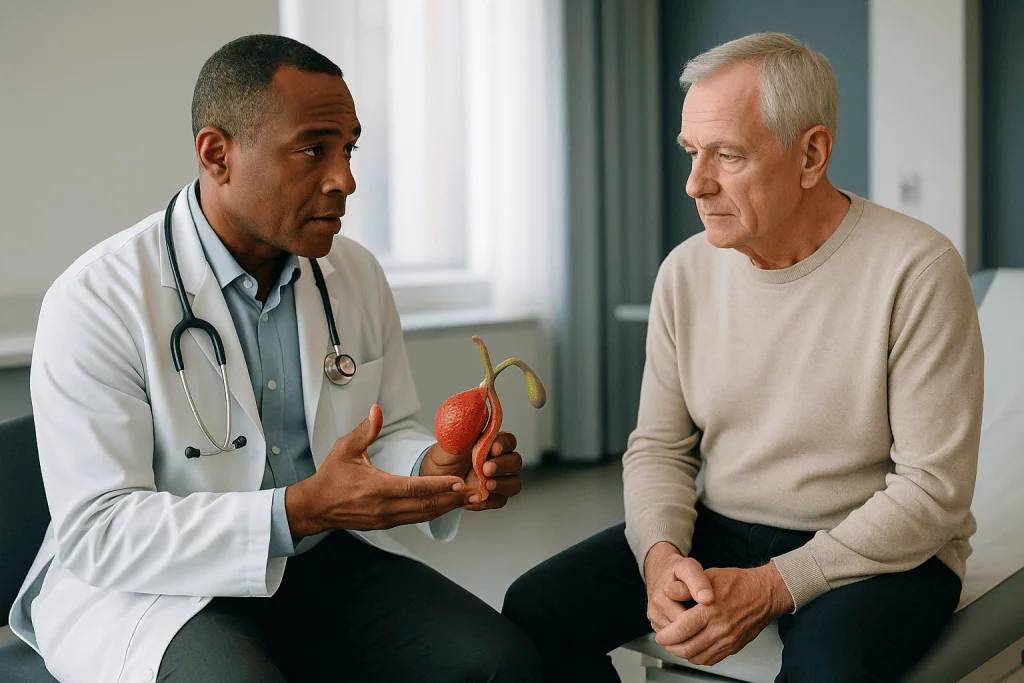
Bacteria are not always present at the start. Early cholecystitis is often a chemical and mechanical injury, which is why the pain is constant rather than the come-and-go cramping of a simple gallstone attack. Bacteria that normally live in the gut, however, find stagnant bile an easy place to multiply, so infection frequently follows. The National Library of Medicine’s StatPearls summary notes that secondary infection is common enough that clinicians generally assume it in moderate and severe cases.
Left alone, several things can go wrong. The wall can lose its blood supply and die, a complication called gangrenous cholecystitis. Gas-forming bacteria can produce emphysematous cholecystitis, more often seen in people with diabetes. Pus can accumulate into an abscess. The wall can tear, spilling bile into the abdomen. The NHS lists these among the reasons untreated acute cholecystitis is regarded as an emergency rather than a nuisance.
A smaller group develops cholecystitis without any stones. This acalculous form, making up roughly 5 to 10 percent of cases according to Cleveland Clinic, tends to affect people who are already critically ill, fasting for long periods, or on intravenous nutrition. The gallbladder simply stops emptying. Its treatment follows the same principles, but the underlying illness often dictates how aggressively the gallbladder itself can be dealt with.
Why the first hours in hospital matter: fluids, fasting and monitoring
The earliest treatment looks unremarkable from a bedside chair. A cannula goes into a vein. A bag of fluid begins to drip. A nurse writes “nil by mouth” on a board. None of this is dramatic, yet each step is doing real work.
Intravenous fluid replaces what vomiting, fever and poor intake have drained away, and it supports blood pressure and kidney function if infection is stressing the body. Withholding food matters because eating, particularly fatty food, triggers the gallbladder to contract against a blocked outlet, which worsens pain and pressure. The NHS describes this initial phase as a way of taking strain off the gallbladder while the team gathers information.
That information comes from several directions. Blood tests look for markers of inflammation and infection, and for liver enzymes or bilirubin that might suggest a stone has moved into the common bile duct, the main channel carrying bile from liver to intestine. An ultrasound scan is usually the first imaging test; MedlinePlus notes it can show gallstones, a thickened wall and fluid around the organ. If the picture is unclear, further scans may follow.
Monitoring also establishes severity. Clinicians commonly grade cholecystitis as mild, moderate or severe, based on features such as how long symptoms have lasted, how high inflammatory markers are, whether there are signs of organ dysfunction, and whether imaging suggests the wall is dying. The StatPearls review describes this grading as the backbone of the widely used Tokyo Guidelines. It matters because the grade steers everything that follows, from whether antibiotics are essential to whether surgery can safely happen this week.
Cholecystitis antibiotics: do you always need them?
People are often surprised to learn that antibiotics are not the centerpiece of cholecystitis treatment. They are a supporting act. The main problem is a blocked, inflamed organ, and no antibiotic unblocks a duct.

That said, most people admitted with acute cholecystitis do receive antibiotics, usually through a vein at first. The reasoning is straightforward: stagnant bile is a good culture medium, infection is common, and the consequences of missing it, such as abscess or sepsis (a life-threatening body-wide reaction to infection), are serious. The NHS lists antibiotics among standard initial treatments, and Mayo Clinic notes they are used when infection is present or suspected.
Which class of antibiotic is chosen depends on the bacteria that typically live in the gut, on local resistance patterns, on kidney function and on allergies. Clinicians generally start with a broad-spectrum agent that covers common gut organisms and narrow it if cultures identify a specific bacterium. That decision sits with the prescribing team, and the choice can change during the admission.
How long antibiotics continue is where practice has shifted. The StatPearls summary of the Tokyo Guidelines notes that for mild or moderate cholecystitis, once the gallbladder has been removed, antibiotics can often be stopped within about a day of surgery, because removing the source of infection removes the need to keep treating it. Longer courses are reserved for people with bile duct stones, abscesses, perforation or severe illness, or for those managed without surgery.
A few points worth holding onto. Feeling better on antibiotics does not mean the gallbladder has recovered; the blockage remains. Stopping early or continuing longer are both decisions for the clinician following your bloods and scans. And antibiotics alone, with the gallbladder left in place, carry a real chance of the problem returning.
Pain relief for cholecystitis: what clinicians use and why
The pain of cholecystitis has a particular character. It sits in the upper right abdomen or just under the breastbone, builds over an hour or so, and then stays. Cleveland Clinic notes that pain lasting more than about six hours is one of the features that separates cholecystitis from a passing gallstone attack. It often radiates to the right shoulder or back, because the inflamed gallbladder irritates the diaphragm, which shares nerve pathways with the shoulder.
Controlling that pain is a treatment goal in its own right, not a luxury. Uncontrolled pain drives up heart rate and blood pressure, makes it harder to breathe deeply, and can mask or mimic the signs a team is watching for. Effective analgesia also lets someone move, cough and, later, recover from surgery more smoothly.
Clinicians typically use a stepwise approach. Simple analgesics and anti-inflammatory drugs are often the first layer, with the caveat that anti-inflammatories are avoided in people with kidney problems, bleeding risk or certain other conditions. Stronger opioid medicines are added for severe pain, usually for short periods. Anti-nausea medicines are frequently given alongside, since vomiting is common and makes everything worse.
The choice, route and duration of pain relief are individual decisions, adjusted hour by hour as the person’s condition changes. What you can reasonably expect is that pain should be asked about regularly and treated promptly, and that persistent or escalating pain despite treatment is itself a signal the team will want to know about, since it may indicate the inflammation is progressing.
Once the gallbladder has been removed, the original pain typically resolves, leaving the different, more manageable discomfort of healing incisions.
Acute cholecystitis treatment: who has early surgery and who is asked to wait
Surgeons divide people with acute cholecystitis into broad groups, and it helps to know which one you are likely to fall into.
The first group is the person who is otherwise reasonably well, whose inflammation is mild or moderate, and whose symptoms began recently. For this group, guidelines increasingly favor removing the gallbladder during the same hospital admission. The NHS states that surgery is usually recommended within about a week of diagnosis if the person is fit enough, and Mayo Clinic describes cholecystectomy as the usual definitive treatment.
The second group is asked to wait, at least for a while. This includes people whose symptoms have been present for many days before presentation, where the tissues may be so inflamed and stuck together that an operation becomes technically more hazardous. It also includes people whose inflammation is settling well on supportive treatment and who have other medical conditions that would benefit from optimization before an anesthetic. For them, a planned operation is often scheduled once things have calmed, typically several weeks later, according to the NHS.
The third group cannot safely have an operation at all in the short term. Severe cholecystitis with organ dysfunction, frailty, recent heart attack or stroke, or advanced lung disease may make general anesthesia too risky. These patients are usually offered a drainage procedure, discussed later, and their long-term plan is revisited once they recover.
People with stones in the common bile duct form a fourth, overlapping group. They may need a separate endoscopic procedure to clear the duct before or around the time of surgery.
None of these boundaries is fixed. Surgeons, anesthetists and physicians weigh them together, and the same patient might move between groups as their condition evolves.
Gallbladder removal timing: what early versus delayed surgery means
For much of the twentieth century, surgeons feared operating on a hot, swollen gallbladder. The standard advice was to cool it down with rest and antibiotics, send the patient home, and operate weeks later. That approach still exists, but the evidence has shifted.
Early cholecystectomy generally means operating during the first admission, ideally within about 72 hours of symptoms starting and usually within a week. Delayed cholecystectomy means a planned operation after the inflammation has settled, typically six to eight weeks later, a window the NHS describes for people whose initial treatment is non-surgical.
Several arguments favor acting early. The person avoids the risk of a second attack while waiting; the StatPearls review notes that recurrence during the waiting period is a genuine concern. Total hospital time across the whole episode tends to be shorter. Early surgical guidance, including from the NHS, now favors this approach for fit patients because pooled trial data have not shown that early surgery increases major complications compared with waiting.
Arguments for delay remain legitimate in specific circumstances. If someone has been unwell for more than a week, the anatomy can be distorted and the chance of needing to convert from keyhole to open surgery rises. If there are untreated medical problems, a few weeks of optimization can make the anesthetic safer. Some hospitals simply do not have emergency theater capacity for same-admission surgery, and a planned slot is the realistic alternative.
What the evidence does not support is indefinite delay with the gallbladder left in place in an otherwise fit person. Each attack carries risk, and the organ rarely returns to normal function once it has been significantly inflamed.
Treatment options for cholecystitis compared
Seeing the pathways side by side makes the logic clearer. The table summarizes typical scenarios, drawn from NHS, Mayo Clinic and the StatPearls review. Every row represents a typical pattern, not a rule; your team may have good reasons to do something different.
| Approach | Usually considered for | What it involves | Typical timing |
|---|---|---|---|
| Supportive care only, initially | Everyone at first presentation | IV fluids, fasting, pain relief, monitoring, antibiotics if infection suspected | Begins on arrival; continues until definitive plan |
| Early laparoscopic cholecystectomy | Fit patients with mild or moderate inflammation of recent onset | Keyhole removal of the gallbladder during the same admission | Often within 72 hours of symptoms, usually within 1 week of diagnosis (NHS) |
| Delayed cholecystectomy | Those whose inflammation settles and who need optimization, or with late presentation | Planned removal after discharge | Commonly 6–8 weeks after the attack (NHS) |
| Percutaneous cholecystostomy | People too unwell or frail for anesthesia | A drain placed through the skin into the gallbladder under imaging guidance | Emergency or urgent; surgery reconsidered later |
| Endoscopic duct clearance (ERCP) | Those with stones also in the common bile duct | Endoscope passed through the mouth to remove duct stones | Before, during or shortly after gallbladder surgery |
| Open cholecystectomy | When keyhole surgery is unsafe or must be converted | Removal through a larger incision under the ribs | Decided during planning or during the operation |
Two things stand out. First, supportive care is not a competitor to surgery; it is the ground on which every other option stands. Second, the drain and the endoscopic procedure are bridges or adjuncts, not usually endpoints in their own right, because the gallbladder that caused the problem is still there.
What actually happens during gallbladder removal
Cholecystectomy is the surgical term for removing the gallbladder. Most operations today are laparoscopic, meaning keyhole: the surgeon works through several small cuts using a camera and long instruments, with the abdomen gently inflated with carbon dioxide to create working space.
Under general anesthesia, the surgeon identifies the cystic duct and the small artery feeding the gallbladder, seals and divides them, and separates the gallbladder from the underside of the liver. It is removed through one of the incisions, sometimes in a small bag. MedlinePlus notes the procedure typically takes one to two hours, and that many people go home the same day or the following day.
The surgeon’s central safety concern is the common bile duct, which runs close to the cystic duct. Injuring it is uncommon but serious, and much of the careful dissection in the operation exists to identify structures clearly before anything is cut. In a badly inflamed gallbladder, this is harder, which is one reason very late presentations sometimes prompt a decision to delay.
Sometimes the operation begins as keyhole and becomes open, meaning a single larger incision under the right ribs. Conversion is not a failure; it is a judgment that the safest way to finish is with direct access. The NHS notes open surgery carries a longer recovery, and surgeons discuss the possibility beforehand so it is not a surprise.
Risks the team will describe include bleeding, infection, bile leak from the small duct stump, injury to the bile duct or nearby bowel, blood clots, and reactions to anesthesia. Living without a gallbladder is compatible with normal digestion because the liver continues to make bile; it simply flows directly into the intestine rather than being stored.
When surgery is too risky: drains and other alternatives
Not everyone can go to theater. For a frail person with severe pneumonia, or someone whose heart would not tolerate a general anesthetic, the inflamed gallbladder still has to be dealt with, just not with a scalpel yet.
The most common alternative is percutaneous cholecystostomy. A radiologist, guided by ultrasound or CT, passes a thin tube through the skin and liver into the gallbladder and leaves it there to drain the infected bile. The NHS describes this as an option for people who are too unwell for immediate surgery. It relieves pressure, allows antibiotics to work and often produces rapid improvement in someone who is septic.
The drain has limitations. It does nothing about the stones. It can dislodge or block. The tube often stays for weeks while a track matures, and many patients find it a nuisance. Crucially, it is usually a bridge: once the person recovers from the acute illness, the surgical team reassesses whether the gallbladder can now be removed. In some very frail patients, the drain becomes the long-term plan, a decision reached after weighing the risks of both options.
Endoscopic approaches exist too. If stones sit in the common bile duct, a procedure called ERCP, in which an endoscope is passed through the mouth to the duct opening, can remove them and place a small tube to keep bile flowing. In selected centers, endoscopic drainage of the gallbladder itself is possible, though the evidence base is smaller and availability varies.
What none of these alternatives offers is a way to make a stone-filled gallbladder healthy again. Medicines that dissolve gallstones act slowly, over months, work only for certain small cholesterol stones, and, according to the NIH’s digestive diseases institute, are not used for acute cholecystitis.
Cholecystitis recovery time: what the days and weeks afterward usually look like
Recovery has two chapters: getting over the inflammation, and getting over the operation.
During the hospital phase, most people notice the deep, constant pain easing within a day or two of fluids, fasting and antibiotics, as the pressure inside the gallbladder falls. Fever settles. Blood tests improve. Diet is reintroduced gradually, starting with fluids and light foods.
After laparoscopic cholecystectomy, the NHS describes a recovery period of about two weeks before returning to normal activities, although this varies with the person’s fitness and job. The first few days bring incision soreness and, quite often, shoulder-tip pain from the gas used during surgery; this fades as the gas is absorbed. Walking early is encouraged because movement reduces the risk of blood clots and helps the bowel wake up. Many people are eating normally within days. Driving, lifting and strenuous exercise are usually restricted until the surgeon is satisfied the incisions have healed and pain no longer limits sudden movements.
Open surgery is a longer road. The NHS gives a typical range of six to eight weeks before full return to normal life, reflecting the larger incision through muscle.
Digestion adjusts. Some people notice looser stools for a few weeks as bile now enters the intestine continuously rather than in meal-timed bursts. For most this settles; a minority have longer-term changes that their team can help manage.
People treated with a drain rather than surgery follow a different rhythm: recovery from the acute infection over days, then a period living with the tube, then a fresh conversation about surgery. Whatever the pathway, the team should give you a clear follow-up plan before discharge.
Does cholecystitis ever go away on its own?
Sometimes the symptoms do. The stone that plugged the cystic duct can fall back into the gallbladder, pressure releases, and the pain subsides within a day or two even without treatment. This is the biological basis for the old wait-and-see approach, and it explains why some people describe an attack that “passed”.
The condition, though, has not really gone anywhere. The stones remain. The gallbladder wall, once significantly inflamed, is often thickened and scarred, and it may never contract normally again. The StatPearls review notes that a substantial proportion of people who are managed without surgery experience recurrent attacks, and each recurrence carries the same risk of complications as the first. That is why the NHS describes gallbladder removal as the usual recommendation even after symptoms have settled, and why the delayed-surgery pathway ends in an operation rather than in watchful waiting.
There are exceptions where a team may reasonably decide against surgery. A person with a very limited life expectancy from another illness, or one whose anesthetic risk is prohibitive, might be managed with symptom control and a plan to treat future attacks as they arise. That is a deliberate, shared decision, not the natural course of the disease.
A related question is whether the diagnosis itself might be wrong. Conditions that can mimic cholecystitis include peptic ulcer disease, pancreatitis, right-sided kidney problems, liver inflammation and even a heart attack presenting as upper abdominal pain. This is one reason imaging and blood tests are done rather than relying on the story alone, and why a team may keep observing for a while before committing to a treatment pathway.
Food and drink: what triggers an attack, and what actually calms the gallbladder
Search engines are full of promises about drinks that “flush” or “calm” the gallbladder. The evidence is thin, and honesty serves you better.
What is well established is the trigger. A meal high in fat causes the gut to release a hormone that makes the gallbladder contract. If a stone is sitting at the outlet, that contraction produces the classic post-meal pain. Cleveland Clinic and Mayo Clinic both note that fatty or heavy meals commonly precede attacks. Large portions, fried foods, rich sauces and very fatty meats are the usual culprits people report.
No specific drink has been shown in good-quality studies to relieve cholecystitis. Water is sensible during recovery to avoid dehydration, and clear fluids are typically what a hospital reintroduces first because they place no demand on the gallbladder. Herbal preparations, apple juice cleanses, olive oil and lemon regimens and similar folk remedies have no supporting evidence for treating an inflamed gallbladder, and some can worsen pain by stimulating contraction. During an acute attack the safest advice from every mainstream source is to stop eating and seek assessment.
Long-term, dietary patterns matter more for prevention than for treatment. The NIH’s digestive diseases institute notes that a diet higher in fiber and healthy fats and lower in refined carbohydrates, along with avoiding rapid weight loss, is associated with lower gallstone risk. Rapid crash dieting and prolonged fasting can actually promote stone formation by changing bile composition.
After the gallbladder is removed, most people can eat normally. Some find that very fatty meals produce loose stools in the first weeks; easing back into rich food gradually is a practical, low-risk approach your team may suggest.
What people often get wrong about how cholecystitis is treated
Misunderstandings cluster around a few themes, and each one can lead to a worse outcome.
“Antibiotics will fix it.” Antibiotics treat the infection that often accompanies cholecystitis. They do not remove the stone or restore the gallbladder’s function. Feeling better on them is common; being fixed by them is not. The NHS and Mayo Clinic both frame antibiotics as part of initial management, with surgery as the definitive step.
“If the pain goes, I can skip the operation.” Settled symptoms mean the stone has shifted, not that the problem is gone. Recurrence is common enough that guidelines still recommend planned surgery for fit patients.
“Surgery on an inflamed gallbladder is more dangerous, so waiting is always safer.” This was the prevailing belief for decades. Pooled trial evidence summarized in the StatPearls review has not shown higher rates of serious complications with early surgery in appropriately selected patients, and early surgery avoids the risk of attacks during the wait. Timing still depends on individual factors.
“Cholecystitis is just a bad gallstone attack.” A simple attack, called biliary colic, comes and goes within a few hours and does not involve inflammation. Cholecystitis persists, often with fever and tenderness, and can progress to gangrene or perforation. The distinction changes the urgency entirely.
“A special drink or cleanse can dissolve the stones.” No drink dissolves gallstones. Prescription bile-acid medicines can slowly dissolve certain small cholesterol stones over many months, but they are not used for acute inflammation.
“Living without a gallbladder means a lifetime of restricted eating.” Most people return to a normal diet. Bile still reaches the intestine; it is simply not stored first.
Questions to ask your care team
A hospital admission moves quickly, and it helps to have questions ready. These are the ones that tend to unlock the most useful conversations.
- How severe is my cholecystitis on the grading system you use, and how does that shape the plan?
- Are you recommending surgery during this admission or a planned operation later? What tipped the decision?
- If we wait, what should I do if the pain returns before the operation date?
- Do my blood tests or scans suggest a stone in the main bile duct? If so, how will that be dealt with?
- Am I having antibiotics because infection is confirmed, or as a precaution? How long do you expect them to continue?
- What is the likelihood, in my case, that keyhole surgery would need to convert to open surgery, and why?
- Which of my regular medicines should continue, pause or change around the operation? Please tell me before I go home.
- If I am not fit for surgery, what does the drain involve, how long might it stay, and when will surgery be reconsidered?
- What symptoms after discharge should bring me straight back rather than waiting for a clinic appointment?
- When can I expect to drive, return to work and exercise, and who signs off on each?
Write the answers down or ask a companion to. Ask for the names and roles of the people making decisions, and for a single point of contact after discharge. If something is explained in language you do not follow, say so; a good team would rather repeat itself than send you home uncertain.
Every one of these decisions belongs with the clinicians who can see your scans and examine you. Questions are not a challenge to that; they are how you become a participant in the plan rather than a passenger.
When to call your doctor: red-flag signs during and after treatment
Cholecystitis can turn from uncomfortable to dangerous within hours, and the same is true of complications after surgery. Knowing the signals that need urgent attention is the single most protective piece of knowledge in this article.
Seek emergency care immediately, by calling emergency services or going to the nearest emergency department, if you have severe abdominal pain that is worsening or unrelenting, a high fever with shaking chills, yellowing of the skin or the whites of the eyes (jaundice), confusion or drowsiness, a racing heart with lightheadedness, or an abdomen that becomes rigid and exquisitely tender. The NHS and Mayo Clinic list these as signs of possible perforation, abscess, sepsis or bile duct obstruction.
After gallbladder surgery, contact your surgical team or emergency services promptly for fever, increasing rather than easing abdominal pain, persistent vomiting, jaundice, dark urine with pale stools, redness, swelling or discharge at an incision, calf pain or swelling, or sudden shortness of breath or chest pain. MedlinePlus notes that bile leak and infection, while uncommon, usually announce themselves this way in the first days.
If you have been sent home to wait for a planned operation, treat any return of the original pain lasting more than a few hours as a reason to be reassessed, not something to sit through. If you are living with a drain, a tube that stops draining, becomes dislodged, or is surrounded by leaking or foul-smelling fluid needs same-day attention.
None of this is meant to alarm. Most people move through treatment without any of these events. The point is that the warning signs are specific and recognizable, and acting on them early is what keeps a manageable problem manageable.
Frequently asked questions
Does cholecystitis ever go away without treatment?
The symptoms sometimes settle on their own when the blocking stone falls back into the gallbladder, but the underlying condition does not resolve. The stones remain and the gallbladder wall is often permanently damaged, so attacks tend to recur and each one carries a risk of complications. That is why guidelines generally recommend planned gallbladder removal even after an attack has subsided, unless a person’s other health problems make surgery inadvisable.
What are three signs of cholecystitis?
The three features clinicians look for are constant pain in the upper right abdomen lasting more than a few hours, tenderness when that area is pressed (especially while breathing in), and fever. Nausea, vomiting and pain spreading to the right shoulder are also common. These signs alone do not confirm the diagnosis; blood tests and an ultrasound scan are needed, and other conditions can mimic it, so anyone with this pattern should be assessed promptly.
How is acute cholecystitis treated in hospital?
Treatment starts with intravenous fluids, a period of not eating, pain relief and, when infection is suspected, antibiotics given through a vein. The team then grades severity and decides on the definitive step: usually keyhole removal of the gallbladder during the same admission for fit patients, a planned operation weeks later for some, or a drainage tube for those too unwell for surgery. Stones in the main bile duct may need a separate endoscopic procedure.
Are cholecystitis antibiotics always necessary?
Not always, but most people admitted with acute cholecystitis receive them because bacterial infection commonly complicates the inflammation and the consequences of missing it are serious. Antibiotics do not unblock the gallbladder, so they are a supporting treatment rather than the main one. For mild or moderate cases, they are often stopped within about a day of surgery once the source has been removed. The choice, route and duration are decided by the prescribing clinician.
What is the best gallbladder removal timing after cholecystitis?
For people who are otherwise fit with mild or moderate inflammation, guidance favors early surgery, ideally within 72 hours of symptoms and usually within a week of diagnosis. Waiting several weeks is considered when someone presented late, needs other health conditions optimized, or when inflammation has settled and theater capacity dictates a planned slot. Pooled trial data have not shown early surgery increases major complications in appropriately selected patients. The surgical team weighs these factors individually.
What is the typical cholecystitis recovery time?
The acute pain usually eases within a day or two of hospital treatment. After keyhole gallbladder removal, most people return to normal activities within about two weeks, with incision soreness and shoulder-tip pain from surgical gas fading over the first days. Open surgery, through a larger incision, typically needs six to eight weeks. Some people notice looser stools for a few weeks as digestion adjusts. Your surgeon will advise on driving, lifting and work.
What drink calms the gallbladder during an attack?
No drink has been shown to calm an inflamed gallbladder. Cholecystitis is a mechanical blockage with inflammation, and folk remedies such as apple juice cleanses or olive oil and lemon mixtures have no supporting evidence; some fatty preparations can worsen pain by stimulating contraction. During an attack, the safest approach is to stop eating, sip water if you are not vomiting, and seek medical assessment. Hospitals reintroduce clear fluids first because they place no demand on the gallbladder.
What foods can trigger cholecystitis?
High-fat and heavy meals are the most consistently reported triggers, because dietary fat prompts the gallbladder to contract, and if a stone blocks the outlet that contraction causes pain. Fried foods, rich sauces, fatty meats and very large portions are frequently mentioned. Food does not cause the inflammation itself; gallstones do. Longer term, diets higher in fiber and lower in refined carbohydrates, along with avoiding rapid crash dieting, are associated with lower gallstone risk.
Can cholecystitis be treated without removing the gallbladder?
In the short term, yes: fluids, antibiotics and pain relief can settle an attack, and a drain placed through the skin can relieve a severely infected gallbladder in someone too unwell for surgery. These approaches leave the stones in place, so recurrence is common. Removal is the usual long-term recommendation for fit patients. Some frail people are deliberately managed without surgery after weighing risks, a decision made with their treating team rather than by default.
Will I need to change my diet permanently after gallbladder removal?
Most people return to a normal diet. The liver continues to make bile, which now flows directly into the intestine instead of being stored, and digestion adapts. Some notice loose stools or discomfort after very fatty meals in the first weeks, so easing back into rich food gradually is a practical approach. A small minority have longer-lasting digestive changes that can usually be managed with guidance from their care team.
References
- NHS: Acute cholecystitis
- MedlinePlus: Acute cholecystitis
- Cleveland Clinic: Cholecystitis (gallbladder inflammation)
- NIH StatPearls: Acute Cholecystitis
This article is for general information only and is not a substitute for professional medical advice. Please consult a qualified doctor about your individual situation.

More from the Blog

How Celiac Disease Is Treated: Lifelong Gluten-Free Nutrition and Correcting Deficiencies
Celiac disease is treated with a strict, lifelong gluten-free diet, which removes wheat, barley and rye so the damaged lining of the small intestine…

How Ulcerative Colitis Is Treated: Inducing Remission, Then Keeping the Colon Calm
Ulcerative colitis is treated in two phases: medicines to induce remission during a flare, then a different or continued medicine to maintain it. Aminosalicylates…

ERCP Preparation: Fasting Hours, Blood Thinners and the Allergy Questions Your Team Asks
Preparing for ERCP usually means an overnight or roughly eight-hour fast from solid food, a personal plan for any blood thinner agreed with the…
Living With Inflammatory Bowel Disease: Stress, Hydration and Nutrition as Part of Care
Living with inflammatory bowel disease means treating stress management, hydration and nutrition as supporting parts of care, not replacements for medical treatment. Stress does…

When Is Anti-Reflux Surgery Considered for GERD? The Treatment Ladder Explained
Anti-reflux surgery is usually considered only after GERD has been confirmed with testing and has not been controlled by lifestyle changes and an adequate…

What Remission Really Means in Crohn’s Disease and How Follow-Up Keeps It on Track
In Crohn's disease, remission means the inflammation has quieted enough that symptoms settle and, ideally, blood tests, stool markers and the gut lining itself…