

How Ingrown Toenail Surgery Is Done: Numbing, Nail Edge Removal and the First Days After

Key Takeaways
- Ingrown toenail surgery is performed under a local anesthetic block at the base of the toe; general anesthesia is not standard and you remain awake.
- The Cochrane review indexed in PubMed found that surgery prevents recurrence better than non-surgical care, and that adding phenol to the nail root reduces recurrence further.
- The same review found phenol carries a higher post-procedure infection rate and longer wound drainage, which is why clinicians weigh it case by case.
- After a partial nail avulsion without matrix treatment, Mayo Clinic notes the nail typically takes two to four months to grow back.
- You can walk out of the clinic the same day, but a closed shoe is usually the last thing to return, and wearing one too early is the commonest cause of setbacks.
- Cutting a V-notch in the nail tip has no evidence behind it; trimming straight across and wearing wide-toed shoes are what mainstream guidance recommends.
Ingrown toenail surgery is a short outpatient procedure done under local anesthetic injected at the base of the toe, so the toe is numb while you stay awake. The clinician lifts and cuts away the offending strip of nail, often treats the nail root with phenol to stop that edge regrowing, then dresses the toe. Most people walk out the same day and expect a sore toe for several days.
The sock comes off and there it is again: the corner of the big toenail has dug into the skin, the fold beside it is red and shiny, and the thought of a shoe makes you wince. You have soaked it, you have wedged cotton under the edge, you have tried to leave it alone. Now someone has said the word surgery, and your mind has jumped straight to scalpels and being knocked out.
The reality of the ingrown toenail surgery procedure is far smaller than that word suggests. It happens in an ordinary treatment room, usually takes less time than a dental filling, and the only part most people remember clearly is the sting of the numbing injection.
This explainer walks through each step, from the anesthetic to the first shower, and separates what the evidence supports from the folklore that circulates in locker rooms and online forums.
What is the ingrown toenail surgery procedure in plain language?
An ingrown toenail, which clinicians call onychocryptosis, is a nail edge that has grown into the soft skin beside it rather than over it. The body treats that buried edge as a splinter. The skin swells, the fold becomes tender, and bacteria that normally live harmlessly on the foot find a way in. The big toe is affected far more often than the others, according to MedlinePlus.
The ingrown toenail surgery procedure aims to remove the piece of nail that is causing the trouble and, in many cases, to stop that same strip from growing back. The formal name for removing nail is avulsion: a partial nail avulsion takes only the offending edge, a total nail avulsion takes the whole plate. The nail grows from a band of living tissue under the skin at its base called the matrix. Destroying the sliver of matrix that feeds the problem edge is called a matrixectomy, and it is what turns a temporary fix into a longer-term one.
Mayo Clinic describes the pathway in tiers. A mildly ingrown nail may be lifted with a splint or cotton and left to grow clear. A more troublesome edge is partially removed under local anesthetic. A nail that keeps coming back is treated by removing the edge together with the underlying matrix, using a chemical, a laser or a scalpel.
Two facts reassure most people before they arrive. First, this is almost always an outpatient visit; you walk in and you walk out. Second, the toe is fully numbed before any cutting begins. Everything that follows in this article builds on those two points.
Is ingrown toenail surgery painful, and do they put you to sleep?
Two of the most searched questions about this procedure have the same honest answer: the surgery itself should not hurt, and you will almost certainly be awake for it.
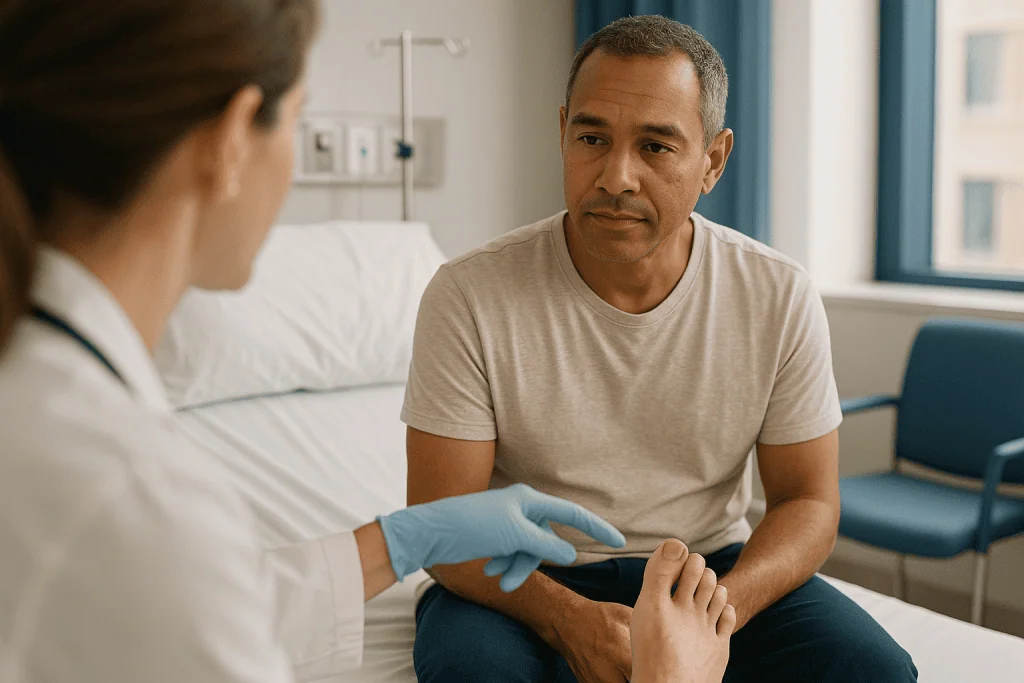
General anesthesia, the medicine that puts you to sleep for an operation, is not standard for an ingrown toenail. The NHS and Mayo Clinic both describe the procedure as being performed under local anesthetic, which numbs a small area of the body while you remain conscious. For a toe this is delivered as a digital block: an injection of numbing medicine into each side of the base of the toe, where the two small nerves that supply sensation run. Once those nerves are blocked, the whole toe beyond the injection point loses feeling.
The injection is the part people remember. Expect a sharp sting followed by a spreading pressure, lasting a few seconds on each side. Clinicians often warm the anesthetic, inject slowly, or apply a cooling spray first to blunt that moment. After a short wait, the clinician will test the toe by pinching the skin beside the nail. If you feel pressure but no sharpness, the block has worked. If you still feel pain, say so; more anesthetic can be given before anything else happens.
During the removal you may notice tugging, pressure or a clicking sensation as the nail is lifted. These are normal and are not pain signals. The toe stays numb for some hours afterward, so the first real soreness usually arrives that evening.
Sedation or general anesthesia is occasionally discussed for young children, for people with severe needle anxiety, or when several toes are treated at once. That decision belongs to the treating team, who weigh the small added risks against the benefit for that individual.
Step by step: what actually happens during nail edge removal
Once the toe is numb, the sequence is remarkably consistent from one clinic to another. Knowing it in advance takes away most of the mystery.
The foot is cleaned with an antiseptic solution and a sterile drape is placed around the toe. Many clinicians then apply a small tourniquet, a snug band around the base of the toe, to keep the field free of blood. A bloodless field matters because, as you will read in the next section, phenol only works on dry tissue.
Next comes the lift. A flat instrument is slid under the ingrown edge of the nail, from its free tip back toward the cuticle, gently separating the nail from the bed beneath. This is the stage where you may feel pressure or a faint pop, with no pain.
The clinician then cuts a straight line along the nail, typically a strip a few millimeters wide, running from the tip all the way back under the skin fold at the base to where the nail begins. The freed strip is gripped and drawn out with a twisting motion. It usually comes away in one piece, longer than you expect, because a good portion of the nail lies hidden under the cuticle.
The groove is inspected. Any overgrown, moist, reddish tissue that has piled up against the nail, called granulation tissue, may be trimmed away. Debris and any remaining nail spicules are cleared.
If a matrixectomy is planned, it happens now. If not, the toe is simply dressed. The tourniquet comes off, a non-stick pad and a light bandage go on, and the whole thing has typically taken well under half an hour. You are then usually given written aftercare and a follow-up plan.
What is a phenol matrixectomy and why is it so often added?
Phenol is a strong chemical that destroys living cells on contact. Applied carefully to the exposed corner of the nail matrix after the strip has been removed, it kills the small patch of tissue that would otherwise grow a new nail edge into the same groove. The rest of the matrix is left alone, so the remaining nail keeps growing normally. The procedure is called a chemical or phenol matrixectomy.

In practice the clinician rolls a tiny amount of phenol on a cotton applicator into the empty groove, holds it there for a timed interval, sometimes repeats it, and then flushes the area with alcohol or saline to neutralize any excess. The tourniquet is essential here: blood dilutes phenol and stops it working.
The evidence for adding phenol is clearer than for almost any other detail of this procedure. A Cochrane systematic review of interventions for ingrowing toenails, indexed in PubMed, found that surgical treatments were more effective than non-surgical ones at preventing recurrence, and that adding phenol to nail avulsion reduced the chance of the nail growing back into the skin compared with avulsion alone. The same review noted a trade-off: phenol was associated with a higher rate of post-procedure infection and a longer period of drainage from the wound.
That trade-off explains why your clinician may or may not suggest it. For a first episode with little tissue damage, some teams prefer a simple avulsion and let the nail regrow. For a toe that has flared repeatedly, most guidance including Mayo Clinic’s points toward removing the matrix.
Alternatives to phenol exist. Sodium hydroxide, electrocautery, laser and cutting out the matrix with a scalpel all aim at the same target. None has consistently outperformed phenol in comparative trials, and the choice usually reflects the clinician’s training and the equipment available.
Who is ingrown toenail surgery usually for, and who is asked to wait?
Not every red toe needs a scalpel, and not every person is a good candidate on the day they walk in.
Guidance from the NHS and Mayo Clinic reserves the procedure for nails that have not settled with conservative care: warm soaks, keeping the foot dry and clean, wearing roomy shoes, and gently lifting the edge with a splint or cotton. Surgery is usually considered when the toe is repeatedly infected, when the skin has overgrown the nail edge, when pain limits walking, or when the same corner has ingrown more than once despite good self-care.
Some people are usually asked to pause before the procedure goes ahead:
- Anyone with a spreading infection, fever, or pus tracking under the nail may first be treated for the infection, since operating through actively infected tissue raises complication risk.
- People with diabetes, poor circulation, or nerve damage in the feet are not excluded, but they are assessed more carefully. Mayo Clinic and MedlinePlus both advise this group to see a clinician promptly for any ingrown nail rather than attempting home care, because slow healing and unnoticed infection are real concerns.
- Those on blood-thinning medicines are asked to tell the clinician beforehand; the procedure can usually still proceed, but bleeding control may need extra attention. Nobody should stop a prescribed anticoagulant on their own.
- Children and teenagers are commonly treated, since the condition peaks in adolescence, but the approach to numbing and comfort is tailored to age.
Pregnancy, a known allergy to local anesthetic, or a previous bad reaction to phenol are all worth raising early. The final call about timing, technique and whether to add a matrixectomy rests with the treating team after they have looked at the toe and your wider health.
Partial removal, total removal or matrixectomy: how the options compare
People often arrive believing there is one operation. There are several, and they differ in how much nail is taken and whether the root is treated. The table below summarizes the mainstream options described by Mayo Clinic, the NHS and the Cochrane review.
| Option | What is removed | Root treated? | Typical use | Main trade-off |
|---|---|---|---|---|
| Splinting or lifting | Nothing; edge is propped up | No | Mild, early cases | Slow; needs daily attention |
| Partial nail avulsion | One strip of nail edge | No | First or occasional episode | Edge can regrow into the groove |
| Partial avulsion with phenol matrixectomy | One strip plus its matrix | Yes, chemically | Recurrent problem on one side | Longer wound drainage; slightly higher infection rate |
| Surgical matrixectomy (excision) | Strip plus matrix cut out | Yes, surgically | Recurrent cases; clinician preference | Stitches; longer healing time |
| Total nail avulsion | Whole nail plate | Usually no | Severe infection, fungal thickening, both edges affected | Regrowth is slow; deformity possible |
A few patterns are worth drawing out. Removing more nail does not mean better results; the Cochrane review found that treating the matrix mattered more than how much nail came away. Total avulsion without matrix treatment carries a real chance that the new nail ingrows on both sides as it returns, which is why it is reserved for particular situations.
The other pattern is cosmetic. After a partial avulsion with matrixectomy, the nail will permanently be a little narrower on that side. Most people find this barely noticeable once the skin fold has settled, but it is a fair thing to ask about if nail appearance matters to you.
Partial nail avulsion recovery: what the first three days usually look like
The numbness fades over the afternoon or evening, and the toe announces itself. This is the window people ask about most, so here is what typically happens, drawing on NHS and Cleveland Clinic aftercare guidance.
Day one is about elevation and rest. Keeping the foot raised above hip level for as much of the first day as practical reduces the throbbing that comes with a swollen toe hanging downward. A small amount of blood or clear fluid seeping into the dressing is expected. Clinicians generally advise leaving the original dressing in place until the first change, often the next day, unless it becomes soaked.
Pain is usually described as a dull ache with a sharper edge when the toe is bumped. Over-the-counter pain relief is what most guidance suggests, taken as your clinician or the packaging directs. If you were given a prescription, follow the instructions you were given rather than a friend’s advice.
Day two typically brings the first dressing change. The wound is redressed with a non-stick pad and light gauze. Many teams recommend beginning daily warm salt-water soaks around this point to keep the groove clean and soften any crusting; others prefer the wound kept dry for a few days. Follow the specific instructions you were given, because the two approaches are not interchangeable.
If phenol was used, expect the groove to weep a yellowish fluid for one to several weeks. This is a chemical burn healing, not an infection, and the Cochrane review specifically flagged longer drainage as a known consequence of phenol. Signs that separate normal drainage from infection appear in the red-flag section later.
Footwear on these first days is open-toed or a post-procedure sandal. A closed shoe pressing on a fresh wound sets recovery back and is the single most common self-inflicted problem.
How long does it take to walk after ingrown toenail surgery?
You can walk immediately. The question people are really asking is when walking stops being uncomfortable, and the honest answer is that it depends on what was done and what you mean by walking.
Leaving the clinic is done on your own feet, in a loose sandal or an open shoe, usually with instructions to keep the walk short. Because the toe is still numb, this part is easy. Driving home is another matter: with a numb toe and a bulky dressing you cannot feel the pedals properly, so most services advise arranging a ride.
Over the first two to three days, walking around the house and short necessary trips are fine. Standing for long periods and walking any distance tend to make the toe throb because blood pools in a dependent foot. NHS guidance suggests resting the foot and keeping it raised where possible during this early period.
Returning to a normal closed shoe is the real milestone. For a simple partial avulsion this often happens within the first week or two, once the tenderness in the groove has settled enough for gentle pressure. After a phenol matrixectomy the groove stays wet and tender for longer, and wide, soft footwear is typically needed until drainage stops.
Running, football, dance and any activity involving repeated toe-off or the risk of a kick are usually held back until the wound has fully closed. Typical advice is a matter of weeks rather than days, but your clinician will set the timeline based on how the toe looks at follow-up.
Two things speed the return to comfortable walking more than anything else: not squeezing the toe into a shoe too early, and keeping the dressing clean and dry so the wound is not repeatedly irritated. A person who follows both is usually back to normal walking noticeably sooner than one who does neither.
Weeks two to twelve: regrowth, footwear and getting back to sport
By the end of the second week the drama has usually passed. The groove is drier, the swelling has gone down, and the dressing has shrunk to a small pad or a plaster. What remains is a longer, quieter phase that is easy to neglect.
If only the nail edge was removed and the matrix was left intact, the nail begins to regrow from the base. Mayo Clinic notes that after partial removal it typically takes two to four months for the nail to grow back. During this time the new edge has to find its way over, not into, the skin fold. Gently pushing the skin back from the growing edge after a shower and keeping the nail trimmed straight across, never rounded at the corners, both help.
If phenol was used, that strip of matrix will not regrow. The groove slowly fills in with skin and the nail edge that remains is stable. Some people notice a slightly irregular or thin margin at first; this generally smooths as the toe heals over the following weeks.
Footwear shapes the outcome more than any ointment. A shoe with a wide, deep toe box, a sock that does not compress the toes, and a lace or strap that stops the foot sliding forward all take pressure off the nail fold. The NHS lists tight shoes as a leading cause of ingrown nails in the first place, so this is prevention as much as recovery.
Sport can resume once the wound has closed and the toe tolerates a closed shoe without pain, which your follow-up appointment will confirm. Swimming in pools is often delayed until the skin has sealed to reduce infection risk. Barefoot activities on shared floors are best avoided while the wound is open.
What are the risks, and how often does the nail come back?
This is a minor procedure, but minor is not the same as risk-free, and a fair explainer names the ways it can go wrong.
Infection is the most common complication. The wound sits in a warm, enclosed space, and if phenol was used the tissue is chemically burned and weeps for longer. The Cochrane review found infection rates were higher after phenol than after avulsion alone, though most such infections were mild and settled with wound care and, where needed, antibiotics prescribed by the treating clinician.
Recurrence is the risk people fear most. The same review found that surgery reduced recurrence compared with non-surgical treatment, and that adding phenol reduced it further compared with surgery alone. Recurrence is not eliminated, however. If a fragment of matrix survives, a thin spike of nail can regrow into the groove, sometimes months later. This is treatable with a repeat matrixectomy on that small area.
Other recognized risks include:
- Bleeding, usually minor and controlled with pressure and dressing.
- Delayed healing, more likely in smokers and in people with diabetes or circulation problems.
- Damage to the nail bed, leaving a ridge or a permanently narrowed, thickened or irregular nail.
- Phenol spilling onto surrounding skin, causing a superficial burn.
- Rare allergic reaction to the local anesthetic.
- Persistent tenderness in the nail fold that lasts beyond the expected healing time.
Nail cosmetic change deserves plain mention. A permanently narrower nail is the intended result of a matrixectomy, not a complication, but people who were not warned sometimes experience it as one.
None of these risks argues against the procedure for someone with a recurrent, painful toe. They do argue for a clear conversation beforehand, and for following aftercare instructions closely, since most infections and healing delays trace back to a shoe worn too soon or a dressing left too long.
What people often get wrong about the ingrown toenail surgery procedure
Ingrown toenails attract folklore. Several of the most common beliefs are wrong in ways that affect how people prepare or recover.
The first myth is that cutting a V-notch into the nail tip relieves pressure and lets the nail grow inward less. There is no good evidence for this, and Mayo Clinic advises trimming straight across instead. The V does nothing to the edge that is actually buried under the skin fold.
The second is that you will be asleep. As covered earlier, the standard is a local anesthetic block with the person awake. Assuming general anesthesia leads people to fast unnecessarily or to arrange elaborate recovery plans they do not need.
The third is that removing the whole nail is a more thorough fix. The Cochrane review points the other way: what prevents recurrence is treating the matrix, not the amount of nail taken. Total avulsion without matrix treatment can bring the problem back on both edges.
The fourth is that drainage after phenol means infection. Weeping for a week or more is an expected part of a chemical burn healing. Infection has other signs, described in the red-flag section, and confusing the two leads to unnecessary worry or unnecessary antibiotic requests.
The fifth is that hot soaks are all you ever need. For a mild early case, soaks and lifting the edge often work, and guidance rightly starts there. Once the skin has overgrown the nail or infection keeps returning, soaking alone rarely resolves it, and delaying assessment simply extends the discomfort.
The last is a quiet one: that the nail will look exactly as before. After a matrixectomy it will be narrower on that side, permanently. Most people are glad of the trade once the pain is gone, but it should never come as a surprise.
Is it worth it? Alternatives and what the evidence actually shows
Whether the procedure is worth having is a personal judgment, but the evidence can frame it honestly.
Conservative care comes first for a reason. Mayo Clinic and the NHS describe soaking the foot in warm water, keeping it clean and dry, wearing roomy shoes, and gently lifting the nail edge with a wisp of cotton, dental floss or a small splint so the nail grows over the skin instead of into it. For a first, mild episode this approach often settles things and carries no procedural risk. It demands patience, daily attention, and a willingness to abandon tight footwear.
A middle option is a nail brace or gutter splint, where a small plastic tube or a spring-like device is fitted along the nail edge to hold the skin away while the nail grows. Cleveland Clinic lists this among non-surgical options. Evidence for braces is thinner than for surgery, and they suit people who want to avoid a procedure and can commit to weeks of wear.
Where the nail has repeatedly ingrown, the picture changes. The Cochrane review’s conclusion was that surgical treatment prevents recurrence more effectively than non-surgical treatment, and that adding phenol strengthens that effect. That is a guideline-level finding, not a marketing claim, and it is the strongest single argument for the procedure in recurrent cases.
What surgery cannot promise is a toe that never troubles you again. Recurrence happens, cosmetic change is permanent, and a small number of people have a rough healing period. Weighed against months of intermittent pain and infection, most clinicians consider that a favorable balance for a recurrent toe, but the weighing is yours to do with your care team.
A useful test: if the toe has stopped you wearing normal shoes or has been infected more than once, the conversation about surgery is worth having. If this is the first mild episode, patience usually earns its keep.
Questions to ask your care team before ingrown toenail surgery
A ten-minute conversation before the procedure prevents most of the surprises people later describe. These questions are worth bringing on a note or a phone.
- Which version of the procedure are you planning: a simple partial avulsion, one with phenol, a surgical matrixectomy, or total removal, and why that choice for my toe?
- Will you treat the nail root so this edge does not grow back, and what does that mean for how my nail will look afterward?
- Do you need to treat an infection first, or can we go ahead today?
- Is there anything in my health history, such as diabetes, circulation problems, blood thinners or a previous anesthetic reaction, that changes the plan?
- How should I manage pain in the first days, and which pain relievers do you advise for me specifically?
- When should I change the first dressing, and do you want me to soak the toe or keep it dry?
- How much drainage should I expect, for how long, and what would make you want to see the toe sooner?
- When can I wear a closed shoe, return to work if I stand all day, and get back to running or sport?
- Will I have a follow-up appointment, and who do I contact if something worries me at the weekend?
- If the nail does grow back into the skin, what would the next step be?
Two further points are worth raising if they apply. If you drive, ask whether you can drive home; a numb toe and a bulky dressing usually make that unwise. If you play a sport where the toe is at risk of a kick, mention it, because protective footwear advice may differ.
Write the answers down. The numbness and the small adrenaline rush of a procedure make it surprisingly easy to forget verbal aftercare instructions by the time you are home with your foot up.
When to call your doctor after ingrown toenail surgery
Most recoveries are uneventful, and a sore, slightly weepy toe for a week or two is expected. A short list of signs, drawn from NHS, Mayo Clinic and MedlinePlus guidance, should prompt a call to the team who treated you rather than a wait-and-see approach.
Seek advice promptly if you notice:
- Redness that spreads up the toe or onto the foot, or a red streak tracking toward the ankle.
- Increasing pain after the third day rather than steady improvement, or pain that pain relievers no longer touch.
- Thick, foul-smelling or green discharge, as distinct from the thin yellowish fluid expected after phenol.
- Fever, chills or feeling generally unwell.
- Bleeding that soaks through the dressing and does not stop with firm pressure and elevation.
- A toe that becomes cold, pale, dusky or numb once the anesthetic should have worn off.
- Any of the above if you have diabetes, poor circulation or a weakened immune system, in which case contact your team the same day.
Call emergency services or go to an emergency department if you develop a rapidly spreading rash, swelling of the face or lips, or difficulty breathing after the procedure, since these can signal a rare allergic reaction to the anesthetic.
Later on, a fresh spike of nail poking into the groove, renewed swelling at the nail fold, or a nail that begins to lift or thicken are reasons to book a routine review rather than to self-treat. Cutting at the corner yourself tends to leave a sharper spicule behind and make matters worse.
Your treating team knows exactly what was done to your toe and what its normal healing should look like. They would rather hear from you about something minor than see you later with something that has been allowed to develop.
Frequently asked questions
How painful is ingrown toenail surgery?
The procedure itself should be painless once the local anesthetic has taken effect. The uncomfortable part is the numbing injection at the base of the toe, which stings sharply for a few seconds on each side. Afterward, once the anesthetic wears off, most people describe a dull ache for several days that is usually managed with over-the-counter pain relief as advised by their clinician.
Do they put you to sleep for ingrown toenail surgery?
No, not usually. The standard approach described by the NHS and Mayo Clinic is a local anesthetic injected around the base of the toe, with you awake throughout. Sedation or general anesthesia is occasionally discussed for young children, people with severe needle anxiety, or multiple toes treated at once, and that decision rests with the treating team.
Is it worth it to get ingrown toenail surgery?
For a nail that keeps ingrowing or repeatedly becomes infected, the evidence supports it: the Cochrane review found surgery prevents recurrence better than non-surgical care. For a first mild episode, conservative measures such as soaking and lifting the edge are usually tried first. The balance of benefit and risk is a conversation to have with your care team.
How long does it take to walk after ingrown toenail surgery?
You can walk immediately in an open shoe or sandal and will leave the clinic on your own feet. Comfortable walking in a closed shoe typically takes longer, often a week or two after a simple avulsion and longer after phenol, because the groove stays tender and wet. Sport usually waits until the wound has closed.
What is a phenol matrixectomy?
It is the application of phenol, a cell-destroying chemical, to the exposed corner of the nail matrix after the ingrown strip of nail has been removed. The aim is to stop that strip regrowing into the skin. The Cochrane review found it reduces recurrence compared with removal alone, at the cost of longer drainage and a somewhat higher infection rate.
What does partial nail avulsion recovery involve?
Expect a numb toe for some hours, then a sore, throbbing toe that settles over several days with elevation and rest. The first dressing is usually changed the next day, followed by daily care as instructed. Drainage lasts longer if phenol was used. Open footwear is needed until the groove tolerates pressure, and follow-up confirms healing.
Will the nail grow back after ingrown toenail surgery?
If only the nail edge was removed and the matrix was left intact, yes; Mayo Clinic notes regrowth typically takes two to four months. If the matrix was treated with phenol or removed surgically, that strip is not meant to grow back, and the nail remains permanently a little narrower on that side.
Can I drive home after the procedure?
Most services advise against it. The toe is numb and covered by a bulky dressing, so you cannot feel the pedals normally, and any bump to the toe is painful once the anesthetic wears off. Arranging a lift or using public transport is the safer plan, and your clinic will tell you their specific recommendation.
How do I know if the toe is infected after surgery?
Look for spreading redness onto the foot, pain that increases after the third day instead of easing, thick or foul-smelling discharge, and fever or feeling unwell. Thin yellowish weeping for a week or more after phenol is expected and is not on its own a sign of infection. Contact the treating team promptly if the warning signs appear.
How can I stop an ingrown toenail coming back after surgery?
Trim the nail straight across rather than rounding the corners, avoid cutting it too short, and wear shoes with a wide, deep toe box so nothing presses on the nail fold. Keep feet clean and dry. If a spike of nail reappears in the groove, see your clinician rather than digging at it, since a repeat matrixectomy on that small area is possible.
References
- NHS: Ingrown toenail
- Cleveland Clinic: Ingrown toenails
- MedlinePlus: Ingrown toenail
- PubMed (NIH): Interventions for ingrowing toenails, Cochrane Database of Systematic Reviews
This article is for general information only and is not a substitute for professional medical advice. Please consult a qualified doctor about your individual situation.

More from the Blog

When Does Trigger Finger Need Surgery? Splints, Injections and the Point of Release
Trigger finger usually needs surgery only when a finger locks and cannot be straightened, when night splinting and one or two corticosteroid injections have…
How Foot Deformities Progress Over Time and How Orthopedic Treatment Is Planned
Most foot deformities progress slowly, over years, as soft tissues stretch, joints drift and bone remodels under repeated load; bunions widen, flatfoot moves from…

Nerve Pain: How It Differs From Other Pain and the Treatments That Target It
Nerve pain, also called neuropathic pain, comes from damage or malfunction in the nerves themselves rather than from injured tissue, which is why it…

NHS Hip Replacement Waiting Times: What They Mean and What You Can Do
In England, the NHS aims to start hip replacement treatment within 18 weeks of GP referral, but many patients currently wait longer, often several…

How Arthritis Wears a Joint Down: When Damage Reaches the Point Where Replacement Is Discussed
Arthritis wears a joint down by thinning the cartilage that cushions the bone ends, roughening the bone beneath, and inflaming the joint lining, until…

How X-Rays and CT Scans Guide Trauma Surgery Decisions After a Serious Injury
After a serious injury, X-rays and CT scans give trauma surgeons a map of what is broken, bleeding or displaced before anyone decides to…