

How Long Does Craniotomy Recovery Take? Hospital Days, Staple Removal and Returning to Work

Key Takeaways
- The brain has no pain receptors, so post-craniotomy pain comes from the scalp, muscles and dura and usually feels like a severe headache and bruised scalp rather than deep pain.
- A typical hospital stay after a planned craniotomy is about three to seven days, and discharge is decided by milestones such as walking safely and managing pain by mouth, not by the calendar.
- Scalp staples or stitches are usually removed one to two weeks after surgery, and the area is often numb, so removal feels like a tug rather than a sharp pain.
- The bone flap is fixed back with small titanium plates that stay permanently and, once healed, is not a fragile area that needs lifelong protection.
- Fatigue and slowed concentration commonly last for weeks even after a technically perfect operation, because the brain swells and works less efficiently after any handling.
- There is no single success rate for a craniotomy, because the operation is a route into the skull and outcomes depend entirely on the condition being treated.
Craniotomy recovery time depends heavily on why the surgery was done, but a hospital stay of roughly three to seven days is typical, skin staples or stitches usually come out one to two weeks after the operation, and most people need several weeks to a few months before returning to work, with physically or mentally demanding jobs often taking longer. The neurosurgical team sets each person's individual timeline.
The bandage is bigger than she expected. Her husband is sitting up in the neurosurgical ward, eating toast with the side of his head wrapped like a boxer’s fist, and the question she has been holding since the consent form finally comes out: when does he get to come home, and when does life go back to normal?
The nurse’s answer is honest and slightly unsatisfying. A few more days here, probably. Staples out in a clinic in a week or two. Then a stretch of weeks at home that will feel slower than anyone wants. Craniotomy recovery time is one of the most searched questions in neurosurgery precisely because the numbers people are given are ranges, not dates.
Those ranges are real, and they are worth understanding. What follows lays out what the evidence and mainstream patient guidance say about each stage, what tends to stretch or shorten it, and where the myths creep in.
What actually happens during a craniotomy
A craniotomy is an operation in which a neurosurgeon temporarily removes a piece of skull, called a bone flap, to reach the brain, then puts the bone back at the end. That last part matters: the word itself is often confused with removing bone permanently, which is a different procedure called a craniectomy.
The steps are more methodical than dramatic. After general anesthesia, the head is held still in a padded frame. A strip of hair along the planned incision is usually clipped, though many surgeons no longer shave the whole head. The scalp is opened and folded back, small holes are drilled in the skull, and a fine saw connects them so the flap can be lifted out. Beneath the bone sits the dura, the tough membrane that wraps the brain; it is opened carefully to expose the area being treated.
What happens next depends on the reason for surgery: removing a tumor, clipping an aneurysm, draining a blood clot, taking a biopsy or treating an epilepsy focus. Some operations use a microscope, navigation software that works like GPS for the brain, or an awake phase so the team can test speech and movement while working near those regions.
Closing is the reverse. The dura is stitched, the bone flap is fixed in place with small titanium plates and screws that stay for life and do not usually set off airport scanners, and the scalp is closed with stitches or staples. MedlinePlus describes the whole procedure as taking several hours, and the closure is the part that shapes the wound-care questions people ask afterward.
Who usually has a craniotomy, and who is asked to wait
Nobody has a craniotomy for a minor reason. Mayo Clinic lists the common indications as brain tumors, bleeding inside the skull, aneurysms and other blood vessel abnormalities, traumatic injury, infection, and some forms of drug-resistant epilepsy. In each case the team has judged that the risk of leaving the problem alone outweighs the risk of opening the skull.
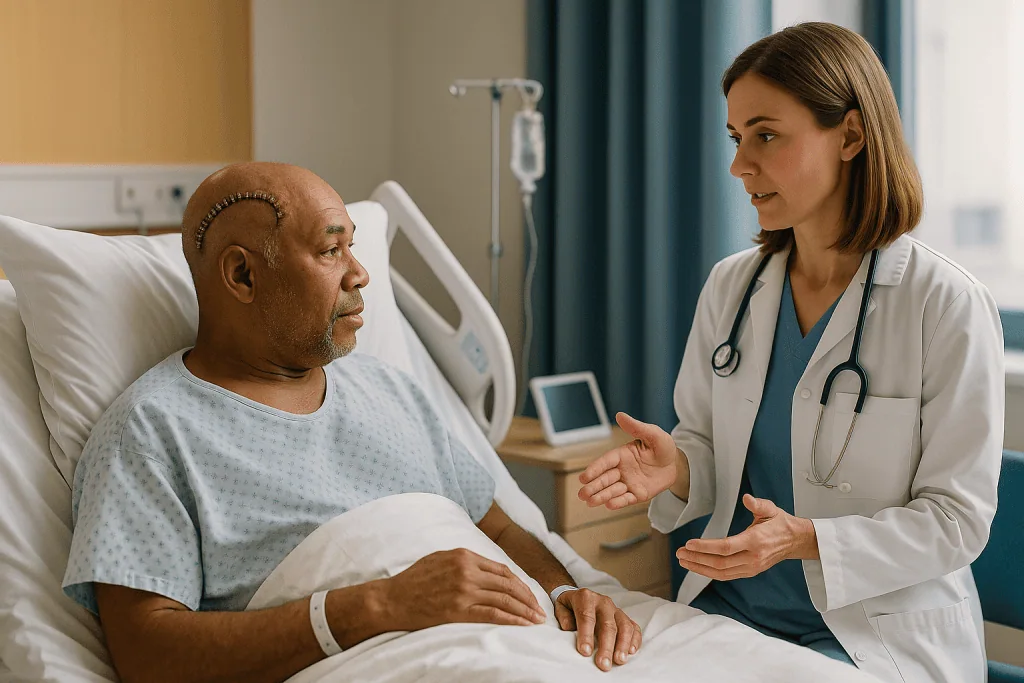
Urgency varies enormously. A person with a large clot pressing on the brain may be in theater within hours. Someone with a slow-growing benign tumor found on a scan for headaches might be scheduled weeks ahead, with time for imaging, anesthesia review and a second conversation. That difference in lead time is one reason recovery experiences vary so widely: planned surgery on a well person and emergency surgery on a critically ill one are not the same journey.
Some people are asked to wait, or offered a different route. Uncontrolled blood pressure, an active infection, a recent heart attack or blood thinners that cannot yet be safely paused can all delay a non-urgent operation. Very small or deep lesions may be watched with repeat scans, treated with focused radiation, or reached through a minimally invasive approach instead. In older adults or those with significant frailty, the team weighs whether the operation will actually improve quality of life.
Alternatives are not consolation prizes; they are part of the same decision. Radiosurgery, endovascular coiling of an aneurysm through a groin artery, medication for seizures, or observation are all legitimate options in the right circumstances. Which one fits is a judgment the treating team makes with the person in front of them, not a rule anyone can read off a page.
Craniotomy recovery time starts in the intensive care unit
Most people wake up in a recovery bay or intensive care unit rather than a normal ward. That is standard, not a sign of trouble. Johns Hopkins Medicine notes that patients are typically observed closely for the first night or two so that nurses can check neurological function frequently, often every hour at first.
Those checks are repetitive by design. A nurse shines a light in each eye, asks the date and your name, has you squeeze her fingers and push against her hand with your feet. The point is to catch the earliest hint of swelling or bleeding, which is why sleep in the first 24 hours is fragmented. Families sometimes worry when a loved one seems drowsy or muddled during this window; anesthesia, pain medicine and the brain’s own reaction to surgery all contribute, and the team expects some of it.
Tubes and lines come and go quickly. A urinary catheter, an arterial line for blood pressure and sometimes a small drain under the scalp are common on day one and often gone by day two or three. Oxygen levels, blood sugar and sodium are monitored because the brain is sensitive to all three. A follow-up CT or MRI scan within the first day or two is routine in many units to confirm the surgical result and rule out complications.
Movement starts early. Sitting on the edge of the bed, then standing with help, then walking to the bathroom often happens within the first two days when the operation has gone as planned. Early mobility lowers the risk of clots in the legs, lung infection and the muscle weakness that sets in surprisingly fast with bed rest.
How many days will I stay in hospital after a craniotomy?
MedlinePlus puts the typical stay after brain surgery at about three to seven days, and most neurosurgical units quote a similar window for a planned operation without complications. Some people leave sooner, particularly after small keyhole procedures; others stay considerably longer.
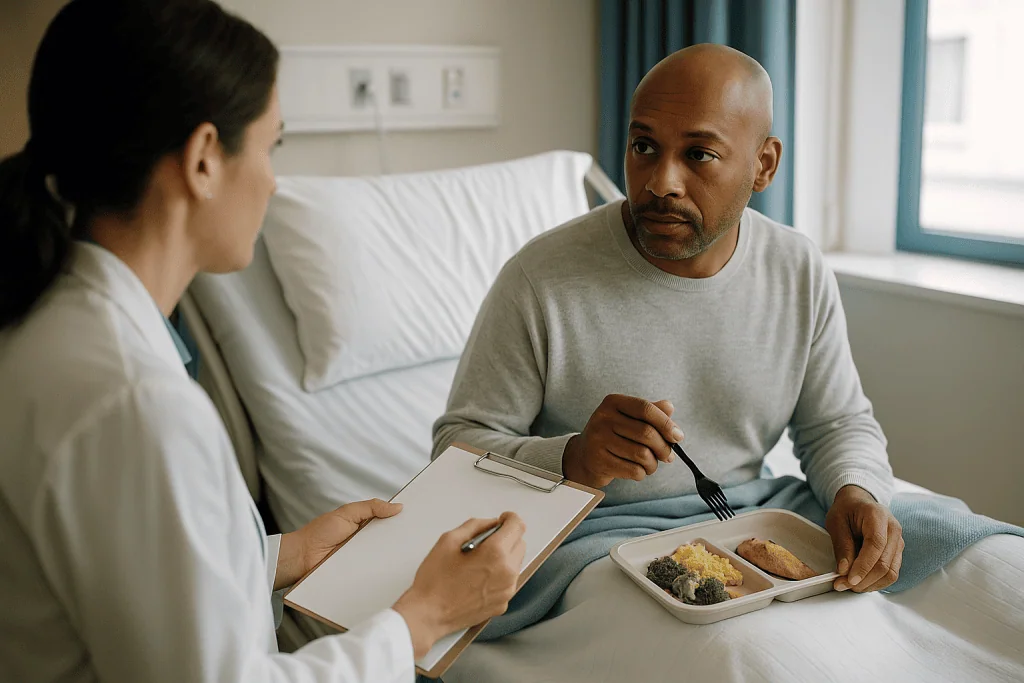
The team is not counting days so much as ticking boxes. Discharge usually requires that you are walking safely, eating and drinking, passing urine normally, managing pain with medicine you can take by mouth, and that the wound looks clean. Any new weakness, speech difficulty or confusion since surgery needs to be stable or improving. If the operation was for a tumor, the team may also want the pathology result or a plan for what comes next before you go.
What stretches the stay is usually predictable. Emergency surgery for bleeding or trauma, a post-operative seizure, swelling that needs a course of steroid medication to settle, a leak of cerebrospinal fluid from the wound, or a chest or urine infection can each add days. So can living alone, or having stairs at home and no one to help on them. Many people move to a rehabilitation unit rather than straight home if weakness, balance or speech need daily therapy.
Ask early who is coordinating discharge and what the specific criteria are for you. Hearing the plan on day one makes the wait feel purposeful rather than arbitrary, and it lets family arrange transport, time off and help at home without guessing. Being told you are staying an extra night is common and usually a sign of caution, not a setback.
Craniotomy staple removal: when, how, and what it feels like
Scalp incisions are closed with either stitches or metal staples, and the choice is largely surgeon preference. Staples are quick to place and hold the thick, well-supplied scalp tissue firmly; stitches sit flatter and are sometimes preferred along the hairline. Some surgeons use dissolvable stitches beneath the skin so nothing needs removing at all.
MedlinePlus discharge guidance describes staples or stitches being removed roughly one to two weeks after surgery, once the skin edges have knitted. This happens in a clinic, a general practice or occasionally at home by a visiting nurse, and it is faster than most people expect. Each staple is lifted with a small tool that bends it open; the sensation is a brief pinch or tug rather than sharp pain, and the scalp is often partly numb anyway because small sensory nerves are cut during the incision.
Wound care before that appointment is simple. Most teams allow gentle washing of the hair with mild shampoo after a couple of days, letting water run over the incision rather than scrubbing it, and patting dry. Ointments, hair dye, swimming and soaking the head are generally off limits until the wound is fully healed. A small amount of crusting along the line is normal; increasing redness, spreading swelling or fluid seeping through is not, and should prompt a call.
After removal, a thin scar remains and gradually fades as hair regrows over the clipped strip. Numbness, tingling or a tight, itchy feeling along the scar can persist for months as nerves recover, and a soft dip or ridge where the bone flap meets the skull is often permanently noticeable to touch but rarely to the eye.
How painful is craniotomy recovery?
Here is a fact that surprises almost everyone: the brain itself has no pain receptors. The pain after a craniotomy comes from the scalp, the muscles that were moved aside, the covering of the bone and the dura. That makes it real, but it also means it is usually more like a bad tension headache and a sore, bruised scalp than the deep agony people imagine.
The first two or three days are the worst. Headache is near universal and is often sharper when coughing, bending or lying flat. Jaw stiffness is common after operations on the side of the head because the chewing muscle sits directly under the incision; soft food and gentle jaw movement help. Swelling can track down into the face and around one eye, especially after frontal approaches, peaking around day two or three and then receding.
Pain control is a ladder rather than a single medicine. Simple pain relievers form the base, with short courses of stronger medication reserved for the early days when needed, and the team will taper these as quickly as comfort allows because stronger medicines add drowsiness, constipation and nausea, all of which slow recovery. Anti-inflammatory drugs are sometimes avoided at first because they affect bleeding, so do not add anything from the medicine cabinet without asking.
By the time staples come out, most people describe soreness and pressure rather than pain. Persistent headache beyond a few weeks is worth discussing, as is any headache that is suddenly much worse, wakes you from sleep or comes with vomiting. The prescribing clinician makes every decision about what to take and for how long; your job is to report honestly how you are doing.
Recovery after brain surgery at home: the first month
The first week at home is mostly about rest, with a purpose. Short walks several times a day, a shower with help if balance is unsteady, and the discipline of not lifting, straining or bending in ways that make the head throb. Mayo Clinic and MedlinePlus both frame this early period as one of gradual increase rather than rules that switch off on a given day.
Fatigue is the symptom people underestimate. It arrives as a wall in the early afternoon, and it does not respond to willpower. Sleep is disturbed, concentration is short, and reading a page twice becomes normal. Steroid medication, if prescribed to control swelling, can add restlessness, a ravenous appetite and mood swings, all of which ease as the course is tapered under the team’s direction. Antiseizure medicine, sometimes given for a limited period after surgery, can also cause drowsiness while the body adjusts.
Some guardrails are consistent across guidance:
- No driving until the team explicitly clears you; many countries impose a mandatory period after brain surgery, longer if a seizure has occurred.
- No alcohol while on pain or seizure medication, and none until the team says otherwise.
- No contact sports, swimming or heavy lifting until the bone flap and wound are judged healed.
- Keep the wound dry and uncovered once allowed, and watch it daily in a mirror or ask someone to check.
Follow-up typically includes a wound check for staple removal and then a clinic visit with the surgeon, often with a scan, a few weeks later. Flying is usually discouraged for the first several weeks and always needs a specific conversation, because cabin pressure changes and the difficulty of getting help at altitude both matter.
Craniotomy recovery timeline at a glance
Ranges below are drawn from patient guidance published by MedlinePlus, Mayo Clinic and Johns Hopkins Medicine. They describe a typical course after planned surgery without complications; emergency operations, large tumors, strokes or seizures shift everything to the right.
| Stage | Typical timing | What usually marks it |
|---|---|---|
| Intensive care or high-dependency observation | First one to two nights | Hourly neurological checks, early scan, lines and drains removed |
| Hospital stay | About three to seven days | Walking safely, eating, oral pain relief, wound clean |
| Staple or stitch removal | Around one to two weeks | Clinic or nurse visit; scalp often still numb |
| Return to light daily activity | Two to four weeks | Short walks, cooking, errands with company |
| Return to desk-based work | Often several weeks, individually decided | Concentration and fatigue tolerable for part days |
| Return to driving | Set by team and local law | Seizure-free period, vision and reaction time confirmed |
| Return to physical or safety-critical work | Often months | Bone flap healed, strength and balance restored |
| Feeling fully yourself | Weeks to months | Energy, sleep and thinking back to baseline |
Two features of this table deserve emphasis. Nothing in it is a deadline; the right-hand column describes the milestone, and reaching the milestone is what moves you on, not the calendar. And the later rows widen deliberately. The evidence is precise about hospital days and wound healing because those are biological processes that behave predictably. It is deliberately vague about work and normality because those depend on what your brain was asked to recover from and what your life demands of it.
Why craniotomy recovery time varies so much between people
Two people can have the same incision and utterly different recoveries, and the reason is rarely the surgeon’s skill or the patient’s grit. It is what was going on underneath.
The underlying problem matters most. A small benign tumor removed from the surface of the brain leaves a brain that was essentially normal to begin with. A large hemorrhage, a stroke, or a tumor that had already caused weakness or speech difficulty means the recovery is really about the brain repairing itself, and surgery is only the first step. Rehabilitation for those effects can run for months and is measured in function regained rather than days since the operation.
Location is the second factor. Operations near the areas that control movement, language or vision carry more risk of temporary or lasting change, and the team may plan a slower, therapy-heavy path from the outset. Deep or hard-to-reach lesions mean longer surgery and more retraction of surrounding tissue, which prolongs swelling.
Then there is the person. Age, general fitness, diabetes, smoking, previous strokes and the medications someone takes all influence healing and complication risk. Mood matters too; anxiety and low mood after brain surgery are common and slow recovery when untreated, and asking for help with them is part of getting better rather than a distraction from it.
Finally, complications reset the clock. A seizure, an infection of the wound or bone flap, a leak of cerebrospinal fluid or a blood clot in the leg each carries its own treatment and recovery period. None is expected in most people, but the possibility is why the team gives ranges rather than dates, and why comparing yourself with someone else’s story on a forum is so unreliable.
Return to work after craniotomy: what decides the date
Nobody can give you a return-to-work date at the time of surgery, and anyone who does is guessing. What the team can do is describe the factors that will decide it, and most fall into three groups.
The first is the job itself. Desk work with a flexible employer is usually the earliest realistic return, often in phased form, because it asks for concentration rather than physical strength and can pause when fatigue arrives. Roles that involve lifting, ladders, machinery or long shifts wait until the bone flap has knitted and stamina has returned, which patient guidance from Mayo Clinic and Johns Hopkins describes as weeks to months rather than a fixed figure. Safety-critical work, including professional driving, flying and some medical roles, is governed by regulators and usually requires formal clearance.
The second is how your brain is functioning. Fatigue, slowed processing, word-finding difficulty and reduced concentration are common for weeks after even a straightforward craniotomy and are the usual reason a return that looked fine on paper fails in practice. Neuropsychological assessment, occupational therapy and a graded return with reduced hours are the tools that make it work.
The third is what comes next medically. If the operation was for a tumor, radiotherapy or chemotherapy may follow, with their own fatigue and appointment schedules, and returning to work often waits until that plan is clear.
Practical steps help. Ask for a fit note or medical letter that states restrictions rather than just a date. Speak to your employer about phased hours before you feel ready, not after. And treat the first fortnight back as a trial: many people find their limits only when they hit them, and a planned step back is far easier than an unplanned collapse.
How to sleep after a craniotomy
Sleep is where recovery does much of its work, and it is also where people struggle most in the first weeks. Headache is worse lying flat, the incision is on the side you usually favor, and the medicines, the hospital routine and the sheer mental noise of what has happened all conspire against rest.
Head elevation is the single most consistent piece of advice. Sleeping with the head and shoulders raised on two or three pillows, or on a wedge, helps gravity reduce swelling and eases the pressure-type headache that peaks when you lie down. Many teams suggest this for at least the first couple of weeks, and some people find a slightly reclined position comfortable for longer.
Side of sleep is a practical question. There is no rule that you must avoid the operated side, but most people cannot bear the pressure early on and naturally roll to the other side or onto the back. A soft travel pillow or rolled towel can stop the head drifting onto the tender area during the night. If the wound weeps or the pillowcase is stained in the morning, that needs a call rather than a fresh pillowcase.
Medicines affect sleep in both directions. Steroid courses given to settle swelling are notorious for wakefulness and vivid dreams; taking them earlier in the day, if the prescribing clinician agrees, often helps. Some pain and antiseizure medicines cause drowsiness that makes daytime naps irresistible and nighttime sleep shallow. Report both patterns; the team can often adjust timing without changing the treatment.
Ordinary sleep hygiene still applies and works. Short daytime naps rather than long ones, a dark room, screens off an hour before bed, and getting daylight and a walk in the morning all help reset a body clock scrambled by a hospital stay.
Is a craniotomy a high-risk surgery?
Yes, in the plain sense that opening the skull carries more serious potential complications than most operations. That statement needs its context, though, because a craniotomy is only ever recommended when the condition being treated is itself dangerous. The comparison that matters is not surgery versus perfect health; it is surgery versus the alternative.
Mayo Clinic and Johns Hopkins list the recognized risks in similar terms. Bleeding in or around the brain, which may need a return to theater. Swelling that raises pressure inside the skull. Infection of the wound, the bone flap or, rarely, the lining of the brain. Seizures, which can occur for the first time after surgery because the brain surface has been irritated. Stroke, when a blood vessel is damaged or blocked. Leakage of cerebrospinal fluid, the clear fluid that cushions the brain, through the wound or nose. New or worsened weakness, speech, vision or memory problems depending on the area operated on. And the general risks of any long operation under anesthesia, including blood clots in the legs and lungs, chest infection and heart strain.
Some of these are temporary and expected, such as swelling and fatigue. Others are uncommon but serious, and the surgeon will have discussed the ones most relevant to your particular operation during consent. The likelihood of each depends so strongly on the location, the diagnosis and the person that a single overall percentage would be misleading, and reputable sources decline to give one.
Risk is also actively managed. Blood pressure control, antibiotics given before the incision, early walking, leg compression during surgery, careful sodium monitoring and planned imaging are all there to catch or prevent the problems above. The most useful question is not whether the operation is risky but which risks apply to you and what is being done about them.
What is the success rate of a craniotomy?
This is the most searched question about the operation, and the honest answer is that it has no single number. A craniotomy is a route into the skull, not a treatment in itself, so success means something different for every reason it is performed.
For an aneurysm, success is a clip that seals the weak spot so it cannot bleed. For a blood clot, it is relief of pressure and preservation of function. For epilepsy surgery, it is fewer or no seizures. For a tumor, the question splits again: how much was removed, what the pathology shows, whether further treatment follows, and whether the person’s symptoms and quality of life improve. Each of those has its own body of evidence, and the figures within it vary by tumor type, grade, size and location as well as by age and general health.
Beware of confident statistics presented without those qualifiers. A percentage quoted for one condition is meaningless for another, and figures lifted from a study of young, fit patients with small lesions say nothing about a different situation. Reputable patient guidance from Mayo Clinic, Johns Hopkins and MedlinePlus describes outcomes qualitatively for exactly this reason.
The productive version of the question is specific. Ask your surgeon what success would look like for your operation, how likely it is in your circumstances, what the realistic range of outcomes is, and how you will know. A good answer will include uncertainty, because uncertainty is the truth. It will also distinguish between what the operation aims to achieve on the day and what recovery afterward is expected to add, since those are separate things that people often blur together.
What people often get wrong about craniotomy recovery
Some beliefs about brain surgery are so widespread that they shape expectations before the first appointment. Most of them are wrong in ways that make recovery harder.
The first is that the whole head will be shaved. Current practice in many centers clips only a narrow strip along the incision, and hair regrows over the scar within months. Coming to terms with the actual appearance beforehand is easier than bracing for something that may not happen.
The second is that the skull is left open or weakened. In a craniotomy the bone is replaced and fixed with small plates that become permanent; once healed, the flap is not a fragile patch. People imagine needing to protect the area for life, when in reality most return to ordinary activities, and only certain contact sports need discussion.
The third is that a good operation means a quick recovery. Surgery can go perfectly and fatigue, headache and slow thinking can still last for weeks, because the brain responds to any handling with swelling and a period of reduced efficiency. Feeling unwell in week three is not evidence that something was missed.
The fourth is that rest means bed. Prolonged lying down increases clot risk, weakens muscles and worsens low mood; gentle daily walking is part of the treatment, not a departure from it.
The fifth is that personality changes are inevitable. They are possible after operations in some regions and after large hemorrhages, and irritability and tearfulness are common early on, but the sweeping transformation of popular fiction is the exception.
The last is that recovery is finished when the surgeon signs you off. For many people the surgical wound heals long before energy, concentration and confidence do, and the later, slower part of recovery deserves as much patience as the first week.
Questions to ask your care team
The consultation before surgery is often short and dense, and the questions that matter surface afterward at the kitchen table. Bringing a written list, and someone to take notes, changes the quality of the answers. These are the ones patients most often wish they had asked.
- What exactly is this operation aiming to achieve, and what would you consider a good result in my case?
- Which specific risks apply to the area you will be working in, and what will you do to reduce them?
- Will any part of my head be shaved, and how will the incision be closed?
- How long do you expect me to be in intensive care, and then in hospital, if things go to plan?
- Who removes the staples or stitches, when, and where?
- Which of my current medicines need to stop before surgery, and when do they restart?
- Will I need steroid or antiseizure medication afterward, and for roughly how long?
- What is the plan if the pathology or scan shows something unexpected?
- When can I shower, wash my hair, drive, fly and lift?
- What kind of work do I do, and given that, what is your realistic expectation for return?
- Who do I call, day or night, if I am worried at home, and what should make me call immediately?
- Will I have physiotherapy, occupational therapy or speech therapy, and how is that arranged?
- When is my first follow-up, and will there be a scan?
Answers will differ between people with the same diagnosis, and that is expected. What you are looking for is a team that explains the reasoning behind each answer and is comfortable saying when something is uncertain.
When to call your doctor
Most of craniotomy recovery is uneventful in the medical sense, but the complications that do occur tend to announce themselves, and the window for acting on them is often short. MedlinePlus discharge guidance and Mayo Clinic list a consistent set of warning signs, and the rule is simple: if you are unsure, call.
Seek emergency care immediately, by calling your local emergency number, for any of the following:
- A seizure, whether or not you have had one before.
- Sudden new weakness or numbness in the face, arm or leg, or a drooping face.
- New difficulty speaking, understanding speech or finding words.
- Sudden severe headache, or a headache that is rapidly worsening and unlike your post-surgical pain.
- Increasing drowsiness, confusion or difficulty waking the person.
- Repeated vomiting, a stiff neck with fever, or new sensitivity to light.
- Sudden loss of vision or double vision.
- Chest pain, breathlessness, or a swollen, painful calf, which can signal a blood clot.
Contact the neurosurgical team or your doctor the same day for:
- Fever, or chills and shivering.
- Redness spreading from the wound, increasing swelling, warmth, or pus.
- Clear or watery fluid leaking from the wound, or a persistent salty drip from the nose or down the throat, which may be cerebrospinal fluid.
- The wound edges opening or a staple pulling free.
- Persistent nausea preventing you from taking medicines or fluids.
- Low mood, anxiety or thoughts of self-harm that are frightening you or your family.
None of these lists replaces the judgment of the people who operated on you. They know what your brain looked like on the table and on the scan, and they would far rather hear from you about a symptom that turns out to be nothing than not hear about one that is not.
Frequently asked questions
How long does craniotomy recovery time usually take overall?
Most people are in hospital for roughly three to seven days, have staples or stitches removed at one to two weeks, and need several weeks to a few months to feel back to normal, according to MedlinePlus and Mayo Clinic guidance. Physically demanding work and full energy often take longer. The exact timeline depends on why the surgery was done and how the brain was affected beforehand, so the treating team sets individual expectations.
What is the success rate of a craniotomy?
There is no single success rate, because a craniotomy is a way of reaching the brain rather than a treatment in itself. Outcomes depend on the condition being treated, its size and location, the person’s age and health, and what treatment follows. Reputable guidance describes outcomes qualitatively for this reason. Ask your surgeon what success would look like in your specific case and how likely it is.
How painful is craniotomy recovery?
The first two or three days usually bring a significant headache, a sore scalp and sometimes jaw stiffness or facial swelling, all of which ease steadily over the first week or two. Because the brain has no pain receptors, the discomfort comes from scalp and muscle rather than deep inside. Pain is managed with a ladder of medicines chosen by the prescribing clinician, tapering quickly to simple pain relievers in most people.
Is a craniotomy a high-risk surgery?
It carries more serious potential complications than most operations, including bleeding, swelling, infection, seizures, stroke and fluid leaks, as Mayo Clinic and Johns Hopkins Medicine describe. It is only recommended when the condition being treated poses a greater danger than the surgery. Individual risk depends on the location and reason for the operation, so ask which risks apply to you and how the team reduces them.
When does craniotomy staple removal happen?
Staples or stitches are usually removed around one to two weeks after surgery, once the skin edges have healed, in a clinic, family practice or by a visiting nurse. The scalp is often partly numb at that stage, so most people feel a brief pinch or tug rather than pain. Some surgeons use dissolvable stitches under the skin instead, in which case nothing needs removing.
What does recovery after brain surgery look like in the first month at home?
The first month is dominated by fatigue, disturbed sleep, headache that gradually eases and short concentration. Gentle daily walking is encouraged, while driving, heavy lifting, alcohol, swimming and contact sports are generally paused until the team clears them. Steroid or antiseizure medicines, if prescribed, may add side effects that fade as they are tapered. Follow-up usually includes wound care and a surgeon visit, often with a scan.
When is return to work after craniotomy realistic?
It depends on the job, how your brain is functioning and whether further treatment follows. Desk-based work is often possible after several weeks in a phased way, while physical or safety-critical roles frequently wait months until the bone flap is healed and stamina has returned. Patient guidance frames this as individually decided rather than a fixed figure. Ask for a letter stating restrictions and plan a graded return with your employer.
What is the best position for sleeping after craniotomy?
Sleeping with the head and shoulders raised on pillows or a wedge helps reduce swelling and the pressure-type headache that worsens lying flat, and many teams suggest this for at least the first couple of weeks. Most people avoid lying on the operated side early on because it is tender. A rolled towel or travel pillow can stop the head drifting onto the incision. Report any overnight wound leakage rather than ignoring it.
Can I drive or fly after a craniotomy?
Not until the neurosurgical team clears you. Many countries set a mandatory no-driving period after brain surgery, longer if a seizure has occurred, and your team will explain what applies where you live. Flying is generally discouraged for the first several weeks because of pressure changes and the difficulty of getting help in the air, and it should always be discussed individually, along with clot-prevention measures such as walking and hydration.
Will my hair grow back and will the scar show?
Hair regrows over the clipped strip within months in most people, and a thin scar gradually fades and is usually hidden once hair returns. A small dip or ridge where the bone flap meets the skull is often noticeable to touch but rarely visible. Numbness, tingling or itching along the scar can persist for months as small scalp nerves recover, and this is expected rather than a sign of a problem.
References
This article is for general information only and is not a substitute for professional medical advice. Please consult a qualified doctor about your individual situation.

More from the Blog

Second Opinions in Neurodegenerative Diseases: When a Diagnosis Deserves Another Look
A neurodegenerative disease second opinion is a fresh review of your history, examination and test results by another neurologist, often one who focuses on…

Neuroinfectious Diseases Treatment: How Meningitis and Encephalitis Care Is Planned
A meningitis encephalitis treatment plan starts within minutes of suspicion, usually before tests confirm the cause. Doctors give intravenous antibiotics, and often an antiviral,…

Who May Be a Candidate for Peripheral Nerve Surgery? Injury, Compression and Tumor Cases
Peripheral nerve surgery is considered for three groups: people with a nerve that has been cut, torn or crushed and shows no sign of…

Can You Keep Working With Multiple Sclerosis? Fatigue, Heat and Pacing Strategies Explained
Many people with multiple sclerosis continue working, often for years, though the path varies with symptoms, job demands and disease course. Fatigue and heat…

Can Home and Work Routines Be Adapted in Motor Neuron Disease? Mobility Aids, Meals and Rest
Yes. Most people with motor neuron disease can adapt home and work routines for a considerable time by pacing activity, changing how meals are…

Questions to Ask Before Agreeing to a Cerebrovascular Disease Treatment Plan
Before agreeing to a cerebrovascular disease treatment plan, ask what the imaging showed (clot, bleed, narrowing or small vessel damage), why this option was…