Epilepsy Surgery
Epilepsy surgery covers a range of brain operations for people whose seizures are not controlled by medication. Options include removing the seizure focus, as in temporal lobectomy, disconnecting pathways that spread seizures,…

Quick answer
Epilepsy surgery is an operation on the brain used when seizures continue despite medication. It may remove the small area where seizures begin, such as in a temporal lobectomy, disconnect pathways that spread seizures, or implant a stimulation device. A detailed evaluation identifies the seizure focus first, and outcomes depend on the epilepsy type.
What is epilepsy surgery?
Epilepsy surgery is an operation on the brain that aims to stop or reduce seizures in people whose epilepsy has not been controlled by medication. Epilepsy is a condition in which bursts of abnormal electrical activity in the brain cause repeated seizures. A seizure is a sudden change in behavior, movement, sensation, or awareness caused by that abnormal activity.
Brain surgery for epilepsy is not one single procedure. It is a group of surgical treatments chosen according to where seizures start and what the surrounding brain tissue does. The main approaches are:
- Resective surgery – removing the small area of brain tissue where seizures begin, called the seizure focus. The most common example is a temporal lobectomy, in which part of the temporal lobe (the region of the brain near the temple that handles memory and language processing) is removed.
- Disconnection surgery – cutting nerve pathways so that seizure activity cannot spread. Examples include corpus callosotomy (dividing the band of fibers that connects the two halves of the brain) and hemispherotomy (disconnecting one side of the brain in severe childhood epilepsy).
- Minimally invasive ablation – destroying the seizure focus with heat delivered through a thin probe, guided by imaging, without a large opening in the skull. Laser interstitial thermal therapy is one such technique.
- Neurostimulation – implanting a device that sends electrical pulses to the nervous system to reduce seizure frequency. Examples include vagus nerve stimulation, deep brain stimulation, and responsive neurostimulation. These do not remove tissue and are usually considered when resection is not possible.
Surgery for epilepsy is most often used for focal epilepsy, meaning seizures that start in one identifiable part of the brain. Common underlying causes include scarring in the temporal lobe (mesial temporal sclerosis), small areas of abnormally developed brain tissue (cortical dysplasia), benign tumors, and blood vessel malformations such as cavernous malformations.
Who is a candidate
Doctors generally consider epilepsy surgery when a person has drug-resistant epilepsy. This is usually defined as seizures that continue despite trying at least two appropriate anti-seizure medications at adequate doses. Many people who reach this point continue to have seizures no matter how many more medications are added, so an evaluation for surgery is often recommended earlier rather than later.
Someone may be a good candidate when:
- Seizures start in one clearly identified area of the brain that can be seen on imaging and confirmed with brain-wave recordings.
- That area can be removed or disconnected without unacceptable harm to speech, movement, vision, or memory.
- Seizures significantly affect daily life, safety, work, schooling, or independence.
- The person, or their family in the case of children, understands the goals, risks, and limits of the operation.
Surgery is usually not suitable, or is approached differently, when:
- Seizures start in several separate areas of the brain at the same time, which makes a single target difficult to define.
- The seizure focus overlaps with brain regions essential for language or movement. In this situation, neurostimulation or a disconnection procedure may be discussed instead of removal.
- The seizures are not actually epileptic. Some events that look like seizures have other causes, and part of the evaluation is to confirm the diagnosis.
- Serious other medical conditions make a long operation under general anesthesia unsafe.
- Medication has not yet been tried properly, or the diagnosis of epilepsy type is still uncertain.
Children can be candidates, and in some severe childhood epilepsies, early surgery is considered because ongoing seizures can interfere with development.
How the procedure works
Before surgery: the evaluation phase. Epilepsy surgery is preceded by a detailed assessment, often called a presurgical evaluation, carried out by a team that typically includes a neurologist specializing in epilepsy, a neurosurgeon, a neuropsychologist, and a neuroradiologist. The purpose is to find exactly where seizures begin and to map the brain functions nearby. Common tests include:
- Video-EEG monitoring – staying in hospital for several days while brain-wave activity (EEG, or electroencephalogram) and video are recorded continuously, so that seizures can be captured and analyzed.
- High-resolution MRI – detailed magnetic imaging of the brain to look for structural causes.
- PET or SPECT scans – imaging that shows how different brain regions use energy or receive blood flow, which can point to the seizure focus.
- Neuropsychological testing – tests of memory, language, and thinking that help predict how surgery might affect these functions.
- Functional MRI or language testing – to locate areas responsible for speech and movement.
If these tests do not agree, or the focus is close to important brain areas, doctors may recommend invasive monitoring. Thin electrodes are placed directly on or into the brain through small openings in the skull, and the person is monitored for days to a couple of weeks until the seizure origin is pinpointed. This is a separate stage before the final operation.
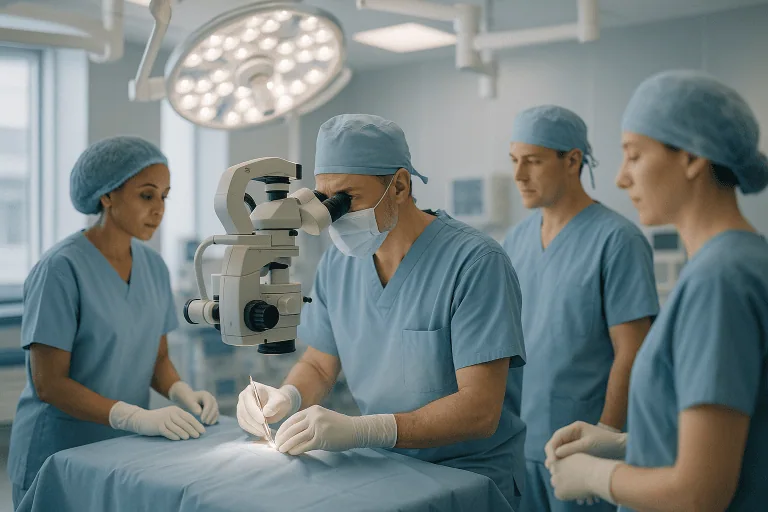
During surgery. Most epilepsy operations are performed under general anesthesia, meaning you are fully asleep. The surgeon makes an incision in the scalp and removes a section of skull bone (a craniotomy) to reach the brain. Using the map created during evaluation, along with navigation systems and sometimes electrical recordings taken in the operating room, the surgeon removes or disconnects the targeted tissue. In some cases part of the operation is done while the patient is awake and speaking, so that language areas can be tested directly; this is called awake mapping and is used when the focus lies near speech regions. The bone is then replaced and fixed with small plates, and the scalp is closed. A typical resective procedure lasts several hours.
Minimally invasive ablation uses a small opening rather than a craniotomy. A thin fiber is guided into the target under MRI, and the tissue is heated in a controlled way while the surgeon watches on the scan. Neurostimulation implants involve placing electrodes and a small battery-powered generator, usually under the skin of the chest or scalp.
After surgery. You are moved to an intensive care or high-dependency unit for close observation for the first night or longer, and then to a regular ward. Anti-seizure medication is continued, and pain, swelling, and wound healing are monitored.
Preparation for epilepsy surgery
Preparation begins well before the day of the operation. Your team will review all your medications, including anti-seizure drugs, blood thinners, and supplements, and tell you which to continue and which to pause. Do not stop epilepsy medication on your own; any changes are made under medical supervision.
Practical steps that are commonly advised include:
- Completing all required blood tests, heart checks, and imaging so that anesthesia can be planned safely.
- Stopping smoking, which helps wound healing and lowers anesthesia risk.
- Fasting from food and drink for the number of hours your anesthesia team specifies.
- Arranging time off work or school and someone to help at home in the first weeks after discharge.
- Washing your hair with the antiseptic shampoo you may be given, and avoiding hair products on the morning of surgery. Only a small strip of hair is usually shaved.
- Bringing a list of your seizure types and triggers, and a family member who has witnessed your seizures, to the final consultation.
It is also helpful to discuss realistic expectations with your team, including whether the goal is complete seizure freedom or a reduction in seizure frequency, and what would happen if seizures continue afterward.
Recovery and aftercare
Epilepsy surgery recovery varies with the type of operation, age, and general health. Typical patterns are described below, but your own timeline may differ.
- Hospital stay: after a craniotomy such as a temporal lobectomy, many patients stay in hospital for around three to seven nights. Minimally invasive ablation and stimulator implantation often involve a shorter stay.
- First two weeks: headache, fatigue, scalp numbness, jaw stiffness when chewing, and mild swelling around the eye on the operated side are common and usually improve gradually. Pain is typically managed with simple analgesics. Stitches or staples are often removed after about one to two weeks.
- Weeks two to six: energy levels return slowly. Light walking is encouraged; heavy lifting, contact sports, and strenuous exercise are usually avoided until the surgeon confirms the bone has healed.
- Return to activities: many patients return to school or desk work within about four to eight weeks, though concentration and stamina may take longer to normalize. Return to work should be discussed with your team.
- Driving: laws vary by country and region, and most require a seizure-free period before driving is allowed. Surgery itself does not automatically restore a license.
Anti-seizure medication is generally continued unchanged for at least the first year after surgery, even if seizures have stopped. If you remain seizure-free, your neurologist may then discuss slowly reducing medication, but this is done cautiously and not everyone is able to stop completely.
Follow-up usually includes wound checks, a postoperative MRI, repeat EEG, and neuropsychological testing some months after surgery to assess memory and language. Emotional changes such as low mood or anxiety can occur in the months after surgery, even when seizures improve, and should be raised with your team so that support can be arranged.
Risks and side effects
All brain surgery carries risk, and the specific risks depend on the location of the operation. Your surgical team will explain the risks that apply to you. In general, possible complications include:
- Infection of the wound, bone, or the fluid around the brain (meningitis).
- Bleeding inside the skull, which may occasionally require a second operation.
- Stroke from injury to a blood vessel, which can cause weakness, numbness, or speech difficulty.
- Memory and language changes. Temporal lobectomy can affect verbal memory, particularly when surgery is on the side of the brain that handles language. Word-finding difficulty may occur and often improves over time but can be lasting.
- Visual field defects. Removing part of the temporal lobe can cut nerve fibers that carry vision, leading to a blind spot in the upper outer part of vision on the opposite side. Many people do not notice this in daily life, but it can affect eligibility to drive in some places.
- Mood changes, including depression or anxiety, and less commonly psychosis, in the months after surgery.
- Continued seizures. Surgery does not stop seizures in everyone, and seizures can sometimes return after an initial seizure-free period.
- Anesthesia-related complications, blood clots, and pneumonia, as with any major operation.
Device-based procedures carry their own risks, such as hoarseness or cough with vagus nerve stimulation, device infection, lead problems, and the need for battery replacement over time.
It is important to weigh these risks against the risks of ongoing uncontrolled seizures, which include injury, drowning, effects on memory and mood, and a rare but serious condition called sudden unexpected death in epilepsy (SUDEP). For many people with drug-resistant focal epilepsy, this balance favors surgery, but the decision is individual.
Results and outlook
The epilepsy surgery success rate depends heavily on the type of epilepsy, the cause, and how precisely the seizure focus was identified. Results are usually described in terms of seizure freedom, meaning no disabling seizures, or worthwhile reduction in seizure frequency.
The evidence generally shows that:
- Temporal lobectomy for mesial temporal sclerosis has the most consistent track record, and a majority of well-selected patients become free of disabling seizures. Randomized studies have found surgery to be more effective than continued medication alone in this group.
- Surgery for a clearly visible single lesion, such as a small benign tumor or cavernous malformation, also tends to have favorable outcomes when the lesion and the seizure focus match.
- Outcomes are generally less predictable when no lesion is seen on MRI, when seizures start outside the temporal lobe, or when the focus is close to essential brain functions.
- Disconnection procedures such as corpus callosotomy are usually aimed at reducing dangerous drop attacks rather than achieving complete seizure freedom.
- Neurostimulation typically reduces seizure frequency over time rather than eliminating seizures, and its effect often builds over months to years.
Some people who become seizure-free have a recurrence years later, so long-term follow-up is important. Even when seizures are not completely eliminated, a large reduction in frequency or severity can meaningfully improve safety, independence, and quality of life. Your team can give you a personalized estimate based on your own findings; general figures do not predict individual outcomes.
Cost considerations
The cost of epilepsy surgery varies widely between health systems and depends on several components rather than a single fee. Factors that usually drive the total include:
- The presurgical evaluation, which may involve several days of inpatient video-EEG monitoring, advanced imaging, and neuropsychological testing, sometimes spread over more than one admission.
- Whether invasive monitoring with implanted electrodes is required, which adds a separate operation and hospital stay.
- The type of operation: open resection, laser ablation, or an implanted stimulation device, each with different equipment and theater time.
- Implants and devices, including the generator and leads for neurostimulation and later battery replacements.
- The length of hospital stay, including time in intensive care.
- Follow-up care, such as postoperative MRI, EEG, neuropsychology reviews, and ongoing medication.
Insurance coverage, public health funding, and eligibility rules differ by country and plan, so it is sensible to ask for a written breakdown of what is included before the evaluation begins. In hospital groups such as Acibadem, epilepsy surgery is managed within the neurosurgery department in collaboration with neurology, and cost estimates are usually prepared after the evaluation clarifies which procedure is appropriate.
Frequently asked questions
What is the epilepsy surgery success rate?
There is no single figure that applies to everyone. Success is usually measured as freedom from disabling seizures, and the likelihood depends on the type of epilepsy, whether a lesion is visible on MRI, and where the focus lies. Temporal lobectomy for scarring in the temporal lobe generally has the most favorable and consistent results, while outcomes for other types are more variable. Your epilepsy team can give an estimate based on your own test results.
How long is epilepsy surgery recovery?
After a craniotomy, many patients spend several nights in hospital and then recover at home for several weeks. Fatigue and headaches usually ease over the first month, and many people return to school or office work within about four to eight weeks. Full recovery, including concentration and stamina, can take longer. Minimally invasive procedures often have a shorter recovery period.
Is brain surgery for epilepsy safe?
Epilepsy surgery is a major operation and carries real risks, including infection, bleeding, stroke, and changes in memory, language, or vision. Serious permanent complications are uncommon in experienced centers, and the detailed presurgical evaluation is designed to lower these risks. Doctors weigh the risks of surgery against the ongoing risks of uncontrolled seizures when advising each patient.
Will I be able to stop taking medication after surgery for epilepsy?
Not necessarily. Anti-seizure medication is usually continued for at least a year after surgery, even if seizures have stopped. If you remain seizure-free, your neurologist may then discuss a gradual reduction. Some people are eventually able to stop medication, while others continue on a lower dose or the same regimen to maintain seizure control.
What does a temporal lobectomy involve?
A temporal lobectomy removes part of the temporal lobe, most often the inner structures involved in memory, such as the hippocampus and amygdala, on the side where seizures start. It is performed under general anesthesia through an opening in the skull and typically takes several hours. Because this area contributes to memory, testing before surgery helps predict and limit memory effects.
Can children have epilepsy surgery?
Yes. Children with drug-resistant focal epilepsy can be evaluated for surgery, and in some severe childhood epilepsies, operating early is considered because ongoing seizures can interfere with learning and development. The evaluation and procedures are adapted to the child’s age and are managed by pediatric epilepsy teams.
What happens if seizures come back after surgery?
Some people have a return of seizures months or years after an initially successful operation. If this happens, your team will reassess with EEG and imaging. Options may include adjusting medication, further evaluation for a second procedure, or neurostimulation. A recurrence does not mean the first surgery was pointless, since seizure frequency is often still lower than before.
When to see a doctor
You should ask for a referral to a neurologist who specializes in epilepsy, ideally at a center that performs epilepsy surgery, if:
- You continue to have seizures despite trying two or more anti-seizure medications at appropriate doses.
- Your seizures cause injuries, falls, or loss of awareness that affects safety at home, work, or school.
- Medication side effects are limiting your daily life even though seizures are partly controlled.
- An MRI has shown a lesion, scarring, or abnormal tissue that may be linked to your seizures.
- You have been told your epilepsy is drug-resistant but have never been assessed for surgical options.
After epilepsy surgery, seek urgent medical attention if you notice any of the following:
- A seizure that lasts longer than five minutes, or repeated seizures without recovering in between.
- Fever, chills, or a stiff neck, which can indicate infection.
- Redness, swelling, leaking fluid, or opening of the wound.
- New or worsening weakness, numbness, difficulty speaking, confusion, or drowsiness.
- A severe headache that is not relieved by prescribed pain medication, or headache with vomiting.
- Sudden loss of vision or new visual disturbance.
- Calf pain or swelling, chest pain, or shortness of breath, which may suggest a blood clot.
- Thoughts of self-harm or a marked change in mood after surgery.
These symptoms do not always mean something serious, but they should be assessed promptly by a doctor because early treatment of complications leads to better outcomes.
Preparation
- Complete the full presurgical evaluation, including video-EEG monitoring, MRI, and neuropsychological testing, so the surgical target is clearly defined. Review all medications with your team and continue anti-seizure drugs exactly as instructed unless told otherwise. Stop smoking, follow fasting instructions before anesthesia, and arrange time off and help at home for the first weeks after discharge.
Aftercare
- Expect headache, fatigue, and scalp numbness in the first weeks, and avoid heavy lifting or contact sports until your surgeon confirms healing. Continue anti-seizure medication unchanged for at least the first year unless your neurologist advises a gradual reduction. Attend follow-up visits for wound checks, postoperative MRI and EEG, and neuropsychological review, and report fever, wound problems, new weakness, or prolonged seizures promptly.
Medically reviewed by the Acıbadem International Medical Board September 8, 2026
See our medical review board →
Update history
- PublishedSeptember 8, 2026
- Medical review approvedSeptember 8, 2026
- Last content updateSeptember 8, 2026
References3
From the Acibadem Blog

What Epilepsy Surgery Results Usually Look Like and Why Medicines Continue Afterward
Epilepsy surgery outcomes are usually described in stages rather than as one verdict: an early period when the brain settles, a first-year review, and…