

What Epilepsy Surgery Results Usually Look Like and Why Medicines Continue Afterward

Key Takeaways
- Epilepsy surgery outcomes are assessed at fixed review points, commonly an early wound check, a review within months, a formal one-year assessment and then annual follow-up, rather than declared on the day.
- Seizures in the first days after surgery are usually interpreted as a sign of an irritated, healing brain and are weighed differently from a recurrence after months of seizure freedom.
- Antiseizure medicines act across the whole brain, not just the removed focus, which is one reason they continue for a year or more so the surrounding networks can settle.
- The World Health Organization notes that even with medicine-only treatment, withdrawal is generally considered only after two to five years seizure-free, a timescale that shapes post-surgical thinking too.
- The Engel classification separates freedom from disabling seizures (Class I) from worthwhile improvement (Class III), and both can transform daily life even though only one is called seizure freedom.
- Memory and mood are formal outcome measures after temporal lobe surgery, and pre-operative neuropsychology testing exists specifically to predict and reduce those trade-offs.
Epilepsy surgery outcomes are usually described in stages rather than as one verdict: an early period when the brain settles, a first-year review, and longer follow-up where seizure freedom, seizure reduction, thinking, mood and daily function are all assessed. Antiseizure medicines almost always continue afterward, typically for a year or more, because the brain needs time to stabilize and the care team needs a clear picture before any taper is considered.
The night before the operation, a woman in her thirties sits on the edge of a hospital bed and asks the question her surgeon has heard hundreds of times: if you take out the part of my brain that causes this, why will I still be swallowing tablets in six months? It is a fair question. She has done everything asked of her, tried medicine after medicine, kept the seizure diary, sat through days of wired-up video monitoring. Surgery was supposed to be the finish line.
It is closer to a bend in the road. Understanding epilepsy surgery outcomes means letting go of the idea of a single result and thinking instead about a sequence: what happens in the first weeks, what the first year tells the team, and how things look years later. Medicines belong to that sequence, not to the past it replaces.
This article walks through what the procedures actually do, how results are measured, why the prescription continues, and what the honest evidence says about the long view.
Why epilepsy surgery outcomes are described in stages, not a single verdict
Ask a neurosurgeon how an operation went and you will often hear a careful answer: the procedure itself went as planned, and now we wait. That is not evasion. Epilepsy surgery outcomes unfold across time in a way that is different from, say, repairing a hernia, where the result is largely known once the wound heals.
Three clocks run at once. The first is surgical recovery, measured in days and weeks: the incision, swelling, headache, fatigue and the slow return of normal sleep. The second is the neurological settling period, measured in months, during which the brain adapts to tissue being removed or disconnected. Seizures in this window do not carry the same meaning as seizures a year later. The third clock is the long-term one, measured in years, and it is the one that answers the question most people are really asking: has my epilepsy been brought under control, and will it stay that way?
Because of this, clinicians tend to speak in review points rather than pronouncements. A common structure, reflected in Mayo Clinic and NHS descriptions of care after surgery, is an early wound check, a review within the first few months, a formal assessment around one year, and then annual visits that track seizure frequency, medication, mood, memory and quality of life.
The practical upshot is worth saying plainly. A good early period is encouraging but not conclusive. A rough early period, including a seizure in the first week or two, is not automatically a failure. The people who cope best with this phase are usually the ones who were told in advance that the result is a story told over time, and who agreed with their team on when each chapter would be read.
How epilepsy surgery actually works in plain language
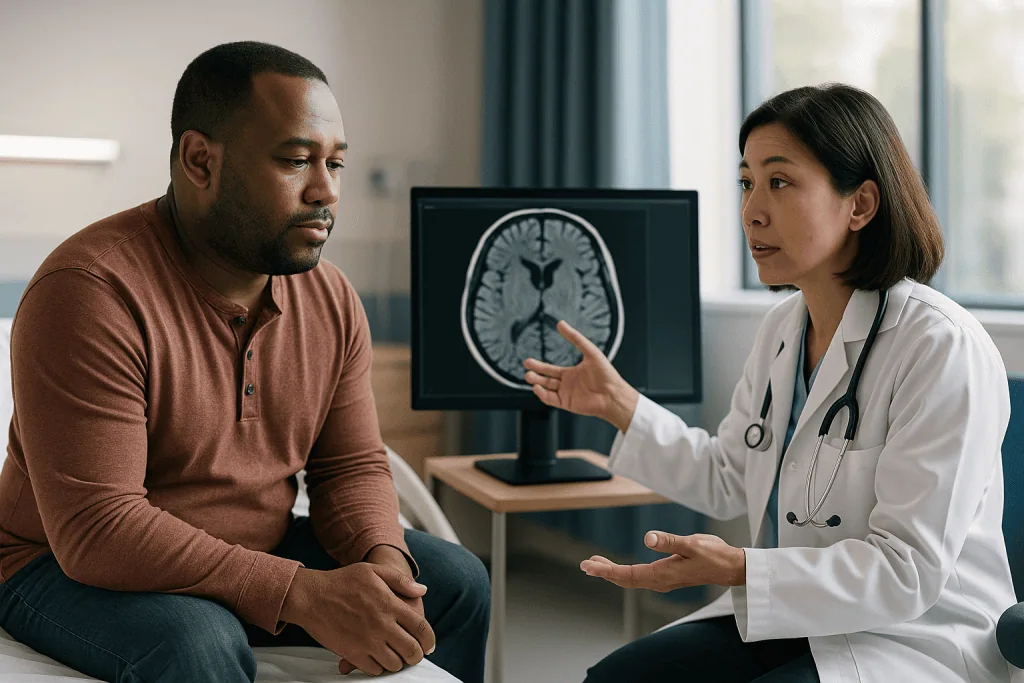
Most epilepsy surgery rests on one idea. In many people with focal epilepsy, seizures begin in a specific, identifiable patch of brain tissue called the seizure focus. If that patch can be safely removed, destroyed or disconnected from the rest of the brain, the seizures may stop or become much less frequent. The National Institute of Neurological Disorders and Stroke (NINDS) describes this as the core rationale for the resective approaches that make up the largest share of procedures.
The main families of operation are:
- Resection, meaning removal of the focus. The temporal lobe, the region behind the temple involved in memory and emotion, is the most common site, because temporal lobe epilepsy is both common and often well localized.
- Laser ablation, in which a thin probe is guided through a small opening in the skull and heat is used to destroy a precisely targeted area while MRI monitors the temperature. MRI is a scan that uses magnetic fields to build detailed pictures of soft tissue.
- Disconnection procedures, such as corpus callosotomy, which cuts some of the fibers linking the two halves of the brain to stop certain seizures spreading, and hemispherotomy, which disconnects a badly damaged half of the brain, usually in young children.
- Neuromodulation, meaning implanted devices that deliver mild electrical pulses to nerves or brain regions to reduce seizure activity. Vagus nerve stimulation is the longest-established example; it does not remove tissue and is usually aimed at reducing rather than eliminating seizures.
Which of these fits a particular person depends on where the focus sits, how confidently it can be located, and what that tissue normally does. Removing a focus that overlaps with language or hand movement is a very different proposition from removing one in a quieter area, and that difference drives much of the outcome conversation.
Who is usually offered epilepsy surgery, and who is asked to wait
Surgery is not the first line of treatment and, for most people with epilepsy, it never becomes relevant. The World Health Organization estimates that up to 70% of people living with epilepsy could become seizure-free with appropriate antiseizure medicines. Surgery is considered for a subset of the remaining group, those whose epilepsy is described as drug-resistant. That term has a specific meaning: seizures that continue despite adequate trials of at least two appropriately chosen and well-tolerated antiseizure medicines, as the NHS and Mayo Clinic both describe.
Meeting that definition opens the door to evaluation, not to an operating slot. The pre-surgical work-up is long and deliberate. Video EEG monitoring, which records brain electrical activity alongside a camera feed while medicines are sometimes reduced to capture typical seizures, helps show where seizures begin. High-resolution MRI looks for a structural cause such as scarring in the hippocampus, a small memory structure in the temporal lobe, or a patch of abnormally formed cortex. Neuropsychological testing maps memory and language so that the team can predict what removing a given area might cost.
People are usually asked to wait, or steered toward other options, when:
- seizures appear to arise from more than one area, or from a network too diffuse to target;
- the focus overlaps with tissue essential for speech, movement or memory;
- the diagnosis itself is uncertain, for example when events may not be epileptic at all;
- a further medicine trial or a change in an existing one has not yet been properly attempted.
Age alone is not usually a barrier. Children with clearly localized epilepsy are often evaluated early, because uncontrolled seizures can interfere with development, and older adults are considered on the basis of overall health rather than a birth year. The deciding voice throughout is the multidisciplinary team: neurologist, neurosurgeon, neuropsychologist and radiologist, weighing your scans and your goals together.
What seizure-free really means: how outcomes are classified
The phrase seizure-free hides more nuance than most people expect. Someone who has had no disabling seizures but still notices brief auras, the warning sensations that can precede a seizure, may be classed as seizure-free in one system and not in another. Because of this, specialists use structured outcome scales rather than a yes-or-no label. The most widely quoted is the Engel classification, which groups results into four broad classes, and the International League Against Epilepsy has a similar scheme that tracks yearly seizure counts more finely.

| Outcome class (Engel, simplified) | What it usually describes | Why it matters for medicine decisions |
|---|---|---|
| Class I | Free of disabling seizures; auras alone may still occur | The group in which a supervised taper is most likely to be discussed, usually after a year or more |
| Class II | Rare disabling seizures, sometimes described as almost seizure-free | Medicines almost always continue; the team may adjust rather than withdraw |
| Class III | Worthwhile improvement in frequency or severity | Surgery has helped, but ongoing treatment remains the foundation |
| Class IV | No worthwhile improvement | Prompts a fresh review: further imaging, another procedure, or neuromodulation |
Two features of this table deserve emphasis. Class I is not the same as having no epilepsy; it is a description of a period of time, usually the most recent year, and it is reassessed at every visit. And classes II and III are not consolation prizes. For someone who has gone from weekly convulsive seizures to two a year, the change in daily life, driving prospects and injury risk can be enormous even though the word freedom does not apply.
When your team reports an outcome, it is reasonable to ask which scale they are using and over what period. That single question tends to make the numbers you read elsewhere far easier to interpret.
Seizures after epilepsy surgery: early events versus true recurrence
A seizure in the first days after surgery lands hard. People often describe it as the moment the whole plan seemed to collapse. Clinically, though, early seizures and later recurrence are treated as different phenomena, and the distinction shapes how the team responds.
In the immediate post-operative period the brain is irritated. There is swelling, a small amount of blood around the operative site, disturbed sleep, pain, and often a temporary change in how medicines are absorbed or timed around the procedure. Any of these can lower the seizure threshold, the level of provocation at which a seizure is triggered. Seizures in this window are sometimes called acute post-operative seizures, and while they are not ignored, many teams do not count them in the same way when judging whether the operation achieved its aim. Your neurologist will usually want to know whether the event looked like your old seizures or something different, since a new pattern can suggest irritation rather than the original focus.
Recurrence later, particularly after a seizure-free stretch of many months, carries more weight. It may indicate that part of the focus remains, that a second area has become active, or that a change in medicine, sleep, alcohol or illness has unmasked residual vulnerability. The typical response is not despair but investigation: repeat EEG, updated MRI, a review of medicine levels and adherence, and a frank conversation about whether further surgery, adjustment of treatment or a device might help.
Keeping a diary through all of this is genuinely useful. Note the time, what you were doing, how much you had slept, whether you were unwell, and how the event compared with those before surgery. That record often tells the team more than any single test, and it puts you in the room as a participant rather than a subject.
Why antiseizure medicines continue after epilepsy surgery
Here is the answer to the question from the first paragraph, and it has several parts.
The first is mechanism. Antiseizure medicines do not act on the seizure focus alone; they act across the whole brain, calming over-excitable nerve cells by altering the flow of sodium, calcium or chloride through their membranes, or by boosting the brain’s main inhibitory messenger, GABA. Surgery removes or disconnects the tissue where seizures started, but the surrounding networks have spent years being pulled into abnormal rhythms. Those networks need time to settle, and the medicine holds the line while they do.
The second is uncertainty. Even with the best imaging, no team can be certain that every seizure-generating cell has been removed. Continuing the same medicine at the same regimen means that if a seizure occurs, it can be interpreted cleanly. If the medicine were reduced at the same time as the operation, a seizure could be blamed on either change, and the team would learn nothing reliable about the surgery.
The third is the healing brain itself. The weeks after any brain operation involve swelling, small areas of bruising and disturbed sleep, all of which lower the seizure threshold. Withdrawing protection at exactly that moment would make little sense.
The fourth is precedent from medical treatment more broadly. WHO notes that even among people whose seizures are controlled by medicine alone, withdrawal is generally considered only after two to five years without seizures, and even then it is not universally successful. Surgery does not shorten that logic to zero; it changes the odds within it.
None of this means the prescription is permanent. It means the medicine and the operation are working together, and that the sequence in which they are adjusted is a clinical decision made with your neurologist, not a leftover to be tidied away.
Stopping seizure medication after surgery: how the conversation usually goes
Nobody should reduce or stop an antiseizure medicine on their own, and this article will not tell you how. What it can do is describe the shape of the conversation, so that you recognize it when it arrives.
The topic is usually raised by the neurologist rather than the surgeon, and usually not before the one-year review. Mayo Clinic’s guidance frames continued medicine after surgery as a matter of at least a year or more, with any change considered only once the team is satisfied with the outcome. When the discussion does begin, it tends to cover four themes:
- The outcome so far. Has the past year been free of disabling seizures? Have auras persisted? What did follow-up EEG and imaging show?
- The original picture. Epilepsy with a clear structural cause that was fully removed on the post-operative scan is generally viewed differently from epilepsy where the focus was less certain.
- What is at stake. Driving licences, employment that depends on seizure freedom, pregnancy plans, and the person’s own tolerance for the risk of a seizure returning.
- How a change would be done. If a taper is agreed, it is gradual, one medicine at a time for people taking more than one, with clear instructions on what to do if a seizure occurs and an agreed way to reach the team quickly.
Some people decide, with their neurologist, that they would rather continue a medicine they tolerate well than accept any added risk. Others feel strongly about being medicine-free and are willing to accept a carefully monitored trial. Both are legitimate positions, and the evidence supports individual decision-making rather than a single rule. The important thing is that the decision is made deliberately, in daylight, with the person who prescribes.
Epilepsy surgery recovery time: what the first days and weeks usually look like
The first sensation most people describe after waking is not pain but heaviness: a thick headache, a tender scalp and a profound tiredness that no amount of sleep quite fixes. That is normal. The brain has been operated on, and the body treats it accordingly.
Mayo Clinic describes a typical hospital stay of a few days for resective surgery, shorter for laser ablation, during which the team watches for swelling, checks the wound, monitors for early seizures and gets you walking. Nausea, sensitivity to light and noise, and swelling around the eye on the operated side are common and tend to ease across the first week or two. Stitches or staples usually come out within about two weeks at a wound check.
Over the following weeks a pattern emerges that catches many people off guard. Physical recovery outpaces mental stamina. You may feel able to walk to the shops but find that a conversation with three people, a busy supermarket or an hour of screen time leaves you drained. Word-finding hesitation and short-term memory slips are common after temporal lobe surgery and often improve over months, though for some people a measurable change persists, which is why neuropsychology testing before the operation matters.
Guidance from Mayo Clinic and the NHS suggests that many people return to work, study or their usual routine within roughly one to three months, depending on the procedure and the demands of the job. Driving remains off the table until your neurologist confirms you meet local rules, which typically require a defined seizure-free period after surgery regardless of how well it went.
Through all of this, medicines continue exactly as prescribed. If nausea makes swallowing difficult or timing is disrupted by travel or sleep, tell the team rather than improvising; missed or delayed medicine is one of the most common avoidable causes of early seizures.
Memory, mood and language: the outcomes that seizure counts miss
A seizure diary with blank pages is a wonderful thing, but it is not the whole result. Epilepsy surgery, particularly in the temporal lobe, touches structures involved in memory, emotion and language, and honest outcome reporting includes them.
Memory is the most discussed. The hippocampus on each side handles different material: in most right-handed people, the left side is more involved in verbal memory (names, words, what was said) and the right in visual and spatial memory (faces, routes, layouts). Removing part of the dominant side can produce a measurable dip in verbal memory that is noticeable in daily life, such as struggling to recall a conversation from earlier in the day. Pre-operative testing is designed to predict this, and in some people it steers the team toward a smaller resection, laser ablation or a different plan altogether. NINDS and Johns Hopkins both describe this trade-off as a routine part of counseling rather than a rare complication.
Mood deserves equal billing. Depression and anxiety are more common in people with epilepsy than in the general population, and the months after surgery can bring an unexpected low even when seizures have stopped. Some of this is the ordinary letdown after a long, tense process; some reflects the biology of the temporal lobe; some is the strange grief of a life reorganized around an illness that has suddenly gone quiet. Teams increasingly screen for it, and it is treatable.
Language changes are less common with modern mapping but can occur when the focus lies near speech areas. Transient word-finding difficulty in the early weeks is expected; persistent change is uncommon and is discussed in advance when the anatomy makes it a possibility.
Asking the team what they measure beyond seizures, and how your own pre-surgical scores compare afterward, gives you a fuller and fairer picture of your outcome.
What are the risks of epilepsy surgery, and what are the alternatives?
Any operation on the brain carries risk, and epilepsy surgery is no exception. The point of listing risks is not to frighten but to make consent meaningful, and to make clear why so much effort goes into deciding who should have which procedure.
General surgical risks include infection of the wound or the space around the brain, bleeding, blood clots in the legs, and reactions to anaesthesia. Risks specific to the procedure depend on location. Temporal lobe surgery can affect memory and, less commonly, cause a partial loss of the upper visual field on the opposite side, which people may not notice until it is tested. Operations near motor areas carry a risk of weakness; those near language areas, a risk of speech difficulty. Disconnection procedures in children can cause temporary loss of function that then recovers as the brain reorganizes. Laser ablation involves a smaller opening and often a shorter recovery but is limited to targets that can be reached and heated safely. Mayo Clinic and Cleveland Clinic resources describe these categories in similar terms, and your surgeon will put figures on them for your particular anatomy.
Alternatives fall into three groups:
- Further medicine trials, including combinations, which remain reasonable when previous trials were limited by side effects rather than lack of effect.
- Dietary therapy, notably the ketogenic diet, a high-fat, very-low-carbohydrate regimen with established evidence in children with drug-resistant epilepsy and growing use in adults, always under medical and dietetic supervision.
- Neuromodulation, such as vagus nerve stimulation, for people who are not candidates for resection or who prefer not to have brain tissue removed.
None of these is a lesser path. They are different tools for different patterns of epilepsy, and the team’s job is to match the tool to the person rather than to sell one approach.
How epilepsy surgery outcomes are tracked over the years
The one-year review is a landmark, but the story does not end there, and long-term follow-up is where epilepsy surgery outcomes become truly meaningful.
Most centers follow people annually for many years. Each visit asks the same core questions: how many seizures, of what kind, in the past twelve months; how many auras; which medicines, and whether they are still needed at their current level; how memory, mood, sleep and work are going. Repeat EEG may be arranged if there is any doubt, and a follow-up MRI in the first year confirms what was removed and checks the healing tissue.
Two long-term patterns are worth knowing about. The first is that seizure freedom at one year is a strong but imperfect predictor of seizure freedom later; a small proportion of people who were free in the first year have a recurrence in subsequent years, sometimes linked to medicine changes, illness or no identifiable trigger. The second is the reverse: some people who had occasional seizures early go on to long seizure-free periods as the brain continues to settle. This is why clinicians resist calling a result final, and why the medicine question is revisited rather than answered once.
Follow-up also captures the effects that matter to daily life. Regaining a driving licence after the required seizure-free interval, returning to full-time work, travelling without a companion, having children with a clearer plan for medicines in pregnancy: these are outcomes too, and many people describe them as the ones that changed things most.
Keep your own record alongside the clinic’s. A simple annual note of seizures, medicines, side effects and how you feel gives you a document you can bring to any appointment, and it makes the long arc of your own outcome visible to you, not just to the team.
What people often get wrong about epilepsy surgery outcomes
Some beliefs about surgery are so common that they are worth correcting one by one.
If surgery works, I stop the tablets straight away. As earlier sections explain, medicines nearly always continue for a year or more, and any change is a separate, later decision. Stopping abruptly is one of the most reliable ways to provoke a seizure, including in people whose surgery went well.
A seizure in the first week means the operation failed. Early post-operative seizures reflect an irritated, healing brain and are interpreted differently from later recurrence. They are reported and reviewed, not treated as a verdict.
Surgery is a last resort for the most severe cases. Guideline-level advice from NINDS and the NHS points the other way: people who meet the definition of drug-resistant epilepsy should be referred for evaluation rather than cycling through many more years of medicines. Evaluation is not commitment; it is information.
Removing brain tissue must mean losing abilities. The tissue targeted is often already scarred or malformed and not doing its normal job; the seizures it generates are frequently more disruptive to thinking than the removal. That said, the memory and language trade-offs described above are real, and pre-operative testing exists precisely to weigh them.
The result is the same everywhere in the brain. Outcomes for well-localized temporal lobe epilepsy with a visible cause on MRI are generally more favorable than for extratemporal or non-lesional epilepsy, a difference that mainstream reviews consistently describe. Ask what your own picture looks like rather than relying on a general figure.
Children should wait until they are older. For some children, ongoing seizures do more developmental harm than a well-planned operation, and the young brain’s capacity to reorganize can work in their favor. Timing is a specialist decision, not a default delay.
Questions to ask your care team before and after epilepsy surgery
Good questions do two things: they draw out information you need, and they signal to the team the kind of partner you want to be. A few suggestions, grouped by when they tend to matter.
Before the decision
- How confident are you about where my seizures start, and what evidence gives you that confidence?
- Which procedure are you recommending, and what were the alternatives you considered?
- What did my memory and language testing show, and what change, if any, do you expect after surgery?
- Using your own audited results for this procedure in people with a picture like mine, how do you describe the range of likely outcomes?
- What would make you advise waiting or choosing a different approach?
Around the operation
- How will my medicines be managed on the day and in the first week, and who do I contact if I cannot take them?
- What symptoms in the first fortnight are expected, and which should prompt a call?
- When is my first review, and what will you be looking for?
In the months and years after
- Which outcome scale are you using, and how would you classify me today?
- What would need to be true for us to discuss reducing medicine, and roughly when would that conversation happen?
- How do you monitor mood and memory, and what support exists if either changes?
- What are the driving rules that apply to me, and what documentation will I need?
Write the answers down or ask permission to record the conversation. Post-surgical fatigue and the sheer volume of information make recall unreliable, and having the answers in your own words is a small act of control in a process that can feel like it belongs to other people.
When to call your doctor after epilepsy surgery: red-flag signs
Most recovery is uneventful, and most symptoms in the early weeks are expected. Some are not, and knowing which is which is part of going home safely. Your team will give you their own contact instructions; these are the signs that mainstream guidance from the NHS and Mayo Clinic treats as reasons to get in touch promptly or seek emergency care.
Call emergency services immediately if:
- a seizure lasts longer than 5 minutes, or one seizure follows another without recovery in between; NHS first-aid guidance sets this threshold for calling emergency help;
- there is sudden severe headache described as the worst ever, especially with vomiting or drowsiness that is hard to rouse;
- new weakness of the face, arm or leg, new difficulty speaking or understanding speech, or a new loss of vision appears;
- breathing is difficult after a seizure or the person does not regain consciousness.
Contact your surgical or neurology team the same day if:
- the wound becomes increasingly red, warm, swollen or leaks fluid, or the edges open;
- you develop a fever, stiff neck or new sensitivity to light;
- headache is steadily worsening rather than easing over the days;
- confusion, unusual drowsiness or a marked change in behavior develops;
- you have a seizure that is different in character from your previous ones, or a cluster of seizures;
- you have vomiting or another problem that prevents you taking your medicines on time.
Persistent low mood, thoughts of self-harm, or anxiety that stops you functioning are also reasons to reach out, not signs to wait out. They are common after brain surgery and after long illness, and they respond to treatment.
Every one of these situations is a decision for the treating team. The purpose of this list is not to help you diagnose anything yourself, but to lower the threshold at which you pick up the phone.
Frequently asked questions
What is the epilepsy surgery success rate?
There is no single figure, because results depend heavily on the type of epilepsy and the procedure. Mainstream reviews consistently describe well-localized temporal lobe epilepsy with a visible cause on MRI as having the most favorable outcomes, with lower seizure-freedom rates for extratemporal or non-lesional surgery and for neuromodulation, which aims at reduction rather than elimination. The most useful number is your own team’s audited result for people with a picture like yours.
Why do I still need medication after epilepsy surgery?
Because the medicine and the operation do different jobs. Surgery removes or disconnects the tissue where seizures started; antiseizure medicines calm over-excitable networks throughout the brain that have been pulled into abnormal rhythms for years. Continuing treatment protects the healing brain, and keeping the regimen unchanged lets the team judge the surgery cleanly if a seizure occurs. Any later change is a separate decision made with your neurologist.
How long after epilepsy surgery can seizure medication be stopped?
Guidance from Mayo Clinic describes continuing medicine for at least a year or more after surgery before any reduction is considered, and many people continue longer. The timing depends on the outcome so far, follow-up EEG and imaging, the original cause, and what a returning seizure would mean for your driving, work or family plans. Reductions, when agreed, are gradual and supervised by the prescribing clinician.
Is it normal to have seizures after epilepsy surgery?
Seizures in the first days or weeks are not unusual and reflect swelling, disturbed sleep and an irritated brain rather than a failed operation. They are reported and reviewed but often not counted in the same way as later events. A seizure after many months of freedom carries more weight and usually prompts repeat EEG, updated MRI and a review of medicines before any conclusions are drawn.
What is the typical epilepsy surgery recovery time?
Mayo Clinic describes a hospital stay of a few days for resective surgery, shorter for laser ablation, with headache, fatigue and scalp tenderness easing over the first weeks. Many people return to work or study within roughly one to three months, depending on the procedure and the job. Mental stamina often lags physical recovery, and driving waits until your neurologist confirms you meet the local seizure-free requirement.
Can epilepsy come back years after successful surgery?
Yes, although it is uncommon after long seizure-free periods. Long-term follow-up studies show that seizure freedom at one year predicts later freedom well but not perfectly; a small proportion of people have a recurrence later, sometimes linked to medicine changes, illness or no clear trigger. This is why annual reviews continue and why medicine decisions are revisited rather than settled once.
Does epilepsy surgery affect memory?
It can, particularly after temporal lobe surgery on the side dominant for language, which is more involved in verbal memory. Pre-operative neuropsychological testing is designed to predict the likely change and may steer the team toward a smaller resection or laser ablation. Some early word-finding and short-term memory difficulty is common and often improves over months; a persistent measurable change occurs in a minority and is discussed before consent.
Who is a candidate for epilepsy surgery?
Evaluation is usually offered to people with drug-resistant epilepsy, defined by the NHS and Mayo Clinic as seizures continuing despite adequate trials of at least two suitable, well-tolerated antiseizure medicines. Candidates typically have seizures arising from one identifiable area that can be removed or disconnected without unacceptable loss of function. Evaluation does not commit anyone to an operation; it provides the information the team and the person need to decide.
What are the alternatives if surgery is not an option?
The main alternatives are further medicine trials or combinations, dietary therapy such as the ketogenic diet under medical supervision, and neuromodulation devices such as vagus nerve stimulation, which aim to reduce seizure frequency rather than remove tissue. Each suits different patterns of epilepsy, and being turned down for resection often means one of these routes is a better fit rather than that nothing more can be done.
Can children have epilepsy surgery?
Yes, and for some children it is considered earlier rather than later, because uncontrolled seizures can interfere with learning and development and the young brain often reorganizes well after surgery. Procedures range from focal resection to hemispherotomy for severe one-sided disease. The pathway involves the same detailed evaluation as in adults, with extra attention to development, school and family support, and every decision rests with the pediatric epilepsy team.
References
- Epilepsy: Treatment (NHS)
- Epilepsy fact sheet (World Health Organization)
- Epilepsy and Seizures (NIH National Institute of Neurological Disorders and Stroke)
This article is for general information only and is not a substitute for professional medical advice. Please consult a qualified doctor about your individual situation.

More from the Blog

Why Do Ischemic and Hemorrhagic Strokes Need Different Stroke Medicine?
Ischemic and hemorrhagic strokes need different medicines because they are opposite problems in the same organ. An ischemic stroke is caused by a clot…
Neuroendoscopic vs Open Brain Surgery: When the Smaller Opening Is the Right Choice
Endoscopic brain surgery reaches a target through a small opening, often the nostril or a coin-sized burr hole, using a thin camera, while open…

Swallowing Therapy, Endoscopy or Surgery for Dysphagia: How Each Option Is Chosen
Treatment for dysphagia is chosen by cause, not by severity alone. Swallowing therapy with a speech-language pathologist is usually first when the problem sits…

Peripheral Nerve Surgery Recovery: Splints, Physical Therapy and How Nerve Healing Is Tracked
Recovery after peripheral nerve surgery is slow because nerve fibers regrow from the repair site at roughly an inch a month. A splint protects…

Acute Flaccid Myelitis Treatment: How Supportive Care and Rehabilitation Are Planned
Acute flaccid myelitis treatment centers on supportive care, because no medicine has been proven to reverse the spinal cord injury. Hospital teams protect breathing…

When Do Tics Need Treatment? How a Tourette Syndrome Care Plan Decides
Tics usually need treatment when they cause pain or injury, real distress, or interfere with school, work, sleep or friendships, not simply because other…