

How Long Does FESS Recovery Take? Crusting, Congestion and When Breathing Improves

Key Takeaways
- FESS reopens the natural drainage openings of the sinuses through the nostrils without external cuts, and its main purpose is to let ongoing medical treatment reach the sinus lining.
- Congestion typically peaks in the first two to three days and can feel worse than before surgery because swelling and crusts fill the newly opened space.
- Crusting is heaviest in the second and third weeks and is dried blood and healing tissue, not infection; consistent saline rinsing and surgeon-performed debridement are what clear it.
- Noticeable airflow improvement usually begins from the second or third week, while the sense of smell follows a slower, less predictable curve.
- Nose blowing, heavy exertion, and picking are the three behaviours most likely to restart bleeding in the early weeks, so each is restricted until the surgeon clears it.
- Saline rinses must be made with sterile, distilled, or boiled and cooled water, and the sprays or rinses recommended after healing are the long-term plan, not an optional extra.
Recovery from functional endoscopic sinus surgery (FESS) usually unfolds in stages rather than on one day. Most people feel congested and tired for the first week, notice crusting and thick drainage for several weeks, and find breathing clearer as swelling settles over about six to twelve weeks. Timelines vary with the extent of surgery and underlying disease, so your surgical team sets your personal schedule.
The morning after sinus surgery, a lot of people do the same thing: they take a slow breath in through the nose, expecting the clear passage they were promised, and feel a nose so blocked it might as well be full of wet cotton. Then the doubt creeps in. Did it work? Is this normal? How long does this last?
That moment is where the search for a realistic FESS recovery timeline begins, and the honest answer is more useful than the cheerful one. The nose is one of the few places in the body where surgery is followed by weeks of visible, feelable healing: blood-tinged mucus, crusts, a voice that sounds flat, a smell sense that comes and goes.
None of that means something has gone wrong. It means a lining that has been inflamed for years is being asked to repair itself. What follows is what the evidence and mainstream patient guidance say about each phase, so you can tell the ordinary from the concerning and know which questions belong to your surgical team.
What actually happens during FESS?
Functional endoscopic sinus surgery, usually shortened to FESS, is an operation performed entirely through the nostrils using an endoscope, a thin rigid tube with a light and camera at the tip. There are no cuts on the face. The word functional matters: the goal is not to remove the sinuses but to reopen their natural drainage pathways so that mucus can clear and medicated rinses can reach the lining afterward.
Inside the nose, the sinuses drain through small openings called ostia. In long-standing sinusitis, meaning inflammation of the sinus lining that has lasted twelve weeks or more, these openings swell shut, mucus stagnates, and infection cycles repeat. Guidance from the NHS and Mayo Clinic describes surgery as an option when medical treatment has been tried for an adequate period without enough relief.
During the operation the surgeon uses fine instruments, and often a powered microdebrider that shaves tissue while suctioning, to remove polyps, widen the ostia, and take out thin bony partitions between ethmoid sinus cells, the honeycomb of small air spaces between the eyes. Which sinuses are opened depends on the scan. A limited procedure might address one or two cavities; a comprehensive one may open all of them on both sides.
Most FESS is performed under general anaesthesia and takes roughly one to three hours, according to Cleveland Clinic patient guidance, with many people going home the same day. Some surgeons place dissolvable packing or a small spacer to hold tissues apart while early healing starts. Others leave nothing at all. This single decision, made in the operating room, shapes how the first week feels, which is why two people with the same diagnosis can describe strikingly different recoveries.
Is FESS a major or minor surgery?
People ask this because the two descriptions they hear do not match. The surgeon says day surgery, small instruments, no external scars. A friend who had it says they were on the sofa for a week. Both are accurate, and the gap between them is exactly what makes a realistic FESS recovery timeline worth reading before the operation rather than after.
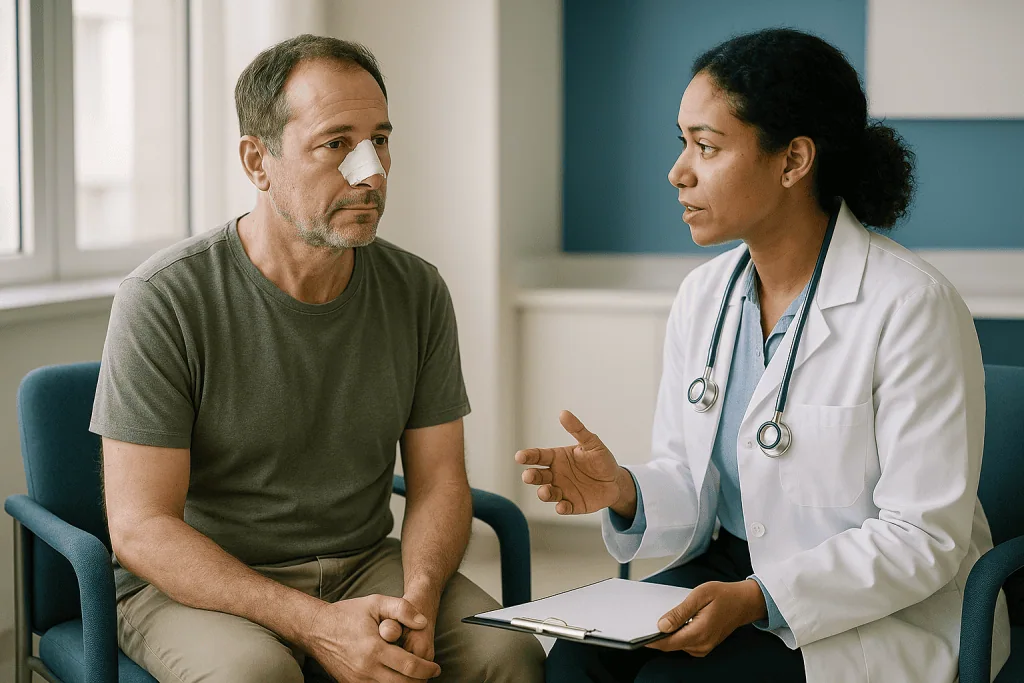
In surgical terms FESS is considered a moderate procedure. It is done under general anaesthesia, it works millimetres from the eye socket and the base of the skull, and it produces a raw mucosal surface that heals over weeks, not days. Yet there is no incision to protect, no muscle to rebuild, and no restriction on walking from the first evening. Cleveland Clinic describes most people returning to desk-based work within about one to two weeks.
The serious complications that make FESS more than trivial are uncommon. Mainstream guidance lists them as significant bleeding, injury to the eye or its muscles causing double vision, a leak of the fluid surrounding the brain, and a reduced sense of smell. Published patient information from Cleveland Clinic and the NHS characterises these as rare, without giving a single universal percentage, because rates depend on how extensive the surgery is and whether it is a revision, a second operation in a previously operated nose.
A useful mental model: the operation itself is minor in terms of trauma to the body, but the tissue you are asking to heal is a specialised, slow-repairing lining. Treat the first two weeks with the seriousness of any operation, and treat the following two months as a rehabilitation project for your sinus lining. That framing keeps expectations in line with what the tissue can actually do.
Who is usually offered FESS, and who is asked to wait?
Surgery is rarely the first move. Both the NHS and Mayo Clinic frame FESS as a step for people whose chronic rhinosinusitis, the medical term for sinus inflammation lasting twelve weeks or longer, has not responded adequately to a proper course of medical treatment. That course usually involves daily saline irrigation, an intranasal corticosteroid spray used consistently for weeks, and, where an infection or allergy is driving things, treatment aimed at those triggers.
The people most often offered FESS fall into a few groups. Those with nasal polyps, soft, non-cancerous growths of swollen lining, whose polyps block breathing or smell despite steroid treatment. Those with recurrent acute infections that keep returning after each course of treatment settles. Those with a structural blockage visible on CT scanning, the detailed X-ray imaging used to map the sinuses. And those with complications, such as a mucocele, a mucus-filled cyst expanding within a sinus.
Who is usually asked to wait? Anyone who has not yet completed an adequate trial of medical therapy, because surgery works best as a way of letting that therapy reach the lining, not as a replacement for it. People whose symptoms are mainly facial pain or headache without matching findings on scan, since those symptoms often have other causes and surgery may not help them. People with an active infection at the time of the planned date, who are usually rescheduled. And people whose breathing problem sits in the front of the nose, in a deviated septum or enlarged turbinates, which may call for a different operation altogether.
The deciding conversation belongs to you and your ENT surgeon, ideally with the scan on the screen. What matters is matching the operation to the anatomy, not to the intensity of frustration.
The FESS recovery timeline at a glance
Every recovery is personal, but patient guidance from Cleveland Clinic and Mayo Clinic describes a recognisable sequence. The table below gathers the typical ranges those sources give. Read it as a map of the terrain, not a schedule your body has signed. Extensive surgery, polyps, revision operations, and conditions such as asthma or aspirin-exacerbated respiratory disease tend to stretch every phase.
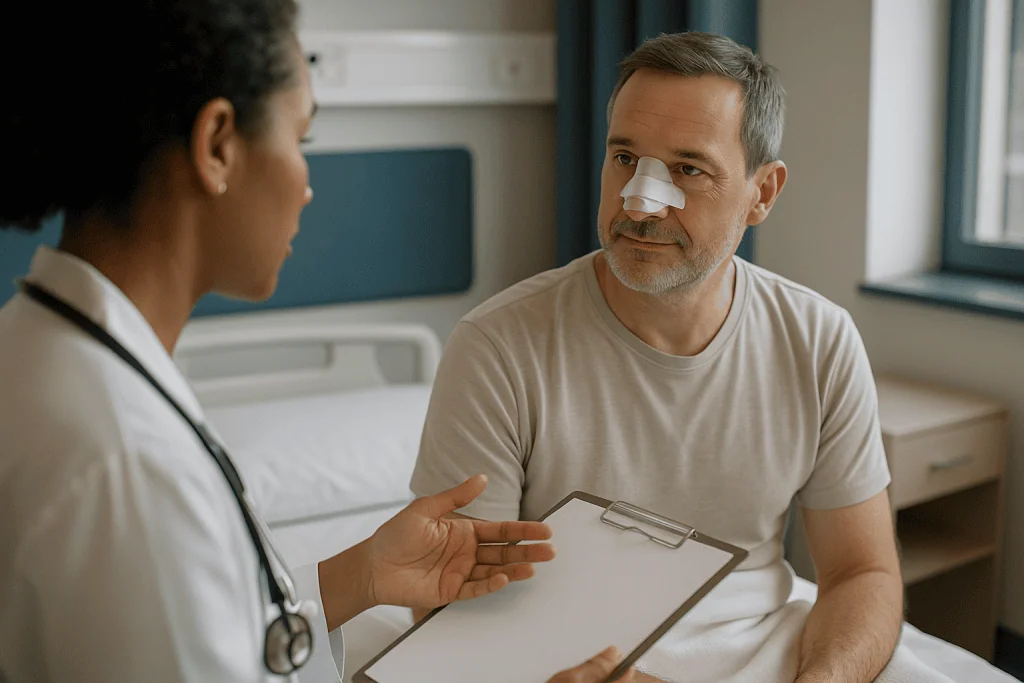
| Phase | What most people notice | Typical range in mainstream guidance |
|---|---|---|
| First 24 to 72 hours | Blood-tinged drainage, heavy congestion, fatigue from anaesthesia, dull facial pressure | Peak discomfort usually within the first two to three days |
| Days 3 to 7 | Drainage thickens and darkens, crusts begin forming, mouth breathing at night | Most people return to light activity by the end of week one |
| Weeks 2 to 3 | Crusting peaks, then starts to lift with rinsing; first debridement visit often falls here | Desk work commonly resumed within one to two weeks |
| Weeks 3 to 6 | Airflow noticeably better, smell fluctuating, occasional dried blood in rinses | Most restrictions on exertion lifted by the surgeon in this window |
| Weeks 6 to 12 | Lining re-epithelialising, congestion mostly gone, symptoms of chronic disease easier to control with rinses and sprays | Healing of the sinus lining generally described as taking several weeks to a few months |
Two things are worth underlining. First, the phase that surprises people most is not the bleeding but the middle stretch, weeks two and three, when the nose can feel more blocked than it did before surgery because crusts and swelling have replaced the polyps that were removed. Second, the end point is not a nose that never needs attention. FESS is designed to make ongoing medical treatment work; the rinses and sprays that follow are part of the plan, not a sign the operation fell short.
What's the worst day after sinus surgery?
Ask a room of people who have been through FESS and the answers cluster around two moments rather than one. The first is the evening of surgery and the following day, when anaesthesia has worn off, the nose is completely obstructed, and a steady trickle of pink fluid needs a gauze drip pad under the nostrils. Cleveland Clinic guidance describes this early bleeding and pressure as expected, usually easing over the first two to three days.
Pain in this phase is generally described as pressure or a dull ache across the cheeks and between the eyes rather than sharp pain. Many people are surprised that it hurts less than they feared and blocks more than they imagined. Headache, a sore throat from the breathing tube, and a heavy, foggy feeling are common companions. Sleep is fragmented because mouth breathing dries the throat.
The second candidate for worst day tends to arrive later and catches people off guard. Around day five to ten, drainage thickens into dark crusts, the nose can feel packed solid, and a metallic or unpleasant smell may drift up from old blood and healing tissue. If packing was placed, its removal or dissolution can also mark a rough day. Because the early bleeding has stopped, people assume they should be improving and read this stage as a setback. It is not. It is the ordinary, unglamorous middle of the FESS recovery timeline.
What helps the worst day is knowing it is coming. Plan for the first three days to be genuinely restful. Keep the head elevated, use the saline rinses your team prescribes as soon as they say to start, and resist the urge to blow. Then plan for a second dip in the second week and treat it as evidence of healing, not evidence of failure.
Sinus surgery recovery week by week: the first seven days
Day one is about rest and drainage. Expect to change a drip pad several times, to breathe through your mouth, and to sleep propped up. Small amounts of blood-tinged fluid are normal; steady bright red bleeding that soaks through pads is not, and your team will have told you how to reach them. Anaesthesia leaves many people nauseated or lightheaded, so the day is best spent lying still with fluids nearby.
Days two and three usually bring the first change: the drainage slows and shifts from pink to rust-coloured. Congestion is at its heaviest because swelling of the operated lining peaks around this time. Facial pressure is common. This is when most surgeons ask you to start gentle saline irrigation, the practice of flushing the nasal cavity with sterile salt water using a squeeze bottle or similar device. The rinse will return with clots and debris, which looks alarming and is precisely what it is for.
Days four to seven bring energy back. Walking around the house feels fine; bending, lifting, and straining still do not. Crusts start forming at the edges of the nostrils and deeper inside. Cleveland Clinic guidance suggests many people can manage light, non-strenuous activity by the end of the first week, with heavier exertion held off until the surgeon clears it, because raised blood pressure in the head can restart bleeding.
Emotionally, the first week is often a slump. You cannot yet feel the benefit, you look and sound congested, and your sense of smell may be absent or strange. The evidence-based reassurance is that this is the expected shape of the curve. The lining is laying down new surface cells under the crusts, and the rinses are keeping that surface clean enough for the next phase to begin.
Crusting after sinus surgery: why it happens and how long it lasts
Crusting is the part of recovery that nobody describes well beforehand, so here is the mechanism in plain terms. Surgery removes diseased lining and thin bone, leaving a raw surface. That surface weeps a mixture of blood, serum, and mucus. Air moving through the nose dries the outer layer of that mixture into a crust, while underneath, new epithelium, the protective surface layer of cells, gradually grows back. Crusts are essentially scabs, and the nose forms them just as skin does.
The difference is that a scab on the knee sits still, while nasal crusts sit in a moving airway. They block airflow, trap old blood that smells unpleasant, and can feel like solid obstruction. Their colour ranges from yellow to dark brown or nearly black, which is dried blood rather than infection. Green or foul-smelling discharge that worsens with fever is a different matter and belongs in the red-flag section below.
How long does crusting last? Mainstream patient guidance describes crusting as heaviest in the second and third weeks, then easing steadily over the following weeks as the lining heals, with the overall mucosal recovery taking several weeks to a few months depending on how much surgery was done. Extensive ethmoid or frontal sinus work, meaning surgery in the spaces between the eyes and above them, tends to crust longer than a limited procedure.
Two things shorten the crusting phase in practice. The first is consistent, high-volume saline rinsing, which softens and floats crusts away and keeps the healing surface moist. The second is the surgeon’s in-office debridement, described in a later section, where loosened crusts and clots are removed under direct vision. What does not help is picking. Fingers and cotton swabs pull away healing cells along with the crust and restart bleeding at the very spot that was trying to close.
When can I breathe after FESS? Congestion versus real airflow
This is the question underneath every other question, so it deserves a precise answer. Breathing after FESS improves in two separate steps, and confusing them is the main source of disappointment in the first month.
Step one is mechanical. On the operating table, the surgeon removes polyps and opens blocked passages, so the airway is physically larger than it was that morning. But within hours, swelling, blood, packing, and crusts fill the new space. That is why the nose feels worse on day one than it did before surgery. Cleveland Clinic guidance describes congestion as expected for the first several days to a couple of weeks.
Step two is biological. As swelling recedes and crusts lift, usually noticeably from the second or third week onward, the enlarged airway becomes usable. Most people describe a moment, often after a debridement visit or a particularly productive rinse, when a full breath suddenly moves through one side. The other side may follow days later. From roughly week three to week six, airflow generally improves week on week, although individual variation is wide.
The sense of smell follows its own slower curve. Smell receptors sit high in the nasal cavity and are among the last areas to clear of swelling. Guidance from Mayo Clinic and Cleveland Clinic notes that smell may be reduced for weeks and that in a small number of people it does not return fully; nobody can promise its recovery, and it is a fair question to raise before surgery.
One honest caveat: FESS improves drainage and access for medication. If the underlying condition is polyps driven by ongoing inflammation, long-term breathing depends on continuing the sprays and rinses the team recommends. Surgery opens the door; daily treatment keeps it open.
What not to do after FESS surgery
The list of restrictions after FESS is short, but each item has a mechanism behind it, and knowing the mechanism makes the rule easier to keep.
- Do not blow your nose for the period your surgeon specifies, commonly the first one to two weeks in mainstream guidance. Blowing forces air and pressure into freshly opened sinuses and can dislodge clots, restart bleeding, or push air into the tissues around the eye. Sniffing gently backward, or letting drainage run onto a pad, is the alternative.
- Do not lift, strain, or exercise hard until cleared. Raised pressure in the head is the commonest reason for delayed bleeding. Walking is encouraged from the first day; anything that makes you hold your breath or turn red in the face is not.
- Do not pick or insert anything into the nostrils, including cotton swabs. Crusts come away on their own with rinsing and at debridement visits.
- Do not take blood-thinning medicines or supplements without checking with your team. This includes aspirin-type pain relievers and some herbal products. Your surgical team will tell you what is safe and when any prescribed blood thinner should restart; never change a prescribed medicine on your own.
- Do not skip the rinses once you are told to begin. Irrigation is the single most consistently recommended part of home care after sinus surgery in NHS, Mayo Clinic and Cleveland Clinic guidance.
- Do not smoke or vape, and avoid smoky environments. Smoke impairs mucosal healing and ciliary function, the beating of tiny hairs that clear mucus.
- Do not sneeze with a closed mouth. If a sneeze comes, let it out through an open mouth to vent the pressure.
Flying and swimming both deserve a specific conversation with your surgeon rather than a general rule, because pressure changes in a cabin and water in an unhealed sinus carry different risks depending on what was done. Ask before you book anything.
How long do I need to sleep sitting up after sinus surgery?
Head elevation after FESS is not a ritual; it is fluid mechanics. Lying flat increases the pressure of blood in the veins of the head and face, which promotes swelling and oozing from the operated lining. Propping the head and shoulders up lets gravity drain that fluid downward, reducing both the congested feeling and the trickle of bloody discharge.
Mainstream patient guidance, including Cleveland Clinic’s, typically advises sleeping with the head raised for the first several nights, often the first week, using two or three pillows or a wedge. Fully upright in a chair is rarely necessary; an angle of roughly thirty to forty-five degrees is what most instructions describe. Your surgeon may extend this if bleeding has been more than expected or if extensive frontal sinus work was done.
Practical details make the difference between elevation you keep and elevation you abandon at two in the morning. A firm wedge pillow or a stack that supports from the mid-back upward prevents the neck-crick that comes from propping only the head. A towel over the pillowcase saves laundry. Because mouth breathing dries the throat, a glass of water within reach and a humidifier in the room help, and dry air is also harder on healing nasal lining.
People who normally sleep on their side or stomach often find the first week the hardest part of recovery for reasons that have nothing to do with the sinuses. Sleeping on the back, semi-reclined, is unfamiliar, and the congestion means breathing through the mouth all night. Expect broken sleep and lower energy for a few days as a consequence. Once your team says elevation is no longer needed, you can return to your usual position; there is no long-term reason to keep the head raised after healing.
Follow-up visits, debridement and saline rinses
Recovery after FESS is a shared job, and the surgeon’s part continues after the operation. Most teams schedule a first review within one to two weeks and further visits over the following one to three months. At these visits the surgeon looks inside with an endoscope, the same camera used in surgery, and performs debridement, the gentle removal of crusts, clots, and early scar bands from the healing cavities.
Debridement sounds worse than it feels for most people, although it is not comfortable. The nose is usually sprayed with a decongestant and a numbing agent first. The procedure takes minutes. Its purpose is to keep the newly opened drainage pathways from scarring shut before the lining has re-covered them. Adhesions, bands of scar tissue bridging two raw surfaces, are among the more common reasons for revision surgery, and early clearance is how surgeons try to prevent them.
Saline irrigation is the home half of this partnership. Isotonic saline, salt water at roughly the concentration of body fluids, flushed through the nose with a squeeze bottle or similar device, softens crusts, washes away debris and old blood, and keeps the surface moist so new cells can spread. The NHS, Mayo Clinic and Cleveland Clinic all list saline rinsing as a core part of managing chronic sinusitis, and after surgery it becomes the main tool of recovery.
Key safety points from CDC and NHS guidance: prepare rinses with sterile, distilled, or previously boiled and cooled water, never straight tap water, because rare but serious infections have been linked to untreated water entering the nose. Clean the bottle after each use and let it dry. Frequency and duration of rinsing are set by your surgeon; many teams ask for several rinses a day early on, tapering as the crusting settles.
Medicines during recovery: what they are for and how long they usually last
People leave hospital with a small collection of medicines and instructions, and it helps to know what each is doing rather than just when to take it. Decisions about any of them, including whether to start, stop, or adjust, rest with the prescribing clinician, not with an article.
Pain relief is usually simple. Mainstream guidance describes post-FESS discomfort as pressure or aching that most people manage with ordinary pain relievers for a few days. Surgeons often advise against aspirin-type anti-inflammatory medicines in the early period because they interfere with platelet function and can prolong bleeding; your team will say which options are acceptable for you.
Saline is the first medicine, even though it needs no prescription. Its role is mechanical cleaning and moisture, and it typically continues for weeks and often indefinitely for people with chronic disease.
Intranasal corticosteroid sprays, or steroid added to rinses, are commonly restarted once early healing has begun. Their mechanism is to dampen the inflammation that caused polyps and swelling in the first place; after surgery, an open nose lets the medicine reach the sinus lining it could not reach before. Mayo Clinic describes these as a mainstay of long-term control of chronic rhinosinusitis, which means they are usually a long-term companion rather than a short course.
Antibiotics are not routine after FESS in most protocols. They may be prescribed if infection was found at surgery or develops afterward. A short course of oral corticosteroids is sometimes used around surgery for people with extensive polyps, to reduce swelling and bleeding; this is a surgeon-level decision with individual risks and benefits.
Newer biologic medicines, injectable treatments targeting specific immune pathways, are an option for some people with severe polyp disease, usually considered by specialist teams in the context of ongoing management rather than as part of routine surgical recovery.
What people often get wrong about FESS recovery
Myth: if I am more blocked after surgery than before, the operation failed. Early congestion is swelling and crusting in a freshly operated cavity, not the return of disease. Airflow typically improves from the second or third week as those clear, according to Cleveland Clinic guidance.
Myth: dark or black discharge means infection. Dark material in the first weeks is almost always old, dried blood. Infection is suggested by increasing thick green discharge with fever, worsening facial pain, or feeling progressively unwell, not by colour alone.
Myth: once the crusting stops, I can stop the rinses and sprays. FESS is designed to make medical treatment work better, not to replace it. Mayo Clinic and NHS guidance describe ongoing saline and intranasal steroid use as the foundation of long-term control of chronic sinusitis, especially where polyps are involved.
Myth: FESS is a nose job. It changes nothing visible on the outside. Any bruising is unusual and, when it occurs, usually relates to work near the eye socket that the surgeon will discuss.
Myth: I should be back to full exercise in a week because it was keyhole surgery. The absence of external cuts does not mean the lining inside has healed. Heavy exertion before clearance is the commonest reason for bleeding that sends people back to the surgeon.
Myth: my sense of smell will come back on a fixed date. Smell recovery is variable, often lags airflow by weeks, and in some people does not fully return. No mainstream source gives a guaranteed timeline, and neither should anyone else.
Myth: bleeding at day ten means something ruptured. Small bleeds when crusts lift are expected. Steady bright bleeding that does not stop with sitting up and gentle pressure is the concern, and it needs a call.
Questions to ask your care team before and after FESS
A ten-minute conversation with the surgeon, with the scan on the screen, does more for a realistic recovery than any general guide. These questions are the ones that most directly shape your personal FESS recovery timeline.
- Which sinuses will you open, and on which sides? Limited and comprehensive surgery heal on different schedules.
- Will you place packing or a spacer, and if so, does it dissolve or need removal? This shapes the first week.
- When do you want me to start saline rinses, how often, and with what water?
- When is my first follow-up, and will debridement be done then? How many visits should I plan for?
- Which pain relievers are acceptable for me, and which should I avoid because of bleeding risk?
- When should my regular medicines, especially any blood thinner, be stopped and restarted? I will not change them without your instruction.
- How long should I keep my head elevated at night, and when can I sleep normally?
- When can I return to work, drive, exercise, lift, swim, and fly?
- What bleeding is normal at home, and what amount or pattern means I should call?
- How long should I expect my sense of smell to be altered, and what is the realistic chance it does not fully return in my case?
- What is the plan for long-term control after healing: which sprays or rinses, and for how long?
- If polyps come back, what are the options, and how would we know early?
Write the answers down or ask for them in writing. Anaesthesia and the fog of the first days make recall unreliable, and the answers to these questions are the ones you will want at two in the morning on day three when the guide in your hand says one thing and your nose says another.
When to call your doctor after FESS
Most of what happens in the weeks after sinus surgery is uncomfortable but ordinary. A small number of signs are not, and they need the same-day attention of your surgical team or emergency services. Mainstream guidance from Cleveland Clinic and the NHS highlights the following.
Call emergency services or go to an emergency department immediately for:
- Heavy, steady bleeding from the nose or into the throat that does not slow after sitting upright and applying gentle pressure to the soft part of the nose for the time your team advised.
- Any change in vision, including double vision, blurring, or loss of sight in one eye; sudden swelling, bruising, or bulging of an eye; or severe pain around the eye. These can indicate bleeding or injury near the eye socket.
- Clear, watery fluid dripping steadily from one nostril, especially when leaning forward, with or without a salty taste. This can signal a leak of the fluid that surrounds the brain.
- Severe headache with a stiff neck, high fever, confusion, drowsiness, or sensitivity to light.
- Difficulty breathing, chest pain, or signs of an allergic reaction.
Contact your surgical team the same day for:
- Fever that develops after the first day or persists.
- Facial pain or pressure that steadily worsens rather than easing after the first few days.
- Thick green or foul-smelling discharge that increases over time, particularly with fever or feeling unwell.
- Pain, redness, or swelling on the face or around the eye.
- Persistent vomiting that prevents fluids or medicines, or signs of dehydration.
- Any new symptom that worries you. Surgical teams would rather hear about a false alarm than miss a real one.
If you are uncertain whether something is normal, the safest default is to call. The number your team gave you exists precisely for that uncertainty.
Frequently asked questions
What is the worst day after sinus surgery?
For most people the roughest stretch is the first two to three days, when congestion is total, drainage is blood-tinged, and anaesthesia fatigue is heavy. A second dip often comes in the second week, when thick crusts make the nose feel packed solid and old blood smells unpleasant. Both phases are described as expected in mainstream patient guidance and do not indicate the operation has failed.
Is FESS a major or minor surgery?
FESS is usually classed as a moderate procedure: it is done under general anaesthesia and works close to the eye and skull base, but there are no external incisions and most people go home the same day. Serious complications such as significant bleeding, eye injury, or a leak of fluid around the brain are described as rare. Recovery of the internal lining takes weeks, so it deserves more respect than the lack of scars suggests.
What should I not do after FESS surgery?
Avoid blowing your nose, heavy lifting, straining, vigorous exercise, and picking or inserting anything into the nostrils until your surgeon clears each activity. Do not take blood-thinning medicines or supplements without checking with your team, do not smoke, and do not skip prescribed saline rinses. Ask specifically about flying and swimming, because pressure changes and water in unhealed sinuses carry their own risks.
How long do I need to sleep sitting up after sinus surgery?
Most patient guidance advises keeping the head and shoulders raised, roughly thirty to forty-five degrees on pillows or a wedge, for the first several nights and often the first week. Elevation reduces swelling and oozing by helping blood drain from the head. Fully upright in a chair is rarely needed. Your surgeon may extend the period if bleeding was heavier than expected.
How long does crusting after sinus surgery last?
Crusting usually builds over the first week, peaks in the second and third weeks, and then eases over the following weeks as the lining re-covers itself. Overall mucosal healing is described as taking several weeks to a few months, longer after extensive or revision surgery. Regular saline irrigation and in-office debridement visits are the two things that shorten this phase; picking lengthens it.
When can I breathe normally after FESS?
Breathing typically feels worse for the first several days because swelling and crusts fill the newly opened passages. From the second or third week most people notice real airflow returning, often one side at a time, with steady improvement through roughly week six. The final result depends on the underlying condition being controlled with the rinses and sprays your team recommends after healing.
What does a sinus surgery recovery look like week by week?
Week one is congestion, blood-tinged drainage, fatigue, and the start of rinsing. Weeks two and three bring peak crusting and usually the first debridement visit, with desk work commonly resumed. Weeks three to six bring clearer breathing and lifting of exercise restrictions by the surgeon. Weeks six to twelve see the lining largely healed and symptoms easier to manage with ongoing treatment.
Is dark or black discharge after FESS a sign of infection?
Usually not. Dark brown or black material in the first weeks is almost always old, dried blood mixed with mucus, and it commonly appears in rinses as crusts lift. Infection is suggested by thick green discharge that increases over time, fever, worsening facial pain, or feeling progressively unwell. Any of those combinations warrants a same-day call to your surgical team.
Will my sense of smell come back after sinus surgery?
Often it improves, particularly when polyps were blocking the smell area high in the nose, but the timeline is slower and less predictable than airflow and can take weeks. Mainstream guidance notes that a reduced sense of smell is a recognised risk of sinus surgery and that in a small number of people it does not fully return. Ask your surgeon what is realistic for your specific anatomy.
Do I still need nasal sprays and rinses after the nose has healed?
In most cases, yes. FESS is designed to open the sinuses so that saline and intranasal corticosteroids can reach the lining and control the inflammation that caused the problem, especially where polyps are involved. Mayo Clinic and NHS guidance describe these as long-term management rather than a short course. Your ENT team will set the plan and review it at follow-up.
References
This article is for general information only and is not a substitute for professional medical advice. Please consult a qualified doctor about your individual situation.

More from the Blog

What Results Does Endoscopic Sinus Surgery (ESS) Usually Bring, and Can Sinus Disease Return?
Endoscopic sinus surgery usually widens blocked sinus drainage pathways so that mucus can clear and medicines can reach inflamed lining. Most people report less…
What Does a Nasal Endoscopy Show in Sinusitis, and How Does It Shape Your Treatment?
A nasal endoscopy in sinusitis lets an ear, nose and throat clinician look directly inside the nose with a thin, lighted camera, checking for…

When Is an Intratympanic Steroid Injection Considered for Sudden Hearing Loss?
An intratympanic steroid injection is usually considered for sudden sensorineural hearing loss in two situations: as initial treatment when oral corticosteroids are unsuitable, unwanted…

Is FESS the Next Step? When Chronic Sinusitis Stops Responding to Medical Treatment
FESS (functional endoscopic sinus surgery) is usually considered only after chronic sinusitis, meaning symptoms lasting 12 weeks or more, has failed a full course…

SMR or Septoplasty: What Is the Difference, and When Do Surgeons Choose Submucous Resection?
SMR (submucous resection) and septoplasty are both operations that straighten the wall between the nostrils. SMR, the older technique, removes most of the deviated…

Sinusitis Warning Signs: High Fever, Facial Swelling and Vision Changes That Need Urgent Care
Most sinusitis improves on its own within about 7 to 10 days and can be managed at home. Seek urgent care the same day…