

How Long to Plan for a Stem Cell Transplant Abroad Before Flying Home

Key Takeaways
- NHS guidance places full recovery from a stem cell transplant at a year or more, with the immune system weakened for much of that time even when blood counts look normal.
- Autologous transplants, which use the patient's own cells, carry no risk of graft-versus-host disease and work to a shorter monitoring timeline than donor transplants.
- Day 100 after an allogeneic transplant is a conventional reassessment point, not a guideline-defined release date, and the team may clear travel earlier or ask for longer.
- The NHS ties increased clot risk to any journey of four hours or more, and recent serious illness and reduced mobility raise that baseline further.
- The CDC Yellow Book describes revaccination beginning months after transplant and live vaccines generally avoided for at least two years, so travel vaccine decisions sit with the team.
- A temperature of 38°C (100.4°F) or above after a transplant requires immediate medical assessment wherever the patient is, including mid-journey.
Most people should plan to remain near their transplant center for weeks to months after a stem cell transplant, not days. Patient guidance from the NHS and Mayo Clinic describes a hospital phase lasting several weeks, followed by close outpatient monitoring, and many programs treat day 100 after a donor (allogeneic) transplant as the earliest point to discuss long-distance travel. The transplant team sets the date.
The return ticket is the problem. Everything else about the trip has a date attached: the admission, the first scan, the day the cells go in. The flight home sits in the planner as a question mark, and the people trying to answer it are usually a patient and a relative with a spreadsheet, a lease on a short-term apartment and no idea whether to book for six weeks or six months.
Anyone working out a stem cell transplant abroad stay length discovers quickly that the honest answer is a range, and that the range depends on the type of transplant, how smoothly the new cells take hold and what the body does in the weeks afterward. Guidance from the NHS, Mayo Clinic and MedlinePlus describes a hospital phase of several weeks and a recovery that stretches well past discharge.
This explainer walks through the phases that set those dates, the evidence on flying with a rebuilding immune system, and the practical steps that make the journey home safer when the team finally agrees it is time.
What actually happens during a stem cell transplant, in plain language
A stem cell transplant replaces damaged or diseased blood-forming cells with healthy ones. Blood stem cells are the immature cells in the bone marrow that grow into red cells, white cells and platelets. When cancer, chemotherapy or a bone marrow disorder leaves that factory unable to work, a transplant restocks it.
The process has three movements. First comes conditioning: high-dose chemotherapy, sometimes with radiation, that clears the marrow and suppresses the immune system so the new cells will not be rejected. According to NHS guidance, this phase itself takes several days and causes the familiar side effects of intensive chemotherapy, including nausea, mouth soreness and a sharp drop in blood counts.
Second is the infusion. The stem cells arrive in a bag and drip into a central line much like a transfusion. The event is brief and often anticlimactic for people who expected an operation. Nothing is cut; the cells find their own way to the marrow spaces.
Third, and slowest, is engraftment, the point at which the transplanted cells begin producing new blood cells in measurable numbers. MedlinePlus describes this waiting period as the most vulnerable stretch, because the body has almost no white cells to fight infection and may need transfusions of red cells and platelets. Protective isolation, daily blood tests and a low threshold for antibiotics are standard in this window.
Where the cells come from matters enormously for everything that follows. An autologous transplant uses the patient’s own stem cells, collected and frozen before conditioning. An allogeneic transplant uses cells from a donor, related or unrelated, matched by tissue type. The second route brings a new immune system into the body, which is both the point and the source of its particular risks.
Why the stem cell transplant abroad stay length is counted in months, not weeks
People tend to picture recovery the way they picture recovery from surgery: wound heals, stitches out, fly home. A transplant does not follow that arc. The thing being rebuilt is the immune system, and immune systems rebuild slowly and unevenly.

Blood counts are the first thing to recover and the easiest to measure. White cells return over the first few weeks after infusion, which is what allows discharge from the hospital. Platelets and red cells follow. These numbers are what the daily blood draws track, and they are what the team is waiting on before anyone leaves the ward.
Immune function is a different story. NHS guidance states plainly that it can take a year or more to fully recover from a stem cell transplant, and that the immune system remains weakened for much of that time. The new white cells exist, but the sophisticated memory that protects against specific infections has to be learned again from scratch. Vaccines given in childhood no longer count, which is why the CDC Yellow Book describes transplant recipients as needing a repeat vaccination series beginning months after the procedure.
Complications also follow their own calendar. Infections cluster early, while counts are low. Graft-versus-host disease, the condition in which donor immune cells attack the recipient’s skin, gut or liver, most often appears in the first weeks to months after an allogeneic transplant, according to Mayo Clinic. Organ stress from conditioning can surface after discharge. Each of these needs a team that knows the case and can act within hours, which is the practical reason transplant programs ask patients to stay within reach.
Measured against that biology, a stay planned in months is not cautious. It is simply accurate.
Autologous versus allogeneic: how the type of transplant changes the timeline
Ask a transplant coordinator how long someone will need to stay and the first question back will be which kind of transplant. The answer shifts the plan by months.
With an autologous transplant, the infused cells are the patient’s own. There is no donor immune system, so graft-versus-host disease does not occur and the long courses of immune-suppressing medicines used after donor transplants are generally unnecessary. Counts tend to recover on a shorter timeline and the period of close monitoring is correspondingly briefer, as MedlinePlus and Mayo Clinic both describe.
With an allogeneic transplant, the body hosts a new immune system that must be kept in balance: strong enough to fight infection and, in blood cancers, to attack residual disease, but not so aggressive that it harms the recipient’s own tissues. Managing that balance requires frequent visits, blood-level checks of immune-suppressing medicines and rapid response to rashes, diarrhea or jaundice. The monitoring window is longer because the risk window is longer.
| Feature | Autologous (own cells) | Allogeneic (donor cells) |
|---|---|---|
| Source of stem cells | Collected from the patient before conditioning | Related or unrelated matched donor, or cord blood |
| Graft-versus-host disease | Does not occur | A principal risk, mostly in the early months |
| Immune-suppressing medicines after transplant | Usually not needed | Typically for months, adjusted by the team |
| Hospital phase (NHS, MedlinePlus) | Several weeks | Several weeks, often longer |
| Conventional close-monitoring milestone | Roughly the first month, program-dependent | Around day 100, program-dependent |
| Full immune recovery (NHS) | Many months | A year or more |
The table shows conventions, not promises. Programs differ, and an individual course can run shorter or longer than any typical range. The treating team’s judgment on the specific case overrides every row.
Bone marrow transplant recovery timeline: the phases that set your dates
It helps to think of the recovery as four phases, each with a different reason for staying put.
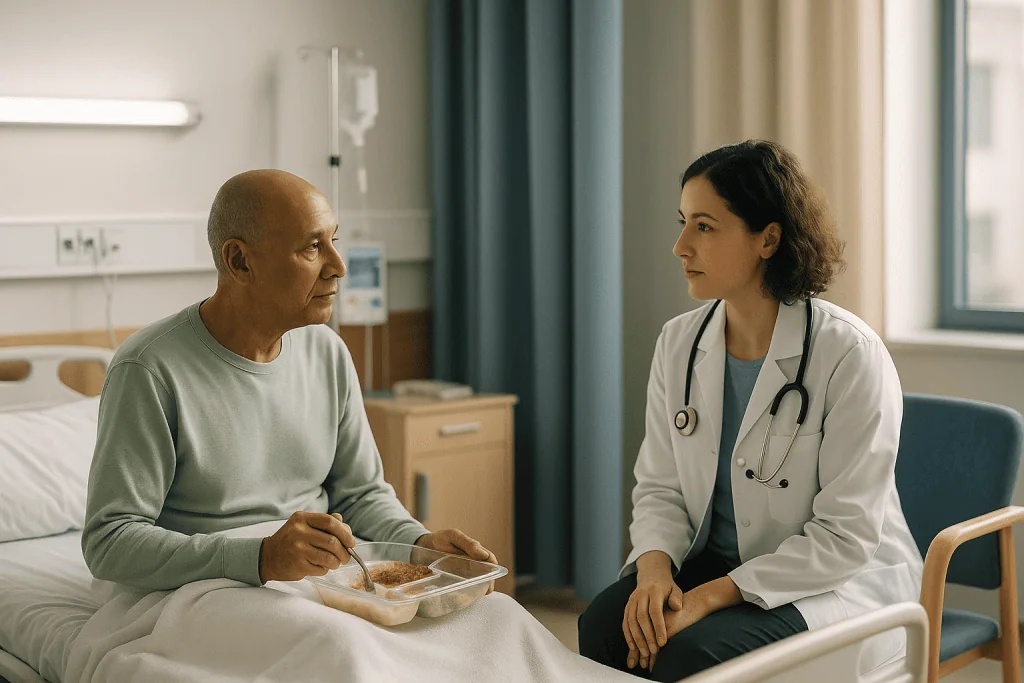
Phase one is the inpatient stay. Conditioning, infusion and the wait for engraftment happen under one roof. NHS guidance describes this as a period of several weeks in a protected environment with daily blood tests and transfusions as needed. Discharge usually follows the recovery of white cell counts to a safe level and the resolution of any fever.
Phase two is early outpatient recovery. The patient lives nearby and returns to clinic several times a week. Blood counts are still fragile, appetite and energy are low, and the central line often stays in place for transfusions and antibiotics. This is also when early graft-versus-host disease is most likely to declare itself after a donor transplant, which is why Mayo Clinic guidance emphasizes prompt reporting of new skin or gut symptoms in this window.
Phase three runs from roughly the end of the first month to around three months. Visits space out. Immune-suppressing medicines, where used, are adjusted by the team. Energy returns in uneven steps. Many programs mark the end of this phase with a formal review that may include a bone marrow test and a conversation about travel.
Phase four is the long tail. According to the NHS, full recovery can take a year or more. The CDC Yellow Book notes that revaccination typically starts months after transplant and that live vaccines are generally avoided for at least two years. Fatigue, concentration problems and vulnerability to common infections can persist well into this phase.
The flight home usually sits somewhere between phases three and four. Exactly where depends on the type of transplant, the complications encountered and the follow-up available at the destination.
Who is usually offered a transplant, and who is usually asked to wait
Transplants are used for a defined set of conditions. According to MedlinePlus and the NHS, these include leukemias, lymphomas, multiple myeloma, severe aplastic anemia and certain inherited disorders of blood or immunity. In cancer, the transplant typically follows chemotherapy that has brought the disease under control; the aim is to consolidate that control and, in donor transplants, to use the new immune system against any remaining disease.
Fitness for the procedure is assessed carefully. Conditioning is demanding on the heart, lungs, liver and kidneys, so teams run organ-function tests beforehand and may choose a lower-intensity conditioning approach for older people or those with other health problems, as Mayo Clinic describes. The decision weighs the risk of the disease against the risk of the treatment, and it is made by a multidisciplinary team, not by any single clinician or by the patient’s preferred calendar.
Some people are asked to wait. Active infection at the time of planned admission is a common reason, because conditioning will remove the body’s ability to fight it. Disease that is not yet adequately controlled may need further treatment first. For donor transplants, the search for a well-matched donor can take weeks to months, and the donor’s own medical clearance adds time.
Travel plans cannot shorten any of this. A program may be able to give a provisional window, but admission dates move when a donor’s availability changes, when a scan shows something unexpected or when a cold turns up the week before conditioning. People planning a stay abroad for a transplant should expect the front end of the schedule to flex as well as the back end, and build that into leases and leave from work.
Whether a transplant is appropriate at all, and when, remains a question for the treating team.
How long to stay near the transplant center after discharge
Leaving the hospital is not the same as being free to leave the city. Every major transplant program asks discharged patients to remain within a short travel time of the center for a defined period, and the reasons are concrete.
First, the frequency of visits. In the early weeks after discharge, Mayo Clinic guidance describes clinic attendance several times a week for blood counts, transfusion needs and medicine monitoring. A patient who cannot reach the clinic within an hour or two cannot practically keep that schedule.
Second, the speed at which problems develop. A fever in someone with a low white cell count can progress to a serious bloodstream infection within hours. MedlinePlus and the NHS both instruct transplant recipients to seek immediate care for a temperature of 38°C (100.4°F) or above. That instruction only works if a hospital that knows the case is close enough to act on it.
Third, the specific expertise involved. Early graft-versus-host disease, a stalled graft or a reaction to medicines are recognized fastest by the people who see transplant patients every day. A general emergency department far from the program can stabilize, but it cannot always distinguish an expected side effect from a complication that needs urgent treatment.
The conventional durations differ by transplant type. After an autologous transplant, programs commonly keep patients close for roughly the first month after infusion. After an allogeneic transplant, the day-100 milestone is widely used as the earliest point at which the question of moving away is raised. Neither figure is a rule in any guideline; both are conventions grounded in when complications tend to appear.
The team may extend the period if counts are slow to recover, if graft-versus-host disease is active or if the destination lacks suitable follow-up. People living abroad for the transplant should assume the lease may need extending and ask the team early about the realistic range for their case.
Day 100 after stem cell transplant: what the milestone really means
Transplant calendars count from the day of infusion, which is day zero. Day 100 has become a familiar landmark in that counting, and many patients fix on it as the date they will be allowed to go home. It is worth understanding what the number does and does not represent.
The 100-day mark exists because the most dangerous complications of allogeneic transplant cluster before it. Acute graft-versus-host disease, by definition in older classifications, was the form appearing within the first 100 days. Early infections associated with very low white cell counts fall inside the window. Many programs therefore schedule a formal assessment around this point: blood tests, sometimes a bone marrow sample, a review of medicines and a conversation about the next phase.
What day 100 does not mean is that the immune system has recovered. NHS guidance places full recovery at a year or more. The CDC Yellow Book treats transplant recipients as significantly immunocompromised for far longer than 100 days, delaying the start of revaccination until months after the procedure and avoiding live vaccines for at least two years. Chronic graft-versus-host disease can appear after day 100, and immune-suppressing medicines often continue well past it.
Nor is 100 a fixed threshold for travel. A patient with a smooth course and a reliable transplant team at home may be cleared earlier. A patient with active complications may be asked to stay considerably longer. For autologous transplants, the relevant milestone is usually much earlier, because the risks that define day 100 do not apply in the same way.
Treat the number as a checkpoint in a longer process, not a finish line. The team’s assessment at that checkpoint, not the date itself, determines what happens next.
Flying after stem cell transplant: what the medical evidence says about safety
Commercial aircraft present three specific issues for someone recovering from a transplant: a crowded enclosed space, prolonged immobility and limited access to care for several hours. None of these is unique to transplant recipients, but each is amplified by a rebuilding immune system and recently low blood counts.
Infection risk is the concern people name first. Cabin air on modern aircraft is filtered and exchanged frequently, and the CDC Yellow Book notes that the principal exposure on a flight is to the people seated nearby rather than to the cabin as a whole. The crowded parts of the journey, meaning security lines, boarding gates and the aircraft aisle, are where close contact is unavoidable. Masking, hand hygiene and avoiding travel during local outbreaks of respiratory illness are the measures the CDC recommends for immunocompromised travelers generally.
Clot risk is the second concern and is better quantified. According to NHS guidance on deep vein thrombosis, journeys of four hours or more, by any mode, increase the risk of a clot forming in the deep veins of the leg. Recent serious illness, reduced mobility and some cancers raise the baseline risk further. The team may assess the individual situation and advise on precautions; any decision about clot-preventing medicines is theirs.
The third concern is distance from care. A fever at cruising altitude cannot be investigated for hours. This is the reason teams generally want counts stable and no active complications before clearing a long flight, and why some will ask that the first leg of a return journey be shorter, or that a connection be avoided.
Cabin pressure itself is not usually the limiting factor. Aircraft cabins are pressurized to the equivalent of roughly 1,800 to 2,400 meters of altitude, which most people tolerate; the team will consider lung function and anemia when deciding whether that applies to a given patient.
Clot prevention, mobility and infection basics for the journey home
Once the team has agreed a travel window, the goal is to make the journey as uneventful as possible. The practical measures are ordinary, and they work best when planned rather than improvised.
For clot prevention, the NHS and CDC advice for long journeys is consistent. Choose an aisle seat where possible so that standing is easy. Walk the aisle when the seatbelt sign allows. Between walks, flex and point the ankles and tighten the calf muscles for a minute at a time; these movements squeeze the deep veins and keep blood from pooling. Drink water regularly and limit alcohol, which contributes to dehydration. Avoid crossing the legs for long periods. The team may discuss graduated compression stockings, which the NHS lists as an option for people at increased risk; whether they are appropriate, and anything beyond them, is the team’s call.
For infection, think in terms of the crowded moments. A well-fitting mask through the airport and during boarding, hand sanitizer used before eating and after touching shared surfaces, and a seat away from anyone visibly unwell are the realistic controls. Carry food that does not depend on the galley if the team has advised food restrictions. Request a wheelchair or assistance if walking long terminal distances would be exhausting; fatigue is normal at this stage and conserving energy matters.
Keep every medicine in hand luggage, in original packaging, with a letter from the team listing diagnosis, transplant date, current medicines and emergency contacts. Carry a copy of the most recent blood results and discharge summary. If a central line is still in place, confirm with the team how it should be cared for in transit and what to do if the dressing loosens.
Finally, plan the arrival. A long drive from the airport is part of the journey too, and the same mobility rules apply.
Arranging follow-up at home before anyone books a flight
The single most important piece of planning happens before the ticket, not after it. A transplant does not end at discharge or at day 100; the NHS describes months of continued monitoring, and that monitoring has to be handed to someone.
Start by asking the transplant program what the destination team will need to do. At minimum this typically includes regular blood counts, monitoring of any immune-suppressing medicines, surveillance for graft-versus-host disease after a donor transplant, and the revaccination schedule that the CDC Yellow Book describes as beginning months after the procedure. Some patients will also need ongoing transfusion support or treatment of late complications.
Identify a hematology service at home that is willing and able to take on that care, and confirm it in writing before travel is finalized. The receiving team should receive a full transfer summary: diagnosis, conditioning regimen, stem cell source, engraftment dates, complications, current medicines and a clear plan for what to monitor and when. Ask the transplant program to send it directly, clinician to clinician, and to remain available for questions.
Agree how emergencies will be handled. A patient who develops a fever on arrival home needs to know which hospital to go to and needs that hospital to understand the urgency. Carry a card or letter that states the transplant history and the instruction that fever requires immediate assessment.
Consider the gap between the two teams. If the first home appointment is weeks after the last appointment abroad, blood counts will go unchecked in the interval, and a problem that develops in that gap will be found late. Aligning the dates so that the handover is seamless is a legitimate reason to delay a flight by a week or two.
Where follow-up cannot be arranged, the transplant team may advise staying longer. That advice is clinical, not administrative, and it deserves the same weight as any other.
What people often get wrong about stem cell transplant abroad stay length
Several assumptions surface repeatedly in conversations with patients planning this kind of stay. Each is understandable, and each can lead to a plan that fails.
The first is that discharge means recovery. In reality, discharge marks the end of the most acute phase and the beginning of a long outpatient one. The NHS places full recovery at a year or more; the first weeks after leaving the hospital often involve clinic visits several times a week.
The second is that day 100 is a universal release date. It is a convention for allogeneic transplants, used because early complications cluster before it, and it is a point of reassessment rather than a guarantee. Autologous transplants work to a shorter timeline; complicated allogeneic courses work to a longer one.
The third is that normal blood counts mean a normal immune system. Counts recover first; the ability to fight specific infections recovers over many months. The CDC Yellow Book treats transplant recipients as immunocompromised long after their blood tests look ordinary, and childhood vaccinations have to be repeated.
The fourth is that a short flight is safe but a long one is not. Flight length matters for clot risk, which the NHS ties to journeys of four hours or more, but the bigger question is whether the patient is stable enough to be hours from a hospital at all. A two-hour flight with a fever is a worse idea than a long flight on a good day with counts stable.
The fifth is that the destination team will pick things up automatically. Handover has to be arranged, documented and confirmed. Without it, the first fever at home becomes a dangerous puzzle for clinicians who have never met the patient.
Correcting these assumptions early tends to produce a plan with more flexibility built in, and a less stressful final few weeks abroad.
Caregivers and companions: planning their time as carefully as the patient's
Transplant programs typically require that a patient discharged from the hospital has a caregiver living with them during the early outpatient phase. This is not a formality. The caregiver is the person who notices the temperature creeping up at two in the morning, who drives to the clinic for the third time that week and who manages a medicine schedule that would challenge a pharmacist.
The implication for planning is that the companion’s stay is as long as the patient’s, and often more demanding. Mayo Clinic guidance describes the caregiver role as including monitoring for symptoms, assisting with central line care, preparing food safely and providing transport and emotional support. Someone doing that full-time for months needs their own plan for rest, for staying in touch with people at home and for what happens if they themselves fall ill.
Illness in the caregiver is a real risk to the patient. A caregiver with a cold is a source of infection for someone with no functioning immune memory. Programs usually ask that caregivers be up to date with routine vaccinations, including influenza, before the patient’s discharge, and the CDC Yellow Book recommends the same for household contacts of immunocompromised people. If the caregiver becomes unwell, a backup arrangement has to exist.
Fatigue and isolation are the quiet hazards. Weeks in a rented apartment in an unfamiliar city, with the patient’s needs structuring every day, wears people down. Transplant social workers and psychologists are there for caregivers as well as patients, and using that support is sensible rather than indulgent.
Finally, the journey home is a two-person event. The caregiver may be carrying documents, managing medicines in transit and watching for symptoms on a long flight. Building rest into the days before departure, for both people, is part of a safe travel plan.
Questions to ask your care team about timing the flight home
Teams expect these conversations and generally welcome them early. Precise questions get precise answers; the list below is a starting point rather than a script.
- Which type of transplant am I having, and what is the usual period you ask patients to remain nearby afterward for that type?
- What specific markers will you want to see before you consider long-distance travel safe: blood counts, absence of fever, settled graft-versus-host disease, stable medicine levels?
- Is there a formal review point, such as around day 100, and what does it involve?
- What would make you extend the stay, and how much notice would I realistically have?
- Is there a maximum flight duration you would be comfortable with at first, and should I avoid connections?
- Do I need any assessment of clot risk before flying, and what precautions do you advise for this journey?
- What should I carry on the flight: medicines, documents, a letter describing my transplant and emergency instructions?
- If I still have a central line, how should it be cared for during travel, and when will it come out?
- What will my home team need to monitor, and will you send the transfer summary directly to them?
- When should revaccination start, and who will manage it?
- Are there foods, environments or activities I should still avoid at the point I travel?
- Who do I contact, and how, if something goes wrong in the first weeks after I arrive home?
Write the answers down. Recovery affects concentration and memory for many people, as the NHS notes, and the caregiver should hear the answers too. If the responses to two different questions seem to conflict, say so; teams would rather clarify in clinic than have a patient discover the ambiguity at an airport.
When to call your doctor: red-flag signs after a stem cell transplant
Transplant recipients are taught a short list of symptoms that require immediate contact with the team or the nearest emergency department, whether they are still abroad, in transit or newly home. The list is deliberately low-threshold because problems escalate fast when the immune system is compromised.
Fever leads the list. MedlinePlus and NHS guidance instruct patients to seek care immediately for a temperature of 38°C (100.4°F) or above, or for shivering and chills even without a measured fever. Do not take fever-reducing medicines first and wait to see; the fever is the signal, and masking it delays assessment.
Other signs that need same-day attention include new breathlessness or chest pain; a cough that is new or worsening; redness, swelling, pain or discharge at the central line site; bleeding that does not stop, blood in urine or stool, or widespread new bruising; persistent vomiting or diarrhea, which can signal infection or graft-versus-host disease; a new rash, especially on the palms, soles or trunk after a donor transplant; yellowing of the skin or eyes; severe headache, confusion or unusual drowsiness; and pain, swelling or warmth in one calf, which can indicate a clot, particularly after a long journey.
Where to go matters. If still near the transplant center, call the team’s emergency line; most programs operate one around the clock. If in transit, inform cabin crew, who can arrange assistance on landing. If newly home, go to the agreed hospital and present the transplant letter at the door so that triage understands the urgency.
None of this is intended to alarm. Most symptoms turn out to be manageable, and early assessment is what keeps them that way. The treating team, not the patient or family, decides what each sign means and what to do about it.
Frequently asked questions
How long do people usually stay near the transplant center after a stem cell transplant abroad?
Typically weeks to months after discharge, depending on transplant type. Programs commonly keep autologous patients close for roughly the first month after infusion and allogeneic patients until around day 100, with the team extending that if complications arise. These are conventions based on when problems tend to appear, not fixed rules; the treating team sets the date for each individual.
What does the bone marrow transplant recovery timeline look like after leaving the hospital?
Early outpatient recovery involves clinic visits several times a week for blood counts, transfusions and medicine checks. Visits space out over the following weeks as counts stabilize. NHS guidance describes full recovery as taking a year or more, with fatigue and infection vulnerability persisting for months. Many programs hold a formal review around day 100 after a donor transplant.
Is flying after stem cell transplant safe?
It can be, once the team judges counts stable and complications settled. The main concerns are infection exposure in crowded airport spaces, clot risk on journeys of four hours or more as described by the NHS, and being hours from care if a fever develops. Masking, hand hygiene, regular movement and hydration address the first two; timing addresses the third.
What is day 100 after stem cell transplant, and why does it matter for travel?
Day 100 counts from the infusion day and marks the end of the window in which acute graft-versus-host disease and early infections most often appear after a donor transplant. Many programs schedule a formal assessment around it and may first discuss long-distance travel then. It does not mean the immune system has recovered, and it is not a fixed release date.
Does an autologous transplant allow an earlier flight home than an allogeneic one?
Usually, yes, because an autologous transplant uses the patient’s own cells and carries no risk of graft-versus-host disease or need for long-term immune-suppressing medicines. Monitoring periods are correspondingly shorter. Individual courses still vary, and infection risk during count recovery applies to both types, so the team’s assessment of the specific case determines timing.
How long after a stem cell transplant does the immune system take to recover?
Blood counts recover over the first few weeks, but functional immunity takes far longer. The NHS states that full recovery can take a year or more. The CDC Yellow Book treats recipients as significantly immunocompromised well beyond that, with revaccination beginning months after transplant and live vaccines generally avoided for at least two years.
What should I carry on the flight home after a transplant?
All medicines in hand luggage in original packaging, a letter from the transplant team listing diagnosis, transplant date, current medicines and emergency instructions, copies of recent blood results and the discharge summary, and contact details for both the transplant program and the receiving team at home. If a central line remains, carry supplies and instructions for its care.
What reduces clot risk on a long flight after a stem cell transplant?
NHS and CDC guidance for long journeys applies: walk the aisle when permitted, flex and point the ankles and tighten calf muscles regularly while seated, drink water, limit alcohol and avoid crossing the legs for long periods. The team may discuss compression stockings and will assess whether any further precaution is appropriate for the individual.
Who should manage my care once I am home after a transplant abroad?
A hematology service at home that has agreed in advance to take over monitoring, ideally confirmed in writing before travel is booked. The transplant program should send a full transfer summary directly to that team. Agree which hospital to attend for emergencies and make sure the dates align so that blood counts are not left unchecked between the two teams.
What symptoms after a stem cell transplant mean I should seek care immediately?
A temperature of 38°C (100.4°F) or above, chills, new breathlessness or chest pain, bleeding that does not stop, redness or discharge at the central line, persistent vomiting or diarrhea, a new rash, yellowing skin or eyes, confusion, or pain and swelling in one calf. Seek care immediately wherever you are, and present your transplant letter on arrival.
References
- MedlinePlus: Bone marrow transplant
- NHS: Stem cell and bone marrow transplants
- NHS: Stem cell and bone marrow transplants, what happens
- NHS: Deep vein thrombosis (DVT)
This article is for general information only and is not a substitute for professional medical advice. Please consult a qualified doctor about your individual situation.

More from the Blog
Eating After Stomach Cancer Surgery: Small Frequent Meals and the New Digestive Rhythm
Eating after gastrectomy usually means six to eight small meals a day instead of three large ones, chewing slowly, putting protein first, separating drinks…
What Debulking Surgery for Ovarian Cancer Removes and Why Completeness Matters
Debulking surgery for ovarian cancer, also called cytoreductive surgery, removes the ovaries, fallopian tubes, uterus, omentum and every visible tumor deposit a surgeon can…
Robotic Partial Nephrectomy Recovery: Early Walking, Lifting Limits and the First Six Weeks
Robotic partial nephrectomy recovery usually means walking within hours of surgery, a hospital stay of one to three days, and light activity within one…
Life After Vulvar Cancer Treatment: Intimacy, Body Image and Emotional Support
Life after vulvar cancer treatment usually involves a slow physical recovery, changes in how the genital area looks and feels, and an emotional adjustment…
Chemotherapy Before or After Breast Cancer Surgery? How Oncologists Choose the Order
Chemotherapy can be given before breast cancer surgery (neoadjuvant) or after it (adjuvant), and pooled data from randomized trials show the order does not…

Questions to Ask the Transplant Team Before a Bone Marrow Transplant
Before a bone marrow transplant, ask the team which type is planned (your own cells or a donor's) and why it is recommended over…