

How Spinal Cord Stimulation Is Implanted: The Trial Phase, the Leads and the Generator
Key Takeaways
- A spinal cord stimulation procedure is done in two stages, and the temporary trial with an external battery is designed to be fully reversible with nothing left inside.
- Trials typically run about five to seven days and are commonly judged against a threshold of at least 50 percent pain reduction plus real gains in sleep or function.
- Percutaneous leads go in through a needle under sedation, while paddle leads require a small bone opening under general anesthesia and tend to migrate less.
- Lead migration is the most frequently reported complication, which is why bending, twisting and lifting are restricted for roughly six to eight weeks after the permanent implant.
- Non-rechargeable generators last around two to five years and rechargeable models up to about ten, with battery replacement being a smaller operation on the pocket alone.
- The device modulates pain signals rather than repairing the spine, so imaging looks unchanged afterward and relief is usually partial rather than complete.
A spinal cord stimulation procedure happens in two stages. First, a short trial: thin wires called leads are placed in the epidural space through a needle and connected to an external battery worn for about a week. If pain relief is meaningful, a second procedure secures permanent leads and places a small generator under the skin. The treating team decides whether each stage is appropriate.
The folder from the pain clinic sits open on the kitchen table, and one word on the consent form has been circled twice in pen: trial. After years of leg pain that outlasted two operations, physical therapy and a shelf of medicine bottles, the idea of a battery-powered device quieting the signals feels either like a genuine turn in the road or one more thing to be disappointed by. The person holding the pen is not sure which.
The spinal cord stimulation procedure is unusual among pain treatments because it lets you test-drive it. Before anything is stitched in place, you live with a temporary version for several days and report back. That structure, more than any brochure, is what separates a considered decision from a hopeful gamble.
This explainer walks through the trial, the leads and the generator in the order you would actually meet them, with the evidence stated plainly, including where it is thinner than the enthusiasm around it.
How does a spinal cord stimulator work?
Picture the spinal cord as a cable bundle carrying messages between your body and your brain. Chronic pain often means some of those messages have become stuck on repeat: the tissue may have healed, or cannot be repaired further, yet the nerve traffic keeps announcing damage. A spinal cord stimulator does not remove the damaged disc, scar or nerve. It changes what the brain receives.
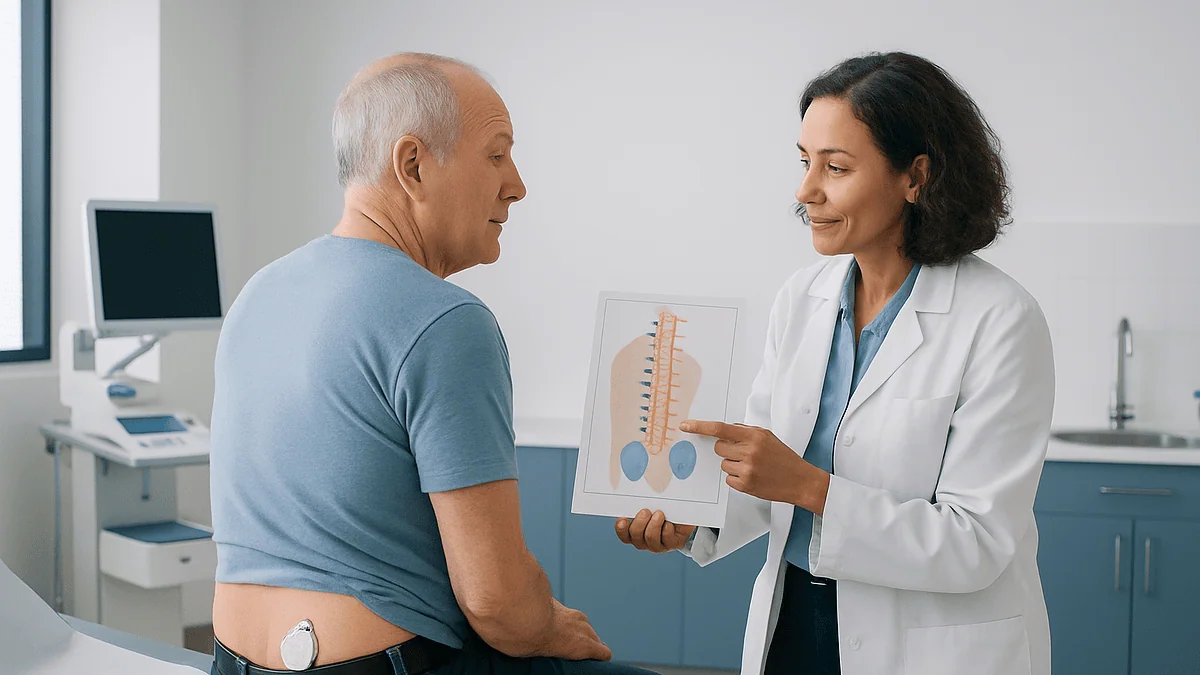
The hardware has three parts. Leads are thin insulated wires with metal contacts along the tip. They sit in the epidural space, the narrow fat-filled gap just outside the tough membrane that wraps the spinal cord, so nothing touches the cord itself. A pulse generator, a sealed battery and computer roughly the size of a pacemaker, delivers tiny electrical pulses through the leads. A handheld remote lets you switch programs, adjust intensity within limits set by the clinic, or turn the device off.
The oldest explanation for why it helps is the gate control theory: gentle electrical activity in the large touch-carrying fibers of the spinal cord competes with, and partly blocks, pain signals traveling in smaller fibers, much as rubbing a banged elbow dulls the sting. Conventional settings produce a tingling sensation called paresthesia over the painful area, and the trick is to steer that tingling so it overlaps the pain map. Newer high-frequency and burst settings work without any noticeable tingling, and the mechanism there is less settled; researchers suspect effects on pain-processing cells in the cord’s dorsal horn rather than simple signal-jamming, as the NIH StatPearls review discusses.
The honest summary: the device modulates pain rather than reversing its cause, which is exactly why a trial exists. Nobody can predict from a scan whether your nervous system will respond.
Who is the spinal cord stimulation procedure usually for, and who is asked to wait
Stimulation is generally considered when pain is chronic, nerve-related and has not responded adequately to more conservative treatment. The conditions most consistently mentioned across the Cleveland Clinic, Johns Hopkins and StatPearls sources are persistent leg or back pain after spine surgery (often labeled failed back surgery syndrome, meaning surgery healed but pain did not), complex regional pain syndrome, painful diabetic neuropathy, pain from arachnoiditis (inflammation of the membranes around the cord) and some forms of limb pain caused by poor blood flow.

Notice what is missing: pain that a straightforward operation could fix. If a compressed nerve can be decompressed, surgeons usually prefer to address the cause first. Stimulation is for pain that remains once the fixable has been fixed, or when surgery is not an option.
Teams also commonly ask people to wait, or decline to proceed, in specific situations:
- An active infection anywhere in the body, since implanted hardware can seed infection.
- A bleeding disorder or blood-thinning medicine that has not yet been reviewed by the prescribing clinician; the epidural space is unforgiving of bleeding.
- Untreated major depression, uncontrolled anxiety or an active substance use disorder. Most programs require a psychological evaluation first, not as a hurdle but because mood and expectations strongly shape how any pain treatment lands.
- Pregnancy, because safety in pregnancy has not been established.
- Spinal anatomy, previous fusion hardware or dense scarring that blocks the needle route, which may steer the team toward a surgically placed lead instead.
- A likely future need for MRI scans that the specific device cannot accommodate.
None of these is a judgment about you. They are the conditions under which the procedure has a reasonable chance of helping rather than harming, and the treating team weighs them case by case.
The spinal cord stimulator trial: what actually happens on the day
The trial is the spinal cord stimulation procedure in miniature, and it is deliberately reversible. According to the Cleveland Clinic and Johns Hopkins descriptions, it is almost always done as an outpatient visit.
You lie face down on a table in a procedure room with an X-ray machine. The skin over the lower back is cleaned and numbed with local anesthetic. Most people receive light sedation so they feel drowsy and comfortable, but not so deep that they cannot answer questions, because your feedback is part of the procedure.
Using fluoroscopy, real-time X-ray imaging, the physician guides a hollow needle into the epidural space, then threads one or two leads through it and advances them upward along the spine. For leg and low back pain the tip typically ends in the mid-to-lower thoracic region, higher than the pain itself, because that is where the relevant nerve fibers enter the cord. Once the leads are positioned, the team turns on test stimulation and asks where you feel it. If the tingling lands in your left calf and your pain is in your right, they adjust. This mapping conversation may take several minutes and is the single most important part of the day.
When coverage matches the pain, the needle is withdrawn, the leads are secured to the skin with sutures or adhesive and covered with a dressing, and the external ends are connected to a small generator you wear on a belt. A representative or clinician programs the initial settings and shows you the remote.
You go home the same day with instructions to keep the dressing dry, avoid bending, twisting or lifting, and not to drive. The leads are not anchored inside; a careless stretch can shift them and spoil the test.
How to judge the trial week honestly
The trial usually runs about five to seven days, per Johns Hopkins, long enough to test the device against ordinary life, short enough to limit infection risk from wires passing through the skin.
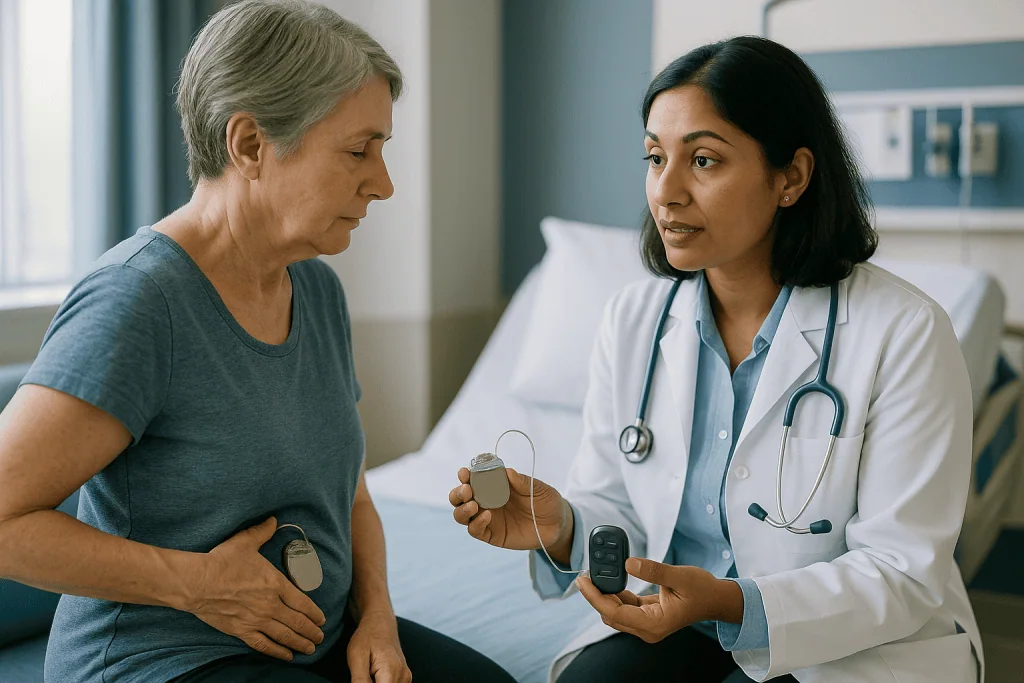
Clinics commonly define a successful trial as at least a 50 percent reduction in pain, the threshold cited in the StatPearls review and widely used in research. Percentages are blunt instruments, so most teams also ask about function. Did you sleep through the night? Stand at the stove long enough to cook? Walk to the mailbox without stopping? Keeping a simple diary, morning and evening, with pain scores and one or two concrete activities, produces far better data than a memory of how the week felt.
A few points of honesty help the trial do its job:
- Do not change any prescribed medicine during the week unless the prescribing clinician has told you to. Cutting a medicine to “prove” the stimulator works confuses the picture and can be unsafe.
- Report unpleasant stimulation, tingling in the wrong place, or jolts when changing position. Settings can often be reprogrammed mid-trial.
- Expect the trial to feel different from the permanent implant. External wires, a dressing and movement restrictions are irritants that disappear later.
At the end of the week you return to the clinic. Removing the trial leads takes moments; the sutures are snipped and the wires slide out, with sensation similar to peeling off a large bandage. Nothing remains inside.
Then comes the decision. A trial that did not deliver meaningful relief is not a personal failure; it is exactly the information the trial was designed to produce, and it spares you an operation unlikely to help. A good trial does not guarantee lasting relief either. It shifts the odds, and the treating team weighs it alongside everything else they know about you.
Percutaneous or paddle leads: the choice that shapes the operation
If the trial goes well, the permanent leads can be placed in one of two ways, and the choice determines what kind of operation you have. Both are described in the StatPearls and Johns Hopkins sources.
Percutaneous leads are the thin cylindrical wires used in the trial, placed through a needle. Paddle leads are flat, wider electrodes placed by a surgeon through a small opening in the bone, a laminotomy, meaning removal of a small piece of the vertebra’s roof to expose the epidural space.
| Feature | Percutaneous leads | Paddle leads |
|---|---|---|
| How they are placed | Through a needle under X-ray guidance | Through a small laminotomy by a spine or neurosurgeon |
| Anesthesia | Local anesthetic with sedation; you can give feedback | Usually general anesthesia |
| Incision | Small incision for anchoring the leads | Larger midline incision over the spine |
| Stability | Higher tendency to migrate, the most common complication per StatPearls | Broader, flatter design tends to stay put |
| Common reasons to choose | Straightforward anatomy, less invasive approach preferred | Scar tissue or prior surgery blocking the needle route, previous lead migration, need for wider coverage |
| Recovery burden | Generally lighter | Generally longer, more like minor spine surgery |
The permanent operation, whichever route, adds steps the trial did not include. The leads are anchored to the tough ligament or fascia near the spine with small fixings so they cannot slide. An extension wire is then tunneled, passed under the skin through a narrow channel, from the back to wherever the generator will live. The whole procedure is typically done in an operating room and, per the Cleveland Clinic, most people go home the same day or after a single night.
Which lead is right for you is a surgical judgment about your anatomy and history, not a matter of preference or prestige.
The generator: where it sits and how long the battery lasts
The generator is the part people notice afterward, so it is worth knowing what to expect. It is a smooth, sealed unit containing the battery, electronics and an antenna, placed in a pocket, a small space the surgeon creates just under the skin and above the muscle. The usual sites are the upper buttock, the flank, or the lower abdomen, chosen so the device does not press against the waistband, the mattress or a car seat. Before surgery, many teams ask you to sit, lie on your side and bend so the pocket can be marked in a spot you will not sit on.
You will feel it. Most people describe a firm bump under the skin, more noticeable in slim builds, that becomes familiar within weeks. The incision over the pocket is often the sorest part of recovery because the surrounding tissue has been stretched.
Two battery designs exist. Non-rechargeable generators last around two to five years before the whole unit is replaced, while rechargeable units can last up to about ten years, according to the Cleveland Clinic. Rechargeable models require you to hold or strap a charging coil over the device for a period every few days; the routine suits some people and irritates others, which is a legitimate topic to raise before surgery. When a battery is depleted, replacing it is a smaller operation on the pocket alone, usually leaving the leads in place.
Programming happens wirelessly. The clinic sets a range of programs for different activities and posture; your remote lets you move within that range or switch the system off entirely. Modern generators are typically MRI-conditional, meaning scanning is permitted under specific conditions, but the exact rules depend on the model and lead combination, and the team must confirm them for any future scan.
How painful is spinal cord stimulator surgery?
Less than most people fear for the trial; more than a simple injection for the permanent implant. Separating the two stages gives a truer picture.
During the trial, local anesthetic numbs the skin and deeper tissue. The most commonly reported sensations are pressure as the needle enters the epidural space, and a brief, odd tingling when the leads are first switched on. Lying face down for a period can be the hardest part for someone with back pain, and the team will position pillows to help. Afterward, the puncture site feels bruised for a few days.
The permanent implant involves real incisions: one or two over the spine for anchoring, one over the pocket, and the tunnel between them. Soreness along that route is expected for one to a few weeks. The pocket site tends to hurt most, especially when sitting or rolling over in bed, and sleeping on the opposite side for the first while is common advice. If paddle leads are placed through a laminotomy under general anesthesia, expect recovery closer to minor spine surgery, with deeper muscle soreness.
Pain control afterward is planned by the surgical team and follows the same principles as other day-case operations: local anesthetic in the wounds, ice, gentle walking, and short-course medicines chosen and adjusted by the prescribing clinician. This article does not cover doses or schedules; those belong in the conversation with your team.
A distinction worth holding onto: incisional pain is new, sharp and localized, and fades day by day. Your original chronic pain will still be there in the background until the device is programmed and stimulation settles. Many programs switch the stimulator on before you leave, others wait a few days for swelling to ease. Knowing which to expect prevents the sinking feeling that “it isn’t working” before it has been turned on.
Spinal cord stimulator surgery recovery: the first days and weeks
Recovery has two clocks running at once: skin healing, which is quick, and lead settling, which is slow. The Cleveland Clinic guidance frames it this way: incisions typically heal within two to four weeks, but bending, twisting, lifting and reaching overhead are restricted for roughly six to eight weeks while scar tissue forms around the leads and anchors them in place. Migration is most likely in that window, which is why the boring rules matter more than they seem.
A typical arc, understanding that your team’s instructions override any general description:
- Days one to three: rest, short walks around the house, dressings kept dry, incisions checked daily for redness or leakage. The generator pocket is tender; sitting on firm surfaces may be uncomfortable.
- Weeks one to two: a wound check, sometimes suture or staple removal, and the first programming session. Programming is iterative; the settings that worked during the trial often need adjustment because the permanent leads sit slightly differently.
- Weeks two to six: gradual return to walking, desk-type work and light household tasks. Driving resumes only when the team clears it. No twisting to reach the back seat, no vacuuming, no lifting more than a light bag.
- Weeks six to twelve: restrictions lift progressively, physical therapy may restart, and stimulation programs are fine-tuned as you resume normal movement.
Return to work depends on the job. Someone at a keyboard may go back within a couple of weeks; someone lifting for a living waits until the lead-settling period has passed and the team agrees.
Expect the early weeks to be a negotiation between healing tissue and a device learning your body. Most clinics schedule several reprogramming visits in the first months. Treat them as part of the procedure, not an afterthought; a stimulator left on its day-one settings rarely performs as well as one adjusted over time.
Why can't you drive with a spinal cord stimulator, and other everyday rules
The driving question has three separate answers, which is why it causes confusion.
During the trial you cannot drive because you have had sedation, you have wires passing through your skin into the epidural space, and turning to check a mirror is exactly the kind of movement that shifts a lead. After the permanent implant, the ban is about fresh incisions, residual anesthesia and the same movement restrictions, and it lasts until the team clears you.
The long-term rule is different. Cleveland Clinic guidance, echoed by device labeling, advises turning the stimulator off while driving or operating machinery. Stimulation intensity can change with posture and vibration; a sudden surge of tingling, or an unexpected jolt when hitting a pothole, is a distraction no driver needs. Some people with paresthesia-free settings are told differently, so the instruction must come from your own team. Once healed and cleared, the vast majority of people return to driving with the device paused for the journey.
Other everyday considerations people ask about:
- MRI: permitted only if your specific device and leads are MRI-conditional and the scanning center follows the model’s conditions. Always tell any clinician you have an implant.
- Security scanners: theft detectors and airport gates can briefly alter stimulation; walking through normally with the device off and carrying your implant card is the standard advice.
- Other medical procedures: diathermy (deep-heating physical therapy) is generally prohibited, and surgeons using electrocautery, or people with pacemakers or defibrillators, need the implant flagged in advance.
- Swimming and bathing: fine once wounds have fully healed and the team confirms.
- Vigorous exercise: usually encouraged after the settling period, with heavy twisting sports discussed individually.
Keep the implant card in your wallet. It carries the model details that answer half of these questions for any clinician you meet.
What are the downsides of a spinal cord stimulator? Side effects and complications
Every honest conversation about this treatment should spend as much time on what can go wrong as on what can go right. The StatPearls review and the Cleveland Clinic list overlapping concerns, which fall into three groups.
Hardware problems are the most frequent. Lead migration, the wire shifting from its mapped position, is the single most common complication and shows up as tingling in the wrong place or loss of relief; it may need reprogramming or a revision operation. Leads can fracture, connections can loosen, and generators can fail or reach the end of battery life earlier than expected. Over years, a meaningful share of people require at least one further operation to revise, reposition or replace components. The exact figure varies widely between studies and device types, so treat any single number with caution.
Procedural risks are less common but more serious: infection at the pocket or along the leads, sometimes requiring removal of the whole system; bleeding into the epidural space, which can compress the cord and is an emergency; accidental puncture of the dura causing a headache that worsens on standing (a cerebrospinal fluid leak); allergic reaction to materials; and, rarely, nerve or cord injury with weakness or numbness.
Living-with-it downsides get less attention but shape satisfaction: discomfort or visible bulge at the generator site, unpleasant stimulation with certain postures, the charging routine, loss of effect over months or years as the nervous system adapts (sometimes called habituation), MRI restrictions, and the need to switch the device off for driving.
Some people also describe a psychological adjustment to carrying a device, and disappointment when relief is partial rather than complete, which is the usual reality. Naming these in advance does not make them more likely. It makes the decision yours.
Is it worth it? What the evidence actually shows, and the alternatives
The answer depends on the question you are asking the evidence to settle.
For persistent pain after spine surgery and for complex regional pain syndrome, randomized trials summarized in the StatPearls review have generally found that adding stimulation to conventional medical management produces greater pain relief and better function than medical management alone over the following one to two years. That is the strongest part of the case, and it is why guideline bodies list these conditions as established indications.
The weaker parts deserve equal airtime. Many trials were funded by device manufacturers. Blinding is difficult when one group feels tingling and the other does not, and the placebo effect in pain research is large. Long-term durability is uncertain: relief that is impressive at one year is often smaller by three to five, and revision rates accumulate. Independent reviews have been more cautious than early studies, and comparisons between traditional and newer stimulation patterns have produced mixed results. Painful diabetic neuropathy has growing but younger evidence.
Alternatives should be on the same table, not as consolation prizes:
- Structured physical therapy and graded activity programs.
- Medicines acting on nerve pain, including certain anticonvulsant and antidepressant classes, prescribed and adjusted by the treating clinician.
- Targeted injections and radiofrequency ablation for specific pain generators.
- Peripheral nerve stimulation, dorsal root ganglion stimulation and implanted medicine pumps for selected patterns.
- Pain psychology, including cognitive behavioral approaches, which have solid evidence for function and mood even when pain scores move less.
So is it worth it? The evidence says: for the right condition, in a person who has passed a trial, with realistic expectations of partial relief and acceptance of possible revisions, the balance often favors trying. The person best placed to weigh that balance is you, with a treating team that has looked at your imaging, your history and your trial diary.
What people often get wrong about spinal cord stimulation
Misunderstandings cluster around the same few ideas, and several of them can quietly steer a decision the wrong way.
“It is a last resort.” Guidance increasingly frames stimulation as one option among several once conservative treatment has failed, not the thing you try after everything else including years of escalating medicines. Timing is a discussion, not a rule.
“It fixes the spine.” The device changes pain signaling. Discs, joints and nerves are exactly as they were. That is why imaging afterward looks unchanged and why the treatment can help someone whose scan looks bad and fail someone whose scan looks mild.
“You will feel buzzing all the time.” Conventional programs do produce tingling, and some people like the reassurance. Paresthesia-free settings exist, and many systems let you switch between them.
“Passing the trial means it will keep working.” A good trial improves the odds, as StatPearls notes, but relief can fade, leads can shift, and expectations set by a good week can make later partial relief feel like failure.
“It is permanent.” The system can be switched off indefinitely or surgically removed. Removal is an operation with its own risks, but the decision is reversible in a way most spine surgery is not.
“It is basically a TENS unit under the skin.” Both use electricity, but TENS stimulates nerves through the skin at the site of pain, while spinal cord stimulation acts on the cord itself through leads in the epidural space. Relief from one does not predict the other.
“You can never have an MRI again.” Most current systems are MRI-conditional. The conditions are specific and must be checked for your device, but a blanket ban is outdated.
“It replaces medicines.” Some people are able to reduce certain medicines over time under their prescriber’s direction. Others are not. Any change belongs to the prescribing clinician, never to the device or to a good week.
Questions to ask your care team before the trial
A good consultation answers most of these unprompted. Bringing the list ensures none are left to assumption, and the answers give you a clearer sense of whether this particular plan fits your particular life.
- Which of my diagnoses is the stimulator meant to address, and which parts of my pain are unlikely to respond?
- Why now, rather than another round of a different treatment, and what are the alternatives you considered for me?
- How will we define a successful trial in my case, beyond a percentage, and what will we measure?
- Do you anticipate percutaneous or paddle leads, and what in my anatomy or history drives that?
- Who performs the permanent implant, and will they be the same clinician who managed the trial?
- Where would the generator sit, and can we mark the site while I am sitting and lying down?
- Rechargeable or non-rechargeable, and what does the charging routine involve day to day?
- Is this system MRI-conditional with these leads, and what future scans might I need for my other conditions?
- What is your team’s approach to blood thinners and other medicines around the procedure? Who gives those instructions?
- How many reprogramming visits are typical in the first months, and who do I call between visits if stimulation feels wrong?
- What restrictions apply after the implant, for how long, and when could I expect to drive and return to my work?
- What would prompt you to recommend switching the device off or removing it, and what does removal involve?
- What signs should make me call urgently rather than waiting for the next appointment?
Write the answers down, or bring someone who will. The details that matter most, such as the trial criteria and the restriction period, are the ones easiest to misremember once the procedure date is fixed. And if the answers leave you uncertain, asking for time or a second opinion within your care network is an ordinary part of a considered decision.
When to call your doctor
Most problems after a spinal cord stimulation procedure are minor and announce themselves gradually: a sore pocket, tingling that has drifted, a battery that needs charging sooner than expected. A small number are emergencies, and the difference is worth knowing before you go home.
Seek urgent care or call emergency services for any of the following, whether during the trial or after the permanent implant:
- New weakness, numbness or heaviness in the legs, or difficulty walking that was not present before.
- Loss of bladder or bowel control, or new difficulty passing urine.
- Severe, rapidly worsening back pain at the lead site, especially with any of the above, which can signal bleeding in the epidural space.
- Fever with chills, particularly alongside redness, warmth, swelling or drainage from an incision, or neck stiffness and severe headache.
- Sudden chest pain, shortness of breath or a swollen, painful calf, which can indicate a blood clot after any period of reduced activity.
Call the clinic the same day for a headache that is much worse when upright and eases lying flat, spreading redness or leaking fluid at any wound, a hard or enlarging swelling over the generator, stimulation that has suddenly stopped or feels like shocks in a new area, or a trial dressing that has come loose or become wet.
Mention at the next visit tingling that has shifted from the painful area, relief that is fading, discomfort at the pocket when sitting, or any concern about the charging routine.
When in doubt, call. The team would far rather hear about a false alarm than learn about a genuine one late, and every decision about adjusting, pausing or removing the system rests with them.
Frequently asked questions
What is a spinal cord stimulator trial and what happens if it fails?
The trial places temporary leads in the epidural space through a needle and connects them to an external battery you wear for about a week. If pain relief is not meaningful, the leads are simply removed in clinic and nothing is left inside. A trial that does not help is useful information, not a failure; it spares you an operation unlikely to work, and your team can then discuss other options.
How does a spinal cord stimulator work to reduce pain?
It delivers tiny electrical pulses through leads placed just outside the spinal cord’s protective membrane. Those pulses interfere with pain signals traveling toward the brain, replacing them with tingling in traditional settings or acting without any sensation in newer high-frequency modes. The device does not repair the underlying disc, nerve or joint; it changes how the nervous system processes the signal, which is why a trial is used to see whether your body responds.
How painful is spinal cord stimulator surgery?
The trial is usually well tolerated under local anesthetic and light sedation, with pressure rather than sharp pain. The permanent implant involves incisions over the spine and a generator pocket, so expect soreness for one to several weeks, most noticeably at the pocket when sitting or rolling over. Your surgical team plans pain control afterward; incisional pain fades daily, while your original pain persists until programming settles.
What are the downsides of a spinal cord stimulator?
Common downsides include lead migration causing loss of relief, discomfort or a visible bump at the generator, unwanted tingling with certain postures, a charging routine for rechargeable units, and the possibility of revision surgery over time. Less common but serious risks are infection, bleeding into the epidural space, spinal fluid leak and, rarely, nerve injury. Relief can also fade over years, and MRI and driving carry conditions.
Why can't you drive with a spinal cord stimulator?
Driving is prohibited during the trial and early recovery because of sedation, fresh wounds and the twisting that can shift a lead. Long term, most teams and device labeling advise switching the stimulator off while driving because posture changes or road vibration can suddenly alter the intensity of stimulation and distract you. Once healed and cleared by your team, most people drive normally with the device paused for the journey.
Is it worth it to get a spinal cord stimulator?
For persistent pain after spine surgery and complex regional pain syndrome, randomized trials have shown better pain relief than medical management alone over one to two years. Longer-term durability is less certain, many studies were industry funded, and revisions are common. Whether it is worth it for you depends on your diagnosis, your trial result and your tolerance for partial relief and possible further surgery, weighed with your treating team.
What are the most common spinal cord stimulator side effects in daily life?
People most often mention tingling that shifts position when they bend or lie down, tenderness or awareness of the generator under the skin, and the need to remember charging sessions. Some notice stimulation change briefly near security gates. Most of these are managed by reprogramming or small habit changes. Persistent pain at the pocket, drifting coverage or fading relief should be reported at follow-up rather than tolerated.
How long is spinal cord stimulator surgery recovery?
Incisions generally heal within two to four weeks, but bending, twisting and lifting are restricted for roughly six to eight weeks so scar tissue can anchor the leads and reduce migration risk. Programming visits continue over the first few months while settings are fine-tuned. Return to work ranges from a couple of weeks for desk jobs to longer for physical work, always on your team’s clearance.
Can you have an MRI with a spinal cord stimulator?
Often yes, but only under specific conditions. Most current systems are MRI-conditional, meaning scanning is permitted when the device, leads and scanner settings all meet the manufacturer’s requirements. The details differ by model, so the scanning center must verify your exact system before any scan. Carry your implant card and tell every clinician about the device, including dentists and physical therapists who might use heat-based equipment.
Can a spinal cord stimulator be removed if it stops working?
Yes. The system can be switched off indefinitely without surgery, and it can be surgically removed if it no longer helps, causes discomfort or becomes infected. Removal is an operation with its own risks, particularly if scar tissue has formed around the leads, and it is planned by the same specialist team. In that sense stimulation is reversible in a way most spine operations are not.
References
This article is for general information only and is not a substitute for professional medical advice. Please consult a qualified doctor about your individual situation.

More from the Blog

How Facet Denervation Works: Radiofrequency Heat on the Nerves That Carry Facet Joint Pain
A facet denervation procedure, also called radiofrequency neurotomy or ablation, uses a thin probe placed under X-ray guidance to heat the small medial branch…

Joint Injections When You Have Diabetes: Why Your Doctor Reviews Blood Sugar First
People with diabetes can usually have joint injections, including corticosteroid (cortisone) shots, but the steroid can raise blood glucose for several days, so clinicians…

Pacing, Sleep and Movement: Daily Habits That Support Chronic Pain Treatment
Daily habits support chronic pain treatment but do not replace it. Pacing means splitting activity into planned, manageable portions instead of pushing through and…

How to Sleep with Sciatica: Positions, Pillows and Habits That Ease Night Pain
Most people with sciatica sleep best on their side with a firm pillow between the knees, or on their back with pillows under the…

Going Home the Same Day After an Interventional Pain Procedure: Soreness, Rest and Activity
Most people go home within one to two hours after an interventional pain procedure such as an epidural steroid injection, nerve block or radiofrequency…

Chronic Pain Treatment Options in Order: Rehabilitation, Injections and When to Consider More
Chronic pain treatment usually proceeds in steps: first, rehabilitation and self-management (graded exercise, physical therapy, sleep and stress work, pain-focused psychological therapy); next, non-opioid…