

How Surgeons Assess Keloid Risk and Scar Tendency Before an Afro Hair Transplant
Key Takeaways
- Keloids can appear 3 to 12 months after a wound and sometimes later, which is why a test patch cannot be judged in a few weeks.
- The single most predictive factor is your own past healing: a previous keloid outweighs any population statistic.
- Afro-textured follicles curve beneath the skin, raising transection risk in FUE and often requiring different punches or slower extraction.
- Curly hair covers more visual area per graft, so fewer grafts, and therefore fewer wounds, are often needed for the same apparent density.
- Active scarring hair loss such as CCCA, ongoing traction or acne keloidalis at the nape is usually treated and stabilized before any grafts are placed.
- Keloids removed surgically on their own frequently recur, sometimes larger, so careful patient selection is prioritized over treatment after the fact.
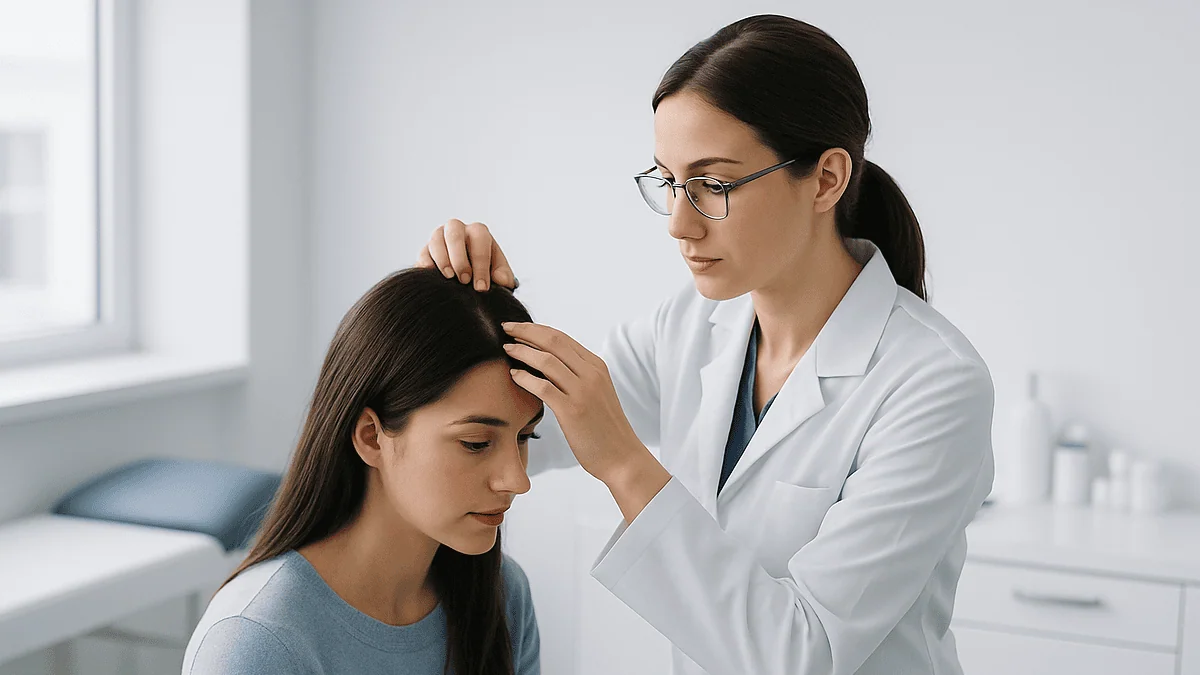
Before an afro hair transplant, surgeons assess keloid risk by asking about personal and family scar history, examining existing scars anywhere on the body, checking the scalp for scarring hair loss such as traction alopecia or acne keloidalis, and often placing a small test patch of grafts first. If the test heals flat over several months, the team decides whether a full procedure is reasonable.
He had already decided. The hairline had crept back a little further each year, the beard was full, and a friend with a similar background had gone through a transplant without trouble. What stopped him at the consultation was a question he had not expected: could he show the surgeon the small raised scar on his shoulder from a childhood vaccination?
That scar, and the way it had thickened beyond its original edges, changed the conversation. Afro hair transplant keloid risk is the part of planning that people with textured hair often hear about last, yet for surgeons it comes first. A transplant creates hundreds or thousands of tiny wounds on the scalp. On skin that heals with keloids, each of those wounds is a possible problem.
The assessment is not a formality and it is not a refusal. It is a structured way of predicting how your particular skin will close a wound, and it leans on history, examination and, frequently, a trial patch before anyone commits to a full session.
Why afro hair transplant keloid risk gets its own consultation step
Most surgical planning for hair restoration concentrates on the hair itself: how much donor supply exists, how far the loss will progress, where the new hairline should sit. For people of African descent, a second track runs alongside that one, and it is about skin rather than hair.
A hair transplant, whatever the technique, is a wound-creating procedure. Follicular unit extraction (FUE) removes individual groups of one to four hairs with a small circular punch, leaving hundreds of tiny round wounds in the donor area. Follicular unit transplantation (FUT), sometimes called the strip method, removes a narrow strip of scalp and closes it with a single linear incision. Both then require thousands of tiny recipient slits where grafts are placed. MedlinePlus describes the procedure as taking several hours and creating small scabs that heal over the following days.
On skin with a tendency toward exuberant healing, this arithmetic matters. Keloids can form after minor injuries, including acne, piercings and small cuts, according to Mayo Clinic. A scalp that receives two or three thousand controlled injuries in a single afternoon is therefore a genuine test of how a person heals.
Surgeons who work with textured hair know that the consequences of guessing wrong are lasting. A keloid on the back of the scalp is visible, sometimes itchy or tender, and difficult to treat once established. Recurrence after removal is common. The sensible response is not to avoid the procedure for an entire population but to assess each person carefully, which is why a keloid and scar-tendency review has become a standard part of the consultation rather than an afterthought.
The rest of this article walks through what that review involves, in the order a thoughtful surgeon usually follows it.
What a keloid actually is, and how it differs from a hypertrophic scar
A keloid is a raised scar that grows beyond the boundary of the original wound. That last phrase is the defining feature. Ordinary scars fill the injury and stop. Hypertrophic scars, a related type, become thick and raised but stay within the footprint of the wound and often soften and flatten over one to two years. Keloids spread sideways into skin that was never injured, and they rarely shrink on their own.
Under the microscope, a keloid is an overproduction of collagen, the protein that gives skin its structure. Fibroblasts, the cells that manufacture collagen, keep working long after the wound has closed. Cleveland Clinic describes the result as a smooth, hard, shiny growth that can feel rubbery and may be pink, red, brown or darker than the surrounding skin.
Timing is one of the more useful clues for surgeons. Mayo Clinic notes that keloids can appear anywhere from 3 to 12 months after an injury, and sometimes later, growing slowly for months or even years. That lag is why a test patch cannot be judged in a fortnight, and why a history of a scar that kept enlarging long after the wound healed is treated as significant.
Symptoms vary. Some keloids are painless; others itch, feel tight or are tender to touch. Location matters as well: the chest, shoulders, upper back, earlobes and jawline are classic sites, and the back of the scalp near the neck is also a recognized area, particularly in men with textured hair.
Distinguishing a keloid from a hypertrophic scar is not academic. A person whose scars are thick but contained is in a different risk category from someone whose scars spread and never settle. Surgeons make that distinction by looking and by asking, and the two together are more reliable than either alone.
Who is more likely to form keloids? What the evidence shows
Keloids are not evenly distributed across the population, and this is the reason the topic is raised specifically with people considering an afro hair transplant. Mayo Clinic states plainly that keloids are more common in people with brown or Black skin, and Cleveland Clinic reports that people of African, Asian and Hispanic descent are affected more often than people with lighter skin. The precise multiple varies between studies, so it is more honest to describe the difference as substantial than to quote a single figure as fact.
Age is a second factor. Keloids occur most often in people between roughly 10 and 30 years old, according to Cleveland Clinic, which overlaps with the age at which many people first consider hair restoration. A third factor is family history: having a parent or sibling with keloids raises the likelihood that you will form them too, which is why the consultation always includes questions about relatives.
A fourth is your own past. The single most predictive piece of information is whether you have already made a keloid after a previous injury, piercing, acne breakout or operation. Someone who has healed a caesarean, an appendectomy and several ear piercings with flat scars carries a different profile from someone whose single chest scar turned into a hard, itchy ridge.
Several things are not risk factors, despite persistent belief. Hair type by itself does not cause keloids; the association is with skin biology, not with curl pattern. Poor hygiene does not cause them. Neither does scratching, although scratching an itchy early keloid can make it more irritated.
The honest summary is that ancestry raises the baseline, but individual history and examination move a person up or down from that baseline far more than any population statistic does. Surgeons use the statistics to decide how carefully to look, not to decide the answer.
The scar history questions a surgeon asks before textured hair surgery
The consultation usually begins with talking, not with instruments. A structured history is the cheapest and, in many respects, the most informative part of a keloid assessment.
Expect to be asked about every wound you can remember. Surgical incisions, including childhood operations, are the obvious ones. Less obvious are ear or nose piercings, tattoos, burns, deep acne on the chest or back, chickenpox marks, vaccination sites and shaving bumps at the back of the neck. Each is a small natural experiment in how your skin closes.
For any scar you report, the surgeon wants three details: whether it became raised, whether it spread beyond the original edges, and how long it kept changing. A scar that thickened for a few months and then softened points toward hypertrophic healing. One that kept growing a year later, or that itches years on, points toward keloid formation.
Family history comes next. Cleveland Clinic and Mayo Clinic both list a family tendency as a recognized risk factor, so questions about parents, siblings and grandparents are routine rather than intrusive. If you do not know, say so; an unknown is recorded as an unknown, not assumed to be safe.
You will also be asked about skin and scalp conditions. Recurrent folliculitis, particularly at the nape, previous treatment for acne keloidalis nuchae, chemical relaxer burns, tight braiding or weaves over many years, and any diagnosis of scarring hair loss all shape the plan.
Finally, current medicines and general health enter the picture, because wound healing depends on circulation, blood sugar control and immune function. None of this is a checklist you need to prepare answers for in advance. Honest recollection is enough, and a surgeon would far rather hear about a small suspicious scar than discover a keloid tendency after the fact.
The skin examination: what surgeons look for on your scalp and body
After the history comes the part that feels more like a medical appointment than a cosmetic one. A thorough surgeon will examine skin well beyond the scalp, because the scalp of a person who has never had a scalp wound tells you nothing about how scalp wounds heal.
The high-risk zones are inspected first. The upper chest, shoulders, upper back and earlobes are the sites where keloids most often declare themselves, according to Mayo Clinic. A raised, shiny, sometimes dark or reddish growth in any of these areas, especially one that clearly overruns the original injury, is close to a deciding finding. Old piercing holes and vaccination sites get a particularly close look.
The scalp itself is examined for several things. The nape and occipital region, which is the donor area for most transplants, is checked for firm papules or plaques consistent with acne keloidalis nuchae, a chronic inflammatory condition of hair follicles that leaves keloid-like scarring. The crown and vertex are checked for smooth, shiny patches without visible follicular openings, a sign of scarring alopecia. The hairline and temples are examined for the thinning pattern typical of traction alopecia, and for whether the edges are still active or have quietly burned out.
Skin thickness, elasticity and pigmentation are noted. Many surgeons use a dermatoscope, a handheld magnifier with polarized light, to assess follicle density, the angle at which hairs exit the skin, and whether the follicular openings in a thinning area are still present. Absent openings suggest the follicles have been replaced by scar and would not benefit from grafts placed among them.
Photographs are usually taken under standardized lighting. They serve as a baseline for judging any future scar and as a record of pre-existing lesions, so that nothing can later be mistaken for a complication of surgery.
How curved follicles change an FUE transplant for black hair
Curl does not stop at the skin surface. In afro-textured hair the follicle itself is curved beneath the scalp, often following a C or J shape, and the hair shaft is elliptical rather than round in cross section. This is the reason a transplant on textured hair is technically different from one on straight hair, and it has direct consequences for wounding and scarring.
In FUE, the surgeon places a small cylindrical punch over a follicular unit and cores it out. On a straight follicle that punch can follow the shaft down in a predictable line. On a curved follicle, a straight punch is likely to cut across the root, a problem called transection, which damages the graft and leaves a wound that produced nothing usable. To reduce transection, surgeons working with textured hair often use slightly larger punches, curved or blunt-tipped instruments, or a slower, more deliberate extraction.
Larger punches mean slightly larger wounds. More attempts to extract a useful graft mean more wounds per graft actually harvested. On skin with average healing, the difference is cosmetically minor: the round dot scars of FUE are small and, as the NHS cosmetic surgery guidance notes, usually well hidden by surrounding hair. On skin with a keloid tendency, every additional or larger wound is an additional chance for a scar to overgrow.
The strip method sidesteps transection at the harvest stage because follicles are dissected under magnification after removal, but it exchanges hundreds of dots for a single long incision. A linear scar is a single wound, which appeals to some surgeons for keloid-prone patients; it is also a long one, and if it does become a keloid it is a large problem in a fixed location. Neither technique is universally safer, and the choice is individualized.
There is a compensating advantage. Curly hair covers more visual area per graft, so fewer grafts are often needed for the same appearance of density, which in turn means fewer wounds.
The test patch: a small trial before a big decision
When history and examination leave genuine uncertainty, many surgeons propose a test session rather than a decision. A small number of grafts, typically a few dozen, are harvested from the donor area and placed in the recipient zone using exactly the technique planned for the full procedure. The area is then left to heal and observed.
The value of the test patch lies in what it reveals about your skin under real conditions. It answers three questions at once: does the donor area heal flat, do the recipient sites heal flat, and do the transplanted follicles survive extraction on your particular curl pattern? A test patch is the only pre-operative step that tests all three simultaneously.
The frustration is the waiting. Because keloids can take 3 to 12 months to appear, according to Mayo Clinic, a test patch cannot be judged after a few weeks. Early healing that looks calm is encouraging but not conclusive. Most surgeons want to see the test area at several points over a period of months before recommending a full session, and they will explain their own timeline.
What they look for is straightforward. Flat, soft, pale scars at both donor and recipient sites, with grafts growing at a normal angle, are reassuring. Firm, raised, itchy or spreading scars at either site point toward deferring surgery or changing the approach. An intermediate result, such as mildly thickened scars that seem to be settling, may lead to a longer observation period or a smaller planned procedure.
A test patch is not a guarantee in either direction. Skin can behave differently under the stress of a full session with thousands of wounds than it did with forty. It does, however, replace population statistics with evidence about you, and that is the most useful information a surgeon can have before committing.
Traction alopecia, CCCA and acne keloidalis: when the hair loss is itself scarring
Not all hair loss is the same, and in people with textured hair the type of loss is central to whether a transplant is appropriate at all, quite apart from keloid risk.
Traction alopecia is hair loss caused by repeated pulling from tight braids, weaves, locs or ponytails. In its early stages the follicles are inflamed but alive, and the hair can recover once tension is removed. In its later stages the follicles are destroyed and replaced by scar, leaving smooth, thinned edges around the temples and hairline. Transplantation can be considered for the late, stable stage, provided the pulling has stopped for good; grafts placed into an area that is still being stretched will follow the original hair out.
Central centrifugal cicatricial alopecia (CCCA) is a form of scarring hair loss that begins at the crown and spreads outward, seen predominantly in women of African descent. It is inflammatory, and while it is active, grafts placed into the affected area are at risk from the same process that destroyed the native hair. Surgeons generally want clear evidence, often including a dermatologist’s assessment and sometimes a scalp biopsy, that the disease has been quiet for an extended period before considering grafts.
Acne keloidalis nuchae, also called folliculitis keloidalis, is a chronic inflammation of follicles at the nape that produces firm bumps and, over time, keloid-like plaques and hair loss. It matters doubly: it sits in the donor area, and its presence is itself a marker of a scalp that scars aggressively.
Each of these conditions is a reason to pause and treat first, not a permanent barrier. A dermatologist and a hair surgeon working together can often bring inflammation under control and then reassess. The sequence, treat and stabilize before you operate, protects both the grafts and the skin.
Who is usually a candidate, and who is usually asked to wait
Surgeons rarely think in terms of yes or no. They think in terms of confidence, and they sort people into rough groups based on how confident they can be about healing.
People who are commonly considered reasonable candidates have healed previous wounds, ideally including one on the scalp or neck, with flat scars; report no keloids in themselves or close relatives; have stable, non-scarring hair loss such as male or female pattern loss; and have realistic expectations about density on textured hair. For this group a test patch may still be offered, but the pre-test likelihood of trouble is low.
People who are usually asked to wait, or to proceed only after further steps, include those with an active inflammatory scalp condition such as untreated acne keloidalis or active CCCA; those with traction alopecia in whom the traction has not clearly stopped; those with a single suspicious scar elsewhere that has not been evaluated; and those whose keloid history is uncertain because no scar has ever been formed or observed for long enough.
People for whom surgeons are generally cautious about proceeding at all are those with confirmed keloids, particularly multiple, large or recurrent ones, or a keloid in the donor or recipient area itself. For this group the calculation shifts from whether grafts will grow to whether the scalp will be left worse than before. Some surgeons will still offer a very small test patch with the understanding that the answer may be no.
Medical factors overlay all of this: uncontrolled diabetes, smoking, certain autoimmune conditions and medicines that impair healing all lower confidence and may prompt a request to optimize health first. None of these categories is rigid, and the decision rests with the treating team, who weigh the whole picture rather than any single finding.
Keloid, hypertrophic scar and normal scar at a glance
Surgeons and patients often use the words keloid and scar interchangeably during consultations, which muddies the assessment. The table below sets the three main healing outcomes side by side. It reflects descriptions from Mayo Clinic, Cleveland Clinic and MedlinePlus, and it is a guide to conversation rather than a self-diagnosis tool: any raised or changing scar should be shown to a clinician.
| Feature | Normal (mature) scar | Hypertrophic scar | Keloid |
|---|---|---|---|
| Relationship to wound edges | Stays within | Stays within, but raised | Spreads beyond into uninjured skin |
| Typical onset | Forms as wound closes | Weeks after injury | 3–12 months after injury, sometimes later |
| Course over time | Flattens and fades | Often softens over 1–2 years | Persists; may keep enlarging for years |
| Texture and color | Soft, pale | Firm, pink or red | Hard, shiny, rubbery; pink, red, brown or darker than surrounding skin |
| Symptoms | Usually none | May itch early on | Itching, tenderness, tightness common |
| Recurrence after surgical removal | Not applicable | Uncommon | Common when removed alone |
| Relevance to transplant planning | Reassuring | Proceed with caution; consider test patch | Major caution; small test or deferral usual |
Two rows deserve emphasis. The onset row explains why patience is built into every stage of the assessment: a scar assessed too early can look normal and later declare itself. The recurrence row explains why prevention through careful selection is prioritized over treatment after the fact. Cleveland Clinic notes that keloids removed surgically frequently return, and may return larger, which is why removal is usually combined with other measures and why nobody wants to reach that stage.
Where a person sits in this table, based on their own healed wounds, is the single most informative input to the decision, more so than ancestry alone.
Is 5,000 grafts overharvesting? Graft numbers and donor scarring in textured hair
Large graft numbers are a popular talking point online, and the question of whether five thousand grafts in one session amounts to overharvesting deserves a grounded answer, particularly for textured hair where scarring is already a concern.
A graft is a follicular unit, a natural bundle of one to four hairs. The donor area at the back and sides of the scalp holds a finite number of these units, and they do not regenerate once removed. Harvesting too many, or harvesting them too densely, leaves the donor area visibly thin and, in FUE, covered in a high concentration of small round scars. On darker skin those dots can heal paler or darker than surrounding skin, making them more noticeable when hair is worn short.
Whether a given number is excessive depends on the size and density of the donor area, hair caliber, and how much loss is still to come. A person with a broad, dense donor zone and stable loss can safely give more than a person with fine hair and a progressive pattern. Textured hair changes the calculation in two ways: higher transection risk means more attempts per successful graft, so the donor takes more wounds than the graft count suggests, and greater visual coverage per hair means fewer grafts are usually needed for the same appearance.
For someone with a keloid tendency, the conversation shifts again. Fewer wounds is the goal, and a surgeon may deliberately plan a smaller first session, spread work across sessions with healing time between, or lower the density of extraction so wounds are spaced further apart. The NHS cosmetic procedures guidance notes that more than one session is sometimes needed to achieve the desired result, and staging is a legitimate safety strategy rather than a failure.
The number itself is not the villain. Harvesting beyond what the donor can spare, or at a density the skin cannot heal, is.
What the days and weeks after surgery usually look like, and when scar problems show
Understanding the ordinary timeline helps you tell routine healing from an early sign of trouble, and it clarifies why the keloid question stays open for many months after the operation itself.
In the first few days both donor and recipient areas are red and slightly swollen, and small crusts form around each graft and each donor site. MedlinePlus notes that scabs typically form and fall away within the first week or two. Mild soreness and tightness are expected; the scalp is, after all, healing a great many small wounds simultaneously.
Between roughly two and four weeks the transplanted hairs commonly shed. This alarms people who have not been warned, but the NHS describes it as a normal part of the process: the follicle remains and the shaft is discarded before a new one grows. New growth typically begins over the following months, and the NHS advises that it can take up to 18 months to see the full result.
Scar assessment runs on a slower clock. By four to eight weeks, donor dots or the strip line should be flat, pink and settling. Firmness, itching or a raised, shiny quality developing at this stage is worth a photograph and a message to your team, although it may still represent a hypertrophic scar that will soften. Because keloids can emerge 3 to 12 months after injury, according to Mayo Clinic, follow-up appointments are often scheduled well past the point where hair growth is the main interest.
Everyday care in this window follows the surgeon’s specific instructions: gentle washing, avoiding friction and sun on the healing areas, and not picking crusts. Heavy exertion, sweating and anything that raises blood pressure in the scalp are usually restricted for a short period, and the exact timing is set by your surgeon rather than by general rules found online.
Keloid scar after hair transplant: how it is usually managed
If a keloid does form after a transplant, the situation is manageable but rarely simple, and it is another argument for the careful selection described above. Treatment aims to flatten, soften and reduce symptoms; it is described here by class and mechanism only, and every choice belongs to the treating clinician.
Corticosteroid injections into the scar are among the most established approaches. The medicine reduces inflammation and slows collagen production by fibroblasts, which over a series of treatments can soften and flatten a keloid. Mayo Clinic and Cleveland Clinic both list this as a first-line option, usually repeated at intervals over several months.
Silicone gel sheets or gel applied to the scar provide hydration and gentle pressure and are used for both prevention and early treatment of raised scars. Pressure therapy, more practical on earlobes than on scalps, works on a similar principle.
Cryotherapy, the application of extreme cold, can shrink smaller keloids by damaging the overactive scar tissue. Laser treatment can reduce redness and, in some cases, height. Surgical removal is possible but is a double-edged option: Cleveland Clinic notes that keloids removed alone frequently recur, sometimes larger than before, so excision is usually paired with injections, radiation or other adjuncts to lower that risk.
Evidence quality across these options is mixed. Many studies are small, and responses vary widely between individuals, so no clinician can promise a particular result. What can be said with confidence is that early recognition improves the range of options: a small, young keloid responds to conservative treatment more readily than a large, established one.
The management plan also addresses the scalp more broadly, including whether any further transplant work should be reconsidered or abandoned. That conversation is honest and individual, and it belongs to you and your team together.
What people often get wrong about afro hair transplant scarring
Online discussion of this topic mixes solid information with persistent myths. Several deserve direct correction.
The first is that people with afro-textured hair cannot have hair transplants. They can, and many do. What is true is that the procedure requires specific technical skill because of follicle curvature, and that the keloid assessment is more thorough. Neither is a reason to rule out surgery for an entire group.
The second is the reverse: that keloid risk is a myth invented by cautious surgeons. Mayo Clinic, Cleveland Clinic and MedlinePlus all document the higher prevalence of keloids in people with darker skin. The risk is real; it is simply individual rather than universal.
Third, people often ask whether a particular public figure had FUE. Nobody outside that person’s care team knows, and speculating about anyone’s medical history is neither respectful nor useful. The honest version of the question is whether FUE is appropriate for you, and the answer depends on your donor area, your curl pattern and your healing history, not on anyone else’s results.
Fourth, a question asked far more often than it is answered: whether sexual activity, including masturbation, is safe after a transplant. There is nothing inherently harmful about it. The clinical concerns are the same as for any exertion: sweating on healing wounds, a transient rise in blood pressure that can cause bleeding around fresh grafts, and accidental friction against the scalp. Surgeons generally give a short window of rest for all strenuous activity and will tell you when normal life can resume. Ask directly; the question is routine to them.
Fifth, that transplanted hair is permanent in every sense. The grafts retain the character of the donor area and usually persist for decades, but the native hair around them continues to thin with age, which is why long-term planning matters. The next section on what twenty years may look like is covered in the FAQs.
Questions to ask your care team before you decide
A good consultation is a two-way examination. You are assessing whether this team understands textured hair and keloid-prone skin as thoroughly as they are assessing you. The questions below are not a script, but each one opens a conversation that matters.
- How do you assess keloid tendency, and what did you find in my history and examination?
- Do you recommend a test patch for me, and how long would you observe it before deciding?
- Which technique are you proposing, FUE or strip, and why for my skin and curl pattern?
- What punch size or instruments do you use for curved follicles, and what transection rate do you typically see with textured hair?
- Have you examined my nape for acne keloidalis and my crown and hairline for scarring alopecia? Do you want a dermatologist to see me first?
- How many grafts are you planning, and how did you arrive at that number given my donor area?
- Would you stage the work across sessions to limit wounding, and what would that timeline look like?
- What will my donor area look like if I wear my hair very short?
- What is your follow-up schedule, and does it extend to the 3–12 month window when keloids can appear?
- If a raised scar develops, who manages it and what options would be considered?
- What activities, hairstyles and products should I avoid, and for how long?
- If my hair loss progresses, how does today’s plan fit with what I might need later?
Take the answers away and think about them. A team confident in its approach will welcome the questions and will not press for a quick decision. If any answer is vague, particularly about scar assessment or follow-up, that is information too. The decision to proceed, defer or decline always sits with you and your treating team together, and a well-informed patient makes that decision easier for everyone.
When to call your doctor: red-flag signs during and after healing
Most recovery from a hair transplant is uneventful, and most raised early scars settle. A short list of signs should nonetheless prompt a prompt call to your surgical team or, where indicated, urgent care.
Contact your surgeon the same day if you notice spreading redness, increasing warmth or swelling around the donor or recipient area, pus or cloudy discharge, a foul smell, or a fever. These may indicate infection, which is uncommon but needs assessment. Bleeding that soaks through a dressing and does not settle with gentle pressure also warrants a call.
Seek urgent medical attention if you develop severe or rapidly worsening pain, a rapidly expanding swollen area, difficulty breathing, facial swelling, a widespread rash, or feel faint or unwell in a way that seems out of proportion to a healing scalp. Allergic reactions to medicines used during or after surgery are rare but serious.
Arrange a non-urgent review, ideally with photographs, if a scar in either area becomes firm, raised, shiny, itchy or tender, or if it appears to be spreading beyond the original wound edges at any point in the first year or beyond. Because Mayo Clinic describes keloid onset at 3 to 12 months, and sometimes later, this applies well after you may have stopped thinking about the operation. Early treatment of a young keloid offers more options than treatment of an established one.
Also report new or worsening hair loss in areas that were not operated on, new bumps at the nape, or any sign that traction or an inflammatory scalp condition has returned, since these affect both the grafts and future planning.
When in doubt, call. Surgical teams expect these questions and would rather assess something minor than miss something that matters. Every decision about investigation and treatment remains with the clinicians who know your case.
Frequently asked questions
Does a keloid scar after hair transplant always mean I have a keloid tendency?
Not necessarily; a raised scar in the first weeks is often a hypertrophic scar that stays within the wound edges and softens over one to two years. A true keloid spreads beyond the original wound and persists or grows. Because the two can look alike early on, surgeons usually photograph the area and reassess over several months before drawing conclusions or changing plans.
Is afro hair transplant scarring more visible than on straight hair?
It can be, for two reasons. Round FUE dot scars sometimes heal lighter or darker than surrounding skin on deeply pigmented scalps, and textured hair is often worn short, which exposes the donor area. On the other hand, curly hair covers well and fewer grafts are usually needed. Discussing how short you like to wear your hair helps the surgeon plan donor density accordingly.
What does a hair transplant on keloid prone skin involve differently?
The main differences are a more detailed scar history and full-body examination, a strong likelihood of a small test patch observed over months, deliberate choices about technique and punch size to minimize wounding, and often a smaller or staged plan. Follow-up is also extended into the 3 to 12 month window when keloids typically appear, so any early change can be treated promptly.
Is 5000 grafts overharvesting?
It depends entirely on the donor area rather than the number alone. Someone with a broad, dense donor zone and stable loss may tolerate a large session; someone with fine hair, a progressive pattern or a scarring tendency may not. For textured hair, transection increases the wounds per usable graft, so many surgeons prefer smaller or staged sessions, especially where keloid risk is a concern.
Did Elon Musk have FUE?
Nobody outside a person’s own care team can know the details of their medical treatment, and it is not appropriate to speculate. The more useful question is whether FUE suits your own scalp, which depends on your donor density, follicle curvature and healing history rather than on any public figure’s appearance. A surgeon who examines you can answer that; celebrity photographs cannot.
Is it okay to masturbate after a hair transplant?
There is nothing specifically harmful about sexual activity after a transplant. The concerns are the same as for any exertion in the early days: sweating on fresh wounds, a temporary rise in blood pressure that can cause bleeding around grafts, and friction against the scalp. Surgeons usually restrict all strenuous activity for a short period and will tell you when to resume; ask them directly.
What happens 20 years after a hair transplant?
Transplanted follicles keep the characteristics of the donor area and usually continue to grow for decades. The surrounding native hair, however, keeps thinning according to your underlying pattern, so a hairline that looked natural at forty may sit in front of thinner hair at sixty. Good planning anticipates this with a conservative hairline and donor reserve. Scars, including any keloids, are permanent unless treated.
Can I have a transplant if I have traction alopecia?
Often yes, provided the traction has stopped permanently and the loss has stabilized. Early traction alopecia may recover on its own once tight styles are abandoned, so surgeons usually wait to see how much returns. Late, scarred areas at the temples and hairline can be grafted, but only if you commit to avoiding the pulling styles that caused the loss in the first place.
Does an FUE transplant for black hair have a higher failure rate?
FUE on curved follicles carries a higher risk of transection, meaning the graft is cut and damaged during extraction, unless the surgeon adapts instruments and technique. With appropriate punches and experience, many surgeons achieve outcomes comparable to straight hair, but no reliable population-level figure exists to quote. Asking a surgeon about their transection rate with textured hair is a reasonable question.
Will a surgeon refuse me if I have one keloid?
A single keloid does not automatically rule out surgery, but it changes the approach. Most surgeons would want to know where it is, how large it grew and whether it has recurred, then would likely propose a small test patch observed for many months before considering a full session. Some may advise against proceeding altogether. The decision rests with the treating team after that assessment.
References
This article is for general information only and is not a substitute for professional medical advice. Please consult a qualified doctor about your individual situation.

More from the Blog
What Happens During PRP for Hair Loss: From the Blood Draw to the Scalp Injections
During PRP for hair loss, a clinician draws a small tube of your own blood, spins it in a centrifuge to separate a platelet-rich…
How a Hair Transplant Without Shaving Is Done: Hidden Donor Windows and Graft Placement
A no shave hair transplant procedure harvests follicles from narrow, concealed strips of the back and sides of the scalp, trimmed short beneath longer…

Beard Transplant Recovery: Healing Without Ruining the Grafts
Most people are socially presentable within 7 to 10 days of a beard transplant, but biological recovery takes months. Grafts anchor securely by about…
How Technique Choice Changes Shaving and Placement: FUE or DHI for a Female Hair Transplant?
For a female hair transplant, FUE and DHI use the same method of harvesting follicles one by one from the back of the scalp;…
Hair Transplant Without Shaving Results: Does Working Around Existing Hair Limit Density?
A hair transplant can be done without shaving the whole head, usually as an unshaven or partially shaved follicular unit extraction. Working around existing…

Who Suits Scalp Micropigmentation for Scars and Thinning, and Who Needs Another Approach?
Scalp micropigmentation for scars usually suits adults whose scar is fully healed and flat, whose skin does not tend to form raised keloids, and…