

How Surgeons Sequence Combined Face Aesthetics Procedures: One Operation or Several?

Key Takeaways
- A facelift alone generally takes three to six hours under anesthesia, and each added procedure extends that time, which is the central reason surgeons cap what is combined.
- Hematoma, a collection of blood under the skin, is the most common serious facelift complication and usually appears within the first 24 hours, so close early monitoring matters more after longer combined cases.
- Eyelid bruising and swelling generally subside over about 10 to 14 days, while most people return to normal activity two to four weeks after a facelift.
- Surgeons often stage brow and eyelid surgery because lifting the brow first can reveal that less eyelid skin needs removing than it appeared.
- Aggressive laser or chemical resurfacing is usually kept off freshly lifted cheek skin because that skin's blood supply is temporarily compromised.
- Facelift results are not permanent; the face keeps aging afterward, and sun protection remains the most consistently recommended maintenance measure.
Surgeons combine facial procedures in one operation when the areas heal on a similar timetable, the patient is medically well, and total anesthesia time stays within a safe window. They stage procedures across separate operations when healing times clash, when one result must settle before another is judged, or when health or anesthesia risk argues for shorter sessions. The treating team makes the final sequencing decision after a full assessment.
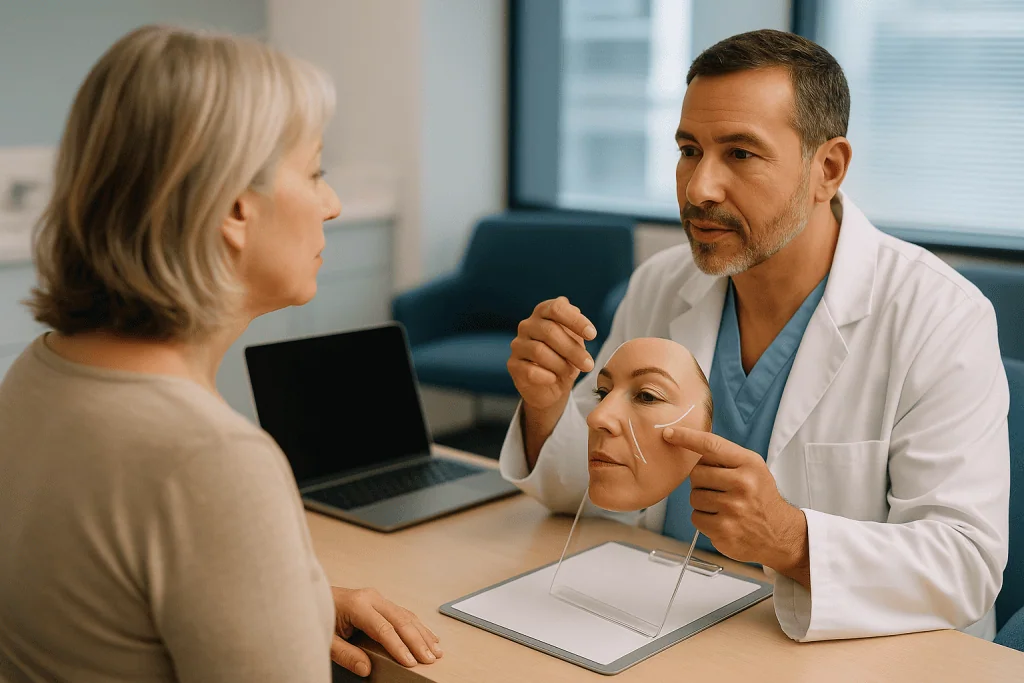
A woman in her early sixties sits in a consultation room with a list on her phone. Loose skin along the jaw. Heavy upper eyelids that make her look tired in photographs. A forehead that has started to press down on her brows. She has one question, and it is a practical one: can all of this be done at once, or will she be coming back three times?
It is a fair question, and the honest answer is that combining facial procedures is neither automatically wise nor automatically reckless. Surgeons think about it the way an architect thinks about renovating a house: which walls can be opened in the same week, which jobs have to dry before the next can start, and how long the family can live with the dust.
This article walks through that reasoning. It covers how a combined operation actually unfolds, why anesthesia time matters, which pairings are common, when staging is the safer plan, and what the weeks afterward tend to look like.
What actually happens when a surgeon combines facial procedures in one operation
A combined operation is not three separate surgeries glued together. It is a single anesthetic, a single surgical field, and a plan that has been drawn before the first incision. In most facial surgery the patient is asleep under general anesthesia or deeply sedated with local anesthetic, and the choice depends on how long the work will take and the patient’s health, as MedlinePlus describes for anesthesia in general.
Once the patient is asleep, the surgeon moves through the face in a set order. The usual logic is to start with the procedures that need the most undisturbed tissue and the longest healing, then finish with the ones that are quicker or that depend on what the earlier steps have changed. A facelift, which surgeons call a rhytidectomy (the surgical lifting and repositioning of the skin and deeper tissues of the lower face and neck), is often done before eyelid work because tightening the cheek changes where the lower lid sits.
Each area is closed and dressed before the next begins, so bleeding is controlled step by step rather than all at the end. Small drains, which are thin tubes that let fluid escape from under the skin, may be placed behind the ears. The Mayo Clinic notes that a facelift on its own generally takes three to six hours and that adding other procedures lengthens that time, which is exactly why planning the order matters.
Afterward the patient wakes once, recovers once, and begins one healing clock for the whole face. That is the main appeal. It is also the main constraint, because every added step adds minutes under anesthesia and square inches of tissue that need blood supply to heal.
Why surgeons plan in layers: skin, fat, muscle and bone
Aging does not happen in one layer. Skin loses elasticity. Fat pads in the cheeks shrink and slide. The thin muscle sheet of the neck, called the platysma, loosens into visible bands. The bone of the jaw and around the eye sockets slowly recedes. A surgeon who treats only the skin is tightening a tent without resetting the poles.

This is why sequencing is really a conversation about depth. Procedures that work on the deepest structures tend to come first in an operation. Fat grafting, which moves a small amount of the patient’s own fat to hollow areas, and work on the SMAS (the superficial musculoaponeurotic system, a fibrous layer under the facial skin that surgeons tighten during a facelift) restore the frame. Skin is redraped last, because its final position depends on everything beneath it.
Surface treatments sit at the other end. Laser resurfacing, chemical peels and other methods that injure the outer skin on purpose to prompt it to rebuild need their own blood supply to heal. Doing an aggressive surface treatment over skin that has just been lifted and partly separated from its blood vessels raises the chance of poor healing, so many surgeons either keep resurfacing to areas not undermined by the lift or schedule it for a later date. The Mayo Clinic lists skin resurfacing among procedures that may be paired with eyelid surgery, but how and when depends on the individual plan.
The practical lesson for a patient is simple. Ask which layer each proposed step addresses. If every item on the list is a surface treatment, no amount of combination will lift a jowl. If every item is structural, the skin texture that bothers you may still need separate attention later.
Is having multiple facial surgeries at once safe?
The honest answer is that safety depends less on the number of procedures and more on three things: total time under anesthesia, the patient’s health, and how much tissue is disturbed.
Longer operations carry more risk. The reasons are not mysterious. Blood pressure and temperature need to be managed for longer, the body is still for longer, and fluid shifts accumulate. MedlinePlus notes that general anesthesia is very safe for most people but that risk rises with age, with heart and lung disease, and with the complexity of surgery. Surgeons and anesthesiologists therefore set a practical ceiling for how long they are willing to keep a particular patient asleep for elective work, and that ceiling is individual.
Blood clots in the leg veins deserve a specific mention. Lying still for hours is a known risk factor for deep vein thrombosis, a clot in a deep leg vein, and for pulmonary embolism, where a clot travels to the lungs. Most operating rooms use compression devices on the calves during longer cases, and the team may ask about hormone therapy, prior clots and mobility beforehand.
Tissue disturbance is the third variable. The face has a generous blood supply, which is why it heals well, but every incision divides some of those vessels. The Mayo Clinic identifies hematoma, a collection of blood under the skin, as the most common facelift complication, and it warns that smoking raises the risk of skin loss and slow healing. Add a brow lift and eyelid work in the same session and the surgeon is managing more raw surfaces at once.
None of this makes combined surgery unsafe. It makes it a judgment call that belongs to a team that has examined you, reviewed your medications and history, and can say how long they are comfortable operating.
Which facial procedures are commonly done together?
Some pairings appear again and again because the areas share incisions, share a healing timeline, or change one another’s appearance. The Mayo Clinic specifically notes that eyelid surgery, called blepharoplasty (removal or repositioning of excess skin, muscle and fat around the eyes), is often performed alongside a brow lift, a facelift or skin resurfacing. The table below summarizes the usual reasoning, drawn from guideline-level descriptions of each procedure.
| Pairing | Why they are often combined | Why they may be staged |
|---|---|---|
| Facelift and neck lift | Same incisions, same deep layer, one continuous contour | Rarely staged; usually considered one procedure |
| Facelift and eyelid surgery | Cheek position affects the lower lid; one recovery | Longer anesthesia; eyelid swelling may obscure the early result |
| Brow lift and upper eyelid surgery | Brow position changes how much lid skin is truly excess | Surgeon may lift the brow first and reassess the lids |
| Facelift and fat grafting | Restores volume as the frame is repositioned | Graft survival is unpredictable; a second small session is common |
| Rhinoplasty and chin surgery | Profile balance is judged as one line | Separate recoveries if breathing surgery is involved |
| Facelift and laser resurfacing | Texture and sag addressed in one window | Resurfacing over lifted skin raises healing risk; often delayed |
Notice that most of the right-hand column is about healing rather than about the result. The surgeon is rarely asking whether two procedures look good together. The question is whether they heal well together, in this patient, in one sitting.
Who is usually a candidate for combining facial procedures, and who is asked to wait
Candidacy for a combined operation starts where candidacy for any single procedure starts. The Mayo Clinic describes the general requirements for facelift as being in good health, not smoking, and having realistic expectations. For a combined plan, those requirements are simply applied with less margin.
People who are commonly considered suitable tend to share a few features. Their blood pressure is controlled. They are not taking medicines that thin the blood, or they have a plan agreed with the prescribing clinician for how to manage them around surgery. They do not smoke or use nicotine in any form, because nicotine narrows the small vessels that lifted skin depends on. They have enough support at home for a longer initial recovery, and they can take the time off that a full-face recovery needs.
People who are often asked to wait, or to split the plan, include those with diabetes that is not well controlled, since high blood sugar slows wound healing; those with heart or lung disease that makes a long anesthetic less attractive; those who have smoked recently; those with a history of blood clots; and those with unrealistic goals or recent major life stress. The NHS cosmetic surgery guidance stresses that anyone considering a procedure should be certain of their reasons and should not feel rushed.
Age by itself is rarely the deciding factor. A healthy seventy-year-old may be a reasonable candidate for a combined lift, while a forty-five-year-old who smokes and has uncontrolled hypertension may be asked to stage, or to defer altogether. The screening is about physiology, not birth year.
A fair surgeon will say when the answer is no, or not yet. That is not a rejection. It is the first act of the treating team doing its job.
How long do you have to wait between facial treatments?
There is no single waiting period, and anyone who quotes one without examining you is guessing. What exists instead is a set of healing milestones that surgeons use as gates.
The first gate is swelling. The Mayo Clinic notes that bruising and swelling after eyelid surgery generally subside over about 10 to 14 days, while after a facelift most people resume normal activities within two to four weeks. The NHS similarly suggests planning for roughly two to four weeks away from work after a facelift. Until swelling has largely gone, a surgeon cannot judge the result and will be reluctant to operate near the same area.
The second gate is blood supply. Lifted skin has been partly separated from the vessels beneath it and must grow new connections. Surgeons generally wait for the skin to regain normal color and warmth before considering resurfacing over it, and that typically means months rather than weeks, although the exact interval is a clinical judgment for each patient.
The third gate is scar maturation. Scars go through a phase of being pink, raised and firm before softening and fading, a process that continues for many months after any surgery. Revising a scar, or operating through it again, is usually postponed until it has settled.
For non-surgical treatments the gates are shorter but still real. A chemical peel or laser session is usually spaced so that the skin barrier has fully recovered before the next injury, and injectables are generally kept away from fresh surgical sites until healing is confirmed. Your treating team will set the interval, and it will be based on how your tissue is actually healing rather than on a calendar.
Staged vs combined facial surgery: when several operations make more sense
Staging is not the consolation prize. In several situations it is simply the better plan.
The clearest case is when one procedure changes the information the surgeon needs for the next. A brow that has dropped can make upper eyelids look heavier than they are. Lift the brow first, let it settle, and the amount of eyelid skin that truly needs removing may be smaller than it appeared. Operating on both at once risks over-correcting the lid.
Fat grafting is another. Transferred fat does not all survive, and the proportion that does varies from person to person. Many surgeons prefer to place a conservative amount during a lift and then add a small second session once the result is visible, rather than overfill in one sitting.
A third case is health. If the anesthesiology team estimates that a full combined plan would keep a particular patient asleep longer than they consider prudent, splitting into two shorter operations lowers the exposure per session. The same applies to patients with a prior clot or with lung disease.
Staging also helps when goals are uncertain. Someone unsure whether they want eyelid surgery at all can have the facelift, see how the refreshed lower face sits with the eyes, and decide later with real information.
The costs of staging are not financial here but practical: two recoveries, two periods away from work, two rounds of anesthesia, and two scar-healing timelines. For some people that is an acceptable trade. For others, one longer recovery is far easier to organize. Neither answer is right in the abstract. The treating team weighs the patient’s anatomy, health and life against both options.
What is the "new facelift procedure" people search for?
Search engines are full of questions about a new facelift procedure, and the phrase usually points to the deep plane facelift. It is worth being precise about what that is and what it is not.
A deep plane facelift is a technique in which the surgeon releases and lifts the SMAS and the cheek fat as a single unit, working beneath that layer rather than tightening it from above. The approach has been described in surgical literature for decades, so it is a variation on established facelift anatomy rather than a new invention. Different surgeons use different planes and different amounts of release, and the choice depends on the pattern of sagging, the thickness of the tissue and the surgeon’s training.
What this means for sequencing is modest but real. Deeper dissection generally takes longer and involves more tissue, so a surgeon planning a deep plane approach may be more cautious about how much else is added to the same anesthetic. The Mayo Clinic’s three to six hour estimate for a facelift already reflects this kind of variation.
Patients also ask about procedures marketed as mini lifts or short-scar lifts. These usually describe shorter incisions and less undermining, which can mean a quicker recovery but also less reach into the neck. Marketing names change quickly; the underlying anatomy does not.
No guideline body endorses one facelift technique as superior for everyone, and this article will not either. The useful question to ask a surgeon is not which technique is newest but which plane they intend to work in, why that suits your face, and how it affects what else can safely be done the same day.
How non-surgical treatments fit around a combined operation
Most people who are considering surgery have already had, or are considering, treatments that do not involve a scalpel. These can sit before, during or after an operation, and the order is not arbitrary.
Before surgery, the main concern is inflammation. A recent aggressive peel or laser session leaves the skin barrier compromised, and surgeons generally want that fully healed before making incisions through it. Injectable fillers, which are gel materials placed under the skin to add volume, can distort the anatomy the surgeon is trying to assess, so some teams ask patients to pause new filler for a period beforehand. Neuromodulator injections, which temporarily relax specific muscles, are less of an issue but are still worth disclosing.
During surgery, light resurfacing of areas not undermined by the lift, such as around the mouth, is sometimes performed. The Mayo Clinic lists skin resurfacing among procedures that may accompany eyelid surgery. Heavier resurfacing over freshly lifted cheek skin is generally avoided because that skin’s blood supply is at its most fragile.
After surgery, non-surgical treatments become maintenance tools rather than corrections. Once the surgeon confirms healing, texture, pigment and fine lines can be addressed with surface treatments, and modest volume changes with injectables. Sun protection is the single most consistently recommended measure across every source cited here, because ultraviolet exposure drives both pigment change in healing scars and the elastin breakdown that caused the sagging in the first place.
The principle underneath all of this is that the surgical result sets the frame, and non-surgical work decorates the frame. Decorating before the frame is built, or while the plaster is wet, tends to need redoing.
What the first days and weeks after combined facial surgery usually look like
The early recovery from a combined operation follows the same arc as a facelift alone, but with more of the face involved. Timelines below are typical ranges from the Mayo Clinic and the NHS, not promises, and your team’s instructions override them.
In the first one to two days, the face is wrapped in a soft dressing and any drains are usually removed. Swelling and bruising increase rather than decrease during this window, which surprises people. Sleeping with the head raised and avoiding bending or lifting are standard advice. Pain is usually described as tightness and soreness rather than sharp pain, and the prescribing clinician decides what, if anything, is needed to manage it.
During the first week, stitches around the ears and eyelids are typically removed, and the eyelid swelling that can briefly limit full lid closure begins to settle. Bruising migrates downward with gravity and may pool in the neck. Numbness of the cheeks and ears is common and usually improves over weeks to months.
By two to four weeks, the Mayo Clinic and NHS both describe most people returning to work and ordinary daily activity, with makeup often permitted over healed incisions. Eyelid bruising generally fades within 10 to 14 days. Strenuous exercise is usually held longer because raised blood pressure can provoke late bleeding.
Over the following months, residual swelling along the jaw and under the eyes slowly resolves, scars soften and fade, and sensation returns. The Mayo Clinic is explicit that facelift results are not permanent and that the face continues to age afterward, which is a reason to think of surgery as resetting a clock rather than stopping it.
Risks that add up when procedures are combined
Every procedure on the plan brings its own risk list, and some risks stack rather than simply sit side by side. Neutral descriptions from the Mayo Clinic and NHS form the basis of what follows.
Hematoma, a collection of blood under the skin that can stretch and threaten the overlying tissue, is the most common serious complication after facelift and usually declares itself within the first day. More raw surface means more places it can occur, and uncontrolled blood pressure in recovery is a recognized trigger. A hematoma typically needs prompt return to the operating room to drain it, which is one reason surgeons prefer patients who can be monitored closely after a long combined case.
Nerve injury is the risk patients fear most. The facial nerve branches that move the forehead and the corner of the mouth run through the layers a surgeon lifts, and temporary weakness is far more common than permanent weakness. Deeper dissection and more extensive work increase exposure of those branches.
Skin loss at the edges of the lift, hair loss along incision lines, asymmetry, prolonged numbness and widened scars are all described in the NHS and Mayo Clinic risk lists. Eyelid surgery adds its own set: dry eye, difficulty closing the lids fully for a time, and rarely a change in vision that needs urgent review.
Anesthesia risk, as MedlinePlus explains, scales with duration and with pre-existing heart or lung disease. Infection is uncommon in the face because of its blood supply but is not zero.
The alternative to accepting these stacked risks is not inaction. It is staging, scaling back, or choosing non-surgical options with their own, generally milder, risk profiles. A good consultation lays all three paths side by side.
What procedure makes your face look younger? The honest answer
People type this question into search engines thousands of times a day, and the only truthful reply is that it depends on what has aged.
If the main change is sagging of the jawline and neck, no surface treatment addresses it, and a facelift is the procedure designed for that problem. If the main change is heaviness of the upper lids or bags under the eyes, eyelid surgery addresses it directly, and a facelift would leave the eyes untouched. If the main change is fine lines, pigment and roughness on otherwise well-supported skin, resurfacing or peels target that layer, and lifting would be the wrong tool. Volume loss in the mid-face points toward fat grafting or fillers rather than skin removal.
This is why surgeons examine rather than prescribe from a menu. The Mayo Clinic describes a facelift as addressing sagging and deep folds but not the fine lines or sun damage of the skin surface. A patient who wants smoother skin and receives only a lift will be disappointed, and vice versa.
It also explains why combination is appealing in the first place. Most faces have aged in more than one layer, and a plan that addresses two or three layers tends to look more natural than a single dramatic correction of one. A very tight lower face above untouched, tired eyes draws attention to the mismatch.
What no procedure does is stop time. The Mayo Clinic is direct that results are not permanent. The reasonable goal, in guideline language, is to look like a rested version of yourself rather than a different person, and to understand that maintenance and sun protection remain part of the picture afterward.
What people often get wrong about combining facial procedures
Several beliefs circulate so widely that it is worth correcting them one at a time.
The first is that doing everything at once is always more efficient. It is more efficient in calendar terms, but efficiency is not the surgeon’s main concern. If adding a procedure pushes anesthesia time past what the team considers prudent for you, or puts resurfacing over freshly lifted skin, the efficiency gain is not worth the healing risk.
The second is that staging means the surgeon is padding the plan. In the situations described earlier, such as brow and eyelid work or fat grafting, staging is a deliberate way to avoid over-correction. A surgeon who recommends it is often protecting the result.
The third is that newer named techniques are automatically better. Technique names change; anatomy does not. No guideline body endorses one facelift method for all patients.
The fourth is that non-surgical treatments can be scheduled freely around surgery. In practice, peels, lasers and fillers are timed around the surgical healing clock for the reasons covered above.
The fifth is that recovery from a combined operation is roughly the sum of each recovery. It is usually closer to the longest single component, which is one of the real advantages, but swelling is more widespread and the first week can feel harder.
The sixth is that results last forever. The Mayo Clinic and NHS both state plainly that facelift results are not permanent and that aging continues.
A last correction: a surgeon declining to combine procedures is not being timid. The willingness to say no is, if anything, a reassuring sign about how the yes decisions are made.
Questions to ask your care team before agreeing to a combined plan
A good consultation is a two-way exam. These questions help you understand how your team is thinking, and the answers belong to them, not to an article.
- Which layer of my face does each proposed procedure address, and what would be left unaddressed?
- How long do you expect the combined operation to take, and what is your ceiling for anesthesia time in someone with my health history?
- Which parts of the plan would you be comfortable staging, and what would you gain or lose by doing so?
- In what order will you perform the procedures during the operation, and why that order?
- What is your plan for monitoring me in the first 24 hours, when bleeding under the skin is most likely to appear?
- Which of my current medicines and supplements need discussion with my prescribing clinician before surgery?
- What is your advice on nicotine, and for how long before and after?
- If swelling makes it hard to judge the eyelid result early, when would you reassess?
- Which non-surgical treatments would you want paused before surgery, and when could they resume?
- What signs should prompt me to call you immediately, and how do I reach the team after hours?
- How do you handle a result that needs revision, and how long would you wait before considering it?
Write the answers down or bring someone who will. The NHS cosmetic surgery guidance encourages a cooling-off period between consultation and decision, and it is reasonable to ask for one. A team confident in its plan will not object to being asked to explain it twice.
When to call your doctor after combined facial surgery
Most recovery days are uneventful, but a few signs mean the team should hear from you the same hour rather than at the next appointment. These red flags are drawn from the Mayo Clinic and NHS descriptions of facelift and eyelid surgery complications.
Call immediately, or seek emergency care, if you notice sudden swelling or tightness on one side of the face or neck, especially with increasing pain, because this can signal a hematoma that needs urgent drainage. The same applies to any bleeding that soaks through dressings and does not slow with gentle pressure.
Seek emergency care for chest pain, shortness of breath, coughing up blood, or pain and swelling in one calf, since these can indicate a blood clot after a long operation. Treat any sudden change in vision, severe eye pain, or an eyelid that will not close after blepharoplasty as urgent.
Contact the team promptly, the same day, for fever, spreading redness or warmth around incisions, cloudy or foul-smelling drainage, wound edges that have separated, new weakness of the forehead or mouth, or skin along the incision that is turning dark or dusky.
Less dramatic symptoms still deserve a call rather than a wait: pain that is getting worse instead of better after the first few days, nausea that prevents fluids, or any concern that something does not look or feel right. Teams would far rather hear about a false alarm than miss an early problem. Every decision about what to do next belongs to the clinicians who operated on you, and they will want to make it with current information.
Frequently asked questions
Can you have a facelift and eyelid surgery together?
Yes, facelift and eyelid surgery are commonly performed in the same operation when the patient is in good health and total anesthesia time remains within the team’s limit. The Mayo Clinic lists facelift and brow lift among procedures often paired with blepharoplasty. Surgeons usually perform the lift first because cheek position influences the lower eyelid. Longer anesthesia and more widespread swelling are the main trade-offs, and the treating team decides based on individual assessment.
How long between facial treatments is typical after surgery?
There is no fixed interval; surgeons use healing milestones instead. Swelling largely settles within two to four weeks after a facelift and about 10 to 14 days after eyelid surgery according to the Mayo Clinic, but skin blood supply and scar softening take months. Resurfacing over lifted skin and any revision are generally postponed until those gates are passed. Your team sets the timing from how your tissue is actually healing.
Is it safe to have multiple facial surgeries at once?
It can be, provided the patient is healthy, does not use nicotine, and the combined operation stays within the anesthesia duration the team considers prudent for that person. MedlinePlus notes that general anesthesia risk rises with age, heart or lung disease and surgical complexity. More tissue disturbed in one sitting also raises the chance of bleeding under the skin. The decision rests on an individual assessment by the surgeon and anesthesiologist.
What is the new facelift procedure called and what does it do?
The phrase usually refers to the deep plane facelift, a technique that lifts the SMAS layer and cheek fat as one unit by working beneath that layer. It has been described in surgical literature for decades, so it is a variation on established anatomy rather than a new invention. Deeper dissection typically takes longer, which can limit what else is combined. No guideline endorses one technique as best for everyone.
What is the newest facial procedure, and should I choose it?
New names appear constantly, but the underlying layers of the face have not changed, and no guideline body ranks techniques as newest or best. The more useful question is which layer each procedure addresses and whether that matches what has aged in your face. A surgeon’s explanation of the plane they work in, and why it suits you, is worth more than any marketing label.
What procedure makes your face look younger?
It depends on what has aged. Sagging of the jaw and neck is addressed by a facelift, heavy lids by eyelid surgery, fine lines and pigment by resurfacing, and volume loss by fat grafting or fillers. The Mayo Clinic notes a facelift does not improve surface skin quality. Most faces have aged in more than one layer, which is why surgeons often propose combinations, with results that are not permanent.
Staged vs combined facial surgery: which gives a better result?
Neither is better in the abstract. Combining offers one anesthetic and one recovery and allows the surgeon to balance the whole face at once. Staging is preferred when one procedure changes what the next needs, as with brow and eyelid work, when fat graft survival is uncertain, or when health argues for shorter operations. The treating team weighs anatomy, health and practical life against both options.
Why do surgeons ask patients to stop smoking before combining facial procedures?
Nicotine narrows the small blood vessels that lifted skin depends on while it regrows connections, and the Mayo Clinic and NHS both identify smoking as a risk factor for skin loss and poor wound healing after facelift. With more tissue disturbed in a combined operation, that risk is magnified. Teams generally ask for complete nicotine avoidance before and after surgery and may decline to combine procedures in current smokers.
How long does recovery take after a combined facelift and eyelid operation?
Recovery is usually closer to the longest single component than to the sum of both. The Mayo Clinic and NHS describe most people returning to work and routine activity two to four weeks after a facelift, with eyelid bruising fading over about 10 to 14 days. Strenuous exercise is held longer, numbness can persist for months, and scars continue to soften over many months. Individual timelines vary.
Can I have fillers or laser treatments right before combined facial surgery?
Usually not without discussing it first. Recent aggressive resurfacing leaves the skin barrier compromised, and fresh filler can distort the anatomy a surgeon needs to assess. Many teams ask patients to pause new treatments beforehand and to disclose any recent ones, including neuromodulator injections. After surgery, these treatments typically resume only once the surgeon confirms healing, with sun protection recommended throughout.
References
This article is for general information only and is not a substitute for professional medical advice. Please consult a qualified doctor about your individual situation.

More from the Blog

How Surgeons Sequence Combined Face Aesthetics Procedures: One Operation or Several?
Surgeons may combine facial procedures such as a facelift, eyelid surgery and fat grafting in one operation when a person is healthy, does not…
Are Facial Implants Right for Your Face? Bone Structure, Skin Thickness and Age Considered
Facial implants are usually considered for adults whose bones have finished growing, who have a specific structural gap such as a recessed chin or…

Silicone vs Porous Polyethylene Facial Implants: What the Material Changes for Healing
Solid silicone and porous polyethylene are the two most common facial implant materials, and the difference is mainly about how tissue attaches. Silicone is…
Is Ethnic Rhinoplasty Right for You? Skin Thickness, Cartilage Strength and Goals Weighed
You may be a reasonable ethnic rhinoplasty candidate if you are in good general health, your nose has finished growing, you have a specific…

CT and MRI Before Orbit Surgery: How Imaging Maps the Eye Socket and Guides the Approach
Before orbit surgery, a CT scan maps the bony walls of the eye socket in fine detail, showing fractures, wall thickness, sinus anatomy and…

Ethnic Rhinoplasty Results: How Surgeons Refine the Nose While Preserving Heritage Features
Ethnic rhinoplasty results depend on reshaping the nose in proportion to a person's own face while keeping the features that signal their heritage, rather…